Showing posts with label Anti-satellite test. Show all posts

Friday, July 24, 2015

Moscow Could Be Prepping for Space War With Aggressive New Satellites

There is an interesting update to this article on the Russianspaceweb.com site http://russianspaceweb.com/Cosmos-2504.html

In a Daily Beast article author David Axe writes that Moscow could be prepping for a space war.

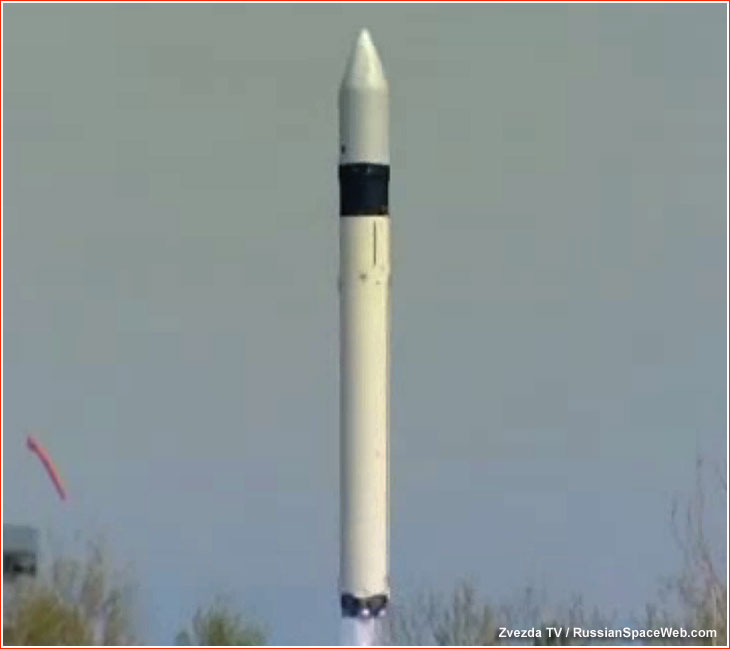
On Christmas Day in 2013, a rocket blasted off from the Russian Federal Space Agency’s Plesetsk Cosmodrome. The rocket carried Rodnik communications satellites, according to Russian officials. It’s customary for Rodnik sats to deploy in threes, but in a notification to the United Nations, Moscow listed four spacecraft inside the Rokot.

Rodnik sats, like most orbital spacecraft, don’t have engines and can’t move under their own power. So it came as a shock to some observers on the ground—a group including amateur satellite-spotters with radios and telescopes; radar-equipped civilian researchers; and military officials monitoring banks of high-tech sensors—when the Rokot’s fourth satellite, designated Kosmos-2491, moved, propelling itself into a slightly different orbit.

Whatever Kosmos-2491 was, it wasn’t some innocuous communications satellite. And over the next year and a half, Russia launched two more of the mysterious, maneuvering spacecraft, each time sneaking it into orbit as part of a routine commsat launch.

No one outside the Russian government, and perhaps the Pentagon, knows for sure what Kosmos-2491, -2499, and -2504 are for. But it’s clear enough what the three mystery sats could do, in theory. Zipping across orbital planes hundreds of thousands of feet above Earth, the spacecraft—which are apparently the size of a mini-refrigerator—are able to get really close to other satellites. Close as in a few dozen feet away.

In other words, Kosmos-2491 and its triplets might be space weapons, the likes of which few other nations possess. And if so, they could upset the orbital balance of power, at a time when government agencies, armies, scientists, and everyday people—in the United States, especially—depend on satellites for communications, surveillance, science, and navigation.

Space Sleuths

Kosmos-2499 joined Kosmos-2491 in low orbit on May 23, 2014, piggybacking on another cluster of three commsats. Kosmos-2504 made its debut on March 31 this year—again, boosting into space alongside a trio of communications satellites.
The three mystery sats have stayed busy, firing their tiny engines to climb and dive hundreds of miles at a time, altering their velocity by hundreds of feet per second while playing chase with abandoned rocket stages and other hunks of space junk, apparently practicing for close passes on active satellites.

In the summer of 2014, Russian radio enthusiast Dmitry Pashkov detected signals that he eventually traced back to Kosmos-2499. Fellow radio aficionado Cees Bassa, who is Dutch, picked up similar chirps from the direction of the other mystery sats and connected the dots. “I was one of the first to confirm that the recent Kosmos-2504 satellite was transmitting on the same frequency as Kosmos 2491/2499, confirming the similarity between them,” Bassa said.

Uniting the space sleuths is Anatoly Zak, a Russian-born journalist and self-described “space historian.” Now living in the United States, Zak aggregates observations of Kosmos-2491 and its siblings at his website, Russianspaceweb.com.

Combining all the evidence, Zak concluded that the mystery craft are all similar in size and shape to Russia’s 200-pound Yubileiny experimental satellite—and are most likely weapons. “You can probably equip them with lasers, maybe put some explosives on them,” Zak said of the Kosmos triplets. “If [one] comes very close to some military satellite, it probably can do some harm.”

You can read the entire article on the Daily Beast at http://www.thedailybeast.com/articles/2015/07/23/moscow-could-be-prepping-for-space-war-with-spooky-new-satellites.html

 

Monday, November 17, 2014

Kosmos-2499: Is it a spy or an assassin... or both?


Blog Editor's Note: Given the ramp up of Russian military operations in Europe and Asia, Radio Sputnik replacing Voice of Russia now on the air with Cold War style propaganda, and now Cold War style space activities, I believe the Russian have reset our relations. If they start operating independently again in space, well those of us who lived through the last Cold War may live to see another one regardless what American politicians have to say on the situation.

Object 2014-28E – Space junk or Russian satellite killer?
By Sam Jones, Defense and Security Editor

It is a tale that could have come from the cold war. A mysterious object launched by the Russian military is being tracked by western space agencies, stoking fears over the revival of a defunct Kremlin project to destroy satellites.

For the past few weeks, amateur astronomers and satellite-trackers in Russia and in the west have followed the unusual manoeuvers of Object 2014-28E (now IDed as Cosmos 2499-LVH), watching it guide itself towards other Russian space objects. The pattern appeared to culminate last weekend in a rendezvous with the remains of the rocket stage that launched it.

The object had originally been classed as space debris, propelled into orbit as part of a Russian rocket launch in May to add three Rodnik communications satellites to an existing military constellation. The U.S. military is now tracking it under the NORAD catalog number 39765.

Go to the link below to read the rest of this article http://www.ft.com/cms/s/2/cdd0bdb6-6c27-11e4-990f-00144feabdc0.html#ixzz3JMzknud9


1986 DIA illustration of the Istrebitel Sputnik (IS) (lit. "fighter satellite").
system attacking a target. (Courtesy of Wikipedia)
Here is the current orbital details of this space object:
Cosmos 2499, NORAD ID: 39765, Int'l Code: 2014-028E
Perigee: 1,158.5 km, Apogee: 1,510.7 km, Inclination: 82.4 °
Period: 112.2 minutes, Semi major axis: 7705 km
Launch date: May 23, 2014

And finally here are some additional details on Cosmos 2499 courtesy of the Zarya Space website at http://www.zarya.info/Diaries/Launches/Launches.php?year=2014

Cosmos 2499  2014-028E NORAD Catalog #39765 
A small satellite with orbit changing capability. Possibly, but speculatively, an inspector satellite with its own Briz-KM rocket body (2014-028D/39764) as a target. Detected by US tracking sensors and originally catalogued as debris, it was not included in early announcements of the launch. Early 2014 July - started a series of manoeuvers to reduce the separation in orbit planes between itself and the Briz-KM.
2014 November 8/9 it matched planes with the rocket and manoeuvered alongside it.

2014 May 23, 20:26 7872 0.0018 1480 1509 115.86 82.45 317  
2014 May 29, 21:19 7873 0.0018 1481 1508 115.86 82.45 304  
2014 Jul 2, 22:32 7872 0.0017 1480 1508 115.85 82.45 228  
2014 Jul 3, 19:47 7871 0.0020 1477 1508 115.82 82.45 218  
2014 Jul 9, 09:02 7868 0.0024 1472 1509 115.77 82.46 200  
2014 Jul 11, 17:00 7866 0.0021 1471 1504 115.71 82.45 189  
2014 Jul 17, 15:46 7855 0.0022 1460 1494 115.47 82.46 166  
2014 Aug 8, 16:11 7684 0.0241 1121 1491 111.72 82.46 99  
2014 Aug 12, 10:19 7621 0.0323 997 1489 110.36 82.46 94  
2014 Aug 20, 09:32 7588 0.0337 954 1465 109.63 82.42 78  
2014 Aug 20, 14:25 7585 0.0371 925 1488 109.57 82.45 73  
2014 Oct 28, 23:22 7652 0.0287 1055 1494 111.03 82.46 254  
2014 Nov 9, 00:02 7681 0.0254 1108 1499 111.67 82.45 231  
2014 Nov 9, 13:19 7705 0.0228 1152 1503 112.19 82.46 230

Wednesday, November 21, 2007

US Military concerns persist over January Chinese anti-satellite test


US concerns about China's military buildup have only been heightened by a Chinese anti-satellite test in January that has yet to be explained, the top US military leader said Tuesday.

"It speaks to a higher level of concern that many of us in the United States have about what is the strategic intent of the investment, the high tech investment the Chinese government is making with respect to its military capability in the future," Admiral Michael Mullen, Chairman of the Joint Chiefs of Staff said.

China used a ballistic missile to intercept and destroy one of its own ageing weather satellites in low Earth orbit on January 11 in a test that demonstrated the vulnerability of US satellites.

Senior US military officials have said the test was a wake-up call and that China will be able to disrupt US military communications in a conflict within three years.

Chinese officials have responded to US questions about the test with bland assurances that it was not hostile and posed no threat, US officials have said.