Friday, April 24, 2015

Russia regains control of radio facility in Cuba's Lourdes base

This article originally appeared on the Sputnik News website on July 16. 2014.

Archive. Photo: RIA Novosti
Russia has retrieved the main Soviet radio interception facility – the signals intelligence center in Cuban Lourdes, the Kommersant newspaper wrote on Wednesday. "The decision to return to Cuba can be explained by Russia's long strengthened financial capabilities, as well as cooling of relations with the US," sources in the Russian power structures said.

The base on the territory of the USSR's and Russia's most consistent ally was built in 1962 and since then, has been repeatedly renewed, satisfying the need for interception of information from American communication satellites, ground-based telecommunications cables and wiretapping the NASA's Mission Control Center on Cape Canaveral. This is facilitated by its location in the Western part of the island, only 250 kilometers from Florida's coast.

In 2001, unexpectedly for the Cubans, Russia refused to use the center, which, according to the then Minister of Defense of Cuba Raul Castro, at the moment of the collapse of the USSR provided up to 75 percent of intelligence information.

The center was closed after Vladimir Putin visited it together with Fidel Castro in December, 2000, and while speaking to the staff stated "the importance of the facility for ensuring Russia's security, the need to support its activities and development prospects." But a year later, head of the Russian General Staff Anatoly Kvashnin made a statement that the center in Lourdes was not important, was costly, and its functions could be easily transferred to modern satellites.

Cubans were able to maintain the center, having created a scientific center on its basis. Since 2004, after the deterioration of relations with the US, Russia began to consider the possibility of returning to Cuba. The talks were sharply intensified at the beginning of this year and successfully completed during Putin's visit to Havana.

Tuesday, April 21, 2015

US warship heads to Yemeni waters!

The Associated Press this morning is reporting that US Navy warships are headed for the waters off Yemen.

"In a stepped-up response to Iranian backing of Shiite rebels in Yemen, the Navy aircraft carrier USS Theodore Roosevelt is steaming toward the waters off Yemen to beef up security and join other American ships that are prepared to intercept any Iranian vessels carrying weapons to the Houthi rebels.

"Navy officials said Monday that the Roosevelt was moving through the Arabian Sea. A massive ship that carries F/A-18 fighter jets, the Roosevelt is seen more of a deterrent and show of force in the region.
 
"The U.S. Navy has been beefing up its presence in the Gulf of Aden and the southern Arabian Sea in response to reports that a convoy of about eight Iranian ships is heading toward Yemen and possibly carrying arms for the Houthis. Navy officials said there are about nine U.S. warships in the region, including cruisers and destroyers carrying teams that can board and search other vessels."
 
You can read the rest of this story at
http://hosted.ap.org/dynamic/stories/U/US_UNITED_STATES_IRAN?SITE=AP&SECTION=HOME&TEMPLATE=DEFAULT

Monday, April 13, 2015

NATO AWACS Investigates Baltic Skies


How to Spot a Russian Bomber

 
Found this interesting article in my stack of stuff from back in the middle of February posted to the BBC News blog (http://www.bbc.com/news/blogs-magazine-monitor-31537705). Given the current situation, this might be helpful to have around.


How to Spot a Russian bomber

Two Russian bombers have been escorted from near UK territory - the latest in a series of similar incidents. How easy is it to spot a Russian plane, asks Jon Kelly.

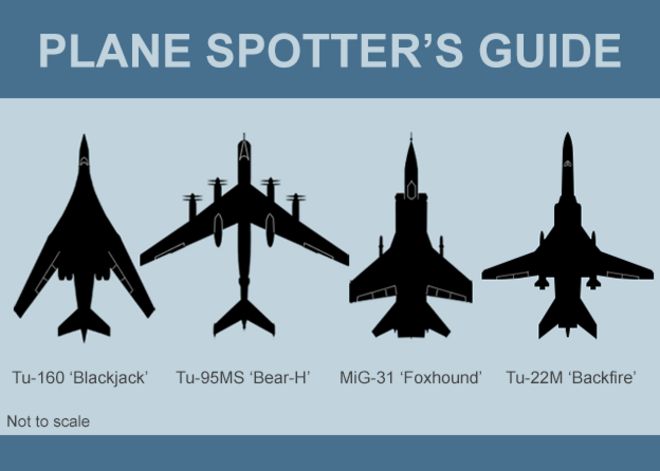
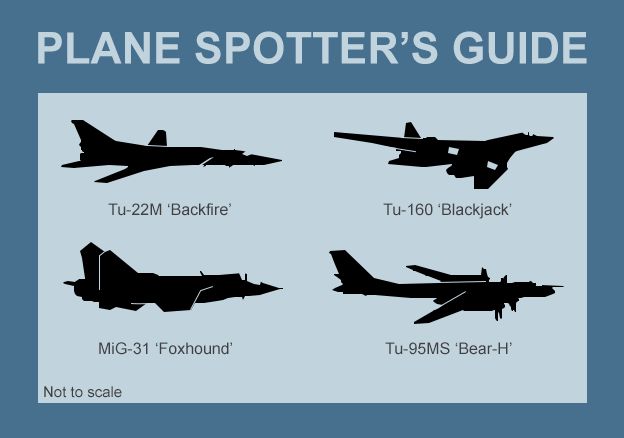
Plane spotter's guide

The Ministry of Defence insists that the Russian aircraft did not enter British airspace, which extends 12 nautical miles from the nation's coast. But it says they were inside the UK's "area of interest", and the RAF scrambled Typhoon jets to intercept them. If the MoD's account is accurate, they may have been flying too far away for ordinary plane spotters to detect them - although a woman in Cornwall claims she saw them flying inland.

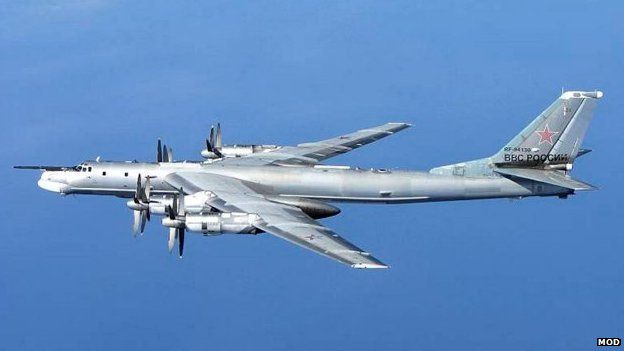
Each was a Tu-95 MS, also known by its NATO reporting name "Bear-H", a four-engine long-range bomber, equipped with turboprop-driven propellers and set-back wings that give it an unmistakable silhouette.

The Bear Bomber
The TU-95 Bear Bomber
The most noticeable thing about the Bear, the earliest iteration of which entered service in 1956, is the almighty racket it makes. Its contra-rotating propellers spin faster than the speed of sound, creating their own sonic boom, making it one of "the loudest combat aircraft ever built", says Justin Bronk of the Royal United Services Institute. The Bear, which typically carries six or seven crew members, is not the fastest aircraft in the Russian fleet, reaching speeds of only about 575 mph (920 km/h). But it is regarded as one of the most reliable, says Bronk, which helps account for its longevity.

A supersonic Tu-160 strategic bomber
A Tu-160 strategic bomber
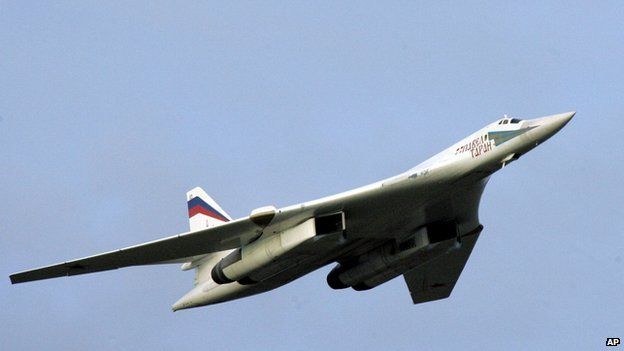
Another bomber you might expect to see just outside British airspace is the Tu-160, known as the Blackjack, two of which were intercepted by RAF Tornado F3 fighters off the Scottish coast in 2010. Unlike the Bear, the Blackjack is capable of supersonic speeds of up to 2,200km/h. "It's essentially a heavier and faster equivalent of the American B1B Lancer," says Bronk. It also has a longer range and can carry more nuclear-capable missiles. An upgraded version of the TU-160 made its maiden flight in November 2014.

A Russian long-range bomber TU-22
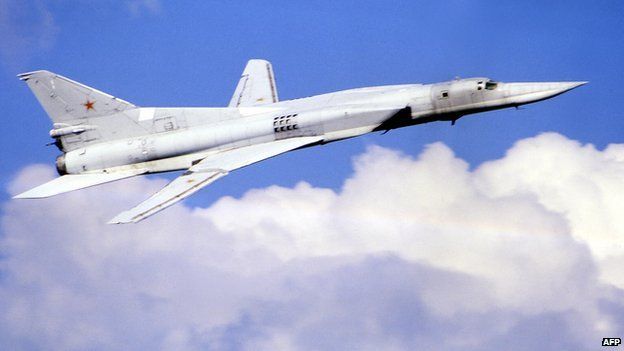
Then there's the Tu-22M3 strategic bomber, which is also supersonic and nuclear-capable. "It's not as big as the Bear and the Blackjack," says Bronk. "Its closest Western equivalent is the F-111." Its variable-sweep wing allows it to take off quickly and fly at very low altitudes. There are thought to be over 100 TU-22Ms in service in the Russian fleet.

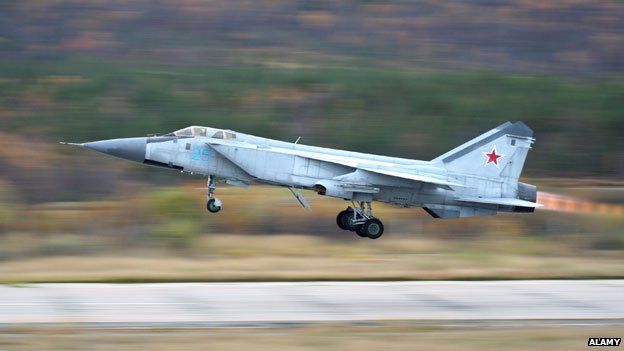
The MiG 31 interceptor
Sometimes Bears are escorted by supersonic MiG-31 interceptors, says Bronk. Among the world's fastest combat aircraft, they are equipped with onboard radar that can track 24 airborne targets and attack six at a time. But Bronk says: "Although they are extremely fast and carry powerful radar, they are a essentially an evolution of a very old design, the MiG-25, and are no match for the RAF's Typhoons in air-to-air combat."

Plane spotter's guide
The incident in Cornwall is unlikely to be the last time radar operators detect Bears. There was a similar incident in January when two Bear bombers were escorted by RAF jet after causing what the Foreign Office called a "disruption to civil aviation". The RAF intercepted Russian aircraft on eight occasions in 2014, and the same number of times in 2013, according to MoD figures released under the Freedom of Information Act.

"Bear raids" just outside British airspace were a common occurrence during the Cold War, sometimes taking place every week, says defence analyst Paul Beaver. Back then, he says, the intention was to test the RAF's reaction time. Their frequency lessened in the final years of the Soviet Union and stopped altogether when the Berlin Wall fell. Under Vladimir Putin's leadership, however, they have resumed. Yesterday, Prime Minister David Cameron said he suspected the Russians were "trying to make some sort of a point", and Bronk agrees. "Essentially, it's rattling the sabre."

Thanks to Nick de Larrinaga of IHS Jane's Defence Weekly for assistance with this article.


Russians intercept US reconnaissance plane - Updated Story

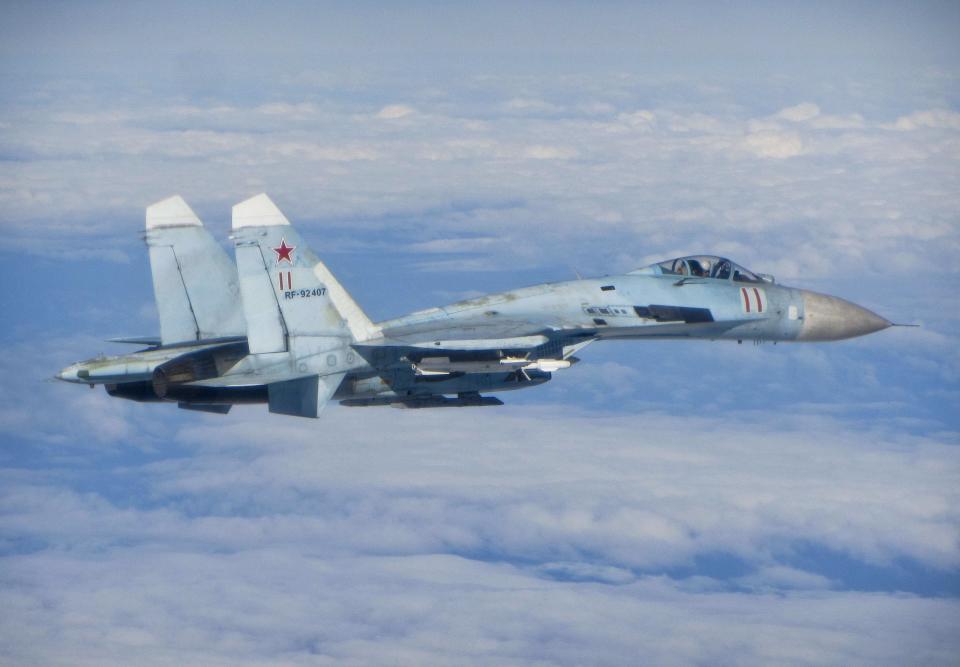
A Russian Sukhoi Su-27 fighter flies in international airspace near the Baltic States in this photograph taken on June 17, 2014 and received via Britain's Ministry of Defence (MoD) in London on June 18, 2014. Photo courtesy of RAF/MoD.
The AP is reporting the U.S. is protesting an intercept of a U.S. reconnaissance plane by a Russian fighter jet last week, calling it "unsafe and unprofessional" amid what it views as increasingly aggressive air operations by Moscow.

The Pentagon says that a U.S. RC-135U plane was flying in international airspace north of Poland. U.S. officials say a Russian SU-27 fighter intercepted the U.S. aircraft at a high rate of speed from the rear, and then proceeded to conduct two more passes using "unsafe and unprofessional maneuvers" in close proximity.

It isn't the first time the U.S. has protested to Moscow what it considered to be an unsafe intercept. Last April, a Russian fighter jet intercepted a U.S. reconnaissance plane in international airspace over the Sea of Okhotsk.


Blog Editor's Note: Media reports indicate that this event occurred on 7 April 2015. A quick check of Mode-S logs for that day indicated the only RC-135U airborne that day was RC-135U 64-14849 (Hex code AE01D5) with a mode-s call sign of Telex 97 and yes it was over Poland/Estonia/Finland area between 1000-1300 UTC. Interestingly, based on the database it looks like that aircraft did not fly the next day. This aircraft is still in theater today and has flown the last 3 days using a mod-s call sign of Cuppy 50. Time to pay closer attention to those foxtrot messages.

Full AP story at http://news.yahoo.com/us-protests-intercept-reconnaissance-plane-russia-040542666.html

RC-135U Combat Sent

Mission
The RC-135U Combat Sent provides strategic electronic reconnaissance information to the president, secretary of defense, Department of Defense leaders, and theater commanders. Locating and identifying foreign military land, naval and airborne radar signals, the Combat Sent collects and minutely examines each system, providing strategic analysis for warfighters. Collected data is also stored for further analysis by the joint warfighting and intelligence communities. The Combat Sent deploys worldwide and is employed in peacetime and contingency operations.

Features
All RC-135U aircraft are equipped with an aerial refueling system, giving it an unlimited flying range. Communication equipment includes high frequency, very high frequency, and ultra high frequency radios. The navigation equipment incorporates ground navigation radar, a solid state Doppler system, and an inertial navigation system that merges celestial observations and Global Positioning System data. Although the flight crew stations are similarly configured, the reconnaissance equipment is slightly unique within each airframe.

The aircraft are identified by their distinctive antennae arrays on the "chin" and wing tips, large cheek fairings, and extended tail.

Crew composition includes two pilots, one navigator, two airborne systems engineers, and a minimum of 10 electronic warfare officers, or "Ravens," and six or more electronic, technical, and area specialists.

Background
There are only two Combat Sent aircraft in the Air Force inventory and both are assigned to the 55th Wing at Offutt AFB, Neb. The RC-135U aircraft are manned by Air Combat Command crews from the 45th Reconnaissance Squadron and the 97th Intelligence Squadron (of the Air Force Intelligence, Surveillance and Reconnaissance Agency). The Combat Sent is composed of a wide variety of commercial off-the-shelf and proprietary hardware and software. Its current configuration allows for both manual and automatic analysis of electronic signals. By combining manual systems with the Automatic Electronic Emitter Locating System, Ravens and intelligence specialists can simultaneously locate, identify, and analyze multiple electronic signals.

The Combat Sent records these signals for future reference or for extensive analysis by electronic systems theorists. Any information garnered from the data will help determine detailed operating characteristics and capabilities of foreign systems. Evasion techniques and equipment are then developed from this knowledge that will detect, warn of, or defeat these electronic systems.

General Characteristics
Primary function: Electronic intelligence reconnaissance and surveillance
Contractor: Boeing Aerospace
Power Plant: Four CFM International F108-CF-201 high bypass turbofan engines
Thrust: 21,600 pounds per engine
Wingspan: 135 feet, 1 inch (41.4 meters)
Length:
140 feet, 1 inch (42.6 meters)
Height: 41 feet, 8 inches (12.7 meters)
Weight: 165,7000 (75,160 kilograms)
Maximum Takeoff Weight: 299,000 pounds (135,626.4 kilograms)
Fuel Capacity: 130,000 pounds (58,967 kilograms)
Speed: 500+ miles per hour (Mach 0.66)
Range: 4,000 nautical miles
Ceiling: 35,000+ feet (10,668+ meters)
Crew: Two pilots, one navigator, two airborne systems engineers, and a minimum of 10 electronic warfare officers (flight crew from 45th RS) and six or more mission area specialists (mission crew from 97th IS)
Unit Cost: Not available
Initial operational capability: April 1964
Inventory: Active force, 2; ANG, 0; Reserve, 0 

Thursday, April 09, 2015

US aerospace command moving comms gear back to Cold War bunker

Blog Editor's Note: YahooNews has picked up the following AFP story. HF radio monitors should keep an eye on the following frequencies for activity related to this story (Mode ALE/USB): 4950.0 6770.0 7718.5 7990.0 9350.0 10800.0 12090.0 14550.0 kHz


Washington (AFP) - The US military command that scans North America's skies for enemy missiles and aircraft plans to move its communications gear to a Cold War-era mountain bunker, officers said.
The shift to the Cheyenne Mountain base in Colorado is designed to safeguard the command's sensitive sensors and servers from a potential electromagnetic pulse (EMP) attack, military officers said.

The Pentagon last week announced a $700 million contract with Raytheon Corporation to oversee the work for North American Aerospace Command (NORAD) and US Northern Command.

Admiral William Gortney, head of NORAD and Northern Command, said that "because of the very nature of the way that Cheyenne Mountain's built, it's EMP-hardened."

"And so, there's a lot of movement to put capability into Cheyenne Mountain and to be able to communicate in there," Gortney told reporters.

"My primary concern was... are we going to have the space inside the mountain for everybody who wants to move in there, and I'm not at liberty to discuss who's moving in there," he said.

The Cheyenne mountain bunker is a half-acre cavern carved into a mountain in the 1960s that was designed to withstand a Soviet nuclear attack. From inside the massive complex, airmen were poised to send warnings that could trigger the launch of nuclear missiles.

But in 2006, officials decided to move the headquarters of NORAD and US Northern Command from Cheyenne to Petersen Air Force base in Colorado Springs. The Cheyenne bunker was designated as an alternative command center if needed.
That move was touted a more efficient use of resources but had followed hundreds of millions of dollars worth of modernization work at Cheyenne carried out after the attacks of September 11, 2001.

Now the Pentagon is looking at shifting communications gear to the Cheyenne bunker, officials said.

"A lot of the back office communications is being moved there," said one defense official.

Officials said the military's dependence on computer networks and digital communications makes it much more vulnerable to an electromagnetic pulse, which can occur naturally or result from a high-altitude nuclear explosion.

Under the 10-year contract, Raytheon is supposed to deliver "sustainment" services to help the military perform "accurate, timely and unambiguous warning and attack assessment of air, missile and space threats" at the Cheyenne and Petersen bases.
Raytheon's contract also involves unspecified work at Vandenberg Air Force Base in California and Offutt Air Force Base in Nebraska.

Iran Warships to Yemen

Blog Editor's Note: Look for Iranian Military QPSK/460/600 CF=1100 short crypto databurst traffic on the following frequencies: 5088.0 7988.0 8760.0 10415.0 10418.0 10723.0 15860.0 17382.2 kHz

Other possible Iranian freqeuncies monitored recently include
6265.0 ALE/USB
14508.0 ALE/USB/Codan traffic
16161.0 ALE/USB
The Associated Press is reporting that Iran is dispatching Iranian naval ships to Yemen coastal waters.


"Iran dispatched a naval destroyer and another logistic vessel on Wednesday to waters near Yemen as the United States quickened weapons supply to the Saudi-led coalition striking rebels there, underlining how foreign powers are deepening their involvement in the conflict.
 
"Iran's English-language state broadcaster Press TV quoted Rear Adm. Habibollah Sayyari as saying the ships would be part of an anti-piracy campaign "safeguarding naval routes for vessels in the region."

Complete story at http://hosted.ap.org/dynamic/stories/M/ML_YEMEN?SITE=AP&SECTION=HOME&TEMPLATE=DEFAULT&CTIME=2015-04-08-08-22-46

Tuesday, April 07, 2015

Russian Navy RAL2 Guided Star Network UDXF Backgrounder

Trond Jacobsen who is located in the Hvaler archipelago, SE Norway,  shared the following interesting monitoring information on the UDXF newsgroup this morning. If you are a Russian Navy buff, you will find this as interesting as I did.
From Trond's UDXF Post:

Some recent interesting findings:
* During the 22utc rc slot on the 5th of April RDU2 was called by an unid station with this command:
"rdu2 de nrzj qsa bk" nothing further received from either party
* RHW2 is almost all the time slightly off frequency.
* Compared with the cluster beacon S on 10871.9 / 13327.9 both RAL2 and RMW2 are prob located in the NW of Russia. Both these stations are strong when the S beacon are too. No other stations in the RAL2 net are heard when the "S" beacons are the solitary ones heard on the cluster beacon frequencies.

Here is a compilation of available data at this end for the "elusive" RAL2 guided star network. (with some detail of loggings at the various frequencies, frequencies with "no further info" are from 3rd party sources, - and are not possible to verify due to rx location)

RAL2 guided star network

NCS: RAL2
NW1: RFH2, RDU2, RHW2, RBL71, RHM2,(RBL62)
NW2: RGH2, RMW2, RHQ2, RBL66, RBI2,(RBL672,RIB2)
NW3: RLM2, RKA2, RBL70, RLO2
NWxx, (outstations not clearly showing up in a specific net): (RIB2, RBL62, RBL672), RKY2, RBY45, RBY46, RDO2, RAI2

Frequency usage: 3314, 3747, 4051, 4970, 4978, 4979, 5797, 5823, 5947, 6989, 7019, 7860, 7861, 8002.5, 9933, 10263, 10425, 12807, 13973, 13975, 13985, 14974, 14975

03314.0 ---: RAL2, RDU2, RHW2, RKA2
03747.0 RAL2: 1703, clg RBY46 (29/Jan/2005)
04051.0 RAL2: 1602, sx rc w/RLM2, RKA2, RBL70 (after qrt of SLB "P" of Naval HQ Kaliningrad) (11/DEC/2007)
04051.0 RAL2: 1600, 1920, rc w/RKA2, RLO2 RBL70, then QRU sk (08/JAN/2010)
04051.0 RAL2: 1810, rc w/RLO2, RBL70 (21/Feb/2012)
04051.0 RAL2: 1830, clg RLO2, RKA2 for qsa and trfc. Using prosigns; qyt8, qlx, qrs, znn (06/JAN/xxxx)
NOTE: 4051 was also in use for strategic bcasts. EX: (04051.0---: Unid CIS Navy station 1507, f1A fsk morse;" RDL RDL RDL 52641 78383 52641 78383 52641 78383 k" (08/JAN2008) )
04970.0 RAL2: w/RHQ2, RBL66
04978.0 RAL2: w/RMW2
04979.0 RAL2: 1620, sx rc w/RHQ2, RMW2, qtc # 290 to RGH2 (11/DEC/xxxx)
04979.0 RMW2: 1919, clg RAL2 for qsa? (25/FEB/2010)
04979.0 RAL2 : 2212, clg RBL66 for qsa "RBL66 DE RAL2 QSA?" RAL66 replies: "RAL2 de RBL66 qsa2 K" ... "qsa4 znn znn sk" (03/DEC/xxxx)
04979.0 RKA2: 0503, CW clg RLO2 for qsa? (23/Nov/xxxx)
04979.0 RAL2: 0510, CW clg RKA2 "qsa3 znn znn va". 0513 "RLO2 de RAL2 qsa?" "qsa1 znn va" (23/NOV/xxxx)
04979.0 RAL2: 0514, CW clg RBL70 "qsa?" (23/NOV/xxxx)
NOTE: va (...- / .-) mistaken for sk (... / -.-) (?)
04979.12 RAL2: ITU terrestrial monitoring, coordinates given as 33 E 44 55 N 20 (west of Moscow, near Vyazma)Only radio related fascility near those coordinates are the 82nd Special Designation RC

05797.0 ---: no further info

05823.0 RAL2: w/RLO2

05947.0 RAL2: 1808, w/RMW2,RHQ2, RBL66, called also RBL672 but this one not audible. (14/APR/xxxx)

06989.0 RAL2: 18:08, sx rc w/RIB2, RHQ2 (30/MAY/xxxx)
06989.0 RBL672: 1604, sx rc w/RAL2 (12/JUN/2011)
06989.0 RAL2: 0009, sx wkg RMW2, RHQ2, RBL66, RBL672 & RIB2. 0409, wkg RKA2, RLO2, RBL70 (id RBL7T). 1502, sx rc w/RBL66, RBL672 (17/SEP/11)
06989.0 RAL2 :2008, sx wkg RHQ2 RBL66, ending w/ znn sk (24/MAY/14)
06989.0 RAL2: 1925 clg "RHW2 de RAL2 = xxx 73727 k".(14/SEP/xxxx)
06989.0 RAL2: 1610, sx rc w/RHW2, RDU2, RFH2, qtc, later "qtc nr 4828 gr 63 24 11 == FFFFF BYYAN DDDDD+ PPP+ DDDSS SOOOS SSGGG JJJRR RRRRRI IIRRR ==' and 5 LGS
06989.0 ---: 1605 CW Weak. "qsa1 znn va" (07/JUL/xxxx)(DW)

07019.0 RAL2: 1215-1530, w/RMW2 and others (xx/xxx/xxxx)
07019.0 RAL2: 0858, w/RKA2 (02/JUN/xxxx)
07019.0 RAL2: 0606, w/RLO2, RKA2, RBL70 (06/JUN/xxxx)
07019.0 RAL2: 2042, w/RBL71, RBL672,RBL66 (18/JUN/xxxx)
07019.0 RAL2: 2106, w/RIB2, RMW2,RHQ2,RBL66, RBL672 (24/JUN/xxxx)
07019.0 RAL2: 2107, w/ RMW2, RBL66, RBL672 (24/JUN/xxxx)
07019.0 RAL2: 1600, 2108, sx rc w/RHQ2 and others (07/MAY/2004)

07860.0 RAL2: w/RDO2

07861.0 RAL2: 0114, sx rc w/RFH2, RDU2, RHW2. Later: "rfh2 rfh2 rfh2 de ral2 ral2 qsa qsa no no no znn znn k" (17/DEC/2009)
07861.0 RAL2: 1611, sx rc w/RFH2 (17/JAN/2010)
07861.0 RAL2: 1335, opchat; " qyt4 qta k as", later: "rhw2 de ral2 k qsa2 znn", "rfh2 de ral2 k" (16/FEB/2010)
07861.0 RAL2: 1510, 1801, w/RDU2, RFH2, 1617, w/RHW2 (04/APR/2009) (13/sep/xxxx)
07861.0 RAL2: 19:00, sx rc w/RHW2 RFH2 RDU2, RBL71 (21/MAR/xxxx)
07861.0 RAL2: 1607, sx rc w/RHW2 (25/MAR/2011)
07861.0 RAL2: 1810, clg RFH2, RDU2, RBL71, as usual RBL71 has difficulty hearing RAL2, rx Alaska (31/DEC/2011)
07861.0 RAL2: 1710, clg RBD2, RCQ64 (xx/xxx/xxxx)
07861.0 RAL2: 1558, opchat w/RFH2, RBL62 (08/DEC/2002)
07861.0 RFH2: fsk vvv before the rc with ral2. The only “real” tfc  heard so far was some years ago on 7861 kHz: "rfh2 de ral2 aa slv svd zbr Ö 13975 qtr 0800 - aa slv sld zbr Ö 99933 qtr 2000 ok ?"

08002.5 RAL2: outstations unknown, (frequency err ???) no further info

09933.0 RAL2: 1900, ITU terrestrial monitoring, neither bearing nor coordinates given.

10263.0  RAL2: 0711, w/RMW2, 0800, w/RGH2 (18/MAR/xxxx)
10263.0  RAL2: 0615, w/RHQ2 (10/APR/xxxx)
10263.0  RAL2: 0623; RMW2 (23/APR/xxxx)

10425.0 RAL2: 1107, sx rc w/RBI2, RGH2, RMW2, RHQ2, RBL66 (12/JUL/2014)

12807 RAL2: outstations unknown

13973.0 ---: no further info

13975.0 RAL2: 0839, clg wkg w/RBL62 - (04/MAR/xxxx)
13975.0 RAL2: 1205, sx rc w/RHW2, 1211, w/RBL71 (14/APR/2011)
13975.0 RAL2: 1102,  sx rc w/RFH2, RDU2, RHW2, RBL71 (12/JUL/2014)
13975.0 RDU2: 0604, sx clg RAL2 (14/APR/2002)
13975.0 RBL62:  opchat: "de RBL62 ... qrj"... "as" (15/SEP/xxxx)
13975.0 RAL2: 0503, sx rc w/RFH2, RHW2, RDU2, RBL62 (14/MAR/02)

13985.0 ---: no further info

14974.0  RAL2: 0407, sx rc w/RDU2, RWH2, RBL62.(10/JUN/2002)

14975.0  RAL2: 0355, sx rc w/RFH2 RDU2 RBL62 (30/JUL/2002)


Intent of Russian military aircraft near U.S. shores remains unclear

Monitoring Russian aircraft

Interesting article on the Los Angeles Times website by W.J. Hennigan re: Russian Bear aircraft flights near Alaska and other NATO countries.

"U.S. F-22 fighter jets scrambled about 10 times last year — twice as often as in 2013 — to monitor and photograph Russian Tu-95 "Bear" bombers and MiG-31 fighter jets that flew over the Bering Sea without communicating with U.S. air controllers or turning on radio transponders, which emit identifying signals.

"The Russian flights are in international airspace, and it's unclear whether they are testing U.S. defenses, patrolling the area or simply projecting a newly assertive Moscow's global power.

"They're obviously messaging us," said Flores, a former Olympic swimmer who is in charge of Tin City and 14 other radar stations scattered along the vast Alaskan coast. "We still don't know their intent."

"U.S. officials view the bombers — which have been detected as far south as 50 miles off California's northern coast — as deliberately provocative. They are a sign of the deteriorating ties between Moscow and the West since Russia's annexation of Ukraine's Crimea region in March of last year and its military intervention to support separatists in eastern Ukraine.
"Similar Russian flights in Europe have irked leaders in Britain, Ireland, Sweden, Norway and elsewhere. In January, British authorities were forced to reroute commercial aircraft after Russian bombers flew over the English Channel with their transponders off.

"In all, the North Atlantic Treaty Organization says its jets scrambled to monitor Russian warplanes around Europe more than 100 times last year, about three times as many as in 2013. Russian air patrols outside its borders were at their highest level since the Soviet Union collapsed in 1991, NATO said.

"We're experiencing a reawakening of the strategic importance of the Arctic," said Navy Adm. William E. Gortney, commander of the Pentagon's Northern Command and of the North American Aerospace Defense Command.

"Is this a second Cold War? It doesn't matter what we think," Gortney said. "Maybe they think the Cold War never ended."

You can read the entire article at http://www.latimes.com/nation/la-na-alaska-russia-20150406-story.html#page=1

Wednesday, February 04, 2015

Milcom Blog Logs - Jan 2015 by Jack NeSmith Central Florida

Our friend Jack Nesmith has pasted along his Jan 2015 milair intercepts. Thanks for sharing Jack.

225.0500 METRO NAS JAX
225.7250 ROOSEVELT COMPUTEX
227.0750 W-470
229.0000 UNKNOWN USER/FUNCTION
229.6250 ROOSEVELT COMPUTEX
231.5250 UNKNOWN USER/FUNCTION
233.6500 ROOSEVELT COMPUTEX
233.7500 ROOSEVELT COMPUTEX
234.6500 ROOSEVELT COMPUTEX
235.1000 INTERPLANE REFUELING
235.6000 INTERPLANE VFA-106 NAS OCEANA
236.0000 W-151B
236.5000 ROOSEVELT COMPUTEX TANGO WHISKEY
239.0500 TOWER CCAFS
239.2500 ZMA
239.3500 ROOSEVELT COMPUTEX
240.1000 A/G/A 23FW MOODY AFB GA
240.5750 UNKNOWN USER/FUNCTION
241.3500 WIDEBAND
241.3750 WIDEBAND
242.6250 INTERPLANE VAQ-137
243.3750 INTERPLANE VAQ-137
246.1500 A/G/A EGLIN AFB
246.7000 WIDEBAND
246.8000 INTERPLANE OPFOR
246.9000 UNKNOWN USER/FUNCTION
246.9500 UNKNOWN USER/FUNCTION
248.6500 UNKNOWN USER/FUNCTION
251.9000 A/G/A PATRICK AFB
254.2750 ZJX
254.3000 TALLAHASSEE REGIONAL
256.7500 INTERPLANE 325FW TYNDALL AFB
257.7000 ZMA
257.8000 TOWER DAYTONA IAP
260.2000 ROOSEVELT COMPUTEX REFUELING BOOM
261.2500 R-2907 LAKE GEORGE TARGETS PINECASTLE RANGE
262.9000 FLIGHT FOLLOWING NADEP NAS JAX
264.6250 R-2901 NORTH TAC RANGE AVON PARK RANGE
265.7750 A/G/A 325FW TYNDALL AFB
267.5000 FACSFAC JAX SOUTH
269.0250 ZJX
269.3000 ZMA
271.4000 A/G/A NAS JAX
278.4000 INTERPLANE 325FW TYNDALL AFB
279.6000 A/D TAMPA IAP
281.1500 TANGO SIERRA/TANGO ZULU SURFACE WARFARE COMMANDE
281.5000 ZMA
282.3000 ZJX
284.6000 A/D JAX IAP
285.0000 TSU "FIDDLE" NAS JAX
285.6500 ZJX
288.7750 CCA ROOSEVELT COMPUTEX
288.9000 INTERPLANE 325FW TYNDALL AFB
289.2000 R-2910 PINECASTLE RANGE
290.3000 DEPARTURE CONTROL TAMPA IAP
290.6750 INTERPLANE 325FW TYNDALL AFB
291.9000 ROOSEVELT COMPUTEX REFUELING BOOM
292.2250 ROOSEVELT COMPUTEX STRIKE
293.2250 ZMA
293.2750 ROOSEVELT COMPUTEX VFA-211 INTERPLANE
293.3750 ROOSEVELT COMPUTEX VFA-11 INTERPLANE
293.6000 NORAD
294.3500 UNKNOWN USER/FUNCTION
294.9000 ROOSEVELT COMPUTEX
296.8750 ROOSEVELT COMPUTEX EXERCISE GUARD
298.3000 INTERPLANE 325FW TYNDALL AFB
298.4750 ROOSEVELT COMPUTEX FAD-2
301.1250 UNKNOWN USER/FUNCTION
307.2500 ZJX
308.4000 APPROACH CONTROL JAX IAP
310.8250 A/G/A 23FW MOODY AFB GA
313.5000 INTERPLANE 325FW TYNDALL AFB
314.0500 W-470A
314.3750 ROOSEVELT COMPUTEX
315.3000 ROOSEVELT COMPUTEX
316.3000 UNKNOWN USER/FUNCTION
317.5250 ZJX
317.6000 ZJX
317.7500 ZMA
318.6000 W-158 DISCRETE
322.4750 ZJX
323.8000 A/G/A EGLIN AFB
326.8250 ROOSEVELT COMPUTEX RESCORT
328.4250 ROOSEVELT COMPUTEX MARSHAL
333.3000 ROOSEVELT VOMPUTEX REFUELING BOOM
336.0250 ROOSEVELT COMPUTEX
336.2250 ROOSEVELT COMPUTEX
337.3000 NAOC
338.9250 TACAMO
338.9500 TACAMO
340.1000 INTERPLANE VFA-136
340.1250 ROOSEVELT COMPUTEX REFUELING BOOM
342.0750 ROOSEVELT COMPUTEX
342.3250 ROOSEVELT COMPUTEX
342.9000 ROOSEVELT COMPUTEX
343.3000 A/G/A EGLIN AFB
348.7000 ZMA
348.9500 ROOSEVELT COMPUTEX
349.4000 ALCC
351.8000 DEPARTURE CONTROL JAX IAP
351.9500 APPROACH CONTROL DAYTONA IAP
352.0000 ZJX
354.8750 ROOSEVELT COMPUTEX
357.0000 R-2910 PINECASTLE RANGE
357.3750 ROOSEVELT COMPUTEX WARRIOR CONTROL
357.5000 A/G/A 325FW TYNDALL AFB
360.7000 ZJX
361.1000 ROOSEVELT COMPUTEX
361.3000 A/G/A VR-58 NAS JAX
362.2500 WIDEBAND
363.6500 ROOSEVELT COMPUTEX
363.7750 ROOSEVENT COMPUTEX FAD-1
363.8250 ROOSEVLT COMPUTEX SURFACE WARFARE COMMANDER
369.1750 ROOSEVELT COMPUTEX
370.7500 ROOSEVELT COMPUTEX
371.0500 ROOSEVELT COMPUTEX RED CROWN
371.3500 A/G/A NAS JAX
371.6000 ROOSEVELT COMPUTEX INTERPLANE VFA-211
373.5750 J-STARS
374.2250 ROOSEVELT COMPUTEX
377.0500 A/D JAX IAP
377.1000 ZMA
379.1750 ZJX

Tuesday, February 03, 2015

Roosevelt CSG Underway for COMPTUEX - Latest Update 3 Feb 2015


Latest frequency update 3 Feb 2015:
From Mike Comer and Jack Nesmith in Central Florida:

8971.0 kHz USB TSC Jacksonville Fiddle Clear voice/ANDVT
8974.0 kHz USB CWC Tango Whiskey Air Defense Net
18795.0 kHz USB CWC Tango Whiskey Air Defense Net

120.950 FACSFAC Jax - Sealord North
133.950 FACSFAC Jax - Sealord South
134.650 FACSFAC Jax

136.775 Air-Air - TR OPFOR
136.875 Air-Air - TR OPFOR

225.350 Pinecastle Range Targets
226.725 TR CSG Silent Warrior (OPFOR) / Warrior Control / Mustang
229.625 Air Ops - Cobra 12 w Mustang / Bullet 13 w Sapphire
233.325 Darkstar with Corvette
234.750 Air Ops

235.350 Pinecastle Target
235.500 TR CSG Link 11 Data
236.500 TR CSG Tango Whiskey
240.550 Air Ops - AIC Tiger E-2D VAW-125242.625 Air-Air - Tron ## (F/A-18G, VAQ-137)
242.750 Secure - Glock
243.375 Air-Air - Tron ## (F/A-18G, VAQ-137)
246.800 Air-Air - OPFOR / Link 11
260.200 Aerial Refueling Boom - Bolt ##
261.250 Pinecastle Range (R-2907) Lake George Targets
262.900 NAS Jax - Mako Base 
264.625 Avon Park North Tac Range
267.500 FACSFAC Jax Sealord South
268.525 Red Talon 21
275.650 Air-Air - River ## Tac VFA-204 (NAS New Orleans)
277.800 Fleet Common
281.150 TR Tango Zulu (Surface Warfare Commander)
283.500 Secure
284.300 Magic / Victor calling Tango Foxtrot
284.500 FACSFAC Jax Sealord North
285.000 NAS Jax TOC Fiddle
288.775 TR CCA Final B (Button 17)

289.200 Pinecastle Range
291.900 Aerial Refueling Boom - Bolt ##
292.200 Avon Park Range Control
292.225 TR Strike
293.275 Air-Air - VFA-211 Nikel ##
293.375 Air-Air  - VFA-11 Ripper ##
296.875 Exercise Guard? - Dart 51
298.475 TR FAD 2
298.725 Air Ops - TBolt Tac

299.475 Air-Air - Rook ##
303.000 Air Ops - Helo Unid
308.750 Air Ops
309.300 Air-Air
312.150 NAS Jax TDY Rawhide Base / VFA-204 River Base
313.700 FACSFAC Jax - Sealord North
314.375 Secure - Tiger / Glock AIC / Red Talon 11 / Cutlass / Nikel 22
318.325 TR Departure
318.600 Jax NAS W-158 Discrete - Ivan Control
320.425 Air Ops
320.525 Aerial Refueling
323.725 TR CCA Final A (Button 15)
324.750 Air Ops
326.825 RESCORT Frequency
328.425 TR Marshal
333.300 Aerial Refueling Boom - Omega
336.025 Air Ops - Ruger 11 / Slayer 01 / Red Talon 12 / Cutlass / Chill 21-22
340.100 Air-Air - VFA-136 Hawk ## F/A-18E (Button 13 Green)
340.125 Aerial Refueling Boom - 601, 602, Tiger 31/41 air-air Talon 22 / Tiger/Skull 21 calling Corvette
342.075 TR Tango Papa (CWC Strike Warfare)
342.325 Air-Air - Mako 31/32 air-air (not 93rd FS), Nickel 73, Sweep 51
348.925 Air Ops - Button 13 - 602 going secondary Tac
349.150 Air Ops - Arrow ## (Unid OPFOR aircraft)
349.450 Air Ops
351.800 Jax Intl App/Dep
354.875 TR Tower
357.000 Pinecastle Range
357.375 Warrior Control
361.100 Air Ops
363.650 Air-Air - Overhead AR (Tentative)
363.775 TR FAD 1
363.825 Air Ops - (Button 14?) 212 calling Tango Sierra (Surface Warfare Commander) / Tango (E-2D, VAW-125) with Tango Zulu
365.925 Vanguard Control / Trial 23 (possible P-8A) calling for radio check
369.175 Air-Air - Ripper ##
370.750 Air Ops
371.050 TR CSG Red Crown - PIRAZ (Positive Identification Radar Advisory Zone)
371.175 Tiger / Magic
371.600 Air-Air VFA-211 TBolt ## F/A-18C / Shark ## Tac
374.000 TR Rep
376.900 NAS Jax W-157 Discrete
377.050 Jax Intl App/Dep
377.425 Dragon Slayer 615/616 wkg unid Control
384.100 Air-Air - OPFOR

Confirmed that the FACSFAC Jax airspace areas within W-157, W-158 have been renamed. Each area is now its own Warning area with a new number and letter. W136 begins closest to the coast and goes east to W140 and letters start at A and go south to G.

ALPHA BRAVO 5## - VAQ-137 F/A-18G
BOLT ### - KC-135, 6th AMW
CHAOS # - Tactical F/A-18 callsign
CHILL ## - B-52H, 5th BW
CORVETTE - Unid surface unit
COURAGEOUS WARRIOR
CUTLASS 4##/## - HSL-46 SH-60B
DART ##  - L-3 Communications Lear 35A
DELTA - CWC unid surface unit
DRAGON - Probable F-21 Kfir (Airborne Tactical Advantage Inc (ATAC)
DUSTY ## - F/A-18 Aircraft
FIDDLE - TSC Jacksonville
GLOCK - E-2D tactical call sign
GOLF - CWC unid surface unit
HAWK ## - VFA-136 F/A-18E
HOTEL - CWC unid surface unit
JULIET -  CWC unid surface unit
KILO - CWC unid surface unit
MAGIC - NATO AWACS backend
MAKO ## - A-18 Aircraft
MIKE - CWC unid surface unit
MOTHER 51/52 - Helicopters (Dragon Slayer 615/616)
MUSTANG
NIKEL ## - VFA-211 F/A-18/F
OPFOR - Opposing Forces
OMEGA 10 - KC10 N974VV
OMEGA 74 - KC135 N624RH
RAWHIDE ## - VRC-40 C-2A
RED CROWN - PIRAZ (Positive Identification Radar Advisory Zone)
RED TALON ## - VP-16 P-8A
RIPPER ## - VFA-11 F/A-18F
RIP TIDE 51 - L-3 Communications Lear 35A
RIVER - VFA-204 (OPFOR) F/A-18A+
RUGER ## - MAGIC tactical call sign
SHARK ## - F/A-18 Aircraft
SILENT WARRIOR (OPFOR)
SKULL 21 - B-52H, 96th BS
SLAYER - HS-11?
SWEEP ##
TALON ## - P-8A
TANGO - VAW-125 E-2D CWC call sign
TANGO FOXTROT - CWC Force Track Coordinator
TANGO PAPA - CWC Strike Warfare Commander
TANGO SIERRA - CWC Surface Warfare Commander
TANGO WHISKEY - CWC Air Defense Commander
TANGO ZULU - CWC Sea Combat Commander
TARBOX ##
TBOLT ## - VMFA-251 F/A-18C
TIGER 6##/## - VAW-125 E-2D
TIGER TAIL
TORINO - Unid surface unit
TRIAL ## - Possible VX-1 P-8A
TRIBE
TRON - VAQ-137 F/A-18G tactical call sign
VANGUARD CONTROL
VICTOR - VAW-125 E-2D CWC call sign
VIPER - Unid OPFOR aircraft (probable VFA-204)
VULTURE - E-8C 461ACW Backend
WARRIOR CONTROL

The aircraft carrier USS Theodore  Roosevelt (CVN 71) and embarked Carrier Strike Group (CSG) 12 staff  departed Naval Station Norfolk to begin Composite Training Unit Exercise  (COMPTUEX), January 8. The naval units completed their TSTA training in October 2014.

Theodore Roosevelt will join the rest of the Theodore Roosevelt Carrier Strike Group (TRCSG) to conduct COMPTUEX, which tests TRCSG's ability to effectively react to real-world scenarios and perform as an integrated unit.

"Carrier Strike Group 4 is evaluating how the battle group defends itself, how it projects power and how well they execute pre-planned responses to multiple types of scenarios," said Master Chief Cryptologic Technician (Technical) Todd Womack, CSG 4's senior enlisted advisor, from Cottonwood, Ala.

Throughout COMPTUEX, Theodore Roosevelt will face training scenarios that simulate real-world situations the ship could encounter during its upcoming deployment.

"TR and her crew will be conducting numerous flight operations, identifying contacts and displaying the information to the entire strike group," said Operations Specialist 2nd Class Jeffery Lain, tactical data coordinator aboard TR.

"We will be as tactical as possible while performing in a carrier environment during a realistic wartime scenario," said Lt. Jeffery Mayer, an F/A-18F Super Hornet pilot from the Red Rippers of Strike Fighter Attack Squadron (VFA) 11.

Following the successful completion of COMPTUEX, CSG 4 will declare TR capable of worldwide operations and ready for its upcoming deployment.

TRCSG is comprised of Carrier Strike Group 12 staff, Destroyer Squadron (DESRON) 2 staff, USS Theodore Roosevelt (CVN 71), Carrier Air Wing (CVW) 1, and the DESRON 2 ships; the guided-missile destroyers USS Forrest Sherman (DDG 98), USS Farragut (DDG 99) and USS Winston S. Churchill (DDG 81), as well as the guided-missile cruiser USS Normandy (CG 60).

There are eigh squadrons assigned to CVW-1:

VFA-11 Red Rippers 
VFA-136 Knighthawks 
VFA-211 Checkmates 
VMFA-251 Thunderbolts 
VAQ-137 Rooks 
VAW-125 Tigertails 
HS-11 Dragonslayers 
VRC-40 Rawhides 

During the TSTA training evolution in October the Carrier Strike Group used 8974.0 kHz USB for their HF CWC Voice Air Warfare Coordination Net (NCS Tango Whiskey). Other HF frequencies we have seen them on in the past include 5281.0 5714.0 6700.0 6703.0 and 8188.0 kHz.

As this training operation steps up here on the east coast, I hope to have further updates on the frequencies being used by the TRR CSG.

Thursday, January 29, 2015

Britain says fighter jets scrambled to intercept Russian bombers


Blog Editor's Note: Yesterday I had an opportunity to monitor the Russian Air Force TU-95 Bear H voice network on 8131 kHz USB during this event. It was pretty neat to know that they were flying their strategic long range bombers in the North Sea and I was listening to them.

Some of the ground station call signs monitored included Adris, Balans, Katolik and Geolog. Aircraft in this net use their five digit numbers from their "RA" registration.
( e.g. RA-72181 would be 72181).
This morning has been quiet but their is activity on the 11360 kHz USB Russian Air Force net.

LONDON (Reuters) - British Typhoon fighter jets were scrambled to intercept
two Russian Bear long-range bombers which had flown close to UK airspace,
Britain's Ministry of Defence (MoD) said on Thursday.

The Russian planes were detected flying over the Channel, south of England,
on Wednesday and typhoons were launched from Royal Air Force (RAF) bases at
Lossiemouth in Scotland and Coningsby in eastern England, the MoD said.

"The Russian planes were escorted by the RAF until they were out of the UK
area of interest. At no time did the Russian military aircraft cross into UK
sovereign airspace," the Ministry of Defence said in a statement.

Last year, NATO conducted more than 100 intercepts of Russian aircraft,
about three times as many as in 2013, amid sharply increased tensions
between the West and Moscow over the Ukraine crisis.

Elizabeth Quintana, a senior research fellow at defence think-tank the Royal
United Services Institute said Wednesday's incident was unusual however, and
could be linked to Britain beginning an inquiry into the death nine years
ago in London of Kremlin critic and ex-KGB spy Alexander Litvinenko.
[ID:nL6N0V742E]

"Normally Russian Bears come past Norway and down the North Sea. It could
have been used to probe the RAF speed of reaction south," she told the Daily
Mail newspaper.

"Flying any military aircraft in or close to the sovereign airspace of
another country signals displeasure or at worst aggression."

Wednesday, January 28, 2015

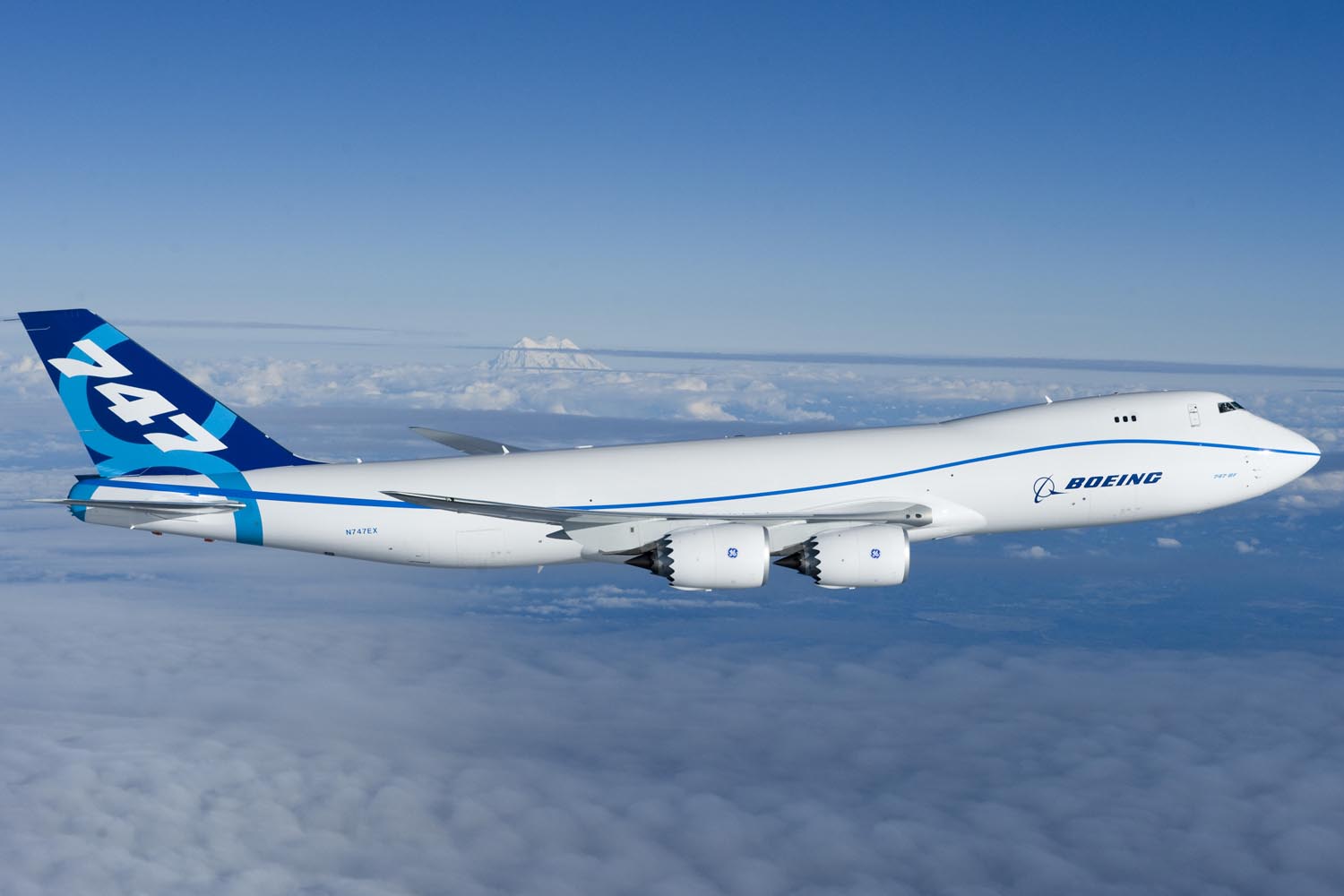
The next Air Force One will be a Boeing 747-8


Boeing will build a fleet of three aircraft based on the 747-8 to serve as the next Air Force One, Bloomberg reports. The 747-8 is the latest version of the iconic jumbo jet — a design that dates back to the 1960s — with new wings, new engines, and an extended fuselage. It's been around since 2005, but has seen limited traction with airlines thanks to rising fuel prices over the last several years, limited interest in ultra-high-capacity long-haul routes, and competition from Airbus' A380.

The aging fortress in the sky that currently ferries the President of the United States around the world is a Boeing VC-25, a military variant of the 747-200. The 747-200 is a very old plane: the last one was built in 1991, and newer aircraft are far more fuel efficient, technologically advanced, and — frankly — better showcases for American industrial might, which the President would probably want to show off on his travels. Boeing archrival Airbus, a European company, did not submit a bid for the contract based on its enormous A380 double-decker.

The current president won't get to experience the comfort and luxury of the new ride, though: the first one won't be delivered until 2018, and it'll undergo five years of testing before entering full service.

Tuesday, January 27, 2015

Navy Installations to Conduct Exercise Solid Curtain-Citadel Shield 2015

From Navy Installations Command and Fleet Forces Command Public Affairs 

WASHINGTON (NNS) -- Commander, U.S. Fleet Forces (USFF) and Commander, Navy Installations Command (CNIC) will conduct Exercise Solid Curtain-Citadel Shield 2015 (SC-CS15) Feb. 2-13 on Navy installations located in the continental United States.

 This annual anti-terrorism force protection (ATFP) exercise is designed to train Navy Security Forces to respond to threats to installations and units.

 "This is the largest force protection exercise conducted across the Department of Defense and the value of training events like this cannot be underestimated. This exercise enhances the training and readiness of our security personnel and first responders. Additionally, it creates an integrated learning environment for installation and afloat personnel to exercise functional plans and operational capabilities," said William Clark, CNIC's exercise program manager.

 Exercise SC-CS15 is not in response to any specific threat, but is a regularly scheduled exercise. The exercise will consist of roughly 130 simultaneous field training exercise attacks across the country, each designed to test different regional ATFP operations.

 "Solid Curtain-Citadel Shield 2015 provides an opportunity to assess the Navy's ability to respond to and recover from a broad spectrum of antiterrorism threats," said Capt. Greg Sandway, USFF ATFP exercise director. "One of the key components of the exercise is to improve our ability to protect our Navy equities, but this exercise also enables us to integrate with the emergency responders from the various local communities and establish coordinated response and recovery procedures that are mutually beneficial."

 Measures have been taken to minimize disruptions to normal base operations, but there may be times when the exercise causes increased traffic around bases or delays in base access. Residents near bases may also see increased security activity associated with the exercise. Base personnel should register for the AtHoc wide area alert network if they have not already done so as this will keep them updated of force protection conditions and other emergency, environmental, or exercise-related impacts on the area.

USS Green Bay Departs for Forward Deployment to U.S. 7th Fleet

By Mass Communication Specialist 1st Class (SW/AW) Elizabeth Merriam, USS Green Bay Public Affairs and Commander, U.S. 3rd Fleet Public Affairs 

SAN DIEGO (NNS) -- USS Green Bay (LPD 20) departed San Diego Jan. 26 for Sasebo, Japan, where the San Antonio-class amphibious transport dock ship will join U.S. 7th Fleet's Forward Deployed Naval Forces.

 Green Bay is replacing the decommissioned Austin-class amphibious transport dock ship USS Denver (LPD 9), previously forward-deployed to Sasebo, and will enhance amphibious presence in 7th Fleet as part of the U.S. Navy's long-range plan to send the most advanced and capable units to the Asia-Pacific region.

 "The crew has worked hard to get Green Bay ready," said Commanding Officer Capt. Kristy McCallum. "By my count, we completed a total of 23 training, certification and maintenance cycles in six months. As we've trained, we have prepared ourselves to be ready for a dynamic security environment and diverse missions."

 In addition to the many capabilities inherent to amphibious transport dock ships, Green Bay will bring a host of new technological advancements and warfighting capabilities to 7th Fleet.

 Green Bay is equipped with an advanced command and control suite, increased airlift capacity, substantial increases in vehicle and cargo carrying capability and advanced ship survivability features. The ship supports the rapid transfer of personnel and equipment via landing craft, helicopters, and MV-22 Osprey tilt-rotor aircraft, making this ship a critical element for amphibious ready groups and expeditionary strike groups.

 In 7th Fleet, Green Bay will become part of the USS Bonhomme Richard (LHD 6) Amphibious Ready Group (ARG). The ARG integrates regularly with the 31st Marine Expeditionary Unit to ensure the services are trained and ready to operate together to provide the most efficient amphibious fighting force in the Asia-Pacific region.

 Green Bay was commissioned in January 2009, embarked on its maiden deployment February 2011 and completed a second deployment in 2013. The ship has since undergone a year-long maintenance availability in British Aerospace Engineering (BAE) systems shipyard and a dry dock period at the National Steel and Shipbuilding Company (NASSCO) in preparation for forward deployment to Japan.

 U.S. 3rd Fleet leads naval forces in the Eastern Pacific from the West Coast of North America to the international date line.

USS California Returns from Maiden Deployment

By Kevin Copeland, Commander, Submarine Force Atlantic Public Affairs

GROTON, Conn. (NNS) -- The Virginia-class attack submarine USS California (SSN 781) returned to its homeport at U.S. Naval Submarine Base, New London, from its maiden deployment Jan. 24.

 Under the command of Cmdr. Shawn Huey, California is returning from the U.S. European Command area of responsibility where the crew executed the Chief of Naval Operation's maritime strategy in supporting national security interests and maritime security operations.

 "The crew of California performed exceptionally on their first deployment and completed all tasking assigned," said Huey. "We conducted two missions vital to national security, theater anti-submarine warfare, and a multi-national theater anti-submarine warfare exercise.

 During the deployment, California transited more than 40,000 nautical miles.

 Port visits were conducted in Haakonsvern, Norway; Rota, Spain; Faslane, Scotland; and Brest, France.

 "We qualified 31 Sailors in Submarine Warfare, and advanced four chief petty officers, five first class petty officers, six second class petty officers, and eight third class petty officers while deployed," said Huey. "Being deployed over three holidays, we kept the schedule light on those days for scheduled, but we all understood that the ship was conducting deployed operations in support of national and theater tasking over those days.

 "We are looking forward to 30-day stand down where we will be able to take some well-deserved leave, go home to visit our families out of the area and relax with families in the area," said Huey. "There will be a light load of maintenance and repairs to be handled by duty section personnel. More than 25 percent of the crew will rotate in the first six months after the deployment as the crew begins their preparations for the next deployment."

 "I would like to thank the families of California crew members, who without their terrific support and selfless sacrifice, none of these accomplishments would have been possible. Now the crew is looking forward to a well-deserved stand down period to spend some quality time with family and friends," Huey said.

 The eighth Virginia-class submarine commissioned, and the seventh U. S. Navy ship named for the Golden State, California, was built by Huntington Ingalls Industries - Newport News Shipbuilding and commissioned on Oct. 29, 2011, at Naval Station Norfolk, Va.

 California enables five of the six Navy maritime strategy core capabilities: sea control, power projection, forward presence, maritime security, and deterrence.

 The submarine is designed to excel in anti-submarine warfare; anti-ship warfare; strike warfare; special operations; intelligence, surveillance, and reconnaissance; irregular warfare; and mine warfare missions.

 California is 377 feet long, has a 34-foot beam, able to dive to depths greater than 800 feet and operates at speeds in excess of 25 knots submerged.

Blazing a Trail With the Pathfinders of Helicopter Maritime Strike Squadron (HSM) 35, Det. 1

By Mass Communication Specialist 2nd Class Antonio Turretto Ramos, USS Fort Worth (LCS 3) Public Affairs

SINGAPORE (NNS) -- The "Pathfinders" of Helicopter Maritime Strike Squadron (HSM) 35, Det. 1, the Navy's first composite expeditionary helicopter squadron, are currently deployed aboard the littoral combat ship USS Fort Worth (LCS 3) during her maiden 16-month rotational deployment to the Indo-Asia-Pacific region.

 HSM-35, Det. 1, is a self-contained portion of the surface warfare mission package on Fort Worth consisting of one MH-60R Sea Hawk helicopter and one MQ-8B Fire Scout unmanned aircraft system.

 "We bring the venerable MH-60R Sea Hawk," said Lt. Cmdr. Douglas Kay, officer-in-charge of HSM-35, Det. 1."The H-60 platform is a tried and true maritime asset with primary missions of surface warfare and anti-submarine warfare. In our current function with the mission package, we are concentrating on surface warfare, but we also carry out secondary missions like vertical replenishments among a number of other things."

 The MH-60R brings search and rescue capabilities, communication relay, and can carry a potential payload of hellfire missiles and a crew-served 50-caliber machine gun to littoral combat ships. Additionally, the MH-60R is equipped with multi-mode radar that includes Inverse Synthetic Aperture Radar and a forward looking infrared electro-optical device, which was used recently during the search for AirAsia Flight QZ8501. The unarmed MQ-8B's primary sensor is a forward looking infrared camera (FLIR). Together the MH-60R and MQ-8B provide enhanced maritime domain awareness with the MQ-8B complementing the MH-60 by extending the detachment's range and endurance capabilities.

 "The Fire Scout increases the aviation detachment's ability to keep eyes on station and provide real time information to the operational commander on the ship," said Kay.
 The 24 Sailors in the detachment are cross-trained to conduct all maintenance and supply for both aircraft. In addition to the helicopter advanced readiness program, as well as the normal workup cycle, the detachment must complete Fire Scout-specific training to fully integrate the unmanned aircraft system into their operations.

 "That's above and beyond what a normal HSM helicopter detachment will have to do," said Kay. "We are currently the only helicopter detachment that does what we do, but HSM-35, Det. 2, is currently in the workup cycle with LCS Crew 103 on USS Freedom (LCS 3) and is preparing to come replace us."

 The first crew swap is scheduled for mid-February, which is when the Pathfinders will rotate to another task, along with LCS Crew 104, after conducting turnover and sharing lessons learned with incoming HSM-35, Det. 2.

 "We're doing great! We've been getting a lot of good flight time in with Sea Hawk and Fire Scout operations and just like our detachment name says, we're the Pathfinders, and we're creating new techniques everyday on how to best operate both Sea Hawk and Fire Scout on a littoral combat ship," said Kay.

 Fort Worth is currently in port Singapore, its maintenance and logistics hub, after having recently returned from supporting the Indonesian-led search to locate the AirAsia plane. Throughout the ship's 13 days on station in the Java Sea, HSM 35, Det. 1, conducted more than 90 hours of search operations using the MH-60R, covering more than 2,500 square nautical miles.

 Over the course of its deployment, Fort Worth will increase LCS operations in the region by visiting more ports, engaging more regional navies during exercises like Cooperation Afloat Readiness and Training, and expanding LCS capabilities with tools like the Fire Scout.

 The U.S. 7th Fleet conducts forward-deployed naval operations in support of U.S. national interests in the Indo-Asia-Pacific area of operations. As the U.S. Navy's largest numbered fleet, U.S. 7th Fleet interacts with 35 other maritime nations to build partnerships that foster maritime security, promote stability and prevent conflict.

Bonhomme Richard Conducts Ammo Onload

By Mass Communication Specialist 2nd Class Adam D. Wainwright, USS Bonhomme Richard Public Affairs

SASEBO HARBOR, Japan (NNS) -- The forward-deployed amphibious assault ship USS Bonhomme Richard (LHD 6) conducted an ammo on-load Jan. 22-23 in preparation for its next deployment in the U.S. 7th Fleet area of responsibility.

 Over the course of two days, Weapons Department Sailors craned on and stored more than 1,000 pallets of ammunition and ordnance in preparation for upcoming exercises.

 "When we conduct the on-load, we're bringing on enough ordnance and ammo to act as a war contingency for all of U.S. 7th Fleet and our allies," said Aviation Ordnanceman 1st Class Christopher Barth, from Medina, Ohio. "Whether it's special warfare forces, explosive ordnance disposal or Marines, we are prepared and ready to assist them in executing their respective missions."

 Gunner's mates, aviation ordnancemen, and Naval Munitions Command (NMC), Sasebo civilian contractors, utilized several tools to safely move ordnance. Barth stressed the importance of taking the proper precautions when moving the ordnance during these evolutions.

 "There are numerous safety hazards when conducting an evolution of this magnitude," said Barth. "Everything from accidents with the forklifts to explosions are things that we need to prevent and be ready to respond to. We've taken every precaution to ensure the safety of our Sailors and our ship."

 This evolution requires Bonhomme Richard's Weapons Department Sailors to not only have the most focused amount of attention to detail to prevent injury, but also a tremendous amount of teamwork.

 "This is the first time 30 of our Sailors have been through this evolution and I'm extremely impressed by their work ethic and positive attitude," said Barth. "We have top notch leadership in weapons department and they've done a tremendous job preparing everyone for the onload."

 The Bonhomme Richard Amphibious Ready Group is currently under the tactical command of embarked Commander, Amphibious Squadron 11, Capt. Heidi Agle and reports to Commander, Amphibious Force U.S. 7th Fleet, Rear Adm. Hugh D. Wetherald, headquartered in White Beach, Okinawa, Japan.

VP-26 Begins Historic Last Deployment of the P-3C Orion

VP-26 Sailors work beneath a P-3C Orion maritime patrol aircraft as they prepare for the squdron's last P-3C deployment on Jan. 16. (Photos by MC1 John Smolinski)

By Mass Communication Specialist 1st Class (SW/AW) John S. Smolinski, Naval Air Station Jacksonville Public Affairs

JACKSONVILLE, Fla. (NNS) -- The "Tridents" of Patrol Squadron (VP) 26 begin their last deployment with the P-3C Orion aircraft with a send-off of their first two planes out of Naval Air Station, Jacksonville, Jan. 22.

 The historic occasion was attended by senior leadership, family and friends of VP-26 Sailors and members of the Jacksonville community.

 "This is a historic deployment for you," said Rear Adm. Matthew J. Carter, commander of Patrol and Reconnaissance Group. "You are the last operational P-3 squadron on the East Coast. Once you go, we are a P-8 only force. That does not diminish anything you do with this aircraft. America has given us the best, and this aircraft is still a very capable airplane."

 Carter knows firsthand how much the P-3 community has contributed to the success of the Navy's mission. He served as both executive officer and commanding officer of VP-26, and he told the Sailors just how special it is to wear the Trident colors.

 "We have been flying this aircraft for 50 years," said Carter. "The whole squadron, from the admin department, the maintainers and the aircrew has continued to go out and do great things, and I know you are going to go out on this deployment and do great."

 Preparing the squadron for a deployment presents its challenges which include everything from packing up parts and equipment, preparing junior Sailors for their first deployment and making sure Sailors are up to date with their training.

 "Seeing that there are not many P-3s around and this being the last P-3 deployment for the East Coast," said VP-26 Command Master Chief James B. Daniels. "Getting parts has been a big issue. Also, since most of our preparations have been during the holidays, we needed to work hard to make sure our Sailors were trained on what is expected of them and they were ready for deployment, but the squadron has met its challenges and now is ready to go."

 The support from family and friends is an integral part of the success of the Sailors.

 "My family is so supportive and so much a part of my life," said Aviation Electronics Technician 2nd Class David Heder. "Having to leave them is the hardest part of deployments."

 Heder's wife and two children were there to show their support. Heder said that he was a little nervous and sad to leave his family.

 "I'm looking forward to this as much as I can," said Heder. "I miss my family when I'm away, but I have a job to do and I enjoy it because I learn something new every day, and I'm challenged every day."

 Heder said this is his second history-making deployment since he has been in the Navy.

 "I actually helped introduce the P-8 while I served at VP-30," said Heder. "It's cool to be able to say that I was a part of the P-8 coming in and now a part of the P-3 going out in Jacksonville."

 Retired Chief William W. Stewart, from the aviation structural mechanic community and a Jacksonville resident, was present to witness this historic day. Stewart served 30 years in the Navy and was factory-trained on the P-3 in 1962.

 "I was assigned to VP-9 as an airframes chief after training with Lockheed on the P-3s and went on their first deployment with the aircraft in November 1964," said Stewart. "It's kind of sad to see the P-3 go, but it's an evolution. It's a new age; we have cell phones, wide-screen TVs and now the P-8s."

 VP-26 became the Navy's first operational P-3B squadron in January 1966, when the squadron received the first production of the P-3B while stationed at Naval Air Station, Brunswick, Maine.

 "I am so proud of all the Sailors who have worked so hard to keep these aircraft flying for so many years," said Cmdr. Gregory Smith, VP-26 commanding officer.

Thursday, January 22, 2015

One Service You Can Hear to Monitor Navy Ships on HF

Interested in listening the Navy ships on HF? Then the U.S. Navy SESEF frequencies are your ticket to make that happen.

The Shipboard Electronic Systems Evaluation Facilities (SESEFs) are land based test sites established to facilitate testing of ships' electromagnetic transmitting and receiving equipment. The SESEFs provide test and evaluation services to U.S. Navy, U.S. Coast Guard and Military Sealift Command activities as well as allied foreign navies.
So were do you listen? Set your rig to USB and try our list below. You will hear occasional encrypted comms and the ships will use tactical voice call signs.
* indicates a frequency guarded continuously during normal working hours.

SESEF Norfolk -
4040.0 4515.0 7535.0* 9260.0 12315.0* kHz (USB) 274.800* MHz (AM)
The Norfolk SESEF facility is operational 5 days a week from 0700-1600, excluding weekends and holidays.

The Norfolk SESEF facility is located in Building 102 at Fort Story, Virginia Beach. The facility overlooks the Atlantic Ocean, Chesapeake Bay and the approaches to the Virginia Capes operating area.  In addition to at-sea testing, directional antennas provide LOS support for pier side testing from all naval and shipyard facilities in the Tidewater area.  The Naval Undersea Warfare Center (NUWC) Division, Newport, RI operates this facility.


Norfolk SESEF at Fort Story (US Navy Photo)

SESEF Mayport -
5745.0 kHz (USB) 274.800* MHz (AM)
The Mayport SESEF site is operational 5 days a week from 0700-1600, excluding weekends and holidays.

The Mayport SESEF is located in Building 1860 on  Naval Station Mayport, FL. The facility has LOS capability for pier side testing as well as easy access to ships in the Jacksonville operating area. This facility is operated by NUWC Division Newport, RI and managed by the Norfolk SESEF facility.

Mayport SESEF (US Navy Photo)
SESEF Ediz Hook (PACNW) -
3235.0* kHz (USB) 308.500* MHz (AM)
The Ediz Hook SESEF facility is operational 5 days a week from 0800-1600,
excluding weekends and holidays.

The Ediz Hook SESEF is located on the U.S. Coast Guard Air Station, Ediz Hook, near Port Angeles, Washington. The Puget Sound coastal waters are adjacent to the facilities. This site supports the Puget Sound Naval Shipyard, Bangor Naval Submarine Base, Naval Air Station Whidbey Island and Everett Naval Station. NUWC Division Keyport, WA operates this facility.

Navy SESEF Ediz Hook (US Navy Photo)
SESEF Pearl Harbor -
16087.0* kHz (USB) 277.000* MHz (AM)
The Hawaii SESEF facility is operational Monday through Friday from 0700-1530, excluding weekends and holidays.

The Hawaii SESEF is located at the Barber's Point Light Station, Kapolei, HI.  It is within line-of-sight (LOS) of Pearl Harbor, Sand Island, Naval Air Station Barber's Point, and the Fleet Operational Readiness Accuracy Check Site (FORACS) III.  Surface ships, submarines, and aircraft can be serviced at dockside, hanger side and underway.  This facility serves the U.S. Naval Forces in the MIDPAC area.  SESEF testing is conducted in port, during transit to and from Pearl Harbor, and on designated test ranges.  NUWC Detachment, Waianae, HI operates this facility. SESEF Hawaii is located at latitude 21 degrees 17 minutes 48 seconds north and longitude 158 degrees 6 minutes 23 seconds west.

Navy SESEF Hawaii (US Navy Photo)
SESEF San Diego -
5742.0 kHz (USB) 236.200 264.200 MHz (AM)
The San Diego SESEF site is operational 5 days a week from 0700-1600, excluding weekends and holidays.

The San Diego SESEF is located at the SPAWAR Seaside Complex, Building 610, on the ocean side of Point Loma, overlooking the Pacific Ocean. This location provides easy access to ships as they transit the entrance of San Diego's harbor. NUWC Detachment, San Diego, CA operates this facility. SESEF San Diego is located at latitude 32 degrees 41 minutes 35 seconds north and longitude 117 degrees 15 minutes 4 seconds west. The Nominal Range Center is located at latitude 32 degrees 41 minutes 12 seconds north and longitude 117 degrees 25 minutes 30 seconds west.

SESEF Facility San Diego (US Navy Photo)
SESEF Yokosuka -
5304.0 kHz (USB) 295.000 MHz (AM)
The Yokosuka SESEF site is operational from 0700-1600, excluding weekends and holidays. 

USS George Washington in Yokosuka (US Navy Photo)
For the radio monitor these are some neat frequencies to monitor and they will let you follow the comings and goings of the fleet.