Showing posts with label Iran. Show all posts

Thursday, June 20, 2019

Breaking News: Iran Shoots Down a US RQ-4A Global Hawk Drone


Lucas Tomlinson, the Pentagon reporter for Fox News, has confirmed what was shot down over the Straits.


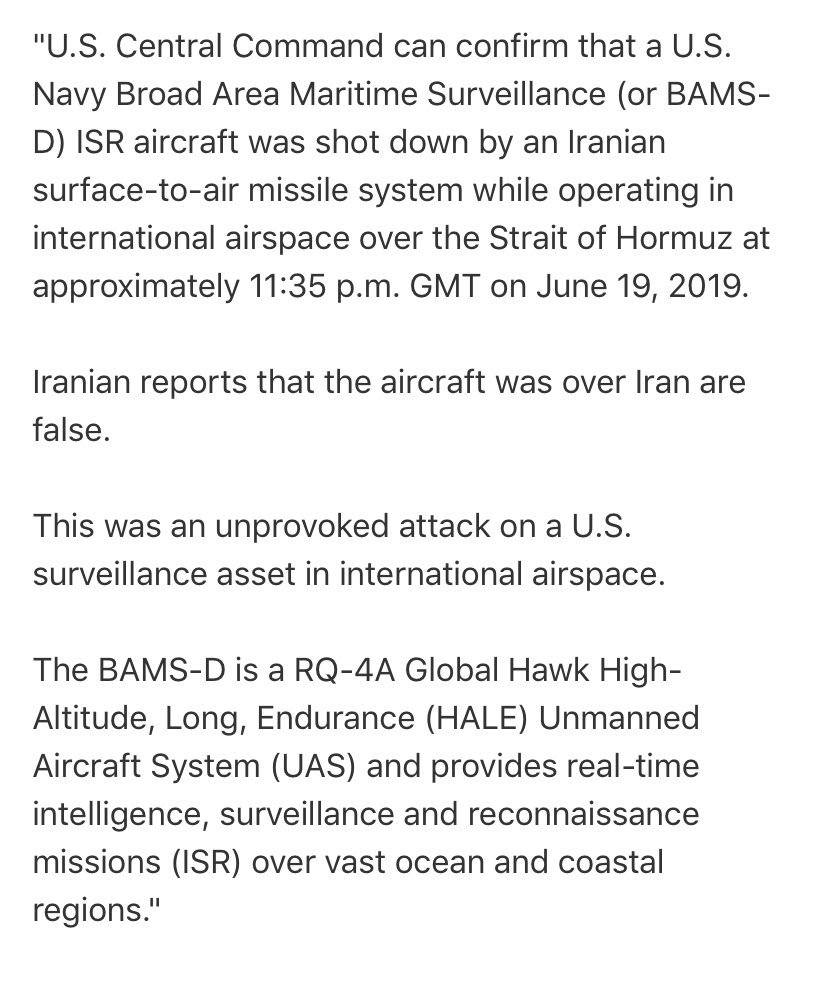
US officials confirm that US RQ-4A Global Hawk drone was shot down by an Iranian surface-to-air missile this evening while operating within international airspace over the Strait of Hormuz.

Image result for rq-8a global hawk

There are several reports that the unmanned aircraft was a US Navy Northrop Grumman MQ-4C Triton which is an American high-altitude long-endurance unmanned aerial vehicle flown by the United States Navy as a surveillance aircraft.

Other reports indicate that the MQ-4C has not been operationally deployed and that there are none known to be in the Middle East region. Tyler Rogoway is reporting on the Wardrive website that this was a U.S. Air Force RQ-4 Global Hawk UAV that Iran shootdown.

Either way, this is a serious escalation of events in the Middle East and in the Straits of Hormuz in particular. More as we get it.

More on this story via The UK Sun at https://www.thesun.co.uk/news/9334596/iran-shoots-down-us-spy-drone-tensions-gulf/

Preview Image


Saturday, September 15, 2012

Armada of British naval power massing in the Gulf as Israel prepares an Iran strike

A copyrighted story by Sean Rayment, Defence Correspondent on The Telegraph website

An armada of US and British naval power is massing in the Persian Gulf in the belief that Israel is considering a pre-emptive strike against Iran’s covert nuclear weapons programme.

(The Strait of Hormuz is only 21 miles wide at its narrowest point Photo: ALAMY)

Battleships, aircraft carriers, minesweepers and submarines from 25 nations are converging on the strategically important Strait of Hormuz in an unprecedented show of force as Israel and Iran move towards the brink of war.

Western leaders are convinced that Iran will retaliate to any attack by attempting to mine or blockade the shipping lane through which passes around 18 million barrels of oil every day, approximately 35 per cent of the world’s petroleum traded by sea.

A blockade would have a catastrophic effect on the fragile economies of Britain, Europe the United States and Japan, all of which rely heavily on oil and gas supplies from the Gulf.

The Strait of Hormuz is one of the world’s most congested international waterways. It is only 21 miles wide at its narrowest point and is bordered by the Iranian coast to the north and the United Arab Emirates to the south.

You can read the rest of the story by clicking here.

Tuesday, July 17, 2012

Pentagon Bulks Up Defenses in the Gulf

A U.S. military facility in 2008 in the Negev desert in Israel that deploys an X-Band radar system. The Pentagon is building a new radar station in Qatar for an X-Band as part of a buildup to counter Iran. (Agence France-Presse/Getty Images)

The Wall Street Journal is reporting this morning that the Pentagon is building a missile-defense radar station at a secret site in Qatar and organizing its biggest-ever minesweeping exercises in the Persian Gulf, as preparations accelerate for a possible flare-up with Iran, according to U.S. officials.

The radar site will complete the backbone of a system designed to defend U.S. interests and allies such as Israel and European nations against Iranian rockets, officials told The Wall Street Journal. The minesweeping exercises, in September, will be the first such multilateral drills in the region, and are expected to be announced by U.S. officials Tuesday.

Read the complete copyrighted online story at by clicking here.

Thursday, July 12, 2012

U.S. moving submersibles to Persian Gulf to oppose Iran

USS Ponce in the Persian Gulf (US Navy Photo)

Tensions continue to rise in the Persian Gulf as the article below by David S. Cloud indicates.

WASHINGTON — The Navy is rushing dozens of unmanned underwater craft to the Persian Gulf to help detect and destroy mines in a major military buildup aimed at preventing Iran from closing the strategic Strait of Hormuz in the event of a crisis, U.S. officials said.

The tiny SeaFox submersibles each carry an underwater television camera, homing sonar and an explosive charge. The Navy bought them in May after an urgent request by Marine Gen. James Mattis, the top U.S. commander in the Middle East.

Each submersible is about 4 feet long and weighs less than 100 pounds. The craft are intended to boost U.S. military capabilities as negotiations with Iran over its nuclear program appear to have stalled. Three rounds of talks since April between Iran and the five countries in the United Nations Security Council plus Germany have made little progress.

The first of the SeaFox submersibles arrived in the Gulf in recent weeks, officials said, along with four MH-53 Sea Dragon helicopters and four minesweeping ships, part of a larger buildup of U.S. naval, air and ground forces in the region aimed at Iran.

The U.S. already has sent two aircraft carriers and a squadron of F-22 fighters to the Persian Gulf, and is keeping two U.S. army brigades in Kuwait. Though much of the buildup has been publicly acknowledged by the Pentagon, the deployment of the submersibles has not been publicly disclosed, apparently to avoid alerting Iran.

The SeaFox is small enough to be deployed from helicopters and even small rubber boats, but it also can be dropped off the back of a minesweeper. It is controlled by a fiber optic cable and sends live video back to a camera operator.

It can be used against floating or drifting mines, which Iran has used in the past. It operates up to 300 meters deep, and moves at speeds of up to six knots. But the $100,000 weapon is on a what amounts to a suicide mission. The “built-in, large caliber shaped charge” it carries destroys the mine but also the vehicle itself.
Wednesday, July 04, 2012

Middle East Hotspot: U.S. Adds Forces in Persian Gulf, a Signal to Iran

The Strait of Hormuz and the Persian Gulf beyond it, as seen from the International Space Station in 2003. Iran is to the right. (NASA Photo)

Article appears online at the NYTimes website
By THOM SHANKER, ERIC SCHMITT and DAVID E. SANGER

WASHINGTON — The United States has quietly moved significant military reinforcements into the Persian Gulf to deter the Iranian military from any possible attempt to shut the Strait of Hormuz and to increase the number of fighter jets capable of striking deep into Iran if the standoff over its nuclear program escalates.

The most visible elements of this buildup are Navy ships designed to vastly enhance the ability to patrol the Strait of Hormuz — and to reopen the narrow waterway should Iran attempt to mine it to prevent Saudi Arabia and other oil exporters from sending their tankers through the vital passage.

The Navy has doubled the number of minesweepers assigned to the region, to eight vessels, in what military officers describe as a purely defensive move.

Since late spring, stealthy F-22 and older F-15C warplanes have moved into two separate bases in the Persian Gulf to bolster the combat jets already in the region and the carrier strike groups that are on constant tours of the area. Those additional attack aircraft give the United States military greater capability against coastal missile batteries that could threaten shipping, as well as the reach to strike other targets deeper inside Iran.

And the Navy, after a crash development program, has moved a converted amphibious transport and docking ship, the Ponce, into the Persian Gulf to serve as the Pentagon’s first floating staging base for military operations or humanitarian assistance.

You can read the entire article online at
http://www.nytimes.com/2012/07/03/world/middleeast/us-adds-forces-in-persian-gulf-a-signal-to-iran.html?_r=1&partner=MYWAY&ei=5065

Monday, February 07, 2011

Iran unveils 4 new satellites


The Associated Press is reporting that Iran has built four new domestically produced satellites as part of a space program that's worrying other nations.

State TV showed President Mahmoud Ahmadinejad unveiling the satellites — Fajr, Rasad, Zafar and Amir Kabir-1 — on Monday at a ceremony in Tehran.

State TV described them as research satellites but did not provide details. Iran says it has launched at least two satellites and has none in orbit now.

Many nations in the West and Middle East fear Iran's space program could also bolster its ballistic missile program and ability to conduct space-based surveillance. The U.S. and other countries have cited fears that Iran's nuclear program and missile program could allow it to target Europe and Israel with atomic weapons.

The Voice of America reported last Monday that Iran unveiled the new rockets and satellites as part of national celebrations of the 32nd anniversary of its Islamic Revolution.

Defense Minister Ahmad Vahidi said Sunday the presentation of Iran's latest space technology will include two rockets, the Safir 1-B (Messenger 1-B) and Kavoshgar 4 (Explorer 4), and two satellites, the Rasad (Observation) and Fajr (Dawn).

Vahidi said the Safir 1-B rocket is capable of carrying a satellite weighing 50 kilograms into an elliptical orbit of 300 to 450 kilometers.

Iranian President Mahmoud Ahmadinejad also inaugurated a new space research and training center Sunday.

Iran on Tuesday begins the 10-day long annual celebration of its revolution. It typically uses the occasion to showcase its scientific and technological achievements.

Monday, March 01, 2010

China, Iran Creating 'No-Go' Zones to Thwart U.S. Military Power


Found this interesting article on Politics Daily by David Wood

"As Defense Secretary Robert Gates summed up the problem this month, countries in places where the United States has strategic interests -- including the Persian Gulf and the Pacific -- are building "sophisticated, new technologies to deny our forces access to the global commons of sea, air, space and cyberspace.''

Read more at
http://www.politicsdaily.com/2010/03/01/china-iran-creating-no-go-zones-to-thwart-u-s-military-power/?icid=mainmaindl1link1http%3A%2F%2Fwww.politicsdaily.com%2F2010%2F03%2F01%2Fchina-iran-creating-no-go-zones-to-thwart-u-s-military-power%2F

Sunday, January 31, 2010

US raises stakes on Iran by sending in ships and missiles

Pentagon says Patriot shield will deter strike on American allies in the Gulf
By Chris McGreal in Washington guardian.co.uk

Tension between the US and Iran heightened dramatically today with the disclosure that Barack Obama is deploying a missile shield to protect American allies in the Gulf from attack by Tehran.

The US is dispatching Patriot defensive missiles to four countries – Qatar, United Arab Emirates, Bahrain and Kuwait – and keeping two ships in the Gulf capable of shooting down Iranian missiles. Washington is also helping Saudi Arabia develop a force to protect its oil installations.

American officials said the move is aimed at deterring an attack by Iran and reassuring Gulf states fearful that Tehran might react to sanctions by striking at US allies in the region. Washington is also seeking to discourage Israel from a strike against Iran by demonstrating that the US is prepared to contain any threat.

You can read the rest of the copyrighted story at
http://www.guardian.co.uk/world/2010/jan/31/iran-nuclear-us-missiles-gulf

All of this was leaked to the press after the Iranian president delivered a veiled threat on Sunday. State-run Press TV quoted Iranian President Mahmoud Ahmadinejad on Sunday as saying that the nation will deliver a harsh blow to "global arrogance" on February 11.

Missile defence
Patriot missiles are designed to intercept enemy missiles before they reach their target. Since production began in 1980, 9,000 missiles have been delivered to countries including Germany, Greece, Taiwan and Japan.

During the first Gulf war Patriot success was 70% in Saudi Arabia and 40% in Israel. Since then the US has spent more than $10bn (£6.3bn) improving, among other aspects, the system's radar and computer compatibility for joint forces action. Once in position, the system requires a crew of only three people to operate. Each missile weighs 700kg and has a range of about 100 miles.

The US navy is in the process of upgrading all its Ticonderoga class cruisers and a number of destroyers to carry the Aegis ballistic missile defence system. It uses a surface-to-air missile that is capable of intercepting ballistic missiles above the atmosphere. It has also been tested on failing satellites as they fall to earth. Each missile is over 6m long and costs more than $9m. James Sturcke

Wednesday, December 30, 2009

Hmm… Israel Calls ALL Ambassadors Home For Special Meeting in Jerusalem

For the first time ever, Israel has called ALL of its ambassadors and consuls home for meetings this week in Jerusalem. The meetings opened Sunday December 27.

The Ministry of Foreign Affairs, headed by Deputy Prime Minister and Minister of Foreign Affairs Avigdor Liberman, will host a conference next week (27-31 December) for Israeli Heads of Missions. At the conference, Israel’s ambassadors and consuls general serving throughout the world will discuss broad diplomatic and strategic issues.

This is the first time a conference for all of Israel’s Heads of Missions has been held. The idea is to facilitate direct dialogue with the country’s leaders, mutual updates on major diplomatic issues, and a discussion of action plans to deal with the challenges awaiting the State of Israel in the international arena in the coming year, including the Iranian threat.

Israel recalls all ambassadors. Probably nothing, but I wouldn’t buy real estate in Tehran anytime soon.

Time to keep a closer watch on Enigma E10 and Israeli AF HF freqs. Those freqs have been posted on this blog at http://mt-milcom.blogspot.com/2009/10/exercise-juniper-cobra-2009-oct-12-16.html and http://mt-milcom.blogspot.com/2006/08/monitoring-middle-east-tinder-box-8-1.html.

Monday, March 16, 2009

Coalition Jets Shoot Down Iranian Drone Over Iraq

By Donna Miles
American Forces Press Service


WASHINGTON, March 16, 2009 - Coalition jet fighters shot down an Iranian drone that was hovering over Iraq late last month, Multinational Force Iraq officials confirmed today.
The incident occurred Feb. 25, about 60 miles northeast of Baghdad, officials said in a statement.

Two coalition aircraft were directed to visually identify the unmanned aerial vehicle after it was detected hovering inside the Iraqi border. The pilots confirmed that it wasn't a coalition aircraft and that no collateral damage would result from a shoot-down. Coalition air forces tracked the UAV for more than an hour before the pilots engaged it, officials said.

"This was not an accident on the part of the Iranians," officials said. "The UAV was in Iraqi airspace for nearly one hour and 10 minutes and well inside Iraqi territory before it was engaged."

Officials said they believe the drone to be an Iranian-made Ababil 3 model UAV.

Defense Secretary Robert M. Gates and military leaders have long accused Iran of interference in Iraq. Iran poses "a real problem," Gates said on PBS' "Tavis Smiley Show" March 11.

"I think it's one of the significant challenges that we're going to face over the next several years," he said.