Wednesday, September 20, 2006

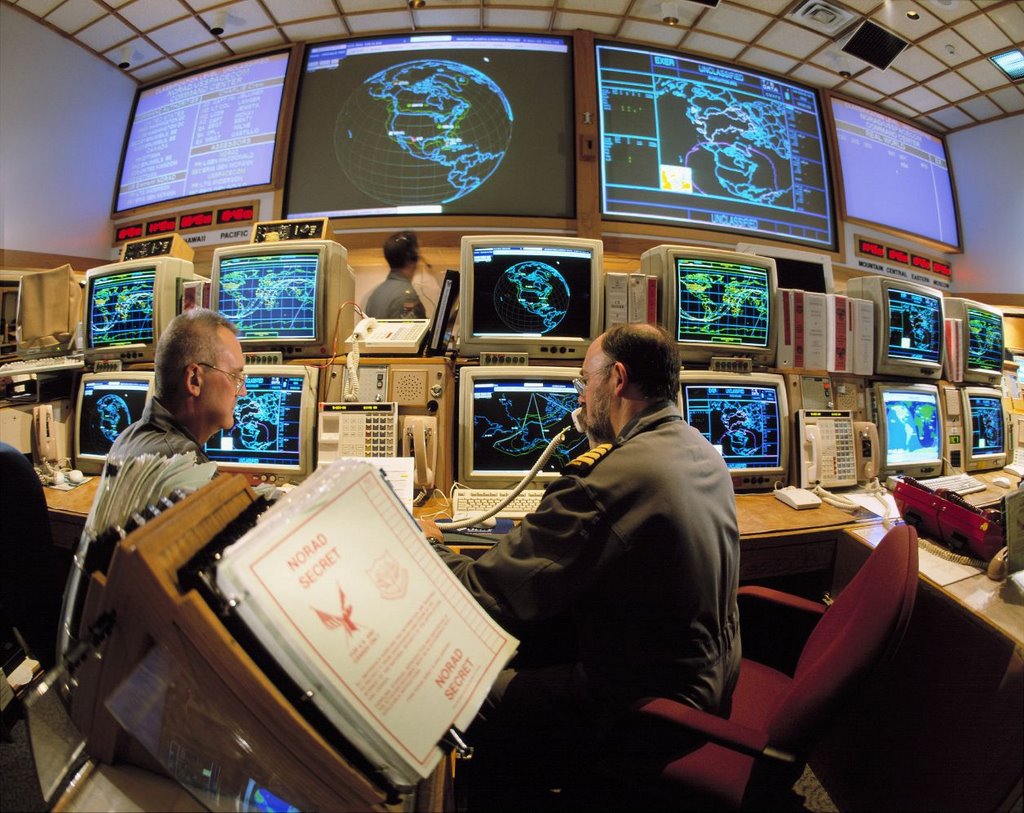
NORAD exercise planned for Washington D.C.


The North American Aerospace Defense Command and its geographical component, the Continental United States NORAD Region (CONR), will conduct Exercise Falcon Virgo 06-12 Wednesday and Thursday (20-21 Sep 2006) in the National Capital Region (Washington,D.C.).

This exercise comprises a series of training flights held incoordination with the Federal Aviation Administration, the National Capital Region Command Center, the Joint Air Defense Operations Center, Civil Air Patrol, U.S. Coast Guard, and NORAD's Northeast Air Defense Sector. Exercise Falcon Virgo 06-12 is designed to test NORAD's intercept andidentification operations. Civil Air Patrol aircraft, Air Force F-16s, Air Force Flight Standards Agency C-21s, and US Coast Guard HH-65 helicopters will participate in the exercise.

Residents in the area can expect flights to occur during the late night and early morning hours. In the event of inclement weather the exercise will push to the next day until all training requirements are complete.

These exercises are carefully planned and closely controlled to ensure NORAD's rapid response capability. NORAD has conducted exercise flights of this nature throughout the U.S. and Canada since the start of Operation Noble Eagle, the command's response to the terrorist attacks on Sept. 11, 2001. As the Continental United States (CONUS) geographical component of the bi-national command NORAD, CONR provides airspace surveillance and control, and directs air sovereignty activities for the CONUS region. CONR and its assigned Air Force assets throughout the country ensure air safety and security against potential air threats.

Since Sept. 11, 2001, NORAD fighters have responded to more than 2,100 possible air threats in the United States, Canada and Alaska, and have flown more than 42,000 sorties with the support of Airborne Warning and Control System and air-to-air-refueling aircraft.


Hezbollah cracked the code

In the aftermath of the conflict in Lebanon between Israel and Hezbollah, Newsday.com is reporting that Hezbollah guerrillas were able to hack into Israeli radio communications. This intelligence breakthrough helped them thwart Israeli tank assaults.

Milcom monitors will want to read this very fascinating article by Mohamad Bazzi online at http://www.newsday.com/news/nationworld/world/ny-wocode184896831sep18,0,3091818.story?coll=ny-worldnews-print.

Saturday, September 16, 2006

Cecil Field Issue Will Not Appear On Ballot

According to a news report appearing on the Jacksonville NBC12 website, voters will not be getting a say in November on whether the city should pursue the Navy to bring a master jet base to Cecil Field.

Circuit Judge Bernard Nachman, in a twenty page ruling, found the proposed voter referendum to change the city charter, "illegal and invalid."

You can find the complete story at http://www.firstcoastnews.com/news/local/news-article.aspx?storyid=64414.

Friday, September 15, 2006

Russia and China have launched milsats

I have received two notices regarding the launch of military satellites from Russia and China.

Russia has launched a Don Class (Yantar-6K/ FR6)/Orlets-1, close look and survey photo recon designated Kosmos 2423. It was launched 14 Sep 2006, at 1341 UTC on a Soyuz-U rocket from Baykonur LC31. Kosmos 2423 carries an international designator of 2006-39A and a SSC number of 24902. The satellite is equipped with a panoramic camera and equipped with eight film return capsules. The satellite was launched into a 317 x 170 km, 64.9 deg inclination orbit. Further orbit maneuvers to raise the perigee of this satellite are expected in the next few days.

China has launched Zhongxing-22A, a communications satellite on a Long March 3A rocket on 12 Sep 2006, at 1602 UTC. The satellite was launched into a 41817 x 202 km, 25 deg transfer orbit. The satellite carries an international designator of 2006-038A and an SSC number of 29398.

This satellite will replace the Zhongxing-22 satellite in orbit at 98 deg east. It has been reported that this series of satellite carries a military communications capability, but we have no specific details on where in the spectrum that package transmits. The Chinaview news service carried the following on the launch:


" Zhongxing-22A, an earth-synchronous telecommunications satellite is designed by the Chinese Academy of Space Technology under the China Aerospace Technology Group Company.

" The satellite has been designed to work for eight years, for the owner - the China Telecommunication Broadcast Satellite Company under the China Telecommunications Satellite Group Company.

" According to some experts, once the satellite shifts its track, it will be fixed above the Equator, at 98 degrees east longitude, under the guidance of the Xi'an center and ocean-going space measuring vessels. Afterwards, it will be handed over to the owner."

Thursday, September 14, 2006

New UHF Milsat Downlink Discovered

According to uhf-satcom.com website and posted on 3 Sep 2006, monitors have uncovered a third UHF downlink on the Italian military satellite Sircal 1A. This new downlink is cross strapped to one of the satellite's 7 GHz transponders.

The three UHF transponders and their 7 GHz counterparts are:
252.200-252.350 MHz 7393.200-7393.350 MHz
258.150-258.300 MHz
267.100-267.250 MHz 7408.100-7409.250 MHz Uplink 308.200-308.350 MHz.

The satellite has a 7500 MHz TT&C beacon on continuously.

Based on intercept reports the squeaky wheel modulation type, STANAG 4285, and voice transmissions have been observed on the 252.200 MHz transponder. Italian Navy coastal station IDR-Rome has been reported on the second transponder at 258.200 MHz.

Thanks to the gang at www.uhf-satcom.com.

China Launches Military Satellite


China has launched a military photographic recon satellite, Shi Jian 8, on September 9, 2006 at 0700 UTC.

International Designator: 2006-035A
SSC Number: 29385
Launcher: Long March 2C
Launch Site: Jiuquan/Shuang Cheng Tzu
Orbit: 445 x 177 km, 63 degree inclination

According to Jonathan McDowell, Jonathan's Space Report, "SJ-8, unlike earlier SJsatellites, is a recoverable satellite derived from earlier FSWreconnaissance and microgravity satellites. It will study the exposureof seeds to microgravity and radiation. The Xinhua news agency reportsthat the launch vehicle was a CZ-2C. Both CZ-2C and uprated CZ-2Drockets are used for the recoverable satellites. Based on orbital data, I estimate that the launch time was 0700 UTC."

At present we have no downlink frequency information on this satellite.

According to press reports, he last Shi Jian satellite, number 7 was launched 5 July 2005 by a Long March 2D into a 565 x 543 km orbit, inclined 97.6 degrees. That was a scientific mission that is scheduled for a three year mission.

The complete launch history of the Shi Jian series follows.

SJ-1 / PRC-2 / China-2 1971-03-03
SJ-2A / PRC-11 / China-11 1981-09-19
SJ-2B / PRC-9 / China-9 1981-09-19
SJ-2C / PRC-10 / China-10 1981-09-19
SJ-4 / Practice-4 1994-02-08
SJ-6A 2004-09-08
SJ-6B 2004-09-08
SJ-7 2005-07-05
SJ-8 2006-09-09

Milair Nationwide Frequencies Part 8

This is part 8 of our exclusive nationwide milair assignment list. Here is a list of previous parts and the dates they appeared on this blog:

Part 1 Monday May 29, 2006
Part 2 Tuesday, June 06, 2006
Part 3 Tuesday, June 13, 2006
Part 4 Tuesday, June 20, 2006
Part 5 Wednesday, July 5, 2006
Part 6 Wednesday, July 26, 2006
Part 7 Thursday, August 24, 2006

264.150 Russian Gonet satellite downlink
264.400 Russian Gonet satellite downlink
264.550 Blue Angel Flight Demo Team - Extra channel
264.600 USAF JStars command and control discrete/Milsat: Russian Gonet satellite downlink
264.625 USAF AWACS Mickey
264.750 Russian Gonet satellite downlink
264.7875 Russian Gonet satellite downlink
264.800 Eastern Test Range - Variety Net (East Coast only)
264.900 USAF Aerial Refueling ACC Spare-Exercise-Contigency CONUS/Milsat: Russian Gonet satellite downlink
264.975 USAF F-15 Flight Demo Team (East)
265.000 Blue Angel Flight Demo Team
265.0625 Russian Gonet satellite downlink
265.1375 Russian Gonet satellite downlink
265.250 Milsat: UFO November Navy Fleet Relay (25 kHz) channel 7
265.350 Milsat: FLTSATCOM Alpha/UFO Oscar Navy Fleet Relay (25 kHz) channel 7
265.400 NORAD CAP/GCI discrete
265.450 Milsat: FLTSATCOM Bravo/UFO Papa Navy Fleet Relay (25 kHz) channel 7
265.550 Milsat: FLTSATCOM Charlie/UFO Quebec Navy Fleet Relay (25 kHz) channel 7
265.950 Russian Gonet satellite downlink
266.050 USAF JStars discrete
266.500 Aerial Refueling ACC Random Tracks CONUS
266.700 US Navy Squadron Common/Command and Control
266.750 Milsat: UFO November Navy Fleet Relay (25 kHz) channel 8
266.800 Air Traffic Control
266.850 Milsat: FLTSATCOM Alpha/UFO Oscar Navy Fleet Relay (25 kHz) channel 8
266.950 Milsat: FLTSATCOM Bravo/UFO Papa Navy Fleet Relay (25 kHz) channel 8
267.050 Milsat: FLTSATCOM Charlie/UFO Quebec Navy Fleet Relay (25 kHz) channel 8
267.100-267.250 Milsat: Italian Sircal 1A downlink
267.800 USAF ACC Air-to-Air Flight Support
267.850 DoD Have Quick discrete
267.900 Air Traffic Control
268.150 Milsat: UFO November Navy Fleet Relay (25 kHz) channel 9
268.225 Reported satellite downlink (East Coast) unknown bird
268.250 Milsat: FLTSATCOM Alpha/UFO Oscar Navy Fleet Relay (25 kHz) channel 9
268.350 Milsat: FLTSATCOM Bravo/UFO Papa Navy Fleet Relay (25 kHz) channel 9
268.400 Aerial Refueling Coronet East (East Coast)
268.450 Milsat: FLTSATCOM Charlie/UFO Quebec Navy Fleet Relay (25 kHz) channel 9
268.700 Air Traffic Control
269.000 Air Traffic Control
269.025 Air Traffic Control
269.050 Air Traffic Control
269.075 Air Traffic Control
269.100 Air Traffic Control
268.125 Air Traffic Control
269.150 Air Traffic Control
269.175 Air Traffic Control
269.200 Air Traffic Control
269.225 Air Traffic Control
269.250 Air Traffic Control
269.275 Air Traffic Control
269.300 Air Traffic Control
269.325 Air Traffic Control
269.350 Air Traffic Control
269.375 Air Traffic Control
269.400 Air Traffic Control
269.425 Air Traffic Control
269.450 Air Traffic Control
269.475 Air Traffic Control
269.500 Air Traffic Control
269.525 Air Traffic Control
269.550 Air Traffic Control
269.575 Air Traffic Control
269.600 Air Traffic Control
269.625 Air Traffic Control
269.650 Milsat: UFO November Navy Fleet Relay (25 kHz) channel 10
269.750 Milsat: FLTSATCOM Alpha/UFO Oscar Navy Fleet Relay (25 kHz) channel 10
269.850 Milsat: FLTSATCOM Bravo/UFO Papa Navy Fleet Relay (25 kHz) channel 10
269.900 Air Traffic Control (Mostly ATIS services)
269.950 Milsat: FLTSATCOM Charlie/UFO Quebec Navy Fleet Relay (25 kHz) channel 10

Saturday, September 09, 2006

STS-115 UHF Air/Ground Comms


Had a nice bit of Atlantis UHF comms on Air/Ground 1 during ascent from the "Negative Return Call" to KSC through the "Single Engine Ops 3 call." After the Atlantis preformed its roll maneuver, heard no more UHF comms.

Beautiful pics on NASA TV of the ET sep from Atlantis. UHF comms from Atlantis running ahead of NASA TV comms by about 2-3 seconds.
Glad to see Atlantis back into orbit safely.

STS-115 Launch Frequencies Update 2

Shuttle launch support net up on 261.875 MHz. Cape Radio working Wolf Den.

Report from the area indicates 318.100 was used by elements of the NORAD Cape CAP this morning.

Thanks Jack.

Friday, September 08, 2006

5711 ALE Activity

While parked on 5711 kHz looking for STS-115 SRB Recovery vessel activity, caught the following ALE soundings (this is SHARES SCN channel 4):

AAT3BFMARS US Army MARS Newark, DE
KNY70 US NTCN-HF Herndon, VA
KNY82 US NTCN-HF Lenexa, KS

STS-115 Scrubbed - Again!

STS-115 has been scrubbed for today. They are in a 24 scrub turnaround for a possible launch on Saturday. New launch time on 9 Sep 2006 is 11:15 EDT or 1515 UTC.

STS-115 Launch Elset

From Ted Molczan and the SEESAT-L newsgroup:

1. Sep 08, 15:51:06 UTC (MECO) - Sep 08, 16:19:43 UTC
1 99999U 6251.66048611 .01000000 00000-0 44275-6 0 03
2 99999 51.6315 117.9773 0132748 348.7800 69.0699 16.48567837 02

STS-115 Launch Frequencies Update 1

As I type there is pre-launch activity for the STS-115 mission on 261.875 MHz. Nice signals levels.

Also for those on the Florida Peninsula, the ETR Variety net is up on 294.6 and also using 141.300 MHz (ID as TAC COMM).

More as I have it.

Thursday, August 31, 2006

NIPR/SIPR HF ALE Network Frequency List


Here is my latest NIPR/SIPR network frequency/station list. Traffic on these frequencies is mostly encrypted message traffic with stations using ALE to sound.

SIPR (Secret Internet Protocol Router) Network Frequencies
(USB/ALE): 3113.0 5702.0 5902.0 6715.0 8968.0 9044.0 11181.0 15091.0 17976.0 27870.0 kHz.

SIPR Gateway/Frequency Matrix
ADWSPR Andrews AFB, Maryland 3113.0 5702.0 6715.0 8968.0 9044.0 11181.0 17976.0 27870.0
AEDSPR Elmendorf AFB, Alaska 6715.0 17976.0
CROSPR Croughton AB, United Kingdom 5702.0 5902.0 6715.0 8968.0 11181.0 15091.0 17976.0 27870.0
GUASPR Andersen AB, Guam 5702.0 8968.0 11181.0 15091.0
HAWSPR Ascension Island 5702.0 6715.0 8968.0 11181.0 15091.0 17976.0 27870.0
HIKSPR Hickam AFB, Hawaii 5702.0 5902.0 6715.0 8968.0 15091.0
ICZSPR Sigonella AB, Sicily, Italy 5702.0 6715.0 8968.0 11181.0 15091.0 17976.0
JDGSPR Diego Garcia, Indian Ocean 5702.0 6715.0 8968.0 9044.0 11181.0 27870.0
JNRSPR Salinas, Puerto Rico 3113.0 5902.0 6715.0 8968.0 11181.0 15091.0 17976.0
JTYSPR Yokota AB, Japan 15091.0
MCCSPR McClellan, California 5702.0 5902.0 6715.0 8968.0 11181.0
OFFSPR Offutt AFB, Nebraska 3113.0 5702.0 5902.0 6715.0 8968.0 11181.0 15091.0 17976.0
PLASPR Lajes AB, Azores 5702.0 6715.0 8968.0 11181.0 15091.0

NIPR (Non-Secure Internet Protocol Router) Network Frequencies
(USB/ALE): 3068.0 4745.0 5684.0 8965.0 10600.0 10830.0 11199.0 13242.0 17973.0 20631.0 kHz.

NIPR Gateway/Frequency Matrix
ADWNPR Andrews AFB, Maryland 3068.0 4745.0 5684.0 8965.0 11199.0 13242.0 17973.0 20631.0
CRONPR Croughton AB, United Kingdom 3068.0 4745.0 8965.0 17973.0
HIKNPR Hickam AFB, Hawaii 8965.0
ICZNPR Sigonella NS, Sicily, Italy 4745.0 5684.0 8965.0 13242.0 17973.0 20631.0
JNRNPR Salinas, Puerto Rico 8965.0
MCCNPR McClellan, California 4745.0 5684.0 8965.0 13242.0 17973.0
OFFNPR Offutt AFB, Nebraska 5684.0 8965.0 11199.0 13242.0 17973.0 20631.0

STS-115 Update

NASA and Russian space managers agreed today to extend the shuttle Atlantis' launch window by one day, to September 8, to bolster the U.S. space agency's chances of getting the weather-delayed shuttle off the ground this month.

If shuttle Atlantis weathers tropical storm Ernesto without any major problems, and if engineers can complete hurried preparations, NASA may be ready to make a launch attempt as early as September 6, one day before the shuttle's launch window closes, officials said late Tuesday (August 29).

If the shuttle Atlantis fails to get off the ground before the September 7, the end of its current launch window which could delay the flight to late October, NASA managers may reconsider an earlier decision to only launch in daylight.

Friday, August 25, 2006

STS-115 UHF Milsat Support Up!

I have caught what appears to be DoD Cape on 261.875 MHz working an unidentified station. This will probably be the support frequency for the STS-115 Atlantis launch on Sunday.

Thursday, August 24, 2006

STS-115 Launch Sunday at 4:30 pm EDT

We are less than four days away from the launch of shuttle Atlantis and the crew of STS-115 to the International Space Station. Like the previous shuttle flight last month, we will have complete coverage of the STS-115 mission including any INMARSAT and Milsat communications coverage right here on the MT-Milcom blog. We should start the countdown tomorrow afternoon, Friday August 25 at 4:30 pm EDT (2030 UTC).

Remember if you want shuttle frequencies, the best and most accurate list on the internet is available free of charge on the Monitoring Times magazine website. Here you will find everything from HF to Ku-band and everything in between. Look for the Monitoring NASA and Space Communications link, part of the MT Radio Reference Library.


Space Shuttle Mission STS-115
Orbiter: Atlantis
Mission: Space Station Assembly Mission 12A
Payload: P3/P4 Integrated Truss Segment
Launch Date: Aug. 27Launch Time: 4:30 p.m. EDT
Launch Pad: 39B Mission Duration: 11 days

Photo courtesy of NASA.

Milair Nationwide Frequencies Part 7

Milair Nationwide Frequencies Part 7

This is part 7 of our exclusive nationwide milair assignment list. Here is a list of previous parts and the dates they appeared on this blog:

Part 1 Monday May 29, 2006
Part 2 Tuesday, June 06, 2006
Part 3 Tuesday, June 13, 2006
Part 4 Tuesday, June 20, 2006
Part 5 Wednesday, July 5, 2006
Part 6 Wednesday, July 26, 2006

262.025 AMC Special Operations Air-to-Ground
262.050 Milsat: FLTSAT AFSATCOM Wideband Ch 23
262.075 Milsat: FLTSAT AFSATCOM Wideband Ch 23 /UFO Oscar Navy Fleet Relay (25 kHz) 262.100 Milsat: FLTSAT AFSATCOM Wideband Ch 23
262.125 Milsat: FLTSAT AFSATCOM Wideband Ch 23 /UFO Quebec Navy Fleet Relay (25 kHz)
262.150 Milsat: FLTSAT AFSATCOM Wideband Ch 23
262.175 Milsat: FLTSAT AFSATCOM Wideband Ch 23 /UFO Oscar Navy Fleet Relay (25 kHz)
262.200 Milsat: FLTSAT AFSATCOM Wideband Ch 23
262.225 Milsat: FLTSAT AFSATCOM Wideband Ch 23 /UFO Quebec Navy Fleet Relay (25 kHz)
262.250 Milsat: FLTSAT AFSATCOM Wideband Ch 23
262.275 Milsat: FLTSAT AFSATCOM Wideband Ch 23 /UFO Oscar Navy Fleet Relay (25 kHz)
262.300 Milsat: FLTSAT AFSATCOM Wideband Ch 23
262.325 Milsat: FLTSAT AFSATCOM Wideband Ch 23 /UFO Quebec Navy Fleet Relay (25 kHz)
262.350 Milsat: FLTSAT AFSATCOM Wideband Ch 23
262.375 Milsat: FLTSAT AFSATCOM Wideband Ch 23 /UFO Oscar Navy Fleet Relay (25 kHz)
262.400 Milsat: FLTSAT AFSATCOM Wideband Ch 23
262.425 Milsat: FLTSAT AFSATCOM Wideband Ch 23 /UFO Quebec Navy Fleet Relay (25 kHz)
262.450 Milsat: FLTSAT AFSATCOM Wideband Ch 23 / Have Quick Training
262.475 Milsat: FLTSAT AFSATCOM Wideband Ch 23
262.500 Milsat: FLTSAT AFSATCOM Wideband Ch 23
262.525 Milsat: FLTSAT AFSATCOM Wideband Ch 23
262.550 Milsat: FLTSAT AFSATCOM Wideband Ch 23
262.650 US Navy Afloat Nets
262.900 US Navy Squadron Common
262.9125 Russian GONET satellite downlinks
263.000 Air Traffic Control
263.025 Air Traffic Control
263.050 Air Traffic Control
263.075 Air Traffic Control
263.0875 Russian GONET satellite downlinks
263.100 Air Traffic Control
263.125 Air Traffic Control
263.150 Air Traffic Control
263.350 Blue Angel Fat Albert
263.500 US Navy Air-to-Air tactical (Eastern US only)
263.575 Milsat: UFO November Navy Fleet Relay (25 kHz)
263.625 Milsat: UFO Papa Navy Fleet Relay (25 kHz)
263.675 Milsat: UFO November Navy Fleet Relay (25 kHz)
263,725 Milsat: UFO Papa Navy Fleet Relay (25 kHz)
263.775 Milsat: UFO Oscar Navy Fleet Relay (25 kHz)
263.825 Milsat: UFO Quebec Navy Fleet Relay (25 kHz)
263.875 Milsat: UFO Oscar Navy Fleet Relay (25 kHz)
263.900 Alaska Aerial Refueling Routes
263.925 Milsat: UFO Quebec Navy Fleet Relay (25 kHz)

Tuesday, August 22, 2006

What is in the September MT Milcom Column?


We have some really neat stuff in our September MT Milcom column. First, our cover is a photo of a Titan 4B launch from Vandenberg AFB carrying a classified DoD payload. This is part of the kick off for a series of columns that will cover monitoring military satellites in the pages of MT.

Monitoring Times was the first commercial hobby publication to carry a column devoted to satellites comms back when we were still in newsprint and bimonthly. That was in the fall of 1983 to be exact and I was the author of the then new Signals From Space column.

Riding on the success of that column was the publication by Grove of my first book, Satellite Communications. It was the first book ever written for the radio satellite monitoring hobby community. It was well received and went through three editions. It helped launch a whole generation of monitors into the satellite listening hobby. Of course, Grove was also the publisher of Satellite Times magazine and during its five year run it helped promote satellite monitoring.

Personally, I have been around satellite monitoring since my early days in the radio hobby. I cut my teeth monitoring Russian military satellites in the 1960s on HF frequencies so I have a bit of experience along these lines. I look forward to sharing that experience with MT readers in future Milcom columns.

As part of this expanded coverage, if you have some specific questions on satellite monitoring, you can email them to the address in the masthead and I will certainly consider them for publication in our MT Help Desk column. Sorry, but due to time constraints, I can't answer each one individually. While you can remain anonymous in the column, I will not accept for publication any query that does not include your name and location.

So what is in the September MT Milcom? We have an overview of the U.S. Military Satellite Program. You will learn about our imaging/recon, early warning, communications, and navigation satellite programs run by the National Reconnaissance Office and DoD. I have included a toolbox of online websites that you can use for more information.

So as I have said before, "miss one issue of MT and you miss a lot."

Photo by Pat Corkery and courtesy Lockheed Martin (copyright held by author and Lockheed and it cannot be reposted or circulated on the net without the permission of the copyright holders).

Monday, August 21, 2006

Atlanta Milcom Monitored Update


Had to make a trip to ATL last week and enjoyed monitoring activity from Dobbins and NAS Atlanta on the Atlanta FPS trunk system. During the visit caught activity on all four sites as we moved around the city. Also monitored several civilian trunk systems and conventional PS frequencies during our visit. You can find a summary of those intercepts on my peronal blog page, The Btown Monitoring Post. Here are the Milcom particulars.

System: Motorola Type II SmartZone (Mixed Mode)

Atlanta 406.4125c 407.2125c 408.5375c 410.1250c
Dobbins ARB/NAS Atlanta 406.7625c 406.9625c 407.5625c 407.8625 408.9625c
Unknown 406.5625c 407.1625c 408.5625c 410.3625c 410.5625
Unknown 407.3625 408.3625c 408.7625c 409.3625c 410.7625

Talkgroups Monitored:
48032 DARB Airfield Ground Control
48080 DARB FD Dispatch

Heard several more TGs but it is difficult to drive, write and monitor at the same time in ATL traffic. Better forgotten than by the cause of an IH-75 pileup.

Was sad to see VFA-203, the Blue Dolphins ramp empty of F/A-18s. The base flying club and VAW-77 have taken over their old hangar on the NW corner of the base. Had a VAW-77 E-2C in front of that hangar with its wings folded when we drove by.

Here is all the aero freqs heard. Had two C-130s from the 94th and several other aircraft in the pattern.

Dobbins ARB/NAS Atlanta (KMGE/KNCQ)

94AW Command Post 379.525 "Dapper Dan"
VR-46 Squadron Common 233.700
Atlanta A/D 121.000/268.700
ATIS (Automatic Terminal Info Service) 269.500
Ground Control 125.300/275.800
Metro 274.750
Pilot-to-Dispatch 139.300/372.200 (Nationwide assignments)
Tower 120.750/370.875

This is not a complete list of base frequencies, just what we logged during our visit. For a complete list of civilian/military Aero and VHF/UHF LMR frequencies for all 50 states, you should purchase the ONLY publication in the radio hobby that has it all the Grove Frequency Master File SFT35 authored by the owner of this blog. This CD-ROM includes military comms (HF/VHF/UHF), Federal freqs (HF/VHF/UHF), and the Grove Shortwave Freq Directory, the definitive guide to the HF utility spectrum) all on one CD.

Sunday, August 20, 2006

Is it right or is it wrong?

From the NOTAM system:

KDPG MICHAEL AAF (DUGWAY PROVING GROUND)
M0068/06 - IT HAS COME TO OUR ATTENTION THAT INDIVIDUALS ARE USING THE AIRNAV WEBSITE AS A PRIMARY SOURCE OF AIRFIELD INFORMATION. THE iNFORMATION CONTAINED ON AIRNAV'S WEBSITE IS NOT CREDITABLE. FOR INSTANCE OUR INFORMATION HAS NOT CHANGED ON AIRNAV'S WEBSITE IN SEVERAL YEARS. WE HAVE TALKED TO AIRNAV, AND THEY TOLD US THEY GET THE LATEST INFOMATION FROM THE FAA. IF THIS WERE TRUE OUR INFORMATION WOULD BE CORRECT. 14 AUG 20:22 UNTIL 02 OCT 23:30

So here is a comparison of the latest DoD IFR Sup info and AirNav:

From latest IFR Supplement:
COMMUNICATIONS - CTAF - 126.2 CLOVER CON SOUTH - 134.1 363.5 FIRE STATION - (E) 126.2R DUGWAY RANGE CON - 36.1 126.2 270.0

From AirNav:
CTAF - 270.3 FIRE STATION - (E) 126.2R RANGE CON - 36.1 CLOVER CON SOUTH - 134.1 363.5.

The AirNav data is from the FAA ATA-100 CD that is being highly touted by some on the net. Based on my last monitoring trip to that area the IFR Sup information was accurate which means that the ATA-100 has missing info and errors.

Falcon Range (R-5601) OK Frequency Changes

The Falcon Range, Oklahoma (part of the Fort Sill Complex) has changed its range frequencies. This change is a result of the new DoD 380-400 MHz LMR band implementation and what appears to be an overhaul of the DoD 138-144/148-150.8 MHz bands.

The current range frequencies are as follows:

363.700 Primary (U) ex-390.100
342.300 Secondary (U) ex-385.900
143.750 Primary (V) ex-149.125
356.500 CAS/FAC Primary
344.500 CAS/FAC Secondary

I will have additional frequencies and a profile on this range in a future MT Milcom column. Watch this blog page for details.

Folks in southern Oklahoma and Northern Texas should find listening interesting on these frequencies.

Saturday, August 19, 2006

New Government Public Health HF Net

The National Public Health Radio Network (NPHRN)

The National Public Health Radio Network (NPHRN) is a collaborative initiative between CDC’s Coordinating Office for Terrorism Preparedness (COTPER) and the National Center for Health Marketing (NCHM). In summary, the NPHRN will provide CDC, state, territorial, and local health departments with non-infrastructure dependent redundant communications capability – a “back up” method of communication when all else fails. Utilizing specific frequencies within the High Frequency (HF) spectrum, the NPHRN provides CDC and the 50 states, Puerto Rico, the Virgin Islands, the Pacific Island Jurisdictions (American Samoa, Commonwealth of the Northern Mariana Islands, Guam, Republic of the Marshall Islands, Republic of Palau, and the Federated States of Micronesia), and the localities of Chicago, Los Angeles County, New York City, and Washington, D.C. with a wireless redundant communications capacity. When participating in the NPHRN, CDC and public health partners will have the capability to transmit and receive vital information in the event that traditional infrastructure dependent communication media (telephone, internet, cellular) are damaged, overloaded, or destroyed thus preventing effective and reliable communication. (from CDC Public Health Emergency Preparedness Cooperative Agreement)

Frequencies (ALE):
4442.0 (USB) 4757.0 (USB) 5820.0 (USB) 8023.0 (LSB) 8023.0 (USB) 9414.5 (USB) 10202.0 (USB) 11485.0 (LSB) 11485.0 (USB) 12164.0 (USB) 13488.0 (USB) 15658.0 (USB)18264.0 (USB) 20659.0 (USB)

Frequency information courtesy of Jack Metcalfe.

New MARS VHF Frequencies

The Mil VHF Hi band continues to slowly evolve into a whole new bandplan. See our Milcom column in the August 2006 issue of Monitoring Times for complete details and additional frequencies.

Via a public domain source: Navy-Marine Corps MARS packet operations in the Northeast US has moved from 142.700 to 140.625 MHz. This is the second ref we have seen to 140.625 MHz being used by MARS. Looks like MARS now has a new nationwide VHF frequency of 140.625 MHz.

A new MARS repeater pair has been also announced in the public domain.

148.950/148.350 MHz is being used at NAS Willow Grove with a 77 Hz PL tone. If your local area MARS repeater disappears, check either of the two freqs above for possible new activity.

Major Army MARS Closes Station

Army MARS has announced the closure of their Eastern Area Gateway station, AAA3USA, at Fort Detrick, MD, as of 1 October 2006. The Army MARS chief has also announced reduced hours at the Western Area Gateway, AAA9USA, Fort Huachuca, AZ.

In other news, the three services have now has setup a MARS tri-service ALE network, using frequencies from each. W hope to have more on this in the future.

Thursday, August 10, 2006

UK Thwarts Massive Terror Plot - North Atlantic MWARA Freqs


Press reports this morning are headlining a story on a terror plan to blow up commercial airlines in mid flight that has apparently been disrupted by Britain's Scotland Yard. Because the US DHS is not sure if the plot has been completely thwarted, they have raised the threat level to critical or red for flights from the UK to the US. The Associated Press is reporting that the terror threat appeared to be aimed at United, American, Continental and British Airways international flights.

Radio monitors can keep tabs on trans Atlantic aircraft traffic via the North Atlantic MMARA family of frequencies listed below. Be especially diligent of the LDOCF frequencies listed below. These ARINC frequencies could provide especially interesting monitoring.

North Atlantic Major World Aero Route HF Frequencies

This aeronautical major world air route has a high concentration of military, airline, charter, and business aircraft crossing the Atlantic on a variety of routes within six sub-families.

Graphics showing the boundaries of each of the NAT sub-families is available courtesy of Risto Hirvomen via the following links:

NAT ABCEF MWARA Graphic

NAT D MWARA Graphic

NAT-A North Atlantic Family A:
This sub-family of frequencies is assigned to aircraft whose route or portion of route transits Gander, New York, Santa Maria and Shanwick areas, especially those aircraft flying routes with reporting point coordinates between 43N and 47N. During off peak periods, and when watch is reduced on other families, Family A will remain the primary assignment for aircraft flying southerly routes.

Frequencies: 3016.0 5598.0 8906.0 13306.0 17946.0 kHz (USB)
Ground Stations: Gander, New York, Santa Maria, Shanwick

NAT-B North Atlantic Family B:
This sub-family of frequencies is assigned to aircraft flying on eastbound or westbound tracks whose route or portion of route lies within the Gander, Iceland and Shanwick areas, particularly aircraft flying routes with reporting point coordinates between 47N and 64N. In order to ensure even peak-time distribution of traffic between Family B and C, aircraft may be assigned to either family on the basis of; state of registry, airline company or other such criteria as agreed between Shanwick Radio and Gander Radio.

Frequencies: 2899.0 5616.0 8864.0 13291.0 17946.0 kHz (USB)
Ground Stations: Gander, Iceland, Shanwick

NAT-C North Atlantic Family C:
This sub-family of frequencies is assigned to aircraft flying on eastbound or westbound tracks whose route or portion of route lies within the Gander, Iceland and Shanwick areas, particularly aircraft flying routes with reporting point coordinates between 47N and 64N. In order to ensure even peak-time distribution of traffic between Family B and C, aircraft may be assigned to either family on the basis of; state of registry, airline company or other such criteria as agreed between Shanwick Radio and Gander Radio.

Frequencies: 2872.0 5649.0 8879.0 11336.0 13306.0 17946.0 kHz (USB)
Ground Stations: Gander, Iceland, Shanwick

NAT-D North Atlantic Family D:
This sub-family of frequencies is assigned to aircraft whose route or portion of route lies within the Bodo, Gander, Iceland and Shanwick areas, particularly those aircraft flying routes with reporting point coordinates north of 62N.

Frequencies: 2971.0 4675.0 8891.0 11279.0 13291.0 17946.0 kHz (USB)
Ground Stations: Artic Radio, Bodo, Gander, Iceland, Shanwick

NAT-E North Atlantic Family E:
This sub-family of frequencies is assigned to aircraft whose route or portion of route transits New York and Santa Maria areas, especially those aircraft flying routes with reporting point coordinates south of 43N.

Frequencies: 2962.0 6628.0 8825.0 11309.0 13354.0 17946.0 kHz (USB)
Ground Stations: Canarias, New York, Santa Maria

NAT-F North Atlantic Family F:
This sub-family of frequencies is assigned to aircraft whose route or portion of route transits New York and Santa Maria areas, especially those aircraft flying routes with reporting point coordinates south of 43N.

Frequencies: 3476.0 6622.0 8831.0 13291.0 17946.0 kHz (USB)
Ground Stations: Gander, Shanwick

13306.0 kHz is shared between families A and C. 13291.0 kHz is shared between families, B, D and F. 17946.0 kHz is shared by all the families. 13354.0 kHz is shared with RDARA 5 and 7.

Based on basic HF propagation priciples, the following bands are used based on time of day.

2-8 MHz Night Propagation
9 MHz and higher Day Propagation

As a general rule, when assigning primary and secondary frequencies, ground station personnel will assign lower frequencies as primary and higher frequencies as secondary for aircraft flying away from the ground station. Conversely, for aircraft routing towards the station, the higher frequencies will be assigned as primary and lower frequencies as secondary.

Ground Station Frequency Profiles

Bodo Norway
2971.0 2983.0 4666.0 4675.0 6544.0 8840.0 8891.0 11279.0 kHz
SAR: 3023.0 5680.0 kHz

Gander Newfoundland, Canada
2872.0 2899.0 2971.0 3016.0 3476.0 4675.0 5598.0 5616.0 5649.0 6622.0 8831.0 8864.0 8879.0 8891.0 8906.0 11336.0 13291.0 13306.0 kHz
VOLMET: 3485.0 6604.0 10051.0 13270.0 kHz.

Reykjavik, Iceland
2872.0 2899.0 2971.0 4675.0 5616.0 5649.0 8864.0 8879.0 8891.0 11279.0 13291.0 13306.0 17946.0 kHz

Bohemia, New York
NAT: 2962.0 3016.0 5598.0 6628.0 8825.0 8906.0 11309.0 13306.0 13354.0 17946.0 17952.0 21964.0 kHz
Caribbean-A CAR-A: 2887.0 5550.0 6577.0 8846.0 11396.0 13297.0 kHz
Caribbean-B CAR-B: 3455.0 5520.0 6586.0 8918.0 11330.0 17907.0 kHz
VOLMET: 3485.0 6604.0 10051.0 13270.0 kHz
LDOCF: 3494.0 6640.0 8933.0 11342.0 13330.0 17925.0 kHz

Santa Maria, Azores
2962.0 3016.0 5598.0 6628.0 8825.0 8906.0 11309.0 13306.0 13354.0 17946.0 kHz

Shanwick, Shannon, Ireland
2872.0 2899.0 2971.0 3016.0 3476.0 4675.0 5598.0 5616.0 5649.0 6622.0 8831.0 8864.0 8879.0 8891.0 8906.0 11336.0 13291.0 13306.0 kHz
SAR: 2182.0 3023.0 5680.0 kHz
VOLMET: 3413.0 5505.0 8957.0 13264.0 kHz

The best online guide I have seen on this that will answer many questions is at: NAT-HF Guidance. You should download this and study it to understand completely the NAT MWARA system.

Wednesday, August 09, 2006

Military Satellite Two Line Orbital Elements Released


Courtesy of Ted Molczan and the good folks on the Seesat-L newsgroup, posted 8 August 2006. Note: USA 186 is NROL-24, probably a KH12-5 imaging satellite in the west plane that replaced USA 129. Photo of a Lacrosse radar imaging satellite courtesy of Phil Chien and Earth News.

=====================================
Here are revised preliminary elements, based upon additional observations received from David Brierley, Russell Eberst and Alberto Rango:

Lacrosse 2 18.0 4.5 0.0 3.6 v
1 21147U 91017A 06220.25882128 .00000090 00000-0 13212-4 0 04
2 21147 67.9824 289.4067 0004995 260.3372 99.7196 14.75449480 06

USA 186 15.0 4.0 0.0 5.3 v
1 28888U 05042A 06220.11163838 .00008316 00000-0 86983-4 0 05
2 28888 97.9400 281.3457 0535511 318.9078 37.2929 14.75809909 05

Ted Molczan

New PCALE Version Now In Beta Testing Phase

From the HFLink #1 Newsletter (see full edition on my Btown Blogspot.

PCALE software author Charles Brain G4GUO has been working on the new version over the past year. Charles has been collaborating with Steve N2CKH (MARS-ALE) on the software and radio support, and with Bonnie KQ6XA on some of the innovative new features. A small group has been working behind the scenes using the experimental software. The exciting release of the new improved PCALE is dependent upon the
successful testing of the PCALE Beta Version. A group of volunteer ALE amateur radio operators is now using it on the air. The PCALE Beta Test Group is looking for more operators, but membership is limited. If you are an experienced operator with PCALE or MARS-ALE, please consider it. Beta Test Group: http://groups.yahoo.com/group/pcale/

Some Of The New PCALE Features Now In Beta Testing:
1. Separately programmable sounding and scanning channels
2. Sounding/traffic associated channels (similar to 3G ALE)
3. New Text Keyboarding window for real time texting
4. GPS interface with ALE-GPR (Geo-Position Reporting)
5. Automatic station status reporting (80 Character text)
6. Ambush (auto message, link when a specific station is heard)
7. Easy channel scan groups and alphanumeric group labeling
8. Improved spectrum scope display, sync, and audio AGC
9. Improved user interface and option setup
10. Improved scanning reliability and timing
11. Improved and expanded radio interface
12. CAT support for more transceivers
13. Improved callsign (address) input
14. Improved modem operation and decoding
15. Other features and improvements.

Italian Navy HF/Milsat Comms Intercepted


Sinageruk, posting on the UDXF newsgroup, has caught the Italian Navy active on HF and on the SICRAL Milsat UHF downlink.

6262.5 kHz USB IDR (Navy HQ Rome), IGMA (Magnaghi hydrographic research vessel), IAOD (corvette Sfinge) coordinating data traffic.

258.200 MHz FM (Satcom) IDR, IAEP (frigate Artigliere) coordinating data traffic.

Thanks to Sinageruk and UDXF for the info.
Photo - The Etna Class A5326 alongside a Lupo Class Frigate (MM) Artigliere (F582) courtesy of naval-technology.com.

Chief of Navy Operations Accepts New EA-18G Growler


ST. LOUIS, Mo. (NNS) -- Chief of Naval Operations (CNO) Adm. Mike Mullen accepted on behalf of the Navy the EA-18G Growler in a formal roll-out ceremony at The Boeing Company's facility here Aug 3.

The Growler will replace its aging predecessor, the EA-6B Prowler, as the Navy's air platform for electronic warfare.

"The EA-18G Growler is a first-class aircraft with a key mission at a critical time in our history," said Mullen.

Naval aviation, he explained, has been a very integral part of the nation's defense in both peace and war.

"As we have seen in operations Enduring Freedom and Iraqi Freedom, naval aviation brings revolutionary capabilities to the fight and demonstrates again and again the enduring criticality of naval air power," said Mullen.

The Growler's speed, range and robust self-defense systems will serve as force multipliers for the joint force, Mullen noted.

"Its pilots and crews will employ Growler's systems not just to jam signals," said the CNO, "but to control all aspects of the electromagnetic spectrum to protect our troops and engage our enemies."

Program managers and engineers saved the Navy billions of dollars, Mullen argued, by using innovative methods such as testing cutting edge technology in existing aircraft and then using the already proven F/A-18 E/F Super Hornet's airframe to create the aircraft.

"Less than three years ago, we signed the contract, and here we are today, on schedule and under budget with a new electronic attack aircraft that exceeds every performance measure," said Mullen.

Mullen praised the men and women flying electronic warfare missions for the Navy in the war on terrorism and stressed the importance of getting Growler to the fleet.

"This roll-out comes none too soon," said Mullen, "because as we speak, the Growler's predecessors are themselves flying vital missions over Iraq and Afghanistan, and they need to be replaced as soon as possible.

"I recently visited some of our Prowler crews in Iraq. I can tell you that they are superb and, like all the Sailors and Marines I met there, are doing remarkable work. It is hard, grueling, vital work. In some ways and in some places, the most vital we are doing."

The CNO also acknowledged the hard work of all those involved in designing and building the Growler.

"You can be justifiably proud of this fine aircraft you have provided our Navy and nation," said Mullen. "Right now, day in and day out, naval aviators bet their lives on your aircraft, flying at sea, far from land, and in combat over some of the most remote places on earth. They are succeeding in their tough missions because of the terrific aircraft you have built for them."

The Growler must still undergo test and evaluation, beginning with a first flight planned in the next two weeks, a month earlier than expected.

New York ARTCC Freq List Update


Here is an update on our New York ARTCC Frequency List. Many thanks to Joe Gallagher for the updated frequency information.


118.975/307.800 Colts Neck, NJ Low/FL230 and below
Dixie/Sector 68
121.325/273.600 North Mountain, PA High/FL180 and above
SFK/Sector 49
123.625/279.550 North Mountain, PA Low/11,000-17,000 ft
Swissdale/Sector 93
125.325/282.300 Matawan, NJ High/FL180 and above
JFK/Sector 56
124.625/278.300 Flint Hill, PA Low/17,000 ft and below
PTW/Sector 92
125.925/284.750 Barnstable, MA High/5,500 ft and above
Joboc/Sector 65
126.025/ na MQI/BGT (Unk RCAG sites) High/FL310
and above Kathy/Sector 82
127.175/350.300 Matawan, NJ High/FL240 and above
ETX/Sector 42
128.300/353.500 Ship Bottom, NJ Low/FL230 and below
Manta/Sector 66
128.575/269.100 North Mountain, PA High/FL180 and above
MIP/Sector 75
132.100/339.800 Flint Hill, PA Low/14,000 ft-FL280
Parke/Sector 39
132.150/354.000 Barnegat, NJ High/5,500 ft and above
Atlantic/Sector 86
132.175/298.900 Elk Mountain, PA High/FL240 and above
ULW/Sector 34
132.200/322.400 Big Flat, PA Low/9,000-17,000 ft
MDT/Sector 27
132.500/322.500 Joliet, PA Low/9,000 ft-FL270
Hyper/Sector 11
132.600/285.500 Huguenot, NY Low/13,000 ft-FL230
HUO/Sector 35
132.875/306.200 Philipsburg, PA High/FL180 and above
PSB/Sector 73
133.150/290.400 Sparta, NJ/Elk Mountain, PA
Low/13,000 ft-FL230 SAX/Sector 36
133.350/372.000 Sayre, PA Low/9,000 ft-FL230
CFB/Sector 50
133.475/270.300 Big Flat, PA High/FL220 and above
HAR/Sector 10
133.500/282.350 North Mountain, PA Low/7,000-17,000 ft
BWZ/Sector 74
133.525/ na ILM (Unknown RCAG) High/FL310 and above
Fairr/Sector 83
133.675/239.050 Joliet, PA Low/7,000 ft-FL210
LRP/Sector 26
134.325/323.300 Millville, NJ High/FL240 and above
EMI/Sector 9
134.450/363.200 Elk Mountain, PA Low/7,000 ft-FL190
LHY/Sector 51
134.600/290.200 Flint Hill, PA Low/14,000 ft-FL280
ARD/Sector 55
134.800/338.300 Philipsburg, PA Low/10,000 ft and below
IPT/Sector 91
135.450/335.600 Modena, PA Low/11,000 ft-FL230
MXE/Sector 25

364.800 Special Military Use (Amber-3)


More updates on other FAA centers will be posted here in the future.

West Point Mil Academy Trunk System Update

We have an update on the West Point Military Academy Trunk System that was profiled in the Milcom column in the August issue of Monitoring Times. This update comes from my fellow MT columnist, Chris Parris.

System Type: Project 25 Standard
System ID: 00f WACN: 580A0
Base Frequency: 136.000 MHz; Spacing: 12.5 kHz; Offset: 380
Site 1 138.0375 138.1875 138.3375 138.5125 138.6875 139.0375 139.1875
Site 2 138.1125 139.3375 139.4875 139.6375 140.6625

You can find talkgroup info in the August issue of Monitoring Times magazine. Thanks Chris

Thursday, August 03, 2006

Airshow Frequency Reports


Just a reminder to those of you who drag your scanner to airshows. We really need your airshow reports to help us compile the next annual MT Airshow column/report. We make this information available for free on our website as a public service to the radio hobby community.

Even if you go to an airshow and the freqs you hear are already on our list, send us that report anyway. I use everything we receive as part of the verification process when I compile the next edition. These type of usage reports help me keep or delete frequencies, especially those that are no longer being used at airshows. No report is to big or little.

Our list for this year is posted on the MT website (link on this page), it is current and up-to-date through the airshows that we received reports from last weekend. We have seen NO frequency changes for any of the major military flight demo teams this airshow season. So the next time someone on your favorite scanner list ask about where to get the latest airshow freqs, point'em at the MT website.

Nebraska NG VHF-Lo Band Freqs


I have received four confirmed Nebraska National Guard VHF lo band frequencies. These look like simplex narrow band frequencies and an asterisk marks the primary state frequency.

38.500 38.600* 38.700 38.800 MHz


Many thanks and a tip of my MT-Milcom hat to "The Researcher" for this freq information.

9/11 Live: The NORAD Tapes


Most active military monitors in the Northeast have heard of NORAD's NEADS (Northeast Air Defense Sector located at Griffiss AFB, NY), callsign Huntress. If you think you are hearing all the juicy stuff on your scanner, think again. During the 9/11 terror attack, NEADS played a pivotal role in the US response to the attack.

Now, in an exclusive Vanity Fair article at the magazine's online website, you can hear excerpts from over 30 hours of never released tapes from the control room of NORAD's northeast headquarters. Read the transcripts, hear the chilling words, and read the story of 9/11 Live: The NORAD Tapes. Read and listen to the stuff you wouldn't hear on your scanner.

Amd a tip of the MT-Milcom ballcap to Bruce Conklin for the heads up.

Tuesday, August 01, 2006

Monitoring the Middle East Tinder Box 8-1 Update

There has been some milair traffic associated with the Middle East crisis passed on the new RAF TASCOMM net (Info first presented here July 7, 2006). Watch for activity from Cyprus:

Cyprus
Voice Call Sign: CYPRUS
Frequency (USB mode): Channel 1 - 4742 kHz (a) Channel 2 - 9031 kHz Channel 3 - 11247 kHs, Note: (a) H+15 weather broadcasts, when active.

Keep a real close watch also on the JCS HF-GCS primary 11175 kHz USB as the RAF Cyprus station has used this frequency in the past crisis.

You can get complete shortwave broadcast schedules and frequencies from the region on Gayle's Blog page (see link on the right). Here is a summary of recently logged frequencies for various Israeli intelligence and military services.

You will find information on Lebanese amateur radio activity including echolink repeater info on my personal blog at http://monitor-post.blogspot.com/.

And for those in country (Israel) with an amateur radio license check out the Israel FM Repeater Network website amateur radio repeater information.

Kol Israel.com
Live TV and radio feeds, news and sports, newspaper links, plus links to over 150 hot Israeli sites. There are also links to various Arabic news sources in English.


Israeli Mossad Number Station (Enigma E10)
An excellent writeup on the Mossad number stations is on Simon Mason's numbers website.
High Traffic ART EZI FTJ JSR KPA PCD SYN ULX VLB YHF
Low Traffic CIO MIW
No Traffic ABC BAY FDU GBZ HNC NDP OEM ROV TMS ZWL

Transmission times:
H+15 KPA MIW
H+45 CIO SYN VLB

ABC 6428.0
ART 3415.0 5435.0 6986.0
BAY 5530.0
CIO 3557.0 4780.0
EZI 6840.0 9130.0 11565.0 15980.0 17410.0
FDU 4418.0 6210.0
FTJ 2628.0 4461.0 7358.0
GBZ 5170.0
HNC 4110.0 6575.0
JSR 5091.0
KPA 3230.0 5339.0
MIW 3270.0 4360.0 5230.0
NDP 6658.0
OEM 5339.0 6911.0
PCD 3150.0 4270.0 6498.0
ROV 4604.0 6438.0
SYN 3640.0 4648.0
TMS 4015.0 5339.0
ULX 2743.0 4880.0 5091.0 6270.0 7760.0
VLB 3360.0 5170.0 5710.0 9165.0
YHF 2844.0 3840.0 4560.0 5820.0 7918.0 9202.0 10648.0
ZWL 3940.0

Military branches: Israel Defense Forces (includes ground, naval, and air components), Pioneer Fighting Youth (Nahal), Frontier Guard, Chen (women)
Note - historically there have been no separate Israeli military services
Website: http://www.idf.il/

4XZ Israeli Defense Forces Haifa(Enigma M22)
Mode: Morse Code (V CW Marker)
2680.0 2800.0 3150.0 3594.0 4159.0 4241.0 4331.0 5159.0 6379.0 8437.0 8594.0 8780.0 10064.0 11096.0 12984.0 kHz

VFT: 6775.3 7866.3 9253.3 11461.3 13485.3 kHz

Israeli Air Force
Voice Tactical Net: 11208 kHz (USB)

Mode: USB/ALE (MIL-STD-188-141A)
3823.0 4507.0 4681.0 4823.0 5210.0 5456.0 5478.0 5720.0 5813.0 6224.0 6288.0 6565.0 6720.0 7390.0 7839.0 7848.0 7957.0 8020.0 8040.0 8135.0 8234.0 8365.0 8858.0 9229.0 9232.0 10537.0 17128.0 19602.0 kHz

Other previously reported frequencies:
5418.0 6864.0 7630.0 7734.0 7780.0 8100.0 9080.0 9248.0 10614.0 11465.0 11491.0 13442.0 14422.0 14535.0 14913.0 19043.0 19309.0 22769.0 kHz

ALE Addresses:
AA1 Ben Gurion (Lod Air Base), 103th Squadron
AA3 Ben Gurion (Lod Air Base)
BB1 Palmachim Air Base, 124th Squadron
BB3 Palmachim Air Base, 161st Squadron
AAA Tel Aviv AF HQ/NCS
RAM Ramat David Air Base

Other stations: 055, AS5, BB2, C53, C56, C65, CCC, DD1, DD2, EEE, MN1, NAK, SSS, TKM, TS2, TSR

USB/ALE (MIL-STD-188-141A)
Frequency: 10537.0 kHz
1DVIAF AF 1st Division
8DVIAF AF 8th Division

Israeli Border Patrols
Frequencies in MHz and narrowband FM mode.
30.000 30.250 30.300 30.350 30.550 30.600 30.750 30.800 30.900 30.950 31.050 31.200 31.250 31.350 31.450 31.850 31.950 32.000 32.050 32.100 32.200 32.300 32.350 32.400 32.450 32.650 32.800 33.050 33.250 33.300 33.350 33.400 33.500 33.600 33.700 33.950 34.050 34.100 34.200 34.300 34.350 34.400 34.450 34.750 34.900 35.000 35.050 35.250 35.300 35.650 35.700 35.750 35.800 36.100 36.150 36.200 36.250 36.350 36.850 37.000 37.400 37.460 37.500 37.850 38.200 38.450 38.800 39.350 39.400 39.500 39.700 40.000 40.150 40.200 40.300 40.400 40.500 40.550 40.600 40.650 40.700 40.750 40.900 41.150 41.200 41.450 41.500 41.550 41.600 41.650 41.700 41.850 41.900 41.950 42.100 42.150 42.300 42.750 42.800 42.850 42.950 43.100 43.200 43.250 43.450 43.550 43.600 43.800 43.850 44.350 44.550 44.850 45.000 45.850 45.950 46.150 46.500 46.600 46.650 46.700 46.750 46.800 47.100

More information as it becomes available.

New-ZNY ARTCC High Altitude Sector Chart


We have a new ZNY Hi Altitude sector chart that is easier to read courtesy of Charles Hargrove, N2NOV. He also has a nice resource for radio hobbyist at http://www.n2nov.net.

New-ZNY ARTCC Low Altitude Sector Chart


We have a new ZNY Low Altitude sector chart that is easier to read courtesy of Charles Hargrove, N2NOV. He also has a nice resource for radio hobbyist at http://www.n2nov.net.

New-ZNY ARTCC Oceanic Sector Chart


We have a new ZNY Oceanic sector chart that is easier to read courtesy of Charles Hargrove, N2NOV. He also has a nice resource for radio hobbyist at http://www.n2nov.net.

DoD Emergency Action Message (EAM) Broadcast Time Slots

These broadcast are commonly heard on HF-GCS primary frequencies plus 11244.0 kHz. Please note that not all HF-GCS published frequencies are active for every EAM broadcast time slot listed below. Also some of the activity listed below is not on HF-GCS published frequencies, but on other selected discrete frequencies.

For an in-depth discussion on what an EAM is, see the utility information file on the MT website What is an EAM.

There was an apparent major change to the restoral schedule noted below as of 1 Oct 2004 (beginning of the new U.S. Government fiscal year).

H+00 HF-GCS Offutt AFB, Nebraska
H+03 HF-GCS Offutt AFB, Nebraska
H+06* USN E-6 TACAMO LANT aircraft (6697/11244/13155)
H+07 USN E-6 TACAMO LANT aircraft (6697/13155)
H+10* USN E-6 TACAMO LANT aircraft (6697/11244/13155)
H+12 HF-GCS Andrews AFB, Maryland
H+20 USN E-6 TACAMO PAC aircraft (6697/13155)
H+21* HF-GCS Offutt AFB, Nebraska
H+25 HF-GCS Offutt AFB, Nebraska
H+31 HF-GCS Offutt AFB, Nebraska
H+33 HF-GCS Offutt AFB, Nebraska
H+35* HF-GCS McClellan, California (11244)
H+37* USN E-6 TACAMO LANT aircraft (6697/13155)
H+39 HF-GCS Offutt AFB, Nebraska
H+40* USN E-6 TACAMO LANT aircraft (6697/13155)
H+50 USN E-6 TACAMO PAC aircraft (6697/13155)
H+53 HF-GCS Offutt AFB, Nebraska
H+59 HF-GCS Andrews AFB, Maryland

Current as of 24 June 2004
H+00 HF-GCS Offutt AFB, Nebraska
H+05 HF-GCS Andersen AB, Guam
HF-GCS Croughton AB, United Kingdom
H+07 USN E-6 TACAMO LANT aircraft (6697.0/13155.0 kHz)
H+08 USN E-6 TACAMO aircraft HF-GCS six character EAMs "FOR..."
H+09 HF-GCS McClellan, California
H+14 USN E-6 TACAMO PAC aircraft (6697.0/13155.0 kHz)
H+20 HF-GCS Salinas, Puerto Rico
H+21 New: HF-GCS Offutt AFB, Nebraska
Old: HF-GCS Elmendorf AFB, Alaska
H+25 USSTRATCOM Looking Glass mission aircraft
H+29 HF-GCS Sigonella Naval Station, Sicily
H+30 HF-GCS Andrews AFB, Maryland
H+34 HF-GCS Hickam AFB, Hawaii
H+35 HF-GCS Croughton AB, United Kingdom
H+37 USN E-6 TACAMO LANT aircraft (6697.0/13155.0 kHz)
H+38 USN E-6 TACAMO aircraft HF-GCS six character EAMs "FOR..."
H+40 HF-GCS Elmendorf AFB, Alaska
H+44 USN E-6 TACAMO PAC aircraft (6697.0/13155.0 kHz)
H+46 Unknown station
H+49 HF-GCS McClellan, California
H+50 HF-GCS Lajes AB, Azores
H+55 USSTRATCOM Looking Glass mission aircraft
H+59 HF-GCS Sigonella Naval Station, Sicily

Earlier examples of this broadcast schedule can be seen in the various 1980s editions of the Grove Shortwave Directories (usually on page 5 for those that still have them) - Those minute stamps were also used for the then common "standing by for traffic" calls heard from the various GIANT TALK ground stations operating under their pre-92 daily changing callsign aliases.]

The FOXTROT (SKYKING) messages are also common, or at least they used to be. You should generally hear more than two over any 24 hour period. Of interest, the preface to the FOXTROT broadcasts that would name the echoing ground stations have not been heard (here) since maybe sometime in April 2003 (around the end of major combat in Iraq.) I've heard no instance of a request to DIEGO GARCIA or THULE or anyone else since around that time, just the occasional FOXTROT broadcast from ANDREWS or whoever. They dropped the DECENT, ENLIST, FAIRLY, EYESTRAIN, DEFROSTER
echo requests sometime around Sept 2001 (maybe) to be replaced with plaintext station names (THULE, DIEGO GARCIA, CYPRUS FLIGHT WATCH) after 9/11, and now since around April 2003 maybe nothing.

Busiest frequencies are 8992.0 ("Eight-Niner") and 11175.0 ("Triple-1"), which most stations guard around the clock. The others operate on a schedule which changes twice yearly, on the first of April and October. The upper sideband (USB) mode is used on all HF-GCS frequencies listed above.

Note: The data signal you will on 9025.0 kHz is ALE which is a computerized system that simplifies HF operation (see section below). Older frequency circulated on the internet continue to list 8968.0 and 17976.0 kHz, but these were removed from HF-GCS service several years ago.

Thanks to my friend Jeff Haverlah for the information in this blog message.

Thursday, July 27, 2006

Dnepr Rocket Launch a Failure - 18 Satellites Lost

A Russian rocket, the Dnepr which is a converted SS-18 ballistic missile, has suffered a launch failure with the loss of all 18 satellites onboard. More details on my personal blog - the Btown Monitor Post.

Wednesday, July 26, 2006

Milair Nationwide Frequencies Part 6

Milair Nationwide Frequencies Part 6

This is part 6 of our exclusive nationwide milair assignment list.

Previous parts and the dates they appeared on this blog:
Part 1 Monday May 29, 2006
Part 2 Tuesday, June 06, 2006
Part 3 Tuesday, June 13, 2006
Part 4 Tuesday, June 20, 2006
Part 5 Wednesday, July 5, 2006

260.200 Aerial Refueling Established Tracks Secondary
260.250 USAF Special Purpose Comms
260.350 Milsat AFSATCOM Wideband Ch 23 Fltsat Alpha
260.375 Milsat AFSATCOM Wideband Ch 23 Fltsat Alpha/Fleet Relay UFO November
260.400 Milsat AFSATCOM Wideband Ch 23 Fltsat Alpha
260.425 Milsat AFSATCOM Wideband Ch 23 Fltsat Alpha/Fleet Relay UFO Papa
260.450 Milsat AFSATCOM Wideband Ch 23 Fltsat Alpha
260.475 Milsat AFSATCOM Wideband Ch 23 Fltsat Alpha/Fleet Relay UFO November
260.500 Milsat AFSATCOM Wideband Ch 23 Fltsat Alpha
260.525 Milsat AFSATCOM Wideband Ch 23 Fltsat Alpha/Fleet Relay UFO Papa
260.550 Milsat AFSATCOM Wideband Ch 23 Fltsat Alpha
260.575 Milsat AFSATCOM Wideband Ch 23 Fltsat Alpha/Fleet Relay UFO Oscar
260.600 Milsat AFSATCOM Wideband Ch 23 Fltsat Alpha
260.625 Milsat AFSATCOM Wideband Ch 23 Fltsat Alpha/Fleet Relay UFO Quebec
260.650 Milsat AFSATCOM Wideband Ch 23 Fltsat Alpha
260.675 Milsat AFSATCOM Wideband Ch 23 Fltsat Alpha/Fleet Relay UFO Oscar
260.700 Milsat AFSATCOM Wideband Ch 23 Fltsat Alpha
260.725 Milsat AFSATCOM Wideband Ch 23 Fltsat Alpha/Fleet relay UFO Quebec
260.750 Milsat AFSATCOM Wideband Ch 23 Fltsat Alpha
260.775 Milsat AFSATCOM Wideband Ch 23 Fltsat Alpha
260.800 Milsat AFSATCOM Wideband Ch 23 Fltsat Alpha
260.825 Milsat AFSATCOM Wideband Ch 23 Fltsat Alpha
260.850 Milsat AFSATCOM Wideband Ch 23 Fltsat Alpha
260.900 NORAD Northeast/Western SOCCs
261.100 Department of Energy
261.200 AWACS voice coordination
261.400 Milsat Unknown transponder downlink
261.425 Milsat Unknown transponder downlink
261.450 Milsat AFSATCOM Wideband Ch 23 Fltsat Bravo
261.475 Milsat AFSATCOM Wideband Ch 23 Fltsat Bravo
261.500 Milsat AFSATCOM Wideband Ch 23 Fltsat Bravo
261.525 Milsat AFSATCOM Wideband Ch 23 Fltsat Bravo
261.550 Milsat AFSATCOM Wideband Ch 23 Fltsat Bravo
261.575 Milsat AFSATCOM Wideband Ch 23 Fltsat Bravo/Fleet Relay UFO November
261.600 Milsat AFSATCOM Wideband Ch 23 Fltsat Bravo
261.625 Milsat AFSATCOM Wideband Ch 23 Fltsat Bravo/Fleet Relay UFO Papa
261.650 Milsat AFSATCOM Wideband Ch 23 Fltsat Bravo
261.675 Milsat AFSATCOM Wideband Ch 23 Fltsat Bravo/Fleet Relay November
261.700 Milsat AFSATCOM Wideband Ch 23 Fltsat Bravo
261.725 Milsat AFSATCOM Wideband Ch 23 Fltsat Bravo/Fleet Relay Papa
261.750 Milsat AFSATCOM Wideband Ch 23 Fltsat Bravo
261.775 Milsat AFSATCOM Wideband Ch 23 Fltsat Bravo/Fleet Relay UFO November
261.800 Milsat AFSATCOM Wideband Ch 23 Fltsat Bravo
261.825 Milsat AFSATCOM Wideband Ch 23 Fltsat Bravo/Fleet Relay UFO Papa
261.850 Milsat AFSATCOM Wideband Ch 23 Fltsat Bravo
261.875 Milsat AFSATCOM Wideband Ch 23 Fltsat Bravo/Fleet Relay UFO November
261.900 Milsat AFSATCOM Wideband Ch 23 Fltsat Bravo
261.9125 Milsat Russian GONETS Store-Dump satellites
261.925 Milsat AFSATCOM Wideband Ch 23 Fltsat Bravo/Fleet Relay UFO Papa
261.950 Milsat AFSATCOM Wideband Ch 23 Fltsat Bravo
261.985 Milsat Unknown transponder downlink

More to follow.

Monday, July 24, 2006

STS-116 to launch Naval Academy Satellites


If STS-116 launches in December, it will carry two experimental satellites into orbit built by students at the US Naval Academy.

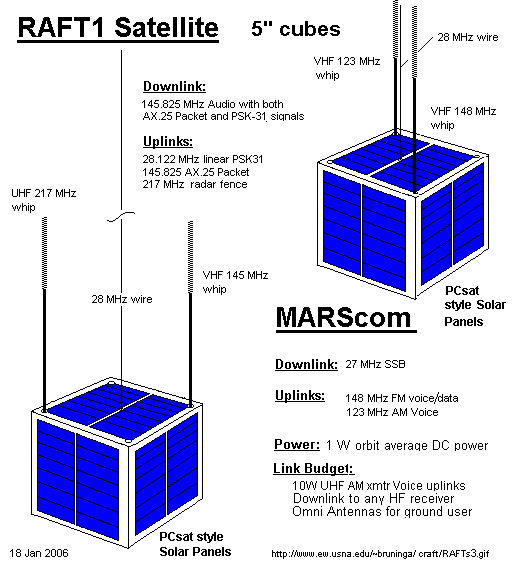
RAFT is a US Naval Academy Aerospace student project currently manifested on Space Shuttle Mission STS-116. It is designed to give students real hands on experience in satellite engineering, design and operations. The USNA RAFT hopes to accomplish the following objectives:


  • The education of Midhsipmen in Aerospace Engineering See their RAFT WEB page.

  • Development of our ability to design/construct CUBESAT/Picosat type spacecraft

  • Provide a 217 MHz transmitter/receiver for Navy Space Surveillance System (NSSS) Radar Fence experiments.

  • Provide TDMA packet, and FDMA Multiuser PSK-31 transponders for experiments in the Amateur Satellite Service.

  • Provide voice/data experiments in support of the Navy/MarineCorp MARS programs and the Naval Academy's boats.

    As usual there is the usual MARS frequency disclaimer on the main webpage stating that the MARS frequencies are sensitive and will not be published. But also as usual digging around the website and its links revealed the following:

    RAFT1 Satellite
    Downlink 145.825 MHz, 2 watts 20 kHz bandwidth FM with both AX.25 packet and PSK-31 signals
    Uplinks
    28.122 MHz linear PSK-31
    216.980 MHz NSSS transponder (Radar fence)

    RAFT1 Satellite Operating Modes:
    Telemetry Mode, Packet Transponder Mode, PSK-31 Transponder Mode, Packet/Voice transponder, and the XP217 radar fence mode.

    MARScom Satellite
    148.975 MHz Uplink
    27.9635 (27.962) MHz SSB downlink
    123.100 MHz SAR AM Monitor

    MARScom Satellite Operating Modes:
    Telemetry Mode, Packet Transponder Mode, Voice Relay Mode, and SAR Monitor Mode.

    What is amazing to me is that the brain thrust in MARS actually thought they could keep the frequencies of an orbiting satellite secret? Even DoD can't pull that one off. Bottom line, I will have more on these two cubesat birds as we approach the STS-116 mission launch.
  • Friday, July 21, 2006

    Cosmos 2422 - A Russian EW Sat Launched Update


    Cosmos 2422 (International Desig 2006-030A/SSC #29260) was launched from the Russian cosmodrome Plesetsk onboard a Molniya-M/2BL rocket at 0420 UTC, 21 Jul 2006. The payload launched by the Molniya-M appears to be a Lavochkin built Oko-class early warning (US-KS) satellite, the 87th satellite in the series, launched into a highly elliptical Molniya orbit. The two satellites currently operational in the early warning HEO constellation are Cosmos 2388 and 2393.

    "The aim of the launch is to reinforce the military network already in space," said Alexei Zolotukhin, a spokesman for the Russian military's space division.

    Reported downlinks for this series of satellites are 2298.0 (channel A) and 2304.0 MHz (channel B), both frequencies courtesy of UHF-satcom.com.

    You can read more information about the Russian early warning satellite network at
    Michael Jasinski, "Russia: Strategic Early Warning, Command and Control, and Missile Defense Overview," Nuclear Threat Initiative website, and at Gunter's Space Page.

    Thursday, July 20, 2006

    What is in the August MT Milcom Column?

    We have some neat stuff for the August MT Milcom column.

    The MT Milcom column was the first to uncover the new 380-400 MHz DoD LMR subband a couple of years ago, even before any of the internet websites carried any info about it. Now in the August issue another MT Milcom first.

    We present the first detailed look at trunk and conventional LMR frequencies in not only the 380-400 MHz band, but new trunk system frequencies in the 138-144 and 148.0-150.8 MHz DoD bands. You will get our exclusive list of the 41.5% of the 800 frequencies in the new DoD subband that we have been identified and their usage.

    We also present a profile of the new West Point VHF trunk system, a Westover ARB P25 frequency update, the story behind the closing of NAS Keflavik, Iceland, and our exclusive list of Seattle and Oakland ARTCC frequencies.

    As I have said before, "miss one issue of MT and you miss a lot." And remember right now you can get special offer on MT Express. Get it delivered via email for only $1.25 per issue. Twelve issues of Monitoring Times Express, the full electronic version of the printed version for #14.95. This offer is available for only a few more days, until the end of the month. See the MT Express offer on this or any of the other MT author blogs.

    Wednesday, July 19, 2006

    DoD FLIP Publications Online

    A couple of people in the last 24 hours have asked me where they can download the electronic versions of the Department of Defense FLIP enroute publications and other aero related products.

    You can download all the FLIP pubs in Adobe pdf format from their internet website at https://www2.nga.mil/products/digitalaero/enroute.cfm.

    But the bad news is after October 1, 2006, these products will no longer be available to the public because the NGA is withdrawing them from the internet. They will only be available to DoD on their secure NIPR network.

    Bottom line: Download them now before they disappear forever. And no, the FAA ATA-100 information base is not as accurate, updated and complete in coverage as the US IFR supplement. There is a lot of information that has changed, especially the ARTCC frequencies. The IFR supplement also suffers from the same problem. Neither publication has been updated to show all the new ARTCC RVSM related frequencies that have been put on the air.

    Tuesday, July 18, 2006

    Middle East Crisis and Italian Navy

    According to international press reports the Italian Navy, based out of Cyprus, is involved in the evacuation of Beirut. European listeners should watch for ship-to-shore activity on the Italian Milsat Sicral UHF transponder (258.150-258.300 MHz). I have also seen some reports of STANAG 4285 activity on the other UHF transponder (252.200-252.350) which is cross strapped to a SHF uplink. This satellite is located in geostationary orbit at 16.3 deg east (no chance from the US east coast). Photo and coverage map courtesy of Alenia.

    Monitoring the Middle East Tinder Box Update


    Photo of an Israeli Air Force F-16 enroute to a mission over Lebanon (Courtesy of Israeli Air Force).

    There has been some milair traffic associated with the Middle East crisis passed on the new RAF TASCOMM net (Info first presented here July 7, 2006). Watch for activity from Cyprus:

    Cyprus
    Voice Call Sign: CYPRUS
    Frequency (USB mode): Channel 1 - 4742 kHz (a) Channel 2 - 9031 kHz Channel 3 - 11247 kHs, Note: (a) H+15 weather broadcasts, when active.

    Keep a real close watch also on the JCS HF-GCS primary 11175 kHz USB as the RAF Cyprus station has used this frequency in the past crisis.

    You can get complete shortwave broadcast schedules and frequencies from the region on Gayle's Blog page (see link on the right). Here is a summary of recently logged frequencies for various Israeli intelligence and military services.

    You will find information on Lebanese amateur radio activity including echolink repeater info on my personal blog at http://monitor-post.blogspot.com/.

    And for those in country (Israel) with an amateur radio license check out the Israel FM Repeater Network website amateur radio repeater information.

    Kol Israel.com
    Live TV and radio feeds, news and sports, newspaper links, plus links to over 150 hot Israeli sites. There are also links to various Arabic news sources in English.


    Israeli Mossad Number Station (Enigma E10)
    An excellent writeup on the Mossad number stations is on Simon Mason's numbers website.
    High Traffic ART EZI FTJ JSR KPA PCD SYN ULX VLB YHF
    Low Traffic CIO MIW
    No Traffic ABC BAY FDU GBZ HNC NDP OEM ROV TMS ZWL

    Transmission times:
    H+15 KPA MIW
    H+45 CIO SYN VLB

    ABC 6428.0
    ART 3415.0 5435.0 6986.0
    BAY 5530.0
    CIO 3557.0 4780.0
    EZI 6840.0 9130.0 11565.0 15980.0 17410.0
    FDU 4418.0 6210.0
    FTJ 2628.0 4461.0 7358.0
    GBZ 5170.0
    HNC 4110.0 6575.0
    JSR 5091.0
    KPA 3230.0 5339.0
    MIW 3270.0 4360.0 5230.0
    NDP 6658.0
    OEM 5339.0 6911.0
    PCD 3150.0 4270.0 6498.0
    ROV 4604.0 6438.0
    SYN 3640.0 4648.0
    TMS 4015.0 5339.0
    ULX 2743.0 4880.0 6270.0 7760.0
    VLB 3360.0 5170.0 5710.0 9165.0
    YHF 2844.0 3840.0 4560.0 5820.0 7918.0 9202.0 10648.0
    ZWL 3940.0

    Military branches: Israel Defense Forces (includes ground, naval, and air components), Pioneer Fighting Youth (Nahal), Frontier Guard, Chen (women)
    Note - historically there have been no separate Israeli military services
    Website: http://www.idf.il/

    4XZ Israeli Defense Forces Haifa(Enigma M22)
    Mode: Morse Code
    2680.0 2800.0 3150.0 3594.0 4159.0 4241.0 4331.0 5159.0 6379.0 8437.0 8594.0 8780.0 10064.0 11096.0 12984.0 kHz

    VFT: 6775.3 7866.3 9253.3 11461.3 13485.3 kHz

    Israeli Air Force
    Voice Tactical Net: 11208 kHz (USB)

    Mode: USB/ALE (MIL-STD-188-141A)
    3823.0 4507.0 4681.0 4823.0 5210.0 5456.0 5478.0 5720.0 5813.0 6224.0 6288.0 6565.0 6720.0 7390.0 7839.0 7848.0 7957.0 8020.0 8040.0 8135.0 8234.0 8365.0 8858.0 9229.0 9232.0 10537.0 17128.0 19602.0 kHz

    Other previously reported frequencies:
    5418.0 6864.0 7630.0 7734.0 7780.0 8100.0 9080.0 9248.0 10614.0 11465.0 11491.0 13442.0 14422.0 14535.0 14913.0 19043.0 19309.0 22769.0 kHz

    ALE Addresses:
    AA1 Ben Gurion (Lod Air Base), 103th Squadron
    AA3 Ben Gurion (Lod Air Base)
    BB1 Palmachim Air Base, 124th Squadron
    BB3 Palmachim Air Base, 161st Squadron
    AAA Tel Aviv AF HQ/NCS
    RAM Ramat David Air Base

    Other stations: 055, AS5, BB2, C53, C56, C65, CCC, DD1, DD2, EEE, MN1, NAK, SSS, TKM, TS2, TSR

    USB/ALE (MIL-STD-188-141A)
    Frequency: 10537.0 kHz
    1DVIAF AF 1st Division
    8DVIAF AF 8th Division

    Israeli Border Patrols
    Frequencies in MHz and narrowband FM mode.
    30.000 30.250 30.300 30.350 30.550 30.600 30.750 30.800 30.900 30.950 31.050 31.200 31.250 31.350 31.450 31.850 31.950 32.000 32.050 32.100 32.200 32.300 32.350 32.400 32.450 32.650 32.800 33.050 33.250 33.300 33.350 33.400 33.500 33.600 33.700 33.950 34.050 34.100 34.200 34.300 34.350 34.400 34.450 34.750 34.900 35.000 35.050 35.250 35.300 35.650 35.700 35.750 35.800 36.100 36.150 36.200 36.250 36.350 36.850 37.000 37.400 37.460 37.500 37.850 38.200 38.450 38.800 39.350 39.400 39.500 39.700 40.000 40.150 40.200 40.300 40.400 40.500 40.550 40.600 40.650 40.700 40.750 40.900 41.150 41.200 41.450 41.500 41.550 41.600 41.650 41.700 41.850 41.900 41.950 42.100 42.150 42.300 42.750 42.800 42.850 42.950 43.100 43.200 43.250 43.450 43.550 43.600 43.800 43.850 44.350 44.550 44.850 45.000 45.850 45.950 46.150 46.500 46.600 46.650 46.700 46.750 46.800 47.100

    More information as it becomes available.

    Monday, July 17, 2006

    US Navy Callign "Catbird"


    A callsign that is commonly heard on US military HF frequencies is "Catbird." You can learn more about this historic callsign and the aircraft that use it on the NAS Sigonella website.

    Thursday, July 13, 2006

    Another MT Author Blogs

    A warm welcome to Hugh Stegman, the author of the Monitoring Times Utility World column to the growing list of MT Column Bloggers. You can visit Hugh's Blog at MT Utility World

    Russian Military Rocket Launch Announced

    The Russian Ministry of Defense is scheduled to launch a missile with a fragment impact area encompassing the following Pacific Ocean latitude/longitude locations: 2210n/17340w 1950n/17220w 1910n/17345w 2140n/17455w 2210n/17340w. The impact area should be avoided for flight operations at all altitudes. Primary launch date: July 12 1400 -1800 UTC. Alternate launch date: July 13 1400-1800 UTC.

    Monday, July 10, 2006

    Wright Patterson AFB Trunk System


    This week we move back east and look at a unique base. In many aspects Wright-Patterson Air Force Base is the largest, most diverse and organizationally complex Air Force base in the U.S. Its mind-boggling array of services include worldwide logistics supporting the entire Air Force, aeronautical research and development, home for more than 70 units, second-largest medical center in the branch, and about 10,000 scientists and engineers.

    Website: http://www.wpafb.af.mil/
    Motorola Type II Trunk System (ID 2b1c)
    For scanner owners use a base frequency of 406.350 MHz, 50-kHz spacing, and an offset of 380.

    System Frequencies:
    406.3500 406.5500 407.1500 407.3500 407.9500 408.7500 408.9500 409.5500 409.7500 409.9500

    Talkgroups:
    16 Patterson Ground
    48 Unknown user/usage
    112 Civil Engineering – Housing
    144 Unknown user/usage
    176 Crash Crews
    208 Hazardous Material?
    272 Fire Ground
    336 Unknown user/usage
    368 Fire – crosspatch to 154.280 MHz
    400 Unknown user/usage
    432 Unknown user/usage
    496 Base Operations
    528 U.S. Air Force Museum
    560 Unknown user/usage
    592 Fire/Medic 1
    624 Unknown user/usage
    656 Fire Ground
    688 Fire Ground
    720 Unknown user/usage
    752 Civil Engineering
    816 Civil Engineering – Grounds
    944 Transportation
    976 Fuel Control
    1008 88 Air Base Wing Flight Line
    1040 Security car to car
    1072 Flight Line
    1136 Flight Line
    1200 Unknown user/usage
    1232 Supply
    1584 Unknown user/usage (heard Charlie 3, Cobra 1 on weekend)
    2352 Medical Net?
    2384 Unknown user/usage
    2480 Bio Net
    2512 Unknown user/usage
    2640 Unknown user/usage
    2704 Unknown user/usage
    3216 445 Airlift Wing Aircraft Maintenance
    3248 Nightwatch Net (E-4B system)
    3280 445 Air Wing Aeromed?
    7568 Unknown user/usage
    8016 Security 1
    8048 Security 2
    8080 Security 3
    9776 Unknown user/usage
    9808 Unknown user/usage
    9840 Unknown user/usage
    9904 Commo
    10000 Unknown user/usage
    10064 Unknown user/usage
    10128 Unknown user/usage
    10224 Civil Engineering
    10320 Unknown user/usage – testing radios
    10352 Unknown User Maintenance
    10640 Civil Engineering
    10672 445 Air Wing
    10736 Unknown user/usage – testing radios
    10800 Civil Engineering
    10928 Civil Engineering
    10960 Fire
    11008 Unknown user/usage
    11024 Security Tactical
    11056 Security Tactical
    11088 Security Tactical
    11216 Transportation
    11248 445 Air Wing
    11280 445 Air Wing Aircraft Maintenance
    11312 Flight Line Operations

    Friday, July 07, 2006

    Shuttle Launch Audio Files Now Available Online

    We have posted our first two audio files on the Milcom webpage. One of these audio files was a pre-launch Milsat SAR net on 261.875 MHz. The other file is actual Shuttle UHF downlink audio and Milsat SAR Support net audio from the July 4, 2006, Discovery launch. I would like to thank Chris C in West Central Georgia for passing these files along and allowing us to post them to our MT Milcom webpage.

    We are working on building an online Milcom audio file library as a free public service for radio hobbyist on the internet. If you have an interesting Milcom audio file you would like to share why not drop me an email at the address in the masthead. I will certainly give it a listen and see if it should be added to this online resource.

    RAF STCICS is no more - Introducing TASCOMM

    Note: TASCOMM frequencies were posted in the previous message of this blog

    On June 12, 2006, Rear Admiral Rees Ward, Chief Executive of the Defence Communication Services Agency (DCSA), opened the hub of a rationalised and enhanced High Frequency (HF) communications service for the UK’s Armed Forces at Forest Moor in North Yorkshire.

    The refurbished Defence High Frequency Communications Service (DHFCS) Network Control Station (NCS) is at the centre of a multi-million pound investment by VT Communications as part of a 15-year PPP (Public Private Partnership) contract valued at £220 million. The DHFCS contract was awarded in 2003 to modernise the HF beyond line of sight communications capability for UK armed forces and other authorised users. The contract has enhanced the quality, availability and reliability of the worldwide network of HF communications assets used by all three UK armed forces, with a programme of improved operational arrangements and new technology introduced by VT. This includes new transmitters, receivers, antennas, and an integrated control system to provide new data services offering Automatic Link Establishment (ALE), Automatic Repeat Request (ARQ) and Automatic Link Management (ALM).

    Admiral Rees Ward commented: “The opening of the Network Control Station marks another major step towards the delivery of the new DHFCS but more importantly demonstrates the strong partnership between the MoD and VT Communications. This successful relationship helps to promote the DCSA's Vision of Industry/MoD partnering to deliver assured, integrated information services to the UK's Armed Forces." VT Communications Managing Director Doug Umbers added: “DHFCS has produced considerable benefits for the users by streamlining and modernising the use of HF communications for ships and aircraft and other users.

    “The programme is a great example of industry and Government working together. Our partnership with the Defence Communications Services Agency (DCSA) and, in particular, the Strategic Terrestrial Radio Systems (STRS) Integrated Project Team has delivered one of the most advanced HF communications systems used by any military in the world.” VT has achieved significant cost savings by utilising modern technology. This has led to the rationalisation of the number of UK sites delivering the service from 14 to six, allowing the return of surplus land. Overseas, four sites provide services to both air and surface platforms. In addition, the global rationalisation programme has led to the release of approximately 200 military personnel to other higher priority duties

    Under DHFCS, Terrestrial Air Sea Communications (TASCOMM) is available for use by RN, RAF and the Army. TASCOMM is a ground-air-ground, ship-shore and ground-to-ground HF radio communications service designed for NATO and National use. Previously known as STCICS, TASCOMM has its control centre at the NCS at Forest Moor with an alternative network control centre (ANCS) located at RAF Kinloss. Both the NCS and ANCS will control, transmit and receive assets around the world to provide an efficient and responsive service to the users.

    Combined with the introduction of new RAF and RN platform HF communications equipment supplied under separate contracts, DHFCS will take full advantage of the modern high-speed waveforms to provide rapid data throughput, eventually including HF email. ALE, ARQ and ALM techniques both simplify and speed up the process of establishing HF communication channels.

    New DoD Flight Information Handbook Released

    A new DoD FLIP Flight Information Handbook was released yesterday (Jul 6) on the NGA public website. This will be the last public edition of this publication. The next edition will be released in Feb 2007 and by that time all the DoD FLIP pubs will be withdrawn from the internet and only available on the DoD NIPR net.

    The big news in this edition of the FIH for radio listeners is the new info on the RAF Flight Watch Support. Here is that information in detail:

    FLIGHT WATCH SUPPORT - The Royal Air Force (RAF) Flight Watch (FW) Centers are:

    The RAF FW mission is to United Kingdom FW station provides United States High frequency (HF) aircraft support to relay command and control messages. Respond to aircraft distress/emergency calls. In addition, assistance with request for or relay of weather information. Reference: Internet http://www.aidu.mod.uk/.

    Phone patches can be provided (where available) to DSN numbers. Aircraft requesting this facility will be required to provide their 10-digit DSN number. NOTE: There is 24 hour manned operations center at DHFCS Forest Moor and DHFCS Kinloss.

    United Kingdom (TASCOMM)
    Voice Call Sign: ARCHITECT
    Frequencies: 4742 5702 9031 11247 13257 18018
    NOTE: Long range HF communications FW for RAF/Naval aircraft from 24 hour manned operations center at DHFCS Forest Moor and DHFCS Kinloss.

    Ascension
    Voice Call Sign: HAVEN
    Frequency: 4742 9031 11247
    NOTE: Flight Watch available for notified flights.

    Cyprus
    Voice Call Sign: CYPRUS
    Frequency: Channel 1 - 4742 (a) Channel 2 - 9031 Channel 3 - 11247
    NOTE: (a) H+15 weather broadcasts, when active.

    Mount Pleasant (MPA)
    Voice Call Sign: VIPER
    Frequency: 4742 (a) 11247 (a)
    NOTE: (a) H+35 weather broadcasts when active.

    1. Flight Watch available for notified flights.
    2. Aircraft not fitted with ALE are to scroll through the frequencies in order to select the best reception. Transmissions are to be made at 15 sec intervals before changing to the next guard frequency.

    Thursday, July 06, 2006

    Hurricane Monitor List Updated

    My N5FPW 2006 Season Hurricane Emergency Monitoring List has been updated. It has links to official publications, including the National Hurricane Operations Plan 2006, and quite a few frequencies for military and government nets. You can see that updated list on my personal blog page the Brasstown Monitoring Post.

    Wednesday, July 05, 2006

    Hot Spot - North Korea


    Kim is at it again. I think he has taken "the rocket's red glare" to new heights with his seven missile launches.

    And contrary to what some have posted in the last 24 hours, you won't directly hear how our US military is responding to these multiple missile launches from North Korea on any DoD HF or military satellite frequencies. But you can listen to English language broadcasts directly from Pyongyang via shortwave radio.

    Ms Gayle, my better half, posted this morning on her blog the latest English language broadcast frequencies from Pyongyang. You can view those freqs on her super spot on the web, the best place for shortwave broadcast info, the MT Shortwave Central Blog. But hey, I am partial and I like to eat.

    But in order for monitors here on the east coast to hear Pyongyang, their signal travels to us via the great circle path over a near polar path. Given the current prop conditions from the N3KL prop monitor on her blog page as I type this (geomagnetic field is at storm levels),we do NOT have good conditions from North Korea right now.

    More as we get it and be sure to stop by the MT-Shortwave Central for the latest SWBC freqs for this event and the Israeli-Palestine situation.

    Milair Nationwide Frequencies Part 5

    Milair Nationwide Frequencies Part 5

    This is part 5 of our exclusive nationwide milair assignment list.

    Previous parts and the dates they appeared on this blog:
    Part 1 Monday May 29, 2006
    Part 2 Tuesday, June 06, 2006
    Part 3 Tuesday, June 13, 2006
    Part 4 Tuesday, June 20, 2006

    255.250 Milsat Fleet Broadcast (25 kHz) UFO November
    255.350 Milsat Fleet Broadcast (25 kHz) Fltsat Alpha/UFO Oscar
    255.400 FAA Flight Service Stations
    255.450 Milsat Fleet Broadcast (25 kHz) Fltsat Bravo/UFO Papa
    255.550 Milsat Fleet Broadcast (25 kHz) Fltsat Charlie/UFO Quebec
    255.600 ATC Tower amd Approach/Departure Control ATC functions
    255.750 Aerial Refueling Operations
    256.375 Newly discovered, previously undocumented Milsat downlink (Note: I first found this frequency 6/22/2006. I have yet to tie this to a particular satellite platform.)
    256.475 Another newly discovered, previously undocumented Milsat downlink (Note: I first found this frequency 6/22/2006. I have yet to tie this to a particular satellite platform.)
    256.600 NORAD Tactical
    256.700 ATC Services
    256.800 ATC Services
    256.850 Milsat Fleet Broadcast (25 kHz) UFO November
    256.875 ATC Services
    256.900 ATC Services (primarily Tower and Approach/Departure Services)
    256.950 Milsat Fleet Broadcast (25 kHz) Fltsat Alpha/UFO Oscar
    257.050 Milsat Fleet Broadcast (25 kHz) Fltsat Bravo/UFO Papa
    257.150 Milsat Fleet Broadcast (25 kHz) Fltsat Charlie/UFO Quebec
    257.200 ATC Services (primarily Tower and Approach/Departure Services)
    257.250 Have Quick
    257.500 AWACS Voice Tel
    257.550 MARISAT Gapfiller 25 kHz narrowband channel
    257.600 ATC Services
    257.625 ATC Services (Local services, i.e. Tower, ATIS, etc.)
    257.650 ATC Services (Local services, i.e. Tower, ATIS, etc.)
    257.675 ATC Services
    257.700 ATC Services
    257.725 ATC Services (Approach/Departure Control Services)
    257.750 ATC Services
    257.775 ATC Services (Clearance Delivery Services)
    257.800 ATC Services (FAA Towers)
    257.875 ATC Services
    257.900 ATC Services (Various services including AR Exit support)
    257.950 ATC Services
    257.975 ATC Services
    258.350 Milsat Fleet Broadcast (25 kHz) UFO November
    258.450 Milsat Fleet Broadcast (25 kHz) Fltsat Alpha/UFO Oscar
    258.550 Milsat Fleet Broadcast (25 kHz) Fltsat Bravo/UFO Papa
    258.575 USAF Special tactical operations training
    258.650 Milsat Fleet Broadcast (25 kHz) Fltsat Charlie/UFO Quebec
    259.000 Search and Rescue (SAR) Operations/Training
    259.100 ATC Services (Approach/Departure Control Services)
    259.300 ATC Services
    259.700 NASA Space Shuttle Orbiter Air-to-Ground

    More to come.

    A Special Offer for MT Blog Readers


    The good folks at Monitoring Times magazine are offering a special, limited time, discounted rate of US$14.95 on a one year MT Express subscription if you mention the BLOG page (Editor’s Page, Fed Files, Milcom, Monitoring Post, or Shortwave) you are viewing right now.

    What is Monitoring Times magazine?
    MT is a full-spectrum monthly magazine for the radio listener, Monitoring Times covers scanning, shortwave, military and federal comms, and other radio topics from below 500 kHz to 900 MHz and above. Presented in an easy-to-understand style by an experienced writing staff, MT helps you get the most out of your time and your equipment with practical listening tips and frequencies.

    What is MT Express?
    MT Express is the same magazine as our printed version but it is presented in Adobe Acrobat portable document file (pdf) format, including full color photography and active links to URLs and email addresses. It is the fastest and easiest way to get the information and frequencies you need on the radio hobby.

    You can see what is in current issue of MT, including sample pages on the MT current issue webpage.

    This special offer is for first-time subscribers and renewals. This offer is available for a limited time only (must be used by the close of business July 31, 2006) and can only be used one time per customer.

    So if you like what we do here on the MT Blog pages and you want even more, then pick up that telephone and call the MT order desk toll free at 1-800-438-8155 (Mon-Fri 9a-5p EDT) and get US$5.00 off the regular price of MT Express.

    And remember you have to mention the BLOG page you are viewing right now in order to get the MT Express Bloggers discount.