Showing posts with label Russia. Show all posts

Tuesday, December 07, 2021

The World of Strange Military Stations - The Russians

Note: This column originally appeared in the January 2021 issue of Spectrum Monitor magazine. Copyright 2021 by the author and Teak Publishing. The full column is available for $3 in pdf format at https://www.thespectrummonitor.com/A one-year sub is only US$24.

Mysteries are always fun. In fact, I am a huge fan of the various Masterpiece Mystery series on Sunday evenings broadcast on our local PBS station. My favorite is Masterpiece’s Endeavor. They even did a show that featured a shortwave radio spy numbers plot in Season 5, Episode 5. You got to love a good mystery. But there are even more mysteries in the world of military communications than even Inspector Endeavor Morse can solve on an episode of Masterpiece’s Endeavor

Probably no other country has as many as Russia. Yes, our old Cold War enemy still has some interesting military stations on the air that qualify as bona fide mysteries. What are they and where are they located? What are they broadcasting? Why are they even on the air?

Maybe we need to call in Endeavor’s partner Inspector Thursday to help us explore some of these Milcom Mysteries. Sorry, I could not resist using the analogy; I like the show.

The Buzzer (Enigma S28)


A Russian military station, nicknamed by radio hobbyists "The Buzzer," is an HF station that broadcasts on a frequency of 4625.0 kHz. First reported in the 1970s, the station transmits using AM with a suppressed lower sideband (USB modulation), but it has also used full double-sideband AM. The signal consists of a short, monotonous buzzer-sounding tone that repeats at a rate of approximately 21 to 30 plus tones per minute, 24 hours per day. 

Sometimes the buzzing sound is interrupted, and a voice message in Russian is broadcast by either a male or female announcer. These messages are usually transmitted live and they do follow a fixed format. Most of the station’s messages are sent weekdays during local daytime (Moscow Time UTC+3).

The traffic sent on this station is simultaneously transmitted in Morse code on multiple other frequencies. Because this station uses old equipment that is prone to failure, channel separation issues have occasionally allowed those Morse code simulcasts to be heard on the voice station.

During these live voice messages, distant conversations and other background noises have frequently been heard behind the buzzer. Some suggest that this means the buzzing tones are not generated internally but are transmitted from a device placed behind a live and constantly open microphone.

Until 2010, the station identified itself as UVB-76, which was a bad mistranscription of the actual call sign UZB76, and it is still often referred to by the media and others by this name. Since then the station operators have used a wide variety of call signs and call words to identify the station.

Speculation over the purpose of this military-controlled station has quite honestly been all over the map. Everything from keeping military communication operators alert to a propagation/channel marker. One theory, described in a BBC article, stated that the tower was connected to the Russian 'Perimeter' missile system. The station was transmitting a “Dead Hand” signal that would trigger a nuclear retaliatory response if the signal is interrupted due to a nuclear attack against Russia. Since the station has been noted off the air at various times in the past, I think we can pretty much put that theory to bed.

There are reports that The Buzzer is controlled by the Russian Sudak communication hub ("Agalatovo"). It is widely believed to have several transmitter sites, which are switched between often. Some of the identified ones include the 69th Communication Hub ("Iskra") and the 60th Communication Hub ("Irtysh"). This station is a Russian military command network that serves the Western Military District. 

The Buzzer is not the only Russian military station mystery. There are two other Russian stations that follow a similar format, nicknamed “The Pip” and “The Squeaky Wheel”. Like the Buzzer, these stations transmit a signature sound that is repeated constantly but is occasionally interrupted to relay coded voice messages.

The Pip (Enigma S30)


Nicknamed “The Pip,” by radio listeners, this Russian military station broadcasts on 5448.0 kHz (day), and 3756.0 kHz (night). It broadcasts continuous short, repeated beeps at a rate of around 50 per minute. Like the Buzzer described above, the beep signal is occasionally interrupted by voice messages in Russian sent by both male and female announcers. The Pip has been active since around 1985 when its distinctive beeping sound was first recorded by listeners. The station's format resembles, in many ways, that of its presumed sister station “The Buzzer.” 

The times at which the station switches from the day to the night frequency or vice versa are changed over the course of the year, presumably to match the changing lengths of day and night. Higher frequencies have better propagation characteristics during the day, while lower frequencies do better in darkness.

The Priyon.org website reports that The Pip usually multicasts traffic, without the channel marker, on either 6913.0, 6922.0, or 7056.0 kHz during daytime with 7126.0 kHz being observed as of December 2019, and on 3371.0 kHz during nighttime. Some of these frequencies also carry exclusive traffic. Transmissions on 6922.0 kHz sometimes leak conversations from within the radio room via an open microphone. Sound familiar?

Like the Buzzer, the purpose of The Pip is not known, although there are many hypotheses. It is often suggested that The Pip is part of a larger radio relay or control system that includes The Buzzer and The Squeaky Wheel stations, which both follow similar formats. 

In fact, activity on The Pip often used to be followed a few minutes later by a voice message on The Squeaky Wheel, suggesting that both were being operated by the same organization and shared the same purpose. On one occasion, The Pip's characteristic beeping sound could be heard in the background while a message was being transmitted on the Squeaky Wheel's frequency, which could indicate that both stations were even operated from within the same building or room. However, these activities have since ceased.

The Pip is transmitting from Rostov-on-Don, Russia. It is also a military command network that serves the Russian Southern Military District. 

Squeaky Wheel (Enigma S32)


The third of our mysterious Russian military stations are known as “The Squeaky Wheel,” another nickname given by the radio hobby community. From around 2000 until 2008 the station's attention tone was a high-pitched two-tone signal that vaguely resembled a squeaky wheel. From 2008 the channel marker changed to two different tones in a short sequence repeated with a short silent gap. This station transmits voice on 3828.0 kHz (nights) with CW on 3895.0 kHz, and 5473.0 kHz (day) voice with CW on 5361.0 kHz.

Since this station appears to be associated with the other two, we may have an indication the true mission of the stations by traffic that has been intercepted from the Squeaky Wheel. There have been several times that voice messages in the format of Russian Military Strategic Flash Messages have been reported by this station. 

The exact transmitter site is unknown but like the “Pip” it is thought to be near Rostov-on-Don, Russia, which would indicate a Southern Military District network station. It has been noted by some regular monitors of this station that the signal strength is not very good in Central Europe and the signal sometimes even disappears for days in the noise.

The Pip/Squeaky Wheel connection

There have been instances of transmission from Squeaky Wheel with clearly audible Pip channel marker in the background having been picked up by the operator's microphone. This implies that the Squeaky Wheel operator is clearly monitoring the Pip. As can be deduced from the complete lack of follow-on message from Pip after a Squeaky Wheel transmission and having never observed Squeaky Wheel channel marker bleeding into Pip transmissions, it seems that Pip does not need to monitor Squeaky Wheel.

Finally, Priyon.org reported that on May 9, 2019, the Squeaky Wheel accidentally began reading a message transmitted from Pip several minutes prior before the operator corrected herself and continued with the appropriate/correct message, definitively proving that Squeaky Wheel indeed copies transmissions from Pip.

Who or what are these stations?

Here is what we believe. Are they Russian? Yes. Are they military? Yes. In fact, based on the Russian military order of battle and who we think is transmitting these broadcasts it looks like we are dealing with some Russian army ground forces HF networks.


Several in our radio hobby believe that the HF radio presence of these Russian Ground Forces consists of many interconnected subnetworks and that the ones I have discussed here are just three of them. 

In these networks, the callsigns are made of either a word and 2 digits (in voice only), or a 4-character combination of letters and sometimes digits. A callsign may refer to either a single unit or a group of units. In some cases, some of the messaging appear to be relaying the same strategic flash messages used by the Russian Supreme High Command (Verkhovnoe glavnokomandovanie--VGK). Yes, the same organization I mentioned last month that sends out strategic submarine flash override messages in VLF and on various other HF radio frequencies.

Priyon,org has a list of Russian ground forces HF networks that you can explore at https://priyom.org/military-stations/russia. These include the following listed below:

Russian Southern Military District: The Pip (5448.0/3756.0 kHz), The Squeaky Wheel 
(5473.0/3828.0 kHz), Vega (5372.0 kHz), Baron-78 (3850.0/4940.0 kHz).

Russian Western Military District: The Buzzer (4625.0 kHz), D marker (5292.0 kHz), T 
marker (4182.0 kHz), The Air Horn (3510.0 kHz), The Goose (4310.0/3243.0 kHz), The 
Alarm (4770.0 kHz), and Katok-65 (4224.0/3218.5 kHz).

Given the proximity of the two areas to eastern Europe, these stations may be part of some early warning nets that are operated by the Russian army ground forces. Their purpose may be to sound the alarm of any potential attack by NATO/U.S. ground forces that threaten Mother Russia (Matushka Rosa). So maybe on the Russian side of the border, if these stations are any indication, Perestroika did not change everything within the Russian military and its posture towards the West.

The Single Letter CW Beacons (Enigma MX)

The Russian Army is not the only player with mystery stations in the HF spectrum. While they do not have cute radio hobbyist nicknames like the army stations do, the Russian Navy has operated a mysterious network of single-letter CW stations since the early 1960s.

My first exposure to these mysterious stations came from a book that was published by Tab in 1981 by the legendry radio monitor and author Harry Helms W5HLH (SK) titled How to tune the secret shortwave spectrum.


In 1978 Harry and several others noted a CW station sending the letter "W" continuously on 3584.0 kHz, in the 80-meter ham band. There was indirect evidence using greyline propagation techniques that this transmitter was in Cuba. He theorized that it may have had something to do with the Russian/Cuban military services. This started a chain of events that elevated the attention of the radio monitoring community to this  “W’ CW station and to other CW beacons in the HF spectrum like it.

In 1982 there were also reports, supposedly based on HF direction finding by the U.S. military, that a station was transmitting the CW letter "K" on 9043.0 kHz it was located near the city of Khabarovsk in the then USSR. This was reported again in 1984 by an anonymous source in the old SPEEDX Reference Guide, and to me by Donald W. Schimmel (SK), a Monitoring Times colleague, in private correspondence. 

Don also indicated that in 1986 the Federal Communications Commission (FCC) released the HF direction finding results for several single letter beacons or what he wanted them called “markers,” and all were DFed to locations in Russia. So in this column to honor Don’s wishes back then, I will call them what he wanted them known as – Single Letter HF Markers or SLHFM. You will probably see others still using the term beacons.

A few years later William (Bill) I Orr W6SAI (SK), in Popular Communications magazine, suggested that the "K" marker was, in fact, located at Petropavlovsk on the Russian Kamchatka Peninsula and the "U" markers were located somewhere along the Barents Sea coast, between Murmansk and Amderma.

Today these Single Letter HF Markers are still active nearly 60 years after their original discovery. My friend and fellow ute monitor Ary Boender, the driving force behind the UDXF/N&O, published definitive locations for most of these stations in 2006.

The single-letter HF markers can be classified into two groups, "cluster markers" and "solitary markers." It should be noted that a "P" marker exists in both groups. 

The Clusters


This group of radio markers with single-letter identifiers (C, D, M, S, P, A, M and K) have been regularly reported centered on 3594.0, 4558.0, 5154.0, 7039.0, 8495.0, 10872.0, 13528.0, 16332.0 and 20048.0 kHz. The term "cluster markers (beacons)" is frequently used for them, as they transmit in parallel on frequencies only 0.1 kHz apart. These beacons transmit only their single-letter identifier in standard Morse code and are located at Russian Naval Bases.

D  RCV Sevastopol, Ukraine  3593.7  4557.7  5153.7  7038.7  8494.7  10871.7  13527.7  
16331.7  20047.7

P  RMP Kaliningrad, Russia  3593.8  4557.8  5153.8  7038.8  8494.8  10871.8  13527.8  16331.8  20047.8

S  RIT Severomorsk, Russia  3593.9  4557.9  5153.9  7038.9  8494.9  10871.9  13527.9  16331.9  20047.9

C  RIW Moscow, Russia 3594.0  4558.0  5154.0  7039.0  8495.0  10872.0  13528.0  16332.0  20048.0

A  Astrakhan, Russia (tentative)  3595.1  4558.1  5154.1  7039.1  8495.1  10872.1  13528.1  16332.1  20048.1

F  RJS Vladivostok, Russia 3595.2  4558.2  5154.2  7039.2  8495.2  10872.2  13528.2  16332.2  20048.2 

K  RCC Petropavlovsk-Kamchatsky, Russia  5154.3  7039.3  8495.3  10872.3  13528.3  16332.3

M  RTS Magadan, Russia  4558.4  5154.4  7039.4  8495.4  10872.4  13528.4  16332.4  20048.4

Monitor reports in the Numbers and Oddities (N&O) bulletin have shown that some cluster markers (especially "F" and "M") have been transmitting on frequencies different from their regular frequencies for short periods.


The Solitaries

The second family of letter markers includes all of those that operate outside the clusters. For this reason, they are often called "solitary markers" or "solitaires". They also transmit their single-letter identifier in standard using Morse code.

A few solitary markers, like "R" on 4325.9 and 5465.9 kHz, operate exactly like the cluster beacons, sending only their single-letter identifier and nothing else.

Most of the solitaries, most notably "P" on various MF and HF frequencies, in addition to their single-letter identifier, send brief messages using high-speed CW or in an FSK digital mode. There is no evidence that the cluster marker "P" and the solitary marker "P" are directly related.

It was reported in Numbers and Oddities, issue 142, that a marker “C” transmitting on 8000 kHz also sent messages using it international call sign RIW, which is allocated to a Russian naval communication station in Khiva, Uzbekistan. 

There are also a few oddities transmitting signals with poor modulation and irregular timing, like the "V" marker listed below. The "P" marker transmissions also carry Russian Navy flash priority Morse code messages with the call signs RPM and RD.

Here is a known list of the solitaries recently reported to the UDXF forum.

R  Izhevsk (Ustinov), Russia  4325.9  5465.9

V  Khiva, Uzbekistan  3658.0  5141.0  5342.0 (irregular)  6430.7 (irregular)  6809.0  7027.5  8103.5  10202.0

P  Kaliningrad, Russia  420.0  583.0 (MW in December 2007)  3167.0  3291.0  3327.0  3699.5  3837.0  4031.0  4043.0  4079.0

C  RIW Khiva, Uzbekistan  8000.0

Who or what are these stations?

According to ENIGMA, these SLHFM stations are used by the Russian navy (especially its submarine branch) to find the most suitable radiofrequency for contact based on current radio propagation conditions.

The purpose of the letter beacons is not yet known with any certainty. Like their Russian Army counterparts, their many theories, but none is based on any documentary evidence. They have been postulated to be radio propagation beacons, channel markers, or beacons used in tracking satellites, or for civil defense purposes. Some stations of this family of stations, in particular the "U" beacon, have been implicated in deliberate jamming.

-30-

Monday, September 26, 2016

The New Cold War Has Begun

The link to the video below is a must watch for Milcom monitors worldwide. This CBS 60 Minutes segement will bring into sharp focus current events that we have been monitoring over the last couple of years including recent USSTRATCOM exercises over the Arctic region by US DoD aircraft assets.
Let's hope cooler heads will prevail especially in and around Estonia and Latvia, an area to watch very closely in the near term IMHO.

The New Cold War http://www.cbsnews.com/videos/the-new-cold-war-2/

Recent Related Stories

Strategic Bomber Force Showcases Allied Interoperability During POLAR ROAR

OFFUTT AIR FORCE BASE, Neb. - Five bombers from all three of the United States' strategic bomber bases completed a mission Monday designed to test the force's long-range, global-strike capability while training and integrating with key allies and partners.

The mission, POLAR ROAR, involved three nonstop, simultaneous flights of three B-52 Stratofortresses and two B-2 Spirits.

One B-52 from the 2nd Bomb Wing flew from Nellis AFB, Nev., to the North and Baltic Seas and through the English Channel, conducting intercept training with Danish F-16s supporting NATO's continuous air policing mission, JAS-39 Gripens from Sweden and other allies and partner nations. The bomber then conducted intercept training with North American Aerospace Defense Command (NORAD)-assigned Royal Canadian Air Force CF-18 fighter aircraft before returning home to Barksdale AFB, La.

Two B-52s from the 5th Bomb Wing, Minot AFB, N.D., flew over the North Pole and mainland Alaska, where they conducted intercept training with NORAD-assigned U.S. F-22s and an inert weapons drop at the Joint Pacific Alaska Range Complex (JPARC).

Simultaneously, two B-2s from the 509th Bomb Wing, Whiteman AFB, Mo., flew over the Pacific Ocean to Alaska's Aleutian Islands, where they practiced intercepts with NORAD-assigned U.S. F-15s and conducted an inert weapons drop at the JPARC.

The POLAR ROAR mission included training in polar navigation and weapons operations, as well as integration with NORAD and NATO allies and partners. It was designed to ensure crews maintain the readiness and proficiency necessary to provide an always-ready global strike capability, It also tested the bomber force's ability to support three synchronized flight paths encompassing more than 55,500 miles.

"POLAR ROAR was specifically designed and closely coordinated with our allies to ensure we are integrating our bomber capabilities with their military assets to the maximum extent, strengthening and improving our ability to work with our allies and partners toward mutual goals," said U.S. Navy Adm. Cecil D. Haney, U.S. Strategic Command commander. "The unique, real-time training with NORAD and NATO allies and partners that was afforded by POLAR ROAR enables us to build enduring relationships necessary to confront the broad range of global challenges."

U.S. Strategic Command routinely conducts strategic bomber operations that provide valuable opportunities for bomber crews to integrate and train with allies and partners and other global combatant commands in a variety of missions.

Most recently, B-52s deployed to RAF Fairford, U.K., in June, to support Exercises BALTOPS and SABER STRIKE.

USSTRATCOM bombers have also conducted intercept training with UK Royal Air Force and Royal Netherlands Air Force aircraft and NORAD-assigned Canadian fighters during POLAR GROWL in April 2015, supported the largest NATO exercise in the last 20 years in TRIDENT JUNCTURE in November 2015, and deployed to Moron Air Base, Spain, for Exercises COLD RESPONSE 16 and SERPENTEX in February through March 2016.

Strategic bombers have also participated alongside NORAD-assigned forces in major training exercises, most recently in October 2015, when B-52s flew to Goose Bay, Canada, during exercise VIGILANT SHIELD.

One of nine DoD unified combatant commands, USSTRATCOM has global strategic missions, assigned through the Unified Command Plan, which include strategic deterrence; space operations; cyberspace operations; joint electronic warfare; global strike; missile defense; intelligence, surveillance and reconnaissance; combating weapons of mass destruction; and analysis and targeting.

Polar Growl strengthens allied interoperability, bomber navigation skills

OFFUTT AIR FORCE BASE, Neb. -- Two pairs of B-52 Stratofortresses completed simultaneous, round-trip sorties from their U.S. bases of Minot Air Force Base, North Dakota, and Barksdale Air Force Base, Louisiana, to the Arctic and North Sea regions, respectively, April 3.

The training mission, coined Polar Growl, allowed the aircrews to hone their navigation skills and enhance their ability to work with allied partners, while demonstrating U.S. Strategic Command capacity.

"These flights, demonstrating the credible and flexible ability of our strategic bomber force in internationally-recognized flight information regions, are the culmination of months of planning and coordination," said Adm. Cecil D. Haney, the STRATCOM commander. "They are one of many ways we demonstrate interoperability, compliance with national and international protocols, and due regard for the safety of all aircraft sharing the air space."

Each of the two legs of Polar Growl provided unique training opportunities, all while testing the bomber force's command and control apparatus' ability to support two synchronized flight paths. The bomber crews flying the North Sea route participated in dissimilar air intercept maneuvers with fighter aircraft flown by the Royal Canadian air force, Royal Air Force and Royal Netherlands air force. In addition to conducting dissimilar air intercept maneuvers with Royal Canadian air force fighters, bomber crews on the Arctic leg of the mission transited around the North Pole, providing the crews invaluable training in polar navigation.

"Today's dynamic global security environment is an interdependent world where international partnerships are foundational," Haney said. "Exercises and operations such as these bomber flights enable and enhance relationships with our allies and partners, and allow others to understand what capabilities U.S. Strategic Command brings to the equation."

The U.S. regularly conducts combined training and theater security cooperation engagements with coalition partners. The combined training provided in Polar Growl follows the participation of B-52s in NATO exercise Noble Justification in October 2014, and the deployment of B-52s and B-2 Spirits to RAF Fairford, United Kingdom, in June 2014.

"The long-range nature of the mission, coupled with the opportunity to interact in real-time with allied aircraft was an invaluable experience that simply can't be replicated out of the cockpit," said Maj. Nathan Barnhart, a 343rd Bomb Squadron instructor radar navigator. "Training like this ensures we are ready to respond to any and all mission directives across the globe."


A B-52H Stratofortress from Barksdale Air Force Base, La., receives fuel from a New Hampshire Air National Guard KC-135R Stratotanker April 2, 2015, near the eastern coast of Canada. The B-52H was returning home after supporting Polar Growl, a U.S. Strategic Command-directed mission to the Arctic and North Sea regions. The mission was to provide a flexible and visible signal that highlights the U.S. ability to deter strategic attacks and respond to any potential future crisis or challenge. (Air National Guard photo/Airman Ashlyn J. Correia)


Thursday, July 28, 2016

U.S. Military Open Skies OC-135B makes emergency landing in Russia

Will Stewart reporting for the Daily Mail.com is reporting that United States Open Skies aircraft has made an emergency landing in eastern Russia.

USAF OC-135 Aircraft (USAF Photo)
The surveillance Boeing OC-135B aircraft was flying a mission over Siberia as allowed under the Treaty on Open Skies when it reported a problem with its landing gear.

The unarmed plane made an emergency landing at Khabarovsk airport, but a military source in Russia has questioned whether the technical glitch was genuine.


Under the treaty, signatories are allowed to overfly the skies of each other gathering information about military forces and activities of concern to them.

The American military aircraft had left after a stopover in Ulan-Ude, in the Republic of Buryatia, and was due to fly north to Yakutsk, capital of Siberia's diamond-rich Sakha Republic.

Instead, after take-off the crew noticed the problem and the Boeing went east and made a landing 1,660 miles away in Khabarovsk.

Read more: http://www.dailymail.co.uk/news/article-3712608/US-spy-plane-makes-emergency-landing-Russia-problem-landing-gear.html#ixzz4FiVFLFXh

Monday, June 27, 2016

Moscow Building Spy Site in Nicaragua

Bill Gertz on the Washington Free Beacon website (http://freebeacon.com/national-security/moscow-building-spy-site-nicaragua/)

The Russian government is building an electronic intelligence-gathering facility in Nicaragua as part of Moscow’s efforts to increase military and intelligence activities in the Western Hemisphere.

The signals intelligence site is part of a recent deal between Moscow and Managua involving the sale of 50 T-72 Russian tanks, said defense officials familiar with reports of the arrangement.

The tank deal and spy base have raised concerns among some officials in the Pentagon and nations in the region about a military buildup under leftist Nicaraguan leader Daniel Ortega.

Disclosure of the Russia-Nicaraguan spy base comes as three U.S. officials were expelled from Nicaragua last week. The three Department of Homeland Security officials were picked up by Nicaraguan authorities, driven to the airport, and sent to the United States without any belongings.
State Department spokesman John Kirby said the expulsion took place June 14 and was “unwarranted and inconsistent with the positive and constructive agenda that we seek with the government of Nicaragua.”

Read the rest of the story at the link above.

Monday, March 07, 2016

Forgotten Station Silently Waiting for Signals

 
Numerous non-functioning antennas are located not so far from Anadyr in the north of Russia. Troposphere communication station "Yukon" and a local civil TV center used to function there too. Due to army reduction and development of satellite means of communication the demand in the costly station finally declined and in 2003 it was closed. The TV center was closed ten years later.
 
The station does not receive any signals today and its rusty discs sadly stare at the sky.
 
Check out how the station, that still has much equipment inside, looks like today.
http://englishrussia.com/2016/02/27/abandoned-station-silently-waiting-for-signals/
 

Monday, February 22, 2016

Russia wants to fly over US with advanced digital camera

AP Story By DEB RIECHMANN

WASHINGTON (AP) — Russia will ask permission on Monday to start flying surveillance planes equipped with high-powered digital cameras amid warnings from U.S. intelligence and military officials that such overflights help Moscow collect intelligence on the United States.
Russia and the United States are signatories to the Open Skies Treaty, which allows unarmed observation flights over the entire territory of all 34 member nations to foster transparency about military activity and help monitor arms control and other agreements. Senior intelligence and military officials, however, worry that Russia is taking advantage of technological advances to violate the spirit of the treaty.

Russia will formally ask the Open Skies Consultative Commission, based in Vienna, to be allowed to fly an aircraft equipped with high-tech sensors over the United States, according to a senior congressional staffer, who spoke on condition of anonymity because the staff member wasn't authorized to discuss the issue publicly.

The request will put the Obama administration in the position of having to decide whether to let Russia use the high-powered equipment on its surveillance planes at a time when Moscow, according to the latest State Department compliance report, is failing to meet all its obligations under the treaty. And it comes at one of the most tension-filled times in U.S.-Russia relations since the end of the Cold War, with the two countries at odds over Russian activity in Ukraine and Syria.

"The treaty has become a critical component of Russia's intelligence collection capability directed at the United States," Adm. Cecil D. Haney, commander of the U.S. Strategic Command, wrote in a letter earlier this year to Rep. Mike Rogers, R-Ala., chairman of a House subcommittee on strategic forces.

"In addition to overflying military installations, Russian Open Skies flights can overfly and collect on Department of Defense and national security or national critical infrastructure," Haney said. "The vulnerability exposed by exploitation of this data and costs of mitigation are increasingly difficult to characterize."

A State Department official said Sunday that treaty nations had not yet received notice of the Russian request, but that certification of the Russian plane with a "digital electro-optical sensor" could not occur until this summer because the treaty requires a 120-day advance notification. The official spoke on condition of anonymity because he wasn't authorized to discuss the issue publicly.

The official also said that the treaty, which was entered into force in 2002, establishes procedures for certifying digital sensors to confirm that they are compliant with treaty requirements. The official said all signatories to the treaty agree that "transition from film cameras to digital sensors is required for the long-term viability of the treaty."
In December, Rose Gottemoeller, undersecretary of state for arms control and international security, sought to temper concerns about Russian overflights, saying that what Moscow gains from the observation flights is "incremental" to what they collect through other means.

"One of the advantages of the Open Skies Treaty is that information — imagery — that is taken is shared openly among all the treaty parties," she said at a joint hearing of the House Foreign Affairs and Armed Services committees in December. "So one of the advantages with the Open Skies Treaty is that we know exactly what the Russians are imaging, because they must share the imagery with us."

Still, military and intelligence officials have expressed serious concern.

"The open skies construct was designed for a different era," Lt. Gen. Vincent Stewart, director of the Defense Intelligence Agency, told lawmakers when asked about the Russian overflights during a congressional hearing. "I'm very concerned about how it's applied today."

Robert Work, deputy secretary of defense, told Congress: "We think that they're going beyond the original intent of the treaty and we continue to look at this very, very closely."

Steve Rademaker, former assistant secretary of state for the bureau of arms control and the bureau of international security and nonproliferation, told Congress at a hearing on security cooperation in Europe in October that Russia complies with the Open Skies Treaty, but has "adopted a number of measures that are inconsistent with the spirt" of the accord.

The treaty, for instance, obligates each member to make all of its territory available for aerial observation, yet Russia has imposed restrictions on surveillance over Moscow and Chechnya and near Abkhazia and South Ossetia, he said. Russian restrictions also make it hard to conduct observation in the Kaliningrad enclave, said Rademaker, who believes Russia is "selectively implementing" the treaty "in a way that suits its interests."

Wednesday, February 10, 2016

Putin Reopening the Lourdes SIGINT station on February 12

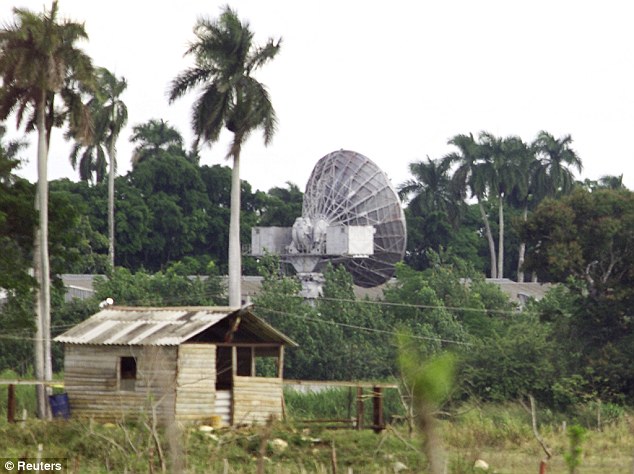
SeaWaves magazine and Russian media reports indicate that Vladimir Putin will be in Havana February 12, 2016, for reopening of the Lourdes SIGINT station.


The Lourdes SIGINT (Signals Intelligence) facility, located near Havana, Cuba, was the largest facility of its kind operated by the Russian Foreign Intelligence Service or SVR, outside of Russia. Located less than 93 miles from Key West, the facility covered 28 square miles. Construction began in July 1962. The station was closed in August 2002. All station facilities were shut down, the buildings were abandoned and later reconstructed to become what is now the University of Information Science.
 
At its peak during the Cold War, the facility was staffed by over 1,500 KGB, GRU, FAPSI, Cuban DGI, and Eastern Bloc technicians, engineers and intelligence operatives. In 2000, it was reported that China signed an agreement with the Cuban government to share use of the facility for its own intelligence agency.
 
In July 2014, reports surfaced that Russia and Cuba agreed to reopen the facility for usage by Russian intelligence. Russia Today later removed their original story and replaced it (using the same url) with one denying there was such an agreement.
 
The complex was capable of monitoring a wide array of commercial and government communications throughout the southeastern United States, and between the United States and Europe. Lourdes intercepts transmissions from microwave towers in the United States, communication satellite downlinks, and a wide range of shortwave and high-frequency radio transmissions. It also served as a mission ground station and analytical facility supporting Russian SIGINT satellites.
 
The facility at Lourdes, together with a sister facility in Russia, allowed the Russians to monitor all US military and civilian geosynchronous communications satellites. It has been alleged that the Lourdes facility monitored all White House communications activities, launch control communications and telemetry from NASA and Air Force facilities at Cape Canaveral, financial and commodity wire services, and military communications links.
 
According to one source, Lourdes had a special collection and analysis facility that is responsible for targeting financial and political information. This activity was manned by specially selected personnel and appeared to be highly successful in providing Russian leaders with political and economic intelligence.
 
From this key facility, first the Soviet Union and later Russia monitored US commercial satellites, and sensitive communications dealing with US military, merchant shipping, and Florida-based NASA space programs. According to a 1993 statement by Cuban Defense Minister Raul Castro, Russia was said to obtain 75 percent of its military strategic information from Lourdes.
 
The Lourdes facility enabled Russia to eavesdrop on US telephone communications. US voice and data telephone transmissions relayed by satellites visible to the facility are vulnerable to Russian intercept. Although sensitive US government communications are encrypted to prevent this intercept, most other unprotected telephone communications in the United States were systematically intercepted.
 
In addition to its military strategic value, after the Cold War Lourdes was increasingly used to support the Russian economy, a high FAPSI priority. In addition to unprotected commercial information, personal information about US citizens in the private and government sectors also could also be snatched from the airwaves and used by Russian intelligence to identity promising espionage recruits in these sectors.


Monday, August 10, 2015

Buzzer is not transmitted from Kerro anymore, new military marker on 4525 USB

The Priyom.org website is reporting that the Russian Buzzer is not transmitted from Kerro anymore, new military marker on 4525 USB.

"The Russian military network The Buzzer on 4625 kHz is not transmitted from the Kerro transmitter site ("Irtysh") anymore. It seems that the Russians are reverting to their old structure, when the frequency 4625 kHz was only used for the Moscow Military District. At present, The Buzzer appears to be broadcast only from the 69th Communication Hub in Naro Fominsk.

"A new military marker, similar to The Buzzer, The Pip, The Squeaky Wheel and S5292, was discovered on the frequency 4525 kHz, starting in August. However, no messages/signals have been caught from that frequency yet."

Friday, July 24, 2015

Moscow Could Be Prepping for Space War With Aggressive New Satellites

There is an interesting update to this article on the Russianspaceweb.com site http://russianspaceweb.com/Cosmos-2504.html

In a Daily Beast article author David Axe writes that Moscow could be prepping for a space war.

On Christmas Day in 2013, a rocket blasted off from the Russian Federal Space Agency’s Plesetsk Cosmodrome. The rocket carried Rodnik communications satellites, according to Russian officials. It’s customary for Rodnik sats to deploy in threes, but in a notification to the United Nations, Moscow listed four spacecraft inside the Rokot.

Rodnik sats, like most orbital spacecraft, don’t have engines and can’t move under their own power. So it came as a shock to some observers on the ground—a group including amateur satellite-spotters with radios and telescopes; radar-equipped civilian researchers; and military officials monitoring banks of high-tech sensors—when the Rokot’s fourth satellite, designated Kosmos-2491, moved, propelling itself into a slightly different orbit.

Whatever Kosmos-2491 was, it wasn’t some innocuous communications satellite. And over the next year and a half, Russia launched two more of the mysterious, maneuvering spacecraft, each time sneaking it into orbit as part of a routine commsat launch.

No one outside the Russian government, and perhaps the Pentagon, knows for sure what Kosmos-2491, -2499, and -2504 are for. But it’s clear enough what the three mystery sats could do, in theory. Zipping across orbital planes hundreds of thousands of feet above Earth, the spacecraft—which are apparently the size of a mini-refrigerator—are able to get really close to other satellites. Close as in a few dozen feet away.

In other words, Kosmos-2491 and its triplets might be space weapons, the likes of which few other nations possess. And if so, they could upset the orbital balance of power, at a time when government agencies, armies, scientists, and everyday people—in the United States, especially—depend on satellites for communications, surveillance, science, and navigation.

Space Sleuths

Kosmos-2499 joined Kosmos-2491 in low orbit on May 23, 2014, piggybacking on another cluster of three commsats. Kosmos-2504 made its debut on March 31 this year—again, boosting into space alongside a trio of communications satellites.
The three mystery sats have stayed busy, firing their tiny engines to climb and dive hundreds of miles at a time, altering their velocity by hundreds of feet per second while playing chase with abandoned rocket stages and other hunks of space junk, apparently practicing for close passes on active satellites.

In the summer of 2014, Russian radio enthusiast Dmitry Pashkov detected signals that he eventually traced back to Kosmos-2499. Fellow radio aficionado Cees Bassa, who is Dutch, picked up similar chirps from the direction of the other mystery sats and connected the dots. “I was one of the first to confirm that the recent Kosmos-2504 satellite was transmitting on the same frequency as Kosmos 2491/2499, confirming the similarity between them,” Bassa said.

Uniting the space sleuths is Anatoly Zak, a Russian-born journalist and self-described “space historian.” Now living in the United States, Zak aggregates observations of Kosmos-2491 and its siblings at his website, Russianspaceweb.com.

Combining all the evidence, Zak concluded that the mystery craft are all similar in size and shape to Russia’s 200-pound Yubileiny experimental satellite—and are most likely weapons. “You can probably equip them with lasers, maybe put some explosives on them,” Zak said of the Kosmos triplets. “If [one] comes very close to some military satellite, it probably can do some harm.”

You can read the entire article on the Daily Beast at http://www.thedailybeast.com/articles/2015/07/23/moscow-could-be-prepping-for-space-war-with-spooky-new-satellites.html


Friday, April 24, 2015

Russia regains control of radio facility in Cuba's Lourdes base

This article originally appeared on the Sputnik News website on July 16. 2014.

Archive. Photo: RIA Novosti
Russia has retrieved the main Soviet radio interception facility – the signals intelligence center in Cuban Lourdes, the Kommersant newspaper wrote on Wednesday. "The decision to return to Cuba can be explained by Russia's long strengthened financial capabilities, as well as cooling of relations with the US," sources in the Russian power structures said.

The base on the territory of the USSR's and Russia's most consistent ally was built in 1962 and since then, has been repeatedly renewed, satisfying the need for interception of information from American communication satellites, ground-based telecommunications cables and wiretapping the NASA's Mission Control Center on Cape Canaveral. This is facilitated by its location in the Western part of the island, only 250 kilometers from Florida's coast.

In 2001, unexpectedly for the Cubans, Russia refused to use the center, which, according to the then Minister of Defense of Cuba Raul Castro, at the moment of the collapse of the USSR provided up to 75 percent of intelligence information.

The center was closed after Vladimir Putin visited it together with Fidel Castro in December, 2000, and while speaking to the staff stated "the importance of the facility for ensuring Russia's security, the need to support its activities and development prospects." But a year later, head of the Russian General Staff Anatoly Kvashnin made a statement that the center in Lourdes was not important, was costly, and its functions could be easily transferred to modern satellites.

Cubans were able to maintain the center, having created a scientific center on its basis. Since 2004, after the deterioration of relations with the US, Russia began to consider the possibility of returning to Cuba. The talks were sharply intensified at the beginning of this year and successfully completed during Putin's visit to Havana.

Saturday, January 03, 2015

Russian Government Presidential Aircraft Fleet


One of the more fascinating things for me as a radio monitor t1o study, research and catalog are other government and military organizations (I really should have been a spook).

The one that fascinates me the most is Russia. Their military, space program, Navy, Air Force, Air Defense Networks, government and all the rest I find fascinating from a monitors point of view. Heck, I even get a big kick working Russian hams and collecting their oblasts and QSL cards.

So when I run across some stuff on their government presidential aircraft fleet I can't pass it up and thought I would post something here in the hope to get some discussion going in various radio circles out there.

According to an article I found at Wikipedia:

"Rossiya Airlines OJSC, operating as Rossiya — Russian Airlines (Rossiya — Rossiyskie avialinii) is a secondary national airline with its head office in Saint Petersburg, Russia, resulting from the 2006 merger of the Moscow-based company of the same name and Saint Petersburg-based Pulkovo Aviation Enterprise. The airline operates scheduled and charter passenger flights from Saint Petersburg and Moscow, and VIP flights on behalf of the Russian government, including the operation of the Russian presidential aircraft fleet for the President of Russia. Rossiya maintains an operational base at Pulkovo Airport in Saint Petersburg."

Rossiya Government Aircraft Fleet

According to the Wikipedia article mentioned above, the Rossiya government fleet consists of the following aircraft (August 2014) (my number varies slightly for the TU-214s and TU-204-300s):

Aircraft Type: In Fleet-Orders-Stored
Airbus ACJ319: 2-0-0
Ilyushin Il-62M: 1-0-0
Ilyushin Il-96-300: 8-0-0
Tupolev Tu-154: 1-0-0
Tupolev Tu-204-300: 2-0-0
Tupolev Tu-214: 10-2-0
Total: 24-2-0

Below is my latest list with a few Mode-S codes that I could find. I hope to add to this list in the future and if you have anything you would like to share, please contact me at the email address in the masthead. My numbers are a bit off from those listed above but as with any secretive style of government I have come to expect that. Here is the best info I have to date. I haven't been able to find anything on the Airbus aircraft. * May not part a current member of the fleet

RA-64057 Tupolev TU-204-300 14FA39
RA-64058 Tupelov TU-204-300 14FA3A*
RA-64059 Tupolev TU-204-300
RA-64515 Airborne Relay Aircraft Tupolev TU-214SR
RA-64516 Airborne Relay Aircraft Tupolev TU-214SR
RA-64517 Command Post Tupolev TU-214PU
RA-64520 Command Post Tupolev TU-214PU
RA-64522 Command Post Tupolev TU-214SUS 14FC0A
RA-64523 Command Post Tupolev TU-214SUS
RA-64524 Command Post Tupolev TU-214SUS
RA-64525 Command Post Tupolev TU-214PU
RA-64526 Airborne Relay Aircraft Tupolev TU-214SR
RA-64527 Airborne Relay Aircraft Tupolev TU-214SR* May still be on order
RA-64528 Airborne Relay Aircraft Tupolev TU-214SR* May still be on order
RA-86570 Airborne command customized for emergency response agency EMERCOM  Il-62M 
RA-85655 Tupelov TU-154M Possible Open Skies aircraft?*
RA-96012 Russian equivalent of AF1 Ilyushin Il-96-300PU
RA-96016 Russian equivalent of AF1 Ilyushin Il-96-300PU 157710
RA-96017 Russian equivalent of AF1 Ilyushin Il-96-300PU 157711*
RA-96018 Russian equivalent of AF1 Ilyushin Il-96-300PU 157712
RA-96019 Russian equivalent of AF1 Ilyushin Il-96-300PU 157713
RA-96020 Russian equivalent of AF1 Ilyushin Il-96-300PU 157714
RA-96021 Russian equivalent of AF1 Ilyushin Il-96-300PU 157715

And then there is this from the Russian Take-Off website: http://en.take-off.ru/news/102-feb2011/640-newaircraftforpresidentialairdetachment-21-2011

"On 27 October 2011, the airfield of the Kazan Aviation Production Association named after S.P. Gorbunov (KAPO) witnessed the maiden flight of the new Tupolev Tu-204SUS special-purpose aircraft (RA-64522) built on order by the Russian Presidential Property Management Department. The aircraft was piloted by a crew led by KAPO test-pilot Alexey Ryabov. The aircraft carrying a “special communications centre” (SUS in Russian), is the fifth airliner out of the six special Tu-214 derivatives ordered by the Presidential Property Management

"The first two aircraft the department ordered from the Kazan-based aircraft manufacturer – Tu-214SR relay aircraft (RA-64515 and RA-64516) – were built in 2008 and handed over to the Rossiya special air detachment in a ceremony on 1 June 2009.

"Last year, KAPO assembled two more aircraft under the Presidential Property Management Department order. They were Tu-214PU VIP airborne command posts. The former of the two (RA-64517) was received by Rossiya in October 2010 and the latter (RA-64520) in January this year.

"The government-awarded order for two Tu-214SUS aircraft is to be fulfilled before year-end. The second aircraft of the type (RA-64524) was rolled out right on the heels of the first Tu-214SUS.

"Once it is delivered, the Kazan-based aircraft maker will have fulfilled the order from the Presidential Property Management Department for six special aircraft derived from the Tu-214.

"The aircraft fleet of the presidential air detachment is to be beefed up with other new domestically-built types as well. In October, the Aviastar-SP close corporation in Ulyanovsk rolled out two Tupolev Tu-204-300A airliners (RA-64057 and RA-64059) at once. RA-64057 first flew on 29 October, controlled by a crew led by Tupolev JSC test-pilot Victor Minashkin. According to Tupolev, the Tu-204-300As slated for the presidential air detachment are equipped with “a VIP cabin that has been soundproofed effectively, furnished with up-to-date telephone communications systems and provided with Internet access."

TU-214 Aircraft

For me the most interesting of all the aircraft studied so far are the Tupolev TU-214 variants. They look like the airborne strategic command post structure of the Russian Government. It would be interesting to catch some HF activity from these birds.

Tu-214 is a variation of Tu-204 first flown on 21 March 1996. It is technically a Tu-204-200, one of the differences being that it is built by a different factory. Planes designated Tu-204 are produced in Ulyanovsk by Aviastar-SP; Tu-214 in Kazan by the Kazan Aircraft Production Association (KAPO). Both factories are independent from the Tupolev design bureau and have some control over the design of the variant they produce.

The Tu-214 is essentially a higher gross weight variant of the Tu-204, being fitted with extra fuel tanks and structural adjustments to deal with the heavier gross weight. For this reason, the Russian government prefers to use it as the platform upon which all further modifications for the 'Special Mission' variants will be based. Some of the special mission variants are disclosed to be capable of a non-stop 10,000 kilometre flight range.

Tu-214ON - Observation version of Tu-204-200 equipped for Treaty on Open Skies missions. Two ordered by Russian Ministry of Defence, with a delivery planned for 2012 and 2013.
Tu-214PU - Airborne command post version. Two operated for Russian Ministry of Defence.
Tu-214SR - Communications relay version. Two operated by GTK Rossiya for Russian government, with three more planned.
Tu-214SUS - Communications relay version for Russian Ministry of Defence. Two on order and they were suppose to be delivered planned by end of 2012.
Tu-214R - Special-mission versions of the Tu-214 commercial transport aircraft, developed under the codename ‘Project 141', to replace the ELINT plattform Il-20 Coot. The aircraft are configured to carry the MRC-411 multi-intelligence payload, to include electronic intelligence (ELINT) sensors, side-looking Synthetic Aperture Radar (SAR) and other Signals Intelligence (SIGINT) and Communications Intelligence (COMINT). In addition, the aircraft will carry multi-spectral electro-optical systems. The aircraft has conducted test flights over the Sea of Japan but the program was experiencing problems as of January 2013 according to Jane's Defense Weekly 16 January 2013. The Tu-214R made it public debut in August 2013 at Moscow Air Show MAKS and is the proposed platform for conducting surveillance of the United States of America in accordance with the open skies treaty to monitor compliance with the relevant treaties.

Tu-214R inflight from Borisoglebskoye airfield (2014) Rimma Sadykova - http://russianplanes.net/id143163

Got anything you want to share, you can do so anonymously or whatever via the email address in the masthead.

Thursday, January 01, 2015

Can You Solve the Mystery of the Russian UVB-76?

Happy New Year to all my readers, and friends. Let's start the New Year out right with an HF radio mystery.


Can you solve the mystery of UVB-76??? Check it our at http://qrznow.com/can-solve-mystery-uvb-76-4-625-khz/

From the Wikipedia article on The Buzzer:

"UVB-76, also known as The Buzzer, is the nickname given by radio listeners to a shortwave radio station that broadcasts on the frequency 4625 kHz. It broadcasts a short, monotonous About this sound buzz tone, repeating at a rate of approximately 25 tones per minute, for 24 hours per day. On very rare occasions, the buzzer signal is interrupted and a voice transmission in Russian takes place. The first reports were made of a station on this frequency in 1982. Its origins have been traced to Russia, and although several theories with varying degrees of plausibility exist, its actual purpose has never been officially confirmed and remains a source of speculation.

"The station is commonly referred to as the Buzzer among English-speaking radio listeners, while Russian listeners refer to it as жужжалка (žužžalka) – "the buzzer". Its official name is not known, although some of the voice transmissions have revealed names which may be call signs or another form of identification. Up until September 2010, the station identified itself as UVB-76 (Cyrillic: УВБ-76), and it is still often referred to by that name. In September 2010, the station moved to another location, and it has used the identification MDZhB (Cyrillic: МДЖБ, phonetic spelling "Mikhail Dmitri Zhenya Boris") from then onwards. It has been suggested that the correct identification until September 2010 was actually UZB-76 (Cyrillic: УЗБ-76), and that the Cyrillic letter Ze (З) had been misheard as the letter Ve (В). However, it is still referred to as "UVB-76" by most people. Although the station, by and large, has used these two codes at the beginning of most voice transmissions, a few voice messages have used other identification codes. This makes it uncertain whether the names are actually the call sign of the station, or some other identifying code.

"The station transmits using AM with a suppressed lower sideband (R3E), but it has also used full double-sideband AM (A3E). The signal consists of a buzzing sound that lasts 1.2 seconds, pausing for 1–1.3 seconds, and repeating 21–34 times per minute. Until November 2010, the buzz tones lasted approximately 0.8 seconds each. One minute before the hour, the repeating tone was previously replaced by a continuous, uninterrupted alternating tone, which continued for one minute until the short repeating buzz resumed, although this no longer occurs since June 2010.

"The Buzzer has apparently been broadcasting since at least 1982 as a repeating two-second pip, changing to a buzzer in early 1990. It briefly changed to a higher tone of longer duration (approximately 20 tones per minute) on January 16, 2003, but it has since reverted to the previous tone pattern."

See additional Wikipedia material at http://en.wikipedia.org/wiki/UVB-76.

There is a great Daily Mail article featuring an interview with UDXF luminary Ary Boender by clicking here.

Saturday, December 06, 2014

Possible Land-Attack Cruise Missile Launch Scheduled for Next Week

The 7 Feet Beneath the Keel Blog is reporting that the Russians may be conducting a cruise missile launch over the Barents Sea Dec 8-10.


The blog reports while the launch platform is not yet known, there are at least two candidates, both of which are armed with the SS-N-30 land-attack cruise missile (range: 800nm-1,400nm, depending on the warhead payload):
Severodvinsk-class nuclear-powered cruise missile submarine "Severodvinsk"
Kilo-class diesel submarine "Novorossiysk", which arrived in Polyarnyy last month

For my Russian UDXF monitor friends it will be interesting to see if any VLF/MF/HF traffic is associated with this launch.

Tuesday, April 15, 2014

A Secret Fight over Russia in the Obama Administration

A Russian Air Force Tupolev Tu-214ON at Ramenskoye Airport (UUBW)
Courtesy of Alan Henney and the Weekly Standard

The Obama administration has scheduled a deputies committee meeting this week tentatively set for Tuesday to resolve a bitter inter-agency dispute over a request from Russia with respect to the Open Skies program. Informed sources believe the White House is likely to side with the State Department, which wants to accommodate Russia, over the objections of the Obama administration's Defense Department and intelligence agencies.

The Open Skies treaty allows the United States and Russia to fly over each other's territory with planes loaded with certain agreed-upon sensor packages, in order to ensure compliance with arms control agreements and to provide assurance against preparations for various military surprises.

Russia has asked the U.S. to agree to an upgrade in the sensor package their planes can carry. The request would apparently result in a significant increase in Russian spying capabilities. The first response from Pentagon was, according to one government official close to the situation. You've got to be kidding.

But the State Department has been making the case for acceding to the Russians' demands, and the White House seems to be on State's side. The White House has also stonewalled requests for information from the congressional intelligence committees.

Thursday, February 27, 2014

Russia has put combat jets on alert

According to press reports Russia has put combat jets on alert over the rising tension in the Crimea/Ukraine. More to follow . . .

Tuesday, June 14, 2011

Russia Objects to US Warship in Black Sea


Accoding to an AP story, Russia voiced concern Sunday about a U.S. warship now just off its shores in the Black Sea, saying the unexpected visit raised further questions about U.S. plans to create a missile shield in Europe.

The USS Monterey, which is capable of detecting and shooting down ballistic missiles, is taking part in annual joint military exercises conducted by NATO and Ukraine.

You can read the full story at Military.com.

Wednesday, December 22, 2010

278 MHz Mystery Milsat Possibly Russian

Our good friend Paul Marsh (Twitter address: UHF_satcom) has a working theory that the 278 MHz satellite downlinks we are hearing may be from a new Russian military satellite program - the Meridian milsats. The first two launches were apparent failures per http://www.russianspaceweb.com/meridian.html.

Signals for our mystery 278 MHz milsat have been heard on: 277.6000 277.8000 277.9500 278.0000 278.0500 278.1000 278.2000 278.2250 278.2500 278.4000 278.4250 278.4500 278.4750 278.5000 MHz

Orbital Information

First valid epoch is 5. Nov 2010
Selected (next earlier) epoch is 7. Dec 2010 Selected (next earlier) epoch is 7. Dec 2010

Brightness: 4.9 mag (at 1000 km and 50% illuminated) 3.7 mag (at perigee and full illumination) Brightness: 4.9 mag (at 1000 km and 50% illuminated) 3.7 mag (at perigee and full illumination)
RCS: 6.8m2 (Radar cross section) RCS: 6.8m2 (Radar cross section)
NORAD Catalog Nr: 37213 NORAD Catalog Nr: 37213
International Designator: 2010-058B International Designator: 2010-058B

Perigee Height: 798.3 km Perigee Height: 798.3 km
Apogee Height: 39616.6 km Apogee Height: 39616.6 km
Orbit Period: 11.98h Orbit Period: 11.98h

Kepler Elements Kepler Elements
Semi-major Axis: 26585.584 km Semi-major Axis: 26585.584 km
Eccentricity: 0.7300645 Eccentricity: 0.7300645
Inclination: 62.829° Inclination: 62.829 °
Argument of Perigee: 269.9111° Argument of Perigee: 269.9111 °
Right Ascension of Ascending Node: 0.6281° Right Ascension of Ascending Node: 0.6281 °
Mean Anomaly at Epoch: 14.4662° Mean Anomaly at Epoch: 14.4662 °
Susceptibility to Drag B*: 1/earth radii Susceptibility to Drag B *: 1/earth radii
Revolutions per Day: 2.00278283 Revolutions per Day: 2.00278283
Number of Orbits since Launch: 67 Number of Orbits since Launch: 67

Epoch (UTC): 7. Dec 2010 0:53:58 (JD=2455537.53747804) Epoch (UTC): 7. Dec 2010 0:53:58 (JD = 2455537.53747804)

State Vector State Vector
Position Vector: x = 21430.31 km Position Vector: x = 21430.31 km
y = 189.415 km y = 189.415 km
z = -88.681 km z = -88.681 km
Velocity Vector: vx = 3.1433 km/s Velocity Vector: vx = 3.1433 km / s
vy = 1.9995 km/s vy = 1.9995 km / s
vz = 3.828 km/s vz = 3.828 km / s

Two-Line Elements Two-Line Elements

Meridian 3 r 4.9 6.8 Meridian 3 r 4.9 6.8 1 37213U 10058B 10341.03747804 -.00001272 00000-0 00000+0 0 164 1 37213U 10058B 10341.03747804 -. 00001272 00000-0 00000 +0 0 164 2 37213 062.8290 000.6281 7300645 269.9111 014.4662 02.00278283 674 237 213 062.8290 000.6281 269.9111 014.4662 02.00278283 674 7300645

From the Russian Strategic nuclear forces blog
http://russianforces.org/blog/2010/11/space_forces_launch_new_meridi.shtml

Space Forces launched new Meridian communication satellite

On November 2, 2010 the Space Forces carried out a successful launch of a Soyuz-2.1a launcher with a Fregat post-boost stage. The rocket was launched at 03:58:39 MSK (00:58:39 UTC) from the launch pad No. 3 of the launch complex No. 43 of the Plesetsk space launch site. According to a Space Forces representative, the spacecraft - a communication satellite of the Meridian type -successfully reached its orbit at 06:13 MSK.

The satellite was identified by the Space Forces by its generic name, Meridian. Its international designation is 2010-058A, NORAD number 37212. According to the satellite manufacturer, the Reshetnev Design Bureau, the satellite successfully reached its operational orbit. Parameters of the orbit: inclination 62.8 degrees, perigee 966 km, apogee about 39800 km, orbital period about 726 minutes.

This is the third Meridian launch. The fist one took place in December 2006, the second - in May 2009.

This launch completed flight tests of the Soyuz-2.1a rocket.

Other links:

http://www.russianspaceweb.com/meridian.html

http://en.wikipedia.org/wiki/Meridian_2

http://en.wikipedia.org/wiki/Soyuz-2_

http://www.satelliteonthenet.co.uk/index.php/launch-schedule

http://www.n2yo.com/?s=35008

http://www.n2yo.com/?s=29668

http://www.calsky.com/cs.cgi/Satellites/1?&satid=2009-029

http://www.calsky.com/cs.cgi/Satellites/1?&satid=2006-061

http://forum.nasaspaceflight.com/index.php?topic=1133.1275

http://forum.nasaspaceflight.com/index.php?topic=14658.15

http://russianforces.org/blog/2006/12/launch_of_meridian_communicati.shtml

http://orbiter-forum.com/showthread.php?t=8350

http://www.skyrocket.de/space/doc_sdat/meridian.htm

Sunday, August 08, 2010

Russian Military Comm Center Destroyed by Fire

Trond J on the UDXF reported the following:

"The Russian Radio Center northwest of the town of Lukhovitsy is believed to have been destroyed on the 29th of July by the forest and bush fires in the Kolomna district of Moscow. The radio center military unit в/ч 73802,г.Луховицы-3 1 УС ГШ ВС РФ (Luhovitsy-3 1 CSS General Staff of Russia), was in use for HF broadcasts to strategic nuclear forces."

Thanks for sharing with thenrest of us Trond.

Monday, November 23, 2009

Russians Launch New Military Elint Into Orbit

I have now confirmed through two independent sources and orbital analysis that this was a Lotus-S elint satellite launch. One source comes from the well respected Russian Strategic nuclear forces blog: http://russianforces.org/blog/2009/11/cosmos-2455_-_a_new_generation.shtml

Russia launched a military spy satellite into space Friday on a Soyuz-U rocket from the country's Plesetsk Cosmodrome (launch complex 16, launch pad no. 2). The secret payload lifted off at 1044 GMT (5:44 a.m. EST). The three-stage Soyuz-U rocket delivered the Kosmos 2455 spacecraft (2009-063A) into an elliptical orbit 905 x 199 km, inclination 67.17°. Catalog numbers associated with the launch are 36095 and 36096.

There are several post on various newsgroups indicating this is an elint satellite. The particulars on this satellite follow.


Payload: Lotos-S Electronic Reconnaissance satellite (Cosmos 2455)
Spacecraft: Lotos-S ("Lotos" means Lotus), possible production item's code 14F145.

Manufacturer: Samara Space Centre; ELINT Payload Manufacturer: PLC Arsenal Machine Building Plant, St. Petersburg

Lotos-S satellites are one component of the the next generation ELINT satellite system Liana. Liana replaces both the Tselina-2 with Lotos-S satellites and the naval US-PM with Pion-NKS spacecrafts. It's built upon Yantar remote sensing satellites' bus. The coming launch is going to be first in the service career of this model.

From the Russian Strategic Nuclea Forces:

"This is the first launch of a satellite of the Lotos-S type. It has been reported that these satellites, with their not yet flown counterparts known as Pion, will work as part of the Liana electronic reconnaissance system. This system is being designed to replace the Tselina electronic intelligence and US-PU/Legenda naval reconnaissance systems. Cosmos-2421, which operated from June 2006 to February 2008, apparently was the last US-PU satellite. The launch of Cosmos-2428 in June 2007 was reported to be the last launch of a Tselina-2 satellite. (At the same time, according to the Kommersant report quoted above, Ukraine will deliver to Russia four 11F644 Tselina spacecraft by January 2012, indicating that launches might continue.)

"The launch was initially planned for July 28, 2009, but was cancelled because of problems with one of the satellite components. The spacecraft was returned to the manufacturer, Arsenal Machine Building Plant in St-Petersburg, which worked on the spacecraft together with the TsSKB-Progress Design Bureau in Samara."

Early initial reports from RIA Novosti that this was another Oko EW mission were not correct.

The Cosmos 2441 (launched on July 26, 2008) is believed to be the first in a new series of spy satellites (Persona), featuring updated imaging technology and an extended lifetime of up to seven years.

The Soyuz-U rocket is designed to orbit Soyuz and Progress manned and cargo spacecraft, as well as special-purpose satellites such as Cosmos, Resurs-F, Foton and Bion.

The rocket has payload of up to 6,950 kilograms. A Soyuz-U was last launched from Plesetsk on April 29, 2009.

Russia reportedly operates a network of 60-70 reconnaissance satellites and has carried out 16 space launches since the beginning of 2009.

Based on the information in my satellite database, I do not believe the later mission tieup since that Oko EW constellation operates around a 65° inclination in a much high Molniya style orbit. For now I will carry this satellite as a Lotus-S elint bird.

Friday, October 02, 2009

New post-Soviet force begins military exercises

By PETER LEONARD, Associated Press Writer

Associated Press article vai BreitBart

ALMATY, Kazakhstan (AP) - Thousands of troops from Russia and four other ex-Soviet nations began military exercises in southern Kazakhstan on Friday, the first of its kind for the newly formed NATO-style rapid-reaction force.

More than 7,000 troops gathered at the Matybulak training grounds for the maneuvers, which are expected to last two weeks, the Kazakh Defense Ministry said in a statement on its Web site.
You can read the full story at
http://www.breitbart.com/article.php?id=D9B2UBOG0&show_article=1