Showing posts with label Solar Storms. Show all posts

Thursday, July 12, 2012

X-Flare - Earth Facing

UPDATE, 3:30 p.m.: NOAA’s Space Weather Prediction Center (SWPC) just posted the following:

The R3 (Strong) Radio Blackout today at 12:49 EDT (1649 UTC) was accompanied by an earth-directed CME. Hampered by limited observations of the event, SWPC forecasters are now anticipating the passage of the [coronal mass ejection] around 1:00 a.m. EDT, Saturday, July 14. G1 (minor) Geomagnetic Storm activity is expected to then ensue through the rest of the day.

In short, NOAA is predicting minor effects from this space weather event - no major impacts on the power grid or satellites anticipated - although we remind you forecasting space weather is difficult and surprises are possible. Sky watchers in northern U.S. (and high latitudes) may have an opportunity to see aurora late Friday night into early Saturday morning.

Original story below . . .

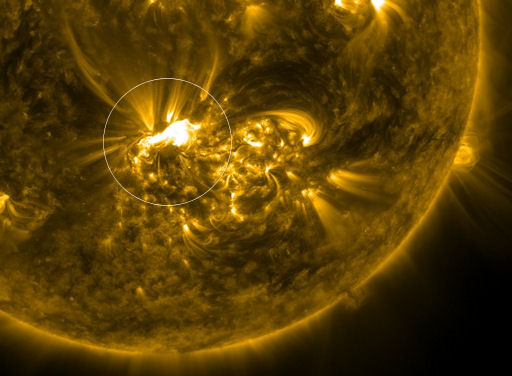
X-FLARE! Big sunspot AR1520 unleashed an X1.4-class solar flare on July 12th at 1653 UT. Because the sunspot was directly facing Earth at the time of the blast, this is a geoeffective event. Stay tuned for updates about possible CMEs and radio blackouts.
NASA's Solar Dynamics Observatory recorded a flash of extreme ultraviolet radiation from the blast site.


The UV and X-ray pulse from the flare will have partially ionized Earth's upper atmosphere on the dayside of our planet, disturbing the normal propagation of radio signals. Watch the Realtime Space Weather Gallery for possible reports of sudden ionospheric disturbances and other effects.

Tuesday, August 03, 2010

Solar Tsunami to Strike Earth

NASA's Solar Dynamics Observatory snapped this X-ray photo of the Sun early in the morning of Sunday, August 1st. The dark arc near the top right edge of the image is a filament of plasma blasting off the surface -- part of the coronal mass ejection. The bright region is an unassociated solar flare. NASA

From FoxNews:

Earth is bracing for a cosmic tsunami Tuesday night as tons of plasma from a massive solar flare head directly toward the planet.

The Sun's surface erupted early Sunday morning, shooting a wall of ionized atoms directly at Earth, scientists say. It is expected to create a geomagnetic storm and a spectacular light show -- and it could pose a threat to satellites in orbit, as well.

"This eruption is directed right at us and is expected to get here early in the day on Aug. 4," said Leon Golub of the Harvard-Smithsonian Center for Astrophysics. "It's the first major Earth-directed eruption in quite some time."

The solar eruption, called a coronal mass ejection, was spotted by NASA's Solar Dynamics Observatory, which captures high-definition views of the sun at a variety of wavelengths. SDO was launched in February and peers deep into the layers of the sun, investigating the mysteries of its inner workings.

"We got a beautiful view of this eruption," Golub said. "And there might be more beautiful views to come if it triggers aurorae."

Views of aurorae are usually associated with Canada and Alaska, but even skywatchers in the northern U.S. mainland are being told they can look toward the north Tuesday and Wednesday evenings for rippling "curtains" of green and red light.

When a coronal mass ejection reaches Earth, solar particles stream down our planet's magnetic field lines toward the poles. In the process, the particles collide with atoms of nitrogen and oxygen in the Earth's atmosphere, which then glow, creating an effect similar to miniature neon signs.

The interaction of the solar particles with our planet's magnetic field has the potential to create geomagnetic storms, or disturbances, in Earth's magnetosphere. And while aurorae are normally visible only at high latitudes, they can light up the sky even at lower latitudes during a geomagnetic storm.

Fortunately for Earth-bound observers, the atmosphere filters out nearly all of the radiation from the solar blast. The flare shouldn't pose a health hazard, Golub told FoxNews.com.

"It's because of our atmosphere," he explained, "which absorbs the radiation, as well as the magnetic field of the Earth, which deflects any magnetic particles produced."

The radiation "almost never" makes it to ground, he noted, though pilots and passengers in airplanes may experience increased radiation levels akin to getting an X-ray.

The solar particles also could affect satellites, though scientists think that possibility is remote. Orbital Sciences Corp. believe a similar blast may have knocked its Galaxy 15 satellite permanently out of action this year.

This type of solar event has both government officials and satellite manufacturers worrying.

NASA scientists warned recently that high-energy electric pulses from the sun could cripple our electrical grid for years, causing billions in damages. In fact, the House is so concerned that the Energy and Commerce committee voted unanimously to approve a bill allocating $100 million to protect the energy grid from this rare but potentially devastating occurrence.

The sun's activity usually ebbs and flows on a fairly predictable cycle. Typically, a cycle lasts about 11 years, taking roughly 5.5 years to move from a solar minimum, a period of time when there are few sunspots, to peak at the solar maximum, during which sunspot activity is amplified.

The last solar maximum occurred in 2001. The latest minimum was particularly weak and long- lasting.

The most recent solar eruption is one of the first signs that the sun is waking up -- and heading toward another maximum.

Space.com contributed to this report.

Propagation Alert: Will it hit Earth?


On August 1, 2010, the Solar Dynamics Observatory (SDO) observed a beautiful prominence eruption that may hit Earth and cause a geomagnetic storm. As the solar cycle progresses and the Sun becomes more active there will be many more opportunities to observe the causes of space weather. Want to see what happens? Follow the event at spaceweather.com.

And from the Spaceweather website:

On August 1st, the entire Earth-facing side of the sun erupted in a tumult of activity. There was a C3-class solar flare, a solar tsunami, multiple filaments of magnetism lifting off the stellar surface, large-scale shaking of the solar corona, radio bursts, a coronal mass ejection and more.

High-latitude sky watchers should be alert for auroras tonight. One and possibly two coronal mass ejections (CMEs) are heading toward Earth, propelled by the solar eruptions of August 1st (see below). NOAA forecasters estimate a 10% chance of major geomagnetic storms and a 45% chance of at least some geomagnetic activity when the clouds arrive on August 3rd and 4th.

And finally this report from our good friend Tomas Hood

At approximately 0855 UTC on August 1, 2010, a C3.2 magnitude soft X-ray flare erupted from NOAA Active Sunspot Region 11092 (1092).

At nearly the same time, a massive filament eruption occurred. Prior to the filament's eruption, NASA's Solar Dynamics Observatory (SDO) Atmospheric Imaging Assembly (AIA) instruments revealed an enormous plasma filament stretching across the sun's northern hemisphere. When the solar shock wave triggered by the C3.2-class X-ray explosion plowed through this filament, it appears to have caused the filament to erupt, sending out a huge plasma cloud (a coronal mass ejection, or CME).

A shock wave can be seen emerging from the origin of the X-ray flare and sweeping across the sun's northern hemisphere into the filament field. The impact of this shock wave may well have propelled the filament into space. The movies (see links, below) seem to support the conclusion that both eruptions, occurring together, are linked, despite the approximately 400,000 kilometer distance between the flare and the filament eruption. How can this be? While we cannot always see the magnetic field lines between solar features (magnetic field lines are not visible unless there is plasma trapped along these field lines), we can assume from this event
that huge connecting field lines existed between the sunspot region and the filament in the sun's northern hemisphere.

This is an amazing event. A complex series of eruptions involving most of the visible surface of the sun has occurred, ejecting plasma toward the Earth. This coronal mass ejection (CME) rides the solar wind. Depending on the speed of the solar wind and the ejected plasma, this cloud will reach Earth's magnetosphere sometime between August 3 and August 5. High-latitude sky watchers should be alert for auroras. Radio communications by way of the ionosphere may become degraded soon after the CME arrives, and the degraded conditions may last for up to three days.

First view at the 304-Angstrom wavelength by SDO/AIA:
http://www.youtube.com/watch?v=VyaqxKkSCpU

Second view at the 171-Angstrom wavelength by SDO/AIA:
http://www.youtube.com/watch?v=HW_-yQY6YlA

Source: SDO/AIA

73 de NW7US, Tomas David Hood ( http://tomas-david-hood.com/ )

Facebook:

Main NW7US Page: http://hfradio.org/
Twitter Space WX : @hfradiospacewx
Twitter NW7US : @NW7US

Podcast: http://podcast.hfradio.org/ (restarting Summer 2010)

Linux User #32405 - Since 1996

Propagation Alert: Will it hit Earth?


Wednesday, December 23, 2009

Naval Research Lab Studies Solar Storms

By Bob Freeman, Special to American Forces Press Service

WASHINGTON - Imagine a threat to the global community with the potential to damage communication satellites, interrupt navigation systems, shut down regional power grids, impede oil and gas exploration, expose aircraft crews to high levels of radiation, and endanger the lives of astronauts.

That threat exists, but it's not from any well-organized terrorist group. It's from the sun.

"Ultraviolet and X-ray radiation and particle emissions from the sun affect the ionosphere and [the Earth's magnetic field] and can cause lots of problems to space and ground assets," explained Russell Howard, an astrophysicist at the Naval Research Laboratory, in a Dec. 21 interview on Pentagon Web Radio's audio webcast "Armed with Science: Research and Applications for the Modern Military."

Howard was joined in the interview by George Doschek, head of the Naval Research Laboratory's Solar Terrestrial Branch, who explained that the "solar wind," a stream of charged particles and radiation constantly blowing toward the Earth, is intensified by disturbances in the sun's magnetic field, such as sunspots, solar flares, and coronal mass ejections.

"All the activity on the sun is produced when the sun's magnetic field is converted into particle emissions and acceleration, and radiation," Doschek said. He explained that the magnetic field of the sun actually stores energy, which is released in bursts when the structure of the field suddenly changes to a configuration that holds less energy.

"When that happens," he said, "we think that the excess energy goes into radiation and accelerating particles."

Howard, who holds a doctorate in chemical physics, said the release of electromagnetic radiation in the form of X-rays, ultraviolet rays, and gamma rays, interacts with the Earth's ionosphere.

"The ionosphere is an electrically charged layer of the Earth's atmosphere," he said. "It's most important, because it reflects radio waves, and that's what allows us to propagate radio waves around the Earth," said Doschek, who holds a doctorate in physics. Radiation affects the ionized particles in the ionosphere, causing them to absorb radio waves, causing communication fade-outs, he explained.

"That's the issue of the satellites themselves," Howard said. "But with ionospheric disturbances, you are also getting an increase in electron density in certain areas, and this can cause failures in GPS." He added that there were about 30 minutes of complete GPS outage in December 2006.

In addition to GPS, Howard noted that the effects of solar storms on communications satellites extend to such things as cell phones, pagers, television, the Internet and streaming video. "Society is becoming increasingly dependent on space-based assets," he commented.

Howard added that strong ionospheric disturbances can also cause ground controllers to lose track of low orbit satellites. "Electromagnetic energy comes in and heats the atmosphere," he said. "When you heat the atmosphere, you get increased density at spacecraft altitude, and that causes an increase in drag, and you can lose track of them."

Solar radiation also can pose a threat to humans. "The radiation can damage astronauts, or if you're flying [in an aircraft] over the polar regions, you have to worry about getting too much radiation from X-rays and ultraviolet radiation," he said.

"The transpolar routes are becoming extremely popular for the airlines," Howard added, "so the crews have to wear radiation dosimeters to measure how much exposure they are getting."

High-energy particles also pose a hazard to anyone working high in the atmosphere or in space, Howard said. "Particles can also be released, and they're coming at fantastic speeds, 500 times that of a bullet, and their combined mass is a million times that of a Nimitz-class carrier," he explained.

"With a coronal mass ejection, you can get a billion tons of matter moving 1 million miles an hour toward the Earth," Doschek added. He noted that coronal mass ejections were first identified by researchers at NRL in 1971.

The solar wind interacts with the Earth's magnetic field, Doschek said. "When solar particles get into the magnetosphere, they're trapped there, and that's when they can do a lot of damage," he noted.

In a large solar storm, the particles also can damage equipment. "You can get energetic particles at hundreds of electron volts of energy, and these can damage electronics in our space assets," Howard said.

"They can cause electrical discharges inside the spacecraft and destroy the circuitry," Doschek added, "and they can cause disruptions in the software and communication links in the satellite until it has to be rebooted."

The solar wind can directly affect people on Earth, as well.

Howard described the impact of the solar wind on the Earth's magnetosphere as a force that puts pressure on the magnetic field. With large solar storms, the pressure intensifies and distorts the shape of the field.

"The magnetosphere, when it gets compressed, induces a current in the Earth's crust," he explained, "and power transmission lines can get a huge amount of back current into transformers that actually burns them up. I've seen pictures of copper straps that are two inches thick that are melted. It's just amazing."

A mass ejection in 1989 shut down the Quebec power grid, which is connected to power grids along the entire East Coast of the United States, Howard said. Quick action on the part of an engineer disconnected the Quebec grid from the other grids. "It was within seconds before it would have taken out the power for the entire northeast part of the U.S.," Howard said.

In addition to the loss of transformers, which cost about $10 million to replace, the disruption of power was estimated to be a loss of $2 billion of gross national product, he said.

These induced currents in the Earth's crust also can affect oil and gas exploration. Howard explained that oil prospecting often is done by trailing a magnetometer behind a ship to look for changes in the magnetic field structure. "A huge oil or gas deposit would be indicated by a change in the field properties," he said, "but if one of these storms comes along, you've completely lost that activity."

While it may not be possible to stop the solar storms, it would be useful to know when they are coming to better prepare for them. To do that, researchers need to have a better understanding of their nature, and NRL has been conducting solar research since 1946, Doschek said.

"We try to understand what is causing the atmosphere to do what it's doing," he said, "which means that we want to understand the mechanisms by which the sun's magnetic field, and the energy within that field, can be converted to particles."

Doschek explained that most solar research needs to be accomplished above the atmosphere, using remote sensing instruments carried on spacecraft.

"We use spectrometers," he said, "to determine the temperature and density, and even the motions within the sun's atmosphere. We have another instrument, called a coronagraph, which blocks out the main radiation from the sun and looks at the outer part of the atmosphere of the corona. With this instrument, we can see hot gases and coronal mass ejections as they come toward the Earth."

Reserachers have made some progress in developing notice of solar activity. "We have instruments that are actually on two NASA spacecraft that are in orbit around the sun, "Howard said. "It's called the STEREO mission. They're looking at the sun and the region between the sun and Earth from two different viewpoints."

Howard explained that these sensors, located more than 100 million miles from Earth, are able to observe solar activity as it happens and more precisely pinpoint the time the charged particles will reach the Earth. But not all solar events send high-pressure streams of dangerous particles towards the Earth.

"Part of our research is to determine the parameters that we need to be studying in order to say whether this will have a powerful impact on Earth or not," he noted.

Another approach to forecasting solar events is with the use of computer modeling. Doschek described three-dimensional numerical simulation models that attempt to portray how changes in the sun's magnetic field get converted into thermal energy based on complex circulations on the sun's surface, and observed phenomena like sunspots.

"The magnetic field is part of a dynamo," he explained, "and when sunspots appear -- these are regions of strong magnetic field -- they get fed into the model and the field moves around the sun."

From these models, the researchers have developed a predictive algorithm for the solar wind. "That works on the basis of how the magnetic field originates on the sun," Doschek said.

Howard acknowledged that the modeling effort is in the infant stages, but noted that the observations and measurements being made by space-based sensors are providing a foundation for improving the models.

"Hopefully, in 10 to 15, maybe 20 years, we'll be much better than we are today," he said.

(Bob Freeman works in the Office of the Oceanographer of the Navy.)