Showing posts with label Aerial Refueling. Show all posts

Friday, July 15, 2016

Aerial Refueling Frequences - Upper Midwest/Northeast United States

One of the more common frequencies that are heard in the 225-400 MHz aero band are the U.S. Air Force (USAF) aerial refueling (AR) frequencies. I have worked with original Department of Defense (DoD) docs and monitoring to update and post the latest AR frequencies for monitors in the upper Midwest and northeast United States.


The are two types of aerial refueling routes: tracks and anchors.

Aerial refueling tracks are established to accommodate refueling operations along a prescribed route. An aerial refueling track consists of an Air Refueling Initiation Point (ARIP), Air Refueling Control Point (ARCP), and an exit point. Navigation check points between the ARCP and exit point are specified, as required, to facilitate navigation along the route. It also includes the tanker orbit pattern at the ARCP, and the altitude block(s) assigned for the track.

The standard anchor area consists of one or more entry points, an ARIP, anchor point, anchor pattern turn points, one or more exit points, and the designated refueling altitude block(s). The standard aerial refueling anchor pattern consists of a left-hand race track orbit with legs at least 50 NM in length. The legs will normally be separated by at least 20 NM. The orientation of the pattern is determined based on the inbound course to the anchor point. Four turn points are designated to describe the anchor pattern.

Each track/anchor has a scheduling unit. That scheduling unit holds clues who is the primary user of the AR routes they control whether it is tankers or receivers. For instance, the 437OSS based at Charleston controls three AR routes and those routes are used by their C-17 aircraft. Various tanker units would support those aircraft when refueling. Any other units wanting to use their routes would have to schedule those activities with the scheduling agency.

The map below shows the various tracks and anchors used by DoD in the upper Midwest and northeastern United States.

Click on graphics to enlarge

Track/Anchor   Primary/Secondary-- Scheduling Agency -- Assigned ARTCC/Controlling Unit


AR-20 341.750/349.700 -- NORAD EADS -- Boston ARTCC/Moncton Center/Gander Center
            305.500/265.650 (Alternate)
AR-80 373.600/343.500 -- NORAD EADS (157ARW/Pease) -- Boston ARTCC/Moncton Center
AR-81 373.600/343.500 -- NORAD EADS (157ARW/Pease) -- Boston ARTCC/Giant Killer
AR-107 324.600/282.700 -- Alpena CTRC (MIANG) -- Minneapolis ARTCC
AR-109H 343.500/320.900 -- 55OSS Offutt AFB -- Minneapolis ARTCC
AR-109L 327.600/320.900 -- 55OSS Offutt AFB -- Minneapolis ARTCC
AR-204 324.600/282.700 -- 305OSS McGuire AFB -- Boston ARTCC
AR-205 327.600/282.700 -- 305OSS McGuire AFB -- Boston ARTCC
AR-206H 348.900/282.700 -- 305OSS McGuire AFB -- Boston ARTCC/Cleveland ARTCC
AR-206L 235.100/282.700 -- 305OSS McGuire AFB -- Boston ARTCC/Cleveland ARTCC
AR-212 238.900/282.700 -- 305OSS McGuire AFB -- Boston ARTCC
AR-217 283.900/282.700 -- 171OSF Pittsburgh ANG -- Cleveland ARTCC
AR-218 274.450/282.700 -- 171OSF Pittsburgh ANG -- Cleveland ARTCC
AR-219 305.500/282.700 -- 171OSF Pittsburgh ANG -- Cleveland ARTCC
AR-220 274.450/282.700 -- 171OSF Pittsburgh ANG -- Cleveland ARTCC
AR-321 276.500/282.700 -- 128ARW (WIANG) Gen Mitchell Intl -- Minneapolis ARTCC
AR-607 235.100/320.900 -- 148FG Duluth MN -- Minneapolis ARTCC
AR-608 343.500/282.700 -- NORAD EADS -- Boston ARTCC
AR-609 276.500/282.700 -- NORAD EADS -- Boston ARTCC
AR-616A/B 283.900/282.700 -- NORAD EADS -- Boston ARTCC
AR-631 295.800/282.700 -- NORAD EADS -- Boston ARTCC
AR-632 238.900/282.700 -- Alpena CTRC (MIANG) -- Minneapolis ARTCC
AR-640A 305.500/320.900 -- CRTC Volk Field ANGB (WIANG) -- Chicago ARTCC
AR-640B 291.900/320.900 -- CRTC Volk Field ANGB (WIANG) -- Chicago ARTCC

AR by Frequency List

235.100 AR-206L (P)/ AR-607 (P)
238.900 AR-212 (P)/ AR-632 (P)
265.650 AR-20 (S Alt)
274.450 AR-218 (P)/ AR-220 (P)
276.500 AR-321 (P)/ AR-609 (P)
282.700 AR-107 (S)/ AR-204 (S)/ AR-205 (S)/ AR-206H (S)/ AR-206L (S)/ AR-212 (S)/ AR-217 (S)/ AR-218 (S)/ AR-219 (S)/ AR-220 (S)/ AR-321 (S)/ AR-608 (S)/ AR-609 (S)/ AR-616A/B (S)/ AR-631 (S)/ AR-632 (S)
283.900 AR-217 (P)/ AR-616A/B (P)
291.900 AR-640B (P)
295.800 AR-631 (P)
305.500 AR-20 (P Alt)/ AR-219 (P)/ AR-640A (P)
320.900 AR-109H (S)/ AR-109L (S)/ AR-607 (S)/ AR-640A (S)/ AR-640B (S)
324.600 AR-107 (P)/ AR-204 (P)
327.600 AR-109L (P)/ AR-205 (P)
341.750 AR-20 (P)
343.500 AR-80 (S)/ AR-81 (S)/ AR-109H (P)/ AR-608 (P)
348.900 AR-206H (P)
349.700 AR-20 (S)
373.600 AR-80 (P)/ AR-81 (P)

I am working on some additional milair frequency lists and will post them here on the MilcomMP as I complete them so check back often.

Good hunting de Chief

Thursday, July 14, 2016

Aerial Refueling Frequencies - Southeast United States

One of the more common frequencies that are heard in the 225-400 MHz aero band are the U.S. Air Force (USAF) aerial refueling (AR) frequencies. I have worked with original Department of Defense (DoD) docs and monitoring to update and post the latest AR frequencies for monitors here in the southeast United States.


The are two types of aerial refueling routes: tracks and anchors.

Aerial refueling tracks are established to accommodate refueling operations along a prescribed route. An aerial refueling track consists of an Air Refueling Initiation Point (ARIP), Air Refueling Control Point (ARCP), and an exit point. Navigation check points between the ARCP and exit point are specified, as required, to facilitate navigation along the route. It also includes the tanker orbit pattern at the ARCP, and the altitude block(s) assigned for the track.

The standard anchor area consists of one or more entry points, an ARIP, anchor point, anchor pattern turn points, one or more exit points, and the designated refueling altitude block(s). The standard aerial refueling anchor pattern consists of a left-hand race track orbit with legs at least 50 NM in length. The legs will normally be separated by at least 20 NM. The orientation of the pattern is determined based on the inbound course to the anchor point. Four turn points are designated to describe the anchor pattern.

Each track/anchor has a scheduling unit. That scheduling unit holds clues who is the primary user of the AR routes they control whether it is tankers or receivers. For instance, the 437OSS based at Charleston controls three AR routes and those routes are used by their C-17 aircraft. Various tanker units would support those aircraft when refueling. Any other units wanting to use their routes would have to schedule those activities with the scheduling agency.

The map below shows the various tracks and anchors used by DoD in the southeast United States.


Track/
Anchor   Primary/Secondary-- Scheduling Agency -- Assigned ARTCC/Controlling Unit

AR-101  324.600/260.200 -- 2OSS Barksdale AFB -- Memphis ARTCC
AR-103  327.600/260.200 -- 55OSS Offutt AFB -- Houston ARTCC
AR-108  348.900/260.200 -- 2OSS Barksdale AFB -- Houston ARTCC
AR-110  327.600/319.700 -- 509OSS Whiteman AFB -- Kansas City ARTCC
AR-111  348.900/319.700 -- 552OSS Tinker AFB -- Memphis ARTCC
AR-200  235.100/319.700 -- 6OSS MacDill AFB -- Miami ARTCC
AR-202/202A 327.600/343.250 -- 437OSS Charleston AFB -- Jacksonville ARTCC
AR-203  238.900/319.700 -- 2OSS Barksdale AFB -- Memphis ARTCC
AR-207SW/NE 324.600/343.250 -- 437OSS Charleston AFB -- Jacksonville ARTCC
AR-216  276.500/343.250 -- 437OSS Charleston AFB -- Atlanta ARTCC
AR-302  278.750/260.200 -- 1SOG Hurlburt Field -- Houston ARTCC
AR-313/313A 352.600/260.200 -- 97OSS Altus AFB -- Fort Worth ARTCC
AR-315  343.250/236.650 -- 121ARW Rickenbacher IAP -- Indianapolis ARTCC
AR-328  235.100/343.250 -- 134ARW McGhee-Tyson -- Atlanta ARTCC
AR-455  336.100/291.900 -- 552OSS Tinker AFB -- Indianapolis ARTCC
AR-600  348.900/319.700 -- 20OSS Shaw AFB  -- Jacksonville ARTCC
AR-601  283.900/319.700 -- 20OSS Shaw AFB  -- Jacksonville ARTCC
AR-615  295.400/260.200 -- 1SOG Hurlburt Field -- Houston ARTCC
AR-617  324.600/343.250 -- 23OSS Moody AFB  -- Miami ARTCC
AR-618  348.900/343.250 -- 23OSS Moody AFB  -- Miami ARTCC
AR-620  238.900/343.250 -- 23OSS Moody AFB  -- Miami ARTCC
AR-627  352.600/319.700 -- 23OSS Moody AFB  -- Jacksonville ARTCC
AR-633A/B 240.350/343.250 -- 134ARW McGhee-Tyson -- Atlanta ARTCC
AR-636  238.900/319.700 -- 1FW Langley AFB  -- Washington ARTCC/Giant Killer
AR-637  291.900/319.700 -- 509OSS Whiteman AFB -- Kansas City ARTCC
AR-638  324.600/343.250 -- 23OSS Moody AFB  -- Miami ARTCC
AR-646  238.900/260.200 -- 552OSS Tinker AFB -- Houston ARTCC
AR-655  276.500/343.250 -- 23OSS Moody AFB  -- Miami ARTCC
AR-716  283.900/342.550 -- 23OSS Moody AFB  -- Miami ARTCC

AR by Frequency List

235.100 AR-200 (P)/AR-328 (P)
236.650 AR-315 (S)
238.900 AR-203 (P)/AR-620 (P)/AR-636 (P)/AR-646 (P)
240.350 AR-633A/B (P)
260.200 AR-101 (S)/AR-103 (S)/AR-108 (S)/AR-302 (S)/AR-313/313A (S)/AR-615 (S)/AR-646 (S)
276.500 AR-216 (P)/AR-655 (P)
278.750 AR-302 (P)
283.900 AR-601 (P)/AR-716 (P)
291.900 AR-455 (S)/AR-637 (P)
295.400 AR-615 (P)
319.700 AR-110 (S)/AR-111 (S)/AR-200 (S)/AR-203 (S)/AR-600 (S)/AR-601(S)/AR-627 (S)/AR-636 (S)/AR-637 (S)
324.600 AR-101 (P)/AR-207SW-NE (P)/AR-617 (P)/AR-638 (P)
327.600 AR-103 (P)/AR-110 (P)/AR-202/202A (P)
336.100 AR-455 (P)
342.550 AR-716 (S)
343.250 AR-202/202A (S)/AR-207SW-NE (S)/AR-216 (S)/AR-315 (P)/AR-328 (S)/AR-617 (S)/AR-618 (S)/AR-620 (S)/AR-633A/B (S)/AR-638 (S)/AR-655 (S)
348.900 AR-108 (P)/AR-111 (P)/AR-600 (P)/AR-618 (P)
352.600 AR-313/313A (P)/AR-627 (P)

I am working on some additional milair frequency lists and will post them here on the MilcomMP as I complete them so check back often.

Good hunting de Chief

Wednesday, October 15, 2014

Midwest Aerial Refueling VHF/UHF Formation Freqs


While digging around the net (I do that a lot), found the following frequencies assigned to the 22ARW out of McConnell AFB for use by their KC-135 tanker cell formations for use in the following states AR CO KS LA MO NE NM OK and TX.

They are authorized 138.5500 MHz (AM), 225.4500 and 225.5000 MHz. I have an indication that more than the 22 ARW may use these freqs. Reports from monitors are appreciated on these freqs and the units that may be using them.


Thursday, August 05, 2010

Coronet mission helps fighters cross Atlantic, other long distances

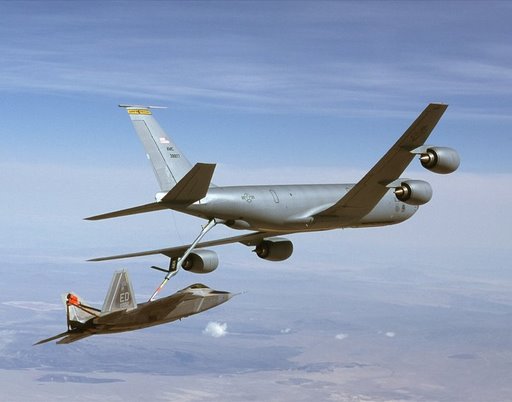
An F-22 Raptor from Elmendorf Air Force Base, Alaska, hangs off the wing of a KC-135 en route to the United States July 27, 2010. By sticking close to the tanker, the fighter could regularly top off its fuel tanks to ensure it had enough fuel to reach safety in the event it had to land unexpectedly. The tanker is assigned to the 100th Air Refueling Wing at Royal Air Force Mildenhall, England. (U.S. Air Force photo/Staff Sgt. Austin M. May)

by Staff Sgt. Austin M. May, 100th Air Refueling Wing Public Affairs

ROYAL AIR FORCE MILDENHALL, England (AFNS) -- From a spectator's point of view, a Coronet mission may seem simple; a group of tankers flies with a group of fighters across the ocean, ensuring the smaller aircraft have enough fuel to get home.

Beyond that first glance, however, the "air bridge" is a complicated, critical mission which takes precise planning and coordination to complete. It's also a mission the 100th Air Refueling Wing members perform several times a week.

The term Coronet refers specifically to a movement of fighter aircraft, such as the F-22 Raptor, said Lt. Col. Jonathan Castellanos, the 351st Air Refueling Squadron director of operations. While heavy aircraft are refueled during their flights between continents, Coronets are specialized missions designed to let fighters traverse long distances safely.

Fighters move for a variety of reasons, the colonel said. Planes must be rotated in an out of the operational theaters to avoid overuse, meet maintenance requirements and, in some cases, stay with the units to which they're assigned.

While the intent is essentially the same as any other air refueling flight, allow aircraft to take on more gas without having to land, the procedure for a Coronet is different.

On a standard refueling sortie, a tanker will enter an orbit in an area of sky set aside for them. Fighters scheduled to refuel with the tanker know where it is and go to them, Colonel Castellanos said.

With a Coronet, the airspace designated for refueling moves with the group of aircraft and takes more coordination to avoid mishaps. Planes must be at precise coordinates and altitudes at the exact time scheduled for the mission to be a success.

In a standard air refueling mission, a receiver may take off, meet up with the tanker for fuel, and then leave for their mission. Coronet fighters must top off several times during the flight.

In the event a fighter must leave the tanker and land, they have to have enough fuel to get to a predetermined divert base. Maintenance issues, mission requirements and weather can affect which bases are available, so precise timing is required to ensure the fighters have the correct amount of fuel at certain points in the flight.

Usually, tankers from the 100th ARW will take fighters to a certain point and hand them over to another tanker to complete the journey. Depending on mission requirements, the KC-135 Stratotanker crew may stop somewhere overnight or return to Royal Air Force Mildenhall. On a recent Coronet during which KC-135 crews "dragged" F-22s across the Atlantic, the crew stopped overnight in Iceland to refuel and meet crew rest requirements.

While home, tanker crews based here have a unique role - they are "deployed in place," Colonel Castellanos said.

"When these Airmen go up to fly, they aren't just training or practicing for a deployment," he said. "They're doing their actual mission, and they do it 24 hours a day, seven days a week."

Despite the simple outward appearance of the air bridge, the crucial Coronet mission is an intensely precise cooperative effort, ensuring the fuel gets to the fighters no matter how far they need to go.

Tuesday, October 13, 2009

Aerial Refueling Frequency Update in the November MT Milcom column


We are a little under two weeks away from the release of the electronic November issue of Monitoring Times magazine -- MTXpress. If you are a MTXpress or print MT subscriber and milcom monitor, you are in for a very special treat in the November issue.

For the first time since 2003 in our November 2009 monthly Milcom column and also as a special download for MTXpress readers, we present our latest and greatest, and completely updated aerial refueling frequency list for North America.

The list in the November print edition will "not" be as comprehensive as the electronic version that will only be available to MTXpress subscribers during the month of November "only."

If you want the latest aerial refueling frequencies then jump on the MTXpress bandwagon and subscribe today.

You can learn more about subscribing to MTXpress by clicking here

Tuesday, June 17, 2008

Another Report on the New TBird freq

Chuck Rapacki in Detroit reported on the Milcom newsgroup that he caught what he believed to be the Thunderbirds on 140.700 MHz conducting A-A comms during a refueling event in his area. I would imagine that Chuck has caught the TBirds on another new VHF freq (see the Quebec City Airshow report below).

Great catch Chuck.

Tuesday, July 31, 2007

Aerial Refueling Frequency Update


Over the last few years I have documented in my Monitoring Times Milcom column and here on this blog the fact that a major overhaul is underway of the 225-400 MHz milair band. Part of this massive change in frequencies is due to the conversion of some of the 380-400 MHz frequencies from aero to LMR frequencies. Other changes appear to involve what appears to be several new subbands devoted to wideband communications, ATC freq blocks, Command and Control frequencies, and other changes.

On July 5, DoD released a new edition of their AP-1B pub. There were quite a few frequency changes in AR section of this pub. The biggest change I noticed was that aerial refueling freqs 319.5 and 319.7 MHz were replaced by 256.650 and 343.250 MHz respectively. Not all of the 319.5/319.7 have changed but a significant number have. If your local AR route uses 319.5 or 319.7, you need to plug in the new freqs above or getting ready for them to go silent. They will change very soon.

In the meantime here is a list below of all the new assignments.

233.7250 AR-136V (North/South) Primary; AR-137V (North/South) Primary; AR-135V (North/South) Secondary
235.1000 AR-332 (NE/SW) Primary; AR-112H (East/West) Primary
236.6500 AR-007B Primary; AR-315 (East/West) Secondary
238.5000 AR-135V (North/South) Primary; AR-136V (North/South) Secondary; AR-137V (North/South) Secondary
240.3500 AR-008A Primary; AR-318 (East/West) Primary; AR-633A/B Primary
256.6500 AR-005L (East/West) Primary; AR-006 Primary; AR-001 (East) Secondary; AR-002 (West) Secondary; AR-003L Secondary; AR-007A Secondary; AR-007B Secondary; AR-008A Secondary; AR-008B Secondary; AR-209 (West/East) Secondary; AR-648A/B Secondary
260.2000 AR-041V (North/South) Secondary; AR-112H (East/West) Secondary; AR-112L (East/West) Secondary
265.5000 AR-003H (East/West) Primary
271.6500 AR-003H (East/West) Secondary
274.4500 AR-220 Primary; AR-006 Secondary
278.7500 AR-010 (SE/NW) Primary; AR-302 (East/West) Primary; AR-005L (East/West) Secondary
291.6500 AR-642 (East/West) Primary; AR-659 Primary
292.6000 AR-610A/B Secondary
295.8000 AR-112L (East/West) Primary
297.3000 AR-406L (East/West) Primary; AR-406H (East/West) Secondary
305.5000 AR-219 Primary
324.6000 AR-653 Primary
327.6000 AR-324 Primary; AR-255L (East/West) Primary
342.5500 AR-005H (East/West) Secondary; AR-716 Secondary
343.2500 AR-315 (East/West) Primary; AR-324 Secondary; AR-332 (NE/SW) Secondary; AR-202 (South/North/Alt North) Secondary; AR-216 (NE/SW) Secondary; AR-328 Secondary; AR-617 Secondary; AR-618 Secondary; AR-620 Secondary; AR-633A/B Secondary; AR-638 Secondary; AR-655 Secondary

I will have more of this in a future MT Milcom column.