Showing posts with label USAF. Show all posts

Monday, August 23, 2021

Minot AFB HF/UHF Channelization


A frequent player in the Middle East in recent months has been B-52 aircraft from the 5BW at Minot AFB, ND. Here is the latest list of channels loaded into 5BW aircraft based at Minot AFB (Freq Card).

Source: USAF MINOT AFBI11-250 14 JANUARY 2014


Monday, February 12, 2018

919SOW C-146 Call Signs


Couple of new AFSOC call signs, at least for me, confirmed.

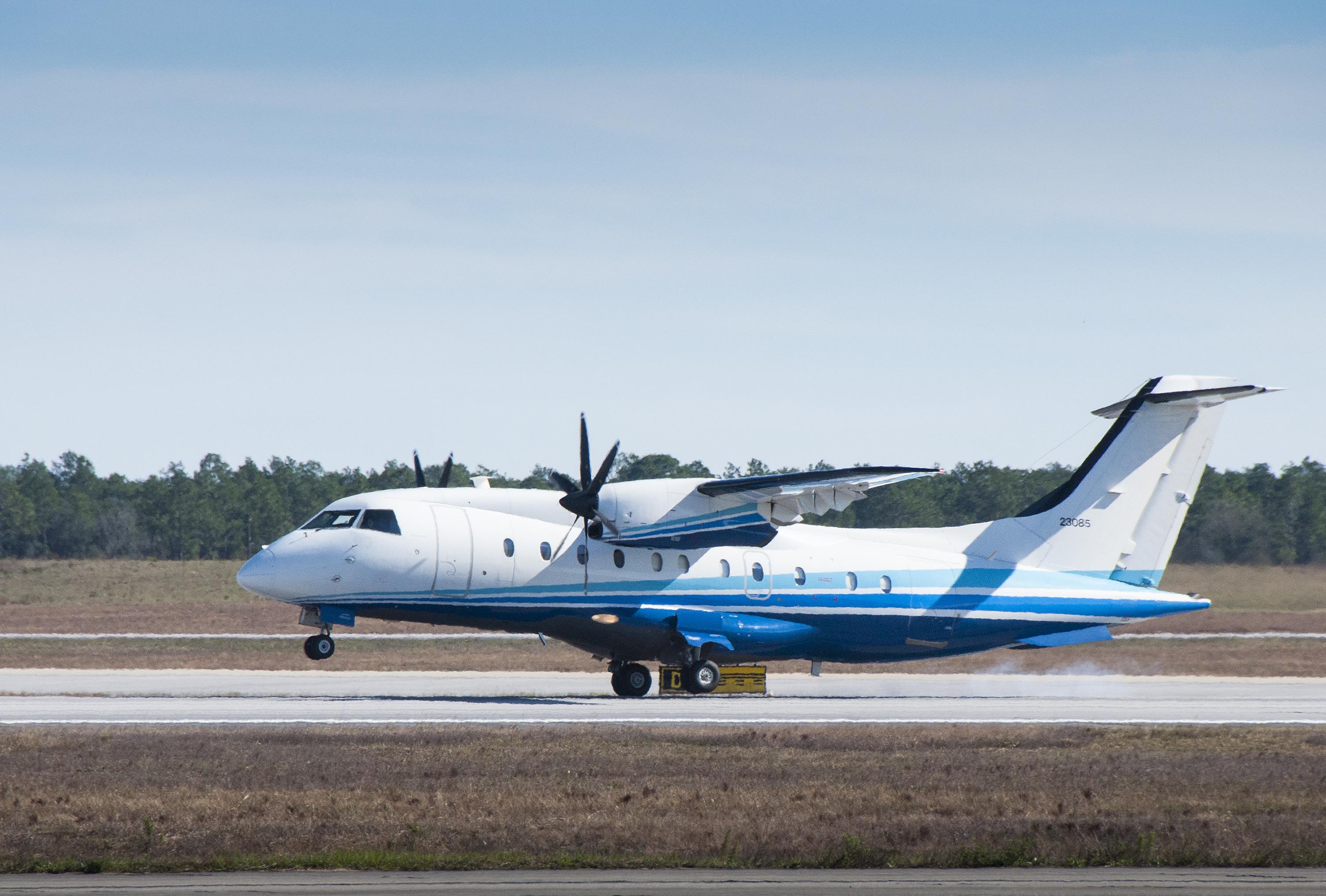
C-146A Wolfhound aircraft have been moved to Duke Field in Florida under the 919SOW.

The active duty component 524SOS (aka Hounds of Heaven) are using the Hound ## call sign.
The reserve component 859SOS are using the Dingo ## call sign.

Details of the 524SOS move from Cannon AFB to Duke Field was published in an AF story at 524th SOS relocates from Cannon to Duke Field.

Details of the 859SOS standup at Duke Field was published in an AF story at 919th SOW welcomes new special operations squadron

Tuesday, October 24, 2017

Rapid Launch of 20 B-52 Bombers at Minot during Exercise Global Thunder 17

Exercise Global Thunder 18 is either underway or will be shortly. Standby for HFGCS EAMs to light up and ur ADS-B to ramp up as well. Should be fun for the next week or so. I will be following the action over on our tweeter feed @MilcomMP. CU there!


Sunday, October 15, 2017

Reach H Flights


For those who have ADS-B equipment, or have been monitoring ATC freqs, you may have noticed the Reach ### flights with a suffix letter of H after the three digit mission numbers, I have been able to confirm my suspicions through an official and  reliable source that these are all AMC hurricane relief airlift flights.


Thursday, August 10, 2017

Projecting power: That’s why there’s nonstop air traffic from McChord this week

Mobility Guardian is filling the skies of the South Sound with military planes from July 31 to Aug. 12. Russ Carmack The News Tribune Staff file, 2005

The event at Joint Base Lewis-McChord, is called “Mobility Guardian.” 

Compete story at http://www.thenewstribune.com/news/local/military/article166190742.html?#emlnl=Morning_Newsletter

Thursday, July 13, 2017

Wanna Know If A New DPRK Missile Test Is About To Take Place? Look For This U.S. Aircraft Online…

You can monitor online the U.S. RC-135S Cobra Ball aircraft used to track ballistic missiles reentry vehicles and warheads during the final phase of flight.


Early in the morning on Jul 4, North Korea successfully tested an intercontinental ballistic missile (ICBM) for the first time.
The ICBM, referred to as Hwasong-14, reached a height of 2,802 kilometers, according to the state-run Korea Central Television (KCTV). The missile was launched from Panghyon, in North Pyongan province, and flew into waters east of the Korean Peninsula after traveling for about 930 kilometers.
The latest missile launch, as well as the previous ones, was almost certainly monitored by the U.S. Forces deployed to the region, using a variety of aerial, ground-based, sea-going assets.
The U.S. Air Force relies on its small contingent of RC-135S Cobra Ball missile tracking aircraft. Based at Offutt Air Force Base, outside Omaha, Nebraska, and  flown by the 45th Reconnaissance Squadron, these intelligence gathering aircraft are often deployed where needed to track ballistic missiles reentry vehicles and warheads during the final phase of flight. The aircraft is equipped with a powerful radar array on the starboard side of the fuselage, just aft of the cockpit. Several optical quality windows are mounted on the starboard side as well, allowing infrared and visible spectrum cameras to record the warheads during their final moments of flight. A distinctive feature of the Cobra Ball is the black low-glare paint used on the starboard wing, to improve image quality and prevent glare during photography.
Unsurprisingly, two Cobra Ball aircraft  (61-2662 and 61-2663) are currently deployed to Yokota Air Base, Japan, from where it is launched when there are signs of an imminent North Korean test. What is far more surprising is the fact that, in spite of their important role, RC-135S aircraft are among the military planes that can be tracked online by exploiting the signals broadcast by their Mode S/ADS-B transponders.
By observing the activities of the RC-135S in Japan you may have a pretty clear idea of what is happening or about to happen in North Korea. For instance, last night, the fact that the Cobra Ball was airborne from Yokota might suggest that the U.S. intelligence had detected activities at the launch site and was preparing to monitor the test. This is the reason why I tweeted the following (later confirmed by the news of the ICBM test):
And that was not the first time. Just a coincidence? Most probably not, considered that the Cobra Ball does not fly that much and almost all sorties tracked online in Japan coincided with North Korea’s tests.
Here are some examples:
On Apr. 15, North Korea test-fired an unidentified land-based missile from the naval base in Sinpo. An RC-135S was flying over Japan:

On May 13, North Korea test-fired an intermediate range ballistic missile, from a test site on the country’s West Coast. That launch reached a then-record altitude of around 2,100 kilometers (1,300 miles) and a Cobra Ball was airborne to watch and collect data:

On Jun. 20, a Cobra Ball and WC-135 Constant Phoenix “nuclear sniffer” flew over Japan. It was later unveiled that the spy satellites had detected new activity at the North Korean nuclear test site.

So, if you want to know when Kim Jong Un is preparing for a new test, you may try to look for a Cobra Ball or Constant Phoenix airborne over Japan on ADSBexchange or simply follow some of the Twitter accounts who constantly track such aircraft, such as our friend @CivMilAir who provided us with most of the updates on the RC-135 and WC-135 flights in the area.


Sunday, June 25, 2017

Air Force Says Tornado Damaged Two “Doomsday” 747s


Story by Tara Copp, Stars and  Stripes

A tornado that struck in Omaha, Nebraska last  week damaged two of the “Doomsday” 747 aircraft that serve as the national  command center for the United States in case of a military attack, the Air Force  said Friday.

Offutt AFB, home to the nation’s four E-4B aircraft, was hit  by the tornado on June 16. The planes are used by the Secretary of Defense and  Secretary of State for international visits and maintain vital communications —  including those with the country’s nuclear missile silos and nuclear-powered 
submarines — in case of an attack.

Ten aircraft, including the two 747s,  were damaged by the tornado, said Capt. Mark Graff, an Air Force spokesman. He  said the other two 747s were not damaged by the tornado and can still be used as the national airborne operations center.

Of the base’s eight RC-135  reconnaissance aircraft, seven had minor damage, Graff said. Six of the damaged  planes have been returned to flight status, he said.

The tornado was  fast-moving, said Col. Pat Ryder, an Air Force spokesman. “They attempted to  hangar as many [planes] as they could. Obviously, some were damaged.”

Ryder said the primary E-4B — the one that is always on alert  status — was not affected and that the Air Force is still assessing the level of  damage to the two other 747s. The tornado also damaged buildings and trees on the Nebraska air base.

Tuesday, June 13, 2017

The Air Force is Reactivating The Gigantic Planes


By , Popular Mechanics


The C-5 Galaxy was originally introduced in the late 1960s as a strategic airlifter able to cross entire oceans without refueling. The C-5 is the largest airlifter built by the United States, 65 feet high and with a wingspan of 247 feet. It can carry a maximum of 135 tons of cargo. With a combat load of sixty tons of cargo, the C-5M can fly from Dover Air Force Base in Delaware to Incirlik Air Force Base, Turkey nonstop without refueling. According to the Air Force, it can fly 7,000 miles without cargo.

Budget cuts immediately sidelined a dozen C-5Ms, and the Air Force's fleet of non-upgraded C-5A/B/C Galaxies and Super Galaxies shrank from 112 to just 56 planes The Air Force plans to bring back two Super Galaxies a year over four years.

What's prompting the return of the giant planes? As the Pentagon reorients to the Asia-Pacific, it faces the prospect of flying long distances without refueling. At a March 31 event attended by reporters and congressional representatives, the head of the Air Force's Air Mobility Command claimed that the C-5 is the only airlifter that can make the trip non-stop from the continental United States, in this case Travis Air Force Base in California, to Yokota Air Base in Japan, just outside Tokyo.

See the whole story at http://www.popularmechanics.com/military/aviation/a26716/air-force-reactivating-c-5-galaxy/

Monday, May 01, 2017

USAF C-130s on parade over the radio ranch

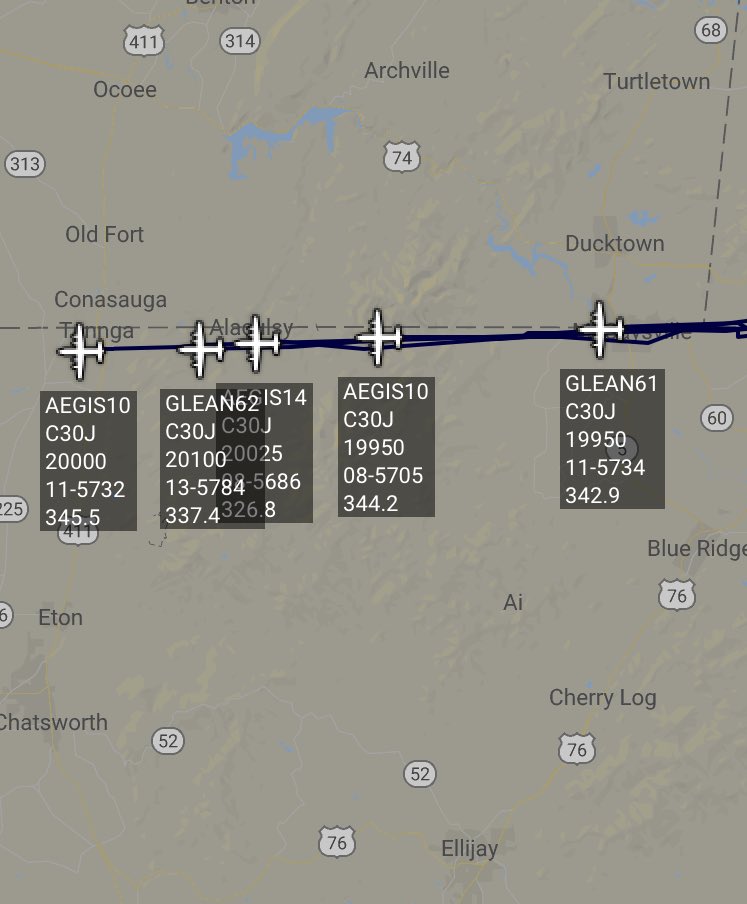
Had this parade of C-130s fly over the radio ranch yesterday afternoon. We could hear them and saw them on Mode-S but they were obscured behind a local ridge visually. Thanks to Buzz‏ @Buzz6868 on twitter  for the graphic See our daily listings below for the list of 130s in this parade.

Thursday, March 09, 2017

US Sending B-1 / B-52 Bombers to South Korea


President Donald Trump is sending nuclear bombers to the Korean peninsula as tensions in the region reach breaking point according to The Sun newspaper. US military chiefs are reportedly planning to fly in B-1 and B-52 bombers – built to carry nuclear bombs – to show America has had enough.

Story online at
https://www.thesun.co.uk/news/3049573/donald-trump-sends-b-52-nuclear-bombers-to-south-korea-after-north-fires-missiles-at-japan-and-us-warns-of-overwhelming-response/


Friday, January 13, 2017

JB McGuire-Dix-Lakehurst, Travis AFB named next KC-46A locations


WASHINGTON (AFNS) -- Air Force officials selected Joint Base McGuire Dix Lakehurst, New Jersey, and Travis Air Force Base, California, as the preferred locations for the next two active-duty-led KC-46A Pegasus bases.

Twenty-four KC-46A aircraft will replace the legacy aircraft currently at each of those bases.

“Joint Base McGuire Dix Lakehurst and Travis AFB were chosen as the next two active-duty-led KC-46A bases because they meet all operational mission requirements at the best value for the Air Force and the American taxpayer and support our tanker recapitalization strategy," said Air Force Secretary Deborah Lee James. "It is absolutely essential that we continue investing in the next generation of tanker aircraft so we have the aircraft necessary to maintain the nation's global reach for years to come."

Fairchild AFB, Washington, and Grand Forks AFB, North Dakota, will be considered as reasonable alternatives during the environmental impact analysis process which is required before a final basing decision is made.

At this time, the Air Force is planning to divest the legacy tankers after growing the tanker fleet to meet its 479 tanker requirement. The timeline is dependent on the KC-46A delivery schedule, but it is not anticipated to reach sufficient KC-46A fleet size and begin legacy divestment at the first location until 2019.

“The KC-46 will afford combatant commanders extended refueling capabilities, improved global reach, and enable timely joint-service response to humanitarian crises and contingency operations around the world,” said Air Force Chief of Staff Gen. David L. Goldfein. “In fact in the fight against (the Islamic State of Iraq and the Levant), the Air Force and joint and coalition partners depend on gas from our tankers. In 2016, the coalition flew over 13,600 tanker sorties, fueling aircraft nearly 80,000 times, delivering about 800-million pounds of fuel.”

Altus AFB, Oklahoma; McConnell AFB, Kansas; Pease Air National Guard Station, New Hampshire; and Seymour Johnson AFB, North Carolina; have already been selected as future KC-46 basing locations. The first KC-46As are expected to begin arriving at McConnell and Altus AFBs in fall of 2017.

The KC-46A will provide improved capability, including boom and drogue refueling on the same sortie, worldwide navigation and communication, airlift capability on the entire main deck floor, receiver air refueling, improved force protection and survivability and multi-point air refueling capability.

Travis AFB and JB McGuire-Dix-Lakehurst currently host the McDonnell Douglas KC-10 Extender.

Monday, November 28, 2016

Who is this mystery KC-135


Recently a new Mode-S hex code AE0542 has popped up/ This hex code definitely looks like a KC-135 tanker based on call signs and boy has this hex code used a wide variety of Mode-S call signs since 1 Oct 2016.

What call signs you ask?

Arius 21
CETUS 21
Cabal 31
Happy 63
Kanza 01/71/81
Snap 83/90/92
Spur 91
Turbo 13/78/81

This one has me scratching my head and if anyone gets a serial number tie up for the airframe, please drop me a note.

Monday, September 26, 2016

Secretive U.S. Air Force Transports Fly All Over the World

Above - a C-146A Wolfhound. Air Force photo. At top - American commandos and locals congregate around a C-146 that landed in Libya. Libyan Air Force photo
A C-146A Wolfhound. Air Force photo
Interesting article on some interesting USAF Spec Ops aircraft I have been watching for some time now. Keep an eye out for those Magma call signs.

https://warisboring.com/secretive-u-s-air-force-transports-fly-all-over-the-world-f6f578cbc8ad#.md7pcnfoy

US Air Force Fact Sheet

Mission  The C-146A Wolfhound’s primary mission is to provide U.S. Special Operations Command flexible, responsive and operational movement of small teams needed in support of Theater Special Operations Commands (TSOC).  Airlift missions are conducted by Air Force Special Operations Command aircrews to prepared and semi-prepared airfields around the world.

Features
The C-146A is a twin-engine, high-wing aircraft equipped with a configurable cabin capable of various passenger  and cargo combinations, as well as casualty evacuation (CASEVAC) missions.  The aircraft can carry a maximum of 27 passengers or 6,000 pounds of cargo, or up to four litter patients.

Background 
The C-146A is the military version of the Dornier 328 turboprop commuter airliner modified to permit cargo and CASEVAC missions.  The aircraft has been continuously deployed since October 2011.  It currently supports overseas contingency operations across four geographic combatant commands.

General characteristics 
Primary function: flexible, rapid, intra-theater mobility for special operations forces
Builder: Dornier
Power plant: two Pratt & Whitney PW119C turboprop engines
Thrust: 2,282 max takeoff shaft horsepower per engine
Wingspan: 68 feet 10 inches (20.98 meters)
Length: 69 feet 10 inches (21.29 meters)
Height: 23 feet 9 inches (7.24 meters)
Speed: 270 knots (310 mph or 500 km/h)
Range: Approximately 1,500 nautical miles with 2,000 pounds of cargo
Ceiling: 31,000 feet
Maximum takeoff weight: 30,843 pounds
Armament: n/a
Crew: two pilots and one loadmaster
Unit cost: $17.6 million
Inventory: active duty,18; Reserve, 0; ANG, 0

(Current as of January 2016)

From the airforce-technology.com website

C-146A Wolfhound is a tactical transport aircraft designed and manufactured by Fairchild Dornier, for the US Air Force (USAF). The aircraft provides flexible, responsive and operational transportation of the US Special Operations Command (USSOCOM) personnel in the theatre.
The aircraft is also used to conduct non-standard aviation (NSAv) missions to assist Joint Special Operations Command of the USSOCOM.

It is deployed with the 524th Special Operations Squadron of the Air Force Special Operations Command (AFSOC) at Cannon Air Force Base to conduct infiltration, exfiltration, cargo resupply, airlift and other military missions in prepared and semi-prepared airfields across the globe.

The airlift aircraft began operations with the USAF in June 2011 and entered into service with the US Africa Command (AFRICOM) to assist Overseas Contingency Operations in October 2011. It is also deployed with four Geographic Combatant Commands.

Orders and deliveries of the C-146A transport aircraft

The C-146A Wolfhound is the military version of Dornier 328 airliner designed and built by Fairchild Dornier. Sierra Nevada Corporation was contracted to provide design, modification, integration, modernization, test and certification for conversion of 17 Dornier 328 airliners for use by the US Military.

Germany-based 328 Group was awarded a four-year contract worth more than $200m to deliver spare parts and logistics support for the conversion in 2009. The 328 Group bought 15 of the aircraft from different sources, including those in Europe, America and Africa, while the remaining two were directly acquired by Sierra Nevada.

The 328 Group delivered the 17th and final Dornier 328 turboprop in July 2013 to Sierra Nevada.

C-146A Wolfhound design and features

The C-146A Wolfhound transport aircraft can be configured to execute multiple missions including casualty evacuation (CASEVAC) and can carry up to four litter patients.
The aircraft has a length of 20.98m, height of 7.24m and wing span of 21.11m. The maximum take-off weight is 30,843lb.

The aircraft can carry up to 27 passengers, while its flight deck accommodates two pilots and a loadmaster. The flight deck and cargo cabin areas are specially configured with night vision goggle (NVG) devices to capture images in low-light conditions.

Avionics of the airlift aircraft

The C-146A Wolfhound is equipped with Primus 2000 avionics systems manufactured by Honeywell Aerospace. The avionics include electronic flight instrument system (EFIS), engine-indicating and crew-alerting system (EICAS), and five cathode ray tube displays measuring 7in x 8in.

The aircraft is also fitted with flight management system, a dual Primus II integrated radio system, dual integrated avionics computer, automatic flight control system, dual digital air data reference unit, dual altitude and heading reference system, Primus 650 weather radar, mode S transponder, fault recording, traffic alert, and collision avoidance system (TCAS 2000). A ground proximity warning system (EGPWS) is also fitted.

The aircraft can be optionally fitted with Allied-Signal GTCP 36-150 auxiliary power unit, ground spoiler, Primus 870 weather radar, global positioning system with non-precision approach, an additional mode S transponder, an enhanced EGPWS, HF, CAT II approach, electronic flight bag, and LED lights.

Engine and performance of C-146A Wolfhound

The C-146A military transport aircraft is powered by two Pratt and Whitney turboprop 119C engines, each producing a power of 2,180shp. The propulsion system includes two-spool, two-stage centrifugal compressors, two-stage power turbine, reverse flow combustor and electronic engine control. The engine is also equipped with off-set reduction gearbox.

The maximum speed of the C-146A Wolfhound is 620km/h, the range is 1,800nm with a cargo load of 2,000lb, and the service ceiling is 31,000ft.

Wednesday, August 31, 2016

USAF B-52 Arrives at Fairford

USAF B-52 callsign Scalp 99 arrives at RAF Fairford. (Photo courtesy of ApronMedia)

Sunday, January 31, 2016

Is this the receiving end of our recent Rock and Roll Skyking messages? Late Breaking News

USAF RC-135U Combat Sent aircraft (USAF Photo)
Late Breaking News: This aircraft was the subject of an incident involving the Russian AF over the Black Sea Saturday. See USA Today story "Russian jet buzzes U.S. Air Force spy plane over Black Sea" at http://www.usatoday.com/story/news/world/2016/01/30/russian-jet-buzzes-us-air-force-spy-plane-over-black-sea/79563912/.

--------------

If you looked at my previous post this morning, and you checked out my "what is an EAM file," you would have discovered a bit of insight on what I believe a Skyking message is used for.

Well the aircraft in the picture above, even as I type, is flying around the Middle East (just spotted today in and around Turkey and Israel). It would certainly fall within the parameters I have set for a user of HFGCS Skyking message traffic.

Call sign seen today "BARN 06" another interesting consequence that I have mentioned before re: four letter ## call signs.

Here is a bit more information on the RC-135U courtesy of the official USAF public information files.

Mission
The RC-135U Combat Sent provides strategic electronic reconnaissance information to the president, secretary of defense, Department of Defense leaders, and theater commanders. Locating and identifying foreign military land, naval and airborne radar signals, the Combat Sent collects and minutely examines each system, providing strategic analysis for warfighters. Collected data is also stored for further analysis by the joint warfighting and intelligence communities. The Combat Sent deploys worldwide and is employed in peacetime and contingency operations.

Background
There are only two Combat Sent aircraft in the Air Force inventory and both are assigned to the 55th Wing at Offutt AFB, Neb. The RC-135U aircraft are manned by Air Combat Command crews from the 45th Reconnaissance Squadron and the 97th Intelligence Squadron (of the Air Force Intelligence, Surveillance and Reconnaissance Agency). The Combat Sent is composed of a wide variety of commercial off-the-shelf and proprietary hardware and software. Its current configuration allows for both manual and automatic analysis of electronic signals. By combining manual systems with the Automatic Electronic Emitter Locating System, Ravens and intelligence specialists can simultaneously locate, identify, and analyze multiple electronic signals.

The Combat Sent records these signals for future reference or for extensive analysis by electronic systems theorists. Any information garnered from the data will help determine detailed operating characteristics and capabilities of foreign systems. Evasion techniques and equipment are then developed from this knowledge that will detect, warn of, or defeat these electronic systems.

Tuesday, September 22, 2015

America's Next Tanker is Finally Going to Fly

America's new aerial refueling tanker, the Boeing KC-46A Pegasus, is set to make its first flight from Boeing's Paine Field in Everett, WA this Friday. It's about time: America's existing airborne tanker fleet is stunningly old. Derived from Boeing's Dash 80 (the prototype of the 707 airliner), the KC-135 Stratotanker entered service with the USAF in 1957. The Air Force currently operates more than 400 of them as KC-135Rs or KC-135Ts. The newest KC-135 currently in the inventory was built in 1964, though it was upgraded along with the others to KC-135R configuration with new engines in the 1980s. Avionics and cockpit upgrades continued through 2014. The KC-135Rs are expected to remain operational until 2040, nearly a century after they were first built. But even with the upgrades, keeping a tanker flying so long inevitably presents reliability and cost problems. So gradually replacing the KC-135 with a new tanker has been an Air Force priority for more than a decade.

It just hasn't gone very well.

The long and troubled history of the tanker replacement effort stretches back to the early part of the last decade, when the Air Force announced the purchase of 80 Boeing KC-767 aircraft and the lease of 20 more. The Pentagon froze the contract in December 2003 and cancelled it in January 2006 following public revelations of corruption connected to the contract. A subsequent KC-X program selected the EADS/Northrop Grumman KC-30 (renamed the KC-45A for the U.S.) over the KC-767 in early 2008. Boeing protested that selection, leading to a new competition in 2010. This time around Northrop dropped out and the Pentagon chose Boeing's 767-based tanker design (KC-46A) in February 2011. Boeing is slated to build 179 KC-46As for the Air Force by 2027 at a unit cost of $188.5 million (in fiscal year 2015
dollars).

Boeing says the KC-46 "promises to revolutionize the air mobility mission." Setting aside that grandiose talk, what we know right now is that the airplane can refuel all U.S., allied, and coalition military aircraft compatible with international aerial refueling procedures. It also has the ability to play other roles for the military, such as carrying passengers, cargo, and patients. The KC-135R can do these things, too, but Boeing says the KC-46 offers room for three times more cargo pallets, up to twice as many passengers, and more than 30 percent more aeromedical evacuation patients compared to the KC-135R. The KC-46 can take off from shorter runways and is far more fuel efficient as well.

Of all the Pegasus's advantages, perhaps the most important is simply that it's a new airplane. The Pegasus' aircrew will enjoy improved situational awareness with a fully modern cockpit and refueling station, the former using 15-inch 787-style advanced electronic displays, redundant displays, and controls. The aircraft can refuel using both its fly-by-wire boom and wing-mounted hose-and-drogue systems. The Pegasus is designed to operate through a nuclear or biological attack, and is hardened against an electromagnetic pulse. According to Boeing, sections of the aircraft are also armored against medium-caliber gunfire though just where a KC-46 might encounter medium caliber gunfire (at low altitude/on the ground?) is an interesting question.

Those improvements come with a marginal increase in fuel delivery capacity. According to the Air Force, the KC-135R has a maximum transfer fuel load of 200,000 pounds (that's how much fuel it can give to other planes or UAVs). The KC-46's maximum transfer fuel load is 207,672 pounds-an increase of less than one percent despite the Pegasus' greater size, takeoff weight and thrust. The KC-135R can also carry more cargo (83,000 pounds) than the KC-46 (65,000 pounds) according to the Air Force.

Still, the KC-46's newness is crucial to Air Force tanker support. Boeing is required to deliver 18 operational tankers to the fleet by August 2017, a timeline that makes this Friday's first flight hugely important, particularly since Boeing was forced to postpone the first flight earlier this summer after a problem with the aircraft's refueling line during testing. It's a tense time: Boeing is under pressure to deliver on schedule or risk losing the contract. Likewise, the government risks breaching the contract with a continuing resolution because it may then not be able to buy
the contractually agreed number of airplanes in the first couple years.In an interview with Defense News Air Force Gen. Mark Welsh said, "We're at a point now where we really need to see the first flight of this tanker."

http://www.popularmechanics.com/military/a17421/kc-46-tanker-first-flight/

Friday, August 28, 2015

USAF F-22/F-16 NYC Flyover

STUNNING VIDEO: A F-22 Raptor and F-16 Viper did a flyover New York City Thursday. They flew by One World Trade Center, the Statue of Liberty, and several other landmarks. http://7ny.tv/1hj6RBs. The planes were making their way to the New York Air Show.

Thursday, August 06, 2015

Oklahoma ANG unit begins transition with arrival of first MC-12W aircraft

By Sr Airman Justin Creech, 137ARW Public Affairs


WILL ROGERS ANGB, OK.  The OK-ANG's 137ARW welcomed the arrival of the MC-12W aircraft here on July 10.  The arrival of the MC-12 marks the return of flying operations to WRANGB for the first time since 2007.

The 137ARW received the MC-12 based on its manpower, facilities, existing command structure, and strong relationships with local community leaders. The geographical location of the 137ARW provides a highly-conducive flying environment and appropriate training facilities.

"The 137ARW is very excited to return flying operations back to Will Rogers ANGB and join Air Force Special Operations Command," said Air Force Col. Devin R. Wooden, 137ARW commander. "Our last eight years at Tinker AFB and our partnership with the 507ARW is an honored part of our great history. We proudly flew off of this ramp for 58 years before we left for Tinker and to be a part of the team to bring flying operations back is very satisfying. I feel like everyone is back home."

The MC-12 is a medium- to low-altitude, twin-engined turboprop aircraft. Its primary mission is to provide intelligence, surveillance, and reconnaissance support directly to ground forces serving overseas.

The partnership between AFSOC and the Air National Guard and the ability of the ANG to retain members is another reason WRANGB was chosen to house the MC-12. Air National Guard members historically leave units at significantly lower rates than Active Duty units, which will allow Manned Airborne Intelligence, Surveillance, and Reconnaissance expertise to be retained long-term and become more fully developed. The ANG unit will be able to retain critical expertise by recruiting and retaining those members who are planning to separate from active duty.

"I am personally very happy to be back at the base at which I began my military career," said Air Force Lt. Col. Justin Walker, 185ARS commander. "I am also very excited about the addition of new tactical Intelligence, Surveillance, and Reconnaissance aircrew members to the squadron.

The basing of the MC-12 is a significant moment for the 137ARW as they transition to an Air Force Special Operations Wing. As a part of AFSOC, the wing will provide highly-trained Air Commandos to execute global special operations missions.

As part of the first Air National Guard/Air Force Reserve partnership, the 137ARW has been functioning as a geographically-separated base with KC-135 Stratotanker flight operations at Tinker Air Force Base and support operations at WRANGB. This partnership was the result of the last major Base Relocation and Closure commission that threatened the 137th with permanent closure.

"The squadron, and ultimately the wing, are poised for complete mission success due to the mix of current and new members," said Walker.

Monday, August 03, 2015

USAF HF Global Communications System (HFGCS) published frequencies

From time to time monitors will pop up and ask about the primary frequencies used by the USAF HFGCS network or someone will publish an old frequency (prior to WARC-92 Aero OR band 3 kHz realignment). I've even still see references in some various online lists to the now no longer active station at MacDill AFB as part of the Global network.

So to set the record straight, here are the latest "published" primary frequencies and stations direct from the Department of Defense for the HFGCS network.


HFGCS is the Department of Defense’s high power, high frequency, over-the-horizon long haul communication system. It's global network operated under the umbrella of the Joint Chief's of Staff and consist of ground stations that provides automated and operator assisted voice services, data transmission and an HF e-mail capability that has an interface to both the classified (SIPRnet) and unclassified (NIPRnet) email networks.

The Radio Equipment High Frequency Global Communications System (HFGCS) is a cost-effective, networked solution providing interoperable voice and data communications for strategic and tactical forces. HFGCS provides near-global, beyond line-of-sight command and control (C2) communications to aircrews, ground troops, naval operations and control stations. The Air Force (AF) is the executive agent for HFGCS per Joint Chiefs of Staff (JCS) direction.

This Command and Control/National Security System (C2/NSS) is the Department of Defense's (DOD's) only high-power HF C2 network. HFGCS serves as the primary C2 resource for Air Mobility Command (AMC) cargo and tanker aircraft. The HFGCS program supports Mystic Star (Presidential communications), the United States Air Force's Global HF System, Defense Communications System (DCS) HF Entry, US Navy High Command (HICOM) Network and other US government high-power HF missions.

The HFGCS supports war plans and the daily operational requirements of the following organizations: White House Communications Agency (WHCA); JCS; US Strategic Command (USSTRATCOM); the National Military Command Center with Emergency Action Message distribution; AMC Special Air Mission (SAM) fleet communications; Air Combat Command (ACC); Air Intelligence Agency (AIA); Air Force Space Command (AFSPC); United States Air Forces in Europe (USAFE) and Pacific Air Forces (PACAF). This program also provides radio support to other governmental organizations such as Civil Air Patrol, Federal Emergency Management Agency, Transportation Security Administration and the State Department.

HFGCS is a fully integrated world-wide C2 high-frequency (2-30 Megahertz) networked radio communications capability consisting of 13 remote radio stations and 10 remote console stations with 15 located OCONUS. 

Remote radio station locations include Joint Base (JB) Andrews (MD), Offutt AFB (NE), Beale AFB (CA) aka West Coast, Elmendorf AFB (AK), Hawaii (Hickam AFB), Guam, Yokota (Japan), Puerto Rico, Lajes (Azores), Ascension Island, RAF Croughton (UK), Sigonella (Sicily), and Diego Garcia.

Network remote consoles are located at Whidbey Island Naval Air Station (NAS) (WA), Sigonella NAS (Sicily), Kaneohe Bay Marine Corps Air Station (MCAS) (HI), Wahiawa Naval Computer and Telecommunications Station (NCTS) (HI), Jacksonville NAS (FL), Misawa AB (Japan), Patuxent River NAS (MD), North Island NCTS (CA), Kadena AB (Okinawa, Japan), and AFSPC Eastern Test Range (FL).  All stations are networked back to control stations located at Joint Base Andrews (MD) and Grand Forks AFB (ND).

You will find additional information on this system including discrete frequencies on this blog at http://mt-milcom.blogspot.com/2006/05/joint-chiefs-of-staff-hf-gcs-network.html

You will find additional information on the HFGCS ALE network on this blog at http://mt-milcom.blogspot.com/2006/08/hf-gcs-scope-command-hf-ale-network.html

So the next time you see someone list a frequency like 11243 or 13201 or list MacDill as part of this global comm network, now you that you are dealing with very old updated information.


Tuesday, December 03, 2013

US Air Force participates in first Israeli Blue Flag exercise

A group of F-15E Strike Eagles taxi following a combat mission during the Blue Flag exercise on Uvda Air Force Base, Israel, Nov. 26, 2013. Aircraft from the 492nd Fighter Squadron, Royal Air Force Lakenheath, England, deployed to participate in the exercise, which promoted improved operational capability, combat effectiveness, understanding and cooperation between the U.S., Israel, Greece, and Italy. The unit engaged multiple heavy air defense assets, ground base targets and simulated opposition forces to meet combined operations requirements. (U.S. Air Force photo by Master Sgt. Lee Osberry/Released)
by Senior Master Sgt. Dwayne Gordon,  48th Fighter Wing Public Affairs

UVDA AIR FORCE BASE, Israel  -- The U.S. Air Force participated in the first Israeli Blue Flag exercise at Uvda Air Force Base, Israel, Nov. 24-28.

Blue Flag is the largest multinational aerial warfare training exercise hosted by the Israeli Air Force. The exercise included forces from the U.S., Israel, Italy, and Greece. Its objectives were to improve operational capabilities and combat effectiveness of the participating nations, and to foster combined relations, cultural understanding, and combat experience.

"It was an outstanding experience for the more than 170-person U.S. Air Force team," said Lt Col John Orchard, 492nd Fighter Squadron commander, Royal Air Force Lakenheath, England, and U.S. Air Force Blue Flag commander. "The Israelis provided an excellent training environment, which offered us the opportunity to learn from each other, and to take advantage of good airspace, surface threat replicators, and challenging scenarios. It was a real pleasure integrating with our Israeli, Italian and Greek partners who all offer unique tactical, strategic and cultural perspectives."

The exercise allowed for the partnering nations to integrate their tactical capabilities to complete a specific mission. It also further strengthened the relationship and military partnership.

"This was a very good opportunity for the participating nations to work on efficiencies, to practice becoming more logistically sound, and how to get our forces from point A, to point B," said Capt. Matthew Kuta, 492nd FS pilot, RAF Lakenheath. "It also provided us training on how to actually operate together to continue to provide stability to the area."

The U.S. Air Force deployed aircraft and support personnel from Royal Air Force Lakenheath, England, and a Combat Communications team from Ramstein Air Base, Germany. The aircraft were F-15Es from the 492nd Fighter Squadron.

Prior to the start of the exercise, the visiting nations had the opportunity to familiarize themselves with the airspace and flying procedures. The training week offered four days of flying and preparation.

"Blue Flag week one was dedicated as training and warm-up towards the actual exercise that took place during week two," said Kuta. The airspace, mission duration, and some of the procedures were a little different to us. After the training week, we were ready to go."

During the exercise, a realistic war scenario was created which employed a friendly, multinational force (Blue Force) against an enemy aggressor force (Red Force). A simulated threat environment was created which caused for the partnering forces to use careful integration and critical analysis to engage the enemy and survive. The exercise included air-to-air and air-to-surface simulated missions.

The Red Force invaded friendly airspace simulating opposing air forces tactics, attempting to engage specific targets and all approaching aircraft. Their actions caused for the Blue Force to take action and attempt to eliminate the threat. The combined force merged their tactics, techniques, and procedures to form a dominate team that effectively terminated attacks by the adversary Red Forces.

Although these partnering air forces have trained separately together before, this was the first opportunity for the Israeli Air Force to conduct a multinational exercise of this magnitude in their country.

"We successfully completed the biggest multinational exercise in Israel's history," said a senior Israeli Air Force source.

"The exercise required many preparations by air and ground crews, long before the partnering air forces landed in Israel. This has helped Israel improve its general air defense capabilities while learning together and cooperating with global allies," the source said.

The U.S. ambassador to Israel, Dan Shapiro, visited the exercise location along with a delegation of observers from different countries. The observers were able to witness some of the action to determine if their country would be interested in participating in future Blue Flag exercises. Israel plans to conduct the exercise every two years.

"Israel lives in a dangerous neighborhood," said Shapiro. "We need the best equipped, best trained forces as possible to protect our people and our security. We also need allies and we have great allies here, all training together and reinforcing a partnership that gets stronger with each passing year."

The U.S. armed forces routinely participate in training exercises with NATO and other partner nations to improve interoperability and preparedness. However, this exercise offered a unique experience for the U.S. Air Force to train in unfamiliar airspace, with great partners.