Showing posts with label X-37B Orbital Test Vehicle. Show all posts

Wednesday, December 12, 2012

Air Force sends mystery mini-shuttle back to space

 
A top-secret X-37B mini-space shuttle has blasted off from Cape Canaveral, Florida.

The Air Force launched the unmanned spacecraft Tuesday aboard an Atlas V rocket with an on-time liftoff at 1:03 p.m. at Launch Complex 41.

The Atlas rocket and its Centaur upper stage performed flawlessly through the first 17 minutes and 34 seconds. The mission then switched into a classified mode, and an information blackout followed.

It's the second flight for this original X-37B spaceplane. It circled the planet for seven months in 2010. A second X-37B spacecraft spent more than a year in orbit. The two previous secret flights were in roughly 200-plus-mile-high orbits. These spacecraft are capable of autonomous atmospheric reentry and landing. The first two missions concluded on a runway at Vandenberg Air Force Base in California.

The military isn't saying much if anything about this new secret mission. But one scientific observer, Harvard University's Jonathan McDowell of the Harvard-Smithsonian Center for Astrophysics, speculates the spaceplane is carrying sensors designed for spying and likely is serving as a testbed.

Wednesday, March 30, 2011

Amateur Skywatchers Spot Secret Space Plane


After an intense search, a crew of amateur satellite sleuths has spotted the U.S. Air Force's second X-37B space plane – a robotic spacecraft that launched into orbit March 5.

The mission of the unmanned X-37B space plane, which is known officially as the Orbital Test Vehicle 2 (OTV-2), is shrouded in secrecy. The Boeing-built spacecraft is believed to be involved in reconnaissance — perhaps testing powerful sensors for a new generation of spy satellites. It looks much like a small version of NASA's space shuttles and blasted off from the Space Launch Complex 41 at Cape Canaveral Air Force Station in Florida.

While its mission is secret, the OTV-2 itself has attracted the eyes of dedicated skywatchers hoping to spot it in orbit just as they saw its predecessor – the first X-37B spacecraft, OTV-1 – during the OTV-1's months-long flight last year.

You can read the rest of this interesting story by clicking here.

And here are the latest orbital elements for OTV-2 the X-37B spacecraft from Ted Molczan via the SEESAT-L newsgroup mentioned in the article on FNC/Space.com.

X-37B OTV 2-1 323 X 339 km
1 37375U 11010A 11087.36528787 .00003054 00000-0 15413-4 0 04
2 37375 42.7986 153.6749 0012455 149.5021 210.6573 15.80518425 00
Arc 20110324.14-0328.38 WRMS resid 0.065 totl 0.023 xtrk

Sunday, March 06, 2011

X-38B Launched from the Cape


The Air Force launched the X37-B, its second unmanned spacecraft, Saturday from Cape Canaveral Air Force Station in Florida. Shot into orbit Saturday by a gleaming white and gold Atlas 5 rocket, the U.S. Air Force's second top secret X-37B space plane will push the boundaries of the craft's design and could stay in orbit longer than its predecessor. The Atlas 5 rocket blasted off at 5:46 p.m. EST (2246 GMT) from Cape Canaveral.

Thursday, March 03, 2011

USAF X-37B Space Plane Launching on Secret Mission Friday


According to Space.com and Mike Wall (Twitter @michaeldwall), the U.S. Air Force's secretive X-37B space plane is poised to launch on its second mission Friday (March 4), though what exactly it will be doing once it leaves the ground remains a mystery.

The robotic X-37B mini-shuttle is slated to lift off from Cape Canaveral, Fla., on Friday atop an Atlas 5 rocket, weather permitting. Its launch window opens at 3:39 p.m. EST (2039 GMT), according to the launch provider United Launch Alliance, which is overseeing the flight.

This will mark the second space mission for the Air Force's X-37B space plane program — but the first for this particular plane. It is the second X-37B spacecraft built for the Air Force by Boeing and carries the name Orbital Test Vehicle 2, or OTV-2.

Tuesday, December 07, 2010

Air Force's X-37B historical landing advances space vehicle technologies

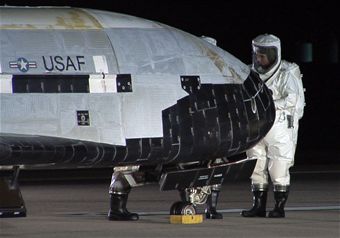
The X-37B Orbital Test Vehicle sits on the runway at Vandenberg Air Force Base, Calif., Dec. 3, 2010, during post-landing operations. Personnel in self-contained atmospheric protective ensemble suits are conducting initial checks on the vehicle and ensuring the area is safe. The X-37B launched April 22 from Cape Canaveral, Fla., allowing teams to conduct on-orbit experiments for more than 220 days during this first mission. (U.S. Air Force photo/Michael Stonecypher)

by Tech. Sgt. Amaani Lyle, Secretary of the Air Force Public Affairs

WASHINGTON (AFNS) -- After 244 days in space since its launch April 22 from Cape Canaveral, Fla., the X-37B orbital test vehicle landing marks the Air Force's latest step in experimental test missions to improve the service's space capabilities, officials said here Dec. 6.

The 11,000-pound OTV made an autonomous landing at Vandenberg Air Force Base, Calif., Dec. 3 at 1:16 a.m., allowing the Air Force to begin evaluation of its functions as a satellite communications, weather and material technology asset, said Deputy Under Secretary of the Air Force for Space Programs Richard McKinney.

"We're in a very serious and important business of providing national security space capabilities for our nation," Mr. McKinney said. "Some of those capabilities are state-of-the-art, highly complex and very technical, ... and for its first flight, we're extremely pleased with the outcome of the X-37B."

Mr. McKinney said the ability to examine such high-tech technologies as space situational awareness, intelligence, surveillance and reconnaissance, and satellite development before they're made operational is a long-sought-after capability that the X-37B provides.

"Now we can test those capabilities long in advance of putting them in operational space," he said.

He added that the X-37B functions like other satellites with operators on Earth monitoring its travels -- with one fundamental difference.

"The vehicle was commanded to re-enter, and there's a pre-determined routine to fold up the solar array and then do its re-entry burn to reorient to the right position to survive the heat during re-entry," said Lt. Col. Troy Giese, the X-37B program manager for the Air Force Rapid Capabilities Office.

Lt. Col. Giese explained that there is no way to "take over" the vehicle upon landing, but 30th Space Wing range controllers at Vandenberg AFB could terminate the end of the flight had the X-37B broken any of the pre-determined safety boundaries.

"The ability to bring a small vehicle that's able to launch, operate and land autonomously is really quite an achievement," Mr. McKinney said. "Hopefully we'll be able to provide a new way for us to develop experiments and technologies for our national security."

Slated to launch in spring 2011, the X-37B OTV-2 orbit will incorporate lessons learned from OTV-1, Mr. McKinney said.

"The vehicle performed everything it was asked to do this particular flight, so now we need to see how the materials operated in this long duration and examine the vehicle, since it was designed to operate for long periods of time," he added.

Saturday, December 04, 2010

X-37B Orbital Test Vehicle lands at Vandenberg AFB

The X-37B Orbital Test Vehicle sits on the runway at Vandenberg Air Force Base, Calif., Dec. 3, 2010, during post-landing operations. Personnel in self-contained atmospheric protective ensemble suits are conducting initial checks on the vehicle and ensuring the area is safe. The X-37B launched April 22 from Cape Canaveral, Fla., allowing teams to conduct on-orbit experiments for more than 220 days during this first mission. (U.S. Air Force photo/Michael Stonecypher)

VANDENBERG AIR FORCE BASE, Calif. (AFNS) -- The U.S. Air Force's first unmanned re-entry spacecraft landed here Dec. 3 at 1:16 a.m.

The X-37B, named Orbital Test Vehicle 1, which launched April 22 from Cape Canaveral, Fla., conducted on-orbit experiments for more than 220 days during its maiden voyage. It fired its orbital maneuver engine in low-earth orbit to perform an autonomous reentry before landing.

The X-37B is the newest and most advanced re-entry spacecraft. Managed by the Air Force Rapid Capabilities Office, the X-37B program performs risk reduction, experimentation and concept of operations development for reusable space vehicle technologies.

"Today's landing culminates a successful mission based on close teamwork between the 30th Space Wing, Boeing and the Air Force Rapid Capabilities Office," said Lt. Col. Troy Giese, the X-37B program manager from the AFRCO. "We are very pleased that the program completed all the on-orbit objectives for the first mission."

OTV-1's de-orbit and landing mark the transition from the on-orbit demonstration phase to a refurbishment phase for the program.

An Air Force launch team is preparing to launch the next X-37B, OTV-2, in Spring 2011 aboard an Atlas V booster.

Thursday, December 02, 2010

Preparations underway for first landing of X-37B

In a testing procedure, the X-37B Orbital Test Vehicle taxis on the flightline March 30, 2010, at the Astrotech facility in Titusville, FLa. (Courtesy photo)

Blog Ed Note: If the weather holds, I expect the X-37B to land tomorrow morning shortly before 6:00 a.m. PST. Time for the 4-6 Dec landing times will also be at or around 6:00 a.m. PST.

VANDENBERG AIR FORCE BASE, Calif. (AFNS) -- Space professionals are preparing for the first landing of the X-37B Orbital Test Vehicle here.

Members of the 30th Space Wing will monitor the de-orbit and landing of the Air Force's first X-37B.

While the exact landing date and time will depend on technical and weather considerations, it is expected to occur between Dec. 3 and Dec. 6.

Wednesday, December 01, 2010

Preparations underway for first landing of X-37B


VANDENBERG AIR FORCE BASE, Calif. -- Preparations for the first landing of the X-37B are underway at Vandenberg Air Force Base.

Space professionals from the 30th Space Wing will monitor the de-orbit and landing of the Air Force's first X-37B, called the Orbital Test Vehicle 1 (OTV-1). While the exact landing date and time will depend on technical and weather considerations, it is expected to occur between Friday, Dec. 3, and Monday, Dec. 6, 2010.

There are two interesting DoD NOTAMS on the board right now for KVBG.

M0487/10 - 4FT OBSTACLE ERECTED 75FT FROM THE EDGE OF THE RWY BETWEEN DRM'S 2/3 ON THE NORTH SIDE OF RWY 30. 30 NOV 01:20 2010 UNTIL 06 DEC 01:00 2010. CREATED: 30 NOV 01:24 2010

M0482/10 - AERODROME OFFICIAL BUSINESS ONLY. 29 NOV 18:34 2010 UNTIL 03 DEC 01:00 2010. CREATED: 29 NOV 18:43 2010

If the landing occurs during the time frame indicated above, here are the possible ladning times at Vandenberg courtesy of the Heavens Above website:

http://heavens-above.com/PassSummary.aspx?satid=36514&lat=34.76305&lng=-120.5983&loc=Vandenberg+AFB&alt=0&tz=PST

Wednesday, August 25, 2010

Secret X-37B Space Plane Has Changed Orbit


By Leonard David and Space.com

The U.S. Air Force's secretive X-37B space plane apparently boosted itself into a new orbit Aug. 9, according to reports from seasoned satellite trackers around the world, SPACE.com has learned.

The rest of the copyrighted story is available at
http://www.space.com/spacewatch/x-37b-space-plane-new-orbit-skywatchers-100823.html

Our original story on this spacecraft appeared on this blog on April 11, 2010 at the link http://mt-milcom.blogspot.com/2010/04/new-unmanned-spacecraft-set-to-launch.html

Little is known about the classified duties of the X-37B. However, Air Force officials did make it clear in pre-launch statements that the craft's first mission would focus on proving technologies necessary for long-duration reusable space vehicles with autonomous re-entry and landing capabilities. According to the Pentagon, a second X-37B is under construction.

Built by Boeing's Phantom Works division, the X-37B space plane is just over 29 feet (9 meters) long and weighs about 11,000 pounds (5,000 kg). It stands slightly more than 9.5 feet (3 meters) high and has a wingspan of just over 14 feet (4.3 meters).

The spacecraft's new mission is overseen by the Air Force Rapid Capabilities Office. The X-37B is believed to be operated by contractors under the direction of Air Force Space Command's 3rd Space Experimentation Squadron at Schriever Air Force Base.

The X-37B is designed to orbit Earth at altitudes of up to 500 nautical miles, loiter in orbit for up to 270 days, then re-enter the atmosphere to make an automated landing at Vandenberg.

"After the test objectives are satisfied, we look forward to a successful re-entry and recovery at Vandenberg Air Force Base, California, and post-landing refurbishment of the vehicle," said Air Force spokesman Andy Roake. "No landing date has been scheduled."

And then we have this from the dean of the SEESAT-L observers and list owner, Ted Molczan, who provides some technical details of the obital shift by the winged DoD spacecraft.

"Leonard David has nicely documented X-37B OTV-1's orbit-raising of Aug 9, including the involvement of several SeeSat-L members in the subsequent tracking and orbit analysis:

"One of the findings reported in the article is the apparent timing of the two orbit-raising manoeuvres to enable nearly continuous monitoring by several Air Force Satellite Control Network (AFSCN) tracking stations. Since that fact may be useful in understanding future manoeuvres, I want to provide some technical details that are not appropriate for a news article, but well-suited to this forum.

"Propagating the new orbit backward to the time of its closest separation from the original orbit, revealed the mid-point between the manoeuvres, which were performed on opposite sides of the Earth, near a perigee and an apogee.

"The first manoeuvre occurred on Aug 09, about 17:12 UTC, near 40 S, 98 E. The spacecraft was near the apogee of its original 403 X 420 km orbit, and manoeuvred to raise its perigee by 42 km, resulting in a 420 X 445 km orbit. Since the new perigee was greater than the original apogee, the line of apsides was effectively rotated 180 deg.

"About 16 minutes later, the spacecraft came within range of the Air Force Satellite Control Network (AFSCN) tracking station at Hawaii, the first of five AFSCN stations in a position to monitor it throughout the remainder of the manoeuvre sequence.

"The final manoeuvre occurred half an orbit after the first one, near the new apogee, at about 17:58 UTC, near 40 N, 100 W. The perigee was raised 12 km, resulting in a 432 x 445 km orbit. This was just before LOS by the AFSCN station at VAFB, and well above the horizon of the Colorado AFSCN station. Depending on the duration of the burn, the New Hampshire station may also have been able to monitor it directly; it certainly would have been able to monitor the results.

"Below are the estimated AOS/LOS times of the AFSCN tracking stations that OTV-1 passed during the manoeuvre sequence:

AOS LOS
17:38:28 - 17:48:29 AFSCN Hawaii Tracking Station, Kaena Point, Oahu, Hawaii
17:40:14 - 17:49:36 AFSCN Guam Tracking Station, Andersen AFB, Guam
17:47:42 - 17:58:13 AFSCN Vandenberg Tracking Station, Vandenberg AFB, California
17:51:24 - 18:01:56 AFSCN Colorado Tracking Station, Schriever AFB, Colorado
17:58:15 - 18:08:31 AFSCN New Hampshire Tracking Station, New Boston Air Station, New Hampshire

"AOS and LOS correspond to estimated time of rise/set, 2 deg above the horizon; actual AOS/LOS depend on local terrain, not considered in this analysis.

"Below are elsets documenting the manoeuvre. The pre-manoeuvre elset is derived from our last observations of the original orbit, on July 29. The two manoeuvre elsets are accurate estimates; their epochs correspond to the manoeuvre times."

Pre-manoeuvre orbit 403 X 420 km
1 36514U 10015A 10210.09309780 .00000000 00000-0 00000-0 0 09
2 36514 39.9851 119.3456 0012533 356.3806 3.6913 15.52766118 04

First manoeuvre 420 X 445 km
1 36514U 10015A 10221.71696759 .00000000 00000-0 00000-0 0 05
2 36514 39.9851 47.8421 0018773 266.6117 0.6500 15.45484000 09

Final manoeuvre 432 X 445 km
1 36514U 10015A 10221.74841435 .00000000 00000-0 00000-0 0 01
2 36514 39.9851 47.6508 0009598 266.8531 175.6000 15.43360000 09

Saturday, April 24, 2010

Air Force officials launch Atlas V carrying X-37B Orbital Test Vehicle

A United Launch Alliance Atlas V rocket with the X-37B Orbital Test Vehicle launches April 22, 2010, from Cape Canaveral, Fla. (Courtesy photo)

CAPE CANAVERAL AIR FORCE STATION, Fla. (AFNS) -- Members of the 45th Space Wing here launched a United Launch Alliance-built Atlas V Evolved Expendable Launch Vehicle carrying an X-37B Orbital Test Vehicle at 7:52 p.m. EDT April 22 here.

The X-37B, making its first space flight, will provide a flexible space test platform to conduct various experiments and allow satellite sensors, subsystems, components and associated technology to be efficiently transported to and from the space environment where it will need to function.

A number of new technologies will also be tested on the X-37B itself.

"If these technologies on the vehicle prove to be as good as we estimate, it will make our access to space more responsive, perhaps cheaper, and push us in the vector toward being able to react to warfighter needs more quickly," said Gary Payton, the Air Force deputy undersecretary for space Programs.

"This launch helps ensure that our warfighters will be provided the capabilities they need in the future," said Col. André Lovett, the 45th Space Wing vice commander and launch decision authority for the mission. "The 45th Space Wing (members are) proud to launch this historic mission and continue our commitment to assuring access to the high frontier."

The mission marked a number of important firsts.

"As the first U.S. unmanned re-entering space vehicle, the first of its kind, it has been remarkably easy to work with," said Lt. Col. Erik Bowman, the 45th Launch Support Squadron commander. "Processing and preparations went extremely smooth, and there were absolutely no delays in the vehicle processing. Overall there was great cooperation between the Air Force (officials) and industry teams of Boeing, (United Launch Alliance) and Astrotech, where we processed the spacecraft, to make sure everything went smoothly."

The mission was also the first launch of an Atlas V with the 501 configuration, requiring no solid rocket motors, and the first launch in five years to involve a 5-meter class fairing, Colonel Bowman said. "This vehicle is light enough to launch without the solid rocket motors even with the larger fairing, making this a rather unique configuration."

The X-37B program directly supports the Department of Defense's technology risk reduction efforts for new satellite systems. It will provide an "on-orbit laboratory" test environment to prove new technology and components before those technologies are committed to operational satellite programs.

Saturday, April 17, 2010

New unmanned spacecraft set to launch


by Staff Sgt. Vanessa Young, Defense Media Activity-San Antonio

SAN ANTONIO (AFNS) -- Air Force officials are scheduled to launch the U.S.'s newest and most advanced unmanned re-entry spacecraft April 22 at Cape Canaveral Air Station, Fla.

The X-37B Orbital Test Vehicle will provide a flexible space test platform to conduct various experiments and allow satellite sensors, subsystems, components and associated technology to be efficiently transported to and from the space environment where it will need to function.

The X-37B will also prove new technology and components before they are committed to operational satellites.

The OTV is the first vehicle since NASA's shuttle orbiter that has the ability to return experiments to Earth for further inspection and analysis.

"The X-37B is the only self contained effort intended to be an economically viable experimental test platform on-orbit for months at a time and then return," said David Hamilton Jr., the Air Force Rapid Capabilities office director.

Mr. Hamilton explained the X-37B as a risk reduction vehicle for space experimentation that explores concepts of operation for a long-duration, reusable space vehicle.

"The OTV has the potential to revolutionize how the Air Force operates in space by making space operations more aircraft like and adding in the capability for returnable plug-and-play experiments," Mr. Hamilton added.

The X-37 program, while originally a NASA initiative, is now led by Air Force Rapid Capabilities Office officials, which expedite development and fielding of select Defense Department combat support and weapons systems. AFRCO officials are currently working on the X-37B program, building upon early development and testing conducted by officials from NASA, the Defense Advanced Research Projects Agency and the Air Force Research Laboratory.

The X-37B's first flights will allow Air Force officials to evaluate the vehicle's performance and ensure the components and systems work the way they were designed.

"There is much to learn in the first few flights on the technologies used on this vehicle, how quickly it can be readied for a re-flight, and on the operational utility," Mr. Hamilton said. "We have started discussions with Air Force Space Command (officials) to plan for the possibility for transition to an operational capability, but the system first must prove its utility and cost effectiveness during the test program."

The X-37B has a 270-day on-orbit capability and will be used to test technologies including advanced guidance, navigation and control, thermal protection systems, avionics and high temperature structures and seals. Once the testing is complete, the OTV de-orbits and lands autonomously.

"While the X-37B is on orbit, it is like most satellites in that there are operators monitoring telemetry and sending commands to maintain the health of the spacecraft," said Lt. Col. Troy Giese, the X-37B systems program director. "Upon being given the command to return to Earth, the X-37B will automatically descend through the atmosphere and land on the designated runway. There is no one on the ground with a joystick flying it."

The X-37B is scheduled to land at Vandenberg Air Force Base, Calif.

"The X-37B is an important step in the effort to make space access more routine, affordable, and responsive," Mr. Hamilton said. "The technologies and concepts of employment that are proven by the Orbital Test Vehicle will be folded into development programs that will provide capabilities for our warfighters in the future."