Showing posts with label C-130 Aircraft. Show all posts

Thursday, July 04, 2019

AE61F6 - AE61F9 Who or what are they?

This block of hex codes is very interesting on many different levels. I have seen tie-ups all over the place because of all the mixed signals that have seen in the various intercepts.

Here is what I have seen:
AE61F6 5/13/2019 Mode-S c/s 1720978, Fixer 55
AE61F7 6/6/2019 Mode-S c/s G20979, R20979, Assault (ASLT) 979, LAC5873
AE61F8 7/2/2019 Mode-S c/s 1820980, LAC5875
AE61F9 7/3/2019 Mode-S c/s Raid 91, LAC5876

The first three do not look like C-130s, unless the Army has purchased some. Look at AE61F7. These Mode-S calls G20979, R20979 indicate US Army and National Guard G#####. The AE61F6 1720978 and AE61F8 1820980 are US Army serials. But all have either a LAC Mode-S or Fixer 55 call which is used by Lockheed down in Marietta and I see here almost daily for the 130J testing program.

Finally, I have seen the Raid ## call used by the 27SOW/9SOS Night Wings out of Cannon AFB, NM. (See below)

AE61F9 17-5876/18-20 RAID91 2019-07-03 13:30:08 MC-130J United States USAF | 5731 20825

Not sure what is going on here but does anyone know if the Army has purchased some 130 rolling stock? Or is Lockheed intentionally miscoding these to fool those of us reporting their test? Or is it something different? These blocks are preassigned by DoD to Majcoms and then usually further assigned to airframes and or tactical use. This block fascinates me. Comments and thoughts are most welcomed at this point. Send them along to the email addy in the masthead.

Happy 4th to you all and keep our military servicemen and their families in your thoughts and prayers as we celebrate the day we declared our independence.


Monday, May 01, 2017

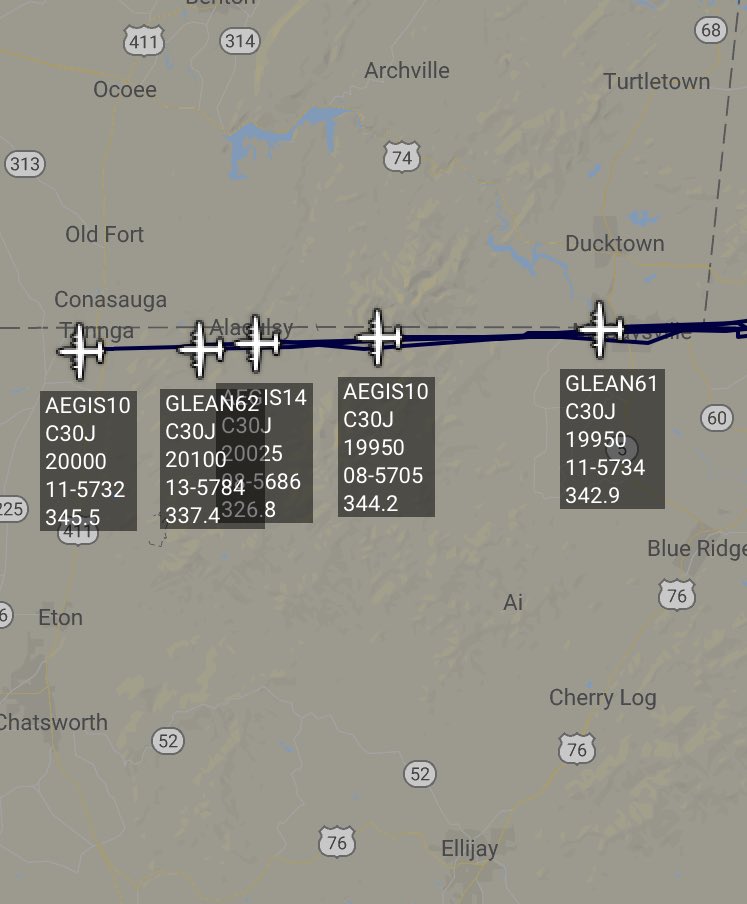
USAF C-130s on parade over the radio ranch

Had this parade of C-130s fly over the radio ranch yesterday afternoon. We could hear them and saw them on Mode-S but they were obscured behind a local ridge visually. Thanks to Buzz @Buzz6868 on twitter  for the graphic See our daily listings below for the list of 130s in this parade.

Wednesday, July 06, 2016

End of an Era: Last C-130 Leaves North Carolina's Pope Field


A C-130 H2 transport aircraft from the 440th Airlift Wing stationed on Pope AFB, North Carolina, flying over North Carolina, Dec. 2008. (U.S. Air Force photo)


Story courtesy of the AP and Military.com. Thanks to Ron Perron for the heads up.

FAYETTEVILLE, N.C. — An era is over at Fort Bragg as the last C-130 cargo plane based at Pope Field has left.

Local media outlets report the plane flew out of Fayetteville on Wednesday for Arizona and the so-called "Boneyard" where the Air Force stores unused aircraft.

The plane's leaving is another step in the deactivation of the 440th Airlift Wing at Pope.
The Air Force announced plans to close down the unit more than two years ago when the wing had more than 1,250 active duty and civilian personnel. It also had 12 C-130s used to support the training of troops at Fort Bragg.

Now the unit has fewer than 400 personnel and it has no planes. Work now turns to closing the unit.

Wednesday, October 22, 2014

Hercules by the Numbers


You may know that the C-130 Hercules is operated by 70 countries. You might even be able to name several of C-130’s 70+ variants. But, here are some facts and figures that you may not know about the Herc courtesy of Lockheed Martin on their website at http://tinyurl.com/kvgv2ac.

Thursday, September 12, 2013

Joint Operational Access Exercise

A C-17 Globemaster taxis Aug. 18, 2013, at Alexandria International Airport, La. The aircraft was participating in a personnel drop of 681 U.S. Army paratroopers during Joint Operational Access Exercise 13-0X. (U.S. Air Force photo/Staff Sgt. Russ Scalf) 
By Staff Sgt. Russ Scalf,  19th Airlift Wing Public Affairs
LITTLE ROCK AIR FORCE BASE, Ark., -- Airmen from the 19th Airlift Wing flew to Alexandria International Airport, La., Aug. 18, 2013, as part of Joint Operational Access Exercise 13-0X. The Airmen provided the Army with airlift muscle for an airborne assault training exercise in conjunction with Green Flag Little Rock 13-09.

The JOAX was a single-day combined military training event designed to prepare Airmen and soldiers to respond to worldwide crises and contingencies. In the ensuing days, combat airlift missions were flown in support of simultaneous exercises conducted by multinational joint forces.

The JOAX tested the ability of three C-130H crews from Little Rock Air Force Base, Ark., combined with three C-130J's and three C-17 Globemasters from other units, to rapidly deploy forces into a region, demonstrate strength, and deter aggression. Numerous contingency missions were executed by the 34th Combat Training Squadron at Little Rock Air Force Base, through the Joint Readiness Training Center at Fort Polk, La., delivering combat airlift support through various resupply and humanitarian missions.

"The exercise planning began at the beginning of June with a mid-planning conference July 16 and final planning conference Aug. 8, both at Pope Air Field, N.C., with the 82nd Airborne Division and the 437th Airlift Wing and C-17 planners," said Capt. Ryan Miller, the JOAX lead C-130 planner. "We had seven mission planning cell days, two meetings with all of the supporting agencies, not including the days of execution."

The Air Force's overall objectives focused on joint planning and execution, goals which were also a priority for the 19th Airlift Wing.

The wing had additional priorities of its own for the exercise. Miller reported they hoped to develop and successfully execute joint airdrop procedures. Specifically, they were seeking to gain experience in tactical planning and flying, testing national military strategy and techniques, tactics and procedures, as well as operational plans for a joint contingency response. Additionally, through partnering with the U.S. Army 82nd Airborne Division, 93rd Fighter Squadron, and New Zealand and Canadian Air Forces, the wing gained integration experience, which according to Miller, can be very difficult to obtain.

"Our involvement in JOAX was successful," said Miller. "All of the paratroopers landed safely on target and we met our objectives. After all of the consolidated efforts working with the 82nd Airborne and the C-17's, it was a relief to know we accomplished our mission, and it was a success."

In addition to the crews in the air, Airmen from Team Little Rock also supported operations by providing maintenance support at Little Rock Air Force Base and at Alexandria. In all, approximately 75 Team Little Rock Airmen played a role in the success of the various exercises.

Friday, August 23, 2013

Airlifters enable jump week


by Airman 1st Class Soo C. Kim,  374th Airlift Wing Public Affairs

YOKOTA AIR BASE, Japan -- The C-130 Hercules shakes with turbulence as it hits a thermal updraft. The seats are packed with adrenaline-soaked Soldiers fully equipped in gear and parachutes.

"Ten minutes!" A jumpmaster yells out over the aircraft noise. "Ten minutes!" Soldiers reply as they prepare themselves for the aircraft's drop zone entry. When given the order, they hook into the zip-line and line up ready to take the dive.

Time seems to fly by as the aircraft steadies its route. "Five minutes!" is announced and soon after comes the call, "Two minutes!"

The loadmaster opens the troop door, letting in blinding light that shines on the Soldiers' determined faces. Beyond the door is nothing but a free-fall to earth.

The aircraft enters the drop window and a voice announces over the radio, "Green light, green light! Go, go, go!"

The paratroopers leap out the door, their C-9 parachutes rapidly deploying behind them. Olive drab canopies open above them, and the Soldiers steer into the wind toward the landing zone.

From Aug. 21-23, 2013, Army Special Forces paratroopers participated in joint jump training with aircrews from the 36th Airlift Squadron at Yokota Air Base, Japan.

"We conduct airborne operations training in order to maintain proficiencies for any possible future combat airborne operations," said Army Staff Sgt. Adrian Colon, 1st Battalion, 1st Special Forces Group.

During the week, the Soldiers participated in multiple jump sorties aboard three C-130 Hercules assigned to the 374th Airlift Wing.

"We had number of people conducting combat jumps, jumping with their combat equipment and we also had people conducting sustainment jumps, with just their parachute and no equipment," said Army Capt. Robert Shumaker, the Headquarters Support Company commander.

The training began with mission briefings, gear checks and run throughs of multiple jump scenarios on the ground before taking to the air.

"The training was a success," Shumaker said.

According to Army Staff Sgt. Emerson McArthur, lead jumpmaster, this training was a rare opportunity for him and his fellow jumpers.

"Today we had three birds following each other for combat mass attack operations," McArthur said. "Normally we don't get to do that, but the 374th provided the support for us."

Not only was the training beneficial to maintain proficiency for the jumpers, but it was also a step necessary for the jumpers to advance into higher ranks.

"(Today's) jump was required to advance to senior jump master status," McArthur said. "(This type of jump) doesn't happen often and we appreciate the support we received today."

Wednesday, August 21, 2013

Airmen accomplish airlift surge

C-130 Hercules fly during a training mission above Yokota Air Base, Japan, Aug. 19, 2013. Seven C-130s flew in formation practicing airlift tactics and procedures. (U.S. Air Force photo by Osakabe Yasuo)

by Tech. Sgt. Christopher Marasky,  374th Airlift Wing Public Affairs

YOKOTA AIR BASE, Japan -- Twenty-eight powerful T56 turboprop engines sit on the flightline, idling as they prepare to generate over 125,000 horsepower to lift seven C-130 Hercules into the air in a coordinated take off.

That was the sight as Yokota Air Base conducted a large formation training operation Aug. 19, 2013. Seven C-130's took off in the surge formation to practice the 374th Airlift Wing's capability to maintain and launch multiple aircraft at once.

Members of the 374th Maintenance Group and the 374th Operations Group worked together over the weekend to ensure all of the aircraft were ready to fly.

"We are working with the crew chiefs and assisting them with everything they need," said Airman 1st Class Nathan Judd, 374th Aircraft Maintenance Squadron electrical and environmental apprentice. "We make sure everything looks right and works correctly, ensuring all of our systems are top notch."

Judd said working with the other units on the large number of aircraft and in the timeframe provided was a unique and challenging opportunity for young Airmen.

"This has been a great experience for a young Airman," he said. "Normal day to day operations feel like training, but when you get to something like this, it feels real. We have a high pace tempo and turn more aircraft, so it's been a great experience and a lot of fun."

Along with the maintainers and operators, many other units around Yokota had the opportunity to practice and showcase their capabilities during the surge event, including the 374th Operations Support Squadron.

"These events really increase our ops tempo, and we look forward to them every time," said Tech. Sgt. Richard Price, 374th OSS tower watch supervisor. "These surges prevent us from becoming complacent, and they showcase our ability to launch and control multiple aircraft outside of the normal."

While the tower has only a small piece of the overall mission during the surge, they highlighted how every piece has to come together to make the event work according to Price.

"Our part might be small in the big picture, but if the aircraft are late taking off, it will throw off the entire schedule," he said. "So we're a small, but important part of the mission."

One member who got a chance to see how it takes a team to accomplish the mission was Senior Airman Jason Cotton, a 374th Maintenance Operations Squadron aerospace propulsion journeyman, who had the opportunity to fly in one of the C-130's in the formation.

"The flight made me realize that every part of this operation is important," he said. "My shop can build engines all day long, but we aren't the ones who put them on the aircraft, and we don't inspect the plane before the flight. I realize now that it takes more than the props shop to make it go, so I see what it's all about now."

Cotton said the experience also helped him understand the importance of what he does and his role within the mission.

"It showed me how all of the hard work pays off," he said. "The whole thing makes you realize a little bit more how important this job is."

Friday, May 04, 2012

Little Rock AFB members say goodbye to last C-130E

C-130E Hercules 61-2358 takes off from the flightline for the last time May 1, 2012, at Little Rock Air Force Base, Ark. 61-2358 will be used as a static display at Edwards AFB, Calif. (U.S. Air Force photo/Tech. Sgt. Chad Chisholm)

by Staff Sgt. Jacob Barreiro, 19th Airlift Wing Public Affairs

LITTLE ROCK AIR FORCE BASE, Ark. (AFNS) -- Airmen gathered for a ceremony here May 1 to say goodbye to the first C-130E Hercules ever produced and the last one to be retired.

Tail No. 61-2358 will retire to Edwards AFB where it will be used as a static display after more than 50 years of service. Leaders and Airmen from three different wings and civic leaders from the local community in attendance to honor the plane prior to its final flight.

"This plane represents a milestone in the history of the C-130 and the history of the Air Force," said Col. Brian Robinson, the 19th Airlift Wing commander. "This is the most capable, tough as nails aircraft, and it's been to every remote corner of the planet, including Antarctica."

Robinson said the aircraft had a distinguished career that fittingly began here. The aircraft flew its first operational mission Sept. 24, 1957, by the mandate of President Dwight Eisenhower, to airlift 1,200 paratroopers to enforce the desegregation of Little Rock Central High School. The mission was carried out successfully, the first of thousands upon thousands 2358 would be used for in its five-decade long career.

"She never rested; she did her mission to the end," Robinson said.

Fred Ross, the vice president of C-130 programs at Lockheed Martin, said the aircraft had a distinguished career, from its first flight to its twilight run to retirement.

"C-130s always carry the load," he said.

Ross said the plane's five decades in the sky is a rare sight, and that no other aircraft has been in continuous production for 57 years like the C-130.

Tail No. 2358 is the last of the C-130E models to be retired from the active duty fleet and is slated to be replaced by the newer J models. The J models are a huge leap in technology, Ross said, but will still be a Hercules in the C-130 tradition, a tradition exemplified by 2358.

"I'm proud of 2358 ... it's been involved in humanitarian airlifts all over the world and contributed numerous air drops in the lands of Afghanistan and Iraq. Most of all I'm proud it was built for (the Air Force) and served (the Air Force) well for more than 50 years."

Robinson said the retirement of 2358 was a great occasion to celebrate the history of combat airlift and to recognize the efforts of the local community.

"Today we not only recognize those who fly and maintain our aircraft, but also the local community and their leaders," he said. "Without your support these planes would not fly."

Friday, January 13, 2012

Boeing's C-130 Transport Upgrades Said to be Ended by the Pentagon

WASHINGTON — The Pentagon has canceled a 10-year-old program that has Boeing upgrading C-130 Hercules transports with modern cockpit electronics, according to two government officials.

The move saves almost $4 billion, including $2.22 billion planned from 2013 to 2016, according to an Air Force program document. The Air Force recommended the program termination and Pentagon planners accepted, said one of the officials familiar with the decision, who spoke on condition of anonymity because it hasn’t been announced.

While Boeing is performing the initial upgrades, the Air Force had planned a competition for most of the work after the program was entangled in a procurement scandal in the mid-2000s. The Pentagon rejected a previous move by the Air Force to kill the program in 2009.

The C-130 has the highest profile among the few programs the Pentagon intends to cancel in its plan for 2013 to 2017, the officials said. The proposed budget will contain more truncations or delays, such as moving the purchase of 100 to 150 Lockheed Martin Corp. F-35 jets beyond 2017, the last year of the coming five-year spending plan.

Defense Secretary Leon Panetta is scheduled Jan. 26 to announce some of the budget details, according to a third defense official. The Budget Control Act directed the Pentagon to cut $261 billion through 2017 from its planned budget, including $46.8 billion in 2013.

“Boeing has not been notified” of any cancellation decision, Jennifer Hogan, a company spokeswoman, said in an e mail. “We continue to meet our C-130 customer commitments and continue to perform on the low-rate initial production contract.”

The initial $4.1 billion C-130 Avionics Modernization Program contract was awarded to Boeing in 2001. Lockheed Martin challenged the win after Darleen Druyun, the Air Force’s former No. 2 acquisition official, told federal prosecutors she improperly favored Boeing in the selection. L-3 Communications Holdings and BAE Systems also protested the award after Druyun’s admission.

The Government Accountability Office recommended in 2005 that the service rebid a portion of the contract. The Air Force agreed in April 2005 to do so.

Druyun was sentenced to nine months in prison October 2004 for discussing a job at Boeing while negotiating a refueling- tanker contract, a conflict-of-interest violation. She also admitted to awarding the C-130 work to Boeing out of gratitude for the company employing her daughter and future son-in-law.

Boeing, based in Chicago, was allowed to update the first 26 of the 221 C-130s through 2015. It has received $1772 million so far for upgrades of six aircraft, engineering and logistics support and spares and installations.

The first four fully upgraded aircraft have been delivered to Little Rock Air Force Base in Arkansas. An additional aircraft is to be delivered next month, according to Air Force spokeswoman Jennifer Cassidy.

The remaining 195 aircraft upgrade kits were to be subject to competition starting in June 2013 with a full-rate production contract awarded in July 2014.

The upgrades outfit the aircraft with a common glass cockpit, integrated digital communications and navigation capabilities that meet Federal Aviation Administration and European air-traffic management and navigation mandates, Cassidy said.

The price for each upgrade kit has increased 16.3 percent to $15.4 million from $13.2 million, the Pentagon said in June 2010.

Cassidy said the Air Force won’t discuss the program’s budget status pending release of the fiscal 2013 budget. The Air Force has spent $1.69 billion on program research, according to a service program document.

The upgrade work is performed in Oklahoma City, Oklahoma. The work is being performed by Boeing’s Global Services & Support division under the company’s Defense, Space and Security unit.

Read more here: http://www.kansas.com/2012/01/12/2172944/boeings-c-130-transport-upgrades.html#storylink=cpyhttp://www.kansas.com/2012/01/12/2172944/boeings-c-130-transport-upgrades.html

Friday, July 15, 2011

MAFFS aircraft, crews conclude firefighting operations in Southwest

A MAFFS-equipped C-130 Hercules drops fire retardant, building a fire containment line in the Sacramento Mountains in New Mexico. (U.S. Forest Service photo/Jennifer Myslivy)

PETERSON AIR FORCE BASE, Colo. (AFNS) -- After performing 242 sorties and dropping 609,960 gallons of fire retardant over the wildfires that have been burning in New Mexico and Arizona, Air Reserve Component personnel and their Modular Airborne Fire Fighting System-equipped aircraft concluded their mission July 13.

National Interagency Fire Center officials released the units along with the command and control element July 13, ending the Air Force Reserve and Air National Guard support of Southwestern U.S. firefighting efforts that began when specially-equipped U.S. Air Force C-130 Hercules aircraft began dropping retardant June 16.

Under the direction of the Joint Forces Air Component Commander for Air Forces Northern, since June, C-130s equipped with fire fighting capabilities deployed to Kirtland Air Force Base, N.M., as part of the 302nd Air Expeditionary Group. Command and control of the aircraft was provided by the 302nd AEG from Boise, Idaho.

"This has been an extremely busy fire season so far," said Lt. Col. Dave Condit, the deputy commander of the 302nd AEG. "We have exceeded our annual average of fire missions by more than 50 percent, and we are just now entering the part of the summer when we are typically first tasked.

"The team success over the past 30 days demonstrated the professionalism and effectiveness of the citizen Airmen who volunteer for this vital mission," Condit added.

Returning to home station July 14 were personnel and two MAFFS-equipped aircraft from the Air Force Reserve's 302nd Airlift Wing based at Peterson AFB, Colo. Other MAFFS units that participated in the firefighting efforts were the North Carolina ANG's 145th Airlift Wing and the California's ANG's 146th AW.

MAFFS is a self-contained aerial firefighting system, which can discharge 3,000 gallons of water or fire retardant in less than five seconds, drawing lines of containment that can cover an area one-quarter of a mile long by 60 feet wide. Once the load is discharged, the MAFFS system can be refilled in less than 12 minutes.

With the use of new MAFFS II units, this year's fire season was the first to successfully fly fire missions using a new concept of operations that increased the effectiveness while decreasing costs.

The MAFFS units are owned by the U.S. Department of Agriculture Forest Service, one of several federal and state government agencies and organizations with roles and responsibilities in wildland fire suppression that make up the National Interagency Fire Center in Boise, Idaho. The Department of Defense flew at the request of NIFC.

AFNORTH is the air component for U.S. Northern Command and when tasked, provides support to local, state, tribal, regional and federal emergency service agencies.

(Courtesy of 302nd Airlift Wing Public Affairs)

Saturday, July 02, 2011

Lockheed Martin testing new C-130 aircraft


Lockheed-Martin down in Marietta, GA has been testing a couple of their new MC-130J airframes this last week. The following aircraft were seen here on the radio ranch courtesy of our Mode-S receiving station.

LAC 5659 MC-130J 6/29/2011 #09-6210 AE29D7
LM 5656 MC-130J 6/30/2011 #09-6207 AE29D4

Thursday, April 21, 2011

Dyess Airmen assist with Texas wildfires

by Tech. Sgt. Robert Wollenberg, 7th Bomb Wing Public Affairs

DYESS AIR FORCE BASE, Texas (AFNS) -- Members of the 7th Bomb Wing and 317th Airlift Group here are lending a helping hand in support of firefighting efforts throughout South Texas.

From logistics to meals to maintenance, Airmen here will support four C-130 Hercules aircraft equipped with Modular Airborne Fire Fighting Systems and more than 60 crew members as they help battle wildfires under the direction of the Joint Forces Air Component Commander for Air Forces Northern at Tyndall Air Force Base, Fla.

"Over the weekend, Dyess Airmen quickly responded to a call from Texas for wildfire support," said Col. James Murray, the 7th Mission Support Group commander. "In a matter of hours, the wing prepared for and received four specially configured C-130 aircraft and 80 aircrew and support personnel who will provide vital airborne fire fighting support to the state of Texas and surrounding areas. The aircraft will start flight operations (April 18), flying numerous missions to drop fire retardant agent on areas designated by the U.S. Forestry Service."

Two of the four aircraft are from the California Air National Guard's 146th Airlift Wing. The third is from the 153rd AW in Wyoming, and the fourth is from the 145th AW in North Carolina.

The MAFFS is a self-contained aerial firefighting system, which can discharge 3,000 gallons of water or fire retardant in less than five seconds, covering an area one-quarter-of-a-mile long by 60-feet wide. Once the load is discharged, it can be refilled in less than 12 minutes.

"Being able to provide airborne firefighting support to the citizens of Texas is job #1 for the MAFFS," said Brig. Gen Robert Branyon, the deputy Joint Forces Air Component commander. "Whether it's a humanitarian effort, evacuee assistance, search and rescue, or dropping food and medical supplies into unreachable areas, we're poised and ready to help in any way possible."

AFNORTH is the air component for U.S. Northern Command, and when tasked, provides support to local, state, tribal, regional and federal emergency service agencies.

"The wing has responded magnificently and we will continue to provide whatever the state of Texas needs to get these fires under control," Colonel Murray said. "We are ready to sustain their operations indefinitely, if required, to ensure property and lives are safe. Between the 7th BW and the 317th AG, we'll make sure they keep flying."

The MAFFS is owned by the USDA Forest Service, one of several federal and state government agencies and organizations with roles and responsibilities in wildland fire suppression that comprises the National Interagency Fire Center in Boise, Idaho.

C-130s continue support of fire fighting efforts in Texas, Mexico

PETERSON AIR FORCE BASE, Colo. (AFNS) -- Under the command of U.S. Northern Command, six C-130 Hercules aircraft, equipped with U.S. Forest Service Modular Airborne Fire Fighting Systems, continue to support firefighting efforts in Texas and Mexico.

Two of the C-130s, from the 302nd Airlift Wing at Peterson Air Force Base, Colo., are deployed to Laughlin Air Force Base, Texas, at the request of the Mexican government to assist the Comisión Nacional Forestal control the wildfires in the Mexican state of Coahuila.

The other four C-130s, from the Wyoming, North Carolina and California Air National Guard, are deployed to Dyess Air Force Base, Texas, to assist the National Interagency Fire Center in controlling fires in south Texas.

In support of fighting the fires in Coahuila, Department of Defense aircraft have completed 28 air drops using 63,000 gallons of retardant as of late April 19.

At the same time, DOD aircraft have made 32 air drops using 90,000 gallons of retardant while fighting the Texas fires.

"We realize that time is important to people who are facing very difficult and challenging times due to the fires, and we're committed to responding as efficiently and quickly as possible," said Col. Jack Pittman, the 302nd Air Expeditionary Group commander. "It's remarkable how all the agencies involved are able to work together in such a dynamic situation to provide timely and effective containment actions, and we're proud to support those agencies."

Monday, November 08, 2010

Samurai surge at Yokota

C-130 Hercules aircraft from the 36th Airlift Squadron taxi out for a mission during a seven-ship sortie Nov. 4, 2010, at Yokota Air Base, Japan. The sortie was part of a Samurai Surge exercise. The squadron is the only forward-based tactical airlift squadron in the Pacific region. They provide C-130 aircrews to conduct theater airlift, special operations, aeromedical evacuation, search and rescue, repatriation and humanitarian relief missions. (U.S. Air Force photo/Osakabe Yasuo)

by Airman 1st Class Katrina R. Menchaca
374th Airlift Wing Public Affairs

YOKOTA AIR BASE, Japan (AFNS) -- Seven C-130 Hercules aircraft took off as part of a Samurai Surge exercise here Nov. 4.

Launching the fleet is an operation that occurs when Airmen launch as many aircraft available on the ramp simultaneously, known locally as Samurai Surge.

"The C-130s here at Yokota Air Base are the only tactical airlift fleet for the Pacific Air Forces, so we provide the tactical airlift to be able to move humanitarian supplies, medical evacuation missions and any cargo-carrying capability that units need here within the Pacific," said Capt. Michael Makaryk, the 374th Aircraft Maintenance Squadron officer in charge. "We launch here from Japan and we go to places like Thailand, Australia, anywhere in the Pacific Command area of responsibility to deliver whatever needs to be delivered."

The Samurai Surge is a joint effort between the 374th Maintenance Group and the 374th Operations Group.

For the groups, the exercise was a way for aircrew and maintainers to test their ability to generate all available aircraft.

"We need to be able to demonstrate our maximum capability at a moment's notice in order to support any type of higher-headquarters tasking, whether it be humanitarian or combat support at a moment's notice," said Chief Master Sgt. Albert Novelli, the 374th Aircraft Maintenance Squadron superintendent. "We need to be able to launch our aircraft and get out of town in support of that mission,"

"The normal flying and training schedule is normally one, two or three aircraft a day, so in order to put up seven or eight aircraft, it takes a lot of effort from our maintainers and our operators," Captain Makaryak said.

Wednesday, June 09, 2010

Reservists talk to Congress about aerial spray mission

by Col. Bob Thompson, Office of Air Force Reserve

WASHINGTON (AFNS) -- Six reservists fresh from the fight to save the Gulf of Mexico coast from one of the worst oil spills in U.S. history briefed congressional members and staffers here June 7 and 8.

As part of the military's only fixed-wing aerial spray team, the Airmen flew specially configured C-130 Hercules aircraft 100 feet above the water and sprayed an oil dispersant to break the oil slick into smaller droplets. Then, the detergent-like dispersant pushed the droplets down to the microorganisms that eat the oil.

"On April 28 at 10:30 p.m., we got the call," said Maj. Drew Tancer, a pilot and the operations officer who led the first-responders from Youngstown Air Reserve Station, Ohio. "Fourteen to 15 hours later, we were on scene."

Major Tancer led a team of about 60 reservists and two C-130 aircraft from the 910th Airlift Wing. Working in careful coordination with the Coast Guard, Environmental Protection Agency and the National Oceanic Atmospheric Administration, the Reserve aerial spray team covered more than 30,000 acres with oil dispersant in the six weeks they were engaged.

The congressional staffers listened to the reservists' brief, and then asked questions about the oil dispersant and the aerial spraying equipment.

"An oil dispersant is used to mitigate the environmental disaster," said Maj. Mark Breidenbaugh, an entomologist from the 910th AW. "It is like a detergent soap that breaks the oil up and moves it under the water so it stays in the water column. This speeds up the natural process that breaks down the oil."

From May 1 until the reservists left Mississippi on June 4, they flew 92 missions and sprayed nearly 150,000 gallons of oil dispersant on the Gulf of Mexico's spill area.

"It comes down to do you want to fight it on the beach or fight it on the water?" said Col. Fritz Linsenmeyer, the 910th AW commander. "The products we use are pre-approved by the EPA and Coast Guard. And, although this spray is like a soap, you wouldn't put it in the water unless you had to. We want to do anything we can to protect the coast as much as possible from this disaster."

For nearly two decades, members of the 910th AW have participated in oil-spill cleanup exercises with the Coast Guard in the Gulf of Mexico and off the coasts of the Atlantic and Pacific Oceans.

Aerial spray is a unique mission conducted by members of the Air Force Reserve, and the Youngstown Airmen have developed close partnerships with other first-responders and insight into disaster response operations.

"After providing the first response, our military aerial spray operators have now returned to home station," Colonel Linsenmeyer said. "This is normal for these situations."

Rear Adm. Mary Landry, the federal on-scene coordinator for the oil spill response, signed a memo releasing the Air Force Reserve planes and people from the spray mission.

Under a transition plan, civilian planes are taking over the delivery of oil dispersant in the gulf waters.

"The military gets things started and now civilian contractors are flying the continuing operations," Colonel Linsenmeyer said. "But, if we're needed to go back, our team is ready at a moment's notice."

"We're proud of what we have contributed to our nation and our communities," Major Breidenbaugh said.

Friday, March 05, 2010

Missouri Air Guard C-130s, crews fly to Chile

by Army Staff Sgt. Jim Greenhill, Special to American Forces Press Service

ARLINGTON, Va. (AFNS) -- Two Missouri Air National Guard C-130 Hercules transport aircraft with 47 crewmembers are en route March 5, to aid earthquake-ravaged Chile.

139th Airlift Wing officials sent the two aircraft, crews and maintenance support personnel from Puerto Rico, where they had been supporting U.S. Southern Command, to Santiago, Chile, March 4, Missouri Gov. Jay Nixon announced in a news release.

Wing officials are scheduled to send additional aircraft and crews to Santiago in the coming weeks, Missouri Guard officials said.
The guardsmen supported earthquake relief efforts in Haiti, flying personnel and supplies to Port-au-Prince.

"The men and women of the Missouri Air Guard are uniquely qualified to provide emergency response, relief and recovery services, both at home and abroad," Governor Nixon said. "I am especially proud of the skill and professionalism of our Air Guard units, and I know they will provide invaluable service to the people of Chile during this time of need."

C-130 aircraft are used to airlift people and cargo long distances in all weather conditions day and night from low to high altitudes and can land in austere areas.

"The 139th Airlift Wing is again at the tip of the spear in supporting humanitarian relief efforts," said Col. Michael McEnulty, the 139th Airlift Wing commander. "We are always leaning forward to come to the aid of those who have been affected by disasters, whether at home or abroad."

Missouri sits on the New Madrid fault, named for the Missouri town hit in 1811 and 1812 by some of the strongest earthquakes in North American history.

Missouri National Guard Airmen routinely train for earthquake response and host national earthquake planning workshops. At the most recent, in September, more than 200 Guard officials and representatives of civilian agencies from eight states discussed emergency response to a catastrophic earthquake in the New Madrid Seismic Zone.

National Guard Airmen are uniquely qualified to respond, a Missouri University of Science and Technology geological engineer told the workshop.

"That's because the National Guard has combat engineering familiarity and background and in a combat situation you don't control the cards you are dealt," David Rogers said. "The response in an emergency situation has to be fluid and capable of changing. There is no manual for disaster response."

National Guard members have a history of responding to earthquakes that goes back at least 100 years. And Guard members have decades of experience supporting disaster relief operations in Central and South America.

In 1906, after a 7.8 magnitude earthquake hit San Francisco, California National Guard members didn't even bother waiting for orders; they just started showing up at their armories ready to assist, which the Guard did in support of civilian agencies throughout the aftermath.

"The work done and still being done by the National Guard members will be long and gratefully remembered," a newspaper editorial stated. "Our present National Guard is descended in direct official line from those citizen soldiers that stood, yielding not, at Saratoga, Ticonderoga, Stony Point and Yorktown, and have proved themselves worthy of their ancestors."

Earthquakes are notoriously unpredictable. Scientists debate whether even trying to predict them is a worthwhile exercise, and the U.S. Geological Survey's National Earthquake Information Center flatly states that they cannot be predicted, while also noting that there is a 100 percent chance that one will strike somewhere on the planet today.

In 1990, a New Mexico climatological consultant predicted devastation coming to New Madrid, Mo., on Dec. 3 that year. The prediction was enough to spark state planning, but the day came and went without incident.

As scientists try to predict where the next big earthquake is likely to strike in the United States, National Guard members stand ready to respond, Guard officials said.

"The National Guard has the trained personnel, the equipment and the command and control capabilities in order to execute this mission to help provide food, water, electricity; anything the citizens would be in need of during a major disaster such as an earthquake," said Army Brig. Gen. Stephen Danner, Missouri's adjutant general.

Tuesday, November 10, 2009

C-130 arrival in Poland marks end, new beginning

Capt. Tyler Robertson performs a walk around inspection prior to engine start up before piloting the last E-model C-130 Hercules Nov. 2, 2009, from Ramstein Air Base, Germany, to Powidz Air Base, Poland. (Defense Department photo/Master Sgt. Scott Wagers)

by Master Sgt. Scott Wagers, Defense Media Activity-Ramstein

RAMSTEIN AIR BASE, Germany (AFNS) -- Ramstein Air Base Airmen delivered the base's last E-model C-130 Hercules Nov. 2 to Powidz Air Base, Poland, marking the end of 38 years of service to the U.S. Air Force but the newest addition to the Polish air force's blossoming fleet of strategic airlifters.

C-130 tail No. 1299 touched down and as the aircrew exited the aircraft Polish air force Brig. Gen. Tadeusz Mikutel, the 33rd Air Base commander, and Lt. Col. Mieczyslaw Gaudyn, 14th Airlift Squadron commander, welcomed the American Airmen with warm greetings and a firm handshake.

"The main task for the C-130s is to support our contingency operations in Afghanistan, Chad, Africa and everywhere Polish troops and supplies are needed," said Colonel Gaudyn, who along with his squadron's airmen will be flying the C-130.

Colonel Gaudyn, a former MiG fighter pilot who transitioned to the Antonov 26 cargo transport aircraft, said Poland has approximately 2,000 troops operating in Afghanistan's Gozni Province. Until now, all of these soldiers were transported into theater and subsequently resupplied using U.S. and Ukrainian airlift.

"Now we have much more capability to transport cargo and supplies to our troops which is very important for them, and much quicker," he said adding that Polish troops will no longer have to wait for available transportation from other nations.

"If you have your own (airlift), you can just react when there is a need," he said.

The primary air transport platform used by the Polish air force has been the Spanish-made CASA C-295, a twin turboprop tactical transport aircraft. The sleek fuselage design fits up to 70 passengers or a payload of approximately 7.5 tons but is not well suited for bulky cargo, Colonel Gaudyn said.

By comparison, the E-model Hercules can carry 90 fully equipped passengers or a payload of 17 tons.

Prepping Polish aircrews and maintainers for the transition to the larger Lockheed-Martin built Hercules has been accomplished with a blend of English language and specialty knowledge training at bases in Texas and Arkansas and through a type of work mentorship exchange between U.S. and Polish air force personnel.

In January 2009 a pair of C-130's and the 86th Wing commander from Ramstein AB visited Powidz AB to give personnel there an overview of the aircraft as a part of European Command's military-to-military program, said Capt. John Szczepanski, an affairs officer based at the U.S. Embassy in Warsaw, Poland.

In March 2009, Powidz AB officials received the first of five donated U.S. C-130Es. Three months later, the Illinois Air National Guard's Peoria-based C-130 wing visited Powidz AB to conduct a two-week flying and maintenance engagement under the auspices of the state partnership program, Captain Szczepanski said.

In the seven months since the first C-130 arrived in Poland, aircrews have successfully flown more than 100 sorties.

C-130 tail No. 1299 is not a part of the four remaining donated aircraft slated for future delivery to Poland. It was transferred to Powidz AB under a Foreign Military Sales lease agreement between Air Force Materiel Command and Poland in support of building partnership capacities and teamwork amongst United States' allies.

According to Capt. Szczepanski, the entire donation of five totally refurbished aircraft, support equipment, supplies, training, and contracted logistics support, is valued at $120 million and 100 percent funded through bilateral military assistance grant money.

After the engines of 1299 came to a rest on the Powidz AB tarmac, Polish air force ground crew and commissioned officers moved in closer to unload pallets and lay eyes on their new plane. Some ventured inside the crew door to survey the interior while others posed for personal pictures in front of the plane.

The 14th Airlift Squadron currently has 25 qualified aircrew to fly the C-130E and growing.

Tuesday, October 06, 2009

Air Force officials dedicate C-130 to Army's 82nd Airborne in Afghanistan

Servicemembers assembled on the flightline to tour a C-130 Hercules from the 440th Airlift Wing at Pope Air Force Base, N.C., Oct. 5, 2009, at Bagram Airfield, Afghanistan. The C-130 was dedicated to the Army's 82nd Airborne Division in honor of the cohesion of the Air Force and the Army in Afghanistan and was put on display for servicemembers to view the aircraft. (U.S. Air Force photo/Senior Airman Felicia Juenke)

by Tech. Sgt. John Jung, 455th Air Expeditionary Wing Public Affairs

BAGRAM AIRFIELD, Afghanistan (AFNS) -- Air Force officials here dedicated a C-130 Hercules to the Soldiers of the Army's 82nd Airborne Division stationed in Afghanistan Oct. 5 at Bagram Airfield.

The transport was originally dedicated at Pope Air Force Base, N.C., Oct. 25, 2008, to Fort Bragg's entire 82nd Airborne Division based in North Carolina.

Tail number 79282 from the Air Force Reserve 440th Airlift Wing from Pope AFB has official nose art prominently displaying an American eagle in flight surrounding the iconic 82nd Airborne's insignia wings on the aircraft's fuselage. The plane also sports "Bragg-Pope" on its tail flash representing the close relationship between the Fort Bragg and Pope AFB.

Using the total force, an active duty crew deployed from the 2nd Airlift Squadron, an associate unit of the 440th AW, to fly the Reserve C-130 to Bagram Afghanistan. The crew included Capt. Alan Rathjen and Capt. Laura Easton, both C-130 pilots, and Staff Sgt. Matt Metz, C-130 loadmaster.

"The aircraft is being dedicated to the 82nd in honor of the cohesion of the Air Force and the Army in the fight in Afghanistan," said Captain Rathjen, a native of St. Louis who is assigned to the 774th Expeditionary Airlift Squadron.

While the dedication was symbolic in nature, the tangible effects of the C-130 are felt every day by Airmen and Soldiers alike.

"A few days ago we airdropped (Meals, Ready to Eat) and water down to Soldiers at a (forward operating base)," said Captain Easton of the 774th EAS and a native of Pittsburgh. "It's the mission we trained for at the 2nd AS and (one) we're ready to employ here for the joint fight."

"I came here to be a part of history," said Army Master Sgt. John Plasse, assigned to the 38th Infantry Division and an Afghan national security forces liaison. "It's great to have something you've worked in, flown into and out of combat with ... and then it's gotten you home safely all those times ... dedicated to you and your fellow Soldiers."

Bringing critical supplies via airdrop to Soldiers on the ground is what the C-130 is suited to and is excelling at in Afghanistan. C-130s at Bagram Airfield average between five and eight tons of cargo per airdrop mission.

Continuing the overall mission to feed, fuel and arm the fight, September marked the fourth consecutive month in which an increase of supplies was airdropped by the Air Force to coalition partners and local citizens across Afghanistan.

In total, 4.1 million pounds of goods were dropped to forward operating bases, combat outposts and other austere locations in support of ground forces.

"It's our day-to-day job," said Sergeant Metz of the 774th EAS who is a native of Springfield, Va. "I'm proud to have brought this C-130 to Afghanistan for the dedication, but I'm more gratified being the loadmaster who gets to airdrop (supplies) to the guys on the ground."

Airdrops have proven to be a safe and reliable method for delivering vital supplies into locations where roads don't exist, the terrain is too mountainous, the cargo is too heavy for helicopters or where the insurgent threat is too great.

Thursday, July 09, 2009

Airmen provide presidential support in Moscow

by Master Sgt. Scott Wagers, Defense Media Activity-Europe

MOSCOW (AFNS) -- Two C-130 Hercules aircraft and aircrews from Ramstein Air Base, Germany, hauled a 17-member presidential support team, 10 portable light carts and a utility truck to Moscow's Vnukovo International Airport July 3 in preparation for President Barack Obama's visit to the region.

Planning the travel route for the 10-hour round trip flight would normally be a routine task for veteran flyers; however, Captain Zac Johnson, the C-130 aircraft commander, said military aircraft haven't made the trip into Russia's capital city for quite some time.

"When we looked at all our products to prepare for this mission, the last account we had of a crew coming out (to Moscow) was from a DC-10 mission 10 years ago, so nobody knew what to expect," he said.

But once the pair of C-130s down at the oldest of Moscow's three operating airports, the 37th Airlift Squadron crew commented that the support was awesome, the facilities were excellent and that help was given where it was needed.

While fuel trucks were being vectored in to top off the planes, Airmen on the presidential support team began pairing with aircrew to unload cargo.

Within 30 minutes, the planes were empty and Capt. William Taylor, the presidential support team's detachment chief, began focusing on preliminary coordination for the commander-in-chief's arrival.

It's a mission that Captain Taylor said was "very normal" for members of the 86th Contingency Response Group but no less special.

"It is definitely awesome to be a part of something that is bigger than just yourself and to also be a part of making history," he said.

The presidential support team, comprised of Airmen representing eight different career field specialties brought communications capabilities, ground security for Air Force One, maintenance, air transportation and even an airfield manager who speaks Russian.

Tech. Sgt. Shawn Smith said he studied Russian in both high school and college and had previously traveled to Moscow to conduct a site survey for an airshow in 2007.

"This is a high-profile mission and a unique opportunity," he said.

The opportunity was also unique for Capt Zac Johnson, a three-year C-130 pilot with only 17-hours of stick time as the aircraft commander.

As the 37th AS transitions from the H to the J model C-130, the pool of experienced H-model pilots is thinning out. Captain Johnson said that while this increases the workload on H-model aviators, it also creates unique opportunities.

"A year ago in our squadron, you would never see a brand new aircraft commander fly a mission into Moscow, let alone a presidential support mission," he said. "I'm lucky I have the chance to do this."

Wednesday, June 03, 2009

Spectres begin their journey to a new home

One of two 16th Special Operations Squadron AC-130H Spectre gunships taxis onto the flightline at Cannon AFB May 19. The 16 SOS formerly transfers from the 1st Special Operations Wing at Hulburt Field, Fla., to the 27th Special Operations Wing at the end of June. (U.S. Air Force photo/Airman 1st Class James Bell)

by 2nd Lt. Mark Lazane, 1st Special Operations Wing Public Affairs

HURLBURT FIELD, Fla. -- Seeing a C-130 Spectre gunship rolling down the strip is a common occurrence here.

So common, in fact, that often the sight of the aircraft taking off does not draw the attention of most personnel on base. To many, it is just another routine training exercise in progress for one of the busiest squadrons in the Air Force.

True to form, on Tuesday, May 19, a pair of Spectre gunships took off in what may have appeared to be yet another normal training flight.

However, this particular take off meant something truly special to all Hurlburt Field personnel, whether they realized it or not.

On this particular takeoff, members of the 16th Special Operations Squadron, the men and women who fly the Spectre gunship, rolled down Hurlburt Field's runway, marking the beginning of the end of a decorated combat squadron located on Hurlburt Field.

The planes reached the end of the runway, climbed into the sky, then quickly headed due west, becoming the first airplanes from Hurlburt Field headed to the squadron's new home awaiting them at Cannon Air Force Base, N.M.

"It was satisfying to see the big pieces of the move getting prepped and ready for their formation departure," said Lt. Col. Sean Farrell, 16th SOS commander. "It marked another milestone [in the move] as it was one of first tangible things to demonstrate that yes, we are actually moving."

Upon landing at Cannon AFB, the two aircraft and their crew members were greeted with a warm reception. Then, with as much simplicity as they had left Hurlburt Field, the crew members got to work. They knew that the gunship's operational tempo does not allow the aircraft or its crew to sit idle for a long period of time, even during historic moments.

"We have to continue to replace and train our guys," said Farrell. "We have to train them to ensure we continue to have the best gunship crews Air Force Special Operations Command's got."

Cannon AFB, formerly a fighter wing base, was named as a new AFSOC base. The addition of a second base dedicated to special operations missions helps alleviate some of the log jam that currently exists for some aircraft at Hurlburt Field who use the Eglin Range for training, said Farrell.

Moving an entire squadron has the potential to cause some headaches.
Col. Farrell, however, believes that a well-developed plan coupled with expert personnel have helped to lessen the impact and shock that could have risen.

"Our maintenance folks have really come through for us," Farrell said. "They have managed to provide us with planes to do the mission. With their help, we have been able to provide training and combat sorties in three different locations. They have done a great job."

"I'm proud of how we have accomplished the move thus far," Farrell said. "We haven't interrupted schoolhouse operations or operational requirements. In addition, despite the move, we have been able to meet the obligations to the combatant commanders down range, while working with reduced operations here."

The move will help the aircraft train more often, which allows them to continue to improve their tactics and techniques to become an increasingly lethal force, said Farrell.

The expansive Melrose Range, located just outside of Cannon AFB, is a range that provides the operators with realistic practice areas. It has similarities to the Eglin Range already in use by the squadron, which helps eliminate much of the lag time for personnel as they get used to their new surroundings, said Farrell.

"The training opportunities will get better every year," Farrell said. "We plan on taking advantage of that. There are some aspects of training that may in fact eventually be a better fit for the squadron [at Cannon]."

The AC-130H Spectre gunship is a modified Lockheed airplane configured with several side-firing weapons, including a 105 mm Howlitzer and a 40 mm Bofors cannon. The aircraft is used for close air support, armed reconnaissance, interdiction, night search and rescue, and airborne command and control.

There will be several events taking place to highlight the squadron's change of location. On June 18, there will be a barbecue organized by the 16th SOS as an opportunity for the squadron to thank the wing for the memories.

The following day, there will be a flag transfer, when the 16th SOS's guidon will be loaded onto a gunship and flown to Cannon to signify the transfer of location. On that day, the detachment currently operating at Cannon AFB will officially become the 16th SOS, and the remaining individuals who are finishing up the move at Hurlburt Field will operate as a detachment here until all aspects of the move are complete.

Though manpower, equipment and aircraft will still be at Hurlburt Field through the end of October, the transformation of the new location will take another step on July 30, when Farrell relinquishes command of the squadron to the current Squadron Operations Officer, Lt. Col. Jason Miller.

The manner in which the 16th SOS is moving is unique, said Farrell. Usually, a squadron will go on inactive status in order to move their people all at once to a new location.

Due to the operational requirements of the aircraft, however, the 16th SOS was not afforded that luxury, as they have had personnel continuously deployed in support of Operation Enduring Freedom since 2001.

The 16th SOS became operational in October of 1968 at Ubon Royal Thai Air Force Base in Thailand. They moved to Hurlburt Field in December 1975, where they have been ever since.

Despite over 30 years at Hurlburt Field, Farrell does not feel that people should be saddened by the move.

"The 16th SOS is not going away, we will still be the 16th SOS no matter where we go," Farrell said. "I understand for former active duty gunship guys, it's bittersweet because we're leaving, but it's not as sad for guys in our unit, though they will miss their friends and family that they have here. It's beneficial to spread units and capabilities around and not hold them in one spot."