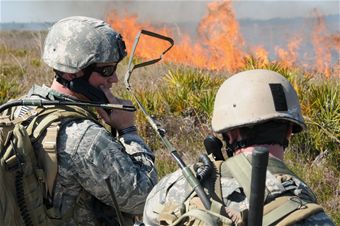
by Airman 1st Class Daniel Phelps, Atlantic Strike Public Affairs
AVON PARK, Fla. (AFNS) -- The team of four trudged down the road in the hot, mid-afternoon sun wearing body armor, Kevlar helmets and radios on their backs with their weapons drawn. There had been reports of an enemy stronghold in the area, and the team's mission was to take the "bad guys" out.
Finally, they came to a split in the road.
This was not a real mission, but rather the south tactical lane portion of Atlantic Strike 10-02, an Air Combat Command sponsored joint exercise designed to hone the tactical employment of air power during close air support missions.
Though the exercise was taking place in Central Florida, the simulation was taking place in Southwest Asia. The two Soldiers, Sgt. Alex Hummell, 25th Infantry Division joint fires observer, and Spc. Ron Aschnewitz, 25th ID joint fires observer, continued down the road while Tech. Sgt. Tony Hall, 118th Air Support Operations Squadron tactical air control party and joint terminal attack controller, and Senior Airman Blake Sigmon, 118th ASOS tactical air control party and radio operator, maintainer and driver, took to the left.
The goal for this scenario was for the JFOs to coordinate close air support with the JTAC in order to engage a ground target in support of the maneuver commander's intent, explained Sergeant Hall.
As the two TACPs began down their path, Sergeant Hall tripped over a wire and a ground burst simulator went off beside them, simulating an improvised explosive device. Soon, they took cover and tried to get in contact with the JFOs to determine the point of origin of the attack. Again the two TACPs came under attack, forcing them to leave and find cover someplace else.
"South TAC is designed to mess with their minds," said Tech. Sgt. Adam Schwartz, South TAC training leader. "It is, mentally, the most challenging lane here. They need to be aware of everything that is going on, spatial relationships and where their partners are at all times while under fire."
They took off and found cover by an old, destroyed vehicle. There, they once again tried to get in contact with the JFOs as an UH-1 Huey and an AH-1W Cobra patrolled the sky overhead, waiting for coordinates on the attack's origin.
Finally, a visual was established on the JFOs location by the air support, and attack coordinates were passed.
The thudding blades of the rotor could be heard over head as the helicopter came in for the attack. The rattle of its gun firing accompanied dirt flying through the air and the pounding of metal as bullets tore into the ground and building. Rockets were launched from the helicopter with a final explosion as the Cobra flew off.
Afterward, the TACPs made a call to see if there were any mosques in the town.
"The reason for this call was to ensure to not cause any cultural or religious damage to anything," said Staff Sgt. Wayne Michaelson, South TAC training leader.
Soon a call came in from the JFOs that one of their troops had been "injured" in the previous attack, and a line was called in to the choppers for a medical evacuation.
The Huey soon landed and the "injured" troop was loaded and evacuated.
Once the Huey departed, the Airmen and Soldiers began working to figure out the coordinates of the recent attack. As they began to establish the location, another mortar occurred, forcing them to flee the area again.
"The constant stress from mortar attacks causes confusion and frustration for the JTACs and JFOs," Sergeant Moon explained.
Once the team reached a protected location, the frustration was evident as they began arguing about the attack's origin.
"Just get the coordinates already," Sergeant Hall shouted.
After much discussion, the location of the mortar attacks was established, and a nine-line for another CAS attack was called in.
"Our job as training leaders is to make the JTACs and JFOs mess up," Sergeant Moon said. "If they are doing too well, we'll find something else to throw at them."
"The stress levels were pretty high," explained Sergeant Hall. "There was a lot going on, confusion about target location and communication issues all while being attacked. It's a lot to react to."
Finally, the Cobra called in from over the radio, "threat neutralized."
"The idea of this scenario is to keep the JFOs and JTACs under constant stress to see if they'll still hit accurate targets," Sergeant Schwartz said.
Sergeant Moon explained that each of the different lanes the participants go through are designed this way so that when they are on the battlefield, they will be better trained to handle the stress of combat.
"This is exactly what we are going to be doing in the real world," concluded Sergeant Hall. "It's as close as you can get without real bullets flying at your head."