Showing posts with label USMC. Show all posts

Thursday, March 31, 2022

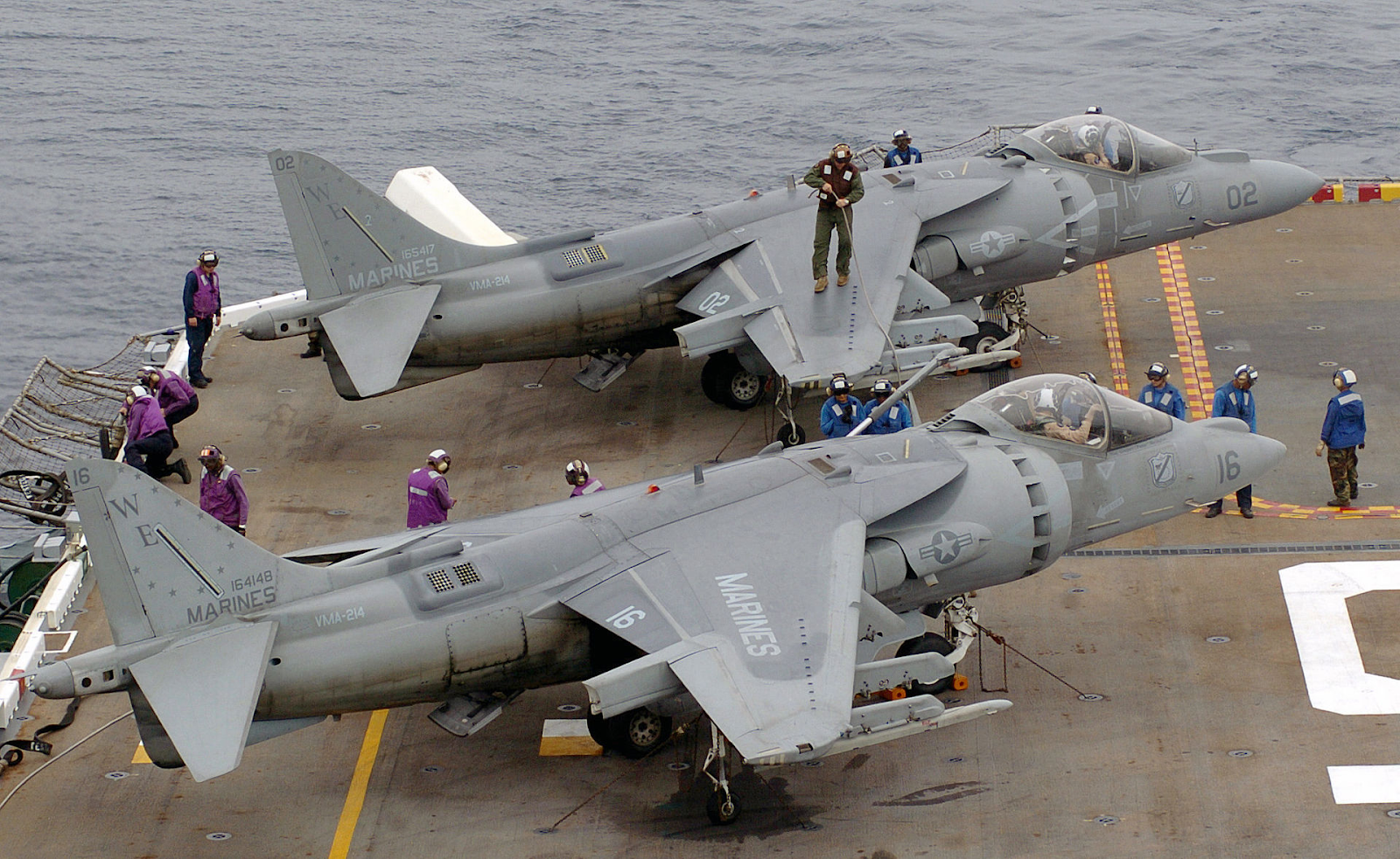
VMA-214 re-designated as VMFA-214

From Scramble News (https://www.scramble.nl/military-news/vma-214-re-designated-as-vmfa-214)

Marine Attack Squadron (VMA) 214 Black Sheep ('WE-xx') was officially re-designated as Marine Fighter Attack Squadron (VMFA) 214 at Marine Corps Air Station Yuma (AZ) on 25 March 2022.

The unit is part of Marine Aircraft Group (MAG) 13, 3rd Marine Aircraft Wing (MAW).

The re-designation of the squadron is part of the transition from the AV-8B Harrier to the Lockheed Martin F-35B Lightning II. In 1989, the Black Sheep transitioned from the A-4 Skyhawk to the AV-8B Harrier which they operated for a period over 30 years.

The unit participated in combat operations throughout the globe, including Operation Restore Hope, Operation Iraqi Freedom, and Operation Enduring Freedom.

Most recently, VMA-214 completed its final AV-8B deployment with the 11th Marine Expeditionary Unit, during which they participated in Operation Inherent Resolve. 


JO2 Zack Baddorf, USN - US Defense Visual Information Center photo DN-SD-06-04295

U.S. Navy aviation fuels (purple) and plane handlers (blue) sailors fuel two U.S. Marine Corps McDonnell Douglas AV-8B Harrier IIs of Marine attack squadron VMA-214 Blacksheep prior to launch from the Tarawa-class amphibious assault ship USS Peleliu (LHA-5). Peleliu was underway in the Pacific Ocean conducting carrier qualifications on 4 Aug 2005. VMA-214 is normally stationed at Marine Corps Air Station (MCAS) Yuma (Arizona, USA).


Thursday, July 21, 2016

US Military Preps F-35 for Operations, Including Possible ISIS Strikes


FARNBOROUGH, England -- The Marines' F-35 Joint Strike Fighter has four deployments lined up across the next five years, a senior official said this week -- and some of them could take it into the heart of the coalition fight against the Islamic State.

Speaking at the Farnborough International Airshow on Monday, Col. William Lieblein said by 2021 the aircraft will have completed three shipboard pumps with a Marine Expeditionary Unit, and one on an aircraft carrier.

"2021 will be here before we know it," he said. "And that's about the same time we start really standing up a significant number of squadrons."

The F-35B "jump jet" variant of the Lockheed Martin aircraft declared initial operational capability just a year ago, and its first deployment has already been announced: Marine Fighter Attack Squadron 121 [VMFA-121], in Yuma, Arizona, will move permanently forward to Okinawa, Japan, where the aircraft will be sent out aboard the 31st MEU, which is also permanently forward-based in the Pacific.

Lieblein said other F-35 squadrons will then deploy with two West Coast MEUs, though he could not specify which units would take out the aircraft or when those deployments would take place. The three West Coast MEUs, based at Camp Pendleton, California, are the 11th, 13th and 15th. The 13th MEU deployed in February and began launching airstrikes on Islamic State militants in Iraq and Syria from the Persian Gulf.

Marine Corps spokeswoman Capt. Sarah Burns confirmed that it was a "very real possibility" that a West Coast-based MEU with a squadron of F-35s aboard could receive a similar tasking.

The first carrier deployment for the Marines will come in 2020, Lieblein said. While he could not name the carrier to deploy the aircraft, a Marine official said it may be the USS George H.W. Bush. The Marine Corps plans to acquire 63 F-35C carrier-variant Joint Strike Fighters, which have larger wings and foldable wingtips and are designed for arrested recovery landings. The F-35C is set to achieve IOC in 2018 or early 2019, shortly ahead of the planned deployment.

Lieblein said the transit across the Atlantic of three F-35Bs, two Marine Corps aircraft and one Royal Air Force bird, to the United Kingdom for participation in the Royal International Air Tattoo and Farnborough was a confidence-builder and was accomplished seamlessly, with the same mission profile and the same number of in-flight tanking evolutions that Lieblein had previously done in a Marine Corps F/A-18 Hornet.

"That was a major milestone for us and it demonstrated to ourselves and to everyone else that we can forward deploy this program whenever we want to," he said.

The F-35B is set to enter full-rate production in 2018, and the Marines' aggressive deployment schedule demonstrates how eager officials are to make use of the long-awaited platform.
But it's possible U.S. troops won't have to wait until late 2017 or 2018 to test the mettle of the fifth-generation fighter in combat.

The commander of Air Combat Command, Gen. Herb "Hawk" Carlisle, said Wednesday that he was prepared to deploy the F-35A Air Force variant immediately after the aircraft reaches IOC later this year.

"The minute I declare initial operational capability, if the combatant commander calls me up and says they needed F-35s, I would send them," Carlisle said, according to Bloomberg News.

Friday, April 30, 2010

Joint F-35 electronic warfare squadron stands up

by Ashley M. Wright, 96th Air Base Wing Public Affairs

EGLIN AIR FORCE BASE, Fla. (AFNS) -- The squadron serving as the sole Department of Defense provider of electronic warfare support for the F-35 joint strike fighter activated April 23 in a ceremony here.

Surrounded by artifacts from the history of airpower in the Air Armament Museum, the 513th Electronic Warfare Squadron stood up as a first step toward preparing Airmen, Sailors and Marines with the latest electronic warfare data for all three variants on the 5th generation aircraft.

"We are not supporting only one variant of the F-35, we are supporting all," said Col. Kevin J. McElroy, the 53rd Electronic Warfare Group commander. "One team, one fight, one guidon."

The squadron, currently manned by 32 technicians and engineers, will grow to 130 members at full strength. Squadron members will operate the $300 million United States Reprogramming Laboratory, that tests all aspects of the joint strike fighter's electronic warfare capability. Half of the staff will be Airmen, while the other half will consist of Navy and Marine members.

Electronic warfare is "any military action involving the use of electromagnetic and directed energy to control the electromagnetic spectrum or to attack the enemy," as described in Air Force Doctrine Document 2-5.1. Mission data is the descriptions the aircraft needs to identify both enemies and allies on the battlefield.

The laboratory is still under construction with a projected completion date of summer 2010 and hardware will arrive a year from now, the colonel said. Until that time, the squadron is performing a plethora of tasks as they become the "one-stop organic shop" for F-35 data.

"Our engineers are currently developing threat models and 5th generation mission data for the F-35," said Lt. Col. Tim Welde, the 513th EWS commander. "Our technicians are undergoing maintenance training as well as prepping the lab with power supplies, network connectivity and data storage devices. Next year, when the F-35 hardware is integrated and the lab is fully operational, the squadron will be able to successfully develop, test and deliver the critical mission data for JSF warfighters."

Thursday, December 24, 2009

Exercise Iron Magic Concludes in Arabian Gulf

By Lt.j.g. Jennifer Womble, Expeditionary Strike Group 5 Public Affairs

Arabian Gulf (NNS) -- The exercise was a culmination of the training conducted during the weeklong exercise which included host nation Marines training alongside the aviation combat element, ground combat element and logistics combat element of the 11th Marine Expeditionary Unit (MEU).

Rear Adm. Sinclair Harris, commander ESG-5 commended the interoperability demonstrated during the exercise.

"The impressive skills exhibited by the host nation Marines ensured the success of this exercise," said Harris. "The relationships we are able to form during this annual exercise are invaluable, and we look forward to future training with them."

Harris also observed the Fleet Shock Trauma Platoon of Combat Logistics Battalion 11, the logistics combat element of the 11th MEU, instructing host nation Marines on basic lifesaving techniques. The surgical team is the first with shock trauma capability to be deployed with a MEU, and consists of two emergency medical physicians, a physician's assistant, a critical care nurse and about 20 corpsmen.

"There is a period known as the golden hour, which is the first 60 minutes following an injury for the medical team to stabilize the victim. That is where we excel by providing advanced care during the first moments following battlefield injuries. Once the patient is stabilized we are able to transport them to a full care hospital where they receive further treatment," said Lt. Brian Downing, emergency response doctor with the Shock Trauma Platoon.

The Marines and Sailors, part of the Bonhomme Richard Amphibious Ready Group, came ashore from amphibious transport dock USS Cleveland (LPD 7) and amphibious dock landing ship USS Rushmore (LSD 47), which departed San Diego Sept. 18, on a deployment to the Western Pacific and Middle East.

Tuesday, December 15, 2009

Marines from Lejeune set to deploy to Afghanistan

Marines from Camp Lejeune are the first of thousands set to deploy to Afghanistan.

Monday, December 07, 2009

DOD Announces Afghanistan Force Deployment

The Department of Defense today announced the deployment of approximately 16,000 additional forces to Afghanistan, the initial elements of the 30,000 troops authorized on Nov. 30. An infantry battalion task force, with approximately 1,500 Marines, from Camp Lejeune, N.C., will deploy later this month. Regimental Combat Team-2, headquartered at Camp Lejuene, N.C., will deploy approximately 6,200 Marines in early spring 2010. A Marine Expeditionary Force (Forward) headquarters from I Marine Expeditionary Force, Camp Pendleton, Calif., will deploy approximately 800 Marines in spring 2010.

A Brigade Combat Team (BCT), with approximately 3,400 soldiers from the 1st Brigade, 10th Mountain Division, Fort Drum, N.Y. will deploy in early spring 2010 to conduct a training mission.

Secretary Gates also approved the deployment of approximately 4,100 support forces, which will deploy at various times into spring 2010.

Wednesday, November 04, 2009

Coast Guard officials pin hopes on flight recorders


Editor note; For those of you who track callsigns, the CG C-130 that was lost was CG 1705 per an official USCG message.

And from the Sacramento Bee online website:

U.S. Coast Guard officials say searchers are turning their attention to finding aircraft flight recorder boxes for clues into the cause of the crash Thursday of a Coast Guard search plane and a Marine helicopter over the ocean near San Diego.

Searchers had found no trace of either aircraft's crew as of Monday. The Coast Guard C-130 carried seven; the helicopter, two.

A memorial service is being planned Friday at McClellan Air Park in North Highlands, home base for the rescue plane. Coast Guard officials on Monday said they have not decided whether the memorial will be public or private.

The Coast Guard plane (CG 1705) was on a search and rescue mission in a military training flight, or "Warning Area," called Whiskey 291. The Marine helicopter was one of several helicopters on a training mission in the area.

The flight recorders are in 2,400 feet of water and may be difficult to retrieve, Coast Guard Lt. Josh Nelson said. A Coast Guard-Marine mishap investigation panel has been established to analyze clues for the cause of the crash, Nelson said.

And the heros lost in the tragedy:

Crash related deaths: Aboard USCG 1705:
LCDR Che J. Barnes, aircraft commander (CG Aviator #3436)
LT Adam W. Bryant, co-pilot (CG Aviator #3935)
AMTC John F. Seidman, flight engineer
AET2 Carl P. Grigonis, navigator
AET2 Monica L. Beacham, radio operator
AMT2 Jason S. Moletzsky, air crew
AMT3 Danny R. Kreder II, drop master

Aboard the Marine Corps AH-1W Super Cobra, assigned to Marine Aircraft Group 39 of the 3rd Marine Aircraft Wing):

Major Samuel Leigh
1st Lt. Thomas Claiborne

Air Station the CG aircraft and/or crew were assigned to: Air Station Sacramento, California

Aircraft type and Coast Guard tail number: Lockheed HC-130H Hercules, 1705*

Location of the incident: About 50 miles off San Diego and 5 miles east of San Clemente Island

Description of the incident: The Coast Guard C-130 1705, with a crew of seven, was involved in a midair collision with a Marine AH-1W Super Cobra helicopter, with a crew of two. The collision occurred around 7 p.m. about 50 miles off the San Diego County coast and 15 miles east of San Clemente Island. The C-130 was engaged in a search for a missing person while the helicopter was involved in a training exercise. The active search for survivors was suspended on Sunday Nov 1, however the search continues for any wreckage that could aid in the investigation into the cause of the accident.

Tuesday, December 09, 2008

Airmen, Marines join forces during exercise at Kadena

By Staff Sgt. Angelique Perez, 18th Wing Public Affairs


Chaplain (Capt.) Martin King (left) and Chaplain (Col.) Clifton Perry set up a cordon after discovering a simulated unexploded ordnance outside Chapel 2 Dec. 4 at Kadena Air Base, Japan. The scenario is part of Exercise Beverly High 09-01, a joint Air Force-Marine Corps exercise designed to test the ability of both services to execute their critical missions under simulated combat conditions. (U.S. Air Force photo/Airman 1st Class Chad Warren)

KADENA AIR BASE, Japan (AFNS) -- Japan-based Airmen and Marines came together for Exercise Beverly High 09-01 the first week of December at Kadena Air Base.

Airmen of the 18th Wing integrated with Marines from Marine Corps Station Iawkuni as they executed their missions under simulated combat conditions.

About 35 aircraft and 700 Marines from Marine Aircraft Group 12 took part in the training, with Marine F/A-18s and AV-8 Harriers flying alongside 18th Wing aircraft as well as flying "red air" sorties against the wing. KC-130 refueling aircraft from Marine Corps Air Station Futenma also participated in the exercise.

"The Marine aircraft are providing a realistic threat replication to challenge our F-15 (Eagle) pilots," said Maj. Michelle Shicks, an 18th Wing weapons and tactics officer. "They are also supporting the joint force commander's objectives by working in conjunction with the F-15s to employ air-to-ground ordnance and destroy enemy targets."

For the Marines, the chance to integrate their air operations with the 18th Wing's was invaluable.

"Joint training allows us to train as we fight," said Marine Capt. Jeff Mueller, a weapons systems training officer with Marine Fighter Attack Squadron 242. "It also allows us to iron out our differences in training and learn from our mistakes so that we can maximize lethality in combat."

This type of joint training opportunity is limited in Okinawa, and both services made the most of it.

"This is a rare opportunity to stay in our local area and conduct joint training with an air-to-air mission happening with a simultaneous air-to-ground mission, all within the same airspace," Major Shicks said. "(We're able to) employ in a joint integration arena, sharing new tactics, techniques and procedures and refining current employment procedures to better prepare for combat against any enemy."

While the flying operation was a huge part of the exercise, every facet of the wing's wartime mission was tested. To validate unit readiness, the 18th Wing Plans and Programs Office exercises division, along with more than 300 exercise evaluation team members, created dozens of tough but realistic wartime scenarios to test Airmen on their critical wartime skills.

"Scenarios range from responding to an attack by a hostile nation to apprehending someone who absent-mindedly drives through one of the gates without showing an ID," said Lt. Col. Steven Plank the 18th Wing Plans and Programs chief.

Other areas of evaluation included self-aid and buddy care responses to medical scenarios, ranging from loss of a limb, severe head trauma and loss of blood to mild cases of dehydration and heat exhaustion.

"The exercise is going well," Colonel Plank said. "There are a bunch of Airmen who were not here for the (Operational Readiness Inspection) that are learning about the tremendous effort it takes to conduct sustained combat operations."

The exercise also allowed units to prepare for the deployment process by sending Airmen through the Installation Deployment Readiness Center where they are processed and briefed for simulated deployments to various locations around the world.

"Training exercises like this help us put into practice the proper response procedures involved with a hostile environment," said Airman 1st Class Timothy Stencil, a tech controller with the 18th Communications Squadron. "The more we prepare at home station, the more it will become second nature to respond correctly when the time comes to perform in a real-world situation."

Airmen practiced donning gas masks and other protective equipment during different alarm and Mission Oriented Protective Posture levels. They also trained to follow the procedures for each specific level and practice accomplishing their mission in full MOPP gear.

"The exercise permits training under more stressful conditions than can be achieved on a daily basis," Colonel Plank said. "Additionally, it helps individuals and units gain confidence in their abilities before entering actual combat."
Tuesday, February 13, 2007

New Florida 380-400 MHz System Uncovered

My close friend Robert Wyman has found a new 380-400 MHz TRS control channel in the Jacksonville, Florida, area. Robert said his 996 was reporting SID 014 Ch-0113 and the frequency was 386.225. No TGs reported yet.

I believe this is part of the Phase 4 USMC 380-400 MHz system deployment and this TRS is located at Blount Island, Florida. I am seeing all these system using the system ID of 14c.

If you are near the following bases please check out the 380-400 MHz LMR subband for one of these new systems.

Phase 1 MCB Camp Lejeune, NC; MCAS Cherry Point, NC
Phase 2 MCAS Yuma, AZ; MCMWTC Bridgeport, CA; MCAGCC 29 Palms, CA
Phase 3 MCAS Beaufort, SC; MCRD Parris Island, SC; MCLB Albany, GA; Henderson Hall, VA
Phase 4 MCLB Barstow, CA

There will also be deployable UHF LMR systems at Camp Pendleton and Camp Lejeune.

If you are in any of the areas above please do a search in the 380-400 MHz band (nfm, 12.5-kHz spacing) and let us know what you have found. I believe there are new trunk radio systems at the bases above.