Showing posts with label F-35 Lightning II JSF. Show all posts

Thursday, May 02, 2019

Air Force F-35As Conduct First Air Strike

Two U.S. Air Force F-35A Lightning II aircraft conducted an air strike at Wadi Ashai, Iraq, in support of Combined Joint Task Force – Operation Inherent Resolve, April 30. This strike marked the F-35A’s first combat employment.
The F-35As conducted the airstrike using a Joint Direct Attack Munition to strike an entrenched Daesh tunnel network and weapons cache deep in the Hamrin Mountains, a location able to threaten friendly forces.
The F-35As, recently deployed from Hill Air Force Base, Utah, joined the Combined Forces Air Component team in the U.S. Central Command area of operations on April 15. This marks the F-35A’s third deployment and first to the CENTCOM AOR. In preparation for deployment, crews prepared and trained on the aircraft for the AFCENT mission.

Tuesday, October 02, 2018

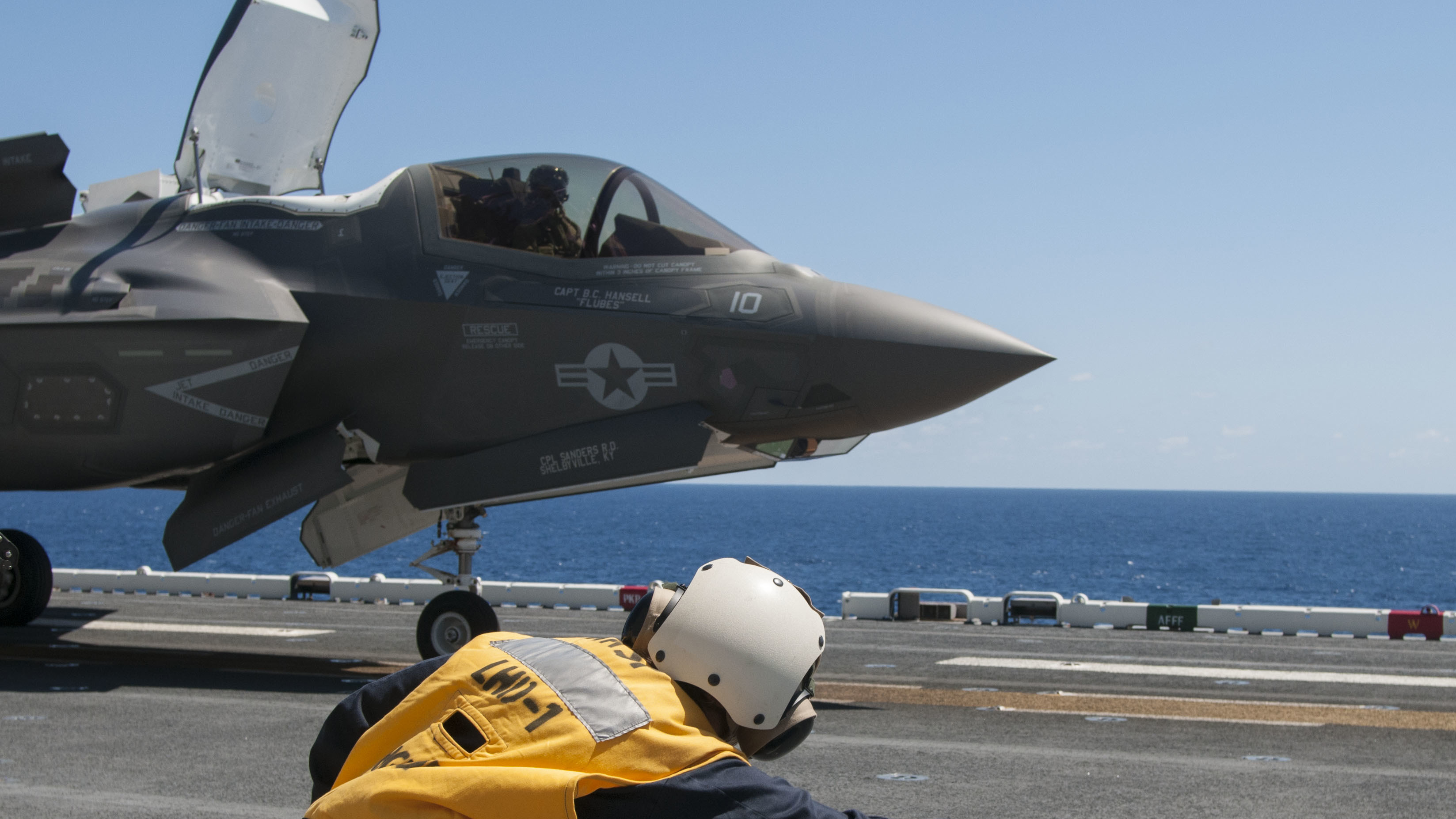
F-35B conducts first combat strike from USS Essex

NavalToday.com is reporting that in a milestone for the F-35 Joint Strike Fighter program, a Marine Corps F-35B flying from amphibious assault ship USS Essex carried out its first combat strike.

The strike took place on September 27 in the US Central Command area of responsibility in support of Operation Freedom’s Sentinel in Afghanistan.

During this mission, the F-35B conducted an air strike in support of ground clearance operations, and the strike was deemed successful by the ground force commander.''

“The F-35B is a significant enhancement in theater amphibious and air warfighting capability, operational flexibility, and tactical supremacy,” said Vice Adm. Scott Stearney, commander, US Naval Forces Central Command. “As part of the Essex Amphibious Ready Group, this platform supports operations on the ground from international waters, all while enabling maritime superiority that enhances stability and security.”

The 13th Marine Expeditionary Unit (MEU) is the first combat-deployed MEU to replace the AV-8B Harrier with the F35B Lightning II. The F-35Bs from Marine Fighter Attack Squadron 211 are currently embarked on the Wasp-class amphibious assault ship USS Essex (LHD 2) as part of Essex Amphibious Ready Group.

Friday, August 31, 2018

Lincoln CSG Underway in the LANT for F-35 testing.

The Arleigh Burke-class guided-missile destroyer USS Mason (DDG 87), top, pulls away from the Nimitz-class aircraft carrier USS Abraham Lincoln (CVN 72) following an underway replenishment.


ATLANTIC OCEAN (Aug. 28, 2018) The Arleigh Burke-class guided-missile destroyer USS Mason (DDG 87), top, pulls away from the Nimitz-class aircraft carrier USS Abraham Lincoln (CVN 72) following an underway replenishment. Abraham Lincoln is underway with Carrier Strike Group 12 (CSG 12) conducting Operational Test-1 (OT1) for the F-35C Lightning II. (U.S. Navy photo by Mass Communication Specialist 3rd Class Jeff Sherman/Released)

Friday, June 29, 2018

U.S. Marine Corps moves forward with F-35 transition

By Courtesy Story, Headquarters Marine Corps

Rear Adm. Cynthia Thebaud, commander of Expeditionary Strike Group Two takes the shooter stance while she launches an F-35B Lightning II off the flight deck of USS Wasp, on the Atlantic Ocean, May 26, 2015. Wasp, with VMFA-121 and VMFAT-501 embarked, is underway conducting the first phase of operational testing for the F-35B aircraft, which will evaluate the full spectrum of F-35B measures of suitability and effectiveness in an at-sea environment.


Marine Fighter Attack Squadron 121 (VMFA-121), based in Yuma, Arizona, was the first squadron in military history to become operational with an F-35 variant after completing years of developmental and operational testing, followed by an intensive Operational Readiness Inspection (ORI). This ORI, which included a capstone surge day, demonstrated that the aircraft and squadron have successfully met all IOC criteria.

"Marine Corps IOC for the F-35B is a significant accomplishment, but we will not stop to celebrate. In addition to aggressively continuing to mature this platform, we will further refine the operational concepts that allow us to fully leverage this transformational capability,” said Gen. Joseph Dunford in a July 2015 statement, when he was serving as Commandant of the Marine Corps. "It is capable of conducting close air support, offensive and defensive counter air, air interdiction, assault support escort and armed reconnaissance as part of a Marine Air Ground Task Force, or in support of the Joint Force."

Dunford added that the F-35B's ability to conduct operations from expeditionary airstrips and sea-based carriers provides our nation and its allies with our first 5th generation strike fighter, which will transform the way the Navy-Marine Corps team fights as a Marine Air-Ground Task Force

The Marine Corps has a program of record to procure 353 F-35Bs and 67 F-35Cs, for a total of 420 aircraft. As the future of Marine Corps tactical aviation, the F-35 will eventually replace three legacy platforms: the AV-8B Harrier, the F/A-18 Hornet, and the EA-6B Prowler. The transition is scheduled to be complete for active duty

Marine Corps aviation squadrons in fiscal year 2031. It is not a one-for-one swap. Because of the enhanced capabilities of the F-35, this strike fighter will replace a significantly greater number of legacy aircraft.

“The performance of VMFA-121, and the entire Marine Corps F-35B team over the past several years, has reinforced my feeling that we not only have great Marines in this program, but that we are giving them the right aircraft,” said Lt. Gen. Jon Davis, Deputy Commandant for Aviation. 

Harrier squadrons will gradually transition to F-35 squadrons over the next 11 years. The planned sundown for the AV-8B is in 2026. This is, however, subject to review, assessment and final decision in 2019.

Marine Corps Hornet squadrons will gradually transition to F-35 squadrons over the next fifteen years. The planned sundown for the Marine Corps F/A-18 is in 2030. As with the Harrier, this is subject to review, assessment and final decision in 2019.

The four EA-6B squadrons at Cherry Point, North Carolina will begin retiring their Prowlers at the rate of one squadron per year, beginning in 2016.

“We intend to extract maximum value and service life out of our Harriers, Hornets and Prowlers,” added Davis.

The U.S. Marine Corps has trained and qualified more than 50 Marine F-35B pilots and certified about 500 maintenance personnel to assume autonomous, organic-level maintenance support for the F-35B.

VMFA-121's recent operational status will be followed by Marine Attack Squadron 211 (VMA-211), an AV-8B squadron, which is scheduled to receive their first F-35Bs in 2016, and become fully operational within two years. In 2018, VMFA-122, an F/A-18 squadron in Beaufort, South Carolina, will begin conducting its transition to the F-35B. Another Hornet squadron, VMFA-115, will start transitioning to the F-35 in early 2020. VMA-311 is scheduled to follow suit later that year.

The F-35’s fifth-generation air superiority preserves U.S. national security and ensures optimum international security across the globe as integrated coalition operations enable the U.S., United Kingdom, Italy, the Netherlands, Turkey, Canada, Australia, Denmark, Norway, Japan, Israel and South Korea to fight shoulder-to-shoulder with an unrivaled first-look, first-shot, first-kill capability.

Thursday, October 20, 2016

Flying over USS Zumwalt advanced multi-mission guided-missile destroyer

F-35 Lightning II Carrier Variant (CV) piloted by U.S. Marine Corps Maj. Robert “Champ” Guyette II, a test pilot from the F-35 Pax River Integrated Test Force (ITF) assigned to the Salty Dogs of Air Test and Evaluation Squadron (VX) 23, flies over the stealth guided-missile destroyer USS Zumwalt (DDG 1000) as the ship transits the Chesapeake Bay on Oct. 17, 2016. USS Zumwalt, the Navy’s newest and most technologically advanced surface ship, joined the fleet Oct. 15. The F-35C Lightning II — a next generation single-seat, single-engine strike fighter that incorporates stealth technologies, defensive avionics, internal and external weapons, and a revolutionary sensor fusion capability — is designed as the U.S. Navy’s first-day-of-war, survivable strike fighter. The U.S. Navy anticipates declaring the F-35C combat-ready in 2018. (U.S. Navy photo by Andy Wolfe/Released)
David Cenciotti on The Aviationist website has posted up a great article on various US Navy aircraft flying over the USS Zumwalt in Chesapeake.

USS Zumwalt is the U.S. Navy’s newest and most technologically advanced surface ship and it was commissioned in Baltimore, Maryland, on Oct. 15. Zumwalt is the first ship of a new class of stealthy multi-mission destroyers that features an advanced power system capable to generate 78 megawatts of power and has the ability to launch TLAMs (Tomahawk Land Attack Missiles) and Evolved Sea Sparrow Missiles, as well as a wide array of other anti-ship and anti-submarine weaponry.

You can read David's story at https://theaviationist.com/2016/10/19/take-a-look-at-these-fantastic-photographs-of-u-s-navy-aircraft-flying-over-uss-zumwalt-advanced-multi-mission-guided-missile-destroyer/

Thursday, July 21, 2016

US Military Preps F-35 for Operations, Including Possible ISIS Strikes


FARNBOROUGH, England -- The Marines' F-35 Joint Strike Fighter has four deployments lined up across the next five years, a senior official said this week -- and some of them could take it into the heart of the coalition fight against the Islamic State.

Speaking at the Farnborough International Airshow on Monday, Col. William Lieblein said by 2021 the aircraft will have completed three shipboard pumps with a Marine Expeditionary Unit, and one on an aircraft carrier.

"2021 will be here before we know it," he said. "And that's about the same time we start really standing up a significant number of squadrons."

The F-35B "jump jet" variant of the Lockheed Martin aircraft declared initial operational capability just a year ago, and its first deployment has already been announced: Marine Fighter Attack Squadron 121 [VMFA-121], in Yuma, Arizona, will move permanently forward to Okinawa, Japan, where the aircraft will be sent out aboard the 31st MEU, which is also permanently forward-based in the Pacific.

Lieblein said other F-35 squadrons will then deploy with two West Coast MEUs, though he could not specify which units would take out the aircraft or when those deployments would take place. The three West Coast MEUs, based at Camp Pendleton, California, are the 11th, 13th and 15th. The 13th MEU deployed in February and began launching airstrikes on Islamic State militants in Iraq and Syria from the Persian Gulf.

Marine Corps spokeswoman Capt. Sarah Burns confirmed that it was a "very real possibility" that a West Coast-based MEU with a squadron of F-35s aboard could receive a similar tasking.

The first carrier deployment for the Marines will come in 2020, Lieblein said. While he could not name the carrier to deploy the aircraft, a Marine official said it may be the USS George H.W. Bush. The Marine Corps plans to acquire 63 F-35C carrier-variant Joint Strike Fighters, which have larger wings and foldable wingtips and are designed for arrested recovery landings. The F-35C is set to achieve IOC in 2018 or early 2019, shortly ahead of the planned deployment.

Lieblein said the transit across the Atlantic of three F-35Bs, two Marine Corps aircraft and one Royal Air Force bird, to the United Kingdom for participation in the Royal International Air Tattoo and Farnborough was a confidence-builder and was accomplished seamlessly, with the same mission profile and the same number of in-flight tanking evolutions that Lieblein had previously done in a Marine Corps F/A-18 Hornet.

"That was a major milestone for us and it demonstrated to ourselves and to everyone else that we can forward deploy this program whenever we want to," he said.

The F-35B is set to enter full-rate production in 2018, and the Marines' aggressive deployment schedule demonstrates how eager officials are to make use of the long-awaited platform.
But it's possible U.S. troops won't have to wait until late 2017 or 2018 to test the mettle of the fifth-generation fighter in combat.

The commander of Air Combat Command, Gen. Herb "Hawk" Carlisle, said Wednesday that he was prepared to deploy the F-35A Air Force variant immediately after the aircraft reaches IOC later this year.

"The minute I declare initial operational capability, if the combatant commander calls me up and says they needed F-35s, I would send them," Carlisle said, according to Bloomberg News.

Wednesday, March 16, 2016

Teak Air Show Guide Update: F-35 to touch down at air shows around the world

Members of the first ever F-35 Lightning II heritage flight team from Luke Air Force Base, Ariz., participate in the Heritage Flight Conference at Davis-Monthan Air Force Base, Ariz., March 4-6, 2016. The Heritage Flight Program features modern Air Force fighter aircraft flying alongside World War II, Korean and Vietnam-era aircraft in a dynamic display of the nation's airpower history. (U.S. Air Force photo/Staff Sgt. Staci Miller)
By Staff Sgt. Staci Miller, 56th Fighter Wing Public Affairs

LUKE AIR FORCE BASE, Ariz. (AFNS) -- Aviation and F-35A Lightning II fanatics have something special to look forward to this 2016 air show season.

The Lightning II qualified March 6 at the Heritage Flight Conference at Davis-Monthan Air Force Base, Arizona, to take part in the Air Combat Command Air Force Heritage Flight program.

The program features modern Air Force fighter aircraft flying alongside World War II, Korean and Vietnam-era aircraft in a dynamic display of our nation's airpower history.

"Being a part of these heritage flights allows the world to learn more about the F-35 and at the same time see just how far airpower has come over the years," said Brig. Gen. Scott Pleus, the 56th Fighter Wing commander. "The F-35 will be the backbone of the Air Force fighter fleet and represent the future for the U.S., our partners and allies. This will be a great opportunity for everyone to see how amazing the F-35 is."

The F-35 heritage flight team includes one pilot and 10 maintainers, all selected from the 61st Fighter Squadron at Luke AFB.

“My team and I are very excited for this year,” said Maj. William Andreotta, an F-35 heritage flight team pilot. “We’re so honored to be the first ever F-35 heritage flight team. We are really laying the foundation for years to come. We know it’s going to be a great season and we’re ecstatic about talking with different communities and showcasing the F-35.”

The team practiced their entire routine at the conference. The maintainers were able to show off their coordinated take-off and landing procedures while Andreotta practiced and perfected flying in formation with heritage aircraft. In the backseat of one of those heritage aircraft held a very interested passenger.

"I got to jump into the back of a P-51 Mustang and view an F-35 off the wing,” said Lt. Gen. Darryl Roberson, Air Education and Training Command commander. “Our F-35 team is ready to hit the road for the show season. It was awesome to see it up close and personal. I feel very confident in what the Luke team is doing here, and I'm excited for them to show this aircraft off to the world."

From the opposite perspective, Andreotta experienced flying in formation with heritage aircraft for the first time during the conference.

“It’s surreal to be flying the latest and greatest fighter aircraft in the world and look over to see fighter aircraft from World War II, Vietnam and Korea right next to you that were at one point the greatest fighters of their generation,” Andreotta said. “It’s like passing the torch in the lineage.”

Heritage flights are just as incredible on the ground as they are from the air.

“Viewers are going to get to see a remarkable show,” said Master Sgt. Ed DeLeon, F-35 heritage flight team superintendent. “They will see America’s newest technology and compare the advances first hand. We’re going to showcase the past, present and future of the Air Force.”

The team will travel to 16 air shows around the U.S. and abroad.

"We're very excited about demonstrating this capability to the world," Air Force Chief of Staff Gen. Mark A. Welsh III said in January when the service first announced the F-35's participation in the Royal International Air Tattoo this summer at Royal Air Force Fairford, England. "The F-35 represents a new way of thinking about data integration, weapons and tactics. We're thrilled to highlight the program and the amazing Airmen who support this cutting-edge fighter."

The F-35 heritage flight team gets to officially start their historic first season at home.

“Our first show is at Luke,” DeLeon said. “It’s nice to be able to start at home and showcase what we’re all about in front of our friends and families. After that, I’m so excited to get on the road and show the world what we’re all about.”

Luke AFB will present the "75 Years of Airpower" air show to the Arizona community April 2-3.

The F-35 Heritage Flight Team schedule:
- April 2-3: Luke AFB
- April 22-24: Langley AFB, Virginia
- May 7-8: Ft Lauderdale, Florida
- May 28-29: Jones Beach, New York
- June 18-19: Ocean City, Maryland
- June 25-26: Hill AFB, Utah
- July 8-17: RIAT/Farnborough, England
- Aug. 19-21: Chicago, Illinois
- Sept. 3-5: Cleveland, Ohio
- Sept. 14-18: Reno, Nevada
- Oct. 14-16: Baltimore, Maryland
- Nov. 12-13: Nellis, AFB, Nevada

==========================

And do you have your copy of the 2016 Teak Air Show Guide yet? Air show season is now in full swing. You can get your copy of this e-book reference at Amazon.
 
Every year, from March through November, millions of people hit the road to watch the excitement and thrills as military and civilian flight demonstration teams put their high performance aircraft through the paces to entertain the crowds and perform at air shows all over the world. Anyone who has attended one of these events will tell you it is thrilling to watch the close quarter flying of the Blue Angels delta formation or the hair-splitting maneuvers of the Thunderbird opposing solos.
 
While attending the show and enjoying the sights and sounds is an exciting experience that is only half the fun. You can add another whole dimension to that visual experience by monitoring the performing teams’ radio communications.
 
With a radio scanner in hand you will experience a whole new perspective of the show that few of the attendees will ever experience – pilot audio from the aircraft cockpit. While everyone else at the air show is just watching and listening to the public address system narrator, you’ll be able to hear what’s happening inside the cockpit, up in the tower and on the ground with the hundreds of players that keep these screaming, state of-the-art air machines thundering through the skies.
 
But you can’t tell the players without a program, and to indulge in the craft of monitoring the air show experience you need a current and well researched list of frequencies that the various performers may use during their performances.
 
In our new expanded 2016 Teak Air Show Guide e-Book, former Monitoring Times Editor and Milcom columnist Larry Van Horn - N5FPW, delivers the hundreds of frequencies you’ll need to monitor the action if you’re within receiving distance of any air show in 2016.
 
From the Blue Angels and Thunderbirds, military parachute and search and rescue demonstration teams, to a wide variety of other military and civilian demonstration teams from the U.S. and abroad, Larry has updated the list of frequencies each unit has used. Now you can bring the excitement you see at the show to your ears. Listening to the nonstop action at the air show on dozens of radio frequencies is part of the real fun of being there.
 
But wait, there’s more! Larry also tells you which scanners work best at the air shows, what features you’ll need and which models can cover the military as well as civilian frequencies used at these events. There is also a chapter on tips for enjoying a great day at the air show.
 
You will also get frequency lists for other possible frequencies that may be used at the air show including GMRS, Family Radio Service (FRS), DoD Intra-Squad Radio frequencies, and even Civil Air Patrol VHF/UHF frequencies and updated call signs. We also include in this eBook an up-to-date air show Internet resource guide and new frequencies/ listings for overseas military and civilian aeronautical demonstrations teams.
 
Finally you will get the latest air show schedules for the Navy Blue Angels, Air Force Thunderbirds, Canadian Forces Snowbirds, and the Army Golden Knight Parachute Teams. We include with each show location, the Internet link for each show, and the latest aero frequencies for each facility hosting a show, when known. This schedule information only covers the United States and Canada.
 
This is the 17th edition of this popular frequency monitoring guide published by the author. The first fourteen editions appeared annually each March in the pages of the former Monitoring Times magazine and were one of the most popular features carried in the magazine. This edition of the Teak Air Show Guide is now weighs-in at 197 pages and it is the most comprehensive collection of air show information and frequencies ever published for the radio listening hobbyist.
 
The 2016 Teak Air Show Guide is now available for purchase worldwide from Amazon.com at http://www.amazon.com/dp/B01AVLCGU4. The price for this third e-Book edition is still only US$3.99. Since this book is being released internationally, Amazon customers in the United Kingdom, Germany, France Spain, Italy, Japan, India, Canada, Brazil, Mexico and Australia can order this e-Book from Amazon websites directly servicing these countries. All other countries can use the regular Amazon.com website.
 
When the T-Birds, Blue Angels, and all the other precision flight teams are in the air, Larry has all the frequencies you need to hear them on the air in this new e-Book from Teak Publishing!
 
Here are a couple of the 5-Star Amazon reviews on the 2015 Teak Air Show Guide.
 
Totally thrilled to prep with the latest edition By Edward Sikora
Whether you're new to this hobby (as I was 2 years ago) or experienced you need reliable resources of information and frequencies. When I started, I was sure I could find my answers on the internet. I didn't think a book would be very useful or up to date. Five air shows later, I'm totally sold on this book. I'm delighted and excited to have the latest copy to prep for upcoming shows. It's a highly detailed road map to where the good stuff is. I haven't found any other resource that even comes close. What a masterpiece of organization and reliable information. This book provides so many answers where the rest of the internet gives you too little, too late. This book is totally awesome! - KB2OB Ed NJ
 
Air Show scanner GO TO GUIDE By Kevin Burke
Larry has been THE go to guy when it comes to air show frequencies for years, but you need more than just a bunch of numbers to enter into a scanner. No problem if you have this book, Larry tells you what your scanner has to be capable of, in order to open your ears to all there is to hear at an air show
 
Frequency updates, correction and late additions between editions of this e-Book will be posted on his Milcom Monitoring Post blog at http://mt-milcom.blogspot.com/.
 
For a complete list of all the authors books, go to his Amazon authors page at http://www.amazon.com/-/e/B00G1QMO4C.
 
You do not even need to own a Kindle reader to read Amazon e-book publications. You can read any Kindle book with Amazon’s free reading apps. There are free Kindle reading apps for the Kindle Cloud Reader, Smartphones (iPhone, iTouch, Android, Windows Phone and Blackberry); computer platforms (Windows XP, Vista, 7 and 8 and Mac); Tablets (iPad, Android and Windows 8), and, of course, all of the Kindle family of readers including the Kindle Fire series. A Kindle e-book allows you to buy your book once and read it anywhere. You can find additional details on these apps by checking out this link to the Amazon website at http://www.amazon.com/gp/feature.html?ie=UTF8&docId=1000493771.
 
For additional information on this and other Teak Publishing radio hobby books, monitor the company sponsored Internet blogs – the Milcom Monitoring Post blog(http://mt-milcom.blogspot.com/), the Btown Monitor Post blog (http://monitor-post.blogspot.com/), and the Shortwave Central blog (http://mt-shortwave.blogspot.com/) for availability of additional e-books that are currently in production.
 
You can learn more about the author by going to his author page on Amazon at http://www.amazon.com/-/e/B00G1QMO4C.


Friday, February 12, 2016

First simulated F-35A deployment conducted at Mountain Home AFB

Two F-35A Lightning IIs taxi after landing at Mountain Home Air Force Base, Idaho, Feb. 8, 2016. The F-35s, from Edwards AFB, Calif., will be part of an initial operating capability test at the nearby range complex. (U.S. Air Force photo/Tech. Sgt. Samuel Morse)

By Kenji Thuloweit, 412th Test Wing Public Affairs
 
EDWARDS AIR FORCE BASE, Calif. (AFNS) -- A much anticipated and important test mission for the F-35 Joint Strike Fighter Program is underway with the "deployment" of six operational test and evaluation F-35s and more than 85 Airmen from the 31st Test and Evaluation Squadron, who arrived Feb. 8-9.

This is the first simulated deployment test of the F-35A Lightning II, specifically to execute three key initial operational capability mission sets: suppression of enemy air defenses, close air support and air interdiction.

The 31st TES will execute each of these in a limited scope from a "deployed" location for this test. The deployed location is Mountain Home Air Force Base, Idaho. The 31st TES at Edwards AFB falls under the 53rd Wing at Eglin AFB, Florida, which is leading the test design, management and execution of the F-35A deployment test.

The achievements of an F-35A squadron testing ability to deploy, employ and sustain operations will set the benchmark capability for the Air Force to declare F-35A initial operational capability scheduled for this fall, according to the 53rd Wing.

During the test at Mountain Home AFB, the aircraft will be engaged in simulated combat scenarios to exercise representative mission processes such as tasking, execution, debrief and intelligence reporting. The test team will be working to capture a broad spectrum of capabilities and limitations of the F-35 system to include both operations and maintenance. The team will focus on areas such as mission planning, scheduling, weapons building/loading, sortie generation, life support, mission employment, debrief and aircraft turn.

Nellis AFB in Nevada will serve as a simulated remote air operations center for the deployed environment. Mountain Home AFB is providing a secure location with ranges to employ fourth-generation aircraft as well. The F-35As will integrate with F-15E Strike Eagles from the 366th Fighter Wing at Mountain Home AFB and A-10 Thunderbolt IIs from the 124th Fighter Wing at Gowen Field, Idaho.

The entire test event is expected to last about a month.

(Editor’s note: Information for this article was provided by the 53rd Wing at Eglin AFB) 


Friday, October 18, 2013

F-35: New fighter creates new culture for 21st Century and beyond

By Rich Lamance, Air Force News Service

EGLIN AIR FORCE BASE, Fla. (AFNS) -- She didn’t have a smudge on her. Not a leak found anywhere. She even had that “new jet smell.” Skies were blue, everything was perfect. Those were the conditions on that July day in 2011 when Lt. Col. Eric Smith took off from the Lockheed facilities at Fort Worth, Texas, in the first operational F-35 to fly to its permanent home at Eglin Air Force Base, in the Florida panhandle.  And the rest, according to Smith, who would go on to pick up three of the first six F-35s from the factory, is history.

 “It was just a great day – I was just a little bit nervous because I knew that if I messed it up it would be on the front page of every newspaper in the country,” said Smith. As he approached the runway at Eglin, he found bleachers full of people and a red carpet rolled out to signify the beginning of an era for not only the plane, but for the newly reorganized 33rd Fighter Wing, Eglin Air Force Base and the future of Air Force air superiority for the 21st Century.
 
The pick of the 33rd Fighter Wing “Nomads” to transition the Air Force’s newest and most lethal fighter into this century and beyond was no accident.  With a history that dates back to World War II when the wing was a pursuit group, the 33rd showcased the F-4 Phantom during Vietnam and the F-15 Eagle through crises such as Grenada, Panama, Desert Storm, and post 9/11,  when the Nomads provided armed over-watch throughout North America for Operation Noble Eagle, securing two presidents of the United States and multiple space shuttle launches.
 
“On Oct. 1, 2009, we stood up as an F-35 unit,” said Lt. Col. Matt Renbarger, 58th Fighter Squadron commander. “We were handed keys to an empty building, with five pilots, a technical sergeant, two lieutenant colonels and three majors.”
 
Renbarger and Smith both admitted that those early days, following the arrival of the first F-35, was a whirlwind of planning, creating policy and guidelines and putting together a training program with a syllabus, academics, and a completely new maintenance program.
 
Smith said that the early days with the first few aircraft were a challenge, not only for the pilots, but for the newly trained crew chiefs as well. “There was a lot of tech data that the technicians needed before they could work on the airplane, so the first six planes we delivered sat for about eight months before we were issued flight clearance.  We didn’t receive our first flight clearance until March of 2012. “
 
Renbarger said that, like anything brand new and right out of the box, there were a lot of things that had to be learned that weren’t known before.  He said that as a training unit, it was more Air Combat Command versus Air Education and Training Command. “It’s not a different mindset, but it’s more of a different mission.  Here we create new pilots and maintainers, so we don’t have the downrange focus.  Training pilots is our product.
 
“When test pilots at Edwards find something they tell us, and when we find something we tell them. When software is released they’ll come down here and tell us things they’ve learned. We’ll take new capabilities and bring them into our training syllabus.  The folks at Edwards bring us the latest so we can teach the people who teach the people. We teach the teachers and the teachers teach the students.”
 
Renbarger said there is a lot to like about the F-35, from the standpoint of the pilot, the maintainer, the trainer, down to the bottom line of mission success. “I’ve never seen a pilot come back from his first sortie without a huge smile on his face. It’s something new, and programs like this only come around every 30 years or so, and to be on the ground floor – it’s the perfect time.
 
“Most pilots come from the F-16, F-15 and A-10 legacy aircraft.  Sensors on the front of the F-35 allow us to have that 360-degree awareness. That was the big leap forward. Computer technology that is 30 years or more advanced than the legacy aircraft is what makes the F-35 so advanced.”
 
Lt. Col. Anthony Pelkington is the 33rd FW chief of safety and was one of the first of the legacy pilots selected for the F-35 program. He said that for pilots transitioning from those legacy systems, the F-35 is a huge deal.
 
“For 10 years in the F-16, I dealt with essentially monochrome cathode ray displays – approximately 6 inch square – and I’ve got two of them.  Now I move up to a contiguous 8 x 20- inch color display that is a huge step forward for the pilot’s situational awareness. Plus, there’s a lot more capability in the display itself.
 
“In the F-16, I had a radar display with a selectable, like turning pages in a book, something that would show my ordnances like I had a stick figure map with monochrome lines on a black background.  It would try to give us a semblance of where we were to maybe a weapons system. But I had to choose.  Every one of those displays was limited to the confines of that small 6-inch to 8-inch screen. 
 
“In the F-35, we now have this massive amount of screen real estate. I can now see multiple sensors at once, which is great because I don’t have to pick and choose.  I don’t have to take away my situational awareness with what the radar is telling me in terms of traffic to bring up situational awareness and what the target pod looks like. It’s all there available for me.”
 
Pelkington added that one of the best aspects of the fifth generation fighter is its ability to communicate with all aspects of the aircraft, as well as customize information to fit each pilot’s needs.  “The displays talk to each other, the sensors talk to each other, and a lot of information is displayed in sensible formats with other sensors in one combined picture.  Now I can bring up large formats on displays so I can see things easier – I can even bring up many formats if I want with a different orientation on how the displays will look. Whatever I want to do to aid my situational awareness I can do and the reality, as a pilot, is that I can customize that setup quite easily to a format that best suits how a pilot understands.”
 
The wing’s safety chief said that one of the biggest advantages to the F-35 over legacy aircraft is the growth in options. “Choosing between a pilot’s eye and ‘god’s eye are all in the system now and weren’t in the F-16. I had one particular display option for radar format for the F-16 – I couldn’t choose anything else. I had to learn to read it in that manner. Which didn’t necessarily match how somebody looking out on a battlefield could see the picture.  So you always had to do that conversion in your mind.  With the F-35 you can choose the display format that best suits your ability, and there are multiple options to allow you to see things from a ‘god’s eye’ perspective. It allows me to see from a much greater perspective than the F-16 ever allowed.”
 
The equipment

Tech. Sgt. Andre Baskin is the wing’s aircrew flight equipment NCOIC, responsible for equipping pilots with the specialized gear required to fly the world’s most state-of-the-art aircraft. He and his small staff of specialists agree that the differences between the F-35 helmet and the rest are many.
 
“One of the biggest differences the F-35 helmet has over the others is that the new helmet encompasses multiple gadgets such as night vision goggles, and for that function you would have to modify the pilot’s flying helmet and add the components on there,” said Baskin.  “With the F-35, it’s all encompassed in the helmet.  The cameras on the jet work in sync with the helmet and whatever the jet picks up visually will be displayed on the visor in the helmet.”
 
From a pilot’s point of view, Renbarger agrees that the nicest part of the new helmet is that everything is self-contained. “The best thing about the F-35 helmet is that it has a big visor with a big display, and we can display a night vision camera visual on the visor and then a distributor aperture system that is basically a set of cameras that are all over the airplane and work in the infrared spectrum. That can be displayed on our visor as well.
“When we get our helmet fit, there is actually a complicated scan process that takes an image of our heads and provides a laser cut-out foam insert for the helmet that is molded to our heads.  Then there’s ear cups that close the helmet around our head and a custom nape strap in the back that basically locks the helmet down on our heads. There’s very little, if any, motion in the helmet when we move our head around. Very well balanced, a very well fit and it feels great wearing the helmet. It’s very specific to each individual pilot.”
 
Pelkington also talked about the difference between the traditional G-suit, which offers pilots about a G and a half of protection, to the one used by F-35 pilots. “Some pilots acclimate to the Gs by genetic makeup, some by experience and can develop a tolerance for 5-ish Gs. With the new suit you can now go up to 7 or 8 Gs without ever having to strain.  When you’re focused on pulling Gs  -- on making sure your eyesight doesn’t gray out – your mind isn’t thinking about the adversary or the situation or the awareness of the battlespace. When you can pull 7 or 8 Gs without having to think about it, combined with the fusion of all the systems and the display on the glass set up the way you want to see it…it’s an amazing reduction in pilot workload.”
 
The maintainers

Senior Master Sgt. Paul Fulkerson is the production superintendent with the 58th Aircraft Maintenance Unit who is on the ground floor of maintenance for the F-35.  He said that for F-35 maintainers, the biggest element that sets them apart is the electronic maintenance program called ALIS. Standing for Autonomic Logistics Information System, ALIS, according to Fulkerson, has all of the forms needed to perform maintenance on the new aircraft.
 
“With ALIS, there are no paper forms and the system allows maintainers to pretty much manage the fleet with the information on the computer,” said Fulkerson.  “With the F-16s, we had to use paper tech data to perform maintenance, where you followed it step-by-step to do the task. With ALIS, our maintainers us ‘tough books,’ where they read the tech data on the screen.”
 
While a very young aircraft, Pelkington said the F-35, maintenance-wise, is very stable and makes a lot of information available to both the pilot and maintainer that isn’t available on the legacy aircraft.
 
“Oftentimes, in a legacy aircraft, you don’t know that something is wrong until you have a major systems failure that generates a warning in the aircraft. The aircraft can no longer perform to spec.  A lot of warnings in the F-35 tend to be advisory, that says ‘this is going to have to be worked on by maintenance when you land.’ In the F-35, there’s no mission degradation. When a pilot gets back, there’s a load of data on every aspect of how the aircraft performs.  From the maintenance standpoint, it gives them an awesome opportunity to catch issues before they become problems.”
 
Staff Sgt. Michael Sanders is an F-35 crew chief who has been with the program for the past three years and has more than a decade of experience on the F-16 and F-15 as a backshop engine maintainer.  He explained that while maintainers in the legacy aircraft normally specialized in one area, such as engines or avionics, in the F-35, maintainers do it all.
 
“My job is completely different now from in the past. We would handle all teardown and build-up required for the engine, whereas now, we perform maintenance on the F-35 as a whole. We’re trained on all maintenance tasks, including the engine. I traveled TDY to Connecticut where I performed teardown and buildup for the new aircraft.”
 
Training

The F-35 Academic Training Center, or ATC, is a sprawling complex responsible for every facet of F-35 training at Eglin. From pilots to maintainers to support Airmen, the ATC has developed, or is in the process of developing, the training syllabuses, procedures, guidelines, certifications and “textbooks” that will become the training standard for decades to come, according to Renbarger.
 
He said that for pilots, training in the F-35 simulator is by far, the best there is. “I’ve flown in F-16 simulators and F-22 simulators and the F-35 simulator is truly state-of-the-art.  They’ve got the best visuals, full dome coverage, 360-degree views, target set build-up, they have runways and very much replicates flying the airplane. I haven’t heard one pilot say it wasn’t the best simulator they’ve ever been in short of flying the airplane.”
 
Renbarger added that because the F-35 is a single-seat plane, the first time a pilot flies the F-35, he’s by himself, making the simulator even more critical.  “The operational flight software that runs the airplane – that same software is in the simulator,” said Renbarger. “In other aircraft I have flown, there have been differences between the simulator and the airplane. This is as close as I’ve ever seen between the simulator and airplane. Exact same cockpit.  The cockpit sits on a rail and you sit in the cockpit and it drives forward and raises up inside the dome and the screens you see are the exact same screens you see on the jet.”
 
On the maintenance side, students are confronted with a similar real-world view, with a weapons load trainer mock-up of the F-35 that contains everything but the tail and the cockpit.  Tech. Sgt. Adam Zakrzewski is an ATC instructor with Detachment 19 of the 372nd Training Squadron. He said that during training on the F-35, students will practice opening and closing doors, checking the hydraulics levels, oil levels, etc., but there’s a big difference between maintenance on legacy aircraft versus the F-35.
 
“There are a lot more steps in gaining access to the legacy aircraft than there are to accessing the F-35,” said Zakrzewski.  “I’m an old A-10 guy, where you have to unfasten 200 screws to get a door panel open.  On the F-35, there’s one interface connect and click two buttons.”
 
Tech. Sgt. Justin Weddle is an ATC instructor and flight chief with the field training detachment of the 372nd Training Squadron, who says that in normal maintenance training, instructors would give students a PowerPoint presentation, cover some TOs and give students hands-on training on the aircraft. 
 
“The maintenance group would have to give up an aircraft or whatever students were training on such as a weapons system, AGE, anything like that.  At the ATC, and in the F-35 training plan, we begin with an EML, or electronic mediated lecture, kind of like the traditional PowerPoint, but it’s done through an electronic system.” Weddle said the student will then transition, in the same classroom and setting, to more self-paced training on the computer.   “It’s just a reinforcement of what the instructor has said during his portion of the training.
 
“Students will then go through an ASMT, which is an aircraft systems maintenance trainer. It’s essentially an avatar, and from that you go and do whatever task you’re learning about. Whether you are installing a hydraulic pump or some other portion of the aircraft. On one side of the screen, students will have their avatar and on the other they’ll have their joint tech data laptop and they can follow all of the steps exactly. That way the training is not all front-loaded, it can be weaved in and out of the training course.”
 
In addition to the Air Force’s F-35A, the Marine Corps and the Navy have their own versions of the F-35. The F-35B will give the Marine Corps a short take-off and vertical landing capability, while the Navy’s F-35C will give them a carrier-based capability.  Smith believes that for the future of the F-35, it may not change the way we fly, but it will make the U.S. and its allies the dominant air power for the next 30 to 50 years.
 
“That’s the beauty of the F-35. There are three variants out there, but all three are going to use the same system software. So as they develop something new for our country, our allies who fly the F-35 will get that same capability. That will make integration much smoother.”
 
Since Smith’s journey home with the first F-35 in 2011, Air Force, Marine, Navy and U.K. pilots have amassed more than 3,100 flying hours in the three versions, flying more than 2,300 sorties.
 
To those who have spent the past four or five years learning the intricacies of a new aircraft -- how to fly it, how to fix it and how to create a plan to teach it, the F-35 has become much more than an airplane showcasing state-of-the-art technology.  For the men and women of the 33rd Fighter Wing at Eglin, responsible for getting the F-35 ready for its grand entrance as the dominant airpower for the 21st Century and beyond, it has spawned a completely new culture and way of life.

Saturday, September 21, 2013

Hill welcomes F-35 workload

Dignitaries and employees at Hill Air Force Base, Utah, get their first look at the F-35A Lightning II Joint Strike Fighter Sept. 20, 2013. Hill, Lockheed Martin, Utah elected officials and community members gathered for a ceremony to commemorate the beginning of F-35 depot maintenance at the Ogden Air Logistics Complex. The F-35A is a multi-variant, multi-role, fifth generation fighter, and will undergo organic depot modification work at Hill AFB. (U.S. Air Force photo/Alex R. Lloyd) (Photo by Alex R. Lloyd)

By George F. Jozens, 75th Air Base Wing Public Affairs
HILL AIR FORCE BASE, Utah (AFNS) -- Several hundred people gathered today in hangar 237 to witness the first F-35A Lightning II which arrived for depot level maintenance during a ceremony hosted by the Ogden Air Logistics Complex commander, Maj. Gen. H. Brent Baker Sr.

The ceremony addressed Hill's key role in the depot repair and the F-35's role in national defense by several different speakers which included Sen. Mike Lee; Lorraine Martin, Lockheed Martin's Executive Vice President and General Manager of the F-35 Lightning II Program; Rear Adm. Randolph Mahr, DoD F-35 Deputy Program Director; Lt. Gen. Bruce Litchfield, Air Force Sustainment Center commander and Sen. Orrin Hatch.

Baker was the final speaker and gave the order to open the doors and unveil the aircraft to the capacity packed hangar's attendees. Other dignitaries at the ceremony included local mayors, Utah Lt. Gov. Greg Bell and members of the Utah State House and Senate.

The first F-35A conventional takeoff and landing variant is from the 422nd Test and Evaluation Squadron, Nellis AFB, Nev., and is in a prototype configuration. The Ogden ALC will modify the aircraft with a series of structural and systems modifications to enhance critical capabilities needed during operational test and evaluation testing.

"For decades the shared partnership between Lockheed Martin the Ogden ALC team has taken our legacy platforms, the F-16, C-130 and F-22, to the next level, and the same will hold true for the F-35 Lightning II," said Lorraine Martin, F-35 vice president and general manager. "This aircraft was designed from its inception to evolve through modifications and upgrades so that our warfighters can continually outpace their opposition. I look forward to what the future holds for the F-35 and am excited to see that evolution unfold."

Litchfield also talked about this historic day in the history of the ALC.

"The F-35 found the right home for sustainment," he said. "Team Hill will deliver cost effective modifications for this aircraft."

The F-35 Lightning II combines advanced stealth with fighter speed and agility, fully fused sensor information, network-enabled operations and advanced sustainment. Three distinct variants of the F-35 will eventually replace the A-10 and F-16 for the U.S. Air Force.

Thursday, August 15, 2013

Strike Fighter Squadron 101 Granted Interim 'Safe for Flight' Completes First Flight in Navy F-35C Lightning II

An F-35C Lightning II aircraft piloted by Lt. Cmdr. Chris Tabert, assigned to Strike Fighter Squadron (VFA) 101, flies the squadron's first local sortie. The F-35C is the carrier variant of the Joint Strike Fighter. VFA 101, based at Eglin Air Force Base, serves as the F-35C Fleet Replacement Squadron, training both aircrew and maintenance personnel to fly and repair the F-35C. (U.S. Navy photo courtesy of Lockheed Martin by Liz Kaszynski/Released)


SAN DIEGO (NNS) -- Strike Fighter Squadron (VFA) 101, the Navy's first F-35C Lightning II carrier variant aircraft squadron, completed its first flight Aug. 14 in its new aircraft at the squadron's home at Eglin Air Force Base, Fla.

The 1.3 hour flight was made by VFA-101 naval aviator Lt. Cmdr. Chris Tabert.

The flight followed a decision by Commander, Naval Air Force, Pacific, Vice Adm. David Buss Aug. 8, granting the Fleet Replacement Squadron interim "safe for flight" status.

"The Lightning II strike fighter represents the future business end of our nuclear powered aircraft carrier force, the embarked carrier air wing," said Buss. "The men and women of VFA-101 are now cleared to take the first steps toward that future as they operate these amazing Navy aircraft and train the aviators who will fly them."

"VFA-101's achievement of the Interim Safe For Flight (ISFF) criteria constitutes a significant milestone in the introduction of the F-35C Lightning II into the fleet," said Capt. Mark Black, commander, Strike Fighter Wing, Pacific. "VFA-101 will now begin to schedule and perform sorties under their own charter from their facilities at Eglin AFB. This will permit the re-established Grim Reapers to begin training for the original flight instructor cadre that will teach future F-35C pilots in the intricacies of mastering the Navy's first 5th generation fighter."

The squadron received the Navy's first F-35C from Lockheed Martin June 22. Today's flight was the first in the new Navy aircraft flown by a VFA-101 pilot at Eglin. "The first flight of Grim Reaper 102 today is the acme of many years hard work and planning by the Sailors of VFA-101 and our Lockheed Martin partners and is an exciting first step in introducing the Navy's first 5th generation fighter to fleet," said VFA Commanding Officer Capt. John Enfield. "Now that we're flying, we will be able to validate and evaluate both the pilot and maintainer syllabi as we train the initial cadre of instructors."

VFA 101 is the F-35C Fleet Replacement Squadron, training Navy aircrew and maintenance personnel to fly and repair the F-35C, a fifth generation fighter that combines advanced stealth with fighter speed and agility, fully fused sensor information, network-enabled operations and advanced sustainment.

"The Interim Safe for Flight will begin in earnest the training of the U. S. Navy personnel in how to maintain this impressive new aircraft," said Black. "Proficient Lockheed Martin technicians will lead Sailors in verifying prescribed maintenance procedures that will ultimately be converted into a robust syllabus that will permit future Navy maintenance personnel to develop the skills necessary to ensure and sustain the flight integrity of the aircraft. Designating VFA-101 as Interim Safe for Flight signifies that the Navy F-35C has begun its service in Naval Aviation for real."

The F-35C will enhance the flexibility, power projection, and strike capabilities of carrier air wings and joint task forces and will complement the capabilities of the F/A-18E/F Super Hornet, which currently serves as the Navy's premier strike fighter.

By 2025, the Navy's aircraft carrier-based air wings will consist of a mix of the F-35C, F/A-18E/F Super Hornets, EA-18G Growler, E-2D Hawkeye, Unmanned Carrier Launched Airborne Surveillance and Strike air vehicles, MH-60R/S helicopters and Carrier Onboard Delivery logistics aircraft.

Wednesday, October 17, 2012

F-35: Newest fighter much more than just 'stealthy plane'

 
by Marine Corps Cpl. Daniel Wetzel, Defense Media Activity

 EGLIN AIR FORCE BASE, Fla. (AFNS) -- The engines roared overhead as an F-35A fell into formation. Although this is a basic maneuver for the test pilots, the possibilities for combat environments created by these elite aircraft working together are anything but mundane.

The F-35, which features three variants to be used by the Air Force, Marine Corps and Navy, is a single-seat aircraft capable of stealthy operations, equipped with an enhanced computer technology system. The Marine Corps B variant is also capable of performing short takeoffs and vertical-landings while maintaining the conventional operations of other airplanes.

The F-35 Lightning II Joint Strike Fighter program started in 1997. The program includes plans to replace the Air Force's aging F-16 Fighting Falcon and A-10 Thunderbolt II, the Marine Corps' short takeoff, vertical landing AV-8B Harrier and dogfighting and air-to-ground attacking F/A-18 Hornet and the Navy's stock of legacy Hornets.

"The F-35 is a fifth-generation fighter; but it's more than just a stealthy airplane," said Marine Corps Col. Art Tomassetti, a pilot who has been with the JSF program since 1998. "It goes beyond stealth and low observable capability. It brings together everything that today's computer and digital age can bring to how the airplane flies and how it's maintained."

The F-35 is an ideal combination of stealth, sensor fusion and a robust digital flight control system making it, not only easy for a pilot to fly, but easy to identify and engage targets in the battlespace. Along with ease of flight, the F-35 also allows pilots greater situational awareness.

"When you look at the F-35, you can't look at it as a single airplane against another single airplane," Tomassetti said. "You have to look at a group of F-35s working together, then you really get to take advantage of what the F-35 brings to the battle space. The ability of the airplanes to use a variety of sensors to gather information and share the information they gather between planes is truly incredible."

With the F-35, pilots can access information about possible targets and threats from supporting F-35 aircraft via data links, which allows them to see more and identify more of what is happening in the battle space, Tomassetti said.

Currently, the military is only training seasoned pilots on the new airplane at Eglin Air Force Base.

When new pilots are allowed into the program, they will find themselves in a unique training environment along with enlisted aircraft maintainers and mechanics from all three branches of service and also coalition partners from several foreign nations.

These service members will learn how to operate and maintain the F-35 through a digital training environment. This kinetic learning system allows the learning to occur through touching and doing, rather than seeing and hearing.

"The fact that we're starting with the same airframe, same formations, same weapons capabilities, I think that already puts us at a better starting point when we show up to a combat theater together," said Lt. Col. Lee Kloos, squadron commander for the 58th Fighter Squadron, of the integration of forces with the F-35.

Kloos, who has more 2,100 hours flying the F-16, said having the Air Force, Marine Corps and Navy field the same airframe allows a common frame of reference for pilots regardless of service.

The aircraft is also a joy to fly, Kloos said. Despite the advanced technology and complexity of the aircraft, it's a very easy aircraft to fly, and basic pilot actions remain the same as in any fighter aircraft.

"Pull back on the stick and the trees get smaller, push forward and the trees get bigger," Kloos said. It is a stable and well-balanced plane designed for today's generation who grew up playing video games, he said.

Comparatively speaking, the F-35 has a clean cockpit. Instead of a multitude of switches inherent of many aircraft, the F-35 has two touch screens with interfaces similar to a tablet computer.

For the maintainers, things are a little tougher.

"I was working on the F-15 C and D models," said Staff Sgt. Matthew Reed, F-35 A maintainer. "The F-35 is a completely different aircraft. The technology is challenging at times."

Since the F-35 is still in operational testing, the maintainers and pilots work through all the bugs together. On a continuous basis, personnel are testing the aircraft in new maneuvers and capabilities. Once these are monitored and assessed, the pilots are cleared to perform them in their daily flight operations.

"Today our training consists of the basics of takeoff, landing, navigation and basic formation as we wait for the flight clearance to expand and allow us to train specific mission sets," Tomassetti said.

Air Force maintainers, the first service members to work on the F-35, use the maintenance side of the computer to do preventative diagnostics and pinpoint possible problems.

With the pilots and maintainers working together, the Air Force and Marine Corps have flown hundreds of training sorties since their first flight in 2011. They continue to fly daily to bring the F-35 A, the Air Force's conventional landing and take-off variant, F-35 B, the Marine Corps' STOVL variant, and F-35 C, the Navy's carrier-based variant, closer to combat operations.