Showing posts with label South Korea. Show all posts

Thursday, September 08, 2016

Army Spy Plane Flying Missions on the Korean DMZ

US Army EO-5C Aircraft courtesy of The Aviationist (US Army Photo)

Mode-S ADS-B tracking and sharing is a really cool aspect of government/military aircraft monitoring. Again this morning it showed its worth when one of my twitter mil friends posted an intercept regarding N59AG flying up on the Korean DMZ. This isn't the first rodeo for that aircraft up there. In fact, they are regular visitors to that garden spot in the world. Disguised with a US civilian aircraft registration, the aircraft is a US Army EO-5C spy plane, one of three in the region.

Read more about these aircraft and their mission in Korea on The Aviationist website at
U.S. Army spyplane pops-up on Flightradar24 during mission south of the Korean DMZ

Thursday, February 27, 2014

Report: North Korea Fires Four Short-Range Missiles

The South Koreans are reporting that North Korea fired off four short-range missiles today. "South Korea says North Korea has fired four suspected short-range missiles into its eastern waters," reports the Associated Press.

A Defense Ministry official said North Korea fired four projectiles believed to be short-range missiles with a range of more than 200 kilometers (about 125 miles) into the waters off its east coast. The official spoke anonymously citing department rules.

North Korea routinely conducts short-range missile tests but Thursday's launch came three days after South Korea and the U.S. began their annual military drills which Pyongyang calls a rehearsal for invasion. North Korea has recently eased tension by taking a series of conciliatory gestures toward South Korea..

Tuesday, December 03, 2013

S. Korea to confirm new air defense zone this week

Things in the eastern Asia continue to heat up. The Yonhap News Agency has a story this morning re: new ADIZ for South Korea.

SEOUL, Dec. 3 (Yonhap) -- Locked in a standoff with China over disputed airspace, South Korea will confirm its new air defense zone expanding southward this week and notify neighboring countries of the plan before making a formal announcement, Seoul officials said Tuesday.

In response to China's controversial Air Defense Identification Zone (AIDZ) overlapping that of South Korea and Japan, Seoul has been preparing a new air defense zone that includes an ocean research station built on an underwater reef and southern islands.

Tuesday, November 26, 2013

U.S. Directly Challenges China's Air Defense Zone (Pair of American B-52 Bombers Fly Over)


WASHINGTON—A pair of American B-52 bombers flew over a disputed island chain in the East China Sea without informing Beijing, U.S. officials said Tuesday, in a direct challenge to China and its establishment of an expanded air-defense zone.

The planes flew out of Guam and entered the new Chinese Air Defense Identification Zone at about 7 p.m. Washington time Monday, according to a U.S. official.

The official said the flight was a training mission and the bombers were not armed. The flight was first reported by The Wall Street Journal on Tuesday.

The Chinese announced over the weekend they were expanding their air defense identification zone to include the islands, known as Diaoyu in Chinese and Senkaku in Japanese. Japan also claims ownership.

For more on background see my original story at China creates air defense zone over Japan-controlled islands in East China Sea.

Sunday, November 24, 2013

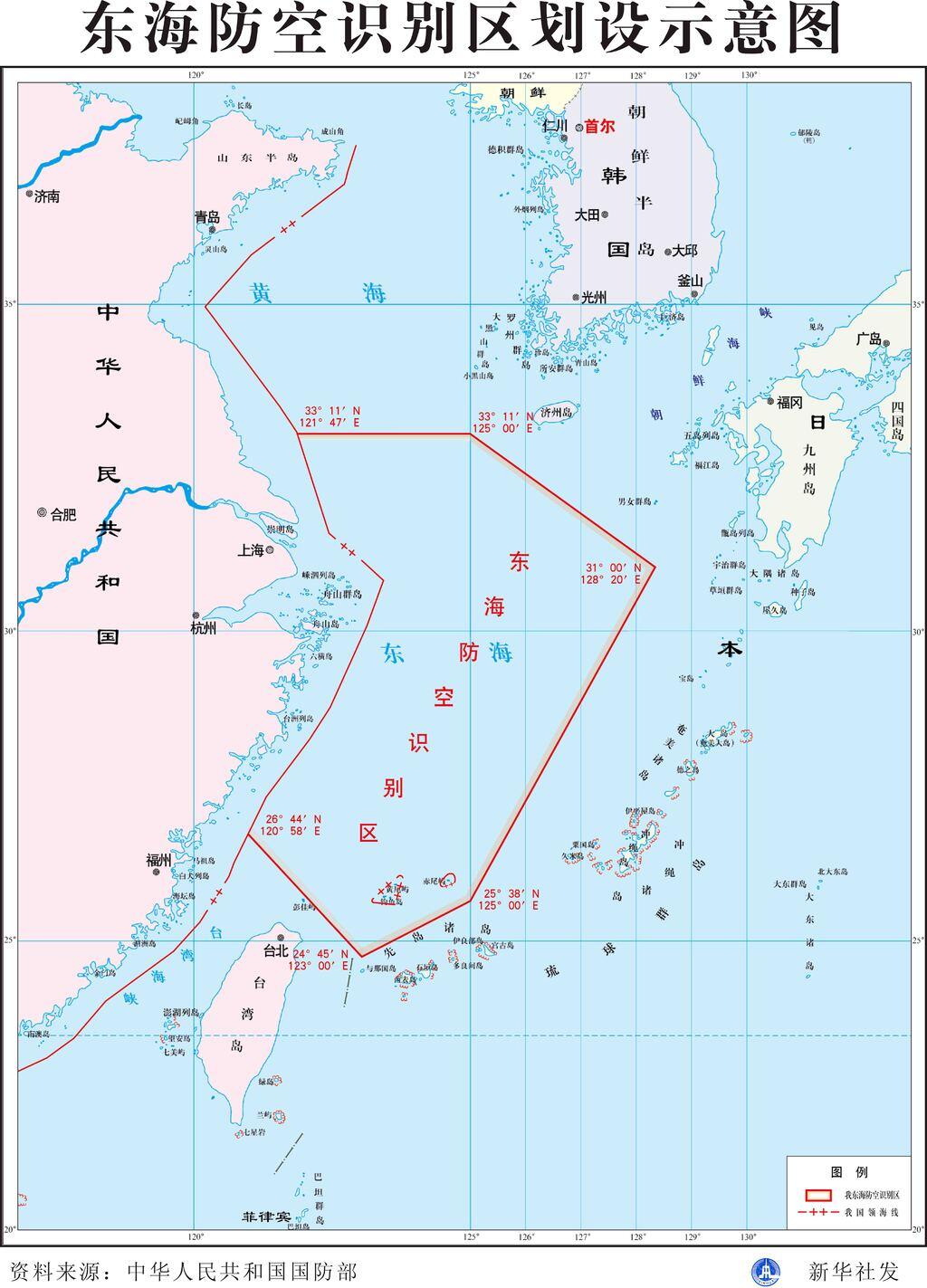
China creates air defense zone over Japan-controlled islands in East China Sea

Blog Editor's Note: This is potentially a very serious international situation in the East China Sea. This directly threatens Japan and South Korea. Keep an eye on our  @QSLRptMT and @MilcomMP twitter feeds for updates and frequency reports as we get them.


A Japan coastguard handout photo taken on November 2, 2013 shows a Chinese coast guard ship cruising near the disputed islets in the East China Sea
The French AFP news service is reporting that Beijing on Saturday announced it was setting up an "air defense identification zone" over an area that includes islands controlled by Japan but claimed by China, in a move that could inflame the bitter territorial row.


Along with the creation of the zone in the East China Sea, the Chinese defense ministry released a set of aircraft identification rules that must be followed by all planes entering the area, under penalty of intervention by the military.

Aircraft are expected to provide their flight plan, clearly mark their nationality, and maintain two-way radio communication allowing them to "respond in a timely and accurate manner to the identification inquiries" from Chinese authorities.

The outline of the new zone covers a wide area of the East China Sea between South Korea and Taiwan that includes the Tokyo-controlled islands known as the Senkakus to Japan and Diaoyous to China.

The Kyodo news service reports that the Japanese government branded the new escalation in the East China Sea as “very dangerous.”

In Tokyo, Junichi Ihara, head of the Foreign Ministry’s Asian and Oceanian Affairs Bureau, lodged a protest by phone with Han Zhiqiang, a minister at the Chinese Embassy, according to a statement issued by the ministry.

Ihara was quoted as telling Han that Japan can “never accept the zone set up by China,” as it includes the Senkakus. He further said the new zone will “escalate” already fraught bilateral ties over the uninhabited but potentially resource-rich islet chain, branding China’s move “very dangerous,” the statement said.

Later Saturday, China scrambled air force jets, including fighter planes, to patrol the new zone.

"China's armed forces will adopt defensive emergency measures to respond to aircraft that do not cooperate in the identification or refuse to follow the instructions," according to the Chinese Defense ministry.

The zone became operational as of 10:00 am Saturday (0200 GMT).

Tuesday, November 23, 2010

Pentagon Channel Report on North Korea Attack

White House officials say they are in close contact with the Republic of Korea after North Korea launched an artillery attack Tuesday on an ROK island.

See a video report at: http://www.pentagonchannel.mil/?pid=FHtce9TwCuQc2jn44C__LPvbUoVWEsio

West Coast Korea Crisis Monitor Report

Our friend Brian Herbert on the SoCalMilcom group reported the following at 0913 UTC to the group:

"South Korean government refuses to comment on the situation. One media outlet is reporting North Korean naval vessels are moving towards South Korea. Well over 200 shells have hit South Korea now, one South Korean Marine has been killed. I have noticed an increase in encrypted RTTY traffic between 4-6 MHz. Im also hearing back to back EAMs on 4724 and two way traffic on 6739 but its too weak to make out whats being said. Residents of Pyongyang have fled the island and taken to the high seas so we might hear some related traffic on the ITU channels."

North Korea Attacks South Korea. Tensions High on the Peninsula!

North Korea Fires at South - North Korea shoots dozens of rounds of artillery onto a populated South Korean island, military officials say, setting buildings on fire and causing injuries; South Korea returns fire and scrambles fighter jets.

Yonhap News Agency - (URGENT) N. Korea's military command vows "merciless" military strike against S Korea.

AP Press Report - NKorea fires artillery onto SKorean island, 1 dead
http://news.yahoo.com/s/ap/20101123/ap_on_re_as/as_koreas_clash

We will continue to watch this situation here at MMP and will be doing some frequency research for the region for posting here.

Thursday, August 19, 2010

Exercise Ulchi Freedom Guardian underway

by Staff Sgt. Jason Lake, 7th Air Force Public Affairs

OSAN AIR BASE, South Korea (AFNS) -- Exercise Ulchi Freedom Guardian, the world's largest command and control simulation exercise began Aug. 16 and continues through Aug. 26.

According to senior Combined Forces Command officials, the annual joint/combined command post exercise is designed to improve the Republic of Korea and U.S. alliance's ability to defend the Republic of Korea. The complex computer simulation exercise aims to train deployed and permanent party servicemembers while refining senior leaders' decision-making capabilities. In total, more than 27,000 U.S. joint forces and 500,000 ROK forces participate in the annual exercise throughout the peninsula.

Osan Air Base's Korea Air Simulation Center plays a critical role in simulating the air component portion of the exercise.

"The bottom line is that we're here to train the warfighter," said Lt. Col. Gary Denny, who serves as the Korea Air Simulation Center director. "There are many simulation centers here in Korea and the United States participating in this exercise, but we're the lead for the air model (simulations)."

Scott Lovelace, simulation manager within the KASC, said more than 40 U.S. simulation centers around the world make up the complex exercise network which also incorporates a similar ROK system.

"It's the largest simulation system in the world," he said. "There's no other type of exercise that creates this type of virtual battle space. Here, we are in a 'fight tonight' mindset and we can't afford to get this simulation wrong."

Col. Patrick Matthews, 7th Air Force director of programs and analyses, said exercises like UFG and Key Resolve/Foal Eagle provide critical readiness training at a base where most Airmen rotate in and out in a single year.

"I've been to the Warrior Preparation Center in Germany and seen its capabilities, but the system in place here has always been the gold standard," he said.

This year marks the 34th anniversary of the joint/combined exercise. In July 1976, ROK forces officials combined Exercise Ulchi with the United Nations Command and its U.S. allied forces Exercise Focus Lens. Exercise Ulchi-Focus Lens, as it was called until its name changed in 2008, was designed to enhance ROK-U.S. interoperability by training commanders and staff from both countries in wartime planning, command and control operations, intelligence, logistics and personnel procedures required for defending the Republic of Korea.

Wednesday, August 18, 2010

U.S., South Korea Announce Yellow Sea Exercise

By Jim Garamone, American Forces Press Service

WASHINGTON - The United States and South Korea announced a new set of military exercises that will be held in the Yellow Sea early next month, a Pentagon official said here today.

South Korean and U.S. forces will participate in anti-submarine warfare exercises. It is too early to detail what surface ships, submarines and air units will participate, Pentagon spokesman Bryan Whitman said.

The exercise is a direct outgrowth of a North Korean submarine sinking the South Korean frigate Cheonan in March. The attack killed 46 South Korean sailors.

In the "2-plus-2" meetings held in the South Korean capital of Seoul last month, South Korean Foreign Minister Yu Myung-hwan and Defense Minister Defense Kim Tae-young met with Secretary of State Hillary Rodham Clinton and Defense Secretary Robert M. Gates to discuss ways to demonstrate to North Korea the solidarity of the American alliance with South Korea.

"We said we would continue a series of exercises – defensive in nature – that are designed to send a clear message to North Korea," Whitman said.

The exercise, to be conducted in international waters, will focus on anti-submarine warfare tactics, techniques and procedures. "It will be conducted in the waters off the western coast of South Korea," Whitman said. "This exercise is designed to improve the readiness and proficiency of U.S. and [South Korean] forces to defend against subsurface attacks."

As it builds on an already strong foundation of interoperability and flexibility, Whitman said, the exercise will strengthen the U.S.-South Korean alliance. "Broadly, what it does is reinforce our resolve to stability and security of the region," he added.

China has objected to U.S. exercises in the Yellow Sea, though the United States military has exercised there for decades.

"China has no reason to view this exercise or this series of exercises as a threat to its security," Whitman said. "These exercises are intended to deter North Korea from future destabilizing attacks such as occurred with Cheonan and assure the region of [U.S. and South Korean] resolve to maintain security and stability on the Korean peninsula."

Wednesday, July 21, 2010

U.S. and South Korean defense leaders announce Exercise Invincible Spirit

by Jim Garamone, American Forces Press Service

SEOUL, South Korea (AFNS) -- Officials from the U.S. and South Korea announced July 20 a series of military exercises designed to send a strong, clear message to North Korea to stop its provocative and warlike acts.

U.S. Defense Secretary Robert M. Gates and South Korean National Defense Minister Kim Tae-young released a joint statement on the exercises following meetings here.

The first in a series is a combined maritime and air readiness exercise named Invincible Spirit. About 8,000 U.S. and South Korean servicemembers will participate. The exercise is in response to the unprovoked attack on and sinking of the South Korean frigate, Cheonan, off the west coast of the peninsula. Forty-six South Korean sailors were killed in the North Korean torpedo attack on the vessel.

"This is the first in a series of (South Korean and) U.S. combined naval exercises that will occur in both the East and West Seas," the two defense ministers said in their joint statement.

To Americans, the East Sea is the Yellow Sea and the West Sea is the Sea of Japan.

"These defensive, combined exercises are designed to send a clear message to North Korea that its aggressive behavior must stop, and that we are committed to together enhancing our combined defensive capabilities," the statement continued.

Navy Adm. Robert F. Willard, the commander of U.S. Pacific Command, said the exercise will begin at the conclusion of the Two-plus-Two meetings between the U.S. and South Korean ministers of defense and foreign affairs.

The exercise includes the USS George Washington Carrier Strike Group and South Korean Navy ships. Aircraft will come from the Seventh Air Force, the George Washington's Air Wing, the South Korean air force and South Korean anti-submarine aircraft.

The exercise will include F-22 Raptor aircraft training for the first time in the theater, Admiral Willard said.

"In all, over a hundred aircraft will fly in the event," Admiral Willard said. "The exercise will include a variety of training opportunities: flight operations from the carrier, there will be an air defense exercise, strike exercises and opportunities for passing exercises."

"Anti-submarine warfare is also included in the exercise with both South Korean and U.S. Navy ships and P-3 aircraft participating," he said.

At the end of the exercise, there will be a counter special forces exercise. "These occur with some frequency in both the East and West Seas, conducted by the (South Korean) and U.S. Navy," Admiral Willard said.

The exercise is part of a continuum of exercises that the U.S. and the South Korea hold.

The end of Invincible Spirit will coincide with the start of exercise Freedom's Guardian, Admiral Willard said.

The admiral said the exercises can be adjusted if North Korea agrees to stop future provocations.

Future exercises may be in the West Sea, Admiral Willard said.

The West Sea is an international waterway, and the U.S. is perfectly within its rights to exercise in that body of water.

Admiral Willard said he is not concerned about China's feeling about U.S. and South Korean naval exercises in that area.

"If I have a concern vis-a-vis China, it's that China exert itself to influence Pyongyang to see that incidents like Cheonan don't occur in the future," he said.

Deterring North Korea is problematic, said Pentagon Press Secretary Geoff Morrell.

"This is what makes North Korea so challenging, and at times, so confounding," Mr. Morrell said. "How do you gain leverage with a regime that doesn't care how it is viewed by the rest of world, and doesn't care how it treats its own people? At the same time, none of us wants to fight another war on the peninsula, and clearly none of us -- certainly the Chinese -- are interested in instability on the peninsula. So, this all combines to make this a challenge."

Saturday, March 07, 2009

U.S. Maintains Commitment to South Korean Security, Commander Says

By Donna Miles, American Forces Press Service

WASHINGTON - The United States will provide South Korea missile defense against a "very real threat" from North Korea as the South Koreans boost their own ballistic defense capabilities, the commander of U.S. Forces Korea said in a published report.

"The North Korean ballistic missile threat to [South Korea] and its allies is very real," Army Gen. Walter "Skip" Sharp said in a written interview published last week in The Korea Times, a daily, English-language newspaper published in South Korea. "They have 800 increasingly sophisticated missiles and have tested a missile that many think could reach the United States."

Because South Korea doesn't currently have a robust missile defense capability in place, the United States likely will provide it as a "bridging capability" until they do, Sharp said.

"In this regard, both [South Korea] and [the] U.S. would benefit greatly with interoperability and exchange of data between missile defense systems," he said. "We encourage [South Korea] to develop a layered and robust defense that provides protection at all levels."

Sharp's assurances came as Stephen W. Bosworth, the Obama administration's special envoy for North Korea, is slated to visit Seoul this weekend in an effort to restart the stalled Six-Party talks.

Those talks, which include North and South Korea, Russia, China and Japan, are viewed as critically important in light of wide speculation that North Korea may soon test fire a long-range ballistic missile.

Further flaming the situation is North Korea's recent statement that it cannot guarantee the security of civilian aircraft flying through its airspace during the upcoming Key Resolve-Foal Eagle exercises.

A United Nations Command delegation met today with North Korean army officers to help reduce mounting tensions on the peninsula.

Sharp emphasized the longstanding and unwavering U.S. commitment to South Korea, and said it will continue to provide capabilities needed to ensure the republic's defense.

"My top priorities as commander are to ensure we are ready to fight and win should we be called upon to do so in the defense of the Republic of Korea and to strengthen the alliance," he said. "That first priority has been the primary mission of the ... alliance for more than 55 years and will remain our top priority."

Sharp offered assurance that sending F-16 aircraft to Korea as a battalion of Korea-based Apache attack helicopters deploy to Afghanistan won't leave a security vacuum on the Korean peninsula.

"The key consideration for the F-16 deployment to Korea was ensuring there was no gap in capability when the Apaches departed," he said. "The F-16 is a highly capable aircraft that adds additional precision firepower to the ... alliance."

The F-16s can conduct a broad range of missions, including close-air support, precision strike and counter-air defense, he said. "So they add significant capability in several areas," he said.

Sharp said he would not rule out that the Apache battalion could return to South Korea when it's no longer needed to support the war on terror. But "there are no plans for that to take place at this time," he said.

The decision to normalize tours in Korea is a key initiative for strengthening the countries' alliance, Sharp said.

"Bringing our families over here strengthens the alliance in signaling our national commitment to the Republic of Korea," he said. "Tour normalization signals a strong and visible commitment by [the United States] to [South Korea], reaffirming our intention to remain here for the long-term."

Also key, Sharp said, is U.S. Forces Korea's Good Neighbor Program that encourages friendship and engagement between U.S. and South Korean citizens. This program helps forge "lifelong friendships at the family level" that personalize a national-level commitment, he said.

Tour normalization will require support from both countries to be successful, Sharp said. While the initiative is already being implemented, he said it will require additional housing, schools and other support facilities.

A longstanding bilateral cost-sharing agreement signed Jan. 15 will help move these efforts forward while supporting long-range alliance planning and the continuity of operations, he said.

Sharp conceded that numerous variables will affect the timeline for relocating U.S. forces to Pyeongtaek. "But we are making real progress in preparing for the future," he said.