Found this interesting article in my stack of stuff from back in the middle of February posted to the BBC News blog (
http://www.bbc.com/news/blogs-magazine-monitor-31537705). Given the current situation, this might be helpful to have around.
How to Spot a Russian bomber
Two Russian bombers have been escorted from near UK territory - the latest in a series of similar incidents. How easy is it to spot a Russian plane, asks Jon Kelly.
The Ministry of Defence insists that the Russian aircraft did not enter British airspace, which extends 12 nautical miles from the nation's coast. But it says they were inside the UK's "area of interest", and the RAF scrambled Typhoon jets to intercept them. If the MoD's account is accurate, they may have been flying too far away for ordinary plane spotters to detect them - although a woman in Cornwall claims she saw them flying inland.
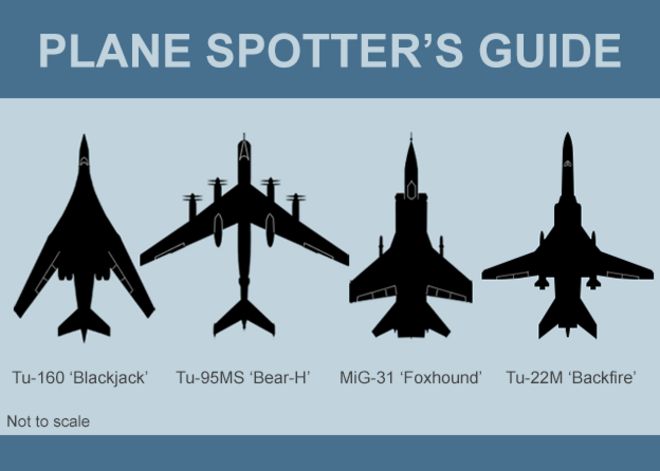
Each was a Tu-95 MS, also known by its NATO reporting name "Bear-H", a four-engine long-range bomber, equipped with turboprop-driven propellers and set-back wings that give it an unmistakable silhouette.
 |
| The TU-95 Bear Bomber |
The most noticeable thing about the Bear, the earliest iteration of which entered service in 1956, is the almighty racket it makes. Its contra-rotating propellers spin faster than the speed of sound, creating their own sonic boom, making it one of "the loudest combat aircraft ever built", says Justin Bronk of the Royal United Services Institute. The Bear, which typically carries six or seven crew members, is not the fastest aircraft in the Russian fleet, reaching speeds of only about 575 mph (920 km/h). But it is regarded as one of the most reliable, says Bronk, which helps account for its longevity.
 |
| A Tu-160 strategic bomber |
Another bomber you might expect to see just outside British airspace is the Tu-160, known as the Blackjack, two of which were intercepted by RAF Tornado F3 fighters off the Scottish coast in 2010. Unlike the Bear, the Blackjack is capable of supersonic speeds of up to 2,200km/h. "It's essentially a heavier and faster equivalent of the American B1B Lancer," says Bronk. It also has a longer range and can carry more nuclear-capable missiles. An upgraded version of the TU-160 made its maiden flight in November 2014.
 |
| A Russian long-range bomber TU-22 |
Then there's the Tu-22M3 strategic bomber, which is also supersonic and nuclear-capable. "It's not as big as the Bear and the Blackjack," says Bronk. "Its closest Western equivalent is the F-111." Its variable-sweep wing allows it to take off quickly and fly at very low altitudes. There are thought to be over 100 TU-22Ms in service in the Russian fleet.
 |
| The MiG 31 interceptor |
Sometimes Bears are escorted by supersonic MiG-31 interceptors, says Bronk. Among the world's fastest combat aircraft, they are equipped with onboard radar that can track 24 airborne targets and attack six at a time. But Bronk says: "Although they are extremely fast and carry powerful radar, they are a essentially an evolution of a very old design, the MiG-25, and are no match for the RAF's Typhoons in air-to-air combat."
The incident in Cornwall is unlikely to be the last time radar operators detect Bears. There was a similar incident in January when two Bear bombers were escorted by RAF jet after causing what the Foreign Office called a "disruption to civil aviation". The RAF intercepted Russian aircraft on eight occasions in 2014, and the same number of times in 2013, according to MoD figures released under the Freedom of Information Act.
"Bear raids" just outside British airspace were a common occurrence during the Cold War, sometimes taking place every week, says defence analyst Paul Beaver. Back then, he says, the intention was to test the RAF's reaction time. Their frequency lessened in the final years of the Soviet Union and stopped altogether when the Berlin Wall fell. Under Vladimir Putin's leadership, however, they have resumed. Yesterday, Prime Minister David Cameron said he suspected the Russians were "trying to make some sort of a point", and Bronk agrees. "Essentially, it's rattling the sabre."
Thanks to Nick de Larrinaga of IHS Jane's Defence Weekly for assistance with this article.