If you are a regular reader of this blog and have some mil frequency information to share, I would like to hear from you. I am interested in mil bases and frequencies worldwide (both aero and LMR), any mil trunk systems, mil satellite systems, and a special interest in any of the recent Euro frequency changes (especially any NATO frequencies and their push designators). You can remain anonymous or full credit will be given to anyone that contributes info (your choice so please advise in your correspondence).
You can send your info to larryvanhorn @ monitoringtimes.com. So how about sharing your frequency and callsign information with other readers of the most popular radio military site on the internet - the MT Milcom Blogspot. 73 de Chief
Thursday, November 30, 2006
C-37A arrives at Hickam AFB - Freq Profile
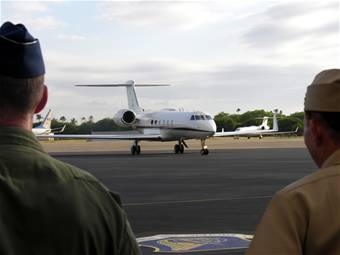
Air Force and Navy members greet the Pacific Fleet’s C-37A upon its arrival at Hickam Air Force Base, Hawaii, Nov. 18. The plane as well as the Navy’s Executive Transport Detachment moved to Hickam, where it will work with the Air Force's 65th Airlift Squadron that flies similar planes for the Pacific Command and Pacific Air Forces commanders. The Navy C-37A business jet replaces the modified P-3 aircraft the unit used to fly. The Executive Transport Detachment will consist of 24 pilots and enlisted aircrew members. They join the aircrew members from the 65th AS, which employs more than 50 pilots, flight engineers, communication system operators, flight attendants and administrative personnel. The squadron routinely flies more than 200 distinguished visitor missions each year to locations around the world and has hosted such dignitaries such as former President George H. W. Bush. (U.S. Air Force photo/Senior Airman Erin Smith)
Hickam AFB, Hawaii, Frequency List
HF-GCS (USB)
4724.0 6739.0 8992.0 9016.0 11175.0 13218.0 13440.0 13900.0 14445.0 15016.0 15038.0 15094.0 15097.0 17973.0 18006.0 18024.0 23265.0 kHz
HF-GCS Scope Command ALE HF Network (ALE/USB)
ALE Address HIK: 3137.0 4721.0 6721.0 9025.0 11226.0 13215.0 15043.0 kHz
NIPR
ALE Address HIKNPR: 8965.0 kHz
SIPR
ALE Address HIKSPR: 5702.0 5902.0 8968.0 15091.0 kHz
Mystic Star Network
4448.0 4452.0 4458.0 4935.5 4941.5 5026.0 5437.0 5817.0 5832.0 5834.0 5840.0 6793.0 6993.0 7494.5 7500.5 7687.0 7693.0 7827.0 8047.0 8057.0 8063.0 8077.0 8083.0 9212.0 9218.0 9317.0 9320.0 10580.0 10586.0 10717.0 10723.0 10877.0 10883.0 11053.5 11153.0 11159.0 11214.0 11220.0 11445.0 11451.0 11488.0 11577.0 11583.0 11627.0 14569.5 14575.5 14763.0 14769.0 14829.0 14864.5 14870.0 15011.0 15041.0 15661.0 15667.0 15724.0 16077.0 16083.0 16117.0 16157.0 16163.0 16186.0 17457.0 17463.0 17477.0 17483.0 18320.0 18397.4 18403.4 18626.0 18632.0 18909.0 19047.0 19089.5 19095.5 19267.0 19273.0 19337.0 19343.0 20147.0 20153.0 20318.0 20324.0 20422.0 20428.0 20758.0 23397.0 24483.0
Trunk Land Mobile Frequencies:
Motorola Type II Smartnet (Analog)
Motorola System ID: 460a
Base frequency: 413.0000 MHz; Spacing: 25.0-kHz; Offset: 380
Frequencies: 415.1500 415.9500c 416.7500c 417.5500c 418.2500c 418.5500c
Talkgroups:
80 Police Dispatch
112 Police/Usage unknown
624 AMC Terminal Aircraft Maintanance
720 AMC Terminal Ground Controller
784 AMC Terminal PAX Control
Honolulu International/Hickam AFB (PHIK/PHNL/HNL)
15AW Command Post 292.500 Callsign KOA Control
Air Mobility Control Center 125.300 349.400 Callsign Shaka Ops
Approach Control 118.300 (IFR) 119.100 (VFR) 239.0500 269.000 (IFR)
ATIS 127.900 251.150
Clearnce Delivery 121.400 281.400
Command Post 311.0 Callsign Bedtime
Departure Control 118.300 119.100 124.800 265.000 269.000 317.600 (124.800 317.600 East)(119.100 265.000 North)(118.300 269.000 West)
Flight Service Station (FSS) Honolulu Radio 122.200 122.600 123.600 255.400 272.700 (113.900T 114.800T 115.300T 122.100R)
Ground Control 348.600
Hickam Advisory Ramp 133.600 234.800
Honolulu Ramp 121.800
Pilot to Dipatcher (PTD) 372.200
PMSV Metro 346.600
Tower 118.100 123.900 257.800 273.575
UNICOM 123.300
As always additions and corrections are most appreciated. You can contact me at the email address in the header.

Tower stays on top of things

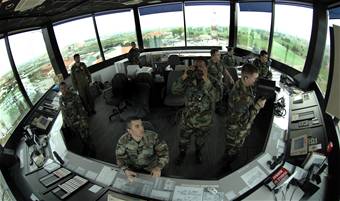
The air control tower is abuzz with activity as Italian air force and U.S. Air Force air traffic controllers direct multiple flights of fighters Nov. 28, 2006, at Aviano Air Base, Italy. Air traffic controllers perform duties within a radar facility and maintain radar surveillance of approach control airspace, processing and coordinating aircraft through terminal control. (U.S. Air Force photo/Airman 1st Class Michael S. Dorus)
Aviano AB (LIPA/LIYW) Frequency List
Approach/Departure Control 120.125 275.325 360.775 362.300 (VFR Radar Advisory Service) 363.250 (134.100 Joint ItAF/USAF)
ATIS 129.300 262.950 (Also listed 341.775 290.875 need to confirm what is in use)
Clearance Delivery 122.100 376.650
Command Post (Yankee OPS/DF msn, Falcon OPS/all others) 369.200 262.950 264.800 (AMCC) 13458.0 kHz (Raven Ops)
Ground Control 122.100 376.650 (122.100 Joint ItAF/USAF) (312.650 is also listed)
Pilot to Dispatcher (PTD) 396.875
PMSV Metro 257.750 341.775
Supervisor of Flying 262.950 (260.925 is also listed)
Tower 142.050 284.650
Treviso Approach 120.400
Wednesday, November 29, 2006
MT Milcom Blog Exclusive - Inside the Changes at NORAD
According to an official we talked to at NEADS yesterday (28 Nov 2006), the new dividing line for the West ADS from the new eastern US ADS based at Griffiss is the Mississippi River. Also I have been told that the NEADS title for the Griffiss bunch will change within the next month. I have a request in for a new graphic of the NORAD Sectors and several other questions I want to have answered and will hopefully hear from more sources very soon. When I do I will pass along those results here on the MT Milcom Blog.
In the meantime, here are some frequencies heard in the southeast United States that Huntress (NEADS) has been heard on since Oak Grove was decommissioned:
243.000
252.000
254.200
265.400
282.600
288.400
320.600
364.200 Air Intercept Control Common (AICC)
387.800
Tuesday, November 28, 2006
SEADS ends operations, becomes AOC

Story by Mike Strickler
AFNORTH Public Affairs
After more than 37 years of monitoring America's airways, the flip of a ceremonial switch on November 17, 2006, marked the close of operations here for the Southeast Air Defense Sector.
More than 100 members of the tight-knit SEADS fraternity looked on as Continental U.S. NORAD Region leaders marked the passing of the SEADS mission while celebrating its impending transformation to the 601st Air Operations Center.
"It's an emotional and historic event," said Colonel David Kriner, former SEADS, and now 601 AOC, commander, "as we are now actively re-rolling this mission, closing one chapter and opening another in supporting this war-fighting headquarters as an Air Operations Center."
SEADS responsibility for air defense of the southeastern United States began in April 1982 following its transfer from Duluth, Minn., where it had served as the 23rd Air Division under the Aerospace Defense Command since November 1969. In October 1996 SEADS transitioned completely to the Air National Guard and became a Geographically Separated Unit assigned within the Florida Air National Guard.
Since then its responsibility for defense of approximately 1,000,000 square miles of airspace, and 3,000 miles of coastline from Virginia to Texas, marked SEADS as the busiest of CONR's three sectors.
That responsibility now rests with CONR's Northeast Air Defense Sector in Rome, N.Y., and Western Air Defense Sector at McChord AFB in Washington state.
"This decision was made nearly four years ago to first modernize the air defense system, and then consolidate CONR's three air defense sectors into two as we transitioned into an AOC" said Col. Kriner. "To facilitate that CONR moved the WADS responsibilities further to the east, while NEADS area of responsibility extended further south, all the way down to the Straits of Florida."
As for the 601 AOC, Colonel Kriner said the next step in the migration involves training.
"We've got more than 250 full-time Air National Guardsmen that need to be trained and integrated into the processes of an AOC in providing air tasking order and strategy-to-task functions," he said.
"We've been working nearly four years toward this, and everyone's excited for what they're going to do next, what they're going to learn, and how we're going to work together as an AOC and Air Force Forces staff in support of CONR."
Brigadier General Charles Campbell, AFNORTH vice commander and Florida Air National Guardsman, lauded the SEADS team on their accomplishments.
"You know, these days, a lot of people talk about finishing well. Well I can tell you, this team finished well," he said. "They held it together while we moved toward the AOC mission through holidays, hurricanes and missed time with families - it was truly a job well done."
Photo above:
Colonel David Kriner (left) 601 AOC commander, flips the ceremonial switch with (right) Maj. Gen. Hank Morrow, 1st Air Force commander, and SEADS Master Sgt Judy Butler-McGuire and Tech Sgt James Middleton. The ceremony marked the closure of operations at SEADS and its continued transition to the 601st Air Operations Center. (Photo by Deb Kiser and courtesy of the USAF).
ARNORTH mobilizes for Exercise Golden Guardian
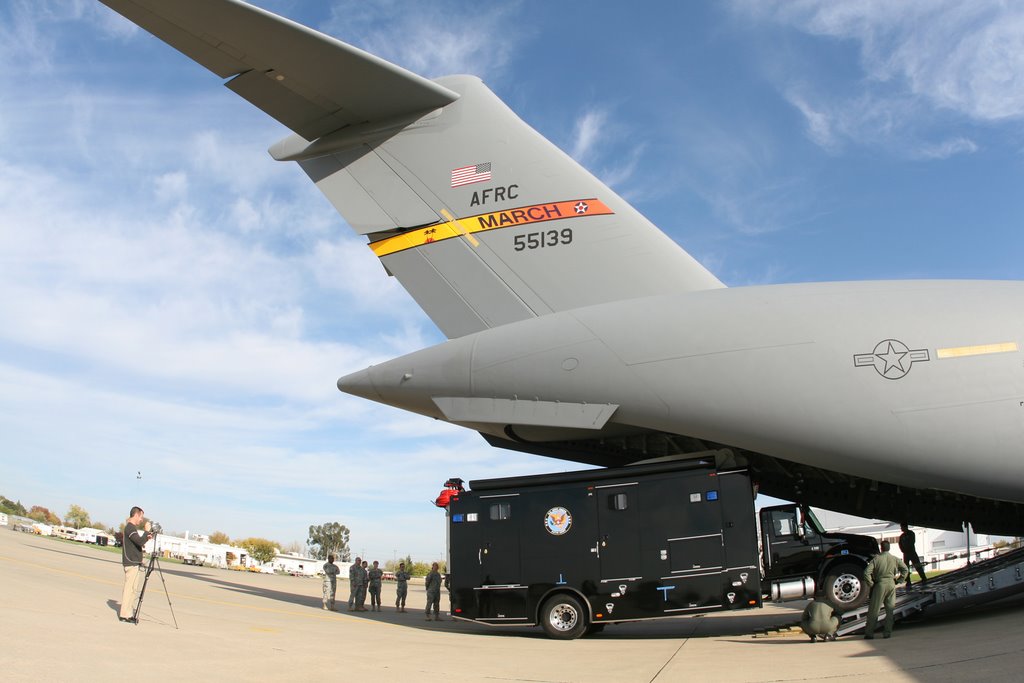
A Sentinel communications vehicle assigned to U.S. Army North is offloaded November 15, 2006, from a C-17 at McClellan Business Park in Sacramento, Calif. The movement from Fort Sam Houston, Texas, marked the first time the communications vehicle has been air deployed. Within one hour of the offload, satellite telephone and computer communications capability were established to support USARNORTH's participation in Exercise Golden Guardian, a weeklong earthquake consequence management exercise. The Sentinel is designed to maintain communications between local, state and federal agencies, as well as Department of Defense assets deployed to support civil authorities during natural or manmade disasters. USARNORTH is the Army's newest service component command and is assigned to U.S. Northern Command, the unified command responsible for defending the U.S. homeland and providing defense support to civil authorities.
Photo by Bob Purtiman
New Mil Intercepts Online
For those of you who may be interested, my latest HF/VHF/UHF terrestrial/satellite mil intercepts from 27 Nov 2006 have been posted on my Btown Monitoring Post at http://monitor-post.blogspot.com/.
Monday, November 27, 2006
HF-GCS Ascension Ops to be Intermittent

ASCENSION HF GLOBAL STATION OPERATIONS WILL BE INTERMITTENT DUE TO AIR FORCE SPACE COMMAND HF MODERNIZATION UPDATES. 27 NOV 07:30 UNTIL 13 DEC 16:30
Saturday, November 25, 2006
Seattle ARTCC Freq Change
Seattle ARTCC (Spokane RCAG) on 282.300 MHz has changed frequencies to 290.550 MHz until further notice. (Source: NOTAM KZSE 09/104).
NORAD Western Air Defense Sector ops center opens
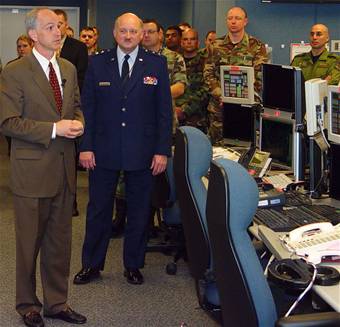
McCHORD AIR FORCE BASE, Wash. (AFPN) -- With the snip of a fiber-optic ribbon, the Western Air Defense Sector opened its multi-million dollar operations center here Nov. 20.
The opening culminated an 18-month effort that now stands WADS as a significant, technically advanced deterrent against asymmetrical threats over a significant portion of America's airspace.
"This is an important technological breakthrough that definitely enhances our nation's defense," said Maj. Gen. Timothy Lowenberg, Washington State's adjutant general. "By incorporating the latest technologies and infrastructure WADS now protects the airspace over roughly 72 percent of the country.
"And we have the capability to cover the National Capitol Region and eastern United States if the call arises," he said.
Gone are the green-swept scopes and darkened control rooms reminiscent of the Cold War. The refurbished Sector Operations Control Center enjoins state-of-the-art air defense systems and cutting-edge computer technology to significantly increase surveillance and identification capabilities, and better protect the nation's airways from intrusion and attack.
The SOCC also incorporates a newly-developed situational awareness system that gives WADS unprecedented tools and technology to assist state and local responders in dealing with natural disasters.
The upgrade included renovation of a 6,300-square-foot WADS operations floor and the installation of more than 22 miles of fiber-optic cable and 10 miles of category 5 copper cables, at a cost of more than $1.8 million. According to General Lowenberg, the installation efforts paralleled the remarkable technology.
"This was quite an engineering feat ... to make massive changes in a building with 10-inch reinforced concrete floors, supported by 15-inch outside walls and a grid of three-foot square concrete columns," he said.
The original facility, built in 1958, housed a node of the nationwide Semi-Automatic Ground Environment, or SAGE, system that revolutionized air defense in the 1960s.
According to the Federation of American Scientists, SAGE's automatic data-processing capability replaced manual systems in observing, plotting and transmitting information, and assigning targets for air defense weapons. Its revolutionary integrated radar and computer technology also contributed significantly to the development of civilian air traffic control systems.
Today, the SOCC employs 27 NORAD contingency suites, and 31 state-of-the-art Battle Control System-Fixed, or BCS-F, displays. A next-generation air sovereignty system, BCS-F fuses data from airborne, ground and naval elements and civil air traffic sensors into an integrated air picture. This allows commanders to surveil and monitor the airspace above, beyond and within U.S. and Canadian borders, providing a major component for homeland defense.
Rep. Adam Smith, of Washington State's 9th District, attended the opening and congratulated the WADS team for stepping up to the difficult challenge
"We have the technology, but getting it in place and making it work is not always easy... It takes all of you to get it done," said Rep. Smith. "For all of you who do the work day in and day out to keep us safe, I thank you."
(Courtesy of 1st Air Force News Service)
Friday, November 24, 2006
Second C-5M Super Galaxy takes flight
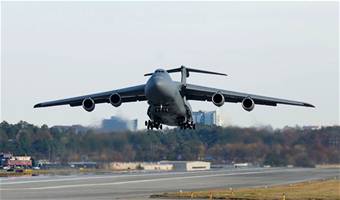
MARIETTA, Ga. (AFPN) -- The second fully modernized Lockheed Martin C-5M Super Galaxy test aircraft made its first flight Nov. 17 from Dobbins Air Reserve Base, Ga. This is the second of three aircraft that will comprise the new C-5M test fleet.
"The C-5M represents a true recapitalization program for a critical capability, ensuring a viable strategic airlift resource for America through the year 2040," said George Shultz, vice president, Lockheed Martin C-5 Modernization program.
"Modernized C-5 Galaxy aircraft will improve the fleet aircraft availability and the overall reliability and maintainability, while reducing total ownership costs," Mr. Shultz said. "The C-5M provides the U.S. Air Force and American taxpayer with a significant return on their investment."
"We're excited about the C-5M," said Col. Devin Cate, 716th Aeronautical Systems Group commander at Wright Patterson AFB, Ohio. "Who wouldn't be excited about being on a new aircraft program? People can say it's an old airplane, but the C-5M is a new version. It has so much more capability than the current fleet."
The C-5M includes avionics modernization, along with reliability enhancement and re-engining. The Avionics Modernization Program adds a new, modern cockpit that includes a digital all-weather flight control system and autopilot, a new communications suite, flat panel displays, and enhanced navigation and safety equipment to ease crew workload and enhance situational awareness.
C-5 aircraft which have completed the AMP process have logged more than 4,000 hours with the new system, many of which were flown in support of Operation Iraqi Freedom.
The centerpiece of the Reliability Enhancement and Re-engining Program is the General Electric CF6-80C2 commercial engine, which has more than 288 million flight hours on more than 229 commercial and military customers, including the VC-25s (Air Force One) used by the president of the United States. This engine delivers a 22 percent increase in thrust to the C-5M, a 30 percent shorter take-off roll, has a 58 percent faster climb rate and will allow significantly more cargo to be carried over longer distances.
The first test aircraft first flew June 19 and has logged more than 51 flight hours. It completed dynamic taxi testing at the Air Force Flight Test Center at Edwards Air Force Base, Calif., in August. This latest aircraft will be used mostly for utilities and subsystem tests, airfield performance, and diagnostics testing. Both of these aircraft were originally C-5B models. A third test aircraft to be brought up to C-5M standards, a C-5A, is currently in the final stages of modernization and scheduled to fly later this year.
With more than 2 million flight hours since entering the fleet in 1970, the C-5 has been the backbone of strategic airlift in every military engagement from Vietnam through Operation Iraqi Freedom. It is the only aircraft capable of carrying 100 percent of certified air-transportable cargo and includes a dedicated passenger compartment enabling commanders to have troops and their equipment arrive in an area of operation simultaneously.
For those of you who live in the SE US, here are some Lockheed freqs to watch for C-5M test activity on from the MT Milcom frequency vault.
Lockheed Flight Test Support:
3443.0 5469.0 5708.0 13212.0 kHz (USB)
123.550 142.200 143.875 MHz (AM)
225.450 229.300 240.600 251.850 255.725 266.300 275.200 314.600 345.400 382.600
384.800 MHz (AM)
Worldwide-Restricted Frequency List
Activity on the frequencies listed below is limited to the description that accompanies it. Any other usage is "TABOO." This is known within the DoD community as the "TABOO" frequency list.
Frequency (kHz)
490.0 GMDSS/METEOROLOGY AND NAVIGATION WARNINGS
500.0 GMDSS/DISTRESS AND CALLING
518.0 GMDSS/NAVTEX/METEOROLOGY AND NAVIGATION WARNINGS
2174.5 INTERNATIONAL DISTRESS/SAFETY
2182.0 INTERNATIONAL DISTRESS
2187.5 INTERNATIONAL DISTRESS/SAFETY
3023.0 INTERNATIONAL SEARCH AND ESCUE
4125.0 INTERNATIONAL DISTRESS AND SAFETY
4177.5 INTERNATIONAL DISTRESS/SAFETY
4207.5 INTERNATIONAL DISTRESS/SAFETY
4209.5 GMDSS/NAVTEX METEOROLOGY AND NAVIGATION WARNINGS
4210.0 INTERNATIONAL MARITIME NAVIGATION SAFETY
5680.0 INTERNATIONAL SEARCH AND RESCUE
6215.0 INTERNATIONAL DISTRESS AND SAFETY
6268.0 INTERNATIONAL DISTRESS/SAFETY
6312.0 INTERNATIONAL DISTRESS/SAFETY
6314.0 INTERNATIONAL MARITIME SAFETY/GMDSS
8291.0 INTERNATIONAL DISTRESS/SAFETY
8364.0 INTERNATIONAL SEARCH AND RESCUE/SURVIVAL CRAFT
8376.5 INTERNATIONAL DISTRESS/SAFETY
8414.5 INTERNATIONAL DISTRESS/SAFETY
8416.5 GMDSS/INTERNATIONAL MARITIME SAFETY
12290.0 INTERNATIONAL DISTRESS/SAFETY
12520.0 INTERNATIONAL DISTRESS/SAFETY
12577.0 INTERNATIONAL DISTRESS/SAFETY
12579.0 GMDSS/INTERNATIONAL NAVIGATION SAFETY
16420.0 INTERNATIONAL DISTRESS/SAFETY
16695.0 INTERNATIONAL DISTRESS/SAFETY
16804.5 INTL DISTRESS/SAFETY
16806.5 GMDSS/INTERNATIONAL MARITIME SAFETY
19680.5 GMDSS/INTERNATIONAL MARITIME SAFETY
22376.0 GMDSS/INTERNATIONAL MARITIME SAFETY
26100.5 GMDSS/INTERNATIONAL MARITIME SAFETY
Frequency (MHz)
121.500 INTERNATIONAL DISTRESS/AERONAUTICAL EMERGENCY
123.100 INTERNATIONAL EMERGENCY/SEARCH AND RESCUE
156.300 INTERNATIONAL SHIP/AIRCRAFT SEARCH AND RESCUE
156.525 INTERNATIONAL DISTRESS/SAFETY/GMDSS
156.650 INTERNATIONAL SAFETY OF NAVIGATION
156.800 INTERNATIONAL DISTRESS AND SAFETY
243.000 AERO EMERGENCY/INTERNATIONAL DISTRESS/SEARCH AND RESCUE
406.050 SATELLITE EPIRB
1227.600 SATELLITE GPS DOWNLINK
1544.500 SATELLITE EPIRB FEEDER LINKS
1575.420 SATELLITE GPS DOWNLINK
1646.000 SATELLITE EPIRB
Frequency (kHz)
490.0 GMDSS/METEOROLOGY AND NAVIGATION WARNINGS
500.0 GMDSS/DISTRESS AND CALLING
518.0 GMDSS/NAVTEX/METEOROLOGY AND NAVIGATION WARNINGS
2174.5 INTERNATIONAL DISTRESS/SAFETY
2182.0 INTERNATIONAL DISTRESS
2187.5 INTERNATIONAL DISTRESS/SAFETY
3023.0 INTERNATIONAL SEARCH AND ESCUE
4125.0 INTERNATIONAL DISTRESS AND SAFETY
4177.5 INTERNATIONAL DISTRESS/SAFETY
4207.5 INTERNATIONAL DISTRESS/SAFETY
4209.5 GMDSS/NAVTEX METEOROLOGY AND NAVIGATION WARNINGS
4210.0 INTERNATIONAL MARITIME NAVIGATION SAFETY
5680.0 INTERNATIONAL SEARCH AND RESCUE
6215.0 INTERNATIONAL DISTRESS AND SAFETY
6268.0 INTERNATIONAL DISTRESS/SAFETY
6312.0 INTERNATIONAL DISTRESS/SAFETY
6314.0 INTERNATIONAL MARITIME SAFETY/GMDSS
8291.0 INTERNATIONAL DISTRESS/SAFETY
8364.0 INTERNATIONAL SEARCH AND RESCUE/SURVIVAL CRAFT
8376.5 INTERNATIONAL DISTRESS/SAFETY
8414.5 INTERNATIONAL DISTRESS/SAFETY
8416.5 GMDSS/INTERNATIONAL MARITIME SAFETY
12290.0 INTERNATIONAL DISTRESS/SAFETY
12520.0 INTERNATIONAL DISTRESS/SAFETY
12577.0 INTERNATIONAL DISTRESS/SAFETY
12579.0 GMDSS/INTERNATIONAL NAVIGATION SAFETY
16420.0 INTERNATIONAL DISTRESS/SAFETY
16695.0 INTERNATIONAL DISTRESS/SAFETY
16804.5 INTL DISTRESS/SAFETY
16806.5 GMDSS/INTERNATIONAL MARITIME SAFETY
19680.5 GMDSS/INTERNATIONAL MARITIME SAFETY
22376.0 GMDSS/INTERNATIONAL MARITIME SAFETY
26100.5 GMDSS/INTERNATIONAL MARITIME SAFETY
Frequency (MHz)
121.500 INTERNATIONAL DISTRESS/AERONAUTICAL EMERGENCY
123.100 INTERNATIONAL EMERGENCY/SEARCH AND RESCUE
156.300 INTERNATIONAL SHIP/AIRCRAFT SEARCH AND RESCUE
156.525 INTERNATIONAL DISTRESS/SAFETY/GMDSS
156.650 INTERNATIONAL SAFETY OF NAVIGATION
156.800 INTERNATIONAL DISTRESS AND SAFETY
243.000 AERO EMERGENCY/INTERNATIONAL DISTRESS/SEARCH AND RESCUE
406.050 SATELLITE EPIRB
1227.600 SATELLITE GPS DOWNLINK
1544.500 SATELLITE EPIRB FEEDER LINKS
1575.420 SATELLITE GPS DOWNLINK
1646.000 SATELLITE EPIRB
Wednesday, November 22, 2006
Happy Thanksgiving to Our Military & Blog Readers

I want to wish all the men and women of our Armed Forces and their families a very Happy Thanksgiving holiday, that will be celebrated here in the US tomorrow November 23. Thank you for your service to this country.
Happy holiday also to all my Milcom Blog readers. Unless there is major breaking news, we will be enjoying the holiday tomorrow with my family and will not be posting to the blog.
Best to all of you, 73 and good hunting,
Larry, N5FPW
VAQ-137 Returns from Six Month Deployment
By Mass Communication Specialist 1st Class Bruce McVicar, Northwest Fleet Public Affairs Center Detachment
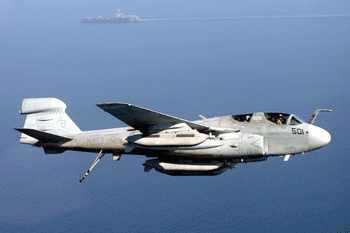
OAK HARBOR, Wash. (NNS) -- The Electronic Attack Squadron (VAQ) 137 “Rooks” returned to Naval Air Station Whidbey Island Nov. 17, concluding a six-month deployment.
“We completed an outstanding deployment, made possible due to a phenomenal effort by the Rook Sailors,” said Cmdr. Mike Buchanan, commanding officer of VAQ-137. “When you put so much focus into your job the last six months, finally seeing your family again is extremely emotional.”
The squadron left Whidbey Island in May, and by the next month were conducting split-site operations from the aircraft carrier USS Enterprise (CVN 65) and from Al Asad air base in Iraq, supporting Operation Iraqi Freedom (OIF).
"It was a great deployment. We received unbelievable support from the carrier and the air base,” said Lt. Colin Allen.
In June, the Rooks flew more than 500 combat hours in country with two jets and 50 maintenance personnel.
They supported a second detachment during September and October with three jets and flew more than 1,200 combat hours. Overall, the Rooks flew 326 sorties out of 330 scheduled for a 99 percent sortie-completion rate in support of OIF. A total of 2,050 hours were flown during the deployment.
“It was a long cruise and felt quite a bit longer than six-and-a-half months,” said Lt. Cmdr. Rich Knapp. “I’m glad to be home and someplace less than 90 degrees every day.”
“The squadrons performance was outstanding. Our maintenance department provided tremendous support,” said Knapp.
The Rooks were also the first Prowler squadron to deploy with the Improved Capability III Block 2 software to include LINK 16. This updated electronic attack detection suite provides for expanded frequency coverage, improved geo-location, increased interoperability, and integrated communications jamming capability.
Also returning are 20 members of the Sea Operational Det. from Fleet Readiness Center Northwest that provides technical support to keep the jets in top condition.
Milcom Unit Report:
Squadron: VAQ-137/CVW-1
Home Port: NAS Whidbey Island, Washington
Common Callsigns: Rook ##/AB 500+
Squadron Frequencies: 242.725 335.700
Tuesday, November 21, 2006
Stennis, Reagan Strike Groups Join Forces, Make Carrier Task Force
By Mass Communication Specialist 1st Class (SW/AW) Chris Fowler, USS John C. Stennis Public Affairs
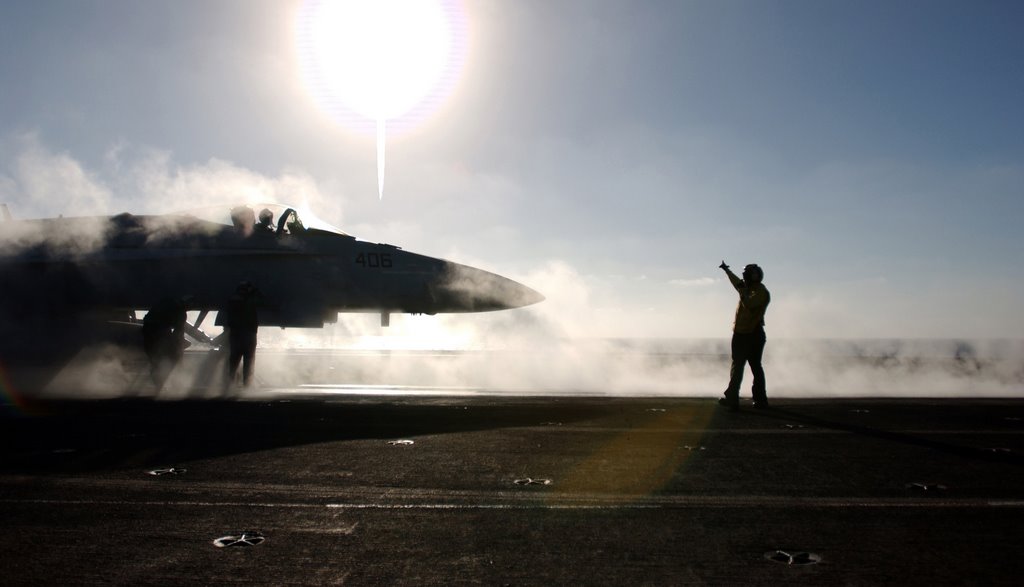
CARRIER TASK FORCE 150, At Sea (NNS) -- The USS John C. Stennis (CVN 74) Carrier Strike Group (JCSSG) combined forces with the USS Ronald Reagan (CVN 76) Carrier Strike Group for its Joint Task Force Exercise (JTFEX) off the coast of Southern California to form Carrier Task Force (CTF) 150, Nov. 12-16.
According to Rear Adm. Kevin Quinn, commander, Carrier Strike Group 3, the purpose of training as a CTF during JTFEX is to provide warfare commanders with the greatest capability and staying power for fighting the global war on terrorism with a dual-carrier, combat-ready, maritime force.
JTFEX is the final phase before JCSSG is certified by Commander, U.S. 3rd Fleet as “deployment ready.” It uses a free-flowing battle problem that employs multiple scenarios to enable JCSSG to demonstrate that it is capable of integrating into a CTF.
As the commander of CTF 150, Quinn has operational control of both carrier strike groups (CSG). Merging strike groups into a CTF increases the assets available to the commander in theater. The mission of the task force is similar to that of a carrier strike group, but much larger in scale and scope: to deter and dissuade aggression, keep sea-lanes open for commerce, and conduct maritime security operations.
“With a carrier task force, we are training like we fight,” said Quinn. “As the Navy looks at different hot spots overseas, the best response to many scenarios requires a multi-carrier task force.”
CTF 150 spent one week conducting a wide range of maritime security operations across many different warfare disciplines. As elements of the CTF, Stennis Carrier Air Wing (CVW) 9 and Reagan's CVW-14 effectively became a single team.
“We are now integrating two CSG air wings who, combined, are providing the strike warfare arm of CTF 150,” said Capt. Sterling Gilliam, commander, CVW-9. “The combination provides greater flexibility, striking power, and persistence than one carrier air wing could provide alone.”
For the JTFEX, air power “persistence” is essential. During normal cyclic flight operations, a pilot spends a significant amount of time transiting to and from target areas. With the enhanced capabilities CTF 150 provides, by alternating air plan flight cycles, CTF 150 is able to maintain a nearly constant air presence over the targeted areas.
According to Gilliam, it is difficult for one CVW to conduct flight operations for much more than about 12 hours before having to stop. However, with the combined striking power of two CVWs, CTF 150 is able to conduct air operations over a continuous 24-hour cycle.
“During the early days of Operation Enduring Freedom, I was aboard USS Enterprise (CVN 65) operating with USS Carl Vinson (CVN 70) off the coast of Afghanistan,” said Gilliam. “When the order to launch air strikes arrived, together, both CVWs flew 24-hours a day.”
“At any one time,” said Gilliam, “We are able to provide focused air power to overwhelm any adversary we could potentially face.”
While CTF 150 conducted air warfare exercises, the surface components operate across the full spectrum of surface warfare. Led by Destroyer Squadron (DESRON) 21, CTF 150’s Sea Combat Commander (SCC) conducted sustained operations in four general disciplines: maritime interdiction operations (MIO), anti-submarine warfare (ASW), anti-surface warfare (ASUW), and mine warfare (MW).
According to Lt. Cmdr. Kitja Horpayak, DESRON 21 tactical action officer, CTF 150 will also conduct exercises in expanded maritime interdiction, vessel boarding, and oil-platform defense.
“This exercise is designed to ensure we have the right assets on station and subject matter experts available, so we can seamlessly shift from planning a mission to executing it,” said Horpayak. “We are also shifting command and control of the various disciplines [MIO, ASW, ASUW, MW] between the Carrier Strike Force to practice shifting authorities, so we can ensure we have the right combination of command and control where and when they are most needed.”
Of the four disciplines, ASW is a top war fighting priority and continues to increase in importance.
“Our ability to track, identify, and if neccessary target submarines is of the utmost importance. Exercises, such as JTFEX 07-1, allow carrier strike groups to hone their warfighting skills and ensure we are proficent and effective during our upcoming deployment in support of global war on terror,” said Horpayak.
“The exercises are very dynamic and challenging,” said Quinn. “No matter what scenario we might face, my number one priority is to provide a combat ready carrier strike group. That way, we are ready for any missions that we could face on deployment.”
Joint tactical radio system fielded soon
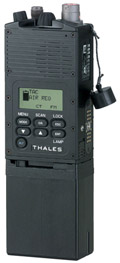
11/20/2006 - WASHINGTON (AFPN) -- The Air Force is about to enter a new era in communications technology. Officials at the Electronic Systems Center at Hanscom Air Force Base, Mass., have signed a $7.8M contract with Thales Communications, Incorporated, for the delivery of the first Joint Tactical Radio System radios to the Air Force.
More than 1200 JTRS-enhanced multiband inter/intra team radios, known as JEM radios, will be delivered to civil engineer explosive ordnance disposal units, security forces and air support operations squadrons across the Air Force. The radios will provide communications for convoy operations and enhance interoperability with the Army.
JTRS is a Defense Department-mandated, software-defined radio development program. A key element of the JTRS program is the network-centric capability it will provide to the warfighter.
JTRS eventually will bring internet-like capabilities to the battlefield, enabling the transfer of voice, data and video between Air Force and joint users alike.
Another significant feature is the ability of JTRS radios to "port" and operate various waveforms. Porting refers to loading of a software application that emulates the capabilities of legacy radios in use in the field today.
In short, if a user needs to talk to an Air Force aircraft using a specific waveform, that waveform is loaded into the radio. If later, that same user needs to communicate with an Army convoy unit using a completely different waveform, then that waveform is loaded into the same radio.
This capability gives the warfighter interoperability in a joint environment without the need to carry and maintain numerous different types of radios.
The JEM being delivered to the Air Force, while not network capable, will provide the interoperability aspects the JTRS program is seeking to fulfill. Aside from the basic ultra high frequency and very high frequency AM voice waveforms, the JEM will work in several frequency-hopping modes, plus is capable of porting future JTRS waveforms within its operating range. Deliveries will begin later this year.
This delivery of radios is just the first installment of a multi-year migration to JTRS. The Air Force's path to JTRS is documented in the Air Force JTRS migration plan. This document, compiled by the Air Force Command and Control Intelligence, Surveillance and Reconnaissance Center JTRS lead command office, was originally signed Dec. 29, 2003.
The JTRS lead command office has conducted numerous data calls throughout the Air Force to determine what requirements exist, validated those requirements through the major commands, and documented them in the migration plan. Version 2 of the migration plan is currently being staffed through the MAJCOMs, and is expected to be signed before the end of the year.
And from Thales:
Thales’ AN/PRC-148 JEM Becomes the First Government Approved Joint Tactical Radio System Radio in Production
CLARKSBURG, Md., November 16, 2006: Thales Communications, Inc., announces the award of a competitive contract from the U.S. Air Force Joint Tactical Radio System (JTRS) Program Office, Electronic Systems Center, Hanscom AFB, Mass., for the purchase of more than 1,200 AN/PRC-148 JEM radios. This award will equip security forces, civil engineering, and tactical air control personnel with the AN/PRC-148 JEM as well as associated ancillaries and accessories.
The AN/PRC-148 JEM--JTRS Enhanced Multiband Inter/Intra Team Radio (MBITR)--is the first JTRS radio certified for compliance with Software Communications Architecture (SCA)*. The only JTRS radio to have successfully completed Joint Interoperability Test Command testing, the AN/PRC-148 JEM has been deemed to be effective and suitable for deployment to the field. The needs of the warfighter are now met with a low-risk radio that not only incorporates JTRS SCA architecture but has also been user-tested and qualified in operational field conditions.
“The JEM provides the backbone for a system communications solution that will allow the Air Force to migrate toward, and stay on the forefront of, new technology,” said Ray Bruhn, manager of Air Force programs at Thales Communications. “It positions them to maximize use of their available resources, meet the mounting challenges of size-, weight-, and power-constrained battlespace environments, and maintain their technological edge.”
Based on the combat-proven MBITR and developed under a formal U.S. Government program of record, the JEM provides a seamless, cost-effective path to JTRS. The radio leverages a proven platform, and provides a JTRS solution that bridges the gap between legacy equipment and future JTRS technologies. Thales has turned the JTRS vision into reality and is providing warfighters with tomorrow’s radio today.
*SCA compliant with waivers
Editor’s Note: There are currently more than 80,000 AN/PRC-148 MBITRs fielded, and this number is continually increasing. The AN/PRC-148 MBITR is being used extensively in Operation Enduring Freedom, Operation Iraqi Freedom, and the Global War on Terrorism. The AN/PRC-148 (both MBITR and JEM configurations) is the cornerstone of a complete system solution for the warfighter which includes a Vehicle Adapter with a unique, cable-free, rapid radio dismount capability; the dual radio AN/VRC-111 Vehicle Adapter Amplifier; Base Station for fixed applications; Tactical Repeater for range extension; and compact, rugged Man Portable System for dismounted operations requiring higher power output (20 watts).
Monday, November 20, 2006
GPS Satelite SVN15 Decommissioned
GPS satellite SVN15 [1990-088A 20830 USA 64/NAVSTAR 21/GPS II-9] (PRN15) was decommissioned from active service on JDAY 321. (17 NOV 2006). PRN15 is available for future satellite vehicles. This satellite was launched 10/1/1990.
Air Force launches Delta II/GPS Mission
 CAPE CANAVERAL AIR FORCE STATION, Fla. (AFPN) -- The Air Force successfully launched a Delta II booster from Cape Canveral, Fla., Nov. 17.
The joint government and industry launch was carrying the NAVSTAR Global Positioning System satellite (GPS 2R-16). This launch was led by the 45th Space Wing.
The satellite launched is the third of the modernized GPS satellites that incorporates various improvements that will provide greater accuracy, increased resistance to interference and enhanced performance for users.
It will become part of a system consisting of a 24-satellite constellation that provides continuous and precise navigation and timing information to military and civilian users worldwide.
"This success is another example of how the 45th Space Wing is at the leading edge of providing combat effects to our warfighters," said Brig. Gen. Susan Helms, 45th SW commander.
Capt. Greg Vice, of the 1st Space Launch Squadron, was the Air Force launch crew commander for the mission.
"Our launch team is tremendous," he said. "This was our third Delta II launch within seven weeks. Launching systems such as GPS is one of the many ways space operators contribute to the Global War on Terror."
The GPS is a space-based positioning and navigation system. Operations such as mapping, aerial refueling, rendezvous operations, geodetic surveying and, search and rescue operations have all benefited from GPS accuracy.
Launch information from the Milcom Space Desk:
Satellite Name: GPS 58/SVN 58/GPS 2R-16/M3
COSPAR Intl Designator: 2006-052A
SSC #: 29601
Launch Date: November 17, 2006
Launc Time: 1912 UTC
Launch Place: Cape Canaveral Launch Complex 17A
Launch Vehicle: Delta 7925-9.5
Orbital Parameters: 20363 x 20205 km, 722.1 minute period, 55 deg inclination
Downlink frequencies:
Civilian L1: 1575.42 MHz (Coarse Acquisition)
Civilian L2: 1227.60 MHz
Military L3: 1381.05 MHz [Nuclear burst detection]
Military L4: 1841.40 MHz (Ionospheric Correction)
Civilian L5: 1176.45 MHz
TT&C: 2227.50 MHz
GPS 2R-16/M3
1 29601U 06052A 06323.26568287 .00000091 00000-0 00000+0 0 78
2 29601 055.0507 135.5549 0029538 246.4743 304.2309 01.99417021 51

Photo courtesy of Carleton Braille and Boeing.
Saturday, November 18, 2006
End of an Era - SEADS/Oak Grove Closes
After more than 37 years of monitoring America's airways, the flip of a ceremonial switch today marked the close of operations here for the Southeast Air Defense Sector.
More than 100 members of the tight-knit SEADS fraternity looked on as Continental U.S. NORAD Region leaders marked the passing of the SEADS mission while celebrating its impending transformation to the 601st Air Operations Center.
"It's an emotional and historic event," said Colonel David Kriner, former SEADS, and now 601 AOC, commander, "as we are now actively re-rolling this mission, closing one chapter and opening another in supporting this war-fighting headquarters as an Air Operations Center."
SEADS responsibility for air defense of the southeastern United States began in April 1982 following its transfer from Duluth, Minn., where it had served as the 23rd Air Division under the Aerospace Defense Command since November 1969. In October 1996 SEADS transitioned completely to the Air National Guard and became a Geographically Separated Unit assigned within the Florida Air National Guard.
Since then its responsibility for defense of approximately 1,000,000 square miles of airspace, and 3,000 miles of coastline from Virginia to Texas, marked SEADS as the busiest of CONR's three sectors.
That responsibility now rests with CONR's Northeast Air Defense Sector in Rome, N.Y., and Western Air Defense Sector at McChord AFB in Washington state.
"This decision was made nearly four years ago to first modernize the air defense system, and then consolidate CONR's three air defense sectors into two as we transitioned into an AOC" said Col. Kriner. "To facilitate that CONR moved the WADS responsibilities further to the east, while NEADS area of responsibility extended further south, all the way down to the Straits of Florida."
As for the 601 AOC, Colonel Kriner said the next step in the migration involves training.
"We've got more than 250 full-time Air National Guardsmen that need to be trained and integrated into the processes of an AOC in providing air tasking order and strategy-to-task functions," he said. "We've been working nearly four years toward this, and everyone's excited for what they're going to do next, what they're going to learn, and how we're going to work together as an AOC and Air Force Forces staff in support of CONR."
Brigadier General Charles Campbell, AFNORTH vice commander and Florida Air National Guardsman, lauded the SEADS team on their accomplishments.
"You know, these days, a lot of people talk about finishing well. Well I can tell you, this team finished well," he said. "They held it together while we moved toward the AOC mission through holidays, hurricanes and missed time with families - it was truly a job well done."
Thanks to Mark Cleary for the heads up.
More than 100 members of the tight-knit SEADS fraternity looked on as Continental U.S. NORAD Region leaders marked the passing of the SEADS mission while celebrating its impending transformation to the 601st Air Operations Center.
"It's an emotional and historic event," said Colonel David Kriner, former SEADS, and now 601 AOC, commander, "as we are now actively re-rolling this mission, closing one chapter and opening another in supporting this war-fighting headquarters as an Air Operations Center."
SEADS responsibility for air defense of the southeastern United States began in April 1982 following its transfer from Duluth, Minn., where it had served as the 23rd Air Division under the Aerospace Defense Command since November 1969. In October 1996 SEADS transitioned completely to the Air National Guard and became a Geographically Separated Unit assigned within the Florida Air National Guard.
Since then its responsibility for defense of approximately 1,000,000 square miles of airspace, and 3,000 miles of coastline from Virginia to Texas, marked SEADS as the busiest of CONR's three sectors.
That responsibility now rests with CONR's Northeast Air Defense Sector in Rome, N.Y., and Western Air Defense Sector at McChord AFB in Washington state.
"This decision was made nearly four years ago to first modernize the air defense system, and then consolidate CONR's three air defense sectors into two as we transitioned into an AOC" said Col. Kriner. "To facilitate that CONR moved the WADS responsibilities further to the east, while NEADS area of responsibility extended further south, all the way down to the Straits of Florida."
As for the 601 AOC, Colonel Kriner said the next step in the migration involves training.
"We've got more than 250 full-time Air National Guardsmen that need to be trained and integrated into the processes of an AOC in providing air tasking order and strategy-to-task functions," he said. "We've been working nearly four years toward this, and everyone's excited for what they're going to do next, what they're going to learn, and how we're going to work together as an AOC and Air Force Forces staff in support of CONR."
Brigadier General Charles Campbell, AFNORTH vice commander and Florida Air National Guardsman, lauded the SEADS team on their accomplishments.
"You know, these days, a lot of people talk about finishing well. Well I can tell you, this team finished well," he said. "They held it together while we moved toward the AOC mission through holidays, hurricanes and missed time with families - it was truly a job well done."
Thanks to Mark Cleary for the heads up.
On-Orbit Checkout of SBIRS Payload Confirmed

Blog Editors Note: Based on the facts in hand I believe that the SBIRS HEO payload described below was carried on the USA 184/NROL-22 satellite launched 6/28/2006 as a secondary payload. Jonathan McDowell in his JSR 567 says the primary payload is a Jumpseat SIGINT. Av Week says the primary payload says it is a SDS relay bird. At this point I do not see any compelling evidence for either of the two missions, however, based on possible length of mission and on-orbit payloads, I tend to lean towards Jonathan's pri payload theory.
Ted Molczan passed along the following elset on the SEESAT-L newsgroup:
USA 184 5.0 2.0 0.0 3.7 v
1 29249U 06027A 06317.06599667 .00000450 00000-0 83648-1 0 08
2 29249 63.2600 28.3156 7179380 268.8551 91.1449 2.00642860 06
PETERSON AIR FORCE BASE, Colo. -- The U.S. Air Force successfully completed initial early on-orbit checkout of the first Space Based Infrared System (SBIRS) payload. SBIRS will deliver a new generation of space-based satellites providing missile warning, missile defense, technical intelligence, and battlespace awareness to combatant commanders.
The SBIRS Wing at the Space and Missile Systems Center (SMC), Los Angeles AFB, Calif., is developing and acquiring the system, and the 460th Space Wing, headquartered at Buckley AFB, Colo., will operate SBIRS.
General Kevin Chilton, Commander, Air Force Space Command, said, "SBIRS presents a new era of global surveillance with the ability to detect and report events that were previously beyond our capabilities, providing greatly improved support to our combatant commanders."
The initial ground phase of SBIRS, called Increment 1, became operational in 2001, using a new consolidated ground architecture that processes data from current on-orbit Defense Support Program satellites. The payload, operating in a highly elliptical orbit (HEO), is the first component of the Increment 2 constellation, ultimately including two HEO payloads and multiple satellites in geosynchronous earth orbit.
The SBIRS team, composed of personnel from the Air Force as well as Lockheed Martin, the prime contractor, and Northrop Grumman, the payload developer, confirmed the deployment, checkout, and testing of the HEO payload, focusing on calibration of the infrared sensors as well as line-of-sight testing. Performance is meeting or exceeding all specified mission requirements. The payload will be fully operationally certified by summer of 2008.
"Launch and checkout of the first SBIRS HEO system is a critical step in demonstrating this important new operational capability," Lt. Gen. Michael Hamel, SMC commander, said. "SBIRS will deliver revolutionary new ways to address some of the most serious threats the nation faces."
System Description (Courtesy of Lockheed Martin)
Under contract to the U.S. Air Force Space and Missile Systems Center at Los Angeles Air Force Base, Calif., Lockheed Martin Space Systems, Sunnyvale, Calif., is the prime contractor and systems integrator for the Space Based Infrared System (SBIRS) High program. SBIRS High is the nationÂ’s next-generation missile warning system and will also provide greatly expanded capabilities for intelligence, surveillance and reconnaissance (ISR) missions.
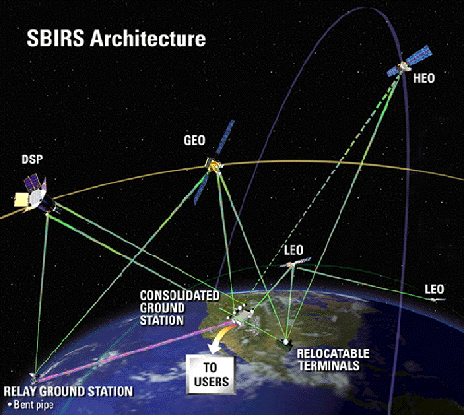
When fully operational, SBIRS High will comprise of two payloads in highly elliptical orbit (HEO), four satellites in geosynchronous orbit (GEO), as well as fixed and mobile ground-based assets to receive and process the infrared data.
SBIRS High is already providing the nation with enhanced worldwide missile detection and tracking capabilities, battlefield data, and technical intelligence through its ground segment. The first phase of the program, declared operational in 2001, consolidated ground functions of four remote sites into one centralized ground station. In addition to processing missile-warning data from Defense Support Program (DSP) satellites currently on orbit and managing the DSP constellation, the SBIRS ground station is credited with delivering significant operations and maintenance savings for its customer.
Subscribe to:
Posts (Atom)