Tyler Rogoway has written another interesting article on the Air Defense System that surrounds Washington, DC in the aftermath of 9/11.
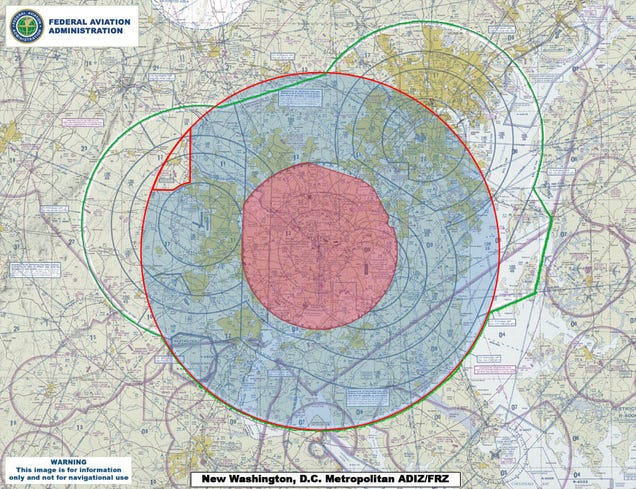
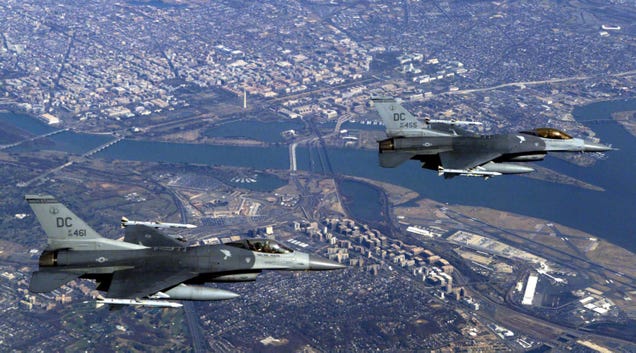
Washington DC and the region around it sits under highly monitored restricted airspace, known as the Washington DC Air Defense Identification Zone (ADIZ). As you fly closer to the center of this zone, the restrictions become increasingly intense, with the areas over the National Mall and the National Observatory being totally restricted to civilian and commercial aircraft.
A 61 year old mailman from Florida flew a USPS adorned gyrocopter onto the Capitol lawn yesterday. He came in low over northeast D.C. around 1:20pm and then turned by the Washington Monument and flew right up the Mall. According to NORAD, the aircraft was never detected, which is not a good thing.
The rest of this interesting article is posted online at http://foxtrotalpha.jalopnik.com/gyrocopter-exposes-weaknesses-in-d-c-s-elaborate-air-de-1698170601
Welcome to the Milcom Monitor Post sponsored by Teak Publishing (Copyright © 2006-2023 Teak Publishing). All rights are reserved. Redistribution of these pages in any format without prior permission is prohibited. Links to individual stories are permitted without permission. The comment section on this blog is closed, but you can pass along material or comments via email MilcomMP at gmail dot com. If you submit material for this blog and want to remain anonymous, indicate that in your message.
Milcom Monitoring Post Profiles
- Home
- What are Emergency Action Messages (EAM)? Updated 20 September 2021
- UFO Milsat Program
- Fleetsatcom System
- UHF 225-380 MHz Milcom Spectrum Holes: Updated 24 July 2019
- Civilian Air Cargo/Airline/Military Call Signs
- Intl HF Aero Civ/Gov/Mil Frequency List
- USN Aircraft Modex Numbers
- University of Twente Wide Band WebSDR Netherlands
- U.S. Military ALE Addresses
- DoD Air Refueling Frequencies - Update 15 Jul 2016
- COTHEN HF Network – Last Update 23 May 2023
- Monitoring the Civil Air Patrol Auxiliary Update 10 Sep 2016
- US Coast Guard Asset Guide - Update 24 May 2023
- The Spectrum Monitor e-Zine Milcom Column Index - Update 17 January 2022
- The Milcom MT Files (1998-2013) Articles Index
Showing posts with label Air Defense. Show all posts
Monday, August 31, 2015
Friday, June 08, 2012
Maritime Forces Train in Air Defense during BALTOPS 2012
By Lt. Cmdr. Candice Tresch, Expeditionary Strike Group 2 Public Affairs USS NORMANDY, At Sea (NNS) -- Maritime forces participating in Baltic Operations (BALTOPS) 2012, one of the largest multinational maritime exercise in the Baltic region, opened its third day at sea by training to respond to airborne adversary attacks, June 5.
The crew of USS Normandy (CG 60) and the embarked Expeditionary Strike Group (ESG) 2 staff; in cooperation with 11 other partnering nations; trained to spot, prepare for, and defend against various airborne attacks to include low sly flyers dispersing toxic chemicals as part of the BALTOPS 2012 exercise.
"Today was the first big day of air battle," said German navy 1st Lt. Oliuer Salmen, air safety officer embarked aboard USS Normandy. "There were twenty-two aircraft sorties that contributed to the exercise by flying against ships, providing support through reconnaissance, and independently observing for the CET/FIT portion of the exercise."
The Combat Enhancement Training (CET) and Force Integration Training (FIT) phase of BALTOPS is the scripted portion of the exercise which allows participating nations and units to build a common operating picture and understanding of each others' tactics in order to strengthen interoperability for the follow-on unscripted phase of the exercise, where simulated opposition forces are identified and combated.
"To prepare for this event, we ran two, three air and subsurface attack scenarios a day during our translant to the Baltic," said Lt. j.g. Michael Foster, the ship's training officer. "During a segment of the event, an inbound PC-9 dropped red dye water and the crew donned gas masks and flash gear in accordance with our pre-planned responses."
"We learned a lot from each other throughout the air defense exercises; there is always something to be learned when navies come together," said Lt. Cmdr. Brandon Murray, ESG-2's BALTOPS operations officer/lead planner. "Everyone brings different perspectives on how to attack the same problem. That extends our knowledge base and makes us a stronger, more capable force."
During air defense events, USS Normandy and the U.S. Air Force alternated serving as Airspace Safety to ensure a safe and realistic training evolution. The embarked ESG-2 Commander, Rear Adm. Ann C. Phillips, is the exercise Combined Forces Maritime component commander.
Air defense is one set of skills which will be honed during BALTOPS 2012. Other events include towing, subsurface exercises and visit boarding search and seizure operations.
The crew of USS Normandy (CG 60) and the embarked Expeditionary Strike Group (ESG) 2 staff; in cooperation with 11 other partnering nations; trained to spot, prepare for, and defend against various airborne attacks to include low sly flyers dispersing toxic chemicals as part of the BALTOPS 2012 exercise.
"Today was the first big day of air battle," said German navy 1st Lt. Oliuer Salmen, air safety officer embarked aboard USS Normandy. "There were twenty-two aircraft sorties that contributed to the exercise by flying against ships, providing support through reconnaissance, and independently observing for the CET/FIT portion of the exercise."
The Combat Enhancement Training (CET) and Force Integration Training (FIT) phase of BALTOPS is the scripted portion of the exercise which allows participating nations and units to build a common operating picture and understanding of each others' tactics in order to strengthen interoperability for the follow-on unscripted phase of the exercise, where simulated opposition forces are identified and combated.
"To prepare for this event, we ran two, three air and subsurface attack scenarios a day during our translant to the Baltic," said Lt. j.g. Michael Foster, the ship's training officer. "During a segment of the event, an inbound PC-9 dropped red dye water and the crew donned gas masks and flash gear in accordance with our pre-planned responses."
"We learned a lot from each other throughout the air defense exercises; there is always something to be learned when navies come together," said Lt. Cmdr. Brandon Murray, ESG-2's BALTOPS operations officer/lead planner. "Everyone brings different perspectives on how to attack the same problem. That extends our knowledge base and makes us a stronger, more capable force."
During air defense events, USS Normandy and the U.S. Air Force alternated serving as Airspace Safety to ensure a safe and realistic training evolution. The embarked ESG-2 Commander, Rear Adm. Ann C. Phillips, is the exercise Combined Forces Maritime component commander.
Air defense is one set of skills which will be honed during BALTOPS 2012. Other events include towing, subsurface exercises and visit boarding search and seizure operations.
Subscribe to:
Posts (Atom)