Showing posts with label US Navy. Show all posts

Thursday, June 20, 2019

Breaking News: Iran Shoots Down a US RQ-4A Global Hawk Drone


Lucas Tomlinson, the Pentagon reporter for Fox News, has confirmed what was shot down over the Straits.


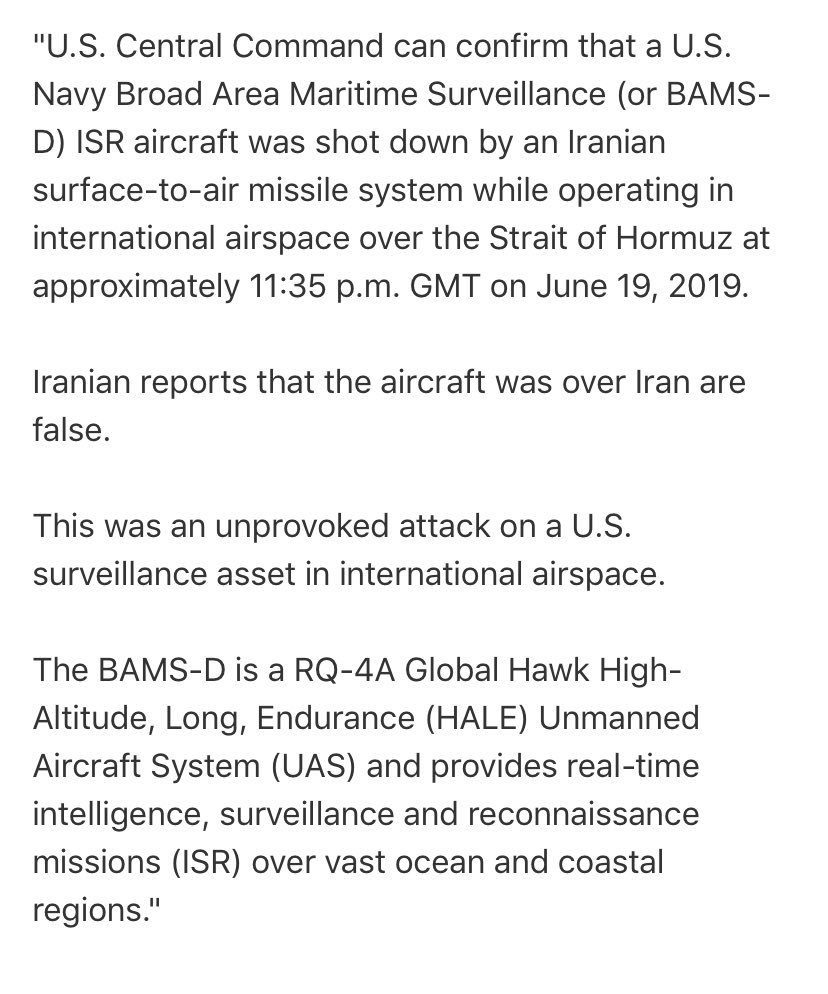
US officials confirm that US RQ-4A Global Hawk drone was shot down by an Iranian surface-to-air missile this evening while operating within international airspace over the Strait of Hormuz.

Image result for rq-8a global hawk

There are several reports that the unmanned aircraft was a US Navy Northrop Grumman MQ-4C Triton which is an American high-altitude long-endurance unmanned aerial vehicle flown by the United States Navy as a surveillance aircraft.

Other reports indicate that the MQ-4C has not been operationally deployed and that there are none known to be in the Middle East region. Tyler Rogoway is reporting on the Wardrive website that this was a U.S. Air Force RQ-4 Global Hawk UAV that Iran shootdown.

Either way, this is a serious escalation of events in the Middle East and in the Straits of Hormuz in particular. More as we get it.

More on this story via The UK Sun at https://www.thesun.co.uk/news/9334596/iran-shoots-down-us-spy-drone-tensions-gulf/

Preview Image


Saturday, June 15, 2019

9075 kHz US Navy NPM STANAG 4481 Audio Recording


An audio recording of US Navy Shore Station NPM NRTF Lualualei Hawaii transmitting a NATO-75 (RTTY) 850/75 KG-84 Crypto broadcast (Stanag 4481) on 9075 kHz.

Audio link at https://instaud.io/3OI5

Friday, June 07, 2019

US and Russian warships almost collide in Philippine Sea

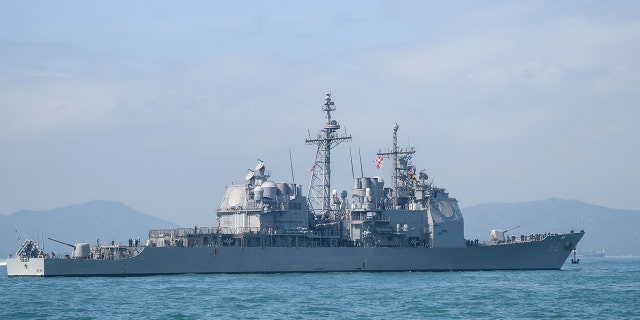
The USS Chancellorsville, a guided-missile cruiser, nearly collided with the Udaloy I DD 572 when it made an "unsafe maneuver", coming within 50 feet, according to the Navy's 7th Fleet in a statement<br data-cke-eol="1">


FoxNews is reporting that US and Russian warships almost collide in the Philippine Sea. The USS Chancellorsville, a guided-missile cruiser, nearly collided with the Udaloy I DD 572 when it made an "unsafe maneuver", coming within 50 to 100 feet, according to the Navy's 7th Fleet in a statement. This unsafe action forced Chancellorsville to execute all engines back full and to maneuver to avoid a collision,” said the Navy’s 7th Fleet in a statement.

Tuesday, May 07, 2019

Carrier Strike Group 12 and Abe Lincoln to the Persian Gulf.

Image result for uss abraham lincoln


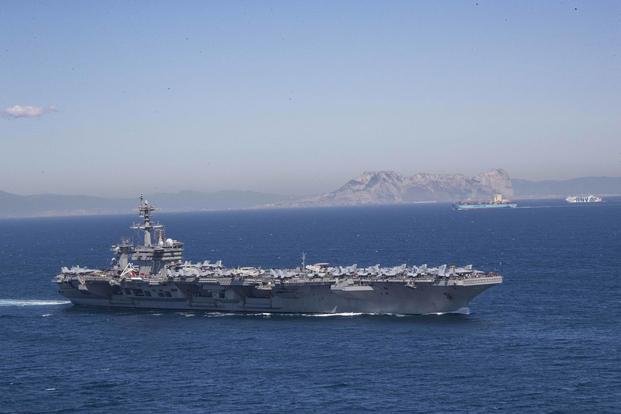
According to the Associated Press, the U.S. is rushing an aircraft carrier and other military resources to the Middle East after seeing Iranian troops and proxy forces making preparations for attacks against U.S. forces and interests in the region, a defense official told The Associated Press.
At the White House, National Security Adviser John Bolton said Sunday night that the U.S. was deploying the USS Abraham Lincoln Carrier Strike Group and a bomber task force to the U.S. Central Command region, an area that includes the Middle East. In a statement, he said the move was in response to "a number of troubling and escalatory indications and warnings," but did not provide more details.

From the Milcom Files: The Abe Lincoln CSG includes Carrier Strike Group 12, the CVW-7 air wing: VFA-143 Pukin Dogs F/A-18E, VFA-103 Jolly Rogers F/A-18F, VFA-86 Sidewinders F/A-18E, VFA-25 Fist of the Fleet F/A-18E, VAQ-140 Patriots EA-18G, VAW-121 Bluetails E2D, HSC-5 Nightdippers MH-60S, HSM-79 Griffins MH-60R, VRC-40 Det. 3 Rawhides C-2A (162143 Nomad 2/162165 Nomad 1), CarStrkgru 12 warships (others may be picked up or operate with the gru when in the Persian Gulf): Leyte Gulf (CG-55); Bainbridge (DDG-96), Mason (DDG-87) and Nitze (DDG-94)

Monday, December 24, 2018

US Navy Stanag 4481 (Encrypted FSK) Broadcasts

Our good friend Mike Chase-Ortiz had been using the SDR.hu TDoA network tool and has pinpointed several of the US Navy NATO RTTY (aka Stanag 4481) broadcast locations during some recent monitor sessions. Here is his field report he posted to the UDXF newsgroup yesterday (12/23/18)

"Checked a number of these 50bd/850 and 75bd/850 US Navy transmissions a couple of weeks ago using TDoA. I believe that the line-up looks something like this:

4005 Davidsonville, MD
4985 Davidsonville, MD
5340 Isabela, PR
6487 Davidsonville, MD
6831 Isabela, PR
7455 Isabela, PR
7597 Dixon, CA
7830 Isabela, PR
8093 Diego Garcia
8547 Diego Garcia
8676 Lualualei, HI
8694 Dixon, CA
9112 Lualualei, HI (seems to be occasional)
9830 Isabela, PR
10153 Isabela, PR
10430 Dixon, CA
11688 Isabela, PR
12015 Davidsonville, MD
12120 Isabela, PR
13229 Isabela, PR (only active briefly in November)
13870 Dixon, CA
14434 Lualualei, HI
15959 Davidsonville, MD
16047 Lualualei, HI (seems to be occasional)
16123 Isabela, PR
16268.5 Dixon, CA
18370 Guam (seems to be occasional)
18558 Lualualei, HI (seems to be occasional)
22471 Diego Garcia
22910 Diego Garcia

It’s been a while since I’ve heard NDT (Totsuka) which has been on 10830, 10827 & 14375 kHz at the beginning of the year."

Thanks for sharing Mike. I think I may have some ideas on what those occasional Stanag 4481 broadcasts are being used for. Further monitoring before I comment further.

Thursday, December 20, 2018

US Navy establishes first CMV-22B carrier onboard delivery squadron

Photo: Bell Boeing


The US Navy established Fleet Logistics Multi-Mission Squadron (VRM) 30 – its first CMV-22B squadron – in a ceremony at Naval Base Coronado on December 14.
VRM-30 was established to begin the Navy's transition from the C-2A Greyhound, which has provided logistics support to aircraft carriers for four decades, to the CMV-22B, which has an increased operational range, greater cargo capacity, faster cargo loading/unloading, increased survivability, and enhanced beyond-line-of-sight communications compared to the C-2A.
The establishment of the squadron follows a $4,2 billion contract from July this year, which will see Boeing deliver 39 CMV-22B aircraft for the US Navy, among other V-22 tiltrotor aircraft deliveries.
“Where no instructions existed, no patch existed, no ‘here’s how we are going to perform our duties everyday’ existed, this team will define that. And it’s exciting because we can establish right off the bat those best practices,” said Vice Adm. DeWolfe H. Miller III, Commander, Naval Air Forces. “This platform is our future and when you look at the nature of the future fight, we need that versatility, that flexibility that’s going to be provided in every subsequent squadron that transitions.”
The first CMV-22B aircraft are scheduled to be delivered to the squadron in FY20. While VRM-30 awaits the arrival of the CMV-22B, navy pilots and maintainers will train with the United States Marine Corps, which has flown the MV-22 since 2007. As the C-2A squadrons stand down, their pilots and aircrew will transition to the CMV-22B. The final C-2A squadron is scheduled to stand down in FY24.
The CMV-22B is the US Navy version of the V-22 Osprey, a multi-engine, dual-piloted, self-deployable, medium lift, vertical takeoff and landing (VTOL) tilt-rotor aircraft.

Argonauts complete F-35C carrier qualifications on USS Carl Vinson

The “Argonauts” of Strike Fighter Squadron (VFA) 147 completed their carrier qualifications December 12 aboard USS Carl Vinson (CVN 70), the US Navy has announced.
The carrier qualifications are the final required component for Commander Joint Strike Fighter Wing (CJSFW) to issue the squadron its safe-for-flight operations certification.
This marks a major milestone for the US Navy toward declaring Initial Operating Capability (IOC) next year.
The safe-for-flight operations certification (SFFOC) is the final step for VFA-147’s transition from the F/A-18E Super Hornet to the F-35C Lightning II.
This process ensures a squadron is manned with qualified personnel to implement maintenance and safety programs in support of fleet operations. All transitioning squadrons are required to complete this certification prior to independently conducting flight operations.
When introducing a new aircraft to the fleet, the appropriate fleet replacement squadron (FRS) is assigned oversight responsibility for the transitioning unit. The VFA-125 “Rough Raiders” were re-activated in January of 2017 to fulfill the appropriate FRS role for the Lightning II. Since completing their combat deployment last winter, VFA-147 has been working with the Rough Raiders to accomplish the safe-for-flight operations certification. The Argonauts will be able to operate independently from the Rough Raiders, having received their safe-for-flight operations certification.
“Since we returned from deployment last December, our team has been driving toward fully bringing this platform online for the Navy,” said VFA-147 Commanding Officer Cmdr. Patrick Corrigan. “As the Argonauts close out 2018 and the final stages of our safe-for-flight certification, we continue to exhibit the relentless drive required to meet transition goals and milestones. With this certification, we are announcing that we have the right skills, training, and people to take this mission and execute it, to its fullest potential.”
The safe-for-flight operations certification encompasses areas such as equipment, personnel and programs. Not least among them is the requirement for the squadron to be in the physical custody of at least 30 percent of the assigned aircraft. Other requirements include the installation and operation of management information systems such as Autonomic Logistics Information System (ALIS) and its accompanying support networks. There is also a requirement for operational F-35C squadrons to maintain robust, on-track, maintenance programs, as well as complete various inspections ranging from weapons to safety. Aircrew completes a transition flight syllabus and maintains certain proficiencies in accordance with Naval Air Training and Operating Procedures and Standardization (NATOPS).
“The Argonauts’ safe-for-flight operations certification was earned through the herculean effort of squadron Sailors and is an acknowledgment that they have developed the skills to safely maintain and operate the F-35C Lightning II,” said Joint Strike Fighter Wing Commander, Capt. Max McCoy. “We eagerly look forward to declaring IOC and integrating the F-35C into the Carrier Strike Group. This aircraft is a key component to maintaining the U.S. Navy’s dominance anywhere in the world.”
“VFA-147 continues to accomplish significant milestones, advancing this program closer to its ultimate goal of integrating the F-35C into the Fleet,” said McCoy. “The exceptional performance of the squadron throughout the entire transition process is a testament to the hard-working Sailors who make the U.S. Navy F-35C program a reality. We will succeed because the professionals in this program will not let it fail. It is evident in all that they do. It is who we are as a team.”

The F-35C will be the first 5th generation aircraft operated from an aircraft carrier. Currently, the US Navy F-35C program is scheduled to declare initial operating capability by the end of February 2019.

Kearsarge ARG ships deploy from Norfolk

US Navy sailors attached to the amphibious ready group centered around the Wasp-class amphibious assault ship USS Kearsarge (LHD 3) started their deployment on December 17, after getting underway from Naval Station Norfolk, Virginia.
In addition to USS Kearsarge as the flagship, the group includes San Antonio-class amphibious transport dock ship USS Arlington (LPD 24), the Whidbey Island-class amphibious dock landing ship USS Fort McHenry (LSD 43), and components of the 22nd Marine Expeditionary Unit (MEU).
The Kearsarge ARG departed Norfolk after the USS Kearsarge completed a Planned Maintenance Availability in 2017 before deploying in support of relief operations in the U.S. Virgin Islands and Puerto Rico in the wake of hurricanes Irma and Maria in late 2017.
The amphibious ready group spent most of 2018 preparing for the deployment. The groups also completed the navy’s first East Coast surface warfare advanced tactical training (SWATT) exercise in June.
Kearsarge’s commanding officer, Capt. Jason Rimmer, said he is confident the ARG is ready to take on the deployment’s challenges.
“Kearsarge has spent the last four months focused on combat readiness and tactical skills,” said Rimmer. “The Kearsarge crew performed across all areas during a number of underway rehearsals and cemented their reputation as who a team that demonstrates the utmost in integrity, trust and grit. Although each of us will bid a sentimental farewell to family and friends, we sail with a confidence built on proficiency and stand ready to take the watch, maintain freedom of the seas and deter aggression.”

Deployments of the Kearsarge ARG usually include operations in European and Middle East waters.

Thursday, October 25, 2018

New UAV Squadron Commissioned at NAS Patuxent River

The US Navy commissioned its first unmanned aircraft system (UAS) test and evaluation squadron during a ceremony at Naval Air Station Patuxent River’s Webster Outlying Field, on October 18.
The new unit, Air Test and Evaluation Squadron (UX) 24, flies over 23 fixed and rotary wing UAS including the MQ-8 Fire Scout, RQ-20 Puma, RQ-21 Blackjack, RQ-26 Aerostar and a number of commercial systems.
During the ceremony, Cmdr. Matthew Densing officially assumed leadership of UX-24.
“This squadron centralizes the Navy’s technical excellence in unmanned aviation,” said Densing. “As the Navy continues to require the broad range of capability offered by UAS, UX-24 will always challenge the status quo.”
In April 2018 Chief of Naval Operations, Adm. John Richardson, approved establishment of UX-24 to provide research, development, test and evaluation support for Navy and Marine Corps UAS as growth in the field required establishment of a command dedicated solely to that mission. The ceremony marked the squadron’s official transition from what was formerly known as NAWCAD’s UAS Test Directorate.
Densing previously oversaw the former UAS Test Directorate. Under his leadership, the directorate executed more than 2,200 flight hours and 2,000 ground test hours in support of UAS developmental test.

Sunday, October 21, 2018

USS New York Arrives in Reykjavik, Iceland

By Mass Communication Specialist 2nd Class Lyle Wilkie, USS New York (LPD 21) 
Public Affairs


REYKJAVIK, Iceland (NNS) -- The San Antonio-class amphibious transport dock 
ship USS New York (LPD 21) arrived in Reykjavik, Iceland, for a scheduled port 
visit Oct. 17.

The ship's port visit serves to enhance U.S.-Iceland relations as the two nations
work together with 31 allies and partner nations in the upcoming Trident 
Juncture exercise. Trident Juncture 18 will take place in Norway and the 
surrounding areas of the North Atlantic and the Baltic Sea, including Iceland 
and the airspace of Finland and Sweden.

More than 40,000 participants are expected to take part in the NATO exercise. 
Of that, more than 14,000 U.S. service members are scheduled to participate, 
including troops and equipment from each branch of service. Around 150 
aircraft, 70 ships and more than 10,000 vehicles will be used during the 
exercise. U.S. participation in this multinational exercise enhances our 
professional relationships and improves overall coordination with ally and 
partner militaries during times of crisis.

"Our crew and Marines are excited for the opportunity [to] visit Iceland, 
said Capt. Brent DeVore, commanding officer aboard New York. “It's an 
unique and beautiful country, and only a very small handful of our team has 
had the chance to visit before. For many of us, this is a first-time visit. We 
look forward to learning about the rich history and culture of our Icelandic 
partners."

The blue green teams will be able to participate in Morale, Welfare and 
Recreation tours to the Thingvellir National Park, UNESCO site, Gullfoss 
Waterfall, and the bubbling hot springs and spouting geyser at Haukardalur. 
Sailors and Marines will also be able to take a dip in the world-famous Blue 
Lagoon.

Saturday, October 20, 2018

Harry S. Truman Strike Group Enters Arctic Circle, Prepares for NATO Exercise

From Harry S. Truman Carrier Strike Group Public Affairs


ARCTIC CIRCLE (NNS) -- For the first time in nearly 30 years, a U.S. aircraft carrier 
entered the Arctic Circle Oct. 19 to conduct operations in the Norwegian Sea.

Accompanied by select ships from Carrier Strike Group Eight (CSG-8), the Nimitz-
class aircraft carrier USS Harry S. Truman (CVN 75) traveled north to demonstrate  
the flexibility and toughness of U.S. naval forces through high-end warfare training 
with regional allies and partners.  USS America (CV 66) was the last ship to operate 
in the area, participating in NATO exercise North Star in September 1991.

“We are unbelievably excited to be operating in the Norwegian Sea,” said Harry S. 
Truman Commanding Officer, Capt. Nick Dienna. “It has been over three decades 
since carrier aviation has been tested by this environment, and, despite the arduous 
weather and sea conditions, these men and women are demonstrating this ship can 
bring a full-spectrum of capabilities to bear anywhere in the world.”

The Harry S. Truman Carrier Strike Group (HSTCSG) will expand its compliment 
of capabilities off the coast of Norway, performing air, surface and subsurface 
operations while being confronted by the trio of freezing temperatures, fierce 
winds, and unpredictable seas.   After honing its skills independently, HSTCSG 
will join 30 NATO allies and partner nations to participate in Trident Juncture 2018.

“Trident Juncture represents the best of NATO – a coalition of allies and partners 
working toward the shared interests of lasting peace and economic prosperity in the 
European region,” said Carrier Strike Group Eight Commander, Rear Adm. Gene 
Black. “This exercise is also a fantastic opportunity to learn from our Allies on their 
home turf.” 

Trident Juncture will take place in Norway and the surrounding areas of the North 
Atlantic and the Baltic Sea, including Iceland and the airspace of Finland and Sweden 
from Oct. 25 to Nov. 23. More than 50,000 participants – including 14,000 U.S. 
service members – are expected to participate, utilizing approximately 150 aircraft, 
65 ships and more than 10,000 vehicles in support of the exercise.

“The combined and bilateral operations we have conducted in the region over the 
last several months embody the U.S.’s commitment to our NATO allies and partners,” 
added Black. “Together, our maritime partnership creates a global network of navies 
capable of uniting against any potential threat.”  

Currently operating in the U.S. Sixth Fleet area of operations, Harry S. Truman will 
continue to foster cooperation with regional allies and partners, strengthen regional 
stability, and remain vigilant, agile and dynamic.  


Tuesday, October 02, 2018

Chinese warship came within 45 yards of USS Decatur in South China Sea

Luis Martinez at ABC News is reporting that the U.S. Navy destroyer USS Decatur had to maneuver to avoid a collision on Sunday after a Chinese warship came within 45 yards of its bow as the American ship transited a disputed island chain in the South China Sea on Sunday, U.S. defense officials said.

he close encounter that the U.S. Navy characterized as "unsafe and unprofessional" comes at a time of heightened tensions between the United States and China.

"At approximately 0830 local time on September 30, a PRC LUYANG destroyer approached USS DECATUR in an unsafe and unprofessional maneuver in the vicinity of Gaven Reef in the South China Sea," said Capt. Charlie Brown, a U.S. Pacific Fleet Spokesman.

Gaven Reef is located in the Spratly Islands chain in the South China Sea where China claims seven man-made islands as its own.

The close encounter with the Chinese warship occurred as the American destroyer was carrying out a freedom of navigation operation (FONOPs) in the Spratlys, the U.S. said.

The U.S. Navy routinely undertakes FONOP missions worldwide to challenge excessive territorial claims of international shipping lanes.

USS Decatur had sailed within 12 nautical miles of Gaven and Johnson Reefs in the Spratly Islands when it was approached by the Chinese destroyer.

Over the last week, the U.S. and Chinese military relationship has deteriorated as both countries are engaged in a bitter trade dispute.

Last week, a U.S. Air Force B-52 flew a mission through the East China Sea and two other B-52 flights were carried out through the South China Sea.

Also last week, China refused a port of call in Hong Kong to the U.S. Navy ship USS Wasp slated for October and pulled a top admiral from a scheduled meeting with his U.S. Navy counterpart.

On Monday, a U.S. official confirmed that Defense Secretary Jim Mattis had canceled a planned trip to China in October after China had downgraded the level of officials he was to meet.

The U.S. Navy destroyer USS Decatur had to maneuver to avoid a collision on Sunday after a Chinese warship came within 45 yards of its bow as the American ship transited a disputed island chain in the South China Sea on Sunday, U.S. defense officials said.

he close encounter that the U.S. Navy characterized as "unsafe and unprofessional" comes at a time of heightened tensions between the United States and China.

"At approximately 0830 local time on September 30, a PRC LUYANG destroyer approached USS DECATUR in an unsafe and unprofessional maneuver in the vicinity of Gaven Reef in the South China Sea," said Capt. Charlie Brown, a U.S. Pacific Fleet Spokesman.

Gaven Reef is located in the Spratly Islands chain in the South China Sea where China claims seven man-made islands as its own.

The close encounter with the Chinese warship occurred as the American destroyer was carrying out a freedom of navigation operation (FONOPs) in the Spratlys, the U.S. said.

The U.S. Navy routinely undertakes FONOP missions worldwide to challenge excessive territorial claims of international shipping lanes.

USS Decatur had sailed within 12 nautical miles of Gaven and Johnson Reefs in the Spratly Islands when it was approached by the Chinese destroyer.

Over the last week, the U.S. and Chinese military relationship has deteriorated as both countries are engaged in a bitter trade dispute.

Last week, a U.S. Air Force B-52 flew a mission through the East China Sea and two other B-52 flights were carried out through the South China Sea.

Also last week, China refused a port of call in Hong Kong to the U.S. Navy ship USS Wasp slated for October and pulled a top admiral from a scheduled meeting with his U.S. Navy counterpart.
On Monday, a U.S. official confirmed that Defense Secretary Jim Mattis had canceled a planned trip to China in October after China had downgraded the level of officials he was to meet.

Read the full story at https://abcnews.go.com/Politics/chinese-warship-45-yards-uss-decatur-south-china/story?id=58210760

Monday, August 27, 2018

US Navy formally re-establishes 2nd Fleet

The US Navy re-established the 2nd Fleet in a ceremony (CVN 77) at Naval Station Norfolk, Virginia, Aug. 24.
Chief of Naval Operations Adm. John Richardson presided over the ceremony aboard the nuclear aircraft carrier USS George H.W. Bush.
Vice Adm. Andrew “Woody” Lewis will be in charge of ships, aircraft and landing forces that will be tasked with protecting the East Coast and patrolling the northern Atlantic Ocean.
“Although deeply consequential, the meaning of this establishment can be summarized simply as a dynamic response to a dynamic security environment — a security environment clearly articulated in the National Defense Strategy,” said Richardson.
“We first need to understand this competitive security environment and why it demands every ounce of our tenacity, ingenuity and fighting spirit. Then we can focus on the mission and how best to accomplish it; 2nd Fleet will enhance our capacity to maneuver and fight in the Atlantic, and as a result, help to maintain America’s maritime superiority that will lead to security, influence and prosperity for our nation.”
Lewis assumed command as the first commander of the re-established C2F, after his confirmation by the Senate June 28.
US 2nd Fleet will be headquartered in Norfolk. All of Lewis’s operational command tours have been on the East Coast making him intimately familiar with operations in the Atlantic. Most recently, he commanded Carrier Strike Group 12 and deployed with USS Theodore Roosevelt (CVN 71) to the U.S. 6th and 5th Fleet areas of operation.
“I am truly honored to lead this fleet. US 2nd Fleet has a storied history, and we will honor that legacy,” said Lewis. “However, we will not simply pick up where we left off. We are going to aggressively and quickly build this command into an organization with operational capability. We will challenge our assumptions, recognize biases, learn and adapt from failures so as to innovate in order to build a fleet that is ready to fight. Ready to fight – so we don’t have to.”

US 2nd Fleet will fall under operational control of US Fleet Forces Command. The fleet had previously been disestablished in 2011.

Tuesday, August 07, 2018

Three Aircraft Carriers to Change Homeports

From Commander, Naval Air Forces Public Affairs
The U.S. Navy announced Aug. 2 that three Nimitz-class aircraft carriers, USS Carl Vinson (CVN 70), USS Abraham Lincoln (CVN 72) and USS John C. Stennis (CVN 74) will conduct homeport shifts.
USS Abraham Lincoln, currently located in Norfolk, Virginia, will rejoin the Pacific Fleet, making San Diego its homeport. Abraham Lincoln, commissioned in 1989, previously served in the Pacific Fleet from 1990-2011 before moving to Norfolk for midlife refueling.
The other two carrier homeport shifts are tied to carrier maintenance. John C. Stennis, currently homeported in Bremerton, Washington, will change homeports to Norfolk in advance of its midlife refueling, or reactor complex overhaul (RCOH) at Newport News Shipbuilding. John C. Stennis was commissioned in 1995; Nimitz-class carriers are built to last 50 years.

USS Carl Vinson (CVN 70) will conduct a homeport change to Bremerton in advance of its docking-planned incremental availability (DPIA) at Puget Sound Naval Shipyard.

Friday, May 11, 2018

US Navy to stand up UAV test unit this October

X-47B over Edwards on maiden flight (110204-F-9126Z-649)


The U.S. Navy will activate a new unit for the development and testing of unmanned air vehicles this October, according to an OPNAV instruction issued in April. Air Test and Evaluation Squadron Two Four (UX24) will be established at Webster Outlying Field in Maryland. UX24’s mission will involve providing research, development, testing and other support for Navy and Marine Corps drone systems.

CNO Announces Establishment of U.S. 2nd Fleet

The aircraft carrier USS Harry S. Truman (CVN 75) and ships assigned to the Harry S. Truman Carrier Strike Group (HSTCSG) transit the Atlantic Ocean while conducting composite training unit exercise (COMPTUEX).


NORFOLK (NNS) -- Chief of Naval Operations, Adm. John Richardson, announced the establishment of U.S. 2nd Fleet during a change of command ceremony for U.S. Fleet Forces Command (USFF) in Norfolk, May 4.

Second Fleet will exercise operational and administrative authorities over assigned ships, aircraft and landing forces on the East Coast and northern Atlantic Ocean. Additionally, it will plan and conduct maritime, joint and combined operations and will train, certify and provide maritime forces to respond to global contingencies. Commander, 2nd Fleet will report to USFF.

"Our National Defense Strategy makes clear that we're back in an era of great power competition as the security environment continues to grow more challenging and complex," said Richardson. "That's why today, we're standing up Second Fleet to address these changes, particularly in the north Atlantic."

Second Fleet was originally established following World War II in order to protect Europe from the Russian threat and to support the North Atlantic Treaty Organization (NATO). Its historic area of operations and responsibility covered the East Coast and fully half of the Atlantic Ocean, from the North Pole down to the Caribbean.

With the collapse of the Soviet Union, Second Fleet began to be thought unnecessary in the face of a vastly diminished Russian threat. It was disestablished in 2011, with many of its personnel, assets and responsibilities merged into USFF. The last several years, however, have seen the resurgence of a belligerent Russia, and the apparent need to bolster European and U.S. defenses.

Tuesday, August 08, 2017

Bush CSG Participates in Saxon Warrior 2017


The Nimitz-class aircraft carrier USS George H. W. Bush (CVN 77) transits the Atlantic Ocean during exercise Saxon Warrior 2017. The U.S. and United Kingdom co-hosted carrier strike group exercise demonstrates allied interoperability and capability to respond to crises and deter potential threats. (U.S. Navy photo by Mass Communication Specialist 1st Class Theron J. Godbold/Released)

Commander, Task Force 75 Successfully Tests High-frequency to Reach U.S. Mainland

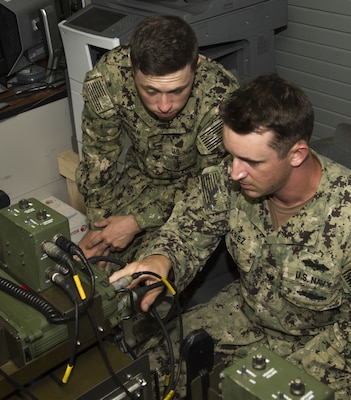
Electronics Technician 3rd Class Codie Flanagan and Electronics Technician 2nd Class Anthony Juarez, assigned to Naval Mobile Construction Battalion (NMCB) 1, adjust frequency codes on a GRC-234 high-frequency base station at Naval Base Guam July 27, 2017. These tests give NMCB 1 Sailors the opportunity to perform quality assurance checks on their system’s maximum range and communication quality with Port Hueneme, Calif. NMCB 1 provides expeditionary construction and engineering support to expeditionary bases and responds to humanitarian assistance disaster relief requests.
Electronics Technician 3rd Class Codie Flanagan and Electronics Technician 2nd Class Anthony Juarez, assigned to Naval Mobile Construction Battalion (NMCB) 1, adjust frequency codes on a GRC-234 high-frequency base station at Naval Base Guam July 27, 2017. These tests give NMCB 1 Sailors the opportunity to perform quality assurance checks on their system’s maximum range and communication quality with Port Hueneme, Calif. NMCB 1 provides expeditionary construction and engineering support to expeditionary bases and responds to humanitarian assistance disaster relief requests. (Photo by U.S. Navy Combat Camera photo by Fire Controlman 2nd Class Alexander Lee)


By Petty Officer 1st Class Torrey Lee | Commander, Task Force 75 |

NAVAL BASE GUAM , Guam -- Commander, Task Force (CTF) 75 successfully completed communications systems tests using high-frequency (HF) radio waves to broadcast voice and data 6,050 miles from Naval Base Guam to Port Hueneme, California, July 27, 2017.

The assessment tested the capabilities of expeditionary forces to use HF waves to deliver data over the Pacific. HF has become a viable alternative for military forces when more common forms of communication, such as satellites, are unavailable.

“In this particular back-up plan, we tested our ability to talk, and we were able to send text to one of our units that is across the Pacific Ocean,” said Lt. Cmdr. Timothy Carmon, a communications planner temporarily assigned to CTF-75. “The transmissions and receptions are not as fast as IP services, however we were still able to communicate in a timely manner with the distant end.”

Utilizing the assets of CTF-75’s Naval Mobile Construction Battalion (NMCB) 1, the command configured its antennae to broadcast to California. Once a successful voice transmission was received, communication directors at Navy Expeditionary Combat Command Pacific requested that CTF-75 try to send a data file.

“These data files allow us to save time,” said Electronics Technician 2nd Class Anthony Juarez, a communications supervisor assigned to NMCB 1. “We can send general diagrams, fire plans and points of interest. Instead of trying to verbally describe something, they [the recipient] have a graphic or a picture that gives them a better idea of the situation.”

Common communication devices used by the U.S. military incorporate satellites. CTF-75 has been testing HF systems in the case of satellite communication failure. HF is a frequency wave broadcast that is transmitted around the curvature of the Earth. Unlike other forms of frequencies, such as very-high frequencies and ultra-high frequencies, the transmission is not distorted by terrain or physical obstructions.

“We may not always have access to operational equipment or the latest assets, but as communicators we should have a backup plan that is ready to be executed,” said Carmon.

Guam is located in the western region of the Pacific. Having an HF range of 6,000 miles is equivalent to broadcasting from Japan to the U.S., or oppositely, from Japan to the middle of Africa. During this most recent test, CTF-75 was also able to establish communications with Mobile Diving and Salvage Unit 1 in Hawaii.

“We can hop our communications from island to island,” said Juarez. “This test gave us the opportunity to know we can push our system to the absolute max from Guam. There are definitely different systems out there, but our system is really efficient at long-range HF. As new radios are incorporated in the Navy expeditionary community, I have no doubt it will get faster, more reliable and easier to set up.”

CTF-75 is currently testing its communication abilities with subordinate commands which include Seabee units, riverine squadrons, cargo handlers, explosive ordnance disposal technicians, and expeditionary intelligence forces.

“This achievement was an important step in an effort to increase our capabilities to be prepared to execute missions in austere locations around the globe,” said Carmon. “Our expeditionary commanders may never need to communicate over a few thousand kilometers, but if the need arises our communicators will be able to provide the connection for that commander.”

CTF-75 is the primary expeditionary task force responsible for the planning and execution of coastal riverine operations, explosive ordnance disposal, diving engineering and underwater construction in the U.S. 7th fleet area of operations.
Tuesday, May 09, 2017

Three Navy carriers in port at Norva

The aircraft carriers USS Dwight D. Eisenhower (CVN 69), pre-commissioning unit aircraft carrier Gerald R. Ford (CVN 78) and USS George Washington (CVN 73) sit pierside at Naval Station Norfolk.


NORFOLK (May 8, 2017) The aircraft carriers USS Dwight D. Eisenhower (CVN 69), pre-commissioning unit aircraft carrier Gerald R. Ford (CVN 78) and USS George Washington (CVN 73) sit pierside at Naval Station Norfolk. (U.S. Navy photo by Mass Communication Specialist 3rd Class Dartez C. Williams/Released)

USS Abraham Lincoln Underway for Sea Trials

By Mass Communication Specialist 1st Class Mark Logico
NEWPORT NEWS, Va. (NNS) -- Nimitz-class aircraft carrier USS Abraham 
Lincoln (CVN 72) got underway for sea trails, May 9, following a four-year 
refueling and complex overhaul (RCOH) at Newport News Shipbuilding, 
Newport News, Virginia.

The four-day sea trails marks Abraham Lincoln's first time underway since 
March 2013. The ship spent its last days in the shipyard completing a five-day
"fast cruise," May 2-7, making final preparations for its transit to Naval Station 
Norfolk.

"We are looking forward to taking the ship out on the open water where we 
belong," said Capt. Amy Bauernschmidt, Lincoln's executive officer. "I am 
honored to serve with our crew. This dedicated and impressive group put an 
incredible amount of work into revitalizing this ship. We are grateful for their 
efforts and to our partners at Newport News Shipbuilding, and eagerly 
anticipate completing successful sea trials and returning to the fleet ready 
for tasking later this year."

During sea trials, the Abraham Lincoln crew will undergo multiple training 
scenarios and qualification evolutions to include engineering maneuvers 
designed to evaluate the performance of the ship after the extensive 
maintenance period.

"Our team has worked hard to get USS Abraham Lincoln ready to redeliver 
to the fleet," said Rear Adm. Brian Antonio, program executive officer for 
aircraft carriers. "She has undergone significant combat systems modernization 
and will also be the first CVN capable of accommodating the F-35C 
Lightning II. This RCOH enabled the ship to meet future missions and 
continued service life requirements for many years to come."

During RCOH, more than 2.5 million man-hours of work were conducted 
aboard the ship, including refueling the reactors, upgrading ship's infrastructure 
and modernizing combat systems and air wing capabilities to increase combat 
effectiveness.

Abraham Lincoln is the fifth Nimitz-class aircraft carrier to complete RCOH, 
a major lifecycle milestone at Newport News Shipbuilding, a division of 
Huntington Ingalls Industries in Newport News. She returns to the fleet as 
one of the most modern and technologically-advanced Nimitz-class aircraft 
carriers in service and will continue to be a vital part of the nation's defense 
for an additional 25 years.