Showing posts with label P-8A aircraft. Show all posts

Thursday, October 31, 2013

Twelfth Production P-8A Poseidon Aircraft Delivered To The U.S. Navy


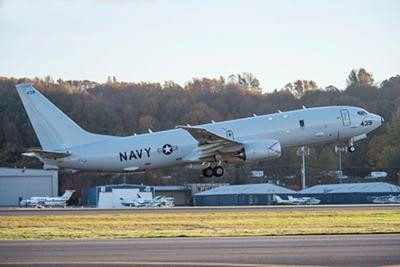
The 12th production P-8A Poseidon has been delivered to the U.S. Navy by Boeing, enhancing the long-range maritime patrol capabilities of the service.
 
The P-8A departed Boeing Field in Seattle for Naval Air Station Jacksonville, FL, where it joined the other Poseidon aircraft being used to train Navy crews. The aircraft is the sixth from the second low-rate initial production contract lot awarded in November 2011.

“This is our second-to-last P-8A delivery of 2013 and the program is meeting all cost and schedule milestones,” said Rick Heerdt, Boeing vice president and P-8 program manager. “As we’ve focused on ramping up production and delivering planes, the Navy is preparing for the first P-8A fleet deployment in the coming months.”

Boeing is on contract to build and support 37 P-8A aircraft as part of four LRIP contracts awarded in 2011, 2012 and 2013. The Navy plans to purchase 117 P-8As, which are based on the Next-Generation Boeing 737-800 platform. The versatile multi-mission aircraft provides anti-submarine warfare, anti-surface warfare, intelligence, surveillance and reconnaissance capabilities and will replace the Navy P-3 fleet.

Blog Editor Note: Here is our MilcomMP list of P-8A serials and Mode-S hex codes

168428 AE4EB2
168429 AE4EB3
168430 AE4EB4
168431 AE4EB5
168432 AE4EB6
168433 AE4EB7
168434 AE4EB8
168435 AE4EB9
168436 AE4EBA
168437 AE4EBB
168438 AE4EBC
168439 AE4EBD
168440 AE4EBE

These are the airframes sent to the Navy test squadrons
167952 AE222D
167951 AE222C
167953 AE222E
167954 AE222F
167955 AE2230
167956 B6495C

Monday, July 30, 2012

VX-1 Flies P-8 Poseidon during RIMPAC 2012


PEARL HARBOR (NNS) -- The P-8A Poseidon jet, a replacement maritime patrol aircraft for the P-3C Orion, made its Rim of the Pacific (RIMPAC) exercise debut this year, flown by two air crews from Air Test and Evaluation Squadron (VX) 1 at Marine Corps Base Hawaii in Kaneohe Bay, during the 23rd edition of the biennial exercise .

"While the P-3C Orion is a very forgiving aircraft and has served the fleet very well, the P-8A Poseidon is easier to fly, trims well, and handles flawlessly [at low altitude]," said Lt. Cmdr. Chris Artis, VX-1 maintenance officer and integrated training team pilot. "It's easy to maneuver, and the situational awareness in the cockpit is unlike anything I've ever seen before. Getting used to the technology and the different displays can be a challenge, but overall it's fun to fly."

The VX-1 crews flew two P-8As during 24 exercise events ranging from routine test flights to simulated anti-submarine warfare. VX-1 officials said training requirements are extensive in the P-8A because of the complexity and the speed of the aircraft, and that RIMPAC provided extensive, open airspace and a robust exercise schedule where the squadron could demonstrate the capability of the new aircraft.

"The addition of two P-8A aircraft from Test and Evaluation Squadron 1 enabled us to get an early look at how we can integrate this new platform in a Joint and Combined operating environment," said Adm. Cecil D. Haney, U.S. Pacific Fleet commander, who flew a mission with VX-1 earlier in the week. "I had the opportunity to personally observe its great potential during a flight where the crew demonstrated each weapon system while we conducted ASW and ISR."

The P-8A is based on the Boeing 737-800ERX airliner, but incorporates a host of modifications. The Poseidon will replace the P-3C Orion, now in its 50th year of service, as a long-range anti-submarine warfare, anti-surface warfare, intelligence, surveillance and reconnaissance aircraft. It will maximize the experience and technology of the Orion but with significant growth potential, greater payload capacity, advanced mission systems, software and communications. Six additional fuel tanks in P-8As allow for the jet's extended range.

"The P-3C is an aging airframe with aging systems on board." said Cmdr. Gregory Sleppy, VX-1 operational test director for the P-8. "It's becoming very expensive to operate because of the age of the airframe, and has been up for 50 years; that's half the life of [naval] aviation."

P-8As feature Raytheon multi-mission surface search radars, and incorporate a short bomb bay aft of the wings for torpedoes, sonobouys (small expendable sonar capsules that are dropped or ejected from the aircraft for anti-submarine warfare or underwater acoustic research), and cargo.

"We can look forward to an increased availability rate right off the bat," said Sleppy. "Next you're going to see a more interoperable platform. The communications suite on the aircraft is far more advanced. Those are going to be the immediate things that the fleet commanders are going to see."

Twenty-two nations, more than 40 ships and submarines, over 200 aircraft and 25,000 personnel are participating in the RIMPAC exercise from June 29 to Aug. 3 in and around the Hawaiian Islands. The world's largest international maritime exercise, RIMPAC provides a unique training opportunity that helps participants foster and sustain the cooperative relationships that are critical to ensuring the safety of sea lanes and security on the world's oceans. RIMPAC 2012 is the 23rd exercise in the series that began in 1971.

Saturday, August 01, 2009

P-8A secretly acquires mission to rival Joint STARS

Stephen Trimble on the Dew Line blog is reporting that the Boeing P-8A Poseidon has secretly acquired a new role for the US Navy that will transform the maritime patrol aircraft into a rival of the US Air Force's Northrop Grumman E-8C Joint Surveillance Target Attack Radar System (JSTARS).

Details of the mission surfaced today in a press release issued by Raytheon, which announced receiving a multi-year contract to develop an advanced new radar for the P-8A programme.

More details at http://www.flightglobal.com/blogs/the-dewline/2009/07/p-8a-secretly-acquires-mission.html

P-8A Poseidon Rollout Unveils Next Maritime Patrol Aircraft

A Boeing P-8A Poseidon test aircraft T-1 conducts a test flight April 25, 2009. The aircraft completed a series of tests during the 3 hour, 31 minute flight and reached an altitude of 25,000 feet before landing at Boeing Field in Seattle. (Photo courtesy Boeing/Released)

SEATTLE (NNS) -- The U.S. Navy and Boeing unveiled the next maritime patrol and reconnaissance aircraft, the P-8A Poseidon, during a rollout ceremony July 30 at Boeing's manufacturing facility in Seattle.

"This is a tremendous day to recognize the outstanding efforts of the U.S. Navy, Boeing and the entire industry team on a job extremely well done," said Rear Adm. Bill Moran, commander, Patrol Reconnaissance Group. "It has been more than forty years since the maritime patrol community has seen a new aircraft; delivery of this aircraft cannot come soon enough."

The admiral said the aircraft's greater situational awareness, open systems architecture and higher operating altitude will bring a greater punch to the fight, across all warfare mission areas and will be a significant force multiplier.

The Poseidon will replace the P-3C Orion as a long-range anti-submarine warfare, anti-surface warfare, intelligence, surveillance and reconnaissance aircraft. It will maximize the experience and technology of the Orion but with significant growth potential, greater payload capacity, advanced mission systems, software and communications.

"The P-8A Poseidon program is an outstanding example of evolutionary acquisition at work. We have established a very solid baseline for initial operational capability, while concurrently making upgrade increments for future insertion as technology matures," said Maritime Patrol and Reconnaissance Aircraft Program Manager Capt. Mike Moran.

"The team has worked hard to stay on schedule and within cost in this developmental effort; we all should be extremely proud of the results."

Boeing was awarded a contract in 2004 to deliver five test vehicles. This acquisition phase provides three flight test aircraft, one full-scale static loads test airframe, and one full-scale fatigue test airframe. The Navy plans to purchase 117 production aircraft.

All five test aircraft are in various stages of assembly and ground test; two of the flight test aircraft have already successfully flown as part of a Boeing relocation and system flight check process. Testing on the static loads airframe is underway and the Navy will begin formal flight testing later this year.

In April, the Australian Department of Defence signed an agreement with the U.S. Department of Defense to join a cooperative partnership in the development of follow-on capabilities to be added to the Poseidon after it enters the fleet in 2013.

Wednesday, May 06, 2009

Navy's Largest P-3 Hangar Takes Flight

By Miriam S. Gallet, Naval Air Station Jacksonville Public Affairs

JACKSONVILLE, Fla. (NNS) -- The acting secretary of the Navy (SECNAV) joined community leaders and hundreds of guests May 5 for the ribbon-cutting ceremony of Hangar 511 built at Naval Air Station (NAS) Jacksonville to increase the Navy's aviation community's warfighting readiness.

"The opening of this hanger brings us one step closer to getting our critical P8 capability to the fleet. This facility is state of the art and incorporates many environmental enhancements which will make operations here safer for our Sailors as well as the environment," stated Acting SECNAV B.J. Penn.

Hangar 511, the largest structure of its kind in the Navy, is a $127-million facility designed to accommodate the P-8 Poseidon, the replacement aircraft for the P-3 Orion.

NAS Jacksonville Commanding Officer Capt. Jack Scorby Jr. expressed his pride on the important role his base is playing in supporting this new capability.

"As commanding officer of the finest naval air station in the world, I could not be more proud of the hard work that went into making this day a reality. Hangar 511 represents the future of naval aviation.

"The $127 million invested in this project will serve the Navy's maritime patrol and reconnaissance community for decades to come," said Scorby. "This facility also rings in a new era of construction design and environmental sustainability that provides our warfighters with the very best in modern infrastructure that includes being the first 'green' aircraft hangar in the U.S. Navy."

Commander, Patrol and Reconnaissance Wing (CPRW) 11 Commanding Officer Capt. Kyle Cozad quoted author Victor Hugo when he told the audience, "There is nothing like a dream to create the future."

He also noted the symbolism of the new hangar's number (511) that represents the upcoming merger of CPRW-5 from NAS Brunswick with CPRW-11 at NAS Jacksonville.

"Today's ceremony brings Hangar 511 to life and reminds us of how our maritime patrol and reconnaissance community has evolved and adapted to remain relevant for the past 50 years. Without question, it's our people who have not only dreamed but taken action to turn those dreams into reality," added Cozad.

The new hangar is a result of the 2005 Base Realignment and Closure Committee (BRAC) that ordered the closure of NAS Brunswick, Maine. On April 13, 2007 officials broke ground for the project designed to accommodate approximately 37 P-3C Orion aircraft. At a length of 333 yards, the structure is longer than three football fields placed end to end.

Local military, political and business leaders attended the ribbon-cutting ceremony and recognized Sailors' important contributions and service to the Navy, nation and local community.

"Jacksonville is proud to be the location for the new P-3 hangar and the additional squadron members who will be living and working in our community. Currently, more than 250,000 Jacksonville residents are active members of the military in addition to the more than 150,000 veterans who call Jacksonville home. This city has enjoyed a true partnership the military and with NAS, in particular," said Mayor John Peyton.

"Members of this community influence Jacksonville's culture, leadership and economy. As always, the military continues to be an incredible asset to the North Florida region, and we are committed to meeting their needs."
Friday, January 02, 2009

P-8A Multi-Mission Maritime Aircraft Homebasing Announced


The Department of the Navy announced today its decision to provide facilities and functions to base five fleet squadrons of the P-8A Multi-Mission Maritime Aircraft (MMA) with a fleet replacement squadron (FRS) at Naval Air Station (NAS) Jacksonville, Fla., four fleet squadrons at NAS Whidbey Island, Wash., and three fleet squadrons at Marine Corps Base Hawaii Kaneohe Bay, Hawaii, with periodic squadron detachment operations at NAS North Island. This decision implements the preferred homebasing alternative 5 identified in the final environmental impact statement (FEIS) for the Introduction of the P-8A Multi-Mission Aircraft into the U.S. Navy Fleet (published November 2008). Introduction of the P-8A MMA squadrons is projected to begin no later than 2012 and be completed by 2019.

The notice of availability of the Navy’s record of decision (ROD) was published in the Federal Register on Dec. 31, 2008 and the ROD is available for public viewing on the project Web site at http://www.mmaeis.com/ along with copies of the FEIS and supporting documents.

This action is needed to transition from existing P-3C aircraft to the P-8A MMA while maintaining the Navy’s overall maritime patrol capability supporting national defense objectives and policies without interruption or impediment to operations or combat readiness. Ultimately, this action will include a total of 84 fleet and FRS aircraft.

Wednesday, April 23, 2008

Navy Awards Northrop Grumman Unmanned Aircraft System Contract


The Department of the Navy announced today that the Northrop Grumman Corp. has been awarded the system development and Demonstration (SDD) contract for the Broad Area Maritime Surveillance Unmanned Aircraft System (BAMS UAS).

The BAMS UAS contract award is the culmination of a year-long source selection process since the Navy received industry proposals in May 2007. The $1.16 billion cost-plus-award-fee contract is to develop a persistent maritime intelligence, surveillance and reconnaissance (ISR) data collection and dissemination capability that fulfills the maritime war fighter's requirement for continuous battle-space awareness. The BAMS UAS will be developed using Northrop Grumman's RQ-4N platform.

"This announcement represents the Navy's largest investment in unmanned aircraft systems to date. The extraordinary efforts leading to this announcement have helped the BAMS UAS program begin to develop a persistent ISR capability never before available to the fleet," said Capt. Bob Dishman, program manager for the BAMS UAS program. "This is a significant milestone for the BAMS UAS program, concluding a deliberate and meticulous source selection process that adhered to stringent Federal Acquisition Regulation and Naval Air System Command source selection processes and documentation requirements."

The BAMS UAS is an integral part of the maritime patrol and reconnaissance Force. As an adjunct to the P-8A Multi-Mission Maritime Aircraft, the BAMS UAS will provide persistent maritime and littoral intelligence, surveillance and reconnaissance to joint forces and fleet commanders worldwide. This capability will enhance battle-space awareness, improve force projection capabilities and protect and defend the fleet and the nation.

Friday, December 21, 2007

First P-8A Poseidon Begins Production


By Kristine Wilcox, PMA-290 Communications

PATUXENT RIVER, Md. (NNS) -- The U.S. Navy and its Poseidon industry team marked the beginning of the P-8A production at a ceremony hosted by Spirit AeroSystems Wichita, Kan., facility, Dec. 11.

The P-8A is the first Navy aircraft to be produced on an existing commercial production line.

"It has been a long time coming, but the P-8A is a reality," said Capt. Joe Rixey, Maritime Patrol and Reconnaissance Aircraft program manager. "I can't be more proud of the partnership between the Navy and Poseidon industry team. They have worked hard to design an aircraft that will replace the legendary P-3C Orion and take our warfighters into the next generation of maritime patrol."

The team loaded the first P-8A fuselage component into a holding fixture on the factory floor during the ceremony attended by Navy program leadership, Spirit employees and representatives from Boeing Commercial Airplanes and Boeing Integrated Defense Systems.

The P-8A fuselage, a derivative of Boeing's Next Generation 737-800, will be built at Spirit then shipped to Boeing Commercial Airplanes in Renton, Wash., for wing assemblies.

"Starting production of the first aircraft is a significant milestone for the P-8A program as we remain focused and committed to delivering this critical weapons system to the fleet on schedule," said Capt. Mike Moran, P-8A Poseidon program lead.

The P-8A, designed to replace the Fleet's P-3C aircraft, is a long-range anti-submarine warfare, anti-surface warfare, intelligence, surveillance, reconnaissance aircraft capable of broad-area maritime operations. It will be equipped with an advanced mission system designed for maximum interoperability in the future battle space. The U.S. Navy plans to purchase 108 P-8A aircraft.Initial operating capability is scheduled for 2013, with full operational capability planned for 2019.