Showing posts with label Persian Gulf. Show all posts

Tuesday, May 07, 2019

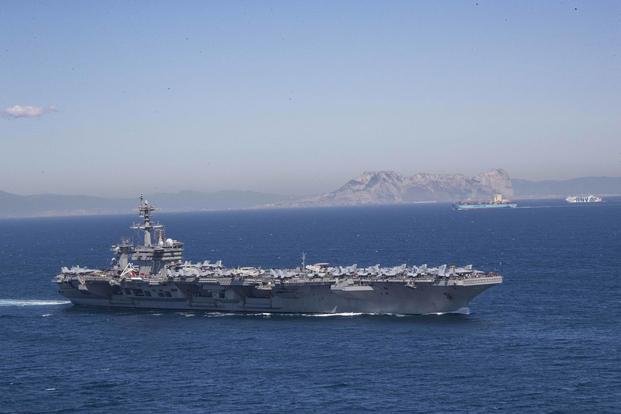
Carrier Strike Group 12 and Abe Lincoln to the Persian Gulf.

Image result for uss abraham lincoln


According to the Associated Press, the U.S. is rushing an aircraft carrier and other military resources to the Middle East after seeing Iranian troops and proxy forces making preparations for attacks against U.S. forces and interests in the region, a defense official told The Associated Press.
At the White House, National Security Adviser John Bolton said Sunday night that the U.S. was deploying the USS Abraham Lincoln Carrier Strike Group and a bomber task force to the U.S. Central Command region, an area that includes the Middle East. In a statement, he said the move was in response to "a number of troubling and escalatory indications and warnings," but did not provide more details.

From the Milcom Files: The Abe Lincoln CSG includes Carrier Strike Group 12, the CVW-7 air wing: VFA-143 Pukin Dogs F/A-18E, VFA-103 Jolly Rogers F/A-18F, VFA-86 Sidewinders F/A-18E, VFA-25 Fist of the Fleet F/A-18E, VAQ-140 Patriots EA-18G, VAW-121 Bluetails E2D, HSC-5 Nightdippers MH-60S, HSM-79 Griffins MH-60R, VRC-40 Det. 3 Rawhides C-2A (162143 Nomad 2/162165 Nomad 1), CarStrkgru 12 warships (others may be picked up or operate with the gru when in the Persian Gulf): Leyte Gulf (CG-55); Bainbridge (DDG-96), Mason (DDG-87) and Nitze (DDG-94)

Tuesday, July 17, 2012

Pentagon Bulks Up Defenses in the Gulf

A U.S. military facility in 2008 in the Negev desert in Israel that deploys an X-Band radar system. The Pentagon is building a new radar station in Qatar for an X-Band as part of a buildup to counter Iran. (Agence France-Presse/Getty Images)

The Wall Street Journal is reporting this morning that the Pentagon is building a missile-defense radar station at a secret site in Qatar and organizing its biggest-ever minesweeping exercises in the Persian Gulf, as preparations accelerate for a possible flare-up with Iran, according to U.S. officials.

The radar site will complete the backbone of a system designed to defend U.S. interests and allies such as Israel and European nations against Iranian rockets, officials told The Wall Street Journal. The minesweeping exercises, in September, will be the first such multilateral drills in the region, and are expected to be announced by U.S. officials Tuesday.

Read the complete copyrighted online story at by clicking here.

Monday, July 16, 2012

USNS Rappahannock Fires after Vessel ignores warnings

USNS Rappahannock (T-AO 204) US Navy Photo

By US Naval Forces Central Command.

FIFTH FLEET AREA OF OPERATIONS (July 16, 2012) — An embarked security team aboard a U.S. Navy vessel fired upon a small motor vessel after it disregarded warnings and rapidly approached the U.S. ship near Jebel Ali, United Arab Emirates today.

In accordance with Navy force protection procedures, the sailors on the USNS Rappahannock (T-AO 204) used a series of non-lethal, preplanned responses to warn the vessel before resorting to lethal force.

The U.S. crew repeatedly attempted to warn the vessel’s operators to turn away from their deliberate approach. When those efforts failed to deter the approaching vessel, the security team on the Rappahannock fired rounds from a .50-caliber machine gun.

The incident is under investigation.

Thursday, July 12, 2012

U.S. moving submersibles to Persian Gulf to oppose Iran

USS Ponce in the Persian Gulf (US Navy Photo)

Tensions continue to rise in the Persian Gulf as the article below by David S. Cloud indicates.

WASHINGTON — The Navy is rushing dozens of unmanned underwater craft to the Persian Gulf to help detect and destroy mines in a major military buildup aimed at preventing Iran from closing the strategic Strait of Hormuz in the event of a crisis, U.S. officials said.

The tiny SeaFox submersibles each carry an underwater television camera, homing sonar and an explosive charge. The Navy bought them in May after an urgent request by Marine Gen. James Mattis, the top U.S. commander in the Middle East.

Each submersible is about 4 feet long and weighs less than 100 pounds. The craft are intended to boost U.S. military capabilities as negotiations with Iran over its nuclear program appear to have stalled. Three rounds of talks since April between Iran and the five countries in the United Nations Security Council plus Germany have made little progress.

The first of the SeaFox submersibles arrived in the Gulf in recent weeks, officials said, along with four MH-53 Sea Dragon helicopters and four minesweeping ships, part of a larger buildup of U.S. naval, air and ground forces in the region aimed at Iran.

The U.S. already has sent two aircraft carriers and a squadron of F-22 fighters to the Persian Gulf, and is keeping two U.S. army brigades in Kuwait. Though much of the buildup has been publicly acknowledged by the Pentagon, the deployment of the submersibles has not been publicly disclosed, apparently to avoid alerting Iran.

The SeaFox is small enough to be deployed from helicopters and even small rubber boats, but it also can be dropped off the back of a minesweeper. It is controlled by a fiber optic cable and sends live video back to a camera operator.

It can be used against floating or drifting mines, which Iran has used in the past. It operates up to 300 meters deep, and moves at speeds of up to six knots. But the $100,000 weapon is on a what amounts to a suicide mission. The “built-in, large caliber shaped charge” it carries destroys the mine but also the vehicle itself.

Thursday, August 28, 2008

Combined Task Force 152 Conducts Exercise Goalkeeper

MANAMA, Bahrain (NNS) -- Ships from Bahrain, the United Kingdom and the United States are conducting Exercise Goalkeeper in the Central and Southern Persian Gulf to train across the spectrum of Maritime Security Operations (MSO).

Led by Royal Navy Commodore Peter Hudson, commander, Combined Task Force (CTF) 152, the five-day exercise began Aug. 24 and seeks to ensure a lawful maritime order as well as improve relationships between regional countries.

"Exercise Goalkeeper provides coalition and regional navies an opportunity to fine tune their skills in conducting essential Maritime Security Operations," said Hudson.

In addition to familiarizing all forces with MSO, Goalkeeper provides participants an opportunity to exercise their abilities to locate and track various vessels, practice boarding techniques and work with the Bahraini Coast Guard.

Coalition units participating in the exercise include RBNS Al Fateh (PGGF 20), HMS Montrose (F 236) and USNS Catawba (T-ATF 168) as well as coalition maritime patrol aircraft.

Hudson explained the exercise's key focus is handling the command and control in locating and tracking specific vessels deemed to pose a threat to coalition nations in the Gulf region. During the exercise coalition teams will board the vessel and practice the procedures for handing them over to Coast Guard ships.

Combined Maritime Forces (CMF) conduct MSO in the region to help develop conditions for security in the maritime environment, which promotes stability and global prosperity. These operations complement the counterterrorism and security efforts of regional nations and seek to disrupt violent extremists' use of the maritime environment as a venue for attack or to transport personnel or weapons.

CMF has a common purpose and goal – to increase the security and prosperity of the region by working together for a better future.

Wednesday, April 30, 2008

Gates Calls Arrival of Second Carrier in Gulf 'Reminder' of U.S. Presence

USS Abraham Lincoln (US Navy Photo)


Blog Editor's Note: The USS Harry S. Truman CSG and the USS Abraham Lincoln CSG are both currenting assigned to the 5th Fleet and operating in the Persian Gulf.

By Donna Miles, American Forces Press Service

MEXICO CITY, April 30, 2008 - The movement of a second aircraft carrier into the Persian Gulf this week doesn't signal an escalation of the U.S. naval presence -- but could serve as a "reminder" of it to countries in the region, Defense Secretary Robert M. Gates said here last night.

Gates did not specifically name Iran when responding to a reporter's question about the arrival this week of USS Abraham Lincoln in the Gulf.

"The size of our naval presence in the Gulf rises and falls constantly," he said. "This deployment has been planned for a long time. I don't think we will have two carriers there for a protracted period of time. So I don't see it as an escalation. I think it could be seen, though, as a reminder."

Pressed by another reporter, Gates denied that heightened Defense Department criticism of Iran means it's laying the foundation for a military strike.

Navy Adm. Mike Mullen, chairman of the Joint Chiefs of Staff, told reporters last week that recently manufactured Iranian weapons found in and around Basra, Iraq, prove that Iran continues meddling in Iraq in ways that hamper progress and put U.S. and Iraqi lives at risk.

Mullen said at an April 25 Pentagon news conference that he's "increasingly concerned about Iran's activity, not just in Iraq, but throughout the region.

"I believe recent events, especially the Basra operation, have revealed just how much and just how far Iran is reaching into Iraq to foment instability," he said.

Mullen said he believes diplomatic, financial and international pressure is the best way to pressure Iran to reverse course. But "we are not taking any military elements off the table," he said.

Army Gen. David H. Petraeus, the top commander in Iraq who is in line for the top U.S. Central Command job, is preparing a briefing that details Iran's activities. That report is expected in the next couple of weeks.

Gates told reporters last night that he does not believe there's been any significant increase in Iranian support for the Taliban and others opposing the government in Afghanistan. "There is, as best as I can tell, a continuing flow, but I would still characterize it as relatively modest," he said.

The nature of the Taliban threat has changed, he said. Large-scale firefights against Afghan and coalition forces have evolved into terrorist acts, many using improvised explosive devices and suicide bombers. Gates noted that Afghan President Hamid Karzai narrowly escaped such an attack on his life earlier this week when Taliban gunmen attacked a military parade in Kabul.

The secretary said he views the latest tactics as a sign that the Taliban recognizes the strength and firepower of the coalition forces they're up against in Afghanistan. "They are changing their tactics, and we will have to clearly continue to adapt our tactics as well," he said.

USS Harry S. Truman (US Navy Photo)

Wednesday, September 12, 2007

Kearsarge Expeditionary Strike Group Enters Persian Gulf


USS Kearsarge Expeditionary Strike Group (ESG) entered the Persian Gulf in September to conduct Maritime Security Operations (MSO) in regional waters and provide air support to ground forces operating in Afghanistan and Iraq.

The Norfolk-based ships entered the region as part of an ongoing rotation of forces, demonstrating the United States’ continued resolve toward enhancing regional security and promoting long-term stability.

Kearsarge ESG is comprised of amphibious assault ship USS Kearsarge (LHD 3), embarked Marines of the 22nd Marine Expeditionary Unit (MEU), amphibious transport dock USS Ponce (LPD 15), dock landing ship USS Gunston Hall (LSD 44), guided-missile frigate USS Carr (FFG 52), guided-missile cruiser USS Vicksburg (CG 69), and fast-attack submarine USS Miami (SSN 755).

Capt. Robert Bougher, commander of the Kearsarge ESG, said the strike group enters the Persian Gulf able to perform a full-spectrum of capabilities that can counter any threat, as well as provide humanitarian aid and disaster relief, if requested.

“We trained hard to prepare ourselves for the challenge of this deployment, and I’m completely confident that we will complement our regional and Coalition partners well,” said Bougher. “We bring a wide range of capabilities to the table that will ensure the conditions for security and stability in the maritime environment are met.”

The expeditionary strike group supports every major maritime warfare function, including air defense, anti-surface warfare, anti-submarine warfare, air strike capability and missile defense.

The 22nd MEU is a force capable of conducting amphibious operations, aviation operations and ground combat operations. The unit is composed of a Ground Combat Element, Battalion Landing Team, 3rd Battalion, 8th Marine Regiment, an Aviation Combat Element, Marine Medium Helicopter Squadron 261 (Reinforced), a Logistics Combat Element, Combat Logistics Battalion 22 and its Command Element.

Kearsarge ESG is also capable of providing advanced disaster relief and medical support. Kearsarge alone can treat over 600 patients while still providing essential treatment to crew members and embarked troops.

While operating in the Mediterranean, the strike group visited 13 ports in eight nations and participated in over 20 community relations events in two weeks, further strengthening partnerships between the United States and partner countries.

After transiting the Suez Canal, the group made a brief stop in Djibouti to provide humanitarian supplies to two charities through the Navy’s program “Project Handclasp.”

Through this and other humanitarian efforts, the Navy is able to promote mutual understanding, respect and good will between Americans and the citizens of other countries.

Maritime Security Operations help set the conditions for security and stability in the maritime environment and complement the counterterrorism and security efforts in regional nations’ littoral waters.

Tuesday, August 21, 2007

Enterprise CSG Commences Ops in Persian Gulf

Enterprise Carrier Strike Group (CSG) commenced operations in the Persian Gulf Aug. 10, where they are currently deployed to support Maritime Security Operations (MSO) as well as Operations Iraqi Freedom (OIF) and Enduring Freedom.

Rear Adm. Daniel P. Holloway, Commander, Carrier Strike Group 12/Enterprise Strike Group, said the strike group is ready to do what it takes to accomplish the mission.

“This is part of what we are out here to do,” said Holloway. “We are a nation at war and we will continue to do our part to stabilize the current situation in Iraq and eliminate terrorist threats.”

Enterprise CSG's deployment will help reassure U.S. allies in the region of the Navy’s commitment to set conditions for security and stability for vessels operating in the Persian Gulf. MSO have a strong track record of providing security and stability in the maritime environment through coordinated operations with coalition partners that complement the security efforts of friends and allies in the region.

The presence of Enterprise CSG in the region allows the coalition to flex multi-dimensional task force capabilities and demonstrate the ability to respond to threats to maritime security.

Enterprise CSG also commenced the first combat missions of their current deployment Aug. 12 in support of OIF.

Aircraft assigned to Carrier Air Wing (CVW) 1, stationed aboard USS Enterprise (CVN 65), conducted multiple-strike missions by providing air support to coalition ground forces.

U.S. naval and air presence in the region is the continuation of a six decade-long U.S. policy to stand by friends and allies among Gulf Cooperation Council nations and protect the free flow of commerce. These relationships support and encourage regional stability and cooperation.

U.S. forces will continue to maintain this regional presence to deter destabilizing activities, while safeguarding the region’s vital links to the global economy.

The squadrons of CVW-1 include the “Checkmates” of Strike Fighter Squadron (VFA) 211; Knighthawks” of VFA-136; “Sidewinders” of VFA-86; “Thunderbolts” of Marine Fighter Attack Squadron 251; “Dragonslayers” of Helicopter Anti-Submarine Squadron (HS) 11; “Rooks” of Electronic Attack Squadron (VAQ) 137; “Screwtops” of VAW-123; “Maulers” of Sea Control Squadron (VS) 32; and the “Rawhides” of Fleet Logistics Support Squadron (VRC) 40.

Thursday, May 24, 2007

Stennis, Nimitz, Bonhomme Richard Enters the Persian Gulf


The USS John C. Stennis (CVN 74) and USS Nimitz (CVN 68) Carrier Strike Groups and USS Bonhomme Richard (LHD 6) Expeditionary Strike Group entered the Persian Gulf May 23.

While operating in the Persian Gulf, the carriers and amphibious strike groups and their associated forces will conduct missions in direct support of Operation Iraqi Freedom and will also perform Expeditionary Strike Force (ESF) training.

This marks the first time the Stennis (JCS), Nimitz (NIM) and Bonhomme Richard (BHR) strike groups have operated together in combined training while deployed to the U.S. Navy’s 5th Fleet. In March, Stennis and the USS Eisenhower Carrier Strike Group conducted a dual-carrier exercise in the Persian Gulf.

The ESF training demonstrates the importance of the strike groups’ ability to plan and conduct multi-task force operations as part of the U.S.’s long-standing commitment to maintaining maritime security and stability in the region.

“We are conducting this training in order to gain valuable experience across a wide spectrum of naval disciplines. This training demonstrates our commitment to security and stability in the Gulf area, and our commitment to regional partners,” said Vice Adm. Kevin J. Cosgriff, Commander U.S. Naval Forces Central Command/U.S. 5th Fleet.

The timing of this exercise is determined by the availability of forces, and is not connected to events in the region. The exercise is not directed against any nation.

The air wings from the aircraft carriers and BHR will conduct air training while the surface components will conduct training in three general disciplines: anti-submarine, anti-surface and mine warfare.

JCS is the flagship for this training. JCS left its homeport of Bremerton, Wash., on Jan. 16 for a regularly scheduled deployment and began operating in the region Feb. 19.

The Nimitz Strike Group left its homeport of San Diego on April 2 and entered the region May 8.

The Bonhomme Richard Expeditionary Strike Group (BHR ESG) left its homeport of San Diego on April 10 and entered the 5th Fleet area of operations May 19.

Along with JCS, other ships in its strike group which made the transit include the guided-missile cruiser USS Antietam (CG 54) and the guided-missile destroyer USS O’Kane (DDG 77).

Stennis’ Carrier Air Wing (CVW) 9 squadrons include the “Black Knights” of Strike Fighter Squadron (VFA) 154, “Blue Diamonds” of VFA-146, “Argonauts” of VFA-147, “Death Rattlers” of Marine Strike Fighter Squadron (VMFA) 323, “Yellowjackets” of Tactical Electronic Warfare Squadron 138, “Golden Hawks” of Carrier Airborne Early Warning Squadron 112, “Topcats” of Sea Control Squadron 31, “Eightballers” of Helicopter Anti-Submarine Squadron (HS) 8, and “Providers” of Logistics Support Squadron 30.

Accompanying NIM is guided-missile cruiser USS Princeton (CG 59) and guided-missile destroyer USS Higgins (DDG 76).

Nimitz's CVW-11 squadrons include VFA-14 “Tophatters,” VFA-41 “Black Aces,” VFA-81 “Sunliners,” Airborne Early Warning Squadron (VAW) 117 “Wallbangers,” VMFA-232 “Red Devils,” Electronic Warfare Squadron 135 “Black Ravens,” Logistics Support Squadron 30 “Providers,” and HS-6 “Indians.”

Accompanying BHR is the amphibious transport dock ship USS Denver (LPD 9), amphibious dock landing ship USS Rushmore (LPD 47) and fast-attack submarine USS Scranton (SSN 756).

Embarked aboard BHR is Amphibious Squadron 7. Also embarked aboard BHR, Denver and Rushmore are units from Beach Master Unit 1, Assault Craft Units 1 and 5, Tactical Air Control Squadron 12, Naval Beach Group 1, and Helicopter Sea Combat Squadron 23. The 13th Marine Expeditionary Unit (MEU) makes up the Marine force embarked with the ESG. Units of the 13th MEU include Combat Logistics Battalion 13; Battalion Landing Team, 3rd Battalion, 1st Marine Regiment; and Marine Medium Helicopter Squadron 163 - Reinforced.
Wednesday, March 28, 2007

Super Hornet Launch Off Ike in the Persian Gulf

An F/A-18E Super Hornet, assigned to the "Pukin Dogs" of Strike Fighter Squadron (VFA) 143, launches from the flight deck of Nimitz-class aircraft carrier USS Dwight D. Eisenhower (CVN 69). The Eisenhower Carrier Strike Group and Carrier Air Wing (CVW) 7 are conducting a dual-carrier exercise with John C. Stennis Carrier Strike Group and Carrier Air Wing (CVW) 9. This marks the first time the Stennis and Eisenhower strike groups have operated together in a joint exercise while deployed to 5th Fleet. This exercise demonstrates the importance the ability for both strike groups to plan and conduct dual task force operations as part of the Navy’s commitment to maintaining maritime security and stability in the region. (U.S. Navy photo by Mass Communication Specialist Seaman Travis Alston)

USS John C. Stennis Now Operating in Persian Gulf

USS JOHN C. STENNIS, At Sea (NNS) -- The aircraft carrier USS John C. Stennis (CVN 74) entered the Persian Gulf on March 27, escorted by the guided-missile cruiser USS Antietam (CG 54).

While in the Gulf, the flagship of the USS John C. Stennis Carrier Strike Group (JCSSG) and its air wing, Carrier Air Wing (CVW) 9, will conduct a dual-carrier exercise with the USS Dwight D. Eisenhower Carrier Strike Group (IKE CSG). This marks the first time the Stennis and Eisenhower strike groups have operated together in a joint exercise while deployed to the U.S. Fifth Fleet area of responsibility.

This exercise demonstrates the importance of both strike groups’ ability to plan and conduct dual task force operations as part of the U. S. long-standing commitment to maintaining maritime security and stability in this region.

Two air wings from the aircraft carriers will conduct air warfare exercises while the surface components will conduct exercises in three general disciplines: anti-submarine, anti-surface and mine warfare.

John C. Stennis left its homeport of Bremerton, Wash., Jan. 16 for deployment and began operating alongside coalition maritime forces in the region Feb. 19. After arriving, JCSSG began conducting Maritime Security Operations (MSO) and providing direct support to coalition ground forces participating in Operation Enduring Freedom in Afghanistan. During the 33 days of operations over Afghanistan, CVW 9 provided close-air support and reconnaissance to International Security Assistance Force troops on the ground.

MSO help set the conditions for security and stability in the maritime environment, as well as complement the counter-terrorism and security efforts of regional nations. These operations deny international terrorists use of the maritime environment as a venue for attack or to transport personnel, weapons or other material.

The CVW 9 squadrons include the “Black Knights” of Strike Fighter Squadron (VFA) 154, “Blue Diamonds” of VFA 146, “Argonauts” of VFA 147, “Death Rattlers” of Marine Strike Fighter Squadron 323, “Yellowjackets” of Tactical Electronic Warfare Squadron 138, “Golden Hawks” of Carrier Early Warning Squadron 112, “Topcats” of Sea Control Squadron 31, “Eightballers” of Helicopter Anti-Submarine Squadron 8 and “Providers” of Fleet Logistics Support Squadron 30.

JCSSG includes John C. Stennis, CVW 9, Destroyer Squadron 21, USS Antietam (CG 54), the guided-missile destroyers USS O’Kane (DDG-77) and USS Preble (DDG 88) and the fast combat-support ship USNS Bridge (T-AOE 10). More than 6,500 Sailors and Marines are assigned to JCSSG.

Tuesday, March 20, 2007

Ike Returns to Persian Gulf to Support OIF, MSO

An F/A-18C Hornet, assigned to the “Wildcats” of Strike Fighter Squadron (VFA) 131, launches from Nimitz-class aircraft carrier USS Dwight D. Eisenhower (CVN 69). (U.S. Navy photo by Mass Communication Specialist Seaman Travis Alston)

By Mass Communication Specialist 2nd Class Nathaniel Moger, U.S. Naval Forces Central Command/U.S. 5th Fleet Public Affairs

The Nimitz-class aircraft carrier USS Dwight D. Eisenhower (CVN 69), flagship of the Eisenhower Carrier Strike Group (Ike CSG), entered the Persian Gulf on March 15, accompanied by the guided-missile destroyer USS Anzio (CG 68).

Starting March 17, Ike and embarked Carrier Air Wing (CVW) 7 began conducting missions in direct support of Operation Iraqi Freedom (OIF) and maritime security operations (MSO) in the Gulf.

Providing support to U.S. and multinational ground forces in Iraq helps set the conditions for security and stability within the region and establishes an environment that allows the Iraqi people to have the opportunity to determine their own future.

Ike and CVW-7 squadrons are ready to take on the challenges OIF presents.

“The whole squadron work-up cycle prepares us for this,” said Command Master Chief (SW) Jon Echols, from the “Jolly Rogers” of Strike Fighter Squadron (VFA) 103. “They’re professionals and will keep the jets flying in whichever environment they work in.”

CVW-7 had been flying missions into Afghanistan since the beginning of February. From Feb. 17 to March 14, the air wing flew more than 4,000 hours and more than 1,400 sorties providing close-air power support and reconnaissance to International Security Assistance Force (ISAF) troops.

The Ike CSG departed Naval Station Norfolk on Oct. 3, for a regularly scheduled deployment in support of maritime security operations and entered the U.S. 5th Fleet area of operations Oct. 30, 2006.