Monday, February 22, 2016

Russia has just deployed its most advanced spyplane to Syria

From the Aviationist Blog By David Cenciotti
Source: http://theaviationist.com/2016/02/15/tu214r-deployed-to-syria/


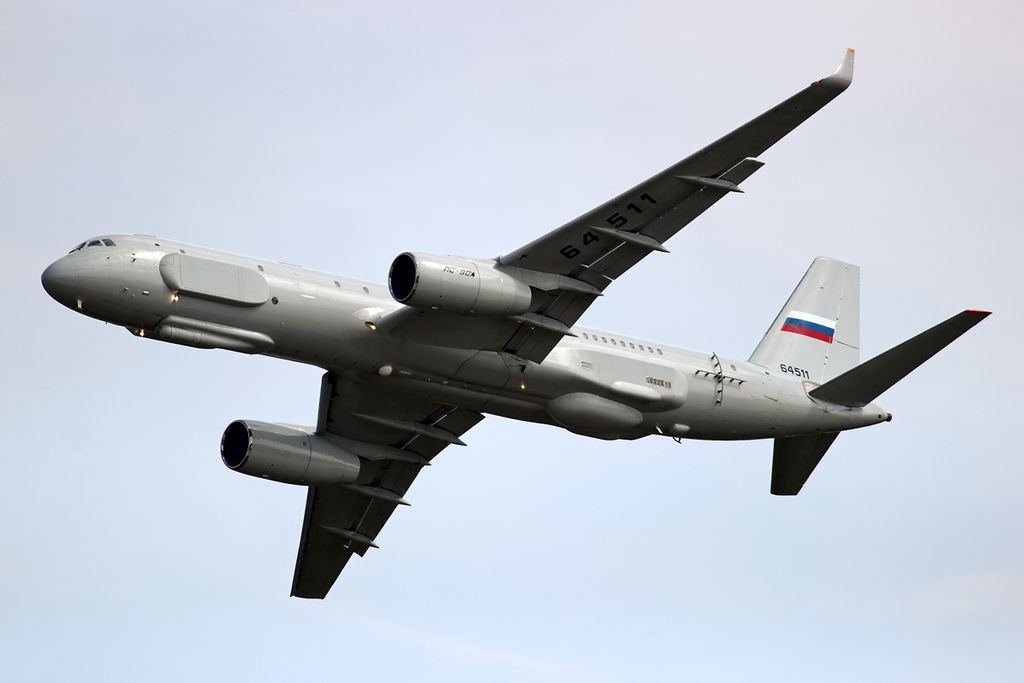
A Russian Air Force Tu-214R is about to land at Latakia, Syria.

The Tu-214R is a Russian ISR (Intelligence Surveillance Reconnaissance) aircraft. In other words, a quite advanced spyplane.

As we have already explained here in the past, it is a special mission aircraft equipped with all-weather radar systems and electro optical sensors that produce photo-like imagery of a large parts of the ground: these images are then used to identify and map the position of the enemy forces, even if these are camouflaged or hidden.

The aircraft is known to carry sensor packages to perform ELINT (Electronic Intelligence) and SIGINT (Signal Intelligence) missions: the antennae of the Tu-214R can intercept the signals emitted by the enemy systems (radars, aircraft, radios, combat vehicles, mobile phones etc) so as it can build the EOB (Electronic Order of Battle) of the enemy forces: where the enemy forces are operating, what kind of equipment they are using and, by eavesdropping into their radio/phone communications, what they are doing and what will be their next move.

The aircraft is built by KAPO (Kazan Aircraft Production Association) and flown from the company?s airfield in Kazan.

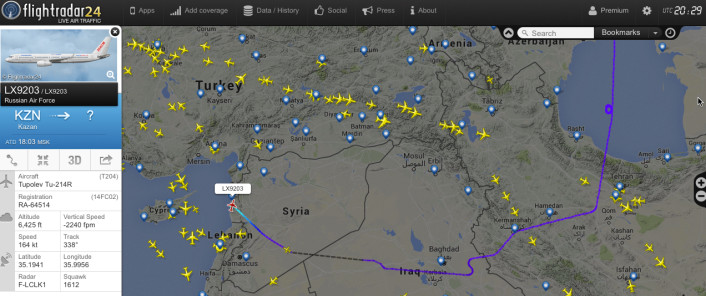
On Feb. 15, the Tu-214R registered RA-64514, serial number 42305014, the second of the two examples of this kind of aircraft built under contract with Russia?s Ministry of Defense, flew from Kazan to Latakia airbase, Syria.
Image credit: Flightradar24.com

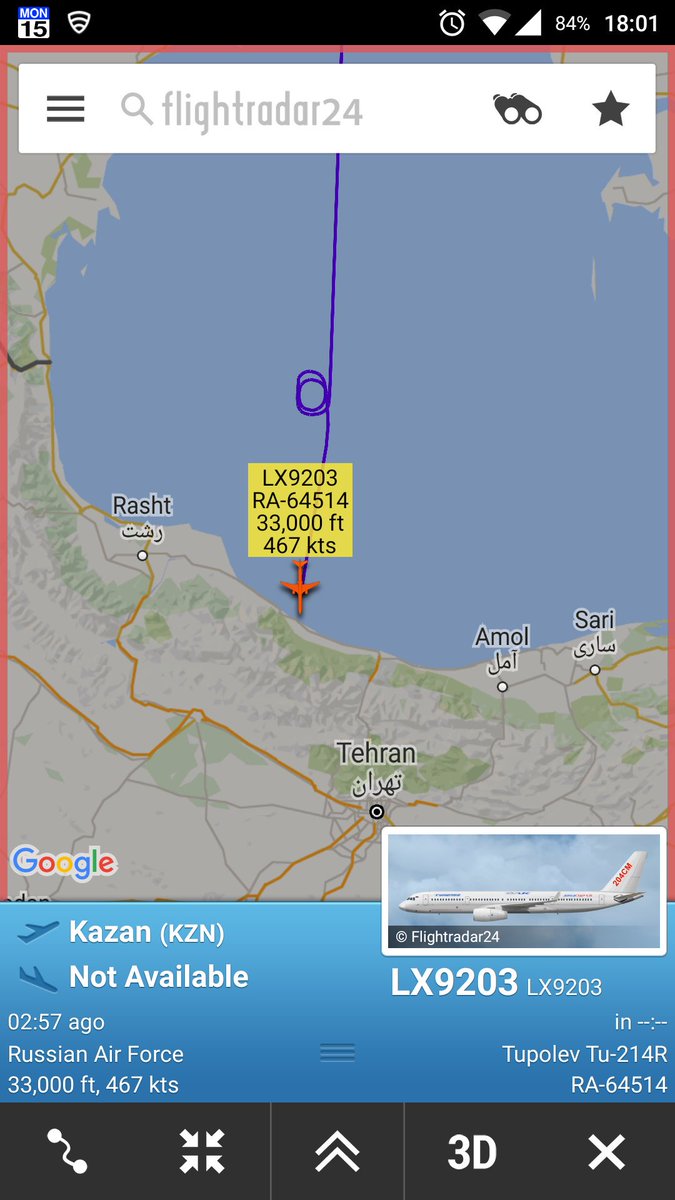
With its ADS-B transponder signals broadcast in the clear and detected by Flightradar24 collecting stations, the aircraft could be tracked as it followed the eastern corridor from Russia, to the Caspian Sea and then to Syria via the Iranian and Iraqi airspaces. It?s not clear whether the aircraft has already been delivered to the Russian Air Force, even though it is quite weird that a developmental aircraft is deployed abroad (unless the reason is testing it at war in a real scenario?).

While it was still under development, the same Tu-214R aircraft flew what appeared to be an operative mission on Jun. 18, 2015, when it flew from Kazan to Crimea and back, closely following the border between Russia and Ukraine, most probably testing some of its sensors against real targets.

Previously, the aircraft was spotted flying near Crimea.Interestingly, while over the Caspian Sea, approaching the Iranian airspace, the Tu-214R performed a couple of 360 degree  turns at 33.000 feet (weird, while enroute): maybe it was working on the diplomatic clearence to enter Iran?

Image credit: Rimma Sadykova/Wiki


Russia wants to fly over US with advanced digital camera

AP Story By DEB RIECHMANN

WASHINGTON (AP) — Russia will ask permission on Monday to start flying surveillance planes equipped with high-powered digital cameras amid warnings from U.S. intelligence and military officials that such overflights help Moscow collect intelligence on the United States.
Russia and the United States are signatories to the Open Skies Treaty, which allows unarmed observation flights over the entire territory of all 34 member nations to foster transparency about military activity and help monitor arms control and other agreements. Senior intelligence and military officials, however, worry that Russia is taking advantage of technological advances to violate the spirit of the treaty.

Russia will formally ask the Open Skies Consultative Commission, based in Vienna, to be allowed to fly an aircraft equipped with high-tech sensors over the United States, according to a senior congressional staffer, who spoke on condition of anonymity because the staff member wasn't authorized to discuss the issue publicly.

The request will put the Obama administration in the position of having to decide whether to let Russia use the high-powered equipment on its surveillance planes at a time when Moscow, according to the latest State Department compliance report, is failing to meet all its obligations under the treaty. And it comes at one of the most tension-filled times in U.S.-Russia relations since the end of the Cold War, with the two countries at odds over Russian activity in Ukraine and Syria.

"The treaty has become a critical component of Russia's intelligence collection capability directed at the United States," Adm. Cecil D. Haney, commander of the U.S. Strategic Command, wrote in a letter earlier this year to Rep. Mike Rogers, R-Ala., chairman of a House subcommittee on strategic forces.

"In addition to overflying military installations, Russian Open Skies flights can overfly and collect on Department of Defense and national security or national critical infrastructure," Haney said. "The vulnerability exposed by exploitation of this data and costs of mitigation are increasingly difficult to characterize."

A State Department official said Sunday that treaty nations had not yet received notice of the Russian request, but that certification of the Russian plane with a "digital electro-optical sensor" could not occur until this summer because the treaty requires a 120-day advance notification. The official spoke on condition of anonymity because he wasn't authorized to discuss the issue publicly.

The official also said that the treaty, which was entered into force in 2002, establishes procedures for certifying digital sensors to confirm that they are compliant with treaty requirements. The official said all signatories to the treaty agree that "transition from film cameras to digital sensors is required for the long-term viability of the treaty."
In December, Rose Gottemoeller, undersecretary of state for arms control and international security, sought to temper concerns about Russian overflights, saying that what Moscow gains from the observation flights is "incremental" to what they collect through other means.

"One of the advantages of the Open Skies Treaty is that information — imagery — that is taken is shared openly among all the treaty parties," she said at a joint hearing of the House Foreign Affairs and Armed Services committees in December. "So one of the advantages with the Open Skies Treaty is that we know exactly what the Russians are imaging, because they must share the imagery with us."

Still, military and intelligence officials have expressed serious concern.

"The open skies construct was designed for a different era," Lt. Gen. Vincent Stewart, director of the Defense Intelligence Agency, told lawmakers when asked about the Russian overflights during a congressional hearing. "I'm very concerned about how it's applied today."

Robert Work, deputy secretary of defense, told Congress: "We think that they're going beyond the original intent of the treaty and we continue to look at this very, very closely."

Steve Rademaker, former assistant secretary of state for the bureau of arms control and the bureau of international security and nonproliferation, told Congress at a hearing on security cooperation in Europe in October that Russia complies with the Open Skies Treaty, but has "adopted a number of measures that are inconsistent with the spirt" of the accord.

The treaty, for instance, obligates each member to make all of its territory available for aerial observation, yet Russia has imposed restrictions on surveillance over Moscow and Chechnya and near Abkhazia and South Ossetia, he said. Russian restrictions also make it hard to conduct observation in the Kaliningrad enclave, said Rademaker, who believes Russia is "selectively implementing" the treaty "in a way that suits its interests."

Mode-S/ADS Milcom Intercepts 20-21 Feb 2016 - Brasstown NC

Here is the latest round of Mode-S/ADS-B intercepts and selected ATC call signs logged from here on the radio ranch in WNC. All dates/times are UTC and list is sorted in Mode-S address order.
00000A Various   ---  2016-02-21 15:24:58 Various Various --- 
0D0978 ---   XAMBC 2016-02-21 19:15:25 --- Mexico ---  
A1ECBD N223GA   N223GA 2016-02-20 04:35:09 Gulfstream V United States US DOJ  ---  41000    
A82698 N624RH   ---  2016-02-21 20:23:25 707-338C United States OMEGA AIR 
ADFCC4 93-0644   ---  2016-02-21 16:18:50 T-1A Jayhawk United States USAF | 71FTW | 32FTS [KEND]  
ADFDEC 94-6707   DAWG 07 2016-02-21 18:32:26 C-130H United States WV ANG | 130AW | 130AS [KCRW]  0000  21000   
ADFE4C 94-0320/95-0099   PAT749 2016-02-21 16:03:05 C-12V United States US Army | B/6-52 AVN (TA) DET-1 [KFTK]  ---  26000    
ADFE4C 94-0320/95-0099   PAT749 2016-02-21 18:44:56 C-12V United States US Army | B/6-52 AVN (TA) DET-1 [KFTK]  ---  26000    
AE015E 59-1512   DIXIE38 2016-02-20 16:35:16 KC-135T United States MI ANG | 127WG | 171ARS [KMTC] 
AE0418 164406   GOTO FMS 2016-02-21 08:10:08 E-6B United States USN | SCW-1 [KTIK]  
AE0489 63-8007   DIXIE39 2016-02-21 15:10:30 KC-135R United States AL ANG | 117ARW | 106ARS [KBHM] 
AE04D8 165830   CNV4564 2016-02-20 00:18:53 C-40A United States USNR | VR-59 [KNFW]
AE056B 86-0014   ---  2016-02-21 20:58:12 C-5B United States AFRC | 439AW | 337AS [KCEF] 
AE05DF 87-9282   ---  2016-02-21 17:53:57 C-130H United States AFRC | 440AW | 95AS [KPOB] 
AE0624 89-1055   PITT55 2016-02-21 17:55:08 C-130H United States AFRC | 914AW | 328AS [KIAG] 
AE08F8 84-24375   PAT044 2016-02-20 14:21:13 C-12U United States USARC | C/2-228 AVN (TA) [KFBG] 
AE0940 166374   ---  2016-02-21 17:58:22 UC-35D United States VMR DET [KADW] 
AE1444 05-8158   HOBBY35 2016-02-21 16:52:50 C-130J-30 United States AFRC | 403AW | 815AS [KBIX] 
AE1EA6 08-3937   ---  2016-02-21 16:43:08 T-6A United States --- 
AE4C61 10-0739   ---  2016-02-20 12:40:38 MC-12W United States USAF | 9RW | 489RS [KBAB] 
AE4E05 02   C102 2016-02-20 09:19:01 C-37A United States USCG | CGAS Washington [KDCA] 
AE5774 10-00259   ---  2016-02-21 14:19:55 C-12V United States ---  0000  27000   

Saturday, February 20, 2016

Mode-S/ADS Milcom Intercepts 17-19 Feb 2016 - Brasstown NC

Here is the latest round of Mode-S/ADS-B intercepts and selected ATC call signs logged from here on the radio ranch in WNC. All dates/times are UTC and list is sorted in Mode-S address order.

0D090F ---       ---  2016-02-18 03:02:42 --- Mexico ---
0D0978 ---      XAMBC 2016-02-17 23:42:53 --- Mexico ---
29CBB8 various   ---  2016-02-17 14:36:28 various various Various
A18143 N1963N   N1963N 2016-02-18 17:40:18 G450 United States Water Force One LLC
A68426 N519PC   ---  2016-02-17 15:08:28 PC-12/45 United States USAF  0000  20000   
A68426 N519PC   ---  2016-02-17 19:33:20 PC-12/45 United States USAF  0000  20000   
AD5AF4 07-0793   ---  2016-02-18 22:07:39 PC-12/47 United States USAF | 27SOW | 318SOS [KCVS]
ADFCF4 95-0040   ---  2016-02-18 14:39:29 T-1A Jayhawk United States USAF | 14FTW | 48FTS
ADFCF4 95-0040   ---  2016-02-19 20:03:38 T-1A Jayhawk United States USAF | 14FTW | 48FTS  0000  13750   
ADFCF4 95-0040   ---  2016-02-19 23:24:29 T-1A Jayhawk United States USAF | 14FTW | 48FTS  0000  13750   
ADFCF7 95-0043   ---  2016-02-18 18:47:13 T-1A Jayhawk United States USAF | 14FTW | 48FTS
ADFD02 95-0054   ---  2016-02-18 19:00:53 T-1A Jayhawk United States USAF | 14FTW | 48FTS
ADFD10 95-0068   ---  2016-02-18 15:30:22 T-1A Jayhawk United States USAF | 14FTW | 48FTS
ADFE62 91-1231   DERBY 85 2016-02-19 16:37:04 C-130H United States KY ANG | 123AW | 165AS [KSDF]
ADFE68 91-1237   DERBY 30 2016-02-19 17:46:41 C-130H United States KY ANG | 123AW | 165AS [KSDF]
ADFE73 92-1536   TETON36 2016-02-17 16:58:29 C-130H United States WY ANG | 153AW | 187AS [KCYS]
ADFE85 92-0550   COBB50 2016-02-17 00:04:25 C-130H United States AFRC | 94AW | 700AS [KMGE]
ADFE86 92-0551   RCH265 2016-02-18 22:56:08 C-130H United States AFRC | 94AW | 700AS [KMGE]
ADFEAC 83-0081   HOIST91 2016-02-17 20:55:50 KC-10A United States USAF | 305AMW [KWRI]
ADFEB8 98-0002   AF 2 2016-02-17 14:23:44 C-32A United States USAF | 89AW | 1AS [KADW]
ADFF7D 67-14850   ---  2016-02-19 16:09:23 T-38C United States 50thFTS
ADFF8C 68-8162   ---  2016-02-18 16:25:04 T-38C United States 50thFTS
AE0171 84-0079   SPAR591 2016-02-18 12:44:13 C-21A United States USAF | 375AW | 457AS [KADW]
AE0171 84-0079   SPAR591 2016-02-19 19:48:52 C-21A United States USAF | 375AW | 457AS [KADW]
AE0210 82-0191   XTNDR85 2016-02-18 14:20:26 KC-10A United States USAF | 60AMW [KSUU]
AE0248 96-8154   BATON91 2016-02-19 20:57:15 EC-130J United States PA ANG | 193SOW | 193SOS [KMDT]
AE036E 98-0008   ---  2016-02-19 15:40:11 UC-35A United States US Army
AE0371 59-1483   EDDIE42 2016-02-19 15:59:08 KC-135R United States OH ANG | 121ARW [KLCK]
AE0371 59-1483   EDDIE42 2016-02-19 16:45:28 KC-135R United States OH ANG | 121ARW [KLCK]
AE0408 165736    RAIDR20 2016-02-18 19:37:22 KC-130J United States USMC | VMGR-352 [KNKX]
AE0428 62-3511   EDDIE41 2016-02-19 15:59:03 KC-135R United States OH ANG | 121ARW [KLCK]  0000  27000   
AE0470 57-1428   SODA81 2016-02-19 14:58:24 KC-135R United States TN ANG | 134ARW | 151ARS [KTYS]
AE049C 59-1517   ---  2016-02-18 23:41:39 KC-135R United States TN ANG | 134ARW | 151ARS [KTYS]
AE049C 59-1517   SODA91 2016-02-18 22:08:38 KC-135R United States TN ANG | 134ARW | 151ARS [KTYS]
AE04D9 165831    RY831 2016-02-18 19:06:37 C-40A United States USNR | VR-59 [KNFW]
AE04D9 165831    RY831 2016-02-18 19:37:03 C-40A United States USNR | VR-59 [KNFW]
AE04D9 165831    RY831 2016-02-18 20:07:16 C-40A United States USNR | VR-59 [KNFW]
AE04D9 165831    RY831 2016-02-18 20:33:53 C-40A United States USNR | VR-59 [KNFW]
AE058F 58-0045   STEEL71 2016-02-18 16:22:09 KC-135T United States PA ANG | 171ARW [KPIT]  0000  27000   
AE05E2 87-9287   ROGUE34 2016-02-19 14:48:40 C-130H United States AFRC | 914AW | 328AS [KIAG]
AE0631 ------   ---  2016-02-17 13:50:07 RC-12K United States USAF
AE06D8 163560   ---  2016-02-18 19:41:17 UC-12F United States USN| AOD Atsugi
AE07A1 58-0099   E80099 2016-02-19 15:07:35 KC-135T United States PA ANG | 171ARW [KPIT]  0000  32000   
AE07E7 95-0104   ELVIS66 2016-02-19 19:18:44 C-17A United States TN ANG | 164AW | 155AS [KMEM]
AE07ED 96-0003   HARD41 2016-02-19 20:36:15 C-17A United States USAF | 62AW [KTCM]  0000  36000   
AE0800 98-0054   RCH803 2016-02-17 14:45:37 C-17A United States USAF | 437AW [KCHS]
AE093B 00-1052   ---  2016-02-18 01:41:03 UC-35B United States US Army | OSACOM PATD [KADW]
AE0940 166374   ---  2016-02-18 20:13:40 UC-35D United States VMR DET [KADW]  00  41000   
AE0940 166374   ---  2016-02-18 23:50:56 UC-35D United States VMR DET [KADW]  00  41000   
AE10BA 01-0191   ---  2016-02-19 21:52:05 C-17A United States USAF | 436AW | 3AS [KDOV]  0000  22600   
AE1176 02-1104   BOE04 2016-02-19 19:31:11 C-17A United States USAF | 62AW [KTCM]
AE118A 02-1863   R1863 2016-02-19 12:39:13 C-37A United States US Army
AE119C 03-3119/03-3126   RCH102 2016-02-19 18:47:01 C-17A United States MS ANG | 172AW | 183AS [KJAN]
AE11E4 78-0576   SNTRY51H 2016-02-19 18:10:40 E-3G United States USAF | 552ACW [KTIK]
AE11F8 02-0042   JUVAT80 2016-02-18 22:20:17 C-40B United States USAFE | 86AW | 76AS [ETAR]
AE1211 03-0726   ---  2016-02-18 14:28:46 UC-35C United States USARC | 2-228 AVN
AE1240 04-4135   ---  2016-02-19 15:34:45 C-17A United States USAF | 305AMW | 6AS [KWRI]
AE1240 04-4135   RCH4135 2016-02-18 17:24:29 C-17A United States USAF | 305AMW | 6AS [KWRI]  0000  27000   
AE1240 04-4135   RCH4135 2016-02-18 18:56:22 C-17A United States USAF | 305AMW | 6AS [KWRI]  0000  27000   
AE1252 165836    CNV4342 2016-02-19 00:16:55 C-40A United States USNR | VR-57 [KNZY]
AE128F 85-0011   ---  2016-02-17 04:02:47 MC-130H United States USAF
AE128F 85-0011   ---  2016-02-18 03:01:32 MC-130H United States USAF
AE1444 05-8158   HOBBY35 2016-02-19 21:58:19 C-130J-30 United States AFRC | 403AW | 815AS [KBIX]
AE146D 07-7175   RCH138T 2016-02-17 22:13:19 C-17A United States USAF | 436AW | 3AS [KDOV]
AE1471 07-7179   RCH109T 2016-02-19 19:47:23 C-17A United States USAF | 60AMW | 21AS [KSUU]
AE1479 166767    VM767 2016-02-19 15:23:27 UC-35D United States MAW-4
AE1488 86-0416   PEACH98 2016-02-17 03:05:36 TE-8a United States 330thCTS
AE189C 05-0932   SPAR10 2016-02-17 15:58:59 C-40C United States AFRC | 932AW | 73AS [KBLV]
AE18E7 78-0693   693 2016-02-18 16:38:17 A-10C United States MD ANG | 175WG | 104FS [KMTN]  0000  20000   
AE1BF5 07-6312   GLEAN40 2016-02-18 14:47:10 C-130J-30 United States USAF | 19AW [KLRF]
AE2FA3 08-8191   RCH207 2016-02-19 21:26:37 C-17A United States USAF | 437AW [KCHS]
AE4A60 166696    CNV4044 2016-02-18 21:11:31 C-40A United States USNR | VR-56 [KNTU]
AE4A60 166696    CNV4286 2016-02-19 11:46:25 C-40A United States USNR | VR-56 [KNTU]  0000  40000    
AE4AF8 08-5683   ---  2016-02-19 02:31:15 C-130J-30 United States USAF | 317AG [KDYS]
AE4E10 11-5736   RCH1941 2016-02-18 15:28:29 C-130J-30 United States USAF | 19AW [KLRF]
AE4E11 11-5738   GLEAN40 2016-02-18 14:44:32 C-130J-30 United States USAF | 19AW [KLRF]
AE4EC6 168761    PELCN11 2016-02-18 13:46:50 P-8A United States USN |
AE4EC6 168761    PELCN11 2016-02-18 15:09:34 P-8A United States USN |
AE4EC8 168763    LANCR24 2016-02-18 18:46:31 P-8A United States USN |
AE54B3 10-0223   RC528 2016-02-19 18:45:55 C-17A United States USAF | 437AW [KCHS]
AE54D5 12-5773   KING21 2016-02-18 03:05:32 HC-130J United States USAF | 23 Wing | 71RQS [KVAD]
AE57B5 168849    VVLL818 2016-02-18 23:28:35 P-8A United States USN |
AE57BB 168855    VVLL812 2016-02-18 21:43:26 P-8A United States USN |  ---  36000    
AE57D7 3361      ---  2016-02-18 21:05:01 C-12V United States ---
AE595C 14-5788   ---  2016-02-18 17:19:51 C-130J-30 United States USAF | 19AW [KLRF]

CTF 55 Conducts Iraqi Bilateral Exercise in the Arabian Gulf

By Mass Communication Specialist 2nd Class Torrey W. Lee

ARABIAN GULF (NNS) -- U.S. maritime forces aboard the Arleigh Burke-class guided-missile destroyer USS Russell (DDG 59) and the Island-class Coast Guard cutter USCGC Monomoy partnered with an Iraqi navy Swift Boat (P-310) to complete a monthly bilateral exercise in the Arabian Gulf, Feb. 14-15.

 The exercise provided a surface warfare experience with the partnering nations by exchanging subject matter experts (SME) and conducting live-fire exercises in a tactical environment.

 "The goal of this exercise is to build interoperability and work together with Iraq," said Lt.j.g. Samuel Ross, a bilateral liaison assigned to Commander, Task Force 55. "The relationships we build through these bilaterals are what allow the Navy to grow and be able to operate in the Arabian Gulf."

 U.S. forces in the U.S. 5th Fleet area of operations have been conducting various Iraqi bilateral exercises over the past 18 months. Each exercise introduces a variety of elements from surface and air warfare, to visit,, board, search, seizures (VBSS) and interdiction operations.

 "An important factor in our operations is communications," said Ross. "In the maritime domain, which is the Arabian Gulf, communications help us level the playing field and work together as a cohesive unit."

 Continuing the theme of strong communication, SMEs from the U.S. and Iraqi maritime forces worked together, going from ship to ship, demonstrating tactics, and synchronizing weapons systems to promote combined-joint interoperability.
 "Having similar weapons systems, we can share the knowledge with our allies so that we both can use our weapons effectively and safely," said Gunner's Mate 1st Class Christopher Lamotte, Russell's armory lead petty officer. "With technology always changing, we can rely on our partners. If they have a new system, we can share the knowledge, and this is what makes us into a stronger Navy."

 During the two-day exercise, coalition forces performed weapons synchronization, maritime infrastructure protection exercises (MIPEX), and combined-joint gun exercises.

 "MIPEX provides an opportunity to practice our force protection tactics with joint and international partners," said Lt. Andrew Corwell, U.S. Coast Guard Patrol Forces Southwest Asia's current operations officer. "The U.S. Coast Guard understands coastal operations, and this helps our ability to interact with various navies and coast guards in this area that are uses to these coastal environments."

 Coalition partners completed live-fire exercises, from basic to more advanced operations. The three ships involved were capable of integrating formation tactics in targeting a simulated surface contact.

 "This bilateral was a big success. We reached all of our mission objectives," said Ross. "We were able to complete multiple scenario-based exercises, and we were able to build on our existing relationship with Iraq. This was a big Bravo Zulu to all of the joint-combined units, and we look forward to our next monthly exercise."

 Commander, Task Force 55 controls surface forces including U.S. Navy coastal patrol craft and U.S Coast Guard patrols boats in the U.S. 5th Fleet area of operations. U.S. 5th Fleet continues to expand its relationship with the Iraqi navy through key leader engagements, professional exchanges and by conducting exercises in the Arabian Gulf.

VFA-113, NAS Lemoore Say Goodbye to the F/A-18C Hornet

 An F/A-18F Super Hornet assigned to Strike Fighter Squadron (VFA) 22, flown by Lt. Cmdr. Warren Tomlinson and Lt. j.g. Josh Raymond, and an F/A-18C Hornet assigned to VFA-113, flown by Cmdr. Craig Sicola, join a formation of aircraft from Carrier Air Wing (CVW) 17 during a mission flown from the Nimitz-class aircraft carrier USS Carl Vinson (CVN 70). Carl Vinson and CVW 17 are deployed to the U.S. 5th Fleet area of responsibility. (U.S. Navy photo by Mass Communication Specialist 2nd Class James R. Evans/Released)
By Ensign Timothy Cole, Strike Fighter Squadron 113 Public Affairs Officer

LEMOORE, Calif. (NNS) -- The "Stingers" of Strike Fighter Squadron (VFA) 113 conducted the last flight of a fleet F/A-18C Hornet based at Naval Air Station (NAS) Lemoore Feb. 17.

 The flight was conducted by VFA-113's Maintenance Officer Lt. Cmdr. Kristen "Dragon" Hansen.

 VFA-113 completed the transition from the A-7E Corsair II to the F/A-18A Hornet Dec. 14, 1983, making the Stinger's the Navy's first fleet operational combat ready strike fighter squadron, and establishing the squadron motto of "First and Finest." In 1989, VFA-113 accepted delivery of the upgraded F/A-18C hornet. In March, VFA-113 will begin transitioning to the F/A-18E Super Hornet.

 In August 2014, the squadron embarked on its final combat deployment with the F/A-18C and Carrier Air Wing (CVW) 17 aboard USS Carl Vinson (CVN 70). The Stingers performed exceptionally on deployment, flying 367 combat missions in support of Operation Inherent Resolve.

 "The legacy F/A-18 has served the Navy brilliantly as a supersonic fighter for over 30 years," said Cmdr. Eric C. Doyle, the commanding officer of the Stingers. "While we remain proud of all the good work we have done with the F/A-18C, we are excited to begin transitioning to some brand new F/A-18E super hornets."

 "It has been an honor and a privilege to fly the F/A-18C Hornet across the Lemoore flight line for the last 10 years," said Hansen. "Although I am excited about receiving our new jets, the 'Charlie' has served me and the majority of the Lemoore Hornet community well over the course of our careers. Our maintainers have done a spectacular job of keeping these aging aircraft combat ready despite the many challenges associated with high-flight hour jets. I'll appreciate the extra gas, but admit that I'll be a little sad when I have to say 'Rhino Ball' vice 'Hornet Ball' behind the boat!"

 After the completion of carrier qualifications for the pilots of VFA-113, the final step in the transition process to the F/A-18E being certified as "Safe-for-Flight." Part of that process involves the loading and delivery of live ordnance. Strike Fighter Weapons School Pacific will conduct the Conventional Weapons Technical Proficiency Inspection (CWTPI) for VFA-113 at the beginning of June. Following the completion of CWTPI, the Stingers will become the newest member of the Super Hornet community, making NAS Lemoore an all super hornet flight line.

 Aviation Electrician's Mate Second Class David Shimizu is looking forward to the benefits of the transition as well.

 "As we think of the word 'transition,' we think of strenuous and difficult times, but in reality, it is our opportunity to purge and rethink our priorities and be intentional about new habits," said Shimizu. "As individuals we set out new goals to be our personal best whether if it is in the work environment, or life in general. We as a team have always pushed ourselves to strive to be the best at any task put forth. Now as we close one chapter of our lives and open a new one, we have the opportunity to make our new normal anything we want."

USS Higgins Returns from Deployment

From Commander, U.S. Third Fleet Public Affairs

SAN DIEGO (NNS) -- The guided missile destroyer USS Higgins (DDG 76) returned home Feb. 11 from a 225-day independent deployment to the Arabian Gulf, Western Pacific, and Indian Oceans.

 While deployed to the U.S. 5th and 7th Fleets, the ship and crew of more than 300 Sailors, assigned to Destroyer Squadron Two Three (DESRON 23), conducted presence and maritime security operations in support of Carrier Strike Group Eight and multiple Combined Task Forces.

 During the deployment, USS Higgins conducted numerous Visit, Board, Search, and Seizure (VBSS) missions, participated in several joint and coalition exercises, and also responded to high priority missions during the first absence of an aircraft carrier from U.S. 5th Fleet since 2007.

 While on station in the Arabian Gulf, USS Higgins also rescued four Saudi Arabian fishermen after their boat had caught fire. The crew was able to retrieve the four men from the water and return them safely to local authorities, greatly contributing to relations between the United States Navy and the local populace.

 "I could not be more pleased with the hard work and dedication from this crew," said Cmdr. Allen P. Johnson, commanding officer of Higgins. "I know we can all reflect on this time we have spent underway and be proud of the contributions we have all made to our nation and national security."

 Higgins is a multi-mission ship with anti-air warfare, anti-submarine warfare and anti-surface warfare surface combatants capabilities; designed to operate independently or with an associated strike group.

 The ship is homeported in San Diego and is part of Naval Surface Forces and U.S. 3rd Fleet.

Mode-S/ADS Milcom Intercepts 11-16 Feb 2016 - Brasstown NC

Here is the latest round of Mode-S/ADS-B intercepts and selected ATC call signs logged from here on the radio ranch in WNC. All dates/times are UTC and list is sorted in Mode-S address order.
00000A Various   ---  2016-02-12 20:16:41 Various Various --- ---  ---   
00000A Various   ---  2016-02-13 17:39:20 Various Various --- 0000  32000   
00000A Various   ---  2016-02-14 04:59:15 Various Various --- ---  ---   
0D099A ---       VIV8402 2016-02-13 20:57:46 --- Mexico --- ---  ---    
0D809A ---       YV1771 2016-02-13 17:38:11 --- Venezuela --- ---  ---   
33FFAF MM62243   IAM9001 2016-02-12 01:16:41 A319-115(CJ) Italy AMI | 31 Stormo | 306 Gruppo TS ---  ---    
33FFAF MM62243   IAM9001 2016-02-13 14:50:49 A319-115(CJ) Italy AMI | 31 Stormo | 306 Gruppo TS ---  ---    
477FF3 03        BRK97 2016-02-15 20:37:53 C-17A Hungary NATO ---  ---   
520274 94-0264   RCH 1028 2016-02-12 01:26:56 RC-26B United States USARMY ADFCF3 94-0148   ---  2016-02-13 22:53:08 T-1A Jayhawk United States USAF | 14FTW | 48FTS ---  ---   
ADFD76 91-0506   ---  2016-02-16 14:59:03 C-26E United States CO ARNG | OSACOM DET-33 [KBKF] ---  ---   
ADFD76 91-0506   ---  2016-02-16 22:38:08 C-26E United States CO ARNG | OSACOM DET-33 [KBKF] ---  ---   
ADFDB8 93-1038   COBB 38 2016-02-12 14:28:09 C-130H United States AFRC | 94AW | 700AS [KMGE] ---  ---   
ADFDC4 93-1457   EPIC 57 2016-02-14 14:19:33 C-130H United States NC ANG | 145AW | 156AS [KCLT] ---  ---   
ADFE85 92-0550   COBB50 2016-02-11 23:14:09 C-130H United States AFRC | 94AW | 700AS [KMGE] ---  ---   
ADFE85 92-0550   COBB50 2016-02-16 21:07:05 C-130H United States AFRC | 94AW | 700AS [KMGE] ---  ---   
ADFEA9 96-1006   GOFER22 2016-02-12 19:57:07 C-130H United States MN ANG | 133AW | 109AS [KMSP] ---  ---   
ADFEE0 87-0160   PAT532 2016-02-11 19:42:33 C-12U United States TX ARNG | OSACOM DET-49 [KAUS] ---  ---   
ADFEF2 161530    LOBO01 2016-02-16 16:04:11 C-9B United States USNR | VR-61 [KNUW] 0000  32975   
ADFEF2 161530    LOBO01 2016-02-16 19:24:19 C-9B United States USNR | VR-61 [KNUW] 0000  32975   
AE010D 97-0400   ---  2016-02-16 03:14:14 C-37A United States USAF | 89AW | 99AS [KADW] 0000  43000   
AE0178 84-0129   SWIFT28 2016-02-15 18:04:52 C-21A United States USAF | 375AW | 457AS [KADW] ---  ---   
AE017A 84-0142   SPAR467 2016-02-11 22:35:31 C-21A United States MI ANG | 110FW | 172AS [KBTL] ---  ---   
AE021D 84-0190   DUCE09 2016-02-11 21:49:03 KC-10A United States USAF | 305AMW [KWRI] ---  ---   
AE0222 85-0030   HOIST90 2016-02-15 02:35:23 KC-10A United States USAF | 305AMW [KWRI] ---  32975    
AE0363 60-0341   ---  2016-02-16 15:52:09 KC-135R United States MS ANG | 186ARW | 153ARS [KMEI] ---  ---    
AE0383 58-0079   RCH806 2016-02-14 17:35:26 KC-135R United States MS ANG | 186ARW | 153ARS [KMEI] ---  ---   
AE0384 59-1458   EDDIE93 2016-02-11 23:06:18 KC-135R United States OH ANG | 121ARW [KLCK] ---  ---   
AE0419 164407    GOTO FMS 2016-02-15 22:43:30 E-6B United States USN | SCW-1 [KTIK] ---  37000    
AE041C 164410    GOBLUE11 2016-02-12 23:30:52 E-6B United States USN | SCW-1 [KTIK] ---  26025    
AE0428 62-3511   EDDIE61 2016-02-16 16:19:41 KC-135R United States OH ANG | 121ARW [KLCK] ---  ---   
AE04AE 165740    EASY40 2016-02-12 14:54:36 UC-35 United States MAW-4 ---  -AE04AE 165740    EASY40 2016-02-12 17:46:07 UC-35 United States MAW-4 ---  --AE0504 60-0345   MOTOWN2 2016-02-16 21:04:54 KC-135T United States MI ANG | 127WG | 171ARS [KMTC] ---  ---   
AE0568 86-0011   RCH407 2016-02-12 03:51:54 C-5M United States USAF | 60AMW [KSUU] ---  ---    
AE0575 86-0024   ---  2016-02-16 15:41:59 C-5M United States USAF | 60AMW | 22AS [KSUU] 5266  40000   
AE0575 86-0024   ---  2016-02-16 17:19:45 C-5M United States USAF | 60AMW | 22AS [KSUU] 5266  40000   
AE0602 80-0323   DAWG 04 2016-02-13 20:30:58 C-130H United States GA ANG | 165AW | 158AS [KSAV] ---  ---    
AE0667 61-0317   ---  2016-02-13 01:46:51 KC-135R United States KS ANG | 190ARW | 117ARS [KFOE] ---  ---   
AE07EC 96-0002   RCH589 2016-02-16 16:53:03 C-17A United States USAF | 437AW [KCHS] ---  ---   
AE07F1 96-0007   RULER63 2016-02-14 00:25:25 C-17A United States MS ANG | 172AW | 183AS [KJAN] ---  ---   
AE07F3 97-0041   TOGO99 2016-02-16 20:32:33 C-17A United States USAF | 437AW [KCHS] ---  ---   
AE080E 99-0168   RCH381 2016-02-16 21:40:27 C-17A United States USAF | 3WG | 517AS [PAED] ---  ---   
AE080F 99-0169   TURTLE4 2016-02-16 17:19:10 C-17A United States USAF | 437AW [KCHS] ---  ---   
AE093B 00-1052   ---  2016-02-16 17:19:19 UC-35B United States US Army | OSACOM PATD [KADW] ---  ---   
AE0976 165833   ---  2016-02-13 19:31:58 C-40A United States USNR | VR-59 [KNFW] ---  ---   
AE0977 165834    CNV4138 2016-02-15 16:35:28 C-40A United States USNR | VR-58 [KNIP] ---  ---   
AE0977 165834    CNV4482 2016-02-12 15:14:01 C-40A United States USNR | VR-58 [KNIP] ---  ---   
AE1177 02-1105   RCH365 2016-02-16 18:41:54 C-17A United States USAF | 62AW [KTCM] ---  ---   
AE1192 166474   ---  2016-02-12 15:13:10 UC-35D United States USMC | VMR-1 [KNKT] ---  28000   
AE1199 03-3116   RULER72 2016-02-13 19:13:12 C-17A United States MS ANG | 172AW | 183AS [KJAN] ---  ---   
AE119C 03-3119/03-3126   RCH605 2016-02-12 18:59:14 C-17A United States MS ANG | 172AW | 183AS [KJAN] ---  ---   
AE119D 03-3120   RCH114 2016-02-16 16:01:44 C-17A United States USAF | 62AW [KTCM] 0000  34000   
AE11D9 75-0559   SNTRY06 2016-02-16 15:23:43 E-3C United States USAF | 552ACW [KTIK] ---  ---   
AE143A 166715   ---  2016-02-12 20:38:29 UC-35D United States USMC | VMR-1 [KNKT] ---  ---   
AE1447 05-3147   GLEAN21 2016-02-12 15:40:00 C-130J-30 United States USAF | 19AW [KLRF] ---  ---   
AE1447 05-3147   GLEAN21 2016-02-12 16:02:52 C-130J-30 United States USAF | 19AW [KLRF] ---  ---   
AE146D 07-7175   RCH138T 2016-02-16 15:18:25 C-17A United States USAF | 436AW | 3AS [KDOV] ---  ---   
AE1531 06-4633   GLEAN23 2016-02-11 22:04:43 C-130J-30 United States USAF | 19AW [KLRF] ---  ---   
AE49C3 09-9207   RCH737 2016-02-13 16:15:03 C-17A United States USAF | 437AW [KCHS] ---  ---   
AE4AF8 08-5683   HAVOC61 2016-02-12 11:37:52 C-130J-30 United States USAF | 317AG [KDYS] ---  ---  
AE4BDE 10-5701   HAVOC62 2016-02-12 13:34:32 C-130J-30 United States USAF | 317AG [KDYS] ---  ---   
AE4D66 10-0213   RCH391 2016-02-15 22:50:58 C-17A United States USAF | 437AW [KCHS] ---  ---   
AE4E0A 08-5724   ---  2016-02-12 13:30:44 C-130J-30 United States USAF | 317AG [KDYS] ---  ---   
AE4E10 11-5736   GLEAN22 2016-02-11 22:07:28 C-130J-30 United States USAF | 19AW [KLRF] ---  ---   
AE4E10 11-5736   RCH1941 2016-02-16 16:53:33 C-130J-30 United States USAF | 19AW [KLRF] ---  ---   
AE54D5 12-5773   KING21 2016-02-11 23:05:04 HC-130J United States USAF | 23 Wing | 71RQS [KVAD] ---  ---   
AE54D5 12-5773   KING21 2016-02-12 00:10:46 HC-130J United States USAF | 23 Wing | 71RQS [KVAD] ---  ---   
AE57B5 168849    VVLL812 2016-02-16 15:12:32 P-8A United States USN | 6671  37000    
AE57B5 168849    VVLL812 2016-02-16 16:17:07 P-8A United States USN | 6671  37000    
AE57B5 168849    VVLL859 2016-02-12 22:47:33 P-8A United States USN | ---  16875    
AE57B5 168849    VVLL859 2016-02-13 00:06:09 P-8A United States USN | ---  16875    
AE57B5 168849    VVLL892 2016-02-16 21:15:54 P-8A United States USN | 6671  37000    
AE57B5 168849    VVLL892 2016-02-16 23:40:00 P-8A United States USN | 6671  37000
Friday, February 19, 2016

Aircraft N351DY in the Med today! - Update:- 30 ISIS Terrorist Killed!

Postscript to my post yesterday from The New York Times headline this morning:-

U.S. Strikes ISIS Camp in Libya, Killing More Than 30

WASHINGTON — American warplanes struck an Islamic State camp in Libya early Friday, targeting a senior Tunisian operative linked to two major terrorist attacks in Tunisia last year. The operative, Noureddine Chouchane, was most likely killed in the strike, according to the Pentagon.
 
The airstrikes, on a camp outside Sabratha, about 50 miles west of Tripoli, killed at least 30 Islamic State recruits at the site, many of whom were believed to be from Tunisia, according to a Western official, who spoke on the condition of anonymity to discuss military operations. Complete story online at http://www.nytimes.com/2016/02/20/world/middleeast/us-airstrike-isis-libya.html


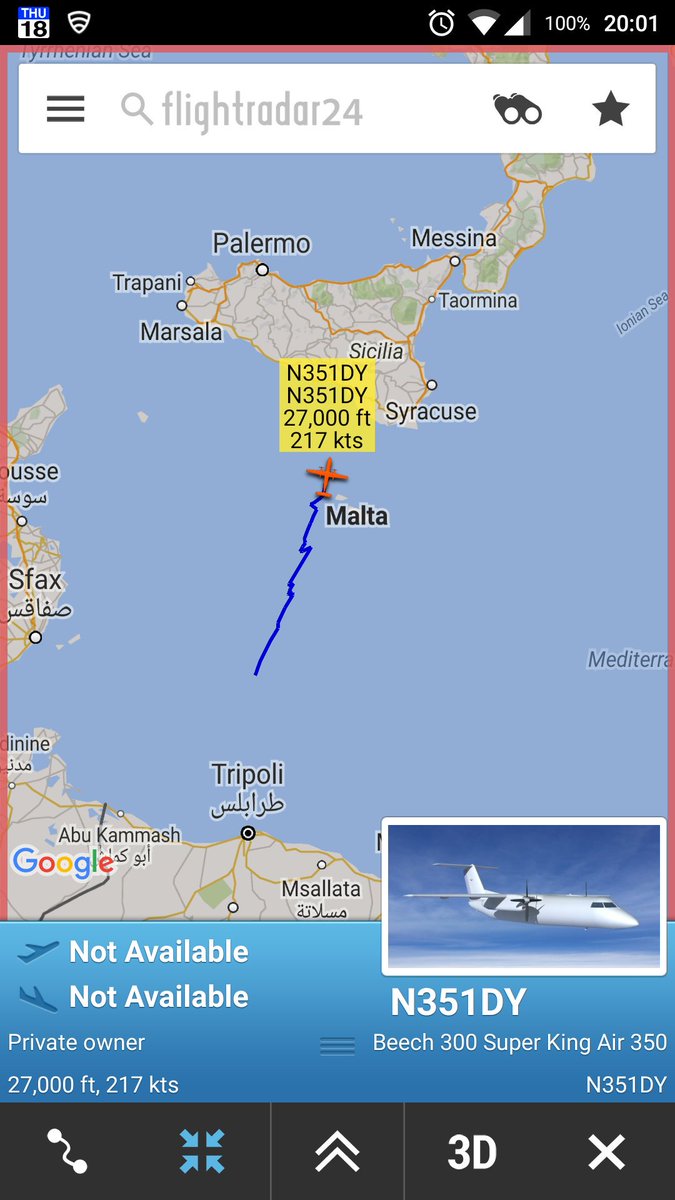
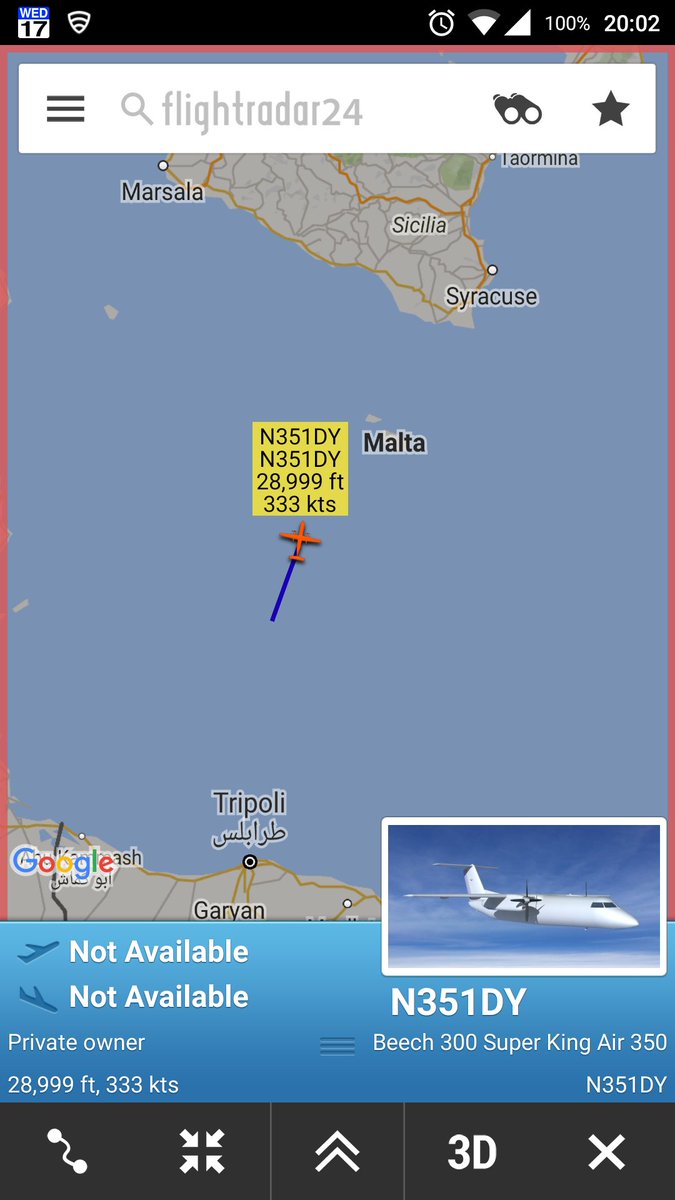
Written yesterday 18 February at 3:45 p.m.) Interesting! U.S. registered aircraft has been spotted apparently leaving Libyan airspace earlier today (18 February) and yesterday (17 February). Dear MMP reader check out the background article below and I will let you draw your own conclusions.


Thanks to @CivMilAir for this heads up.

Background from The Aviationist blog:

Here’s where a U.S. spyplane sought terrorists behind Bardo museum attack in Tunisia

From Mar. 21 to 26, a U.S. Beechcraft King Air 350ER has conducted reconnaissance missions over the western Tunisia regions where jidahist terrorists behind the Bardo Museum attack have been hiding.

The news, exposed by the Corriere della Sera newspaper, was unveiled by Tunisian bloggers who noticed the civil-registered plane on Flightradar24.com: in fact, although it was probably involved in an intelligence gathering mission, the King Air “N351DY” did not turn off its ADS-B transponder and could be clearly tracked on the popular website (as already happened to other U.S. spyplanes over Afghanistan…) as it circled over the Jebel Chambi mountain between 22,500 and 24,500 feet.

Noteworthy, the aircraft operated by Pantelleria airport, a little Italian island off Tunisia: most probably, deploying the plane to a Tunisian airport was not safe, Sigonella airbase, in Sicily, from where U.S. Global Hawk and Predator and Reaper drone operate, was too far and Pantelleria was chosen as the closest base for the clandestine task.

The N351DY is registered to Aircraft Logistics Group LLC, based at Oklahoma City, known to have cooperated with Pentagon in the past.

You can read the rest of this article at http://theaviationist.com/tag/n351dy/

And then there is yesterday's flight seen leaving that garden spot in the world - Libya. Wonder how the shopping is down around Tripoli?


Again kudos to @CivMilAir for both intercepts.

Thursday, February 18, 2016

F-22 Raptors conduct show of force over South Korea

Four U.S. Air Force F-22 Raptors from Kadena Air Base, Japan, fly over the skies of South Korea, in response to recent provocative action by North Korea Feb. 17, 2016. The Raptors were joined by South Korean F-15K Slam Eagles and U.S. Air Force F-16 Fighting Falcons. The F-22 is designed to project air dominance rapidly and at great distances and currently cannot be matched by any known or projected fighter aircraft. (U.S. Air Force photo/Airman 1st Class Dillian Bamman)
By 51st Fighter Wing Public Affairs

OSAN AIR BASE, South Korea (AFNS) -- Four U.S. F-22 Raptors conducted a combined formation flight alongside South Korean F-15K Slam Eagles and U.S. F-16 Fighting Falcons here to demonstrate the capabilities of both nations Feb. 17, in response to recent provocative actions by North Korea.

“The F-22 Raptor is the most capable air superiority fighter in the world, and it represents one of many capabilities available for the defense of this great nation. The U.S. maintains an ironclad commitment to the defense of the Republic of Korea,” Lt. Gen. Terrence O'Shaughnessy, the United Nations Command Korea and U.S. Forces Korea deputy commander and U.S. 7th Air Force commander, told reporters.

Lt. Gen. Lee Wang-keon, the South Korea Air Force Operations Command commander, spoke about the strength of the alliance’s air combat capabilities during his brief remarks.

“The ROK and U.S. combined air forces remain ready to deter North Korean threats, and are postured to defeat them with the strength of our combined air combat capability,” Lee said.

U.S. Air Force Lt. Col. Nicholas Evans, the 36th Fighter Squadron commander, flew alongside the formation, showcasing Osan Air Base’s readiness mission.

“The combined nature of this flyover highlighted the high level of integration and interoperability between our two air forces, developed through decades of combined training,” Evans said.

“Furthermore, the inclusion of F-22s, and a B-52 in January, demonstrated the firm resolve of all (U.S.) forces as we stand united with our counterparts from the ROK air force,” he added.

The mission demonstrated the strength of the alliance between the U.S. and South Korea and the resolve of both nations to maintain stability on the Korean Peninsula.

Boxer ARG Operating in Pacific and Central Command AORs


U.S. Navy Sailors with the Boxer Amphibious Ready Group prepare MV-22B Ospreys with Medium Tilt Rotor Squadron 166 Reinforced to take off from the USS New Orleans. The Boxer Amphibious Ready Group and the 13th Marine Expeditionary Unit will be operating in the Pacific and central Commands area of responsibilities during their western pacific deployment 16-1. (U.S. Marine Corps photo by Sgt. Tyler C. Gregory/released)

Navy Leap Frogs Training in San Diego


Members of the U.S. Navy Parachute Team, the Leap Frogs, perform a tethered flag during a training demonstration. The Navy Parachute Team is based in San Diego and performs aerial parachute demonstrations around the nation in support of Naval Special Warfare and Navy recruiting. U.S. Navy photo by James Woods (Released)

Wednesday, February 17, 2016

USNS Maury (T-AGS 66) Delivered

From Team Ships Public Affairs
PASCAGOULA, Mo. (NNS) -- The Navy accepted USNS Maury (T-AGS 66) from builder VT Halter Marine Feb. 16.

The USNS Maury was designed to perform acoustic, biological, physical and geophysical surveys. The vessel will provide the U.S. military with essential information on the ocean environment.

"The Navy's acceptance of T-AGS 66 is the culmination of a dedicated team effort between the Navy and VT Halter," said Mike Kosar, the Support Ships, Boats, and Craft program manager for the Navy's Program Executive Office (PEO) Ships. "I look forward to learning of the new and innovative contributions to science and ocean exploration that USNS Maury and her crew will undoubtedly make over the next 30 years."

T-AGS 66 is named in honor of Cmdr. Matthew Fontaine Maury, known as the "Father of Modern Oceanography," and nicknamed, "Pathfinder of the Seas." He dedicated his life to the study of naval meteorology and oceanography, and made copious contributions to the charting of wind and ocean currents. USNS Maury will continue to contribute to his curiosity and thirst for ocean discovery and understanding.

The vessel is 353 feet in length with an overall beam of 58 feet. Maury is 24 feet longer than the previous T-AGS design to accommodate a moon pool for deployment and retrieval of autonomous underwater vehicles.

Maury will be operated by the Miitary Sealift Command (MSC). MSC consists of non-combatant, civilian crewed ships that replenish U.S. Navy ships, chart ocean bottoms, conduct undersea surveillance, tactically preposition combat cargo at sea and move military equipment nd supplies used by deployed U.S. forces around the world.

As one of the Defense Department's largest acquisition organizations, PEO Ships is responsible for executing the development and procurement of all major surface combatants, amphibious ships, special mission and support ships, and special warfare craft.

Tuesday, February 16, 2016

Blue Ridge Conducts Sea Trials, Preps for Spring Patrol in 7th Fleet AOR

By Mass Communication Specialist 2nd Class Michael Hendricks, USS Blue Ridge Public Affairs
YOKOSUKA, Japan (NNS) -- U.S. 7th Fleet flagship USS Blue Ridge (LCC 19) departed Commander, Fleet Activities Yokosuka to conduct sea trials prior to initiating its spring patrol season in the 7th fleet area of operations, Feb. 16.

During sea trials, Blue Ridge will execute a series of exercises, testing every aspect of the ship and crew, from full power runs and boilers flexes to seamanship training including man overboard and abandon ship drills.

Blue Ridge spent the last six months in selective restricted availability (SRA), making repairs and improvements throughout the ship, ranging from major systems upgrades in Information Systems Department and Engineering Department to habitability upgrades.

"Sea trials is an opportunity to test the crew in all areas of the ship," said Blue Ridge Operations Officer Lt. Daniel Kohlbeck. "We just spent the last six months tied to the pier for renovations and repairs and now, we need to switch our mindset to being at sea. Sea trials will give us the opportunity to adjust to the high-tempo daily routine that being underway demands."

Throughout sea trials, the crew will be expected to maintain and demonstrate its high standards of operability and attention to detail. They will also be tested to show that the ship is ready for patrol season.

"Sea trials is our opportunity to fully test the ship in a safe environment," said Blue Ridge Chief Engineer, Lt. Cmdr. Stephen Hartley. "Throughout dock trials and since the light-off assessment, the engineers are already fully engaged and ready to deploy. We will be doing a full power run to check that all of our systems work in tandem.

"The crews focus will be key in determining if there are any outstanding issues that need to be addressed prior to our deployment in support of 7th Fleet operations," said Hartley.

For many Blue Ridge Sailors, sea trials will be their first time spent underway and the first opportunity for them to familiarize themselves with life at sea, away from Yokosuka.

"It's my first time," said Yeoman 3rd Class Daniel Ross. "I'm pretty nervous and it's definitely a shift from shore command.

"Out at sea, the only people you have to rely on are your shipmates," he said. "I'm working to get my qualifications so I can contribute, especially my ESWS, but overall, I'm looking forward to experiencing life at sea and the challenges that come with it."

Blue Ridge has been forward deployed to Yokosuka, Japan, for 36 years. As the flagship for Commander, U.S. 7th Fleet, Vice Adm. Joseph Aucoin, Blue Ridge is committed to strengthening and fostering relationships within the Indo-Asia Pacific region.

USS Emory S. Land Arrives in Singapore


By Mass Communication Specialist 1st Class Brandon Shelander, USS Emory S. Land Public Affairs
CHANGI NAVAL BASE, Singapore (NNS) -- Submarine tender USS Emory S. Land (AS 39) arrived in Singapore for a port visit Feb. 11.

"We are honored to visit the beautiful country of Singapore and further strengthen our friendship with the Singapore navy," said Capt. Mark A. Prokopius, commanding officer. "We did an outstanding job as the lead maintenance activity for USS Florida during her continuous maintenance availability in Diego Garcia, and now we look forward to a productive port visit to Changi Naval Base."

While in port, Emory S. Land Sailors will have the opportunity to experience Singapore's natural beauty and surrounding land and seascapes through local tours and Morale, Welfare and Recreation-coordinated events.

Emory S. Land is a forward-deployed expeditionary submarine tender on an extended deployment conducting coordinated tended moorings and afloat maintenance in the U.S. 5th and 7th Fleet areas of operations.

USS Mustin Visits Hong Kong


By Mass Communication Specialist 2nd Class Christian Senyk, Commander Task Force 70 Public Affairs
HONG KONG (NNS) -- Arleigh Burke-class guided-missile destroyer USS Mustin (DDG 89) arrived in Hong Kong Feb. 13 for a port visit during a routine patrol in the 7th Fleet area of operations.

Mustin is forward deployed to the Indo-Asia-Pacific region, and sails with a crew of approximately 300 Sailors.

The destroyer visited Hong Kong in 2015 and the crew was excited to return to the "Fragrant Harbor," a favorite port for many.

"I'm excited to visit Hong Kong again," said Logistics Specialist 2nd Class Steven Smith. "There's too much to see in just one visit. I love the sights, the smells, and the people."

While in Hong Kong, Mustin Sailors have the opportunity to participate in two community programs. Sailors will assist with serving food to elderly citizens of Hong Kong at a local non-governmental organization.

Through the "Meals in the Home" program, the American Women's Association provides the opportunity for Sailors to spend the day enjoying the hospitality of expat families in Hong Kong.

Mustin is assigned to Destroyer Squadron 15 located in Yokosuka, Japan, and operates to maintain security and stability in the Indo-Asia-Pacific region.

USS William P Lawrence, First US Navy Warship to Visit Fiji in 10 Years


By Lt. j. g. Jane M. Baird, USS William P. Lawrence Public Affairs
SUVA, Fiji (NNS) -- The guided-missile destroyer USS William P. Lawrence (DDG 110) completed a port visit in Suva, Fiji, Feb. 14.

Lawrence's port call in Suva is the first time a U.S. warship has visited Fiji in almost 10 years. Ship visits like these provide excellent opportunities for the United States and Pacific Island Nations to strengthen theater security cooperation and help to ensure a safer and more prosperous future for the region.

While in port Suva, the crew of more than 300 Sailors actively integrated with the local community. Sailors visited Samabula Senior Citizens Home, painted one of the wards in Colonial War Memorial hospital and met with students from Veiuto Primary School and Cathedral High School.

"It was a truly rewarding experience to give back to the Suva community," said Personnel Specialist 2nd Class Brian Swarthout who provided landscaping services to the elderly at Samabula. "Seeing the sheer joy on their faces is unforgettable, and we will cherish the friendships made during our short stay."

The port visit provided opportunities to foster U.S.-Fiji military relations through a series of bilateral engagements. During the port visit Fiji military officials organized a roundtable to discuss the U.S. Navy and U.S. Coast Guard Search and Rescue Mission. "The meeting provided an outstanding exchange with Fiji, one of our regional SAR mission partners," said U.S. Coast Guard Lt. Matthew Guanci. "It has surely laid the foundation for future engagements with the new Fiji Rescue Coordination Center."

Lawrence also engaged with the next generation of Fiji military leadership. Commanding Officer Cmdr. Walter C. Mainor held a leadership symposium with cadets from the Royal Fijian Maritime Academy. The meeting was followed by a soccer match between members of the ship's crew and the Academy.

The engagements culminated with a reception held aboard Lawrence. Senior leaders present included President Konrote and Ambassador Cefkin.

Following the visit in Suva, Lawrence will commence maritime law enforcement operations in support of the Oceania Maritime Security Initiative (OMSI). OMSI is a secretary of defense program which leverages Department of Defense assets transiting the region to increase the Coast Guard's maritime domain awareness.

A law enforcement detachment from U.S. Coast Guard Tactical Law Enforcement Team South based out of Miami will work with Lawrence to conduct maritime law enforcement operations in support of U.S. and Pacific Island Nations fisheries laws and to suppress illicit activities. Upon completion of OMSI, the ship will continue operations in the Indo-Asia-Pacific region.

Commissioned June 4, 2011, Lawrence is named after Vice Adm. William P. Lawrence, a naval aviator, former Vietnam prisoner of war and former commander of U.S. 3rd Fleet. Lawrence is a recipient of the Silver Star and the Distinguished Service Medal, the nation's third highest military award, for his inspirational leadership while in captivity. Commanded by Cmdr. Walter C. Mainor, the ship is assigned to the John C. Stennis Carrier Strike Group and is operating as part of the Great Green Fleet on a regularly scheduled Western Pacific Deployment.

U.S. 3rd Fleet leads naval forces in the Pacific and provides the realistic, relevant training necessary for an effective global Navy.

USS Missouri Returns from 6-Month Deployment

By Chief Mass Communication Steve Owsley, Naval Submarine Support Center, New London, Public Affairs
GROTON, Conn. (NNS) -- Virginia-class, nuclear-powered, fast-attack submarine USS Missouri (SSN 780) returned to its homeport at Naval Submarine Base New London in Groton from a regularly scheduled deployment, Feb. 12.

Under the command of Cmdr. Fraser Hudson, Missouri returned from the European Command (EUCOM) areas of responsibility (AOR) where the crew executed the chief of naval operations' maritime strategy in supporting national security interests and maritime security operations.

"Missouri conducted operations in the EUCOM AOR as part of the U.S. Navy's forward presence in support of national interests," said Hudson. "The extended operations also provide critical experience to our future submarine leaders. This is essential to maintaining an experienced submarine force, ready to operate in any environment."

During the deployment Missouri steamed approximately 37,000 nautical miles, or 42,578 standard miles, equal to approximately 1.7 trips around the world at the equator or driving nearly 7.3 trips between New London to San Diego. Port visits were conducted in Faslane, Scotland; Rota, Spain, and Brest, France.

Like the Missouri and her crew, some loved ones attending the homecoming ceremony also travelled great distances. Some from warm weather states like California, Florida, Texas, and Arizona to brave the coldest day of Groton's winter.

The cold weather didn't dampen the friends and families' enthusiasm as they held signs and cheered as Missouri was guided alongside the pier.

The first person to welcome her Sailor home was Katy Slavin who won the traditional "first kiss" from her husband, Petty Officer 1st Class Michael Slavin Jr.

Clara Grace Abplanalp said she got "the best birthday present ever," when she won the first hug and welcomed her father, Missouri Weapons Officer Lt. Chris Abplanalp, home.

Another Missouri Sailor was working hard below decks so his shipmates could enjoy time with their friends and family.

"I didn't think I had anyone waiting for me on the pier, then my chief came down, very casually and said I should go topside," said Seaman Daniel Martin.

When he got to the pier he was surprised to find his mother and grandmother waiting for him.

"Wow, this is the best surprise ever!" said a stunned yet, happy Martin. "I had no idea. Wow! I can't believe it."

Martin may be new to the Navy, but another Sailor was not. Erin Mills met her husband Chief Petty Officer Aaron Mills who is set to retire in June after 20 years of service. This is most likely his last homecoming ceremony before retiring.

As Mills gets ready to close one chapter of his life, Petty Officer 1st Class Tyler Schneider will start another as learned that his wife, Leigh is expecting their first child after they shared a port visit in Faslane, Scotland.

Reigning Ms. Connecticut 2015 USA Ambassador, Kaitlyn Olson welcomed the crew and her husband, Petty Officer 2nd Class Sean Ingino, home. Olson's attendance was part for herself and part for her title.

"Since being crowned, I have had so many wonderful opportunities," said Olson. "My platform is working with military families in need and I have attended many veteran's events and met many wonderful veterans and their families."

The friends and family of the Missouri crew are happy to have their Sailors home safe and the Sailors are happy to be reunited with their loved ones. But, it can also be bitter sweet for the close-knit crew of a fast attack submarine.

Hudson said he was proud of the crew's tireless work and accomplishments on deployment, as well as, the families' extra work at home, which allowed he and his crew to deploy successfully.

"It's wonderful to be home with our family and friends. I am personally looking forward to hearing all about what my wife and two children did while I was away," said Hudson. "Though, a part of me will miss Missouri. She was our home for the last six months, she carried us across and under the ocean and then returned us safely home."

Fast-attack Submarines like Missouri are multi-mission platforms enabling five of the six Navy maritime strategy core-capabilities - sea control, power projection, forward presence, maritime security, and deterrence. The submarine is designed to excel in anti-submarine warfare, anti-ship warfare; strike warfare; special operations; intelligence; surveillance and reconnaissance; irregular warfare and mine warfare - from open ocean anti-submarine warfare to intelligence, surveillance and reconnaissance, to projecting power ashore with special operation forces and Tomahawk cruise missiles in the prevention or preparation of regional crises.

Commissioned July 31, 2010, Missouri is the seventh Virginia-class submarine and the fifth U.S. Navy ship to be named for the state of Missouri. It is 377 feet long with a beam of 34 feet. Virginia-class, fast-attack submarines have a crew of approximately 132, made up of 15 officers and 117 enlisted Sailors.

Monday, February 15, 2016

Jackson Gold Returns Home to Puget Sound


The Gold Crew of the Ohio-class ballistic-missile submarine USS Henry M. Jackson (SSBN 730) transits the Hood Canal as the boat returns home to Naval Base Kitsap-Bangor following a routine strategic deterrent patrol. Jackson is one of eight ballistic missile submarines stationed at the base providing the survivable leg of the strategic deterrence triad for the United States. U.S. Navy photo by Mass Communication Specialist 2nd Class Amanda R. Gray (Released)

Sunday, February 14, 2016

Antietam, McCampbell Complete IFR 2016 in India

By Ensign Soon Kwon, Commander Task Force 70
Bay of Bengal (NNS) -- The forward-deployed Ticonderoga-class guided-missile cruiser USS Antietam (CG 54) and Arleigh Burke-class guided-missile destroyer USS McCampbell (DDG 85) concluded the International Fleet Review (IFR) 2016 in India with a passing exercise (PASSEX) that involved multiple international navies in formation.

Both ships arrived in India on Feb. 4 to participate in IFR 2016, which was an international military exercise hosted by the Indian Navy to help enhance mutual trust and confidence with navies from around the world. During the five-day exercise, more than 50 countries participated in the event.

"IFR 2016 was a great opportunity to strengthen our partnership with Indian Navy and other navies from around the world on professional and personal levels," said Cmdr. Ed Sundberg, McCampbell's commanding officer. "An event where more than 50 navies gather together is a rare sight, and through IFR 2016, our sailors made new friends and learned about how other navies operate."

Chief of Naval Operations Adm. John Richardson was also present at IFR 2016 to help deepen maritime partnerships between India and the United States. During IFR 2016, the officers and sailors of McCampbell had a unique chance to meet and talk to the CNO, who made a brief visit to the ship.
IFR 2016 provided an opportunity for the crews of both Antietam and McCampbell to enjoy a port visit to India, where they met sailors from all around the world.

Logistics Specialist 2nd Class Chancer Warner, from Norman, Oklahoma, said, "IFR 2016 was a unique experience. I will never forget my time spent in India because I not only learned about Indian culture, but variety of cultures from sailors around the world."

Antietam and McCampbell are forward-deployed to Yokosuka, Japan, and are on patrol in the 7th Fleet area of operation in support of security and stability in the Indo-Asia-Pacific.

Future USS Portland (LPD 27) Launches

From Team Ships Public Affairs
PASCAGOULA, Miss. (NNS) -- The future USS Portland (LPD 27) was successfully launched at the Huntington Ingalls Industries (HII) shipyard Feb. 13.

The ship was transferred from the land level facility to the drydock, which was then flooded allowing her to float off the blocks.

"Every milestone in the construction of a ship is significant, but seeing the ship float out of drydock is visually one of my favorites," said Capt. Darren Plath, LPD 17 Class Program Manager, Program Executive Office (PEO), Ships. "I'm looking forward to sea trials, delivery and other exciting milestones."

The ships are designed to support embarking, transporting, and landing elements of over 800 Marines with both a flight deck which accommodates CH-53 helicopters and MV-22 Osprey tilt-rotor aircraft, and a well deck that can launch and recover landing craft and amphibious vehicles.

LPD 17 class ships are versatile players in maritime security with the ability to support a variety of amphibious assault, special operations or expeditionary warfare missions, operating independently or as part of Amphibious Readiness Groups (ARGs), Expeditionary Strike Groups (ESGs), or Joint Task Forces (JTFs). In addition to performing their primary mission, San Antonio class ships have supported anti-piracy operations, provided humanitarian assistance, and foreign disaster relief operations around the world.

Portland will be the 11th San Antonio class ship delivered by HII which is also currently in the final stages of production on the future John P Murtha (LPD 26).

As one of the Defense Department's largest acquisition organizations, PEO Ships is responsible for executing the development and procurement of all destroyers, amphibious ships, special mission and support ships, and special warfare craft.

Saturday, February 13, 2016

Airmen strengthen forward capability in Bulgaria

By Airman 1st Class Luke Kitterman, 52nd Fighter Wing Public Affairs

PLOVDIV, Bulgaria (AFNS) -- Airmen from the 352nd Special Operations Wing supported deterrence-specific training here in conjunction with the 74th Expeditionary Fighter Squadron Feb. 9-11.

A-10C Thunderbolt II pilots, assigned to the 74th EFS and currently deployed to Bulgaria as part of the European Theater Security Package, performed unimproved surface landings on an austere landing strip to simulate conditions of a deployed environment.

"The A-10 is a fighter aircraft that specializes in close air support," said Lt. Col. Bryan France, the 74th EFS commander. "This training will prepare our pilots to land in a variety of surface conditions allowing us to bring the fight even further."

To aid the pilots, 321st Special Tactics Squadron combat controllers surveyed and set up the landing strip with visual reference markers while also providing air traffic control.

"A lot of preparation is done by the combat controllers to make the austere landing strip as favorable as possible for the pilots," France said. "They go in early to control that airfield and provide to the pilots' needs."

Austere landings are nothing new for the TSP mission; however, the A-10s were not the only aircraft using the landing strip. An MC-130J Commando II, assigned to 67th Special Operations Squadron, also practiced landing on the unimproved surface, bringing with it a key capability.

"The MC-130 is a tactical airlifter designed to operate in austere environments," said Capt. Justin Nadal, a 67th SOS MC-130J aircraft commander. "Because it can carry a lot more cargo while simultaneously having the ability to land in these difficult conditions, it makes for an effective aircraft to provide supplies to troops on the ground or in this case a forward area refueling point to extend the range of our aircraft assets."

A forward area refueling point, or FARP, is a location where fuel can be transferred from one aircraft to another; in this case from the MC-130 to the A-10s.

There are less than 60 Airmen in the Air Force that share the title of FARP team member and Senior Airman Tristan Mitchell, a 100th Logistics Readiness Squadron fuels operator, is one of them.

"We can provide fuel to a range of different aircraft," Mitchell said. "Our job is to make sure our birds get the fuel they need quickly to get back in the fight faster."

The FARP team can be ready to transfer fuel in less than 15 minutes after exiting the MC-130. Once set up, the MC-130 can provide tens of thousands of pounds of fuel to multiple aircraft in a matter of minutes.

This fast-paced refueling and interoperability between different groups is a continued effort to sustain enemy deterrence and assure European allies the U.S. commitment to the region.

"FARP operations in combination with austere field operations provide commanders the ability to project combat capability to areas otherwise denied by traditional airpower methods," France said. "This exercise demonstrates our ability to integrate across commands with joint forces while supporting our NATO allies."

USS Boxer Amphibious Ready Group and 13th Marine Expeditionary Unit Deploy

Amphibious assault ship USS Boxer (LHD 4), fleet replenishment oiler USNS Guadalupe (T-AO 200) and Ticonderoga-class Cruiser USS Port Royale (CG 73) steam alongside each other during a replenishment at sea. Boxer is currently underway conducting routine training exercises and maintenance in preparation for its upcoming deployment. (U.S. Navy photo by Mass Communication Specialist Seaman Craig Z. Rodarte/Released)
From Amphibious Squadron 1 Public Affairs
SAN DIEGO (NNS) -- More than 4,500 Sailors and Marines from the Boxer Amphibious Ready Group (ARG) and 13th Marine Expeditionary Unit (MEU) departed San Diego for a deployment to the U.S. 3rd, 5th and 7th Fleet areas of operations (AOO), Feb. 12.

"The Boxer ARG, 13th MEU team has truly excelled in their preparation for deployment," said Capt. Keith Moore, Commander, Amphibious Squadron 1. "The Sailors and Marines of the ARG/MEU team are well trained and ready to deploy in support of all missions."

Before being certified to deploy, the individual ships and units of the ARG/MEU team were required to complete and pass four integrated and advanced training exercises that were designed to test and evaluate their capabilities during battle-force scenarios and real-world situations they may face while deployed.

"I echo the commodore's statements," stated Marine Col. Anthony Henderson, commanding officer, 13th MEU. "Whether a humanitarian assistance mission or combat operations, we are ready. An equally critical contribution to our nation's security is the presence and interaction of America's sons and daughters of this Navy-Marine Corps team around the world as representatives of freedom, liberty, and hope."

U.S. 3rd Fleet and I Marine Expeditionary Force (MEF) certified Boxer ARG and the 13th MEU to deploy after the ships and units successfully completed PHIBRON-MEU Integrated Training (PMINT), Composite Training Unit Exercise (COMPTUEX), Certification Exercise (CERTEX), and Sustainment Exercise (SUSTEX).

The mission of the Boxer ARG is to help provide deterrence, promote peace and security, preserve freedom of the seas and provide humanitarian assistance/disaster response as well as support the Navy's Maritime Strategy when forward deployed.

The mission of the 13th MEU is to provide a forward deployed, flexible sea-based Marine Air Ground Task Force capable of conducting amphibious operations, crisis response and limited contingency operations, including enabling the introduction of follow on forces and designated special operations in order to support the theater requirements of Geographic Combatant Commanders.

While deployed, the ARG/MEU team serves as a sea-based, expeditionary crisis response force capable of conducting amphibious missions across the full range of military operations.

Also during deployment Boxer ARG and 13th MEU will participate in the Great Green Fleet, a yearlong initiative highlighting the Navy's efforts to transform its energy use to increase operational capability. Sailors and Marines will use energy efficiency measures, to include technologies and operational procedures, and alternative fuel in the course of its normal operations.

Boxer ARG comprises Amphibious Squadron (COMPHIBRON) 1 and the 13th MEU. COMPHIBRON 1 is composed of its command ship, amphibious assault ship USS Boxer (LHD 4), amphibious transport dock USS New Orleans (LPD 18) and amphibious dock landing ship USS Harpers Ferry (LSD 49).

The 13th MEU comprises a ground combat element, Battalion Landing Team 2nd Battalion, 1st Marine Regiment; an aviation combat element, Marine Medium Tiltrotor Squadron 166 (Reinforced); a logistics combat element, Combat Logistics Battalion 13; and a command element.

The "Wildcards" of Helicopter Sea Combat Squadron 23 Detachment 1, homeported at Naval Air Station North Island in San Diego, will conduct flight operations with three MH-60S Knighthawks throughout the deployment. This armed helicopter detachment provides the following missions to the ARG/MEU: day and night defense of the amphibious task force, search and rescue (SAR), Helicopter Visit, Board, Search, and Seizure (HVBSS), Special Operations Forces (SOF) support, personnel recovery (PR) missions, and logistics support.

Other elements of the BOXARG include: Fleet Surgical Team 3; Tactical Air Control Squadron 11; Assault Craft Unit 1; Assault Craft Unit 5, and Beachmaster Unit 1.

For more information on Boxer ARG visit:
http://www.public.navy.mil/surfor/cpr-1/
http://www.facebook.com/amphibioussquadronone/

For more information on the 13th Marine Expeditionary Unit, visit:
http://www.13thmeu.marines.milhttp://www.facebook.com/13thMEUView/

For more information on USS Boxer (LHD 4) visit:
http://www.public.navy.mil/surfor/lhd4/
https://www.facebook.com/USSBOXER
Ship photo: http://www.navy.mil/view_image.asp?id=203080
Navy fact file: http://www.navy.mil/navydata/fact_display.asp?cid=4200&tid=400&ct=4

For USS New Orleans (LPD 18) visit:
http://www.public.navy.mil/surfor/lpd18/
https://www.facebook.com/bigeasy18/
Ship photo: http://www.navy.mil/view_image.asp?id=204902
Navy fact file: http://www.navy.mil/navydata/fact_display.asp?cid=4200&tid=600&ct=4

For USS Harpers Ferry (LSD 49) visit:
http://www.public.navy.mil/surfor/lsd49/
https://www.facebook.com/pages/USS.HARPERS.FERRY/
Ship photo: http://www.navy.mil/view_image.asp?id=207258
Navy fact file: http://www.navy.mil/navydata/fact_display.asp?cid=4200&tid=1000&ct=4

Friday, February 12, 2016

Exercise Cope North 2016

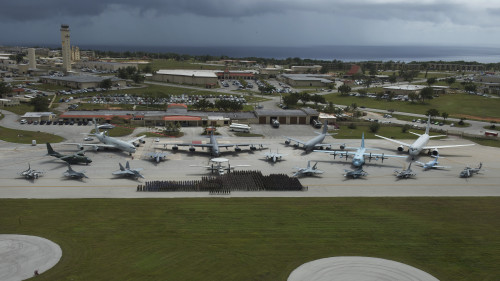
Exercise Cope North 16 participants pose for a group photo, Feb. 10, 2016, Andersen Air Force Base, Guam. Cope North 16 includes nearly 3,000 personnel from six countries and continues the growth of strong, interoperable, and beneficial relationships within the Indo-Asia-Pacific region through integration of airborne and land-based command and control assets. (U.S. Air Force photo by Staff Sgt. Matthew B. Fredericks/Released)
JOINT BASE PEARL HARBOR-HICKAM, Hawaii --  Story by Headquarters Pacific Air Forces Public Affairs
            
The U.S. and five ally and partner nations in the Indo-Asia-Pacific region are scheduled to participate in exercise Cope North 2016 at Andersen Air Force Base, Guam, Feb. 10 through 26.
 
 
Exercise CN16 is a long-standing exercise designed to enhance multilateral air operations between the U.S. Air Force, U.S. Navy, Japan Air Self-Defense Force and Royal Australian Air Force. As part of CN16, additional participants from the Philippines Air Force, Republic of Korea Air Force and Royal New Zealand Air Force will participate in humanitarian assistance and disaster relief training.
 
 
More than 930 U.S. Airmen and Sailors will train alongside approximately 490 JASDF, 375 RAAF, 5 PAF, 20 ROKAF and 35 RNZAF service members. Additionally, more than 100 aircraft, comprised of 23 flying units from the U.S. and Indo-Asia-Pacific region, will participate in CN16. 
 
 
The exercise will begin with a two-day table-top Humanitarian Assistance Disaster Relief exercise to enhance command and control prior to the week-long HA/DR training. This will be the first time a table-top HA/DR exercise has been completed prior to executing the training. During the second part of the exercise, the focus will shift to large-force employment training, fighter-versus-fighter air combat tactics training, and air-to-ground strike mission training over the Farallon de Medinilla range 160 nautical miles north of Guam.  The U.S. Air Force's 353rd Combat Training Squadron from Eielson Air Force Base, Alaska, will participate in the exercise and conduct multilateral survival training for the first time this year.
 
 
Additionally during CN16, Andersen AFB will open its doors to the general public to attend an open house featuring static displays and flyovers.
 
 
Beginning in 1978 as a quarterly bilateral exercise held at Misawa Air Base, Japan, Cope North was moved to Andersen AFB in 1999. Today, the annual exercise serves as a keystone event to promote stability and security throughout the Indo-Asia-Pacific region by enabling regional forces to hone vital readiness skills critical to maintaining regional stability.
 
U.S. Air Force, Japan Air Self-Defense Force and Royal Australian Air Force aircraft, fly in formation during a photo exercise at Cope North 15, Feb. 17, 2015, off the coast of Guam. Through training exercises such as Exercise Cope North 15, the U.S., Japan and Australia air forces develop combat capabilities, enhancing air superiority, electronic warfare, air interdiction, tactical airlift and aerial refueling. (U.S. Air Force photo by Tech. Sgt. Jason Robertson/Released)


Leap Frogs Preparing for Air Show Season


Members of the U.S. Navy Parachute Team, the Leap Frogs, perform a drag plane during a training demonstration at Skydive Arizona. The Leap Frogs are in Arizona preparing for the 2016 show season. U.S. Navy photo by Bruce Griffith (Released)
 
Have you gotten your 2016 Teak Air Show Guide yet? It is now available on Amazon at http://www.amazon.com/dp/B01AVLCGU4?ref_=pe_2427780_160035660 for US$3.99. That is 197 pages of the best information on monitoring the air show season that officially starts next month. Get yours today!


First simulated F-35A deployment conducted at Mountain Home AFB

Two F-35A Lightning IIs taxi after landing at Mountain Home Air Force Base, Idaho, Feb. 8, 2016. The F-35s, from Edwards AFB, Calif., will be part of an initial operating capability test at the nearby range complex. (U.S. Air Force photo/Tech. Sgt. Samuel Morse)

By Kenji Thuloweit, 412th Test Wing Public Affairs
 
EDWARDS AIR FORCE BASE, Calif. (AFNS) -- A much anticipated and important test mission for the F-35 Joint Strike Fighter Program is underway with the "deployment" of six operational test and evaluation F-35s and more than 85 Airmen from the 31st Test and Evaluation Squadron, who arrived Feb. 8-9.

This is the first simulated deployment test of the F-35A Lightning II, specifically to execute three key initial operational capability mission sets: suppression of enemy air defenses, close air support and air interdiction.

The 31st TES will execute each of these in a limited scope from a "deployed" location for this test. The deployed location is Mountain Home Air Force Base, Idaho. The 31st TES at Edwards AFB falls under the 53rd Wing at Eglin AFB, Florida, which is leading the test design, management and execution of the F-35A deployment test.

The achievements of an F-35A squadron testing ability to deploy, employ and sustain operations will set the benchmark capability for the Air Force to declare F-35A initial operational capability scheduled for this fall, according to the 53rd Wing.

During the test at Mountain Home AFB, the aircraft will be engaged in simulated combat scenarios to exercise representative mission processes such as tasking, execution, debrief and intelligence reporting. The test team will be working to capture a broad spectrum of capabilities and limitations of the F-35 system to include both operations and maintenance. The team will focus on areas such as mission planning, scheduling, weapons building/loading, sortie generation, life support, mission employment, debrief and aircraft turn.

Nellis AFB in Nevada will serve as a simulated remote air operations center for the deployed environment. Mountain Home AFB is providing a secure location with ranges to employ fourth-generation aircraft as well. The F-35As will integrate with F-15E Strike Eagles from the 366th Fighter Wing at Mountain Home AFB and A-10 Thunderbolt IIs from the 124th Fighter Wing at Gowen Field, Idaho.

The entire test event is expected to last about a month.

(Editor’s note: Information for this article was provided by the 53rd Wing at Eglin AFB) 


French and US Navy Conducting Bi-Lateral Exercise in Indian Ocean


French sailors assigned to the Aquitaine-class frigate Provence (D652) watch a live-fire gunnery exercise from the bridge wing of the Ticonderoga-class guided-missile cruiser USS Antietam (CG 54) during a bilateral exercise. Antietam, forward deployed to Yokosuka, Japan, is on patrol in the 7th Fleet area of operations in support of security and stability in the Indo-Asia-Pacific. U.S. Navy photo by Mass Communication Specialist 3rd Class David Flewellyn (Released) 160211-N-ZZ786-204

USS John C. Stennis CSG Participating in Great Green Fleet in WestPAC


Airman Tuan Hoang, from Cleveland, signals an MH-60S Sea Hawk assigned to the Chargers of Helicopter Sea Combat Squadron (HSC) 14 to take off from USS John C. Stennis' (CVN 74) flight deck. Providing a combat-ready force to protect collective maritime interests, Stennis is operating as part of the Great Green Fleet on a regularly scheduled Western Pacific deployment. U.S. Navy photo by Mass Communication Specialist Seaman Cole C. Pielop (Released)

US Navy Riverine Squadron Patrolling Gulf of Tadijoura

 
Sailors assigned to Coastal Riverine Squadron 10 conduct a patrol in the Gulf of Tadjoura, Djibouti. U.S. 6th Fleet, headquartered in Naples, Italy, conducts the full spectrum of joint and naval operations, often in concert with allied, joint, and interagency partners, in order to advance U.S. national interests and security and stability in Europe and Africa. U.S. Navy photo by Master-at-Arms 2nd Class Perry Lafoe (Released

USS Farragut Concludes Mobile Port Visit

By Ensign George Hinerman, USS Farragut Public Affairs
MOBILE, Ala. (NNS) -- Arleigh Burke-class guided-missile destroyer USS Farragut (DDG 99) completed a scheduled port visit in Mobile, Feb. 10.

The ship visited Mobile, the birthplace of Mardi Gras in the United States, as part of the Navy's Community Outreach Program.

Upon arrival, the ship received a warm welcome from various community leaders including U.S. Rep. Bradley Byrne of Alabama's 1st Congressional District, as well as Gina Gregory, president of the Mobile City Council representing District 7.

While in port, the crew conducted a community relations (COMREL) project at the Harmon Recreational Center and participated in numerous Mardi Gras parades and balls. Farragut also hosted a ship tour for the Davidson High School Navy Junior ROTC and Sea Cadets, as well as a breakfast for several distinguished guests including the city of Mobile Mayor Sandy Stimpson and retired Rear Adm. Rich Landolt.

"The Navy's ties to the city of Mobile continue to grow stronger," said Cmdr. Cory Applebee, Farragut's commanding officer. "With its rich history that includes Adm. Farragut himself and extends up to the production of the Navy's newest warships, it was a pleasure to meet some of the community's most influential leaders that truly appreciate our nation's brave men and women."

More than 15 Farragut Sailors volunteered their time to help paint designs on the walls of the Harmon Recreation Center as part of the COMREL project.

"The Harmon Recreation Center COMREL was a great success," said Chief Electrician's Mate Francisco Eraula. "Everybody had fun and enjoyed volunteering for the benefit of the kids of Mobile. We are standing by to help more communities in the future."

Farragut Sailors also had the opportunity to experience many of the Mardi Gras events, a first for many of them, while others took the opportunity to visit other local attractions including USS Alabama Battleship Memorial Park.

"Mobile has a rich, vibrant, and welcoming culture that was appreciated by the Farragut crew," said Lt. j.g. Richard Schroyer. "I would love to visit the area again with my family."

Several Sailors who are natives of Mobile also had an opportunity to visit with family members.

"I was able to visit many family members, attend and actually march in a Mardi Gras parade," said Information Systems Technician 3rd Class Johnathan Austin. "Hearing all of the applause from the crowd showed how much support the Navy has."

David Glasgow Farragut, the ship's namesake, was a flag officer of the United States Navy during the American Civil War. He was the first rear admiral, vice admiral, and admiral in the United States Navy. He is remembered for his order at the Battle of Mobile Bay, in which he was victorious, "Damn the torpedoes, full speed ahead."