Showing posts with label Andersen AFB. Show all posts

Friday, February 12, 2016

Exercise Cope North 2016

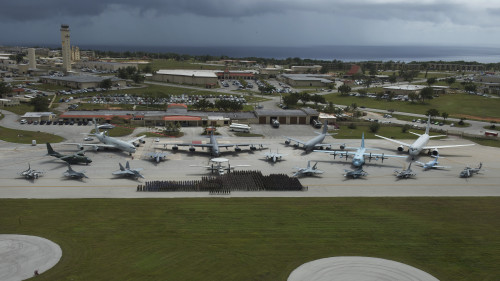
Exercise Cope North 16 participants pose for a group photo, Feb. 10, 2016, Andersen Air Force Base, Guam. Cope North 16 includes nearly 3,000 personnel from six countries and continues the growth of strong, interoperable, and beneficial relationships within the Indo-Asia-Pacific region through integration of airborne and land-based command and control assets. (U.S. Air Force photo by Staff Sgt. Matthew B. Fredericks/Released)
JOINT BASE PEARL HARBOR-HICKAM, Hawaii --  Story by Headquarters Pacific Air Forces Public Affairs
            
The U.S. and five ally and partner nations in the Indo-Asia-Pacific region are scheduled to participate in exercise Cope North 2016 at Andersen Air Force Base, Guam, Feb. 10 through 26.
 
 
Exercise CN16 is a long-standing exercise designed to enhance multilateral air operations between the U.S. Air Force, U.S. Navy, Japan Air Self-Defense Force and Royal Australian Air Force. As part of CN16, additional participants from the Philippines Air Force, Republic of Korea Air Force and Royal New Zealand Air Force will participate in humanitarian assistance and disaster relief training.
 
 
More than 930 U.S. Airmen and Sailors will train alongside approximately 490 JASDF, 375 RAAF, 5 PAF, 20 ROKAF and 35 RNZAF service members. Additionally, more than 100 aircraft, comprised of 23 flying units from the U.S. and Indo-Asia-Pacific region, will participate in CN16. 
 
 
The exercise will begin with a two-day table-top Humanitarian Assistance Disaster Relief exercise to enhance command and control prior to the week-long HA/DR training. This will be the first time a table-top HA/DR exercise has been completed prior to executing the training. During the second part of the exercise, the focus will shift to large-force employment training, fighter-versus-fighter air combat tactics training, and air-to-ground strike mission training over the Farallon de Medinilla range 160 nautical miles north of Guam.  The U.S. Air Force's 353rd Combat Training Squadron from Eielson Air Force Base, Alaska, will participate in the exercise and conduct multilateral survival training for the first time this year.
 
 
Additionally during CN16, Andersen AFB will open its doors to the general public to attend an open house featuring static displays and flyovers.
 
 
Beginning in 1978 as a quarterly bilateral exercise held at Misawa Air Base, Japan, Cope North was moved to Andersen AFB in 1999. Today, the annual exercise serves as a keystone event to promote stability and security throughout the Indo-Asia-Pacific region by enabling regional forces to hone vital readiness skills critical to maintaining regional stability.
 
U.S. Air Force, Japan Air Self-Defense Force and Royal Australian Air Force aircraft, fly in formation during a photo exercise at Cope North 15, Feb. 17, 2015, off the coast of Guam. Through training exercises such as Exercise Cope North 15, the U.S., Japan and Australia air forces develop combat capabilities, enhancing air superiority, electronic warfare, air interdiction, tactical airlift and aerial refueling. (U.S. Air Force photo by Tech. Sgt. Jason Robertson/Released)


Tuesday, November 26, 2013

U.S. Directly Challenges China's Air Defense Zone (Pair of American B-52 Bombers Fly Over)


WASHINGTON—A pair of American B-52 bombers flew over a disputed island chain in the East China Sea without informing Beijing, U.S. officials said Tuesday, in a direct challenge to China and its establishment of an expanded air-defense zone.

The planes flew out of Guam and entered the new Chinese Air Defense Identification Zone at about 7 p.m. Washington time Monday, according to a U.S. official.

The official said the flight was a training mission and the bombers were not armed. The flight was first reported by The Wall Street Journal on Tuesday.

The Chinese announced over the weekend they were expanding their air defense identification zone to include the islands, known as Diaoyu in Chinese and Senkaku in Japanese. Japan also claims ownership.

For more on background see my original story at China creates air defense zone over Japan-controlled islands in East China Sea.

Wednesday, August 28, 2013

Continuous bomber presence exemplifies Global Vigilance, Global Reach, Global Power

Airmen from the 2nd Aircraft Maintenance Squadron prepare to launch a B-52H Stratofotress on Barksdale Air Force Base, La., Aug. 26, 2013. Aircrew and their crew chiefs deployed to Anderson AFB, Guam, to support the continuous bomber presence in the Pacific. The crew chiefs deployed to provide maintenance support for the B-52. (U.S. Air Force photo/Senior Airman Micaiah Anthony)

by Staff Sgt. Katherine Holt,  2nd Bomb Wing Public Affairs
BARKSDALE AIR FORCE BASE, La.  -- Barksdale aviators, maintainers and B-52H Stratofortress aircraft deployed to Andersen AFB, Guam, this week to demonstrate the United States' continued commitment to stability and security in the Asia-Pacific region.

Air Force Global Strike Command's deployment of bombers to Andersen AFB not only showcases the command's ability to conduct its mission, but also exemplifies commitment to providing global vigilance, reach and power.

"Our main mission is to deter and assure," said Capt. Michael Lopez, 20th Bomb Squadron pilot. "We are there to provide support to our allies in the region and to provide combat capability, if needed, for the Pacific Air Forces and Pacific Command."

Movement of U.S. Air Force bombers into the Western Pacific has been ongoing since March 2004, as the U.S. Pacific Command regularly adjusts its force posture to maintain a prudent deterrent capability within the region.

"As we know, the United States has done a strategic pivot toward the Pacific," said Lt. Col. Scott Maytan, 20th BS commander. "Strategic continuous bomber presence is part of that. It is a way for B-52s to augment military forces that we have in the theater."

The continuous bomber presence showcases the 2nd Bomb Wing's ability to operate aircraft within the Pacific and support exercises, operations, and contingencies as required.

"We own 50 percent of the responsibility for this, it is shared across the B-52 community, so that's a big piece for the 2nd BW to support," Maytan said. "It's a full spectrum effort--we've got aircrew, airplanes, maintenance support and other operations support personnel that go out to make sure we are able to do the mission just like we would do it with the resources we have here at home."

The Air Force's nuclear and conventional precision strike forces can credibly threaten and effectively conduct global strike by holding any target at risk and if necessary, disabling or destroying it promptly--the key to Global Vigilance, Global Reach and Global Power.

"What we do day to day with this presence mission is show our ability to fly our airplanes around the Pacific theater and support whatever contingencies we might be asked to do," Maytan said. "The continuous bomber presence maintains long-range strike capability in theater, so our national decision makers have assets that they can use should they ever need to."

CBP also allows bombers the opportunity to integrate into joint and coalition training exercises in the Pacific.

"We are going to go out there and continuously sharpen our skills," Lopez said. "We will have local training missions to continue training on all of our different combat capabilities. In addition, we will also be out there working with our partners training with them in different exercises throughout the region."

Aircrews also plan to take advantage of being in close proximity to other U.S. services, along with the opportunity to work on aviation and combat concepts.

"It is a great opportunity for us when we go out there and work with all different players in the region," Lopez said. "Going out there we get to integrate with them to assure the Pacific."

Though they have been to Guam numerous times, Lopez says every time is a little different than the last, and they never lose the enthusiasm.

"We are excited to go out there to provide this force capability from here...to the Pacific," he said. "We are there to provide the security that is needed; and if called upon, use the firepower we provide to the nation."
A B-52H Stratofortress takes off from Barksdale Air Force Base, La., Aug. 26, 2013. Barksdale aviators, maintainers and B-52s deployed to Anderson AFB, Guam, demonstrating continuing U.S. commitment to stability and secuirty in the Asia-Pacific region. (U.S. Air Force photo/Senior Airman Micaiah Anthony)

Friday, August 23, 2013

Stratotanker, Stratofortress tandem continue half a century of Asia-Pacific partnership


by Airman 1st Class Marianique Santos,  36th Wing Public Affairs
ANDERSEN AIR FORCE BASE, Guam -- America's involvement in the Vietnam War continued to escalate in 1965, and on June 18, 27 B-52 Stratofortresses broke the threshold of Guam's airspace toward the open skies of the Pacific to conduct the first Arc Light mission. At the same time, 27 KC-135 Stratotankers departed Japan to rendezvous with the bombers in the Philippines to refuel them for a 4,500 nautical mile round trip.

Ever since its first sortie, the KC-135 has played an important role in extending the reach of the B-52's airpower and lengthening the duration of its hovering capabilities -- capabilities that are crucial to a region surrounded by water.

"The relationship between the KC-135 and B-52 is one that has grown over the years and is now ideally suited to the Pacific Air Forces area of responsibility," said Lt. Col. Harry Dyson, 36th Operation Support Squadron commander.

"Andersen is one of the critical bases here in the Pacific because it's close enough to all our allies and our adversaries, while still being outside of immediate threat range," he continued. "The distances involved in the PACAF region are so great, and the ability to employ from Andersen is achievable because of the KC-135s and B-52s that rotate here regularly."

A B-52 Stratofortress and a KC-97 Stratotanker take a slow dive during an aerial refueling in the 1950s. The B-52 had to slow down, drop its flaps and tires in order for the KC-97 to keep up with its speed and altitude. (Courtesy photo)
The B-52 started flying in 1952, while the first KC-135 was first delivered to the Air Force in 1957. Though the tanker was a little behind on the delivery, it was built to cater to the in-flight capabilities of the B-52's speed and operational altitude. Prior to the delivery of the KC-135s, The Air Force relied on the KC-97 Stratotanker for in-flight refueling, which was less than ideal for the Stratofortress' speed and operational high operational altitude.

As the U.S. Air Force started using the KC-135 more and more, the B-52 and KC-135 tandem was pivotal in historical combat operations stretching from the War in Vietnam to present day conflicts in Iraq and Afghanistan.

According to an article written by U.S. Air Force (Ret.) Col. Walter Boyne, a combat veteran, aviation historian and author, during Arc Light, KC-135s were used to keep the bombers in the air during missions that lasted for 12 hour or longer. Though some tankers stayed in the Philippines to be on stand-by for tactical aircraft during the span of Linebacker and Linebacker II, one tanker was always assigned to one bomber during inbound portions.

"That was pretty much the case for every mission," Meyer said. "Even when they started making the G and the H models for the Stratofortress, which actually fly a little bit further, the KC-135s were still important to accomplishing the bomber missions."

By 1972, there were 195 KC-135s stationed in the Asia-Pacific region to support the 155 B-52s on Andersen's ramp and other combat aircraft spread all throughout the region.

After the Vietnam War, the tandem also conducted missions that forwarded or launched from the Pacific. Meyers said that multiple operations required aerial refueling capabilities in order to get the B-52s to their destination and back.

A B-52 Stratofortress tries to connect to a KC-135 Stratotanker in order to execute aerial refueling over the Pacific Ocean, Aug. 10, 2012. The B-52 and KC-135 tandem has been used in pivotal wars, including historical combat operations during the War in Vietnam to present day conflicts in Iraq and Afghanistan. (U.S. Air Force photo by Airman 1st Class Marianique Santos/Released)
The duo was always ready on Andersen  when it was a Strategic Air Command base during the Cold War and continued to be used in the Middle East during operations Desert Shield and Desert Storm.

"During Operation Desert Shield in 1991, the bombers utilized Andersen as a forward base to get to an expeditionary location where they launched for attack," he continued. "Two B-52s launched from here in 1996 for Operation Desert Strike and conducted a 33-hour to drop conventional bombs in Iraq as a warning."

Today, the partnership lives on with the 506th Expeditionary Air Refueling Squadron and the expeditionary B-52 bomb squadrons that rotate in and out of Andersen Air Force Base, Guam, to support U.S. Pacific Command's Continuous Bomber Presence and continue a partnership that has proven itself through history.
 

Saturday, August 25, 2012

B-52s bring persistent airpower to Exercise Pitch Black 12

by Airman 1st Class Marianique Santos, 36th Wing Public Affairs

ANDERSEN AIR FORCE BASE, Guam (AFNS) -- The 69th Expeditionary Bomb Squadron, Minot Air Force Base, N.D., took to the skies of Australia's Northern Territory Aug. 2 to 18 as the lone U.S. Air Force unit flying in Exercise Pitch Black 12.

With more than 2,200 personnel and up to 100 participating military aircraft, Exercise Pitch Black 12 is the Royal Australian Air Force's largest and most complex air exercise.

From July 27 to Aug. 17, the U.S. Marine Corps, U.S. Air Force, Australian Defense Force, Royal Thai Armed Forces, Singapore Armed Forces, New Zealand Defense Force, Malaysian Armed Forces, French Armed Forces, British Armed Forces, Indonesian National Armed Forces and a component operating under the North Atlantic Treaty Organization participated in the exercise.

The 69th EBSs' participation in Pitch Black 12 is critical to satisfying their mission objectives in support of Pacific Air Forces' continuous bomber presence.

As part of the mission, bombers participate in exercises while deployed in order to showcase both U.S. offensive and defensive capabilities, engage with the citizens of regional partners and ultimately contribute toward interoperability with other countries.

"In traversing the Pacific Ocean for large-scale exercises such as Rim of the Pacific and Pitch Black 12, our crews hone their skills, as well as assure our allies of the United States' commitment to the region," said Capt. Timothy May, 69th EBS weapons and tactics flight commander and bomber liaison officer representing the squadron for planning and briefings in Australia for Pitch Black 12.

"It shows that the United States maintains a credible strike capability in the region at all times," he said.

For more than 20 years, the RAAF has conducted the biennial Pitch Black Exercises as major training activities, providing participating nations the opportunity to obtain useful military training and the chance to strengthen ties with regional partners.

Captain May said that integrating into Pacific Command joint and coalition exercises, operations and training provided aircrews unique training opportunities in support of the continuous bomber presence..

"This exercise afforded my colleagues and I a tremendous opportunity to learn and expand our skills as aviators," said Captain May. "Communicating and planning with our Pacific allies provided a unique learning opportunity that bolsters cultural and professional relationships among regional partners."

During the exercise, the B-52 displayed unique capabilities that make it a commodity in such large-scale air exercises. Along with its ordnance capacity, the B-52 brings a long-endurance capability, which translates directly to persistent airpower.

"The B-52 brings a volume of ordnance that smaller, tactical assets cannot match," said Captain May. "In multiple cases during the exercise, a single B-52 covered nearly 50 percent of its team's targets in given scenarios."

The exercise required participants to conduct offensive counter air and defensive counter air missions launched from RAAF Bases Darwin and Tindal.

Pitch Black 12 utilized massive training areas that featured realistic threat simulations and targets. These training areas accommodated larger aircraft formations and provided a formidable obstacle course for the aircraft and crews of participating nations.

"During the exercise we integrated into flying formations with the other nations," said Maj. Christopher Morris, 69th EBS mission planning cell team chief. "On a training day, we can have Indonesian or Taiwanese aircraft escort us to the target and protect us from the opposing targets. Such formations promote good integration with our regional partners' air forces."

Captain May said that the exercise gave participants opportunities to practice operating in high threat environments against very capable adversaries.

"With six nations participating we receive different perspectives from regional air forces, from mission planning to execution to debrief," said Captain May. "The collective efforts of all six nations bring an impressive array of aircraft and skills to the fight."

The 69th EBS participation in Pitch Black 12 is only one among multiple exercises where in the B-52 has represented the U.S. Air Force and its air-strike capability.

"We are grateful for the opportunity to integrate with our allies through participation in Pitch Black 12," said Lt. Col. Doug Gosney, 69th EBS commander. "Our B-52 bomber force and aircrew maintain a high level of readiness across all mission sets. Participation in these types of exercises allow us to hone our skills even further while simultaneously forging and strengthening relationships with our friends and allies."

Along with experiences gained and reinforced international ties, the 69th EBS continues to support the CBP mission and take part in exercises that develop greater interoperability, strengthen regional peace, and promote stability and prosperity within the Asia-Pacific Region.

"I am extremely proud of our bombers and crew force for their accomplishments and participation in regional activities in the Pacific," said Gosney. "Their service and dedication bring unique capabilities to these coalition and joint exercises as part of the continuous bomber presence mission and is a testament to the fact that the Air Force stands ready for the call and can successfully accomplish all assigned missions."

Tuesday, August 07, 2012

B-52s provide RIMPAC 2012 air capability

by 2nd Lt. Sarah Bergstein, 36th Wing Public Affairs

ANDERSEN AIR FORCE BASE, Guam (AFNS) -- Members from the 69th Expeditionary Bomb Squadron, Minot Air Force Base, N.D., participated in nine sorties in support of this year's Rim of the Pacific exercise July 11 to 31 in and around training areas surrounding the Hawaiian islands.

Six B-52s from the 69th EBS, accompanied by more than 200 Airmen, are currently deployed to Andersen AFB, Guam, in support of U.S. Pacific Command's Continuous Bomber Presence to maintain security and stability in the Western Pacific.

"RIMPAC reminds us how vital it is to train with our fellow U.S. forces as well as our international partners around the globe, enabling us to work together and respond effectively if needed," said Col. Randy Kaufman, 36th Operations Group commander. "The 69th EBS' participation in RIMPAC, not only shows their ability to support PACOM's CBP, but also the global readiness they bring to the fight."

RIMPAC is a biennial multinational maritime exercise held by commander, U.S. Pacific Fleet. Beginning in 1971 and now in its 23rd year, RIMPAC boasts 22 participating nations, 42 surface ships, six submarines, more than 200 aircraft and more than 25,000 personnel.

Scheduled from June 27 to Aug. 9, the theme of RIMPAC 2012 is, "Capable, Adaptive, Partners."

"Our participation in a multi-national exercise like RIMPAC affords us the opportunity to improve interoperability and strengthen relationship with our regional partners," said Lt. Col. Doug Gosney, 69th EBS commander. "Additionally, our aircrews get first-rate training and gain invaluable experience by operating in this dynamic, joint coalition environment. RIMPAC provided an unmatched training opportunity for my aviators."

The B-52 Stratofortress is a long-range heavy bomber that can perform a variety of missions. The primary objective of bomber participation in this year's RIMPAC exercise was to enhance crew proficiency and promote international military cooperation.

"These long-duration sorties helped simulate our real-world taskings," said Gosney. "Employing with other Air Force assets, our sister services and the nations of the Pacific theater afforded us a unique training opportunity."

Averaging 20 to 22-hour sorties, each with two air refuelings, the 69th EBS flew over 180 hours from Guam to the Hawaiian airspace and back.

"We started with a crawl, walk, run mentality," said Maj. Christopher Morris, 69th EBS mission planning cell team chief. "At first, our participation focused at the unit level and then moved into force-integration training where we worked with other players. In the final phase of RIMPAC, we integrated B-52s into a robust regional combat scenario."

In the first phase of unit level training, targets are generally pre-planned and aircrews know exactly what to look for. In the force-integration phase and the final combat scenario, targets are unknown, meaning aircrews not only have to locate their targets, but also determine how to strike and with what weapons to strike.

"This demonstrates the flexibility of the B-52 and our aircrews," said Morris. "Our joint-service commanders know they can count on the B-52 to deliver bombs on target 24 hours a day, seven days a week, 365 days a year--worldwide--and in this case, from more than 3,000 miles away."

The 69th EBS' first two sorties for this year's RIMPAC, July 11 and 13, supported a high-priority MINEX, a low-level mine-laying exercise designed to train the Navy's counter-mine specialists.

"We're working with Navy fleet to train in aerial interdiction of maritime targets," said Morris. "This includes gathering intelligence, honing our skills in low-level flying, providing close air support and simulating strikes when targets are found."

Exercises in the region are ideal forums to showcase U.S. defense aircraft and equipment, work hand-in-hand with regional partners and contribute toward interoperability with other countries.

Movement of U.S. Air Force bombers into the Western Pacific has been ongoing since March 2004, as the U.S. Pacific Command adjusts its force posture to maintain a prudent deterrent capability.

Rotational bomber deployments to Guam help maintain stability and security in the Western Pacific, while allowing units to become familiar with operating in the Pacific Theater.

"As a Navy-centric exercise, we're thrilled about the air capabilities that our B-52s were able to provide in support of RIMPAC," said Kaufman. "There's something to be said about U.S. Air Force B-52s flying with Marine Corps F-18s alongside Royal Canadian Air Force CF-18s and P-3s as well as Japanese F-2s and F-15Js."

As the world's largest international maritime exercise, RIMPAC is a unique training opportunity that helps participants foster and sustain the cooperative relationships that are critical to ensuring the safety of sea lanes and security on the world's oceans.

Other U.S. Air Force aircraft participating in RIMPAC 2012 include: KC-130 Hercules, C-17 Globemaster IIIs, KC-135 Stratofortresses, E-3 Sentries, A-10 Thunderbolt IIIs, F-15 Eagles, F-16 Fighting Falcons and HH-60G Pave Hawks.

"RIMPAC is a testament to the mutual understanding and respect we gain from exercising with regional partners, all working together on a number of different and potential operations and missions," said Kaufman. "We look forward to participating again in 2014 and bringing an enhanced portfolio of new capabilities."

Wednesday, February 15, 2012

Cope North 2012 combines forces, efforts

by Senior Airman Veronica McMahon, 36th Wing Public Affairs

ANDERSEN AIR FORCE BASE, Guam (AFNS) -- Joint operations kicked off between the U.S. Air Force, the Japan Air Self Defense Force and the Royal Australian Air Force as the first day of exercise Cope North 2012 began here Feb. 13.

Whether it was the JASDF's F-2s flying alongside the RAAF's F-18s, or RAAF troops joining 36th Contingency Response Group Airmen in building a tent city, the three services worked together to ensure a successful start to the next two weeks.

Throughout the exercise, participating forces will demonstrate their ability to effectively deploy and train together. Participants will also have the opportunity to improve their ability to employ both tactical air power in the skies, and humanitarian and disaster relief efforts on the ground.

During the aerial portion, F-2s, F-15s, F-16s, F-18s and B-52s were among the first aircraft to take to the skies during morning operations on day one of training.

While sorties multiplied in the skies, troops on the ground began training for humanitarian and disaster relief efforts at Andersen's Northwest Field. The RAAF worked with Andersen Airmen to conduct a heavy equipment drop and also combined forces to set up a tent city, where they will spend five days simulating possible conditions during real-world relief efforts.

The day's events culminated in a field training exercise. The field training portion focused on coordination and evaluation between RAAF and U.S. Air Force personnel. Throughout the simulation, different roles are played out, such as security, emergency response, medical and evaluation.

"The reason why we are here is because we all need each other," said U.S. Air Force Lt. Col. Joseph Mull, the 36th CRG deputy commander. "The camaraderie we have developed with the Australians is awesome."

The exercise has also provided an opportunity to cultivate common bonds and foster goodwill between the multinational partners.

"We are part of the group providing security for the Cope North exercise with our Australian counterparts," said U.S. Air Force Senior Airman Clint Seal, of the 736th Security Forces Squadron. "It's pretty neat to work with a foreign military. Because we work in the same theater, we might cross each other's path again."

The U.S. military is always seeking opportunities to strengthen its relationship with other nations through activities such as subject matter expert exchanges, host nation visits, trilateral engagements, exercises and operations such as those experienced during Cope North, officials said.

"It's good to work together and see what each nation brings to the actual mission, especially in this area where humanitarian assistance and disaster relief is very important," said RAAF Wing Commander Lee de Winton, the 381st Expeditionary Combat Support Squadron commanding officer.

"It's been great to meet our sister squadron," de Winton continued. "All of this is built on relationships that will endure throughout what we do in this region."

Saturday, February 11, 2012

Cope North kicks off at Andersen AB

by Airman 1st Class Whitney Tucker, 36th Wing Public Affairs

ANDERSEN AIR FORCE BASE, Guam (AFNS) -- More than 1,000 military members from units spanning the Pacific are ready to kick off exercise Cope North 2012, which runs from Feb. 11 through 24.

The trilateral, multinational exercise is designed to enhance air operations between the U.S. Air Force, the Japan Air Self Defense Force and the Royal Australian Air Force.

"The relationships built and sustained with our multinational partners in the Asia-Pacific region through exercises, civil-military operations and military exchanges help tremendously in preserving peace and stability in the region, including humanitarian efforts and disaster response," said Maj. John Greven, assigned to the 13th Air Force's Detachment 1 at Yokota Air Base, Japan.

During Cope North, participating forces will demonstrate the ability to effectively deploy forces and train together to improve aircrew abilities to employ tactical air power as a multinational force, exercise officials said. Andersen AFB has hosted Cope North for 10 years as a bilateral training event between the JASDF and U.S. Air Force. This year's exercise marks the first time the RAAF will participate, further demonstrating the regional allies' resolve to promote security and cooperation in this area of responsibility.

The field training exercise focuses on coordination and evaluation of air tactics, techniques and procedures between the three nations.

"Humanitarian assistance and disaster relief exercises, dissimilar air combat training, and strike mission training will be conducted during the first week of the exercise," said Maj Greven, the lead planner for this year's Cope North. "Large force employment training will be the focus of the second week. Additionally, JASDF and USAF will conduct live surface attack tactics training on the Farrallon de Medinilla range in the Commonwealth of the Northern Marianas Islands."

For only the fourth time in Cope North history, dedicated opposing forces will be integrated in the exercise for training purposes.

"The aggressor aircraft will primarily be played by F-16 Fighting Falcons out of the 18th Aggressor Squadron from Eielson AFB, Alaska," Greven said. "The B-52 Stratofortresses out of the 23rd Bomb Squadron from Minot AFB will be one of the units that will participate as both blue air, or friendly forces, as well as being tasked to simulate opposing forces during some days of the exercise. "

The U.S. military is always seeking opportunities to strengthen its relationship with other partner nations through activities such as subject-matter expert exchanges, host-nation visits, bilateral engagements, and multinational exercises and operations, such as those experienced at Cope North, officials said.

"As I experienced firsthand during Operation Tomodachi, there is tremendous value added in working and exercising side-by-side with our allies," Greven said. "When real-world events occur, these training events improve our capability to operate in a multinational environment and respond effectively and efficiently. We also send an unequivocal message that our nations are committed to continued peace and stability in the Pacific theater."

Thursday, September 15, 2011

Continuous bomber presence restructuring saves DOD $12 million

by Megan Meyer, Air Force Global Strike Command Public Affairs

BARKSDALE AIR FORCE BASE, La. (AFNS) -- Air Force Global Strike Command and Pacific Air Forces officials teamed up recently to restructure logistics support and aircraft rotations for the continuous bomber presence in the Pacific.

The restructuring is estimated to save the Defense Department more than $12 million annually.

"The continuous bomber presence in the Pacific is vital in assuring our regional allies," said Lt. Gen. James M. Kowalski, the commander of Air Force Global Strike Command. "It is important we support U.S. Pacific Command in this critical mission."

The first of these logistics changes involved the B-52 Stratofortress mobility readiness spares package kits -- eight semi-trucks worth of critical parts for day-to-day flying. These kits will now be left in place in Guam between deployments, rather than sending each kit home with its owning squadron, officials said.

One independent MRSP kit is assigned to each AFGSC combat B-52 squadron here and at Minot Air Force Base, N.D., said Chief Master Sgt. Jeffrey Buxton, the weapons system team superintendent for AFGSC Logistics, Installations and Mission Support. Kits previously remained with their assigned squadron, whether that squadron was deployed or stateside in the continental U.S., he said.

By avoiding sea or air transport for the MRSP package to Guam and funding the ride for the kit from Barksdale AFB to Minot AFB and back by land instead, a $12 million cost is avoided per year, officials said. Minot AFB and Barksdale AFB squadrons rotate in and out of Guam every six months on average.

In addition to the cost avoidance associated with transportation, PACAF funded additional standardization of the MRSP kits between the two CONUS bases. Minot AFB's MRSP kits have traditionally been housed in internal aircraft slingable container units, while Barksdale AFB kits were not. PACAF's funding of these containers avoided an additional cost of $90,000 to AFGSC and further standardized MRSP kits between stateside squadrons, officials said.

Saturday, December 04, 2010

Bomb squadrons rotate at Andersen AFB

by Airman 1st Class Anthony Jennings, 36th Wing Public Affairs

ANDERSEN AIR FORCE BASE, Guam (AFNS) -- More than 200 Airmen and two B-52H Stratofortress aircraft arrived here recently to replace the 23rd Expeditionary Bomb Squadron.

The Airman are assigned to the 69th Bomb Squadron from Minot Air Force Base, N.D., and are supporting U.S. Pacific Command's continuous bomber presence.

"Our number one priority is to support theater objectives and maintain peace and stability in the region," said Lt. Col. Michael Cardoza, the 69th EBS commander. "After that, we are looking forward to honing our combat skills in a variety of conventional mission sets.

"We have spent the last year primarily focused on perfecting our nuclear mission. Now we are able to shift our focus somewhat and are very motivated to support the Andersen AFB CBP mission," he said. "This deployment will give us a lot of outstanding training opportunities throughout the Pacific area of responsibility."

The swap out is historic for several reasons.

The 69th and 23rd EBS are units from the 5th Bomb Wing at Minot AFB, and the swap out marks the first time the wing will have two units on back-to-back deployments in support of the CBP in Guam, officials said. The 69th EBS, which was recently reactivated at Minot AFB Sept. 4, 2009, will be on its first deployment back here since the Vietnam War.

"It is a great milestone in a year full of milestones for the newest B-52 squadron," Colonel Cardoza said. "Deploying to Andersen and supporting the CPB mission allows us to show our allies and enemies that (69th EBS members) are open for business and ready to execute the mission worldwide."

The 23rd EBS is scheduled to depart Andersen AFB later this month after its nearly six month deployment here.

"Being able to replace our fellow Minot (AFB) squadron has been a huge advantage," Colonel Cardoza said. "The 23rd EBS continuously fed us lessons learned throughout their deployment and built a very strong foundation for us to work from. It also allowed us to swap personnel without having to move large amounts of equipment and airplanes."

During their deployment here, the 23rd EBS members had the opportunity to get unique training they couldn't get anywhere else, officials said.

Logging more than 1,400 hours of flight time, dropping more than 700 bombs and performing 200 sorties, both aircrew members and maintainers had to be on their toes to meet their flight schedule.

"This deployment has been so dynamic," said 1st Lt. Corrine Hester, a 69th EBS dual-seat navigator. "From working with multinational and joint forces, to sinking a boat in the middle of the ocean, this has been the best training we could get for what we do. It's been a great time and we will be back, but for now, it's time to go home and give our brothers and sisters a chance to take advantage of what a deployment here has to offer."

Friday, June 04, 2010

B-52s head to Guam for continuous bomber presence rotation

by Senior Airman Benjamin Stratton, 5th Bomb Wing Public Affairs

MINOT AIR FORCE BASE, N.D. (AFNS) -- Six B-52H Stratofortresses and nearly 350 Airmen here left June 1 for Andersen Air Force Base, Guam, to start a six-month deployment.

The 5th Bomb Wing's role in U.S. Pacific Command's continuous bomber presence mission "is vital to national security," said Col. Charles Patnaude, the 5th Operations Group commander. "Our mission is to deter and assure."

Colonel Patnaude said Minot's Airmen will be there to deter and dissuade potential regional aggressors and to assure U.S. allies of the commitment to the Pacific region.

"This is a great mission for Minot's B-52s because it enables us to demonstrate our broad range of capabilities," he said.

The 5th BW's two B-52 squadrons, the 23rd and 69th Bomb Squadrons, will share the six-month deployment. The 23rd BS will serve the first half of the deployment.

The mission to the island had Airmen's spirits high and eager to get underway.

"I know many of them are excited about this deployment," Colonel Patnaude said. "The training environment is fantastic and basing out of Andersen (AFB) will offer up great opportunities. Our personnel will get to interact with folks from other weapon systems and other services."

Colonel Patnaude said PACOM's continuous bomber presence mission has been ongoing since March 2004 when 5th BW officials first established the operation.

"B-52s, B-1 (Lancers) and B-2 (Spirits) have each taken turns as a continuous sentinel for the Pacific theater," he added. "The 5th BW has been to Guam several times since 2004 and I suspect will continue deploying there until Pacific Command no longer needs us."

PACOM officials said they routinely evaluate the command's readiness and reposition forces as needed to ensure they maintain both the operational and support capabilities necessary to meet the obligations of national defense.

Officials added the bombers serve in a continuous role that is not tied to any specific events in the Pacific.

Maybe the mission of this deployment is significant to send a message to a rogue neighbor in the Pacific neigborhood - North Korea - LVH.

Thursday, March 04, 2010

B-2s arrive at Andersen

A B-2 Spirit from Whiteman Air Force Base, Mo., gets airborne while another B-2 waits for clearance March 4, 2010, at Andersen Air Force Base, Guam. More than 270 Airmen and four B-2 Spirits are deployed to Andersen AFB supporting the Pacific regions continuous bomber presence. (U.S. Air Force photo/Master Sgt. Kevin J. Gruenwald)

ANDERSEN AIR FORCE BASE, Guam (AFNS) -- More than 240 Airmen from Whiteman Air Force Base, Mo., arrived here in late February to support the deployment of B-2 Spirits as part of the continuous bomber presence here.

The Airmen and aircraft replaced the servicemembers and the B-52 Stratofortresses deployed here from Barksdale AFB, La.

Andersen AFB has had bombers present on its runway since 2004, the year the continuous bomber presence mission began.

The B-2's stealth characteristics give it the unique ability to penetrate an enemy's most sophisticated defenses and threaten its most valued and heavily defended targets. The bomber's capability to penetrate air defenses and threaten effective retaliation provides a strong effective deterrent and combat force well into the 21st century.

The B-2s join forces with F-22 Raptors deployed from the 90th Fighter Squadron, Elmendorf AFB, Alaska, as part of the theater security package. The tandem of premier airframes creates a formidable alliance supporting Andersen AFB's mission within the Pacific region. This is the second pairing of these airframes for this mission.

Wednesday, February 10, 2010

Aircraft arrive at Andersen for Cope North 10-1 kickoff

A Japan Air Self Defense Force F-2 fighter lands in order to participate in the two-week Cope North exercise Feb. 5, 2010, at Andersen Air Force Base, Guam. The Japanese F-2 single-engine fighter has performance capabilities roughly comparable to those of the F-16 Fighting Falcon. (U.S. Air Force photo/Airman 1st Class Julian North)

by Senior Airman Shane Dunaway, 36th Wing Public Affairs

ANDERSEN AIR FORCE BASE, Guam (AFNS) -- Twenty-one aircraft from more than a six military units throughout the Pacific region arrived here for Cope North 10-1, a two-week annual bilateral exercise between U.S. forces and the Japan Air Self Defense Force that began Feb. 7.

This is the 11th time Cope North has been held here. U.S. and Japan officials have been conducting Cope North exercises since 1978.

About 24 aircraft will be working with two B-52 Stratofortresses, currently deployed here supporting the continuous bomber presence mission.

"Conducting joint bilateral flying operations allows us to practice all facets of mission planning and execution," said Maj. Marcelo Morales, a member of the Cope North 10-1 staff. "We are able to train to each service's strength and to discover and overcome any shortfalls. Our maintainers, operators, and support personnel are able to interact face-to-face so that we can enhance our interoperability and learn from our bilateral partners."

Cope North is designed to strengthen military relationships between the two countries as well as enhance U.S. and Japanese air operations in defense of Japan.

"Exercises such as Cope North demonstrate our firm resolve to the U.S. - Japan alliance and send an unequivocal message that both nations are committed to continued peace and stability in the region," Major Morales said.

Four Japan Air Self Defense Force F-2s prepare to land to participate in the two-week Cope North exercise Feb. 5, 2010, at Andersen Air Force Base, Guam. The Japanese F-2 single-engine fighter has performance capabilities roughly comparable to those of the F-16 Fighting Falcon. (U.S. Air Force photo/Airman 1st Class Julian North)

Thursday, December 31, 2009

Raptors to deploy to Guam

Fifteen F-22 Raptors from the 90th Fighter Squadron at Elmendorf Air Force Base, Alaska, are slated to deploy to Andersen AFB, Guam, in January. The deployment supports U.S. Pacific Command's theater security packages in the Western Pacific. (U.S. Air Force photo/Senior Airman Cynthia Spalding)

HICKAM AIR FORCE BASE, Hawaii (AFNS) -- Fifteen F-22 Raptors are scheduled to deploy to Andersen Air Force Base, Guam, in January 2010 for approximately three months.

The fighters and associated personnel will deploy from the 90th Fighter Squadron at Elmendorf AFB, Alaska.

The deployment supports U.S. Pacific Command's theater security packages in the Western Pacific and follows the recent departure from the theater of two deployed squadrons of F-22s that also were supporting U.S. PACOM's TSP. The fighters and personnel deployed to Andersen AFB, Guam, and Kadena Air Base, Japan, completed their redeployment in October 2009.

The F-22 is a transformational combat aircraft that can avoid enemy detection, cruises at supersonic speeds, is highly maneuverable, and provides the joint force an unprecedented level of integrated situational awareness.

As part of continuing force posture adjustments to address worldwide requirements, U.S. officials continue to deploy additional forces throughout the Western Pacific. This is the latest example of the flexibility U.S. forces have to meet their ongoing commitments and security obligations throughout the Pacific region.

Friday, July 18, 2008

Raptors set to deploy to Guam

F-22 Raptors from the 90th Fighter Squadron at Elmendorf Air Force Base, Alaska, will be deploying to Andersen AFB, Guam, July 18 - Aug. 2 to participate in Exercise Jungle Shield and to conduct additional training. (U.S. Air Force photo/Tech. Sgt. Mikal Canfield)

Six F-22 Raptors from the 90th Fighter Squadron at Elmendorf Air Force Base, Alaska, are set to deploy to Andersen AFB, Guam, July 18 to Aug. 2.

The F-22s, along with associated maintenance and support personnel, will deploy to Guam to participate in the Jungle Shield exercise and conduct Cope Thaw training.

Jungle Shield will exercise 13th Air Force's air defense mission in Guam and validate the area air defense commander's ability to command and control such missions from the 613th Air and Space Operations Center here.

Following the exercise, the F-22 personnel will take part in Cope Thaw, one in a series of regularly occurring training events in which aircraft and personnel have an opportunity to conduct training in environments different from those at their home station.

This is the first deployment of Pacific Air Forces-assigned F-22s. It also marks the second deployment of the F-22 to the Pacific theater. In February 2007, F-22s and personnel from the 27th FS at Langley AFB, Va., deployed to Kadena Air Base, Japan.

F-15E Strike Eagles and B-52 Stratofortresses and their aircrews already deployed to Andersen also will participate in Jungle Shield. Other participants include 13th AF and 613th AOC personnel here and 36th Wing personnel assigned to Andersen.

The United States routinely evaluates readiness and repositions forces as needed to ensure capabilities necessary to meet obligations in the Asia-Pacific region. These deployments demonstrate the continued U.S. commitment to fulfill security responsibilities throughout the Western Pacific and to maintain peace in the region.

Thursday, December 27, 2007

B-2 mission shows bomber flexibility

by Tech. Sgt. Steven Wilson, 36th Operations Group Public Affairs


ANDERSEN AIR FORCE BASE, Guam (AFPN) -- Members of the 393rd Expeditionary Bomb Squadron deployed here with B-2 Spirits from Whiteman Air Force Base, Mo., took off on a two-ship exercise destined to Alaska Dec. 18 when one bomber was diverted to a global power sortie.

Global power missions, which are more than 20 hours long, demonstrate the global strike capability of America's bomber force.

"The jets were launched with flight plans and mission materials for Alaska," said Lt. Col. John Vitacca, the 393rd EBS commander. "However, in flight, one jet was re-tasked to Hawaii and was sent new target information to facilitate coordinated weapons releases with ground parties at Pohakuloa Training Range."

Both bombers later hit their intended targets near simultaneously. This ability to instantly adjust target sets is a cornerstone of America's airpower.

"This tasking demonstrates how flexible our Airmen and aircraft are," said Col. Damian McCarthy, the 36th Operations Group commander. "Our global strike capability can be adjusted mid-mission should the combatant commander deem it necessary. The strategic battlefield is in a constant state of flux and our adaptability makes our bomber force a very lethal platform."

Thursday, November 01, 2007

B-2s train with JTACs, drop bombs on target

by Tech. Sgt. Steven Wilson, 36th Operations Group Public Affairs
Airman 1st Class Robert Gaines calls in an air strike Oct. 23 during the Koa Lightning exercise at the Pohakuloa Training Area, Hawaii. Airman Gaines is a tactical air controller from the 25th Air Support Operations Squadron, Wheeler Army Air Field, Hawaii. (U.S. Air Force photo/Tech. Sgt. Shane A. Cuomo)

ANDERSEN AIR FORCE BASE, Guam (AFPN) -- The B-2 Spirit stealth bomber deployed here practiced weapons drops in the Pohakuloa Training Area, Hawaii Oct. 23 without using built in state of the art targeting system.

This time, the fliers were conducting operations with joint terminal attack controllers on the ground to allow the specially trained Airmen an opportunity to hone their skills with a bomber platform.

JTACs say the difference in what the B-2 brings to the battlefield is dramatic.

"Strategic bombers in and of themselves are huge force multipliers," said Tech. Sgt. Richard Setlock, a JTAC from the 25th Air Support Operations Squadron. "Fighter
attack aircraft can stay on station for 45-minutes and provide six to eight bombs. We can have a bomber overhead for two to four hours and provide four times the firepower that a fighter attack aircraft could."

The global reach and long loiter time over a target is a unique capability of America's bomber force. This makes the B-2 especially lethal to America's enemies.

"Our aerial refueling capability means we're only limited by the human factor of aircrew fatigue," said Col. Damian McCarthy, 36th Operations Group commander. "Having the ability to stay over a target for extended periods, especially in a stealth airframe, gives the combatant commander the option to strike the bad guys at a time and place of their choosing."

This capability can be put to good use by the Airmen on the ground.

"(Bombers) can strike several targets at one time, where a fighter attack aircraft is basically doing one at a time. With accurate coordinates pulled up by a JTAC, we can hit up to fourteen targets at once," Sergeant Setlock said.

For this series of exercises, the B-2s were dropping 2,000-lb bombs on targets in the training area. They did it the old fashioned way too. No laser designating the target and no joint direct attack munitions with global positioning system guidance. It was just the aviators, their instruments, a deadly airframe and some Airmen on the mock battlefield calling in the coordinates.

"This is the first time I've worked with the B-2, and I was actually kind of amazed by the accuracy, considering we weren't using precision weapons," Sergeant Setlock said.

The B-2 deployment to Guam demonstrates the commitment of the U.S. to regional and global security. Alaska, Hawaii and Guam create a strategic triangle in this area of the world and allows the Air Force to project its capabilities from U.S. soil.
A lone crew chief launches a B-2 Spirit stealth bomber for a training combat sortie Oct. 24 on the Pohakuloa Training Area, Hawaii. They practiced combat operations while working with joint terminal attack controllers on the ground that were calling in coordinates. (Air Force photo/Senior Airman Brian Kimball)

Thursday, October 18, 2007

Spirits set to soar over Pacific

by Tech. Sgt. Steven Wilson, 36th Operations Group Public Affairs

A B-2 Spirit bomber is prepared for a morning mission at Anderson Air Force Base, Guam. The aircraft is from the 509th Bomb Wing at Whiteman Air Force Base, Mo. (U.S. Air Force photo/Master Sgt. Val Gempis)

ANDERSEN AIR FORCE BASE, Guam -- B-2 Spirits recently deployed here from Whiteman Air Force Base, Mo., are scheduled to fly their first missions over Guam in mid October as part of a continued bomber presence in the Pacific region.

The B-2s are at Andersen AFB to enhance regional security, demonstrate the nation's commitment to the Western Pacific and focus on integrated training opportunities.

"The B-2s are normally deployed in garrison," said Lt. Col. John Vitacca, the 393rd Expeditionary Bomb Squadron commander. "For us, that means we are prepared to fly from Whiteman at any time to strike targets anywhere in the world in a moment's notice."

While Colonel Vitacca's squadron goes "wheels up" for the first time on this deployment, he said the first large-scale integration is during Exercise Koa Lightning in late October over Hawaii.

The Koa Lightning operations demonstrate the Air Force's unique capability to strike an adversary anywhere on the globe. The B-2s will take off from Guam, refuel with a tanker deployed from the Ohio Air National Guard, engage their targets over the bombing range in Hawaii, and then return to Andersen AFB. These sorties are about 20-hours long.

"This exercise will provide good training for our crews as they drop weapons and integrate with ground forces at the Pohakuloa Training Area," Colonel Vitacca said.

"I'm glad to see the B-2 operation up and running," said Col. Damian McCarthy, the 36th Operations Group commander. "We have a great opportunity to practice joint operations across the board with a truly unique bomber. I'm looking forward to fully integrating the B-2s into the 36th Wing."

A B-2 Spirit bomber refuels from a KC-135 Stratotanker during a deployment to Andersen Air Force Base, Guam. The bomber deployed as part of a rotation that has provided U.S. Pacific Command officials a continuous bomber presence in the Asia-Pacific region, enhancing regional security and the U.S. commitment to the Western Pacific. The B-2 is from the 509th Bomber Wing at Whiteman AFB, Mo. The KC-135 is assigned to the Illinois Air National Guard's 126th Air Refueling Wing at Scott AFB, Ill. (U.S. Air Force photo/Master Sgt. Val Gempis)

Thursday, October 11, 2007

B-2s deploy to Guam


Four B-2 Spirits from the 393rd Bomb Squadron, deployed from Whiteman Air Force Base, Mo., arrived here Oct. 7 as part of a continuous bomber presence in the Asia-Pacific region.

The B-2 Spirit is a multi-role bomber capable of delivering both conventional and nuclear munitions. A dramatic leap forward in technology, the bomber represents a major milestone in the U.S. bomber modernization program. It brings massive firepower to bear, in a short time, anywhere on the globe, through previously impenetrable defenses.

The Spirit's low observability is derived from a combination of reduced infrared, acoustic, electromagnetic, visual and radar signatures. These signatures make it difficult for sophisticated defensive systems to detect, track and engage the B-2.

Many aspects of the low-observability process remain classified; however, the B-2's composite materials, special coatings and flying-wing design all contribute to its "stealthiness."

"I'm extremely pleased the B-2s are here," said Col. Damian McCarthy, 36th Operations Group commander. "These aircraft have truly unique capabilities and the training opportunities available here will translate into increased combat airpower."

Monday, October 08, 2007

Total force tanker operation comes to Andersen

by Tech. Sgt. Steven Wilson, 36th Operations Group Public Affairs
A KC-135 Stratotanker, deployed from the Ohio Air National Guard's 121st Air Refueling Wing, takes off Oct. 4 from Andersen Air Force Base, Guam, for an aerial refueling mission.(U.S. Air Force Photo/Senior Master Sgt. Rasouliyan) U

ANDERSEN AFB, Guam (AFPN) -- Airmen here are used to seeing tanker units come and go, but this time a deployed contingent of aerial refueling specialists from Ohio are here to stay for about two months instead of the usual two or three weeks.

"We want to fully integrate with the 36th Wing and be a part of team Andersen," said Lt. Col. Steve Siefert, 506th Expeditionary Air Refueling Squadron commander. "We want our active duty counterparts to know we are here, know we are part of the same team and increase our (operational) knowledge base of each other."

The tankers and their crews are part of a large contingent of deployed Ohio Air National Guardsmen from the 121st Air Refueling Wing. They say their being here is important, given the state of affairs in today's world that require a U.S. military presence.

"This gives our (Air) Guard men and women an opportunity to use all of their training in a real world situation," said Lt. Col. Andrew Knapp, 506 EARS liaison officer. "Secondly, it gives our active duty counterparts an opportunity to see how well the Guard can assimilate alongside active duty personnel."

The deployed Airmen say they're slated to be here longer than the normal tanker rotation so Air Force officials can meet their continued goal of modernization and recapitalization of the current force.

"Currently in the Air National Guard community there are several units that are going through conversion or have been (affected by) base realignment and closure," Colonel Knapp said. "As a result of this, they are unable to deploy. So, the rest of the (Air) Guard tanker units have had to increase the number or length of their deployments to fill this void."

Their time here also will equate to plain old mission accomplishment, translating into raw combat power, said Colonel Siefert.

"By deploying to different locations and practicing how we go to war, we increase our breadth of experience," he said.

Their contributions aren't unnoticed.

"Aerial refueling truly gives our forces that global reach capability," said Col. Damian McCarthy, 36th Operations Group commander. "I'm glad the deployed Airmen from Ohio are here and I'm very much looking forward to working with them for the next few months."

Colonel Knapp said he will focus on the interface with Air Guard units and other agencies while deployed with one far-reaching objective in mind.

"I think the presence here of both tanker and bomber forces is true force projection," he said. "Our presence shows our enemies in this global war on terror that the U.S. is truly able to project our airpower anywhere in the world in a very short time."

The tanker operation here will directly support the continuous bomber presence in the Western Pacific, which is aimed at enhancing regional security and provides integrated training opportunities.