Showing posts with label China. Show all posts

Friday, January 14, 2022

17th Edition of the Global Radio Guide (Winter 2021-22) Now Available


Press Release:                                                                         
Teak Publishing Company 
P.O. Box 297
Brasstown NC 28902
www.teakpublishing.com
For Immediate Release                                                                       Thursday, December 2, 2021

On any given day, the People’s Republic of China (PRC) fueled by a meteoric rise in the country's economics, politics, the covid pandemic, cyber security and human rights issues, Beijing Winter 2022 Olympics, and a strident expansion of the country’s military forces dominates global news headlines and news cycles. These headlines include China’s recent tensions with Taiwan, which are said to be the worst in forty years, and its other neighbors in the South China Sea region.

As China’s influence continues to expand worldwide, so have the country’s huge radio broadcast services. Local, regional, and international mediumwave and shortwave networks carry news and programming to audiences around the world. Since these services are government-sponsored you are hearing China’s Communist Party’s (CCP) perspective of worldwide events as they unfold. Topping the list of the country’s media outlets is China Radio International (CRI) the largest and most widely heard station in China.

For those who want to follow all the ongoing storylines originating from the PRC, Gayle Van Horn’s 17th Edition of her Amazon bestselling Global Radio Guide (Winter 2021-22) has all the details you need to monitor all the radio services from the Land of the Red Dragon.

Her feature is one of the most comprehensive articles ever written on the Chinese radio broadcast system. Complete schedules for all China radio services, a section of how to ID national stations broadcasting in Chinese, and links to videos with CRI IDs in 45 languages on the author’s YouTube channel that are just some of the materials you will find in this all-important cover story in the GRG. This is an indispensable guide for the radio listener to hear China as tensions in the region continue to heat up.

China’s broadcasters are not the only focus of this completely updated edition of the GRG, though. Worldwide, tensions are continuing to escalate, and – in another case of what is old becoming new – people around the world are once again turning to shortwave radio to place themselves on the front lines.

With the help of the GRG, you can tune in to shortwave broadcast stations from other hotspots such as Cuba, India, Iran, North/South Korea, Taiwan, Hong Kong, and many other counties. If you have a shortwave radio receiver, SDR, or Internet connection, pair it with this unique radio resource to know when and where to listen to the world.

This newest edition of the GRG carries on the tradition of those before it with an in-depth, 24-hour station/frequency guide with schedules for selected AM band, longwave, and shortwave radio stations. This unique resource is the only radio publication that lists by-hour schedules that include all language services, frequencies, and world target areas for over 500 stations worldwide. The schedules included in this edition of the GRG are valid from 31 October 2021 until 26 March 2022, the B21 broadcast schedule period.

The GRG includes listings of DX radio programs and Internet website addresses for many of the stations in the book. There are also entries for time and frequency stations as well as some of the more “intriguing” transmissions one can find on the shortwave radio bands.

Gayle has also updated her now-famous SDR Buyer’s Guide, a must-have compendium that helps you navigate through the revolutionary world of software-defined radios (SDRs), the new digital frontier of the radio hobby.

Also new in this 17th edition, James Careless, in an article that originally appeared in Radio World, looks at the current state of shortwave receiver technology. Dr. Adrian Peterson of AWR looks back at the early days of Philippine broadcasting. David Harris has written a review of the bhi NES10-2MK4 Noise Cancelling Speaker. Spectrum Monitor columnist Fred Waterer will take you on a guided tour of shortwave music programs from around the world.

There are updated columns including the latest radio news in Bits & Bytes, current radio QSL information and addresses, the Best of the Best DX shortwave program listings, and a listing of radio station Internet websites.

This edition also has introductory articles for beginners on Traveling the World via Shortwave Radio Broadcasts, Monitoring the Shortwave Action Bands, and Teak’s latest greatly expanded frequency list of HF non-broadcast radio stations worldwide.

Global Radio listeners are routinely entertained with unique perspectives to events, music, culture, history, and news from other countries that you will not see or hear on your local or national broadcast channels. Global Radio broadcasts are not restricted by country borders or oceans and can travel thousands of miles, reaching millions of listeners worldwide, now in over 300 different languages and dialects.

Whether you monitor shortwave radio broadcasts, amateur radio operators, or aeronautical, maritime, government, or military communications in the HF radio spectrum, this book has the frequencies to help you to hear it all. Teak Publishing’s Global Radio Guide "brings the world to you."

You can find this edition of the Global Radio Guide, along with all of Teak Publishing e-book titles currently available for purchase, on the Teak Publishing Web site at http://www.teakpublishing.com. This includes all previous editions of the Global Radio Guide available at reduced sale prices.

The 17th edition of the Global Radio Guide e-Book (electronic book only, “no print edition available”) is available worldwide from Amazon and their various international websites at https://www.amazon.com/dp/B09MV5XMFZ.

The price for this latest edition is US$8.99 for over 1000 pages of radio hobby content and frequencies. Since this book is being released internationally, Amazon customers in the United Kingdom, Germany, France Spain, Italy, Japan, India, Canada, Brazil, Mexico, and Australia can order this e-Book from Amazon websites directly servicing these countries. Customers in all other countries can use the regular Amazon.com website to purchase this e-Book.

You can read any Kindle e-Book with Amazon’s ‘free’ reading apps on literally any electronic media platform. You do not have to own a Kindle reader from Amazon to read this e-book. There are Kindle apps available for iOS, Android, Mac, and PC platforms. You can find additional details on these apps by checking out this link to the Amazon website at http://www.amazon.com/gp/feature.html?ie=UTF8&docId=1000493771. 

Monday, November 26, 2018

Chinese PLAN Video

The 2018 PLAN naval review and military exercises conducted in the first half of 2018. An alarming glimpse of where China has been spending their new found wealth and all the technology they have appropriated from other countries.


Thursday, March 03, 2016

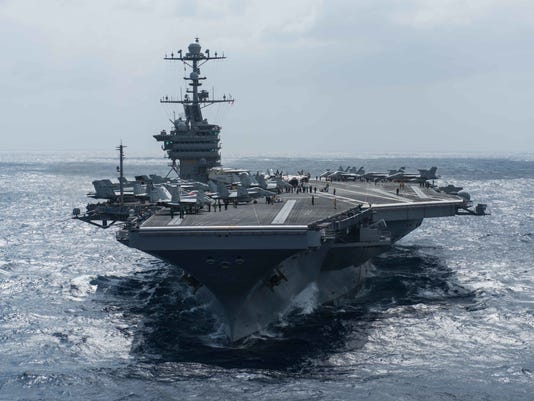
The U.S. just sent a carrier strike group to confront China

Aircraft carrier John C. Stennis has sailed into the South China Sea to exercise their freedom to navigate through the tense region. The show of force comes a week after the head of U.S. Pacific Command said China was militarizing the region.(Photo: MCSA Justin Rayburn/Navy)
By David Larter, Navy Times

The U.S. Navy has dispatched a small armada to the South China Sea.
The carrier John C. Stennis, two destroyers, two cruisers and the 7th Fleet flagship have sailed into the disputed waters in recent days, according to military officials. The carrier strike group is the latest show of force in the tense region, with the U.S. asserting that China is militarizing the region to guard its excessive territorial claims.
Stennis is joined in the region by the cruisers Antietam and Mobile Bay, and the destroyers Chung-Hoon and Stockdale. The command ship Blue Ridge, the floating headquarters of the Japan-based 7th Fleet, is also in the area, en route to a port visit in the Philippines. Stennis deployed from Washington state on Jan. 15.

The rest of the article can be seen on the Navy Times website at http://www.navytimes.com/story/military/2016/03/03/stennis-strike-group-deployed-to-south-china-sea/81270736/

Sunday, January 31, 2016

More Rock amd Roll Adventures from the HFGCS Chronicles

Saturday, the U.S. Navy sent the USS Curtis Wilbur (DDG-54) warship near a disputed island in South China Sea according to various press reports. See CNN story at http://www.cnn.com/2016/01/30/asia/us-navy-south-china-sea/.
 
Pacific Ocean: The guided-missile destroyer USS Curtis Wilbur (DDG 54) transits through the Pacific Ocean with Mt. Fuji in the background. Curtis Wilbur is underway supporting security and stability in the western Pacific Ocean. (U.S. Navy photo by Mass Communication Specialist Seaman Adam K. Thomas/Released)
Any naval operation like this can be a bit dangerous especially if the three parties involved in the disputed land mass get edgy. But there is also a potential treasure trove of intelligence to be gathered.
 
And what did we have flying around the South China Sea area Saturday using call sign Tora 82 (a 4-digit call I might add)? A USAF RC-135V Rivet Joint aircraft.
 
 
And what is this aircraft used for. From the official US Air Force public fact sheet:
 
Mission The RC-135V/W Rivet Joint reconnaissance aircraft supports theater and national level consumers with near real time on-scene intelligence collection, analysis and dissemination capabilities.

Features The aircraft is an extensively modified C-135. The Rivet Joint's modifications are primarily related to its on-board sensor suite, which allows the mission crew to detect, identify and geolocate signals throughout the electromagnetic spectrum. The mission crew can then forward gathered information in a variety of formats to a wide range of consumers via Rivet Joint's extensive communications suite.

The interior seats more than 30 people, including the cockpit crew, electronic warfare officers, intelligence operators and in-flight maintenance technicians.

The Rivet Joint fleet was re-engined with CFM-56 engines with an upgraded flight deck instrumentation and navigational systems to FAA/ICAO standards. These standards include conversion from analog readouts to a digital "glass cockpit" configuration.

All Rivet Joint airframe and mission systems modifications are overseen by L-3 Communications (previously Raytheon), under the oversight of Air Force Materiel Command.

Background The current RC-135 fleet is the latest iteration of modifications to this pool of -135 aircraft going back to 1962. Initially employed by Strategic Air Command to satisfy nationally tasked intelligence collection requirements, the RC-135 fleet has also participated in every sizable armed conflict involving U.S. assets during its tenure. 

RC-135s were present supporting operations in Vietnam, the Mediterranean for Operation El Dorado Canyon, Grenada for Operation Urgent Fury, Panama for Operation Just Cause, and Southwest Asia for operations Desert Shield, Desert Storm, Enduring Freedom and Iraqi Freedom. RC-135s have maintained a constant presence in Southwest Asia since the early 1990s.

All RC-135s are assigned to Air Combat Command. The RC-135 is permanently based at Offutt Air Force Base, Neb., and operated by the 55th Wing, using various forward deployment locations worldwide. More recently, RC-135s have also supported Operation Allied Force in Kosovo, and Operation Odyssey Dawn/Unified Protector in Libya
So looks like we had Tora 82 supporting the Curtis Wilbur on Saturday in the South China Sea. Was our Saturday "Santana" Foxtrot/Skyking message directed at Tora 82?
 
Maybe!  Chief Sends


Tuesday, December 03, 2013

S. Korea to confirm new air defense zone this week

Things in the eastern Asia continue to heat up. The Yonhap News Agency has a story this morning re: new ADIZ for South Korea.

SEOUL, Dec. 3 (Yonhap) -- Locked in a standoff with China over disputed airspace, South Korea will confirm its new air defense zone expanding southward this week and notify neighboring countries of the plan before making a formal announcement, Seoul officials said Tuesday.

In response to China's controversial Air Defense Identification Zone (AIDZ) overlapping that of South Korea and Japan, Seoul has been preparing a new air defense zone that includes an ocean research station built on an underwater reef and southern islands.

Tuesday, November 26, 2013

U.S. Directly Challenges China's Air Defense Zone (Pair of American B-52 Bombers Fly Over)


WASHINGTON—A pair of American B-52 bombers flew over a disputed island chain in the East China Sea without informing Beijing, U.S. officials said Tuesday, in a direct challenge to China and its establishment of an expanded air-defense zone.

The planes flew out of Guam and entered the new Chinese Air Defense Identification Zone at about 7 p.m. Washington time Monday, according to a U.S. official.

The official said the flight was a training mission and the bombers were not armed. The flight was first reported by The Wall Street Journal on Tuesday.

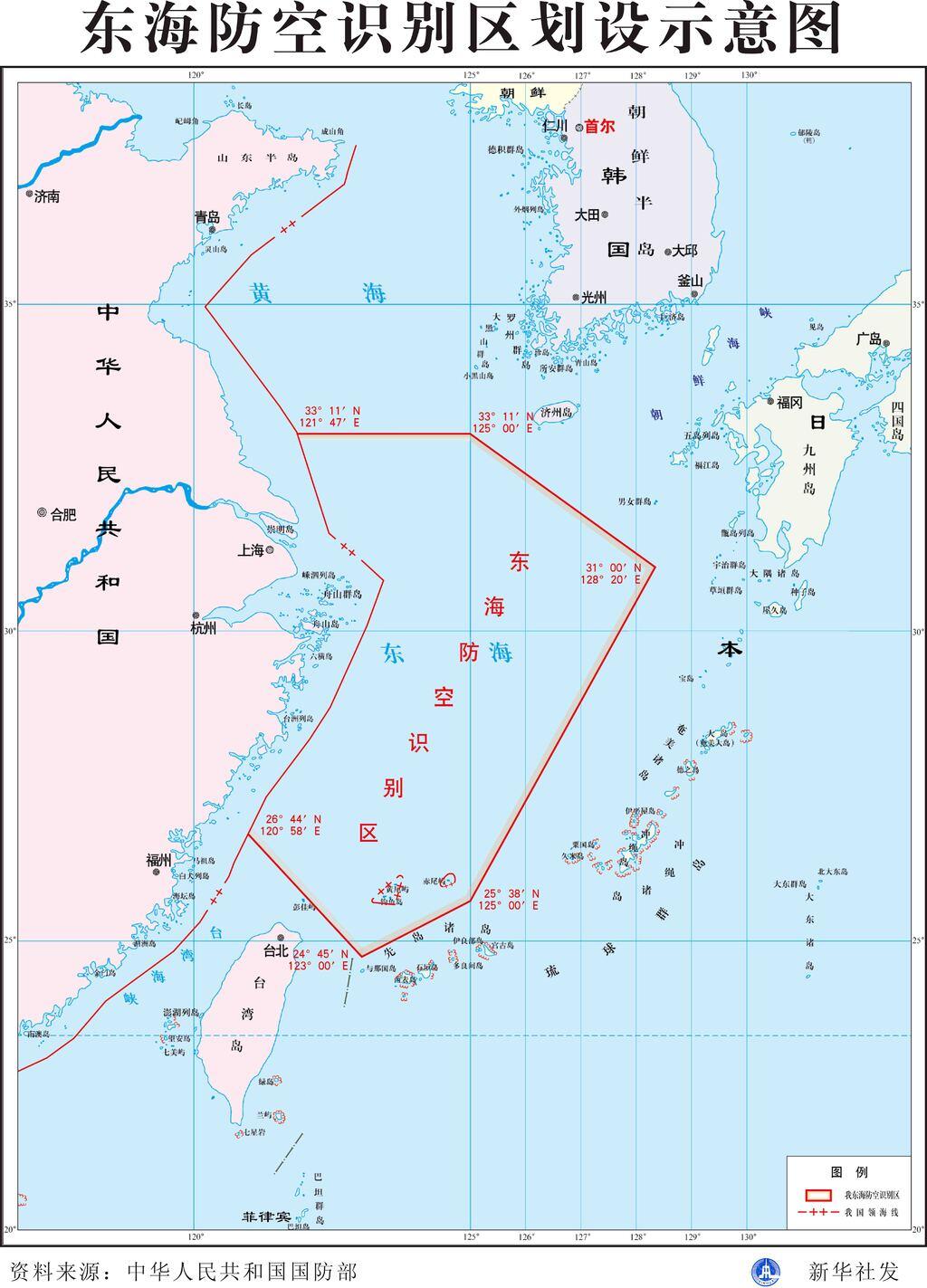
The Chinese announced over the weekend they were expanding their air defense identification zone to include the islands, known as Diaoyu in Chinese and Senkaku in Japanese. Japan also claims ownership.

For more on background see my original story at China creates air defense zone over Japan-controlled islands in East China Sea.

Sunday, November 24, 2013

China creates air defense zone over Japan-controlled islands in East China Sea

Blog Editor's Note: This is potentially a very serious international situation in the East China Sea. This directly threatens Japan and South Korea. Keep an eye on our  @QSLRptMT and @MilcomMP twitter feeds for updates and frequency reports as we get them.


A Japan coastguard handout photo taken on November 2, 2013 shows a Chinese coast guard ship cruising near the disputed islets in the East China Sea
The French AFP news service is reporting that Beijing on Saturday announced it was setting up an "air defense identification zone" over an area that includes islands controlled by Japan but claimed by China, in a move that could inflame the bitter territorial row.


Along with the creation of the zone in the East China Sea, the Chinese defense ministry released a set of aircraft identification rules that must be followed by all planes entering the area, under penalty of intervention by the military.

Aircraft are expected to provide their flight plan, clearly mark their nationality, and maintain two-way radio communication allowing them to "respond in a timely and accurate manner to the identification inquiries" from Chinese authorities.

The outline of the new zone covers a wide area of the East China Sea between South Korea and Taiwan that includes the Tokyo-controlled islands known as the Senkakus to Japan and Diaoyous to China.

The Kyodo news service reports that the Japanese government branded the new escalation in the East China Sea as “very dangerous.”

In Tokyo, Junichi Ihara, head of the Foreign Ministry’s Asian and Oceanian Affairs Bureau, lodged a protest by phone with Han Zhiqiang, a minister at the Chinese Embassy, according to a statement issued by the ministry.

Ihara was quoted as telling Han that Japan can “never accept the zone set up by China,” as it includes the Senkakus. He further said the new zone will “escalate” already fraught bilateral ties over the uninhabited but potentially resource-rich islet chain, branding China’s move “very dangerous,” the statement said.

Later Saturday, China scrambled air force jets, including fighter planes, to patrol the new zone.

"China's armed forces will adopt defensive emergency measures to respond to aircraft that do not cooperate in the identification or refuse to follow the instructions," according to the Chinese Defense ministry.

The zone became operational as of 10:00 am Saturday (0200 GMT).

Friday, October 04, 2013

China Testing New Space Weapons

Long March 4c on July 20 of the Chuangxin-3, Shiyan-7, and Shijian-15 military satellites
Bill Gertz on the Washington Free Beacon website is reporting that China has conducted a satellite capture mission in space as part of Star Wars military program.

The test conducted last week consisted of a maneuvering satellite that captured another satellite in space. Pentagon officials say that was a significant step forward for Beijing’s space warfare program.

The satellite capture involved one of three small satellites fitted with a mechanical arm that were launched July 20 as part of a covert anti-satellite weapons development program, said U.S. officials familiar with reports of the test.

One official described the satellite-grabbing spacecraft as a “mobile satellite launch vehicle.”

The satellites involved in the space warfare development program were identified by the Chinese as “scientific experimentation satellites,” according to a notice published July 24 in the online journal Space News.

They were identified as Chuangxin-3 (Innovation-3), Shiyan-7 (Experiment-7), and Shijian-15 (Practice-15). The spacecraft with the robotic mechanical arm that conducted the satellite capture experiment has not been authoritatively identified from among the three orbiters. However, space analysts suspect it is Shiyan-7.

The three satellites were launched atop a Long March-4C rocket on July 20 from the Taiyuan Satellite Launch Center in north central China.

You can read the entire article including comments by space analyst Bob Christy, who writes the blog Zarya at http://freebeacon.com/china-testing-new-space-weapons/.

According to an article posted yesterday on SatNews (http://www.satnews.com/story.php?number=1243651026), Rick Fisher, a Chinese military affairs specialist, said the robot-arm satellite that he believes is the Shiyan-7 is part of China’s dual-use space program that includes satellites for military close-surveillance and attack missions. Civilian applications include development of space manipulator arm technology.

“As an ASAT, a future version of the SY-7 could be used to take close-up images of U.S. satellites, to remove systems from those satellites and return them to China, to directly damage U.S. satellites or to plant ‘mines’ on those satellites or close nearby,” said Fisher, with the International Assessment and Strategy Center.  “An SY-7-like ASAT gives China the option to attack enemy satellites without creating a large cloud of debris that may also damage other Chinese satellites.”  Fisher said China recently hosted a major space conference and is seeking to position itself as a space “superpower” as a means to increase cooperation and technology acquisition from other countries. At the conference, “Chinese officials made a deliberate appeal to Canada, which developed and built the manipulator arm used on the International Space Station and U.S. Space Shuttles,” Fisher said.  However, Fisher said China made every effort to conceal the People’s Liberation Army’s role in the space program and would probably deny any military role in the developing mechanical arm technology for offensive space operations.  “The ‘Canadarm’ [manipulator arm] was developed in Canada with Canadian funding and four were purchased by NASA for the U.S. Space Shuttle program,” he said.
China conducted a test launch of a new high-Earth orbit anti-satellite missile called the DN-2 in March, according to U.S. officials.

Tuesday, April 02, 2013

China mobilizing troops, jets near Korea - the McCain enters Korean waters

Arleigh Burke Destroyer the USS John S. McCain (DDG-56) has been ordered into Korean Waters

Bill Gertz is reporting on the Washington Free Beacon website that "China has placed military forces on heightened alert in the northeastern part of the country as tensions mount on the Korean peninsula following recent threats by Pyongyang to attack, U.S. officials said."

"Reports from the region reveal the Chinese People’s Liberation Army (PLA) recently increased its military posture in response to the heightened tensions, specifically North Korea’s declaration of a “state of war” and threats to conduct missile attacks against the United States and South Korea."

"According to the officials, the PLA has stepped up military mobilization in the border region with North Korea since mid-March, including troop movements and warplane activity."

"China’s navy also conducted live-firing naval drills by warships in the Yellow Sea that were set to end Monday near the Korean peninsula, in apparent support of North Korea, which was angered by ongoing U.S.-South Korean military drills that are set to continue throughout April."

"North Korea, meanwhile, is mobilizing missile forces, including road-mobile short- and medium-range missiles, according to officials familiar with satellite imagery of missile bases."

Meanwhile, other press reports indicate that the U.S. Navy is shifting a guided-missile destroyer in the Pacific to waters off the Korean peninsula in the wake of ongoing rhetoric from North Korea, U.S. defense officials said.

The USS McCain is capable of intercepting and destroying a missile, should North Korea decide to fire one off, the officials said.

If you are a shortwave broadcast enthusiast, Gayle has just posted the latest A13 schedule for the Voice of Korea from Pyongyang, KCBS and PBS on her Shortwave Central blog (http://mt-shortwave.blogspot.com/).

You can also follow our late breaking real time news items on twitter via @MilcomMP and @QSLrptMT.

Saturday, November 10, 2012

Analysts keep close eye on China's mystery space plane

A close-up of China's robotic Shenlong space plane prototype tucked beneath a Chinese H-6 bomber for glide testing in December 2007. (Source Chinese Internet)

Story By Leonard David, Space.com

As the next secretive flight of the U.S. Air Force's robotic X-37B mini-shuttle draws closer, analysts are keeping a close eye on China’s own potential space plane, the Shenlong.

Last year several Chinese media outlets reported a test flight of the Shenlong space plane that apparently included its airdrop from an H-6 bomber. But the nature of the Shenlong project's testing, as well as what the robot vehicle truly represents, remains sketchy.

Several China watchers in the U.S. have taken a stab at what the Shenlong (Mandarin for "Divine Dragon) might mean, with some experts conjecturing that the craft is simply a tit-for-tat response to the unmanned X-37B space plane.

You can read the rest of this story by clicking here.

This December 2007 image shows China's robotic Shenlong space plane prototype carried by an H-6 bomber during testing.(Source Chinese Internet)

Tuesday, September 18, 2012

Chinese General: Prepare for Combat

SIX CHINESE SHIPS BREACH JAPAN’S NAVAL BORDER


From an article by Bill Gertz on The Washington Free Beacon

China’s most powerful military leader, in an unusual public statement, last week ordered military forces to prepare for combat, as Chinese warships deployed to waters near disputed islands and anti-Japan protests throughout the country turned violent.

Gen. Xu Caihou, vice chairman of the Central Military Commission, considered the most senior military political commissar, said Friday that military forces should be “prepared for any possible military combat,” state run Xinhua news agency reported.

Heightened tensions over the Senkakus come as Defense Secretary Leon Panetta arrived in China Monday.

You can read the rest of this fascinating article on the Beacon website at
http://freebeacon.com/chinese-general-prepare-for-combat/

Thursday, January 27, 2011

China's J-20 Aircraft

Pentagon Press Secretary Geoff Morrell says recent reports about China's J-20 aircraft have been premature.

Pentagon Spokesman Discusses China, North Korea

By Karen Parrish, American Forces Press Service

WASHINGTON - The jury is still out on China's apparent fifth-generation J-20 stealth aircraft, Pentagon spokesman Geoff Morrell said today.

"The J-20 stories, frankly, that I've seen over the past couple weeks ... have been a little over the top," Morrell said during a Pentagon news conference. He noted that reports of "successful testing" ignore the unknowns of the Chinese aircraft.

"What we know is that a plane that looks different than any other they produced, that they claim to be their J-20, had a short test flight when we were in Beijing," the press secretary said. "But we don't know, frankly, much about the capabilities of that plane."

The test flight occurred during Defense Secretary Robert M. Gates' visit to China this month.

The J-20's engine capabilities and degree of stealth capability are among the unknowns, Morrell said, adding that the U.S. current and developing air fleet is more than equal to any possible Chinese challenge.

"That's why we have pursued not just the F-22, which we have in more than enough numbers to deal with any scenario involving China, but also the F-35, to the tune of nearly 2,500 planes," Morrell said.

Morrell said "given what little we know," of the Chinese aircraft, "I would just urge everybody to ... slow down a little bit on our characterizations of the J-20 at this point."

China's capabilities and North Korea's recent provocations make the question of U.S. force presence in the region an important one, Morrell said.

"In light of the threat that we see emanating ... from Pyongyang," he said, "we have said that we will do what is necessary to protect ourselves here as well as our forward-deployed forces [and] our allies, who we have security commitments to."

The United States has 28,500 troops on the Korean peninsula and more than 50,000 more in Japan, Morrell noted.

"And over the long-term lay-down of our forces in the Pacific, we are looking at ways to even bolster that, not necessarily in Korea and Japan, but along the Pacific Rim, particularly in Southeast Asia," he said.

Australia and Singapore may offer U.S. access to certain military facilities in the region, he said, adding, "Guam, obviously, would be the best example of us changing our lay-down and our footprint in the region, enhancing [our presence] in Southeast Asia."

Morrell said Gates' recent comments on the North Korean threat shouldn't be construed as applying immediately.

"I think what he said is they're becoming a direct threat to the United States," the spokesman said. "By that, he doesn't mean at this very moment. But given their pursuit of both the nuclear weapons and their ballistic-missile capabilities, he sees them being a direct threat not within five years, but sooner than that."

Morrell said that's why defense officials are working with China, Japan and others to impress on North Korea that "they've got to cut out this provocative behavior, the destabilizing behavior, and they've got to seriously reevaluate their pursuit of nuclear weapons and delivery vehicles."

Monday, March 01, 2010

China, Iran Creating 'No-Go' Zones to Thwart U.S. Military Power


Found this interesting article on Politics Daily by David Wood

"As Defense Secretary Robert Gates summed up the problem this month, countries in places where the United States has strategic interests -- including the Persian Gulf and the Pacific -- are building "sophisticated, new technologies to deny our forces access to the global commons of sea, air, space and cyberspace.''

Read more at
http://www.politicsdaily.com/2010/03/01/china-iran-creating-no-go-zones-to-thwart-u-s-military-power/?icid=mainmaindl1link1http%3A%2F%2Fwww.politicsdaily.com%2F2010%2F03%2F01%2Fchina-iran-creating-no-go-zones-to-thwart-u-s-military-power%2F

Thursday, December 31, 2009

China accelerates space research and development

Chinese Long March Family of Boosters.

Craig Covault at SpaceFlight Now has posted a fascinating article on the Chinese Space Operations. According to Covault, "China in 2010 will be engaged in the most ambitious and diverse manned and unmanned space system research and development surge since the U.S. and Soviet Union squared off in the 1960s space race."

"In addition to maturing its manned program for ambitious flight operations in 2011 the Chinese will also launch its second lunar orbiter mission and complete development of a nuclear powered common lunar lander bus that by 2013 is to support Chinese lunar rover operations then unmanned lunar sample return flights by 2017."

For more on this article jump over to http://www.spaceflightnow.com/news/n0912/28china/ to read the rest of this copyrighted article.

Thursday, May 07, 2009

Chinese Vessels Approach Sealift Command Ship in Yellow Sea


By Jim Garamone, American Forces Press Service

WASHINGTON (NNS) -- Chinese fishing vessels closed in on and maneuvered near the USNS Victorious (T-AGOS 19) in international waters in the Yellow Sea on May 1, Pentagon officials announced.

The Victorious is one of the five ocean surveillance ships that are part of the 25 ships in Military Sealift Command's Special Mission Ships Program.

The vessel was conducting routine operations 170 miles off the coast of China when two Chinese fishing vessels approached, Pentagon spokesman Bryan Whitman said.
"This was an incident where a couple of Chinese fishing vessels maneuvered close to the Victorious in what was an unsafe manner," Whitman said.

The Victorious took defensive measures as the vessels got close. The Victorious crew sounded the ship's danger alarms and manned fire hoses. They sprayed water at the Chinese vessels, but did not hit them, officials said.

The Victorious requested the assistance of a nearby Chinese government vessel, at which time the fishing vessels departed, Whitman said.

He did not comment on the motive of the Chinese vessels. "That requires you to get inside the heads of the mariners out there," he said. "What is clear is that it is unsafe and dangerous behavior, and it needs to be addressed. We do not want the mariners of any of the vessels out there in jeopardy."

One Chinese vessel approached within 30 yards of the Victorious, officials said. "They are clearly demonstrating unsafe seamanship," Whitman said. "As we have in previous incidents, we'll be developing a way forward to deal with this diplomatically."

On March 8, five Chinese vessels surrounded the USNS Impeccable (T-AGOS-23) as it was conducting operations 80 nautical miles off Hainan Island. There have been other incidents where Chinese vessels operated in an unsafe manner around U.S. ocean surveillance ships.

"It's in everybody's interest to ensure that safe procedures on the seas are followed," Whitman said. "This was clearly well into international waters."

Military vessels are not subject to coastal state jurisdiction and do not require the prior consent of the coastal state for activity in the exclusive economic zone.

Thursday, March 12, 2009

Discussions Aim to Resolve U.S. Ship Incident

From Jim Garamone, American Forces Press Service

WASINGTON (NNS) -- The incident in the South China Sea involving a U.S. ocean surveillance ship is serious enough to merit face-to-face discussions between U.S. and Chinese officials, Pentagon Press Secretary Geoff Morrell said March 11.

USNS Impeccable (T-AGOS 23) -– an unarmed Military Sealift Command vessel -- was conducting operations in international waters 70 miles south of Hainan Island on March 8 when the ship was surrounded and harassed by five Chinese vessels.

Morrell said the U.S. defense attaché in Beijing has been talking with China's defense ministry about the incident.

The Chinese defense attaché also is speaking with Defense Department officials.

"[The incident] is serious enough that we believe it requires face-to-face talks to find out what was going on here and to ensure that there are no further incidents of this nature in the future," Morrell said.

Morrell reiterated the U.S. position that Impeccable was performing its mission in international waters.

"We hope that the Chinese would behave in a similar way, that is, according to international law," he said. "Furthermore, this incident is not at all consistent with the expressed desire of both governments to build a closer relationship, particularly a closer military-to-military relationship."

The U.S. position is that if a ship is lawfully operating in international waters, "that that is legal and permitted, and there should be no … reason to interfere with those operations," Morrell said.

Officials are hopeful that the conversations between the two nations will clear up any misunderstandings about this incident and ensure it doesn't happen again, he added.

Tuesday, March 10, 2009

Chinese Vessels Shadow, Harass Unarmed U.S. Survey Ship

A crewmember on a Chinese trawler uses a grapple hook in an apparent attempt to snag the towed acoustic array of the military Sealift Command ocean surveillance ship USNS Impeccable (T-AGOS-23). Impeccable was conducting routine survey operations in international waters 75 miles south of Hainan Island when it was harassed by five Chinese vessels. (U.S. Navy photo/Released)

By Jim Garamone
American Forces Press Service

WASHINGTON - Five Chinese vessels shadowed and aggressively maneuvered close to the USNS Impeccable in the South China Sea yesterday, a senior Pentagon official said today.
The U.S. oceanographic ship was 70 miles south of Hainan Island conducting routine operations in international waters when the ships approached, Pentagon spokesman Bryan Whitman said.

"We view these as unprofessional maneuvers by the Chinese vessels and violations under international law to operate with due regard for the rights and safety of other lawful users of the ocean," Whitman said.

A civilian crew mans the ship, which operates under the auspices of the Military Sealift Command.

The incident began as the ships surrounded the Impeccable and two craft closed to within 50 feet, Whitman said. The Chinese ships included a Chinese navy intelligence collection ship, a Bureau of Maritime Fisheries patrol vessel, a State Oceanographic Administration patrol vessel and two small Chinese-flagged trawlers.

Crewmen aboard the Impeccable used fire hoses to spray one of the vessels as a protective measure. The Chinese crewmembers disrobed to their underwear and continued closing to within 25 feet.

The Chinese vessels dropped pieces of wood in the water directly in the Impeccable's path, and two of the ships stopped directly in the U.S. vessel's path, forcing it to stop.

Whitman said the Chinese used poles in an attempt to snag the Impeccable's towed acoustic array sonars. Impeccable's master used bridge-to-bridge radio circuits to inform the Chinese ships in a friendly manner that it was leaving the area and requested a safe path to navigate.

"These are dangerous close maneuvers that these vessels engaged in," Whitman said.

The incident was the culmination of earlier harassment. A Chinese patrol vessel shined a high-intensity spotlight March 4 on the USNS Victorious operating in the Yellow Sea 125 miles from China's coast. Chinese maritime aircraft "buzzed" the ship 12 times March 5.

A Chinese frigate crossed the bow of the Impeccable at a range of about 100 yards March 5. Maritime aircraft buzzed the ship after that incident.

Another Chinese ship challenged Impeccable over bridge-to-bridge radio March 7, calling its operations illegal and directing the American ship to leave the area or "suffer the consequences," officials said.

The Impeccable is one of six surveillance ships that gather underwater acoustical data, Whitman said. U.S. ships routinely operate in the area.

"We expect Chinese ships to act responsibly and refrain from provocative activities that could lead to miscalculation or a collision at sea, endangering vessels and the lives of U.S. and Chinese mariners," a Defense Department official said.

U.S. embassy officials lodged a protest against these actions with the Foreign Ministry in China, and Defense Department officials have protested with the Chinese embassy here.

Tuesday, May 13, 2008

Wednesday, November 28, 2007

China Has Done It Again!

Hong Kong Harbor (Photo courtesy of http://www.ussschenectadylst1185.org/)

China, which denied the USS Kitty Hawk and her Carrier Strike Group permission to dock in Hong Kong for Thanksgiving (see that story on this blog at:
http://mt-milcom.blogspot.com/2007/11/china-denies-kitty-hawk-csg-access-to.html), also recently refused access to two minesweeping ships seeking refuge from a storm, the commander of U.S. Forces Pacific said yesterday in a Pentagon video conference.

The USS Patriot and USS Guardian were forced to refuel at sea and return to their homeport of Sasebo in Japan when China refused their request for shelter in Hong Kong, Admiral Timothy Keating told reporters in Washington yesterday.

The incidents came about two weeks after Defense Secretary Robert Gates visited China seeking greater cooperation between the two countries and more transparency from the government in Beijing about its military buildup.

China's denial violated an "unwritten law among seamen that if someone is in need" you give them safe harbor, Keating said in a video conference from his headquarters at Camp Smith, Hawaii, according to a DoD transcript. Keating said that while the decision to refuse the Kitty Hawk access was "perplexing" and "troublesome," the minesweeper incident was "more disturbing."

Foreign Ministry spokesman Liu Jianchao said in a statement today that all dockings by U.S. naval ships in Hong Kong must be "applied for in advance" and in accordance with the territory's laws. "In this case, the applications were not made in advance and in a timely fashion."