Welcome to the Milcom Monitor Post sponsored by Teak Publishing (Copyright © 2006-2023 Teak Publishing). All rights are reserved. Redistribution of these pages in any format without prior permission is prohibited. Links to individual stories are permitted without permission. The comment section on this blog is closed, but you can pass along material or comments via email MilcomMP at gmail dot com. If you submit material for this blog and want to remain anonymous, indicate that in your message.
Milcom Monitoring Post Profiles
- Home
- What are Emergency Action Messages (EAM)? Updated 20 September 2021
- UFO Milsat Program
- Fleetsatcom System
- UHF 225-380 MHz Milcom Spectrum Holes: Updated 24 July 2019
- Civilian Air Cargo/Airline/Military Call Signs
- Intl HF Aero Civ/Gov/Mil Frequency List
- USN Aircraft Modex Numbers
- University of Twente Wide Band WebSDR Netherlands
- U.S. Military ALE Addresses
- DoD Air Refueling Frequencies - Update 15 Jul 2016
- COTHEN HF Network – Last Update 23 May 2023
- Monitoring the Civil Air Patrol Auxiliary Update 10 Sep 2016
- US Coast Guard Asset Guide - Update 24 May 2023
- The Spectrum Monitor e-Zine Milcom Column Index - Update 17 January 2022
- The Milcom MT Files (1998-2013) Articles Index
Showing posts with label MUOS. Show all posts
Saturday, July 20, 2013
Navy Satellite Launch to Boost DoD Satellite Communications
By Steven A. Davis, Space and Naval Warfare Systems Command Public Affairs
CAPE CANAVERAL AIR FORCE STATION, Fla. (NNS) -- The Navy's second Mobile User Objective System satellite was launched today at 9:00 a.m. EDT from Space Launch Complex 41. The successful launch represents a key step in providing enhanced satellite communications for the Navy and Department of Defense (DoD).
MUOS is a next-generation narrowband tactical satellite communications system designed to significantly improve beyond-line-of-sight communications for U.S. forces on the move. MUOS will provide military users 10 times more communications capacity over the existing system by leveraging 3G mobile technology, including simultaneous voice and data capability.
"The MUOS-2 launch is an especially significant event for the program because not only are we launching the second satellite, but the ground system, the networking software and the waveform are all aligning at the same time," explained Navy Cmdr. Matt Bohlin, the MUOS principal assistant program manager. "With MUOS-2 on-orbit this fall, we'll be testing the full system with all the new capabilities that it brings to the warfighter."
The first MUOS satellite, launched in February 2012 and accepted for operational use by U.S. Strategic Command in November, has been providing high quality voice communications for users.
The Navy plays a key role in national space efforts by providing narrowband satellite communications for the DoD and other government agencies. MUOS satellite communications capability is designed for mobile users who require high-speed mission data with higher data rates and improved operational availability.
Bohlin says users requiring these essential services will soon see significantly improved benefits when the full system suite comes on-line.
"Users are going to notice more bandwidth that is accessible on demand as opposed to preplanned channels, better voice quality and better connectivity while not being impacted by remote regions, urban environments or inclement weather." he said. "It will be a revolutionary leap for satellite communications for DoD."
With current capability, tactical users have limited access to narrowband satellite communications, and channels must be preplanned and allocated. Additionally, dismounted users had to be stationary to acquire the satellite.
With MUOS, users will have access on demand and be able to use the service while on the move and in all environments and weather to talk to beyond-line-of-sight recipients, whether they are on the other side of a mountain or the other side of the world.
Services will also be available for platforms such as ships, aircraft and vehicles.
Over the next several days, the satellite, which functions much like a cell tower in space, will transition to its geosynchronous orbit location 22,000 miles above the earth. Its solar arrays and mesh antennas will then be deployed and on-orbit testing will begin for eventual commissioning into service.
The constellation of four satellites and one on-orbit spare will extend narrowband communications availability well past 2025.
The Space and Naval Warfare Systems Command, San Diego, the Navy's Program Executive Office for Space Systems, Chantilly, Va., and its Communications Satellite Program Office, San Diego, are responsible for the MUOS program.
Tuesday, July 16, 2013
Mobile Communications Satellite Scheduled to Launch July 19
Navy All Hands Video at http://www.navy.mil/viewVideo.asp?id=18656
Transcript:
THE SECOND SATELLITE IN THE NAVY'S NEW MOBILE COMMUNICATIONS NETWORK IS SET TO LAUNCH INTO ORBIT JULY 19TH.
THE MOBILE USER OBJECTIVE SYSTEM OR MUOS SATELLITE, IS A SYSTEM THAT USES COMMERCIAL 3-G CELL PHONE TECHNOLOGY TO PROVIDE COMMUNICATIONS SERVICES TO MOBILE MILITARY TROOPS.THE ASSISTANT PROGRAM MANAGER, COMMANDER MATT BOHLIN, EXPLAINS THE TIMELINE OF THE PROGRAM.
"SO MUOS 2 SORT OF REPRESENTS THE PENTULTIMATE MOMENT IN THE DEVELOPMENT OF THE MUOS PROGRAM, IN THE SENSE THAT, NOT ONLY ARE WE LAUNCHING THE SECOND SATELLITE, BUT THE GROUND SYSTEM, THE NETWORKING SOFTWARE, AND THE WAVEFORM, ARE ALL BEING DELIVERED WITHIN THE NEXT COUPLE OF MONTHS. SO WITH MUOS 2 ON ORBIT THIS FALL, WE WILL BE TESTING THE FULL MUOS SYSTEM WITH ALL OF THE NEW CAPABILITIES THAT IT BRINGS, THEN THAT WILL BE DELIVERED TO THE WARFIGHTER NEXT SUMMER."
MUOS WORKS LIKE A CELL TOWER TO SERVE SHIPS, SUBMARINES, AIRCRAFT AND LAND TERMINALS THAT THE MILITARY USES TO COMMUNICATE.
ONCE THE SYSTEM IS COMPLETE IN 20-17, IT WILL PROVIDE COVERAGE FOR MOBILE MILITARY COMMUNICATIONS LIKE NEVER BEFORE AND USERS WILL BENEFIT FROM THE SYSTEM IN MANY WAYS.
"OVER THE CURRENT UHF LEGACY SYSTEM, THE USERS GOING TO NOTICE MORE BANDWIDTH THAT'S ACCESSIBLE ON DEMAND AS OPPOSED TO PRE-PLANNING THE CHANNELS, BETTER VOICE QUALITY, SIMULATANEOUS VOICE AND DATA, BETTER CONNECTIVITY IN REMOTE REGIONS, WHILE THEY'RE ON THE MOVE IN URBAN ENVIORNMENTS, IN THE WEATHER... SO IT SHOULD BE A GREAT REVOLUTIONARY LEAP FOR UHF SATELLITE COMMUNICATIONS FOR THE DOD."
TO LEARN MORE ABOUT THE MUOS SATELLITE PROGRAM VISIT PUBLIC.NAVY.MIL/SPAWAR.
FROM THE DEFENSE MEDIA ACTIVITY, I'M PETTY OFFICER ANDREW JOHNSON
Transcript:
THE SECOND SATELLITE IN THE NAVY'S NEW MOBILE COMMUNICATIONS NETWORK IS SET TO LAUNCH INTO ORBIT JULY 19TH.
THE MOBILE USER OBJECTIVE SYSTEM OR MUOS SATELLITE, IS A SYSTEM THAT USES COMMERCIAL 3-G CELL PHONE TECHNOLOGY TO PROVIDE COMMUNICATIONS SERVICES TO MOBILE MILITARY TROOPS.THE ASSISTANT PROGRAM MANAGER, COMMANDER MATT BOHLIN, EXPLAINS THE TIMELINE OF THE PROGRAM.
"SO MUOS 2 SORT OF REPRESENTS THE PENTULTIMATE MOMENT IN THE DEVELOPMENT OF THE MUOS PROGRAM, IN THE SENSE THAT, NOT ONLY ARE WE LAUNCHING THE SECOND SATELLITE, BUT THE GROUND SYSTEM, THE NETWORKING SOFTWARE, AND THE WAVEFORM, ARE ALL BEING DELIVERED WITHIN THE NEXT COUPLE OF MONTHS. SO WITH MUOS 2 ON ORBIT THIS FALL, WE WILL BE TESTING THE FULL MUOS SYSTEM WITH ALL OF THE NEW CAPABILITIES THAT IT BRINGS, THEN THAT WILL BE DELIVERED TO THE WARFIGHTER NEXT SUMMER."
MUOS WORKS LIKE A CELL TOWER TO SERVE SHIPS, SUBMARINES, AIRCRAFT AND LAND TERMINALS THAT THE MILITARY USES TO COMMUNICATE.
ONCE THE SYSTEM IS COMPLETE IN 20-17, IT WILL PROVIDE COVERAGE FOR MOBILE MILITARY COMMUNICATIONS LIKE NEVER BEFORE AND USERS WILL BENEFIT FROM THE SYSTEM IN MANY WAYS.
"OVER THE CURRENT UHF LEGACY SYSTEM, THE USERS GOING TO NOTICE MORE BANDWIDTH THAT'S ACCESSIBLE ON DEMAND AS OPPOSED TO PRE-PLANNING THE CHANNELS, BETTER VOICE QUALITY, SIMULATANEOUS VOICE AND DATA, BETTER CONNECTIVITY IN REMOTE REGIONS, WHILE THEY'RE ON THE MOVE IN URBAN ENVIORNMENTS, IN THE WEATHER... SO IT SHOULD BE A GREAT REVOLUTIONARY LEAP FOR UHF SATELLITE COMMUNICATIONS FOR THE DOD."
TO LEARN MORE ABOUT THE MUOS SATELLITE PROGRAM VISIT PUBLIC.NAVY.MIL/SPAWAR.
FROM THE DEFENSE MEDIA ACTIVITY, I'M PETTY OFFICER ANDREW JOHNSON
Tuesday, March 27, 2012
U.S. Navy's newly launched spacecraft is flying high
BY JUSTIN RAY, SPACEFLIGHT NOW

The U.S. Navy's new satellite to provide more agile communications for forces on the move has successfully maneuvered itself into a perch 22,300 miles above Earth and unfurled its giant umbrella-like mesh antennas.
Launched by ULA's Atlas 5 rocket on Feb. 24 from Cape Canaveral into a geosynchronous transfer orbit, the Mobile User Objective System 1 satellite has executed eight firings of its liquid apogee main engine to ascend from that dropoff point. The rocket delivered the craft to a preliminary 2,150 by 22,237 statute mile orbit, which has now been circularized, and the inclination was reduced from 19 degrees to about 5 degrees relative to the equator.
The Navy has not announced which of five available orbital zones the spacecraft will be operated from -- the vast Pacific Ocean, the continental U.S. coverage area, the Atlantic Ocean region, or two positions over the Indian Ocean and the Middle East. The testing location is over the Pacific in view of ground station in Hawaii.
You can read the entire copyrighted article from Spaceflight Now by clicking here.
The U.S. Navy's new satellite to provide more agile communications for forces on the move has successfully maneuvered itself into a perch 22,300 miles above Earth and unfurled its giant umbrella-like mesh antennas.
Launched by ULA's Atlas 5 rocket on Feb. 24 from Cape Canaveral into a geosynchronous transfer orbit, the Mobile User Objective System 1 satellite has executed eight firings of its liquid apogee main engine to ascend from that dropoff point. The rocket delivered the craft to a preliminary 2,150 by 22,237 statute mile orbit, which has now been circularized, and the inclination was reduced from 19 degrees to about 5 degrees relative to the equator.
The Navy has not announced which of five available orbital zones the spacecraft will be operated from -- the vast Pacific Ocean, the continental U.S. coverage area, the Atlantic Ocean region, or two positions over the Indian Ocean and the Middle East. The testing location is over the Pacific in view of ground station in Hawaii.
You can read the entire copyrighted article from Spaceflight Now by clicking here.
Sunday, February 26, 2012
Navy Successfully Launches Next Generation Communications Satellite
A United Launch Alliance Atlas V rocket blasts off from Space Launch Complex-41 with the U.S. Navy Mobile User Objective System-1 (MUOS-1) satellite. The nearly 15,000 pounds satellite is the heaviest satellite launched to date by an Atlas launch vehicle. MUOS-1, built by Lockheed Martin, is a next-generation narrowband tactical satellite communications system designed to significantly improve ground communications for U.S. forces. (U.S. Navy photo by Pat Corkery, courtesy United Launch Alliance/Released) From Space and Naval Warfare Systems Command Public Affairs
CAPE CANAVERAL AIR FORCE STATION, Fla. (NNS) -- The Navy's first Mobile User Objective System satellite was launched Feb. 24 from Space Launch Complex 41.
MUOS is a next-generation narrowband tactical communications system designed to improve communications for U.S. forces on the move. MUOS will provide military users simultaneous voice, video and data capability by leveraging 3G mobile communications technology.
Born from the need for stable, 24/7 ship-to-shore communication that could be successful regardless of environments and geographical conditions, the Navy is responsible for providing narrowband satellite communication for the Department of Defense.
"MUOS' top requirements include capacity, coverage and link availabilities. It will provide 24 hours a day, seven days a week global coverage," said Navy Capt. Paul Ghyzel, MUOS program manager. "The ability for a warfighter to make a telephone call over a MUOS terminal and send data at 10 times more capacity than they can now will be a significant improvement."
For the Navy MUOS team, many of whom have spent years on the program, the successful launch is just the beginning of work to come. "We are very excited to see this milestone today. It's the end of one phase and the beginning of another," said Navy Cmdr. Jeff King, a MUOS systems engineer who worked on the program for three years.
King explained that upon separation from the launch vehicle the satellite will stay in a temporary orbital slot for initial testing.
"The satellite will spend the next several months in its geostationary orbit and be thoroughly checked out by the combined government and contractor team before being turned over for operational use."
Operational use, also known as initial operational capability, for the first MUOS satellite is expected in summer 2012. Control of the satellite will then be turned over to the Naval Satellite Operations Command in Point Mugu, Calif.
Ultimately, the MUOS constellation will consist of four satellites and an on-orbit spare. The system also includes four ground stations strategically located around the globe, which provide worldwide coverage and the ability to connect users wherever they are. The ground system transports data, manages the worldwide network and controls the satellites.
With today's narrowband communication system, users have to be stationary with an antenna up and pointed toward a satellite.
"With MUOS they'll be able to move around the battlespace," said King. "They'll be able to communicate to users on the other side of a mountain or the other side of the world."
Beyond providing continuous communication for all branches of the U.S. military, Navy provided space-based narrowband capability also ensures reliable worldwide coverage for national emergency assistance, disaster response and humanitarian relief.
The MUOS constellation is expected to achieve full operational capability in 2015, extending narrowband availability well past 2025.
Today's launch was originally scheduled for Feb. 16 and again Feb. 22, both canceled and rescheduled due to unfavorable weather conditions.
The program is managed by the Navy's Program Executive Office for Space Systems, Chantilly, Va., and its Communications Satellite Program Office in San Diego.
AGI Launch Notification:
New Launch: 2012 February 24, 2215 UTC
Site: Air Force Eastern Test Range, Florida, USA
Launcher: Atlas V
International Designator(s): 2012-009A
SSC Name Owner
38093 MUOS-1 US
"Like erecting a cellular telephone tower 22,300 miles [35,888 km] tall, the U.S. Navy's first-of-its-kind mobile communications satellite rose high above Earth tonight to provide 3G voice, data and video services to military troops on the move.
"Soaring away from Cape Canaveral's Complex 41 at 5:15 p.m. EST (2215 GMT), the Atlas 5 rocket sped towards space carrying the Mobile User Objective System 1 satellite.
"MUOS 1 became the heaviest payload ever launched by an Atlas rocket in more than 600 launches under the venerable booster's name, weighing nearly 15,000 pounds [6,804 kg].
"And to heave the craft into a lofty geosynchronous transfer orbit, the Atlas 5's largest, most energetic configuration—previously used to hurl space probes toward Jupiter and Pluto—was tapped for the mission with five forceful solid rocket boosters flanked around the vehicle.
"What's more, the launch also marked the milestone 200th flight for the dependable Centaur upper stage, which conducted three critical firings over the course of three hours to position MUOS 1 into the proper orbit to score a successful launch.
"The sophisticated MUOS system—to be fully assembled with four more launches over the next few years—was designed around the commercial third-generation cellular telephone architecture to substantially increase the number of users and amount of communications that can be routed to military forces. The satellites will ring the planet and provide capacity, availability and global coverage for mobile military communications like never before.
"From its eventual spot in geosynchronous orbit, matching Earth's rotation to hover in a parking spot 22,300 miles [35,888 km] up, the expansive footprint of MUOS 1 will cover a huge swath of the planet to serve ships, submarines, aircraft, land vehicles and terminals in the hands of troops.
"Initial testing of the craft will be performed later this spring over the mid-Pacific Ocean in view of a Hawaiian ground station. However, the final operational position in space and what geographical area of the globe the craft will cover hasn't been chosen yet."
"MUOS will offer 10 times greater communications capacity to the mobile warfighter over the Navy's current generation of Ultra High Frequency Follow-On spacecraft to relay narrowband tactical information such as voice calls, data messaging, file transfers and email on rates of up to 384 Kilobits per second."
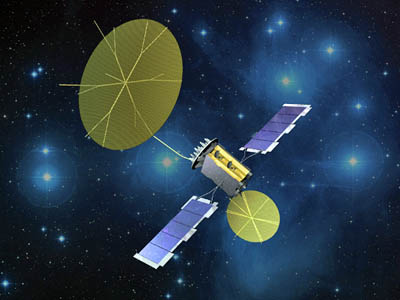
"At the heart of the MUOS satellite's communications payload are two gold mesh antenna reflectors, built by Harris Corp. Coverage to legacy users will transmit through a 17.7-foot [5.4-m]-diameter reflector on the bottom of the craft and the advanced, multi-beam features of MUOS to significantly increase the transmission capacity over the Navy's previous satellites will use a large 46-foot [14.0-m] reflector atop the satellite."
"Ground controllers established contact with the satellite to begin what's expected to be a three-month process of maneuvering MUOS 1 into geosynchronous orbit, deploying its power-generating solar arrays to span more than 90 feet, unfurling a pair of umbrella-like antenna reflectors on boom assemblies and fully checking out the onboard communications equipment.
Eight orbital raising burns are expected over the next 10-14 days, followed by the test program that Lockheed Martin will perform, Ghyzel said. The military will take control of the satellite in about 90 days to conduct its own acceptance evaluation before the craft enters service."
Source: Spaceflight Now, "Atlas 5 rocket navigates new Navy satellite into orbit"
Thursday, February 09, 2012
Atlas 5 rocket topped with Navy's newest satellite

Blog Editor Note: We hope to have more information on this new DoD UHF mil comsat including active UHF downlinks after launch and testing is complete.
BY JUSTIN RAY, SPACEFLIGHT NOW
Looking towards launch next week to begin dramatically improving the capacity for U.S. military mobile communications, a new breed of satellite was hauled to the towering Atlas 5 rocket assembly building today for mounting atop the powerful booster.
The Navy's first Mobile User Objective System satellite, dubbed MUOS 1, is scheduled for blastoff next Thursday, Feb. 16, at sunset from Complex 41 at Cape Canaveral, Florida.
You can read the entire Spaceflight Now article on the Navy's newest UHF satellite by
clicking here.
Description:
Mobile User Object System (MUOS) is a narrowband Military Satellite Communications (MILSATCOM) system that supports a worldwide, multi-Service population of mobile and fixed-site terminal users in the Ultra High Frequency (UHF) band, providing increased communications capabilities to smaller terminals while still supporting interoperability to legacy terminals.
Features:
MUOS adapts a commercial third generation Wideband Code Division Multiple Access (WCDMA) cellular phone network architecture and combines it with geosynchronous satellites (in place of cell towers) to provide a new and more capable UHF MILSATCOM system. The constellation of four operational satellites and ground network control will provide greater than 10 times the system capacity of the current UHF Follow-On (UFO) constellation.
MUOS includes the satellite constellation, a ground control and network management system, and a new waveform for user terminals. The space portion is comprised of a constellation of four geosynchronous satellites, plus one on-orbit spare. The ground system includes the transport, network management, satellite control, and associated infrastructure to both fly the satellites and manage the user’s communications. MUOS and these newer terminals are designed to support users that require greater mobility, higher data rates, and improved operation availability. The new waveform is termed the MUOS Common Air Interface (CAI), a Software Communications Architecture compliant modulations technique for the Joint Tactical Radio System (JTRS) terminals. The MUOS CAI waveform will be available to the Services for porting to JTRS terminals in late 2008. The first MUOS satellite is scheduled to provide an On-Orbit Capability in March 2010. MUOS achieves Full Operational Capability in 2014.
Background:
The flow of information between users when MUOS is operational will be much different than today’s systems. Users will communicate with the satellite via UHF WCDMA links and the satellites will relay this to one of four ground sites located in Hawaii, Norfolk, Sicily, and Australia via a Ka-band feederlink. These ground sites are interconnected to switching and network management facilities located in Hawaii and Virginia. These facilities identify the destination of the communications and route the information to the appropriate ground site for Ka-band uplink to the satellite and UHF WCDMA downlink to the correct users.
The network management will feature a government controlled, priority-based resource management capability that will be adaptable and responsive to changing operational communication requirements. Additionally, MUOS will provide access to select Defense Information System Network services, a voice and data capability that has not been available to UHF MILSATCOM users on prior systems. For satellite telemetry, tracking and command, MUOS will use the existing control system operated by the NavalSatelliteOperationsCenter at Pt. Mugu, California with the Air Force Satellite Control Network as a back-up.
When MUOS is fielded it will serve a mixed terminal population. Some users will have terminals only able to support the legacy waveforms while other users will have newer terminal able to support the MUOS CAI. In anticipation of this, each MUOS satellite carries a legacy payload similar to that flown on UFO-11. These legacy payloads will continue to support legacy terminals, allowing for a more gradual transition to the MUOS WCDMA waveform.
General Characteristics:
Operator: US Navy
Contractors: Lockheed Martin (Prime), Boeing, General Dynamics
Wingspan: 92 Ft
Configuration: A2100M
Propulsion: IHI BT-4
Power: 2 deployable solar arrays, batteries
Bus Width: 14 Ft
Bus Height: 26 Ft
Weight: 6800 lbs Dry
Design Life: 15 Years
Satellite Power: 9.800 Watts
XMT Antenna diameter: 46 Ft
Orbits 22,236 miles above the Earth
Friday, July 16, 2010
First MUOS Satellite Successfully Completes Key Ground Test Milestone

SAN DIEGO (NNS) -- The Mobile User Objective System (MUOS), directed by Team Space and Naval Warfare Systems Command's (SPAWAR's) Communications Satellite Program Office (PMW 146), completed a significant test milestone for the program's first satellite June 29.
A next-generation narrowband tactical satellite communications system, MUOS will provide the warfighter with the latest mobile technology such as simultaneous voice and data, as well as improved service to legacy users of the current ultra high frequency (UHF) Follow-On system.
"Since the MUOS spacecraft's Critical Design Review in March 2007, we have overseen the manufacture and delivery of hundreds of components that make up the MUOS spacecraft," said Navy Capt. Jack Nicholson, PMW 146's acting program manager.
The successful testing demonstrates that components work together as an integrated spacecraft and will meet the warfighter's needs for UHF communications. "It is a major accomplishment to have first pass success at the system level testing for such a complex spacecraft," said Nicholson.
The next steps are spacecraft level vibration and acoustic tests to simulate the launch environment, followed by thermal vacuum tests that simulate the extreme hot and cold temperature on orbit. Upon completion of these tests there will be final post-environmental performance tests to verify that the satellite works properly prior to launch.
"We are about one year from being ready to launch the first MUOS spacecraft, and we are ready for the next major test event: spacecraft vibration and acoustic testing," explained Nicholson. The first MUOS satellite is projected to provide on-orbit capability by the end of 2011.
The first MUOS satellite successfully completed Passive Intermodulation (PIM) testing, Electromagnetic Interference (EMI) and Electromagnetic Compatibility (EMC) testing, as well as the Spacecraft Level Baseline Integrated System Test (BIST) at Lockheed Martin facilities in Sunnyvale, Calif.
Completion of PIM testing assured that the high power satellite downlink transmissions do not interfere with the extremely low power signals uplinked from the legacy terminals used by the warfighter. The EMI/EMC testing ensures self-compatibility of the payloads on the satellite, as well as satellite compatibility with the launch vehicle electromagnetic environment. BIST testing verifies the overall performance of the fully integrated MUOS spacecraft is compliant to the MUOS Performance Specification and establishes a performance baseline prior to entering the environmental test phase.
"Completion of PIM, EMI and EMC on the first pass and in less than two months on a UHF satellite as complex as MUOS is the result of months of planning and hard work by the entire MUOS space segment team," said Nicholson. "This team was efficient at identifying and completing risk reduction activities that led to this major testing milestone."
Following BIST, a series of critical environmental test phases that validate the overall satellite design, quality of workmanship and survivability during space vehicle launch and on-orbit operations will take place.
MUOS is the Defense Department's next-generation military satellite communication system that supports a worldwide, multi-service population of users in the narrowband. The system is designed to support users that require greater mobility, higher data rates and improved operational availability. This system will provide greater than 10 times the system capacity of the current narrowband constellation.
MUOS will support unified commands and joint task force components, DoD and non-DoD agencies, and U.S. allies by providing worldwide tactical narrowband netted, point-to-point, and broadcast voice and data services in such challenging environments as double canopy foliage, urban environments, high sea states and all weather conditions.
The Mobile User Objective System is an array of geosynchronous satellites being developed for the United States Department of Defense (DoD) to provide global satellite communications (SATCOM) narrowband (64 kbit/s and below) connectivity for communications use by the United States and allies.
The Mobile User Objective System (MUOS) is an Ultra High Frequency (UHF) SATCOM system, primarily serving the DoD. As mentioned above, the MUOS will replace the legacy UHF Follow-On (UFO) system before that system reaches its end of life to provide users with new capabilities and enhanced mobility, access, capacity, and quality of service. Intended primarily for mobile users (e.g. aerial and maritime platforms, ground vehicles, and dismounted soldiers), MUOS will extend users' voice, data, and video communications beyond their lines-of-sight.
The MUOS operates as a global cellular service provider to support the war fighter with modern cell phone-like capabilities, such as multimedia. It converts a commercial third generation (3G) Wideband Code Division Multiple Access (WCDMA) cellular phone system to a military UHF SATCOM radio system using geosynchronous satellites in place of cell towers. By operating in the UHF frequency band, a lower frequency band than that used by conventional terrestrial cellular networks, the MUOS provides warfighters with the tactical ability to communicate in "disadvantaged" environments, such as heavily forested regions where higher frequency signals would be unacceptably attenuated by the forest canopy. The MUOS constellation will consist of four operational satellites and one on-orbit spare. MUOS will provide military point-to-point and netted communication users with precedence-based and pre-emptive access to voice, data, video, or a mixture of voice and data services that span the globe. Connections may be set up on demand by users in the field, within seconds, and then released just as easily, freeing resources for other users. In alignment with more traditional military communications methods, pre-planned networks can also be established either permanently or per specific schedule using the MUOS' ground-based Network Management Center.
In a related story by Space News Staff Writer Turner Brinton, integration woes have delay the launch of Navy's 1st MUOS satellite into 2011.
The Navy is now developing a strategy to mitigate a potential gap in narrowband ultra-high frequency (UHF) satellite capacity in the next few years, Navy Vice Adm. Harry B. Harris, deputy chief of naval operations for communications networks, said during a 2009 hearing of the Senate Armed Services strategic forces subcommittee. One option the Navy looked at, which entailed having a commercial satellite host a dedicated UHF payload for Navy use, would not have been ready in time to solve the problem, he said.
Today, the Navy gets its UHF satellite capacity via its fleet of eight operational UHF Follow- On satellites built by Boeing Space and Intelligence Systems of Seal Beach, Calif.; two previous-generation Fleet Satellite Communications System craft; the Leasat 5 satellite leased from Intelsat General Corp. of Bethesda, Md.; and leased capacity on the Skynet 5C satellite owned by Paradigm Secure Communications of the United Kingdom. The UHF Follow-On constellation was predicted to degrade to an unacceptable performance level by May 2010, and the Leasat 5 satellite is expected to reach the end of its service life in early 2011, Harris said.
Lockheed Martin Space Systems of Sunnyvale Calif., is building four next-generation MUOS satellites that were previously expected to begin launching in March 2010. That launch date has now slipped to no earlier than February 2011, Harris said. Based on the current launch manifest, we believe here on the Milcom blog that the February 2011 will slip later into 2011.
The MUOS satellites, designed to provide links to ships at sea as well as to highly mobile ground forces operating in hard-to-reach places such as beneath jungle canopies, have two payloads: a legacy payload built by Boeing that is identical to those on the UHF Follow-On satellites, and a more advanced Lockheed Martin-built UHF payload that will provide more capacity. Lockheed Martin is experiencing difficulties mating the Boeing-built payload with its A2100 satellite bus, Harris said.
The Navy is taking steps to minimize the impact of any possible UHF gap in the future. The service has extended its leases on commercial satellites, and the UHF Follow- On program office took advantage of the satellites' component redundancy to allow the use of 10 additional channels, which have been in use since December 2008, Harris said.
The Navy in March 2008 solicited information from industry about the possibility of hosting a UHF payload aboard a commercial satellite. When asked about this option, Harris said a commercial solution could not be operational until around 2012, presumably after the first MUOS satellite has been launched.
The Navy canceled its plans to enter into a hosted UHF payload arrangement earlier this year.
Saturday, May 01, 2010
Second MUOS satellite gets new communications system module

The second satellite in the U.S. Navy's Mobile User Objective System (MUOS) program now has a new communications system module from Lockheed Martin.
Supporting ultra-high frequency (UHF) satellite communications (SATCOM), MUOS will provide assured communications, including simultaneous voice, video, and data, for mobile warfighters.
Designed and built by Lockheed Martin in Newtown, Pa., and delivered to the company's facilities in Sunnyvale, Calif., the module features a wideband code division multiple access payload that incorporates advanced technology to provide a 10-fold increase over legacy UHF SATCOM in the number and capacity of satellite links, Lockheed Martin officials say. These technologies will support new mobile satellite terminals that are under development for the Joint Tactical Radio System (JTRS).
The module also includes a legacy UHF payload provided by Boeing Defense, Space and Security in El Segundo, Calif., that is compatible with more than 10,000 deployed UHF SATCOM terminals that will transition to MUOS as existing UHF Follow-on (UFO) satellites reach the end of their on-orbit life.
Over the next few months, Lockheed Martin will complete the final test verification phase on the system module, integrate it with the spacecraft propulsion core module and other space vehicle components, and begin environmental and acceptance testing of the fully integrated space vehicle.
The first MUOS satellite has completed Passive Intermodulation testing and is currently undergoing electromagnetic interference/electromagnetic compatibility testing in support of the spacecraft Level Baseline Integrated System Test (BIST). BIST testing will characterize the overall performance of the fully integrated MUOS
spacecraft and establish a performance baseline prior to entering the environmental test phase, which includes acoustic and thermal vacuum testing.
The first MUOS satellite, along with the associated ground systemprovided by General Dynamics C4 Systems, Scottsdale, Ariz., is scheduled for on-orbit hand-over to the Navy in 2011.
The Navy Advanced Narrowband System (ANS)/Mobile User Objective System (MUOS) is being developed as a replacement to the UFO constellatio. It will provide global SATCOM narrowband (64kpbs and below) connectivity for voice, video and data for U.S. and Allied services.
The Mobile User Objective System (MUOS) will be a network of DOD-controlled satellites and associated ground facilities providing narrowband BLOS communication services for a worldwide population of mobile and fixed site terminal users. The ground control segment will feature a distributed, government-controlled, precedence and priority based resource management system that will be responsive to the communications requirements of commanders with apportioned resources.
Lockheed Martin Space Systems in Sunnyvale, Calif., is the MUOS prime contractor and system integrator. The Navy's Program Executive Office for Space Systems in Chantilly, Va., and its Communications Satellite Program Office in San Diego are responsible for the MUOS program.
Saturday, March 14, 2009
Dedicating a New Satellite Communications Facility in Hawaii
By James Johnson, Naval Facilities Engineering Command Hawaii Public Affairs
WAHIAWA, Hawaii (NNS) -- Development of the first global third generation (3G) cellular communications network reached an important milestone March 3, with the dedication of an antenna site at Naval Computers and Telecommunications Area Master Station, Pacific (NCTAMS PAC) in Wahiawa, Hawaii.
The Hawaii site is the first of four antenna installations that are part of a state-of-the-art satellite communications program called Mobile User Objective System (MUOS). The system is intended to improve ground communications capabilities for U.S. forces on the move by adapting a commercial 3G wideband cellular phone network with geosynchronous satellites. It was developed by a partnership that included the Navy Program Executive Office (PEO) for Space Systems, Lockheed Martin Corporation, and General Dynamics Corporation.
"We're all really excited about providing this 3G capability to the warfighter," said Wayne Curles, PEO Space System's MUOS program manager. "It will provide a significant improvement of communication [resources] to the warfighter. Think about the special operations guys in Afghanistan getting more communications than they get today. Sailors, Soldiers in the field, and Airmen can get the services they so desperately need, and really we all hope that translates into saving lives."
Site preparation was completed by Watts Constructors, LLC, a local Hawaii contractor. Work included the building of three "Earth Terminals" used to support the new antennas, and renovating other buildings. They also poured large concrete pads to support the structures, and built a security fence around the facility.
The $10.8 million firm-fixed price contract was awarded to Watts Constructors, LCC, by Naval Facilities Engineering Command (NAVFAC) Pacific in March 2007, and the contract was administered by NAVFAC Hawaii Resident Officer in Charge of Construction, Wahiawa.
"I wanted to remark on the absolutely outstanding partnering effort between the contractor, the Navy and everyone involved in the project," said Construction Manager Vince Fragomene, Watts Constructors, LLC. "To look at how [the facility] looks right now, it's just incredible."
The Wahiawa site was the first to be completed; it boasts three large antenna dishes that are 60 feet across and weigh approximately 500,000 pounds each. The antennas will eventually be interconnected by satellite with antenna sites in Virginia, Italy, and Australia.
"This is just the tip of the iceberg, what you see here," said John Weidman, vice president, General Dynamics, referring to the antennas. "You don't see all the software and the millions of lines of code that have been written that go behind it."
The dedication was led by Capt. Jack Nicholson, deputy program manager, Navy Communications Satellite Programs, and attended by representatives from Lockheed Martin Corporation, General Dynamics Corporation, the Navy Program Executive Office for Space Systems, Watts Constructors, LLC, and NAVFAC Pacific and Hawaii.
A traditional Hawaiian blessing was given by Rev. William Kaina.
The MUOS is scheduled to provide initial on-orbit capability in 2011 and achieve fully operational capability in 2014.
WAHIAWA, Hawaii (NNS) -- Development of the first global third generation (3G) cellular communications network reached an important milestone March 3, with the dedication of an antenna site at Naval Computers and Telecommunications Area Master Station, Pacific (NCTAMS PAC) in Wahiawa, Hawaii.
The Hawaii site is the first of four antenna installations that are part of a state-of-the-art satellite communications program called Mobile User Objective System (MUOS). The system is intended to improve ground communications capabilities for U.S. forces on the move by adapting a commercial 3G wideband cellular phone network with geosynchronous satellites. It was developed by a partnership that included the Navy Program Executive Office (PEO) for Space Systems, Lockheed Martin Corporation, and General Dynamics Corporation.
"We're all really excited about providing this 3G capability to the warfighter," said Wayne Curles, PEO Space System's MUOS program manager. "It will provide a significant improvement of communication [resources] to the warfighter. Think about the special operations guys in Afghanistan getting more communications than they get today. Sailors, Soldiers in the field, and Airmen can get the services they so desperately need, and really we all hope that translates into saving lives."
Site preparation was completed by Watts Constructors, LLC, a local Hawaii contractor. Work included the building of three "Earth Terminals" used to support the new antennas, and renovating other buildings. They also poured large concrete pads to support the structures, and built a security fence around the facility.
The $10.8 million firm-fixed price contract was awarded to Watts Constructors, LCC, by Naval Facilities Engineering Command (NAVFAC) Pacific in March 2007, and the contract was administered by NAVFAC Hawaii Resident Officer in Charge of Construction, Wahiawa.
"I wanted to remark on the absolutely outstanding partnering effort between the contractor, the Navy and everyone involved in the project," said Construction Manager Vince Fragomene, Watts Constructors, LLC. "To look at how [the facility] looks right now, it's just incredible."
The Wahiawa site was the first to be completed; it boasts three large antenna dishes that are 60 feet across and weigh approximately 500,000 pounds each. The antennas will eventually be interconnected by satellite with antenna sites in Virginia, Italy, and Australia.
"This is just the tip of the iceberg, what you see here," said John Weidman, vice president, General Dynamics, referring to the antennas. "You don't see all the software and the millions of lines of code that have been written that go behind it."
The dedication was led by Capt. Jack Nicholson, deputy program manager, Navy Communications Satellite Programs, and attended by representatives from Lockheed Martin Corporation, General Dynamics Corporation, the Navy Program Executive Office for Space Systems, Watts Constructors, LLC, and NAVFAC Pacific and Hawaii.
A traditional Hawaiian blessing was given by Rev. William Kaina.
The MUOS is scheduled to provide initial on-orbit capability in 2011 and achieve fully operational capability in 2014.
Subscribe to:
Comments (Atom)