Showing posts with label South China Sea. Show all posts

Sunday, May 07, 2017

Dewey-Sterett Conduct Unrep in South China Sea

The guided-missile destroyer USS Sterett (DDG 104) prepares to join USS Dewey (DDG 105) for a replenishment-at-sea with the Henry J. Kaiser-class fleet replenishment oiler USNS John Ericsson (T-AO 194).


SOUTH CHINA SEA (May 6, 2017) Sailors aboard the Arleigh Burke-class guided-missile destroyer USS Sterett (DDG 104) prepares to join USS Dewey (DDG 105) for a replenishment-at-sea with the Henry J. Kaiser-class fleet replenishment oiler USNS John Ericsson (T-AO 194). Sterett and Dewey comprise the Sterett-Dewey Surface Action Group and is the third deploying group operating under the command and control construct called 3rd Fleet Forward. U.S. 3rd Fleet operating forward offers additional options to the Pacific Fleet commander by leveraging the capabilities of 3rd and 7th Fleets. (U.S. Navy photo by Mass Communication Specialist 1st Class Byron C. Linder/Released)

Friday, May 05, 2017

Sterett-Dewey Surface Action Group Operating in South China Sea

Cmdr. Claudine Caluori, seated, commanding officer of the Arleigh Burke-class guided-missile destroyer USS Sterett (DDG 104), Cmdr. Sean Lewis, executive officer, and the bridge watch team monitor a replenishment-at-sea.


SOUTH CHINA SEA (May 4, 2017) Cmdr. Claudine Caluori, seated, commanding officer of the Arleigh Burke-class guided-missile destroyer USS Sterett (DDG 104), Cmdr. Sean Lewis, executive officer, and the bridge watch team monitor a replenishment-at-sea with Henry J. Kaiser-class fleet replenishment oiler USNS John Ericsson (T-AO 194). Sterett is part of the Sterett-Dewey Surface Action Group and is the 3rd deploying group operating under the command and control construct called 3rd Fleet Forward. (U.S. Navy photo by Mass Communication Specialist 1st Class Byron C. Linder/Released)

Monday, May 01, 2017

UAV Test aboard USS Coronado in South China Sea


SOUTH CHINA SEA (April 30, 2017) Sailors assigned to the "Wildcards" of Helicopter Sea Combat Squadron 23 run tests on the MQ-8B Firescout unmanned aerial vehicle aboard the littoral combat ship USS Coronado (LCS 4). The ship is on a rotational deployment in U.S. 7th Fleet area of responsibility, patrolling the region's littorals and working hull-to-hull with partner navies to provide the U.S. 7th Fleet with the flexible capabilities it needs now and in the future. (U.S. Navy photo by Mass Communication Specialist 3rd Class Deven Leigh Ellis/Released)

Monday, April 17, 2017

Makin Island ARG Operating in the South China Sea

An MV-22B Osprey assigned to the Ridge Runners of Marine Medium Tiltrotor Squadron (VMM) 163 to take off from the flight deck of the amphibious assault ship USS Makin Island (LHD 8).

Aviation Boatswain's Mate (Handling) 2nd Class Leo Gonzales, from San Diego, signals for an MV-22B Osprey assigned to the Ridge Runners of Marine Medium Tiltrotor Squadron (VMM) 163 to take off from the flight deck of the amphibious assault ship USS Makin Island (LHD 8). Makin Island, the flagship for the Makin Island Amphibious Ready Group, with the embarked 11th Marine Expeditionary Unit (11th MEU), is operating in the Indo-Asia-Pacific region to enhance amphibious capability with regional partners and to serve as a ready-response force for any type of contingency. U.S. Navy photo by Mass Communication Specialist 3rd Class Devin M. Langer (Released) 170412-N-LI768-337

Sunday, April 09, 2017

USS Carl Vinson CSV transiting the South China Sea

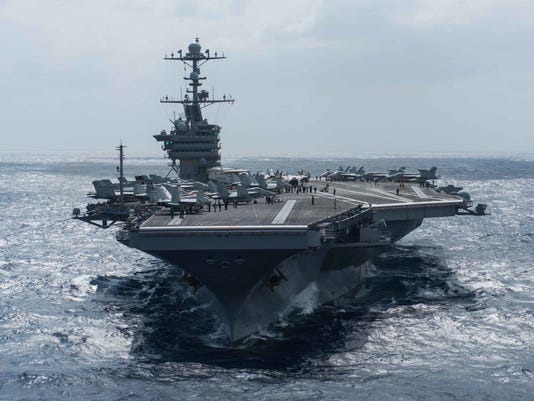
The aircraft carrier USS Carl Vinson (CVN 70) transits the South China Sea.
The aircraft carrier USS Carl Vinson (CVN 70) transits the South China Sea. The Carl Vinson Carrier Strike Group is on a regularly scheduled Western Pacific deployment as part of the U.S. Pacific Fleet-led initiative to extend the command and control functions of U.S. 3rd Fleet. U.S Navy aircraft carrier strike groups have patrolled the Indo-Asia-Pacific regularly and routinely for more than 70 years. U.S. Navy photo by Mass Communication Specialist 3rd Class Matt Brown (Released) 170408-N-HD638-152

USS CARL VINSON, At Sea (NNS) -- Adm. Harry Harris, commander, U.S. Pacific Command, has directed the Carl Vinson Strike Group to sail north and report on station in the Western Pacific Ocean after departing Singapore April 8.

Carl Vinson Strike Group, including Nimitz-class aircraft carrier USS Carl Vinson (CVN 70), embarked Carrier Air Wing (CVW) 2, Arleigh Burke-class guided-missile destroyers USS Wayne E. Meyer (DDG 108) and USS Michael Murphy (DDG 112), and Ticonderoga-class guided-missile cruiser USS Lake Champlain (CG 57), will operate in the Western Pacific rather than executing previously planned port visits to Australia. The Strike Group will remain under the operational control of U.S. 3rd Fleet as part of the 3rd Fleet Forward initiative.

Deployed from San Diego to the Western Pacific since Jan. 5, the Strike Group has participated in numerous bilateral exercises with the Japan Maritime Self Defense Force and Republic of Korea Navy, various maritime security initiatives, and routine patrol operations in the South China Sea.

For more than 70 years, the U.S. Navy has maintained a persistent naval presence in the Indo-Asia Pacific. The U.S. Navy is committed to continuing this forward presence, which is focused on stability, regional cooperation and economic prosperity for all nations. Carl Vinson has deployed to the region several times, starting with a deployment to the Western Pacific in 1983, a year after commissioning. Most recently in 2015, Carl Vinson conducted port visits and exercises with regional navies in the South China Sea.

U.S. 3rd Fleet leads naval forces in the Pacific and provides the realistic, relevant training necessary for an effective global Navy. Third Fleet constantly coordinates with U.S. 7th Fleet to plan and execute missions based on their complementary strengths to promote ongoing peace, security, and stability throughout the entire Indo-Asia-Pacific theater of operations.

Tuesday, March 08, 2016

Stennis Strike Group Wraps Up Routine Operations in the South China Sea

USS John C. Stennis (CVN 74) participates in a replenishment-at-sea with the fast combat support ship USNS Rainier (T-AOE 7) and the guided-missile cruiser USS Mobile Bay (CG 53). Mobile Bay is receiving an advanced biofuel mixture from Rainier. Providing a ready force supporting security and stability in the Indo-Asia-Pacific, Stennis is operating as part of the Great Green Fleet on a regularly scheduled 7th Fleet deployment. (U.S. Navy photo by Mass Communication Specialist 2nd Class Andrew P. Holmes/Released)
From John C. Stennis Strike Group Public Affairs 

PHILIPPINE SEA (NNS) -- The John C. Stennis Strike Group (JCSSG) has completed routine operations in the South China Sea, and transited into the Philippine Sea through the Luzon Strait.

 The JCSSG operated in the South China Sea, March 1 through March 6.

 It was the crew's first time operating there since their regularly scheduled deployment began Jan. 15. The JCSSG conducted daily flight operations and a replenishment-at-sea during their transit, receiving advanced bio fuel, aviation fuel, and supplies from USNS Rainier (T-AOE 7).

 While operating in the South China Sea, the crew sharpened their skills in one of the most heavily trafficked areas in the world. Roughly $5 trillion in trade is shipped through the South China Sea every year.

 Senior Chief Quartermaster Henry Nicol, USS John C. Stennis' (CVN 74) navigation department leading chief petty officer, said it's essential to carefully monitor the ship's position and course, because of congested sea lanes.

 Sailors working in Stennis' Carrier Air Traffic Control Center (CATCC) also take on a more active role in controlling aircraft.

 Lt. Jason Falk, from the Wizards of Electronic Attack Squadron (VAQ) 133, from Stuart, Florida, welcomes the challenge.

 "It feels exciting," Falk said. "I'm putting what I have learned to use."

 Falk said the crew remains on higher alert while operating in this congested area to identify contacts as early as possible to maintain awareness.

 Additionally, People's Liberation Army (Navy) ships remained in the vicinity of Stennis during its time in the South China Sea. All bridge-to-bridge interactions between the Sailors of both navies were professional.

 "Based on the bridge-to-bridge communications USS Chung-Hoon had with the PLA(N) ships, it is clear that the Chinese Navy prides itself on professional
communications and interactions," said Cmdr. Tom Ogden, commanding officer of USS Chung-Hoon (DDG 93).

 Rear Adm. Ronald Boxall, JCSSG's commander, said he is not surprised by other countries' interests in the strike group.

 "We're exercising our right to operate in international waters," Boxall said. "Our presence here promotes peace and stability in the region."

 The strike group is comprised of Stennis with Carrier Air Wing (CVW) 9 and Destroyer Squadron (DESRON) 21 embarked, Arleigh Burke-class guided-missile destroyers USS Chung-Hoon (DDG 93), USS Stockdale (DDG 106), USS William P. Lawrence (DDG 110), and Ticonderoga-class guided-missile cruiser USS Mobile Bay (CG 53).

 CVW-9 consists of Helicopter Maritime Strike Squadron (HSM) 71, Helicopter Sea Combat Squadron (HSC) 14, Airborne Early Warning Squadron (VAW) 112, Electronic Attack Squadron (VAQ) 133 and Strike Fighter Squadrons (VFA) 151, 97, 41, and 14.

 The strike group is the centerpiece of the Great Green Fleet, a yearlong initiative highlighting the Navy's efforts to transform its energy use to increase operational capability. JCSSG will use energy efficiency measures, to include technologies and operational procedures, and alternative fuel in the course of its normal operations.

Thursday, March 03, 2016

The U.S. just sent a carrier strike group to confront China

Aircraft carrier John C. Stennis has sailed into the South China Sea to exercise their freedom to navigate through the tense region. The show of force comes a week after the head of U.S. Pacific Command said China was militarizing the region.(Photo: MCSA Justin Rayburn/Navy)
By David Larter, Navy Times

The U.S. Navy has dispatched a small armada to the South China Sea.
The carrier John C. Stennis, two destroyers, two cruisers and the 7th Fleet flagship have sailed into the disputed waters in recent days, according to military officials. The carrier strike group is the latest show of force in the tense region, with the U.S. asserting that China is militarizing the region to guard its excessive territorial claims.
Stennis is joined in the region by the cruisers Antietam and Mobile Bay, and the destroyers Chung-Hoon and Stockdale. The command ship Blue Ridge, the floating headquarters of the Japan-based 7th Fleet, is also in the area, en route to a port visit in the Philippines. Stennis deployed from Washington state on Jan. 15.

The rest of the article can be seen on the Navy Times website at http://www.navytimes.com/story/military/2016/03/03/stennis-strike-group-deployed-to-south-china-sea/81270736/

Sunday, January 31, 2016

More Rock amd Roll Adventures from the HFGCS Chronicles

Saturday, the U.S. Navy sent the USS Curtis Wilbur (DDG-54) warship near a disputed island in South China Sea according to various press reports. See CNN story at http://www.cnn.com/2016/01/30/asia/us-navy-south-china-sea/.
 
Pacific Ocean: The guided-missile destroyer USS Curtis Wilbur (DDG 54) transits through the Pacific Ocean with Mt. Fuji in the background. Curtis Wilbur is underway supporting security and stability in the western Pacific Ocean. (U.S. Navy photo by Mass Communication Specialist Seaman Adam K. Thomas/Released)
Any naval operation like this can be a bit dangerous especially if the three parties involved in the disputed land mass get edgy. But there is also a potential treasure trove of intelligence to be gathered.
 
And what did we have flying around the South China Sea area Saturday using call sign Tora 82 (a 4-digit call I might add)? A USAF RC-135V Rivet Joint aircraft.
 
 
And what is this aircraft used for. From the official US Air Force public fact sheet:
 
Mission The RC-135V/W Rivet Joint reconnaissance aircraft supports theater and national level consumers with near real time on-scene intelligence collection, analysis and dissemination capabilities.

Features The aircraft is an extensively modified C-135. The Rivet Joint's modifications are primarily related to its on-board sensor suite, which allows the mission crew to detect, identify and geolocate signals throughout the electromagnetic spectrum. The mission crew can then forward gathered information in a variety of formats to a wide range of consumers via Rivet Joint's extensive communications suite.

The interior seats more than 30 people, including the cockpit crew, electronic warfare officers, intelligence operators and in-flight maintenance technicians.

The Rivet Joint fleet was re-engined with CFM-56 engines with an upgraded flight deck instrumentation and navigational systems to FAA/ICAO standards. These standards include conversion from analog readouts to a digital "glass cockpit" configuration.

All Rivet Joint airframe and mission systems modifications are overseen by L-3 Communications (previously Raytheon), under the oversight of Air Force Materiel Command.

Background The current RC-135 fleet is the latest iteration of modifications to this pool of -135 aircraft going back to 1962. Initially employed by Strategic Air Command to satisfy nationally tasked intelligence collection requirements, the RC-135 fleet has also participated in every sizable armed conflict involving U.S. assets during its tenure. 

RC-135s were present supporting operations in Vietnam, the Mediterranean for Operation El Dorado Canyon, Grenada for Operation Urgent Fury, Panama for Operation Just Cause, and Southwest Asia for operations Desert Shield, Desert Storm, Enduring Freedom and Iraqi Freedom. RC-135s have maintained a constant presence in Southwest Asia since the early 1990s.

All RC-135s are assigned to Air Combat Command. The RC-135 is permanently based at Offutt Air Force Base, Neb., and operated by the 55th Wing, using various forward deployment locations worldwide. More recently, RC-135s have also supported Operation Allied Force in Kosovo, and Operation Odyssey Dawn/Unified Protector in Libya
So looks like we had Tora 82 supporting the Curtis Wilbur on Saturday in the South China Sea. Was our Saturday "Santana" Foxtrot/Skyking message directed at Tora 82?
 
Maybe!  Chief Sends


Tuesday, March 10, 2009

Chinese Vessels Shadow, Harass Unarmed U.S. Survey Ship

A crewmember on a Chinese trawler uses a grapple hook in an apparent attempt to snag the towed acoustic array of the military Sealift Command ocean surveillance ship USNS Impeccable (T-AGOS-23). Impeccable was conducting routine survey operations in international waters 75 miles south of Hainan Island when it was harassed by five Chinese vessels. (U.S. Navy photo/Released)

By Jim Garamone
American Forces Press Service

WASHINGTON - Five Chinese vessels shadowed and aggressively maneuvered close to the USNS Impeccable in the South China Sea yesterday, a senior Pentagon official said today.
The U.S. oceanographic ship was 70 miles south of Hainan Island conducting routine operations in international waters when the ships approached, Pentagon spokesman Bryan Whitman said.

"We view these as unprofessional maneuvers by the Chinese vessels and violations under international law to operate with due regard for the rights and safety of other lawful users of the ocean," Whitman said.

A civilian crew mans the ship, which operates under the auspices of the Military Sealift Command.

The incident began as the ships surrounded the Impeccable and two craft closed to within 50 feet, Whitman said. The Chinese ships included a Chinese navy intelligence collection ship, a Bureau of Maritime Fisheries patrol vessel, a State Oceanographic Administration patrol vessel and two small Chinese-flagged trawlers.

Crewmen aboard the Impeccable used fire hoses to spray one of the vessels as a protective measure. The Chinese crewmembers disrobed to their underwear and continued closing to within 25 feet.

The Chinese vessels dropped pieces of wood in the water directly in the Impeccable's path, and two of the ships stopped directly in the U.S. vessel's path, forcing it to stop.

Whitman said the Chinese used poles in an attempt to snag the Impeccable's towed acoustic array sonars. Impeccable's master used bridge-to-bridge radio circuits to inform the Chinese ships in a friendly manner that it was leaving the area and requested a safe path to navigate.

"These are dangerous close maneuvers that these vessels engaged in," Whitman said.

The incident was the culmination of earlier harassment. A Chinese patrol vessel shined a high-intensity spotlight March 4 on the USNS Victorious operating in the Yellow Sea 125 miles from China's coast. Chinese maritime aircraft "buzzed" the ship 12 times March 5.

A Chinese frigate crossed the bow of the Impeccable at a range of about 100 yards March 5. Maritime aircraft buzzed the ship after that incident.

Another Chinese ship challenged Impeccable over bridge-to-bridge radio March 7, calling its operations illegal and directing the American ship to leave the area or "suffer the consequences," officials said.

The Impeccable is one of six surveillance ships that gather underwater acoustical data, Whitman said. U.S. ships routinely operate in the area.

"We expect Chinese ships to act responsibly and refrain from provocative activities that could lead to miscalculation or a collision at sea, endangering vessels and the lives of U.S. and Chinese mariners," a Defense Department official said.

U.S. embassy officials lodged a protest against these actions with the Foreign Ministry in China, and Defense Department officials have protested with the Chinese embassy here.