Friday, January 12, 2007

Travis, Robins test wireless aircraft intercom system


FORT DIX, N.J. (AFNEWS) -- For five days, Air Force aircraft maintainers at Travis Air Force Base, Calif., and Robins Air Force Base, Ga., demonstrated the Telephonics TruLink Wireless System at their respective bases to great success.

The system demonstration was conducted as part of an initiative dubbed "Wireless Intercom for Aircraft Ground Operations," or WIAGO, by the Air Mobility Warfare Center's Air Mobility Battlelab here.

The purpose of the WIAGO system is to improve on the current corded aircraft intercom system by migrating it into a wireless system, said Master Sgt. Rudy Cartagena, the battlelab's project officer on the initiative. The current intercom system for short range communications in and around airlift and tanker aircraft uses 50- to 100-foot-long cords that physically connect maintainers and aircrew to the aircraft. These cords, by their very nature, restrict user movement.

"The problem is amplified when cords become tangled with other cords and equipment," Sergeant Cartagena said. "When maintenance must be conducted beyond the reach of the cords, maintainers are forced to use hand signals, which can be misinterpreted."

The WIAGO system is based on a hand-held radio-size, battery-powered adapter.
"There are two, almost identical, variations of the adapter with the only difference being the connectors they use," Sergeant Cartagena said. "This is because one connects to the aircraft intercom system, called the access point, and the other connects to the user's headset, called the portable transceiver. WIAGO can operate as a stand-alone system, independent from the aircraft intercom system, or in concert with it, allowing personnel wearing a portable transceiver to communicate with personnel connected to the aircraft intercom system via cords."

The access point does not require permanent installation and connects to any active aircraft intercom terminal, using an aircraft-specific cable, Sergeant Cartagena said. The portable transceiver clamps on to the uniform and has a banana jack receptacle for use with standard Air Force issue headsets.

"WIAGO operates in the 2.4 Gigahertz license free band," Sergeant Cartagena said. "The adapters have 50 channels and can support 31 users per channel, six in full duplex. Full duplex capability means no 'push to talk' is needed -- similar to carrying a conversation on a regular phone using a receptionist headset.

"The system has a low probability of intercept due to its short range and use of frequency hopping," Sergeant Cartagena added. "It also has a very effective noise suppression system; we were extremely impressed."

During the demonstration of the system, WIAGO adapters were used to transmit and receive during pre-determined scenarios and maintenance tasks to assess the adapter's functionality. C-5 Galaxy and KC-10 Extender aircraft were selected for use in the demonstration because of the challenge their large size would present to the WIAGO wireless system.

"The logic going in was if WIAGO works well with these large aircraft, it should also work with smaller ones," Sergeant Cartagena said. "Using maintenance Airmen at Travis and Robins to demonstrate the system made sense because it provided a larger user sample and enabled equipment assessment in two different maintenance environments -- at organizational and depot levels."

Some of the maintenance tasks performed during the demonstration time period included towing an aircraft, an engine run and a floor board installation at the depot. During towing, WIAGO enabled cordless, spoken communication between all tow team members, Sergeant Cartagena said.

"Being able to communicate specific instructions directly into one's ear is a more efficient approach than using hand signals," he said. "This was also an improvement when connecting the tow truck."

During the engine run, WIAGO's noise suppression capability enabled clear spoken communication in a high noise environment of more than 120 decibels.

"This, in turn, eliminated time wasted repeating instructions due to background noise," Sergeant Cartagena said. "The system's compatibility with the aircraft communication system enabled an Airman in the cockpit to communicate with maintainers on the ground as well as with the air traffic control tower."

During the floor board installation at the depot, headsets are not normally used. "The floor between the workers, and with rivet gun noise in the background, presents a tough communication barrier during the installation process," Sergeant Cartagena said. "Yelling instructions, which is the standard way of doing things, is inefficient. Use of the aircraft communications system would eliminate this problem, but it requires aircraft power, which isn't always permitted during depot work. Using the WIAGO system made this operation more efficient by virtually eliminating the need to repeat instructions when they aren't heard."
First Lt. Steven LeBlanc, a maintenance officer for the 60th Aircraft Maintenance Squadron at Travis, said the wireless intercom system was well received by the maintainers.
"The Airmen expressed great interest in the system and felt it would really help them in their day-to-day operations," Lieutenant LeBlanc said. "They appreciated the fact they were able to move in and around the aircraft unrestricted while keeping clear and sustained communication with their teammates."

Although the WIAGO system did not face every possible maintenance scenario during demonstration period, it faced enough scenarios to confidently arrive at one conclusion -- WIAGO will provide maintenance personnel increased mobility, improving efficiency and enhancing communications capabilities during ground operations, Sergeant Cartagena said.

Expensive new U.S. spy satellite USA193/NROL-21 not working: sources


Author Note: So much for the theory by some that these US government satellites get their USA ### designation when they become operational. This mission a subsequent failure would indicate that theory is not correct. I originally reported on this satellite in this blog on December 16, 2006.

This satellite was USA-193/NROL-21 launched on December 13, 2006, at 2100 UTC (1600 EST) from the Western Test Range, Vandenberg AFB, California (Launch complex/pad: SLC2W) It carries an International Designator: 2006-057A (SSC #: 29651).

Many thanks to Ted Molczan and the SEESAT-L newsgroup for this heads up.
Here is an excerpt from the Reuters news article that broke this story.
By Andrea Shalal-Esa - Exclusive
WASHINGTON (Reuters) - U.S. officials are unable to communicate with an expensive experimental U.S. spy satellite launched last year by the U.S. National Reconnaissance Office (NRO), a defense official and another source familiar with the matter told Reuters on Thursday.
Efforts are continuing to reestablish communication with the classified satellite, which cost hundreds of millions of dollars, but "the prognosis is not great at this point," said the defense official, who asked not to be identified.
"They have not yet declared it a total loss. There are still some additional steps that can be taken to restore communication," the official added, noting some satellites had been recovered in similar situations in the past.
The official said the problems were substantial and involved multiple systems, adding that U.S. officials were working to reestablish contact with the satellite because of the importance of the new technology it was meant to test and demonstrate.
The other source said the satellite had been described to him as "a comprehensive failure."

Wednesday, January 10, 2007

Russian Military Navsat Status Report


In the October 2006 issue of my Monitoring Times Milcom magazine column, I covered a lot of the easy satellites there are to hear in the radio spectrum. One of those is the Russian "Cosmos" military navsats that transmit in the 150 and 400 MHz portions of the spectrum. You can get a reprint of that article from the folks at Monitoring Times. It will also be available soon on CD-ROM on the 2006 MT Anthology.

In the article I covered modulation and decoding information on these military navsats.

But as an exclusive for my blog readers, here is my latest Russian Navsat constellation status report based on monitoring from my Btown Monitoring Post:


Russian Parus Military Navasat Constellation Status
Freq (MHz) Int Desig (SSC #) Name

149.910/399.760 2003-023A (27818) Cosmos 2398, Orbital Plane 2
149.940/399.840 2001-023A (26818) Cosmos 2378, Orbital Plane 6
149.970/399.920 2004-028A (28380) Cosmos 2407, Orbital Plane 1
149.970/399.920 2005-002A (28521) Cosmos 2414, Orbital Plane 4
150.030//400.080 1998-076A (25590) Cosmos 2361, Orbital Plane 5

Tuesday, January 09, 2007

US Army Golden Knights 2007 Schedule


Photo courtesy of the US Army Black Knights.
You will notice in the schedule we have provided below that the GK Team may be appearing in more than one location during a given weekend. This is because they have two teams (Gold/Black). The pre-public release schedule we received from the team does not show which team is going to which location. We hope to have that very soon.

In the meantime, don't forget our eighth annual Air Show Guide that will appear in the March 2007 issue of Monitoring Times magazine. It will be loaded with the latest frequencies (for US and foreign teams), combined schedules, and radio equipment recommendations to make your air show experience an enjoyable and pleasurable one.

The web version of our March guide won't be posted to the MT website until mid to late April. This is done as a courtesy to our subscribers and readers who pay the freight. So get your copy of the March issue before it sells out when it is released in the last week of February. Better yet, get a subscription and don't miss a single exciting issue of Monitoring Times magazine.

Golden Knights 2007 Performance Schedule
March
17-18 Davis-Monthan AFB AZ/Titusville FL
24-25 Punta Gorda FL/Luke AFB AZ
April
14-15 Eglin AFB FL
21-22 Charleston AFB SC/Wilmington NC

May
05-06 Ft. Lauderdale FL/Offutt AFB NE
12 Seymour-Johnson AFB NC
12-13 McGuire AFB NJ
18-20 Andrews AFB MD
19-20 Ft. Jackson SC
26-27 Jones Beach NY
27 Charlotte NC

June
02-03 Rockford IL
09-10 Travis AFB CA
16-17 Muncie IN
29-30 Binghamton NY
30 Evansville IN

July
01 Evansville IN
04 Ft. Bragg NC
07-08 Camp Grayling MI
14-15 McConnell ARB KS/Gary IN
21-22 Peoria IL
25 Ionia MI
25-28 Sioux City IA
28-29 Dayton OH
August
04-05 Janesville WI
11-12 Altoona PA/Hillsboro OR
15 Atlantic City NJ
18-19 Eau Claire WI/Chicago IL
25-26 Kansas City MO/Otis ANGB MA

September
01-03 Cleveland OH
08-09 Window Rock AZ
15-16 NAS Brunswick ME
22-23 El Paso TX/Millington TN

October
06-07 Pope AFB NC
13-14 MCAS Miramar CA/MCAS Kaneohe HI
20-21 Ft. Worth (Alliance Airport) TX/Richmond VA
27-28 Muskogee OK

November
03-04 Cape Canaveral FL

CTF 150 Maintains Presence Off East Coast of Africa


This is the Task Force that is hunting down Al-Qaida in Somalia.


From U.S. Naval Forces Central Command/U.S. 5th Fleet Public Affairs

MANAMA, Bahrain (NNS) -- Coalition ships from the British-led Combined Task Force (CTF) 150 continue to maintain a presence off the east coast of Africa in response to the recent events in Somalia.

CTF 150 includes USS Ramage (DDG 61) and USS Bunker Hill (CG 52) and other coalition ships. These warships are conducting maritime security operations (MSO) to ensure continued security and stability of international waters surrounding the Horn of Africa.

Coalition naval forces are performing boardings on a number of vessels to deter individuals with links to al-Qaida and other terrorist organizations the use of the sea as a potential escape route.
The coalition ships of CTF 150 maintain a maritime presence in the international waters of the Gulf of Oman, North Arabian Sea, parts of the Indian Ocean, Gulf of Aden, and the Red Sea.
Recent events in Somalia are a cause of concern because of the potential for an increased risk of piracy and illegal activities that historically has followed the instability in that country.

Royal Navy Commodore Bruce Williams, Commander, Task Force 150, based in Bahrain, said, “In response to international will, CTF 150 provides an enduring coalition maritime presence in the region to promote a safe and secure maritime environment, and most importantly, support our regional friends in their drive for peaceful use of the high seas and territorial waters. Coalition Forces will continue routine operations in this unstable area as long as the need exists for our presence.”

MSO help set the conditions for security and stability in the maritime environment, as well as complement the counter-terrorism and security efforts of regional nations. These operations deny international terrorists use of the maritime environment as a venue for attack or to transport personnel, weapons or other material.

CTF 150 is one of three coalition maritime task forces that conduct MSO under the direction of U.S. Navy Vice Admiral Patrick Walsh, Combined Forces Maritime Component Commander, based in Bahrain. Walsh also commands CTF 158 in the North Arabian Gulf and CTF 152, which is responsible for patrolling the Central and Southern Arabian Gulf.

HSL 43 Det. 4 Returns from Counter Narco-Terrorism Deployment


By Lt. Ryan Atwood, Helicopter Anti-Submarine Squadron Light 43 Public Affairs

NORTH ISLAND, Calif. (NNS) -- The “Rat Pak” of Helicopter Anti-Submarine Squadron Light (HSL) 43, Detachment (Det.) 4, returned to San Diego Dec. 15 from a six-month counter narcotics deployment aboard USS Thach (FFG 43).

The detachment conducted operations in the eastern Pacific Ocean and Caribbean Sea. The primary mission of the deployment was detection and monitoring of suspected drug smuggling vessels using Airborne Use of Force (AUF), the Navy’s newest tactic in the war on narco terrorism. AUF combines Navy helicopters with U.S. Coast Guard airborne controllers and gunners to use warning shots and disabling fire to stop drug trafficking speed boats. The speed boats previously out-ran slower Navy ships and outlasted fuel limited helicopters.

Squadron personnel integrated with Thach and U.S. Coast Guard Sailors to locate, identify and query vessels for boarding and search by the Coast Guard law enforcement team.
During the deployment, counter narcotic operations resulted in four successful drug busts. A combined total of nearly 23 tons of cocaine, with a street value estimated at $600 million, was seized and 34 drug-traffickers were detained.

In one instance Det. 4, used AUF by firing two rounds to disable the engines of a high-speed drug-trafficking vessel known as a “go fast” boat. After the boat was stopped, Det. 4 seized 1,000 lbs. of cocaine and captured four drug traffickers. Over the course of the deployment, Det. 4 flew over 500 mishap-free flight hours. While deployed, the detachment visited Panama, Peru, and the Bahamas.

U.S. icebreaking ship arrives in McMurdo


1/8/2007 - MCMURDO, Antarctica (AFNEWS) -- The Coast Guard became part of the Air Force-led Joint Task Force Support Forces Antarctica Jan. 1 with the arrival of the Cutter Polar Sea at McMurdo Station, Antarctica.

Home ported in Seattle, the Polar Sea arrived after a month-long voyage including stops in Honolulu and Sydney, Australia.

The Polar Sea joined the Swedish icebreaker Oden, which began breaking ice Dec. 26.
For the past 50 years, Coast Guard icebreakers have deployed to Antarctica in support of Operation Deep Freeze, where ships have broken through as much as 84 nautical miles of ice to produce a navigable shipping channel into McMurdo Station. This year's channel will be approximately 23 nautical miles long -- 13 of which is first year ice at an average thickness of 3 to 5 feet and 10 of which is multi-year ice at an average thickness of 5 to 11 feet.

This vital shipping channel allows supply ships to deliver more than 6 million gallons of fuel and 4,000 metric tons of cargo, enabling McMurdo Station and South Pole Station to remain manned and operational throughout the harsh winter months. The Polar Sea also acts as a floating research platform for scientists that travel onboard.

Ice breaking operations will continue until the departure of the cargo ship in mid-February when the Polar Sea will return home.

The Polar Sea, a 399-foot polar class icebreaker with a 140-person crew, is recently out of a two-year overhaul. The Polar Sea conducted sea trials in the Arctic this summer to test all the ship's equipment and train the crew prior to transiting to Antarctica to re-supply the McMurdo station for the National Science Foundation.

The Polar Sea was specifically designed for solo icebreaking in remote Polar Regions. The cutter's red reinforced hull is made of 1.75 inches of steel that covers a specially contoured icebreaking bow. The cutter can call on 75,000 shaft horsepower enabling it to break up to 21 feet of ice. The Polar Sea has deployed 17 times in support of Operation Deep Freeze.

(Courtesy of 13th Air Force Public Affairs)

HF and VHF frequencies used in Antarctica
Source: Field Manual for the US Antarctica Program

HF Comms
Primary HF transmission mode is USB. Communications between Antarctica field parties and fixed-wing aircraft normally occur on 9032 kHz. If a fixed-wing aircraft cannot be reached on that frequency, they use 4770 kHz or 11553 kHz to contact MAC Ops at McMurdo. Helo secondary frequency is 9032 kHz. The primary frequencies for passing weather observations is:

• 11553 kHz for remote-site field parties.
• 4770 kHz for Dry Valley and surrounding areas field parties.

McMurdo Station
Frequency Channel Description
4770 kHz Ross Island and Dry Valley Field Parties
5100 kHz Air-to-Ground
5400 kHz Scott Base Field Parties
7995 kHz Remote/South Pole
9032 kHz Air-to-Ground
11553 kHz Remote Field Parties

Palmer Station
Frequency Channel Description
4125 kHz Secondary USAP Field Parties
11553 kHz Primary USAP Field Parties

VHF Comms
McMurdo Frequency Plan (For vehicle and handheld radios in the McMurdo vicinity):
Transmit Receive CH Net Name freq. (MHz) freq. (MHz)
1* I-Net (T-Site ) 143.000 143.000
2* Crash Net (T-Site) 139.600 139.600
3* NZ Portable 142.800 138.800
4* NZ Crater Hill 139.300 143.800
5 Public Works (T-Site) 139.000 142.600
6 Airfield Ops 139.200 139.200
7 Science Net 139.500 139.500
8 Field Party Ops 138.600 143.225 (Aurora repeater)
9 Fuels Net (T-Site) 143.600 143.600
10 Movement Control Center 139.800 143.725 ( U.S. Crater Hill repeater)
11 Helo Ops 143.400 143.400
12 Penguin Ops/ANG 143.200 143.200

Further Field Party Frequency Plan (For portable and handheld VHF radios issued to science groups and support personnel deploying to the Dry Valleys, sea ice camps, and Ross Island camps):
Transmit ReceiveCH Net Name freq. (MHz) freq. (MHz)
1* I-Net (T-Site ) 143.000 143.000
2* Crash Net (T-Site) 139.600 139.600
3 Science Net 139.500 139.500
4 Helo Ops 143.400 143.400
5* NZ Crater Hill 139.300 143.800
6 Helo Flight Following 138.500 143.975
7 Field Party Ops 138.600 143.225 (Taylor repeater)
8 Field Party Ops 138.600 143.225 (Wright repeater)
9 Field Party Ops 138.600 143.225 (Terror repeater)
10 Field Party Ops 138.600 143.225 (Aurora repeater)
11 Field Party Ops 138.600 143.225 (Brooke repeater)
12 Blank

Callsigns
Mac Ops -- Field Operation Communications Center, second floor of Bldg 165 at McMurdo. Air National Guard LC-130 aircraft are identified by the call sign “Skier,” followed by a specific aircraft number.Helicopters are identified by the last three digits on the helicopter tail. The digits are always two numbers and a letter.

Thursday, January 04, 2007

Second Carrier to Deploy to the Persian Gulf


The Reuters news agency is reporting that the USS John C. Stennis will soon join the USS Dwight D. Eisenhower in the Persian Gulf. According to anonymous sources this is at the request of US Central Command and is designed as a show of force to Iran and Syria.

You can read the complete story at:

Thanks to Chris Corley via the Milcom newsgroup for this heads up. And remember if you have something to share with the blog and our readers, please send it along to larryvanhorn @ monitoringtimes.com.

US Navy Photo: VFA-146 F/A-18 side number 307 flies over the USS John C. Stennis.

USAF not being stealthy about upgrading B-2 fleet


1/2/2007 - LANGLEY AIR FORCE BASE, Va. (AFPN) -- The Air Force isn't being stealthy about plans to upgrade its B-2 Spirit fleet; officials say the bomber will need numerous upgrades over its life span.
Some upgrades are already complete, but others are planned years, even decades ahead, said Lt. Col. Brian Zembraski, 509th Bomb Wing director of staff at Whiteman Air Force Base, Mo.
"We need to look to the future to the ways to keep up with the changes in technology, improve upon the aircraft, implement those things in any future platforms that the Air Force may move towards," Colonel Zembraski said.
The colonel said the B-2 has already been fitted with improved bomb racks that have increased the number of 500-pound guided bombs these aircraft can carry from 16 to 80, a 500-percent expansion. More important upgrades are coming, he said.
In addition, Colonel Zembraski said improvements have been made to the Spirit's coating, which has reduced maintenance actions from days to minutes.
Next in line for the B-2 is "Link-16," a radio that will feed targeting information directly to individual bombs. Other future upgrades include radar updates, which will enable the B-2's weaponry to reach targets further underground.
"With the capabilities of satellite communications, our ability to get e-mail into the cockpit, direct communications into the cockpit, pictures of the battlefield with Link 16, (it) is absolutely essential to the battlefield of today," the colonel said.
Photo: A B-2 Spirit bomber from the 509th Bomb Wing at Whiteman Air Force Base, Mo., takes off for a mission during a recent air and space expeditionary force deployment to Andersen Air Force Base, Guam. Air Force officials are planning numerous upgrades for the B-2 Spirit fleet over its life span. (U.S. Air Force photo/Master Sgt. Val Gempis)

AWACS - A Team Effort


There is an interesting feature story on the key members of an USAF AWACS crew at the link below. The story is built around the deployment of the 964th Expeditionary Airborne Air Control Squadron to the Manta Forward Operating Location in Ecuador in support of counter narco operations. You can read the story at http://www.af.mil/news/story.asp?storyID=123035975

Photo: Tech. Sgt. Erich Ross runs through operational checklists during an E-3 Sentry mission Dec. 21 over Ecuador. Sergeant Ross is a flight engineer with the 964th Expeditionary Airborne Air Control Squadron. (U.S. Air Force photo/2nd Lt. Amber Balken)

Saturday, December 30, 2006

New Cleary HF Counter Narco Net List Posted


I have added the latest Mark Cleary U.S. Counter-Drug/Law Enforcement/Homeland Security HF ALE List to my Btown Monitor Post blogspot. If you are interested in the ALE addresses and frequency information for the COTHEN Net, TISCOM Net, FBI ALE Net, US Army/DEA PANTHER Net, and US Army South Flight Following Service (SKYWATCH) Net, jump over to my other blog and take a peak.

Friday, December 29, 2006

More Washington, DC Frequency Coverage

I have posted additional material on Washington DC government frequencies and area major airport frequencies on my other blogspot, the Btown Monitoring Post.

Andrews AFB Aeronautical Frequencies

Since there is going to be a lot of traffic in and out of Andrews AFB over the next few days, here is my latest list of aero freqs for the base.

Potomac Approach 119.300 335.500
Potomac Departure 125.650 348.725
Andy Tower 118.400 349.000
Andy Ground Control 121.800 275.800
ATIS 113.100 251.050
Clearance Delivery 127.550 285.475
Pilot-to-Dispatcher 139.300 USN/USAF/372.200 USAF/386.800 USN
PMSV Metro 344.600

Base/Unit Command Post
141.550/378.100 89AW Command Post
141.700/292.200 89AW/1HS Operations Mussel Control/Ops
143.800/351.200 459AW/756AS Command Post/Operations
251.900 89AW/1HS UH-1 Mussel c/s
266.500 113FW Safety of Flight (SOF)
314.250 113 Wing/201AS Operations Boxer Ops
328.400 VR-53 Squadron Common
351.800 113 Wing/121FS Command Post/Supervisor of Flight

129.525 89AW SAM Aircraft Interplane
136.725 89AW SAM Aircraft Interplane
225.600 89AW SAM Aircraft Interplane
283.875 357AW/457AS Aircraft Interplane
297.500 89AW/1HS Aircraft Interplane
320.400 HMX-1 Com 3

DoD Switchboard 268.000 287.500 293.500

Guard Dog Washington Area NORAD CAP Profile

Washington D.C. Combat Air Patrol - GUARD DOG (DC and Camp David Airspace)
Since there will be a lot of VIPs in the Washongton, D.C. area over the next few days, here is a small profile on NORAD CAP frequencies and callsign that will surely be up 24/7.

121.500 International Civilian Calling/Emergency
135.525/350.250 Washington ARTCC Guard Dog Coordination Frequencies (UHF new ex-288.350 MHz)
134.150/327.000 Washington ARTCC
228.900 NORAD Discrete "Huntress"
243.000 International Military Calling/Emergency
255.400 FAA Flight Service Station Leesburg, Virginia
260.900 NORAD Discrete "Huntress"
320.600 CAP Aerial refueling Boom Freq
324.000 CAP Aerial refueling Boom Freq
364.200 NORAD AICC369.150 Occasional CAP unit air-air

Callsigns:
Arrow ## 33FW/60FS (Eglin AFB) 338.750/369.150 MHz
Brave ## 113 Wing/121FS (DC ANG) 139.700 MHz A-A
Cosmic ## 177FW/119FS (NJ ANG) 138.200 MHz A-A
Harass ## 1FW/27FS (Langley AFB)
Pittman ## 20FW/79FS (Shaw AFB) 142.125 143.800 MHz A-A
Spider ## 119FW (ND ANG) 138.000 MHz A-A
Tanker ## Aerial refueling aircraft

Huntress NEADS/SEADS NORAD Air Defense Control Center

Military TRS Freqs to Monitor During Prez Ford Funeral Events

The following military trunk systems should be monitored for support of the President Ford funeral events in the Washington, DC area. Reports, updates, additions and corrections would be most appreciated. Send your stuff to larryvanhorn @ monitoringtimes.com.


380-400 MHz Trunk Radio Systems

MCB/MCAS Quantico, VA
Site 1 385.6750/395.6750c
Site 2 385.6250/395.6250c 386.4375/396.4375 386.9125/396.9125 387.9500/397.9500
Site 3 380.4875/390.4875c 381.2000/391.2000 381.3375/391.3375 381.6875/391.6875 381.83750/391.8375

Washington, D.C. – Joint National Capitol Region System
Site 1 386.1875/396.1875 386.9875/396.9875 387.0625/397.0625 388.1125/398.1125 388.1375/398.1375 388.1625/398.1625 388.1875/398.1875 388.2125/398.2125 388.2625/398.2625 388.3125/398.3125 388.3375/398.3375

Ft. Detrick, Maryland
Site 1 385.7000/395.7000c 385.8000/395.8000c 385.9500/395.9500 387.2375/397.2375 387.5375/397.5375 387.6375/397.6375

Ft. A. P. Hill, Virginia System 00a
System ID: 00a P25 WACN: 580A0
Site 1 385.7875/395.7875c 387.2250/397.2250c 387.5250/397.5250 387.8250/397.8250 389.1250/399.1250 389.3000/399.3000

Washington, D.C. System 00c
System ID: 00c P25 WACN: 580A0
Site 1 385.7125/395.7125c

Tyson's Corner, Virginia System 00d
System ID: 000d P25 WACN: 580A0
Site 1 380.1250/390.1250c 380.4250/390.4250c 380.4875/390.4875

Ft. Belvoir, Virginia System 1
System ID: 001 P25 WACN: 580A0
Site 1 381.6750/391.6750c 381.8250/391.8250c 381.9750/391.9750 385.0125/395.0125 385.2125/395.2125 385.8875/395.8875 386.3375/396.3375

Ft. Meyer, Virginia System 2
System ID: 002 P25 WACN: 580A0
Site 1 380.0625/390.0625 380.3250/390.3250 380.3750/390.3750 380.6250/390.625 380.6750/390.6750 380.8250/390.8250 380.9750/390.9750 381.0875/391.0875 381.2375/391.2375c 381.2875/391.2875 381.6250/391.6250 381.7750/391.7750 381.9250/391.9250Site 2 380.5250/390.5250c

Fort Meade, Maryland System 7
System ID: 007 P25 WACN: 580a0
Site 1 380.3875/390.3875c 380.5500/390.5500c 380.8375/390.8375c 380.9875/390.9875c 381.3250/391.3250 381.7875/391.7875Site 2 380.5750/390.5750 386.5625/396.5625

Washington, D.C. System 8
System ID: 008 P25 WACN: 580A0
Site 1 380.0750/390.0750c 380.4250/390.4250c 380.7250/390.7250

Washington, D.C. System 9
System ID: 009 P25 WACN: 580A0
Site 1 380.2750/390.2750c 380.5750/390.5750c 380.8750/390.5750

Washington, D.C. – Walter Reed Army Medical Center (WRAMC)
System ID: 032 P25 WACN: BEE0A
Site 1 385.7125/395.7125c 385.9125/395.9125c 386.2125/396.2125c 386.5625/395.5625c

Andrews AFB, Maryland
System ID: 017a P25 WACN: BEE00
Site 1 385.2125/395.2125c 385.3125/395.3125c 385.9000/395.9000 385.9125/395.9125 386.0375/396.0375 386.2000/396.2000 386.3375/396.3375 386.5000/396.5000 386.6375/396.6375 386.8000/396.8000

US Department of Defense System
Fort Meade, Maryland and other areas
System ID: 001 P25 WACN: 1b5c8
Site 202 380.1750/390.1750 380.4125/390.4125 380.6875/390.6875 380.7375/390.7375 381.1125/391.1125 381.1625/391.1625c 381.4250/391.4250 381.5625/391.5625 381.7500/391.7500c 381.8750/391.8750c

Site 303 385.0625/395.0625 385.9250/395.9250 386.9625/396.9625c 388.2625/398.2625 388.8875/398.8875 389.1625/399.1625 389.2375/399.2375 389.4875/399.4875 389.8375/399.8375

Site 404 380.4375/390.4375 380.8625/390.8625Site 505 380.4625/390.4625 380.9125/390.9125

Site 707 380.6625/390.6625 385.7125/395.7125c

Site 808 380.7125/390.7125

Site 909 385.7750/395.7750 386.3125/396.3125c 387.3375/397.3375c 387.6750/397.6750c

Site 1010 380.8875/390.8875

Site-1616 380.8875/390.8875c


VHF Trunk Systems

Washington Naval District, D.C.
System: EDACS Regular
Site 1 Washington Naval Shipyard: 138.775 (LCN1) 140.125 (LCN2) 140.625 (LCN3) 138.650 (LCN4) 140.275 (LCN5) 140.225 (LCN6) 140.550 (LCN7) 139.525 (LCN8) 139.475 (LCN9) 140.300 (LCN10) 150.150 (LCN11) According to reports only the first four channels are being used. Not sure the status of LCN 5-11.
Site 2: Bethesda Naval Hospital: No frequencies available, need reports from the area.
Site 3 Annapolis Naval Academy: 138.125 (LCN1) 142.100 (LCN2) 142.600 (LCN3) 143.700 (LCN4)
System wide frequencies: 138.575 (Security talk around) 138.550 (Fire talk around) 143.550 (Non-public safety talk around). Unconfirmed reports indicate that 138.775 could have replaced 138.175 in this system.

Fort A.P. Hill, Virginia
System: Motorola Type II SmartNet (Analog)
141.2000c 142.4750c 142.9250c 143.3250c 143.4000


UHF Trunk Systems

Andrews AFB, Maryland
System: Motorola Type II Smartzone 3600 baud (Mixed Mode)
406.3500c 406.9500c 407.1500c 407.4250c 408.0250 408.2000 408.7500 408.9500 409.3500 409.7250

Fort Detrick, Maryland
System: Motorola Type II Smartnet
406.3500 407.0750 408.5500 409.1500 409.7500

Fort Meade, Maryland
System: Motorola Type II Smartnet
406.3250 407.4000 407.5750 409.4500

Fairfax County, Virginia – Department of Defense FED-SMR
System: Motorola Type II SmartNet
406.2000 406.3000 406.5250 406.7750 407.0250 407.9500 408.8500 409.2500 410.2750 411.2000

Fort Belvoir Area, Virginia – Unknown Federal System
System: Motorola
System 1 406.1125 406.3625 406.5250 406.7750 406.9250 407.0875 407.2375 407.4125 407.5625 407.7125 407.8875 408.0875 408.2625 408.4250 408.5750 408.7375 408.9125 409.1125 409.2750 409.4750 409.6375 409.9125 410.7625

System 2 409.9125 410.5625 410.7625

Will have additional information on area government systems and frequencies on my Btown Monitoring Post Blog.

Military tradition to be evident in Ford funeral events


by John J. Kruzel American Forces Press Service

12/28/2006 - WASHINGTON (AFPN) -- Military tradition will be evident throughout the events associated with the Dec. 26 death of former President Gerald R. Ford, as the services join the nation in bidding farewell to their former commander in chief.

Ford's three-stage state funeral will begin Dec. 29 with the former president's remains lying in repose at St. Margaret's Episcopal Church in Palm Desert, Calif. He then will be honored in the nation's capital, and finally in his home state of Michigan, where he will be buried.

President Ford's casket will arrive at Andrews Air Force Base, Md., Dec. 30. A motorcade will travel through Alexandria, Va., where he resided while serving as a congressman and vice president. After a pause at the World War II Memorial -- the former president served in the Navy during the war -- the motorcade will proceed to the U.S. Capitol, where he will lie in state.

President Ford's coffin will be draped in a U.S. flag, with the blue field over his left shoulder. The custom began in the Napoleonic Wars of the late 18th and early 19th centuries, when flags were used to cover the dead as they were taken from the battlefield on a caisson.

Graveside military honors in Michigan will include the firing of three volleys each by seven servicemembers. This commonly is confused with an entirely separate honor, the 21-gun salute. But the number of individual gun firings in both honors evolved the same way.

The three volleys came from an old battlefield custom. The two warring sides would cease hostilities to clear their dead from the battlefield, and the firing of three volleys meant that the dead had been cared for properly and the side was ready to resume the battle.

The 21-gun salute traces its roots to the Anglo-Saxon empire, when seven guns constituted a recognized naval salute, as most naval vessels had seven guns. Because gunpowder in those days could be more easily stored on land than at sea, guns on land could fire three rounds for every one that could be fired by a ship at sea.
Later, as gunpowder and storage methods improved, salutes at sea also began using 21 guns. The United States at first used one round for each state, attaining the 21-gun salute by 1818. The nation reduced its salute to 21 guns in 1841 and formally adopted the 21-gun salute at the suggestion of the British in 1875.

An "order of arms" protocol determines the number of guns to be used in a salute. A president, ex-president or foreign head of state is saluted with 21 guns. A vice president, prime minister, secretary of defense or secretary of the Army receives a 19-gun salute. Flag officers receive salutes of 11 to 17 guns, depending on their rank. The rounds are fired one at a time.

A U.S. presidential death also involves other ceremonial gun salutes and military traditions. On the day after the death of the president, a former president or president-elect -- unless this day falls on a Sunday or holiday, in which case the honor will rendered the following day -- the commanders of Army installations with the necessary personnel and material traditionally order that one gun be fired every half hour, beginning at reveille and ending at retreat.

On the day of burial, a 21-minute gun salute traditionally is fired starting at noon at all military installations with the necessary personnel and material. Guns will be fired at one-minute intervals. Also on the day of burial, those installations will fire a 50-gun salute -- one round for each state -- at five-second intervals immediately following lowering of the flag.

The playing of "Ruffles and Flourishes" announces the arrival of a flag officer or other dignitary of honor. Drums play the ruffles, and bugles play the flourishes - one flourish for each star of the flag officer's rank or as appropriate for the honoree's position or title. Four flourishes is the highest honor.

When played for a president, "Ruffles and Flourishes" is followed by "Hail to the Chief," which is believed to have been written in England in 1810 or 1811 by James Sanderson for a play by Sir Walter Scott called "The Lady of the Lake." The play began to be performed in the United States in 1812, the song became popular, and it became a favorite of bands at festive events. It evolved to be used as a greeting for important visitors, and eventually for the president, though no record exists of when it was first put to that use.

The bugle call "Taps" originated in the Civil War with the Army of the Potomac. Union Army Brig. Gen. Daniel Butterfield didn't like the bugle call that signaled soldiers in the camp to put out the lights and go to sleep, and worked out the melody of "Taps" with his brigade bugler, Pvt. Oliver Wilcox Norton. The call later came into another use as a figurative call to the sleep of death for soldiers.

Ford will be buried with full military honors at his presidential museum in Grand Rapids, Mich., Jan. 3.

(John D. Banusiewicz of American Forces Press Service contributed to this article. Information from Web pages of the Military District of Washington and Arlington National Cemetery was used in this article.)

Photo Credit: Military tradition will be evident throughout the events associated with the Dec. 26 death of former President Gerald R. Ford, as the services join the nation in bidding farewell to their former commander in chief. (DOD photo/Cherie A. Thurlby)

Nearly 4,000 servicemembers to support Ford's funeral


by Donna Miles, American Forces Press Service

12/28/2006 - WASHINGTON (AFPN) -- Almost 4,000 Airmen, Soldiers, Sailors, Marines and Coast Guard members are gearing up to support the national farewell to former President Gerald R. Ford that will span a seven-day period with events in California, Maryland, the nation's capital and Michigan.

"This is DOD's way of showing respect and honor to a former commander in chief and president, so it's very important to us," said Army Col. Jim Yonts, public affairs officer for the Military District of Washington.

The military's experience in planning, attention to detail and execution makes it ideally suited to conducting state funerals honoring former presidents, Colonel Yonts said.

"It ensures the synchronization of many, many moving parts, with ground assets, air assets, intelligence assets and all kinds of other assets coming together to ensure a safe and secure state funeral that properly honors a former commander in chief and president," he said.

The MDW, operating as the Joint Force Headquarters-National Capital Region, will serve as the Defense Department's command and control headquarters for the funeral activities. Military support ranges from color guards and honorary pallbearers to airlift and other transportation to logistics, Colonel Yonts said.

About 100 members of a joint-service honor guard from throughout the National Capital Region arrived Dec. 27 in Palm Desert, Calif., where Ford will lie in repose Dec. 29 and 30, he said.

Marine Corps Air Ground Combat Center Twentynine Palms, Calif., will coordinate events in California, and the Michigan National Guard will coordinate events in Michigan, he said.

The U.S. Marine Corps Twentynine Palms Band will play a military arrival ceremony and private family prayer service at 4 p.m. Dec. 29 at Palm Desert's St. Margaret's Episcopal Church.

After the service, Ford's remains will lie in repose through early Dec. 30. Members of the Washington-based 3rd U.S. Army Infantry Regiment, "the Old Guard"; the U.S. Marine Corps Ceremonial and Guard Company; the U.S. Navy Ceremonial Guard; the U.S. Air Force Honor Guard and the U.S. Coast Guard Ceremonial Honor Guard will attend the casket, Yonts said.

A military honor guard will accompany Ford's remains as they are flown to Andrews Air Force Base, Md., Dec. 30.

There, a joint-service honor cordon and color guard will meet them for a 5:30 p.m. arrival ceremony. The U.S. Air Force Band will provide music, and The Old Guard's Presidential Salute Battery will render a 21-gun salute, Colonel Yonts said.

Joint-service pallbearers will carry the casket to a hearse, which will lead a motorcade through Washington, D.C., en route to the U.S. Capitol. The motorcade will pause in front of the World War II Memorial, a tribute to Ford's service in the U.S. Navy during World War II.

Once at the east side of the Capitol, the pallbearers will carry Ford's casket into the House chambers, where he will lie in state to commemorate his many years as a U.S. congressman. From there, the pallbearers will carry the casket to the rotunda to lie in state, before moving it again to the Senate chambers to honor Ford's time as vice president, and therefore, president of the Senate.

On Jan. 2, the pallbearers will carry the casket down the Senate steps to the awaiting hearse. His motorcade will proceed to a 10:30 a.m. state funeral at the Washington National Cathedral, where President Bush will speak.

Following the state funeral, Ford's body will be flown to Grand Rapids, Mich., for burial on the grounds of the Gerald R. Ford Presidential Museum in the former president's hometown.
There, he will lie in repose before being moved at 1 p.m. Jan. 3 for a private funeral service at Grace Episcopal Church, Colonel Yonts said. Following the ceremony, the casket will be returned to the presidential museum for burial.

Throughout the funeral events, every branch of the armed forces and the U.S. Coast Guard will provide personnel, support and ceremonial units to the Joint Task Force National Capital Region, Colonel Yonts said. These ceremonial units have participated in state funerals for Presidents Eisenhower, Truman, Kennedy, Johnson, Nixon and Reagan.

Photo Credit: President Ronald Reagan was the last former president to receive a state funeral, in June 2004. The bugle call "Taps" originated in the Civil War with the Army of the Potomac to signal the end of the day. The call later came into another use at funerals as a figurative call to the sleep of death for soldiers. (U.S. Air Force file photo)

Thursday, December 28, 2006

What is in the January MT Milcom Column?


We have some really neat stuff in our January 2006 Monitoring Times Milcom column.

Titled, The FLTSATCOM System - we cover indepth the FLTSATCOM UHF milsat birds, including their entire frequency bandplan (downlink/uplinks) and current operational status. This is the most comprehensive coverage of this satellite system since I first wrote up this system in my old book, Communications Satellites. And yes, we still have two of these satellites on station and in operation. So as I have said before, "miss one issue of MT and you miss a lot."

Monitoring Times - Helping You to Master the World of Radio.

Wednesday, December 27, 2006

No More Marine 121.5/243.0 MHz EPIRBs

From my original post on my Btown Monitoring Post Blog last week.

U.S. Coast Guard - Press Release
Date: Dec. 8, 2006

BOATERS MUST NOT OPERATE 121.5/243 MHZ EPIRBs AFTER 31 DECEMBER 2006

WASHINGTON - The Coast Guard reminds all boaters that beginning January 1, 2007, both 121.5 and 243 MHz Emergency Position Indicating Radio Beacons (EPIRBs) are prohibited from use in both commercial and recreational watercraft. Boaters wishing to have an emergency rescue beacon aboard their vessel must have a digital 406 MHz model.

The January 1, 2007, date to stop using 121.5 MHz EPIRBs is in preparation for February 1, 2009, when satellite processing of distress signals from all 121.5/243 MHz beacons will terminate. Following this termination date, only the 406 MHz beacons will be detected by the International Cospas-Sarsat Satellite System which provides distress alert and location data for search and rescue operations around the world.

The regulation applies to all Class A, B, and S 121.5/243 MHz EPIRBs. It does not affect 121.5/243 MHz man overboard devices which are designed to work directly with a base alerting unit only and not with the satellite system.

This change, in large part, was brought about by the unreliability of the 121.5/243 MHz beacons in an emergency situation. Data reveals that with a 121.5 MHz beacon, only one alert out of every 50 is a genuine distress situation. This has a significant effect on expending the limited resources of search and rescue personnel and platforms. With 406 MHz beacons, false alerts have been reduced significantly, and, when properly registered, can usually be resolved with a telephone call to the beacon owner. Consequently, real alerts can receive the attention they deserve.

When a 406 MHz beacon signal is received, search and rescue personnel can retrieve information from a registration database. This includes the beacon owner's contact information, emergency contact information, and vessel/aircraft identifying characteristics. Having this information allows the Coast Guard, or other rescue personnel, to respond appropriately.

In the U.S., users are required by law to directly register their beacon in the U.S. 406 MHz Beacon Registration Database at: http://www.beaconregistration.noaa.gov/ or by calling 1-888-212-SAVE. Other users can register their beacon in their country's national beacon
registration database or, if no national database is available, in the International Beacon Registration Database at https://www.406registration.com/.

The United States Coast Guard is the lead agency for coordinating national maritime search and rescue policy and is responsible for providing search and rescue services on, under and over assigned international waters and waters subject to United States jurisdiction.

Thanks to Leo Salas and the DFW Scan gang for passing along this press release. And remember if you have something to share with the blog and our readers, please send it along to larryvanhorn @ monitoringtimes.com.

Last Chance for this Special Offer


The good folks at Monitoring Times magazine are offering a special, limited time, discounted rate of US$14.95 on a one year MT Express subscription if you mention the BLOG page (Editor’s Page, Fed Files, Milcom, Monitoring Post, Shortwave, and Ute World) you are viewing right now. This is a great price on a great magazine and you get MT delivered electronically every month well before the print edition hits the streets.

This special offer is for first-time subscribers and renewals. This offer is available for a limited time only (must be used by the close of business December 31, 2006) and can only be used one time per customer.

And MT Express makes a great holiday gift at US$14.95 for a one year subscription.


What is Monitoring Times magazine?
MT is a full-spectrum monthly magazine for the radio listener, Monitoring Times covers scanning, shortwave, military and federal comms, and other radio topics from below 500 kHz to 900 MHz and above. Presented in an easy-to-understand style by an experienced writing staff, MT helps you get the most out of your time and your equipment with practical listening tips and frequencies.


What is MT Express?
MT Express is the same magazine as our printed version, but it is presented in Adobe Acrobat portable document file (pdf) format, including full color photography and active links to URLs and email addresses. It is the fastest and easiest way to get the information and frequencies you need on the radio hobby. You can see what is in current issue of MT on the MT website, including sample MT Express issue.

So if you like what we do here on the MT Blog pages and you want even more, then pick up that telephone and call the MT order desk toll free at 1-800-438-8155 (Mon-Fri 9a-5p EDT/1400-2100 UTC) and get US$5.00 off the regular price of MT Express. And remember you have to mention the BLOG page you are viewing right now in order to get the MT Express Bloggers discount.

Profile: MacDill AFB, Florida, Trunk Radio System


My old friend and former MT columnist Robert Wyman has made a couple of trips to MacDill AFB, Florida, area and did some VHF/UHF monitoring. During those sessions Robert intercepted the base trunk system and he has passed along the following profile of the TRS at that base. Thanks Robert.


MacDill AFB, Florida
System: Motorola Type II Smartzone (APCO-25 Exclusive)
Motorola System ID: b112
Base Frequency: 406.5625; Spacing: 12.5-kHz; Offset: 380
Frequencies: 406.5625c 406.7625c 406.9625 407.3625 407.5625 407.7625c 407.9625c 408.1625 408.3625 408.5625

Talkgroups:
16 Unknown user/usage
64 Unknown user/usage
1600 Unknown user/usage
1616 Unknown user/usage
1632 Unknown user/usage
1648 Unknown user/usage
4800 MacDill Control
4816 Unknown user/usage
4832 Unknown user/usage
4848 Security
4864 Security
4880 Unknown user/usage
8000 Unknown user/usage
9600 Unknown user/usage
11200 Unknown user/usage
12800 Unknown user/usage
14400 Unknown user/usage
16000 Unknown user/usage
19200 Unknown user/usage
19600 Alpha
20800 Unknown user/usage
20864 Unknown user/usage
24900 Tiger
25600 Unknown user/usage
25616 Unknown user/usage
25632 Unknown user/usage
25648 Unknown user/usage
27200 Unknown user/usage
30400 Unknown user/usage
35216 Unknown user/usage
35248 Unknown user/usage

Saturday, December 23, 2006

MARScom Satellite Launched - Where to Hear It!

This message below has been posted to the Navy/Marine Corps MARS website.

PP NOALL
DE NNN0ASA 139P 211235Z DEC 2006
FM NNN0ASA VA
TO NNN0ALL
ZEN/AAA9A AZ
ZEN/AGA3C IL
BT
UNCLAS
SUBJ: MARSCOM SATELLITE INITIAL OPERATIONS
1. THE FOLLOWING WAS RECEIVED FROM NNN0APR MDE, ON THE LATEST STATUS OF THE MARSCOM SATELLITE:
QUOTE
FOR ALL NAVY MARINE CORPS MARS AND ALL ARMY AND AF MARS:
AT 0156Z ON 21 DECEMBER, THE MARSCOM SATELLITE WILL DEPLOY FROM THE SPACE SHUTTLE AND BEGIN OPERATING. IT'S PACKET CALLSIGN IS NMARS ANDWE INVITE ALL ACTIVE MARS MEMBERS TO TRY TO COPY ITS WEAK SIGNAL ON------ MHZ +/- 2 KHZ. THE MODE WILL BE AX.25 PACKETS BUT IN SSB MODE.
IT WILL ONLY TRANSMIT ONE PACKET A MINUTE UNLESS WE HAVE USERS PINGING THE SPACECRAFT. TO PING NMARS, SIMPLY SEND AN UNPROTO PACKET VIA NMARS ON THE NAVY MARS UPLINK OF ------- FM STANDARD PACKET. IF THE SPACE CRAFT HEARD YOU, IT SHOULD DIGIPEAT THE PACKET. THIS WILL GIVE YOU A SIGNAL TO TUNE IN AS THE DOPPLER CHANGES.THE PRIMARY MISSION OF MARSCOM WILL EVENTUALLY BE FOR VOICE NETS, BUT THE COMMAND AND CONTROL REQUIRES PACKET. AND SO WE CANNOT ACTIVATE THE VOICE TRANSPONDER UNTIL WE HAVE COMMAND. THIS WILL BE HARD DUE TO THE DOPPLER AND SSB DOWNLINK.
SO WE INVITE ALL MARS STATIONS THAT ARE CAPABLE OF PACKET, TO PING ON------- FOR THE FIRST DAY OR SO OF OPERATION DURING PASSES OF THE SPACE SHUTTLE (THEY WILL BE IN SIMILAR ORBITS FOR THE FIRST FEW DAYS).
PLEASE MONITOR THE ------- FREQUENCY BEFORE TRANSMITTING BECAUSE IT IS A VERY COMMON INPUT OR OUTPUT TO OVER 60 NAVY MARS REPEATERS ACROSS THE USA. IT IS OFTEN PAIRED WITH ------- MHZ SO CHECK BOTH FREQUENCIES TO MAKE SURE A NET IS NOT IN PROGRESS BEFORE TRANSMITTING TO THE SATELLITE ON -------. FOR MORE INFORMATION PLEASE SEE HTTP://WWW.EW.----------------/MARSCOM.HTML
BOB --------, NNN0APR
US NAVAL ACADEMY SATELLITE LAB
ANNAPOLIS, MD
UNQUOTE
NOTE: THE SATELLITE OPERATES 1200 BAUD VHF PACKET.
2. A LATER E-MAIL UPDATE INDICATES MARSCOM WAS SUCCESFULLY DEPLOYED AND NNN0APR REPORTS THAT TELEMETRY HAS BEEN RECEIVED FROM THE SATELLITE INDICATING BATTERIES ARE CHARGING UP.
3. NAVMARCORMARS: PROUDLY SERVING THOSE WHO SERVE.
BT
NNNN

Since Bo and the Navy MARS folks continue to play their secrecy game, here is the scoop in the MARScom (ie frequencies) direct from a public website associated with the mission. Someone really needs to teach these people that you can't run from Google.

As first published on this blog July 24, 2006:


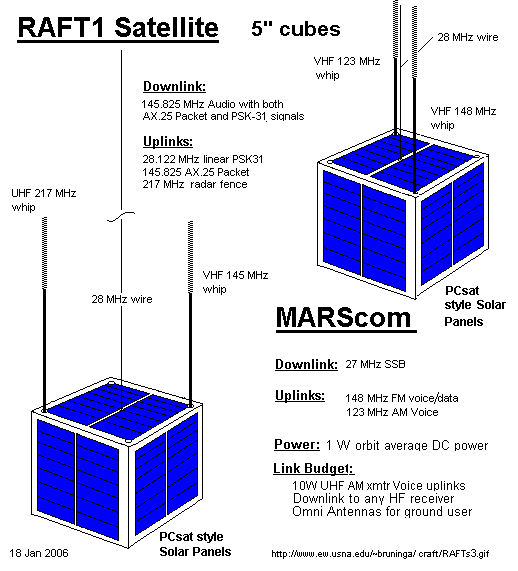
If STS-116 launches in December, it will carry two experimental satellites into orbit built by students at the US Naval Academy.

RAFT is a US Naval Academy Aerospace student project currently manifested on Space Shuttle Mission STS-116. It is designed to give students real hands on experience in satellite engineering, design and operations. The USNA RAFT hopes to accomplish the following objectives:

  • The education of Midhsipmen in Aerospace Engineering See their RAFT WEB page.
  • Development of our ability to design/construct CUBESAT/Picosat type spacecraft

  • Provide a 217 MHz transmitter/receiver for Navy Space Surveillance System (NSSS) Radar Fence experiments.
  • Provide TDMA packet, and FDMA Multiuser PSK-31 transponders for experiments in the Amateur Satellite Service.
  • Provide voice/data experiments in support of the Navy/MarineCorp MARS programs and the Naval Academy's boats.

    As usual there is the usual MARS frequency disclaimer on the main webpage stating that the MARS frequencies are sensitive and will not be published. But also as usual digging around the website and its links revealed the following:

    RAFT1 Satellite
    Downlink 145.825 MHz, 2 watts 20 kHz bandwidth FM with both AX.25 packet and PSK-31 signals, Uplinks
    28.122 MHz linear PSK-31
    216.980 MHz NSSS transponder (Radar fence)

    RAFT1 Satellite Operating Modes:
    Telemetry Mode, Packet Transponder Mode, PSK-31 Transponder Mode, Packet/Voice transponder, and the XP217 radar fence mode.

    MARScom Satellite
    148.975 MHz Uplink
    27.9635 (27.962) MHz SSB downlink
    123.100 MHz SAR AM Monitor

    MARScom Satellite Operating Modes:
    Telemetry Mode, Packet Transponder Mode, Voice Relay Mode, and SAR Monitor Mode.

    What is amazing to me is that the brain thrust in MARS actually thought they could keep the frequencies of their orbiting satellite secret. It is obvious that they are not technically the sharpest knives in the drawer. Someone needs to educate these folks that low earth orbiting platforms are quite easy to hear, even on simple multimode handhelds. Duh huh!
  • 20 Charleston C-17s fill the sky


    Several C-17 Globemaster IIIs fly as part of a 20-ship formation Dec. 21 over South Carolina. The C-17s, assigned to the 437th and 315th Airlift Wings at Charleston AFB, were part of the largest formation in history from a single base and demonstrated the strategic airdrop capability of the Air Force. (U.S. Air Force photo)
    And via Mark Cleary:
    Charleston AFB breaks C-17 flying record
    by Airman 1st Class Sam Hymas 437th Airlift Wing Public Affairs
    12/21/2006 - CHARLESTON AIR FORCE BASE, S.C. -- The largest formation of C-17 Globemaster IIIs from a single base took off from here Dec. 21 in a demonstration of Charleston AFB's strategic airdrop capability.
    After taking off at 9:30 a.m. at 30-second intervals, the 20 C-17s flew over the Arthur Ravenel Jr. Bridge and then back over the base to "wave" at maintenance, aerial port and other support Airmen who helped make the flight possible.
    The formation continued to North Auxiliary Field near Orangeburg, S.C., and completed a massive airdrop.
    "The 437th and 315th Airlift Wing partnership allows us to deliver a huge amount of airpower in a short amount of time," said Col. Steven Harrison, 437 AW vice commander. "This training demonstrates the outstanding teamwork between both organizations to be mission ready when the nation needs this critical capability."
    The formation was designed to help Airmen involved complete needed training. More than 500 training events took place during the flight and seven aircrews were certified as formation airdrop leads.
    "We had a chance to see the muscle and the might the 437th Airlift Wing can put forward," said Capt. Jaron Roux, 15th Airlift Squadron pilot who was the aircraft commander on the second plane in the formation.
    The 437th Airlift Wing must be able to meet the Army's goal of airdropping a brigade's worth of Soldiers and their equipment within 30 minutes. An Army brigade includes about 3,250 Soldiers and 3,450 tons of equipment.
    Additionally, nine of the C-17s practiced aerial refueling as part of the training. "It's important to us to stress our organization occasionally and make sure we're able to support the Global War on Terrorism and still respond to any other contingency in the world. We must make sure we can generate the crews and the aircraft in a timely manner," said Colonel Harrison.
    On average, more than 200 tons of Operation Iraqi Freedom and Operation Enduring Freedom cargo is processed through the 437th Aerial Port Squadron daily with approximately 65 percent of all air cargo bound for American warfighters in Iraq and Afghanistan originating here.
    "I don't know if there's another unit in the world that could do this," said Colonel Harrison.

    10 Globemaster IIIs fly in formation over Washington state


    Several C-17 Globemaster III's wait on the flightline prior to launching as part of a 10-ship formation training exercise Dec. 20 at McChord Air Force Base, Wash. Key players included the 62nd Airlift Wing and 446th Maintenance Group, which will generate, launch and recover the aircraft. (U.S. Air Force illustration/Abner Guzman)

    by Tyler Hemstreet
    12/21/2006 - MCCHORD AIR FORCE BASE, Wash. (AFPN) -- Like an iron alligator in the sky, a band of 10 C-17 Globemaster IIIs flew in formation Dec. 21 from Puget Sound to eastern Washington .

    Taking off in five-minute intervals from McChord AFB, C-17s with aircrews from the 62nd and 446th Airlift Wings rendezvoused in the sky to align into a single file formation before performing an airdrop over a site near Moses Lake.

    The objective of the exercise was to test all the organizations and different aspects of the mission that have to come together to facilitate launching, executing and recovering a large formation of C-17s in a short period of time, said Lt. Col. Gregory Schwartz the 8th Airlift Squadron and mission commander.

    "It's a great chance to get some valuable training and test our abilities to work together to meet a significant mission requirement," Colonel Schwartz said.

    Flying a mere 2,000 feet between each plane, the 10-ship exercise added a level of difficulty pilots don't get when they are just simulating flying in routine, three-ship formations, Colonel Schwartz said.

    The yearly exercise also enlisted the work of the 62nd and 446th Maintenance Groups members, who generated, launched and recovered the aircraft; 62nd Aerial Port Squadron members who built and recovered the platforms for the airdrop portion of the mission; and from 62nd Logistics Readiness Squadron members who supplied the transportation and fuel for the aircraft.

    The 62nd Maintenance Group started planning for the operation a month ahead of time calling in reinforcements to help prepare all the jets, said Lt. Col. Thomas Jackson the deputy group commander of the 62nd Maintenance Group.

    Several maintenance training crews were pulled from their programs to get "real, live hands-on training" and a team from the 373rd Training Detachment Squadron even pitched in, Colonel Jackson said.

    "It's probably the biggest undertaking we've had since the Operational Readiness Inspection," Colonel Jackson said.

    While the exercise utilized the same training drop zones as usual for aircrews, the large formation presented a unique opportunity for pilots, said Col. Damon Booth the commander of the 62nd Operations Group.

    "It's routine training, just more complex because there are that many planes in the air at one time," Colonel Booth said. "We're trying to exercise the formation because it could be something we are required to do."

    Lightning in sky for first time


    12/22/2006 - The F-35 Lightning II Joint Strike Fighter takes off for its initial flight Dec. 15 over Fort Worth, Texas. (Lockheed Martin photo/Tom Harvey)

    This information originally appeared in the July 2006 MT Milcom column. Copyright 2006 by Monitoring Times magazine and Teak Publications. For personal use only. All rights reserved and not for redistribution in any form.


    NAS/JRB Fort Worth Base Communications Profile
    DSN Prefix: 874 ICAO Code: KNFW

    Area/Base Aero Frequencies
    ATIS 273.575
    Base Operations 139.300 291.775
    Brownwood MOA (FTW Center) 380.050 317.700 (Hornet) 343.600 (Tomcat) 282.200 (Loon)
    DFW Regional Approach/Departure 125.800 257.950 363.150
    Falcon Range (FTW Center) 290.100
    Ground Controlled Approach 128.775 132.225 371.875
    Navy Fort Worth Arrival 128.775 371.875
    Navy Fort Worth Tower 120.950 269.325 284.725
    Navy Fort Worth Ground 126.400 254.325 279.575
    PMSV Metro 342.550
    Sheppard AFB Monitor 335.900
    Lockheed Fort Worth Operations 123.150 (Tertiary) 123.400 (Secondary) 123.575 (Primary) 284.100 (Primary) 292.500 (Secondary) 349.725 (Tertiary)
    Flight Test Support 231.450 277.750 300.400 349.700

    Base Unit List
    USAF 136AW/181AS (Callsign Rodeo) No frequencies currently identififed
    USAF 301FW/457FS (Callsign Spad) 252.100 (Ops) 276.500 (A-A) 306.000 (A-A)
    VHF Freqs: 140.175 140.275 141.650 149.050 149.075 149.125
    USMC VMFA-112 (Callsign Cowboy) 252.525 (A-A) 318.600 (Ops) 318.650 (A-A)
    VHF Freqs: 140.325 141.950
    USMC VMGR-234 (Callsign Ranger) 233.900 289.800 Operations (Range Ops)
    USN VFA-201 (Callsign Pistol) 291.675 (A-A) 299.500 (A-A) 320.500 (A-A) 344.200 (Ops) 344.250 (A-A) 355.100 (A-A)
    Unknown Unit 355.400 (Ops)

    Lockheed-Martin Callsigns:
    Lightning F-35 Aircraft
    Picasso Aircraft Painters
    Rocket Civilian Test Pilots
    Viper USAF Test Pilots
    Wagon Wheel Lockheed Flight Test Support Van

    Land Mobile Frequencies
    Lockheed Fort Worth 72.040 72.180 72.240 72.360 72.440 152.345/157.605 153.080/158.310 153.140/160.065 153.230 153.350/160.185 451.225/456.225 451.3625 456.3625 461.1875 461.825 462.0125 462.0625 462.1125 462.1625 462.3625 462.4000/467.4000 462.9125 462.3250 462.8875 463.2375/468.2375 463.3125/468.3125 463.7375 463.8125 463.8500 463.8625 464.0125 464.3375 464.7125 464.9625 466.1875 466.8125 466.8250 467.0125 467.0625 467.1125 467.1625 467.7500 467.9125 468.8125 468.3500 469.0125 469.3375 469.9625 855.3375/810.3375

    49.2375 Unknown user/usage
    138.575 Fire/EMS repeater (103.5-Hz PL tone)
    140.025 Miscellaneous Net
    140.050 Miscellaneous Net
    140.100 Fire/Crash Net
    140.325 Marine Ground Maintenance Frequency (tentative)
    141.950 Marine Ground Maintenance Frequency (tentative)
    149.200 Flight Line/Transit Ops (linked to TG 24576) [This is NOT 149.205 that has been reported on some list-LVH]
    163.4635 Lockheed Security Repeater (114.8-Hz PL tone)
    163.4875 Miscellaneous Net
    461.8125 Lockheed Flightline (123.0-Hz PL tone)
    Base Trunk System
    Motorola ASTRO 3600 baud (APCO 25 Mixed Mode)
    System ID: 7504
    Base Frequency: 406.500 MHz, Spacing: 12.5-kHz, Offset: 380
    Frequencies: 407.3635 407.9625 408.5625 408.9625 409.4375 409.9625 410.3625 410.7625

    Talkgroups:
    48 Base Security (Analog)
    80 Base Security
    112 Base Security
    144 Base Security
    192 Unknown user/usage
    272 Unknown user/usage
    8240 Unknown user/usage(Digital)
    8272 Unknown user/usage(Digital)
    8304 Unknown user/usage(Digital)
    8752 Unknown user/usage(Digital)
    9360 Unknown user/usage(Digital)
    9456 Unknown user/usage(Digital)
    9648 Unknown user/usage(Digital)
    9760 Unknown user/POL (P25) [tentative]
    24576 Flight Line/Transit Ops (P25)
    24608 VFA-201 Maintenance (P25)
    24624 Base Public Works (P25)
    24640 136AW/181AS Texas ANG
    32784 301FW Aircraft Maintenance [Viper/Red]
    32816 Unknown user/usage (Digital)
    32880 Aircraft Maintenance [Red]
    32912 Aircraft Maintenance/Inspection [Maverick] (P25)
    32944 Unknown user/usage
    33008 301FW Security
    40992 Fire Dispatch (P25)
    41008 Fire Talk
    41072 Fire Prevention (P25)
    41088 Fire Talk (P25)

    Thursday, December 21, 2006

    HCS-5 Decomms, HCS-4 to Follow


    Thanks to Adam (AirShowFreak) for this piece he cross posted to several list. So time to remove HCS-5 callsign and squadron common frequencies from our databases and websites. Wonder how many will really do it? We will know pretty soon, won't we!

    Firehawks of HCS-5 Disestablish at NAS North Island
    Navy News Story Number: NNS061205-06
    By Mass Communication Specialist 2nd Class Margaret A. Peng
    Fleet Public Affairs Center San Diego

    NAVAL AIR STATION NORTH ISLAND, Calif. (NNS) -- More than 500 Sailors, former unit members, and family attended the disestablishment ceremony Dec. 3 for Helicopter Combat Support Special Squadron (HCS) 5 aboard Naval Air Station North Island.

    The ceremony served to commemorate the past missions of HCS-5 and the official end of activities for the specialized Reserve helicopter squadron.

    "Today we disestablished the Navy's most combat effective helicopter squadron of the past 30 years," said Cmdr. Patrick Baccanari, the unit's commanding officer.

    Established in 1988, HCS-5 was a Naval Air Reserve Squadron under Commander, Helicopter Wing Reserve, San Diego, and Naval Air Reserve Force, New Orleans. The squadron, which was composed of selected and full-time support Reservists, flew the HH-60H Seahawk helicopter primarily for combat search and rescue, and to support Sea, Air, Land (SEALs) and other special warfare units.

    HCS-5, along with its sister squadron, HCS-4, were the only Navy squadrons that perform both combat search and rescue and special warfare support as their primary missions.

    The keynote speaker was former HCS-5 Commanding Officer, Capt. Dan Pinkerton, who spoke proudly of the lineage and the history of the unit. Pinkerton had served in various division officer tours for Vietnam-era Helicopter Attack (Light) Squadron (HAL) 5, the precursor to HCS-5.

    During his speech, Pinkerton saluted all the men and women who had served in the unit, past and present. He ended his speech with an emotional goodbye and the words, "Born in combat, standing down in combat. We did our duty."

    The disestablishment is part of the Naval Air Reserve's plan to reshape its aviation forces. The "Firehawks" filled a role shared by its sister squadron, the Norfolk, Va.-based "Red Wolves" of HCS-4, which also is slated to be disestablished.

    "This ceremony marks a transition for our Sailors, but we are not losing the capability nor the talent of our people," said Rear Adm. Jeffrey Lemmons, vice commander, Naval Air Forces. "They will go on to serve in other units and keep this mission alive, and their skill sets well-honed."

    Guests at the ceremony included Sailors from the early days of Helicopter Attack (Light) Squadron 3, HAL-5, and HCS-5. Many used this opportunity to reunite with old friends and reminisce about the "old days."

    "I am glad to be here," said Dennis Russell, a former HCS-5 member who flew in from El Paso, Texas. "I am lucky to have served with such great people."

    Some felt the bond to the unit very strongly and got emotional when they spoke of their feelings about the disestablishment.

    "As a junior Sailor in the unit, I got to work with people who had combat experience in Vietnam," said Aviation Warfare Systems Operator 1st Class Shawn Porter. "They took me in and showed me how to do things right. I will never forget them. The experience I gained here will be with me for the rest of my Navy career."

    Aviation Structural Mechanic 1st Class Richard Sanchez, a member who had been with the unit for 15 years, said that this has been the best unit he has worked with and they have proved what they can do for the Navy.

    "I see the same pride and dedication to service in the Sailors today that we had during the days of Vietnam. This unit is the best of the best," said Aviation Electrician's Mate 2nd Class Mike Dobson, a member of HAL-3 "Seawolfs," the grandfather of HCS-5.

    Capt. James Iannone, commodore of Helicopter Wing Reserve San Diego and New Orleans, summarized his thoughts about the unit after the ceremony.

    "When I think of this unit, I think of the words, 'The many have come to rely on the few.' These men and women are the proud few who stand together and have served whenever and wherever they are called," Iannone said.

    Earlier this year, the Firehawks received the Navy Unit Commendation for exceptionally meritorious service from March 2003 through April 2004.

    During this period, the squadron completed more than 1,700 combat flight hours and 900 combat air missions in direct support of U.S. and multinational special operations forces in support of Operation Iraqi Freedom.

    After reading the orders of disestablishment and words of goodbye from their commanding officer, the Sailors of HCS-5 were dismissed by the executive officer. The Sailors filed out proudly and silently to begin a new chapter in their lives.

    Wednesday, December 20, 2006

    Keeping the fuel flowing


    12/19/2006 - A KC-10 Extender from the 380th Air Expeditionary Wing pulls into a parking spot Dec. 19 after returning from a mission over Iraq. The air refueler is part of the largest air-refueling unit in Southwest Asia consisting of KC-10s and KC-135 Stratotankers. The KC-10 can carry about 56,000 gallons of gas, enough to fill a sport-utility vehicle 1,400 times. (U.S. Air Force photo/Master Sgt. Jason Tudor)

    Iraq Area Control Centers
    Balad Center 123.525/274.575
    Kirkuk Center 125.300/237.325
    Ali Center 132.775/322.050

    Terminal Control Areas
    Al Asad Approach 147.850/298.025
    Al Taqaddum Approach 147.300/125.250/295.850
    Balad Approach Sctr A/B 131.900/246.425, Sctr C 123.525/274.575
    Basrah Approach 119.400/233.225
    Kirkuk Approach Sctr A/B 129.750/264.200, Sctr C 125.300/237.325
    Mosul Approach 119.450/259.125
    Ali Approach Sctr A/B 126.925/324.925, Sctr C 132.275/322.050

    Vandenberg successfully launches Delta II


    Vandenberg successfully launches Delta II
    by Airman 1st Class Erica Stewart
    30th Space Wing Public Affairs

    12/19/2006 - VANDENBERG AIR FORCE BASE, Calif. (AFPN) -- Vandenberg AFB officials successfully launched a Delta II rocket carrying a National Reconnaissance Office payload from Space Launch Complex-2 at 1 p.m. Dec. 14 here.

    The Delta II, a 125.75-foot expendable launch, medium-lift vehicle, launches civil and commercial payloads into low-earth, polar, geosynchronous transfer and stationary orbits.

    "(This) successful launch was accomplished from the outstanding teamwork from all organizations to include the 30th Space Wing, Space and Missile Systems Center, NRO, and recently named United Launch Alliance," said Col. Jack Weinstein, 30th SW commander.

    "Vandenberg ensures national security with each executed launch, continuously proving that no one does it better," he said.

    "The perfect orbit insertion we achieved is a testament to the hard work and dedication of the professional Airmen of the 30th Space Wing," said Lt. Col. David Goldstein, commander of the 4th Space Launch Squadron. "The 4th SLS along with the 30th Launch Support Squadron and the Aerospace corporation conducted launch base mission assurance guaranteeing 100 percent mission success and we delivered; the satellite launched will provide invaluable intelligence data to support the war on terrorism."

    The next United Launch Alliance mission from Vandenberg AFB will be an Atlas V in the spring.

    Italian Air Force HF ALE Net

    Here is a little profile I have put together on an Italian Air Force HF ALE network that is being heard on a regular basis over in Europe. The NCS for this net appears to be the 46th Aerial Brigade, ALE Address - Charly 46 .


    Frequencies: 3932.0 4716.0 5712.0 6600.0 6748.0 8020.0 kHz


    ALE Addresses:

    Charly 46 - 46ªBrigata Aerea Pisa - San Giusto "Arturo Dall'Oro" (LIRP)
    40 - Unknown user/usage
    41 - 41° STORMO ANTISOM "Athos Ammannato" Catania - Sigonella "Capitano Pilota Cosimo di Palma" (LICZ) [Tentative]
    44 - Unknown user/usage
    46 - Unknown user/usage
    47 - Unknown user/usage
    50 - 50° STORMO Piacenza - San Damiano "Gaetano Mazza" (LIMS) [Tentative]
    51 - 51° STORMO "Ferruccio Serafini" Istrana - Treviso "Vittorio Bragadin" (LIPS) [Tentative] 54 - Unknown user/usage
    55 - Unknown user/usage
    56 - Unknown user/usage
    57 - Unknown user/usage
    59 - Unknown user/usage
    61 - 61° STORMO Lecce - Galatina "Fortunato Cesari" (LIBN) [Tentative]

    If you have any additional frequencies, corrections or ALE address IDs to add, please send it along to larryvanhorn @ monitoringtimes.com.