By Mass Communication Specialist 3rd Class (SW) James Mitchell, USS Nimitz Public Affairs
SAN DIEGO (NNS) -- The aircraft carrier USS Nimitz (CVN 68) sent its Inspection and Survey (INSURV) Department Head underway aboard the aircraft carrier USS Ronald Reagan (CVN 76) May 18 to begin preparing for Nimitz' INSURV later this year.
Chief Warrant Officer Daniel Milligan, Nimitz' INSURV department head, departed with Reagan to gain first-hand knowledge as they conduct their scheduled INSURV.
"The best thing he will bring back is the knowledge and lessons learned from their INSURV," said Chief Warrant Officer John Penick, Nimitz' INSURV command trainer. "We will benefit first-hand by looking at how they are inspecting [Reagan]."
Learning from another ship's INSURV is a key training tool for succeeding in the upcoming INSURV.
"INSURV is a tremendously large and important inspection of the ship's overall material condition readiness," said Senior Chief Gunner's Mate (SW/AW) Greg Smiler, Nimitz INSURV Department's leading chief petty officer. "We're starting out early because we plan on doing above average."
Nimitz has established an INSURV Department to conduct training periods to teach personnel how to "recognize space discrepancies and know what to look for," said Smiler.
Additionally, the INSURV department is reviewing lesson's learned from previous INSURV'S and putting together a do's and don'ts training program, said Penick.
Milligan's observations on board Reagan, combined with INSURV Department's training program, will help Nimitz establish "a focused mission to get everything done right the first time with no re-work," said Penick.
Nimitz' INSURV is scheduled for October.
Nimitz is the flagship for Carrier Strike Group 11. Nimitz returned home to San Diego March 26 after completing a successful eight-month Western Pacific deployment.
Friday, May 21, 2010
USS Texas Departs for U.S. 4th Fleet Deployment
By Mass Communication Specialist 2nd Class Ronald Gutridge, Commander, Submarine Force, U.S. Pacific Fleet Public Affairs
PEARL HARBOR (NNS) -- The Virginia-class submarine USS Texas (SSN 775) departed Joint Base Pearl Harbor-Hickam for a scheduled deployment to U.S. 4th Fleet Area of Responsibility May 19.
"USS Texas is flexible and ready to rapidly respond to a wide range of situations on short notice in support of national security," said Cmdr. Bob Roncska, USS Texas commanding officer. "I am extremely proud of my Texas crew. No doubt, the best crew I have had the opportunity to serve with in all my 20 years of naval service"
This is Texas' first deployment since changing homeports to Pearl Harbor in November 2009.
Commissioned Sept. 9, 2006, Texas was the second Virginia-class attack submarine constructed and the first submarine to be named after the Lone Star State. The state-of-the-art submarine is capable of supporting a multitude of missions, including anti-submarine warfare, anti-surface ship warfare, strike, naval special warfare involving special operations forces, intelligence, surveillance, and reconnaissance, irregular warfare, and mine warfare.
PEARL HARBOR (NNS) -- The Virginia-class submarine USS Texas (SSN 775) departed Joint Base Pearl Harbor-Hickam for a scheduled deployment to U.S. 4th Fleet Area of Responsibility May 19.
"USS Texas is flexible and ready to rapidly respond to a wide range of situations on short notice in support of national security," said Cmdr. Bob Roncska, USS Texas commanding officer. "I am extremely proud of my Texas crew. No doubt, the best crew I have had the opportunity to serve with in all my 20 years of naval service"
This is Texas' first deployment since changing homeports to Pearl Harbor in November 2009.
Commissioned Sept. 9, 2006, Texas was the second Virginia-class attack submarine constructed and the first submarine to be named after the Lone Star State. The state-of-the-art submarine is capable of supporting a multitude of missions, including anti-submarine warfare, anti-surface ship warfare, strike, naval special warfare involving special operations forces, intelligence, surveillance, and reconnaissance, irregular warfare, and mine warfare.

4th FW Strike Eagles assist shuttle launch

CAPE CANAVERAL AIR FORCE STATION, Fla. (AFNS) -- Airmen from the 4th Fighter Wing at Seymour Johnson Air Force Base, N.C., and the Continental U.S. North American Aerospace Defense Command Region, or CONR, and Air Forces Northern Command provided crucial airspace control and manning support to the successful launch of Space Shuttle Atlantis May 14 here.
CONR members ensured airspace sovereignty by enforcing the Federal Aviation Administration's temporary flight restriction area established around Kennedy Space Center. Using F-15E Strike Eagle aircraft from the 4th FW, CONR Airmen identified and redirected five aircraft that inadvertently violated the restricted airspace.
"The U.S. Air Force protects the United States every day in support of Operation Noble Eagle," said Lt. Col. Gabriel Green, the 333rd Fighter Squadron commander. "When needed, the 4th FW supports this mission. (The wing) protected the (sky) by flying an air patrol over and around the space shuttle. When an aircraft entered the no-fly zone, we intercepted, identified and redirected (it) out of the airspace."
CONR also deployed the Joint-Based Expeditionary Connectivity Center team to here to provide additional support for the launch.
AFNORTH provided the headquarters manning for U.S. Northern Command's Joint Task Force-Space Transportation System, responsible for the search and rescue of the astronauts and recovery of the orbiter if the need arises. AFNORTH also serves as the operational level focal point for situational understanding and crisis response to space shuttle mission contingencies.
"As members of CONR, we are very proud of our mission to protect the (airspace above) the shuttle while AFNORTH personnel provide manning for potential search and rescue operations," said Col. Scott Barberides, the JTF-STS commander.
The task force provides the command and control of Department of Defense forces during crisis response from the Morrell Operations Center at Cape Canaveral AFS.
"Flexibility is a key strength of airpower and Seymour Johnson (AFB) Airmen," Colonel Green said. "We are proud to have contributed to our space program and the Air Force's success."
X-51A Waverider flight planned for May 25
WRIGHT-PATTERSON AIR FORCE BASE, Ohio (AFNS) -- Weather permitting, Air Force officials said the X-51A Waverider will make its first hypersonic flight test attempt May 25 after it is released from a B-52 Stratofortress off the southern coast of California.
The unmanned X-51A is expected to fly autonomously for five minutes, powered by a supersonic combustion scramjet engine, accelerating to about Mach 6 and transmitting vast amounts of data to ground stations before breaking up after splashing down into the Pacific, as planned. There are no plans to recover the flight test vehicle, one of four built.
"In those 300 seconds, we hope to learn more about hypersonic flight with a practical scramjet engine than all previous flight tests combined," said Charlie Brink, X-51A program manager with the Air Force Research Laboratory's Propulsion Directorate here.
The longest previous hypersonic scramjet flight test performed by a NASA X-43 in 2004 was faster, but lasted only about 10 seconds and used less logistically supportable hydrogen fuel, Mr. Brink said.
The X-51A program is a collaborative effort by representatives from the Air Force Research Laboratory and the Defense Advanced Research Projects Agency, with industry partners The Boeing Company and Pratt & Whitney Rocketdyne.
The X-51 will depart Edwards Air Force Base, Calif. and be carried aloft under the wing of a B-52 belonging to the Air Force Flight Test Center there. It will be released at approximately 50,000 feet over the Point Mugu Naval Air Warfare Center Sea Range. A solid rocket booster will accelerate the X-51A to approximately Mach 4.5, before being jettisoned.
Then the cruiser's scramjet engine, remarkable because it has virtually no moving parts, will ignite. Burning the same JP-7 jet fuel once used by the SR-71 Blackbird, it will accelerate the X-51A to Mach 6 as it climbs to nearly 70,000 feet. Hypersonic combustion generates intense heat so routing of the engine's own JP-7 fuel will serve to both cool the engine and heat the fuel to optimum operating temperature for combustion.
A U.S. Navy P-3 Orion will aid in transmitting telemetry data to people at both Naval Air Station Point Mugu and Vandenberg AFB, Calif., before it arrives at its final destination: Ridley Mission Control Center at Edwards AFB.
The May 25 hypersonic test will actually be the third time the X-51 has flown, but in each previous instance it has remained attached to the B-52's wing. The first captive carry flight Dec. 9, 2009, verified the B-52's high-altitude performance and handling qualities with the X-51 attached and tested communications and telemetry systems. The other flight, intended essentially as a dress rehearsal for the hypersonic flight, took place earlier this year.
Program officials said this will be the only hypersonic flight attempt this fiscal year, a change from the original test plan which was to fly in December 2009 then three more times in 2010.
A combination of factors, including access to supporting flight test and range assets, was cited as the reason for the pause. Availability of the Air Force Flight Test Center's B-52, which has been in high demand to support a number of other high-priority weapon system tests and is readying to undergo periodic depot-level maintenance later this year, was noted.
"This is an experimental X-plane and it's a complicated test. We knew the original schedule was aggressive and we would need to be flexible," Mr. Brink said. "It's also expensive to keep a staff of engineers and support staff at the ready and then not be able to fly when supporting assets aren't available. So we elected to make only one hypersonic try this spring and then pause for a few months to conserve funding."
Mr. Brink called the test "a major team effort" by AFRL, DARPA, Air Force Flight Test Center, NASA, the U.S. Navy, Boeing and Pratt & Whitney Rocketdyne.
The shark-like shape of the 14-foot long X-51A cruiser gives a hint to the technologies it is designed to explore, Mr. Brink said. Virtually wingless, it is designed to ride its own shockwave, thus the nickname, Waverider. The heart of the system is its Pratt & Whitney Rocketdyne SJY61 scramjet engine, but other key technologies that will be demonstrated by the X-51A include thermal protection systems materials, airframe and engine integration, and high-speed stability and control.
Officials said the X-51A program will pave the way to hypersonic weapons and future access to space. Since scramjets are able to burn atmospheric oxygen, they don't need to carry large fuel tanks containing oxidizer like conventional rockets, and are being explored as a way to more efficiently launch payloads into orbit.
The unmanned X-51A is expected to fly autonomously for five minutes, powered by a supersonic combustion scramjet engine, accelerating to about Mach 6 and transmitting vast amounts of data to ground stations before breaking up after splashing down into the Pacific, as planned. There are no plans to recover the flight test vehicle, one of four built.
"In those 300 seconds, we hope to learn more about hypersonic flight with a practical scramjet engine than all previous flight tests combined," said Charlie Brink, X-51A program manager with the Air Force Research Laboratory's Propulsion Directorate here.
The longest previous hypersonic scramjet flight test performed by a NASA X-43 in 2004 was faster, but lasted only about 10 seconds and used less logistically supportable hydrogen fuel, Mr. Brink said.
The X-51A program is a collaborative effort by representatives from the Air Force Research Laboratory and the Defense Advanced Research Projects Agency, with industry partners The Boeing Company and Pratt & Whitney Rocketdyne.
The X-51 will depart Edwards Air Force Base, Calif. and be carried aloft under the wing of a B-52 belonging to the Air Force Flight Test Center there. It will be released at approximately 50,000 feet over the Point Mugu Naval Air Warfare Center Sea Range. A solid rocket booster will accelerate the X-51A to approximately Mach 4.5, before being jettisoned.
Then the cruiser's scramjet engine, remarkable because it has virtually no moving parts, will ignite. Burning the same JP-7 jet fuel once used by the SR-71 Blackbird, it will accelerate the X-51A to Mach 6 as it climbs to nearly 70,000 feet. Hypersonic combustion generates intense heat so routing of the engine's own JP-7 fuel will serve to both cool the engine and heat the fuel to optimum operating temperature for combustion.
A U.S. Navy P-3 Orion will aid in transmitting telemetry data to people at both Naval Air Station Point Mugu and Vandenberg AFB, Calif., before it arrives at its final destination: Ridley Mission Control Center at Edwards AFB.
The May 25 hypersonic test will actually be the third time the X-51 has flown, but in each previous instance it has remained attached to the B-52's wing. The first captive carry flight Dec. 9, 2009, verified the B-52's high-altitude performance and handling qualities with the X-51 attached and tested communications and telemetry systems. The other flight, intended essentially as a dress rehearsal for the hypersonic flight, took place earlier this year.
Program officials said this will be the only hypersonic flight attempt this fiscal year, a change from the original test plan which was to fly in December 2009 then three more times in 2010.
A combination of factors, including access to supporting flight test and range assets, was cited as the reason for the pause. Availability of the Air Force Flight Test Center's B-52, which has been in high demand to support a number of other high-priority weapon system tests and is readying to undergo periodic depot-level maintenance later this year, was noted.
"This is an experimental X-plane and it's a complicated test. We knew the original schedule was aggressive and we would need to be flexible," Mr. Brink said. "It's also expensive to keep a staff of engineers and support staff at the ready and then not be able to fly when supporting assets aren't available. So we elected to make only one hypersonic try this spring and then pause for a few months to conserve funding."
Mr. Brink called the test "a major team effort" by AFRL, DARPA, Air Force Flight Test Center, NASA, the U.S. Navy, Boeing and Pratt & Whitney Rocketdyne.
The shark-like shape of the 14-foot long X-51A cruiser gives a hint to the technologies it is designed to explore, Mr. Brink said. Virtually wingless, it is designed to ride its own shockwave, thus the nickname, Waverider. The heart of the system is its Pratt & Whitney Rocketdyne SJY61 scramjet engine, but other key technologies that will be demonstrated by the X-51A include thermal protection systems materials, airframe and engine integration, and high-speed stability and control.
Officials said the X-51A program will pave the way to hypersonic weapons and future access to space. Since scramjets are able to burn atmospheric oxygen, they don't need to carry large fuel tanks containing oxidizer like conventional rockets, and are being explored as a way to more efficiently launch payloads into orbit.
Thursday, May 20, 2010
Ships Arrive for Exercise Phoenix Express 2010
By Mass Communication Specialist 1st Class (SW) Edward Vasquez, Navy Public Affairs Support Element - East Det. Europe
SOUDA BAY, Greece (NNS) -- USS Gunston Hall (LSD 44) arrived in Souda Bay, Greece, May 18 to participate in exercise Phoenix Express 2010 (PE-10).
Gunston Hall will be joined by the USS John L. Hall (FFG 32), military sealift command ships USNS LCPL Roy M. Wheat (T-AK3 016) and USNS Laramie (T-AO 203), as well as several ships from 20 nations.
Maritime and land forces are participating in a large international military partnering exercise in the Mediterranean Sea May 10 – June 2. PE-10 aims to improve maritime safety and security in the Mediterranean Sea through increased interoperability and cooperation among partners from Africa, Europe and the United States.
One of the goals of this exercise is enabling participants to advance information sharing, which is crucial to maintaining a region free from transnational threats and enhanced capability to conduct multinational peacekeeping missions.
The exercise will start with a pre-sail conference and initial in port training; all participating countries are expected to arrive by May 19. Involved ships and personnel will then depart later in the month in order to conduct the at sea portion of PE-10. PE-10 will official end with a post-exercise conference to be held in Taranto, Italy.
This comprehensive training agenda provides all participating maritime forces with numerous opportunities to demonstrate the ability to operate together and develop productive relationships through diverse and challenging operational scenarios.
SOUDA BAY, Greece (NNS) -- USS Gunston Hall (LSD 44) arrived in Souda Bay, Greece, May 18 to participate in exercise Phoenix Express 2010 (PE-10).
Gunston Hall will be joined by the USS John L. Hall (FFG 32), military sealift command ships USNS LCPL Roy M. Wheat (T-AK3 016) and USNS Laramie (T-AO 203), as well as several ships from 20 nations.
Maritime and land forces are participating in a large international military partnering exercise in the Mediterranean Sea May 10 – June 2. PE-10 aims to improve maritime safety and security in the Mediterranean Sea through increased interoperability and cooperation among partners from Africa, Europe and the United States.
One of the goals of this exercise is enabling participants to advance information sharing, which is crucial to maintaining a region free from transnational threats and enhanced capability to conduct multinational peacekeeping missions.
The exercise will start with a pre-sail conference and initial in port training; all participating countries are expected to arrive by May 19. Involved ships and personnel will then depart later in the month in order to conduct the at sea portion of PE-10. PE-10 will official end with a post-exercise conference to be held in Taranto, Italy.
This comprehensive training agenda provides all participating maritime forces with numerous opportunities to demonstrate the ability to operate together and develop productive relationships through diverse and challenging operational scenarios.
Phoenix Express Kicks Off from Souda Bay
By Mass Communication Specialist 2nd Class (SW/AW) Felicito Rustique, Navy Public Affairs Support Element - East Det. Europe
SOUDA BAY, Greece (NNS) -- Phoenix Express 2010 (PE-10), a two-week, two-phase, multinational, maritime exercise among regional partners from Africa, Europe, and the United States, is set to conduct its kickoff pre-sail conference and conclude its in port training portion of the exercise.
The in port phase, which began in Rota, Spain, and continued in Souda Bay, Greece, focuses on medical training, maritime interdiction operations (MIO), helicopter operations and safety, damage control, navigation, deck seamanship, search and rescue (SAR), small boat operations and a leadership round table.
Ships and personnel involved will depart Souda Bay later this month and sail into international waters in the central Mediterranean Sea.
During the underway portion of PE-10, countries will track and board suspect vessels carrying suspicious cargo, and Maritime Patrol Aircraft and Automated Identification Systems, along with MIOs like SARs and visit, board, search and seizures will be performed.
U.S. commanders believe PE-10 is invaluable to theater partners because it fosters mutual understanding and improves international military partnering.
"Phoenix Express demonstrates theater partner nations' commitment to regional stability and maritime security," said Capt. Martin Beck, commander, Task Force 68, whose task force is in command of the exercise. "During this exercise, maritime professionals will further develop the capacity to maintain maritime domain awareness. When they meet in the future to conduct combined peacekeeping or humanitarian operations, or to counter trafficking in drugs, people, or weapons in this region, they will be better able to respond and work together."
Twenty countries are expected to participate in the exercise as an either an active participant or observer. U.S. units participating in Phoenix Express include the USS Gunston Hall (LSD 44), home ported in Virginia Beach, Virginia; USS John L. Hall (FFG 32), home ported in Mayport, Florida; Military Sealift Command ships USNS LCPL Roy M. Wheat (T-AK3 016) and USNS Laramie (T-AO 203); and members of the U.S. 6th Fleet staff.
SOUDA BAY, Greece (NNS) -- Phoenix Express 2010 (PE-10), a two-week, two-phase, multinational, maritime exercise among regional partners from Africa, Europe, and the United States, is set to conduct its kickoff pre-sail conference and conclude its in port training portion of the exercise.
The in port phase, which began in Rota, Spain, and continued in Souda Bay, Greece, focuses on medical training, maritime interdiction operations (MIO), helicopter operations and safety, damage control, navigation, deck seamanship, search and rescue (SAR), small boat operations and a leadership round table.
Ships and personnel involved will depart Souda Bay later this month and sail into international waters in the central Mediterranean Sea.
During the underway portion of PE-10, countries will track and board suspect vessels carrying suspicious cargo, and Maritime Patrol Aircraft and Automated Identification Systems, along with MIOs like SARs and visit, board, search and seizures will be performed.
U.S. commanders believe PE-10 is invaluable to theater partners because it fosters mutual understanding and improves international military partnering.
"Phoenix Express demonstrates theater partner nations' commitment to regional stability and maritime security," said Capt. Martin Beck, commander, Task Force 68, whose task force is in command of the exercise. "During this exercise, maritime professionals will further develop the capacity to maintain maritime domain awareness. When they meet in the future to conduct combined peacekeeping or humanitarian operations, or to counter trafficking in drugs, people, or weapons in this region, they will be better able to respond and work together."
Twenty countries are expected to participate in the exercise as an either an active participant or observer. U.S. units participating in Phoenix Express include the USS Gunston Hall (LSD 44), home ported in Virginia Beach, Virginia; USS John L. Hall (FFG 32), home ported in Mayport, Florida; Military Sealift Command ships USNS LCPL Roy M. Wheat (T-AK3 016) and USNS Laramie (T-AO 203); and members of the U.S. 6th Fleet staff.
First Student Takes Flight in T-6
By Lt. j.g. Michael M. Daharsh, Naval Air Station Whiting Field Public Affairs
WHITING FIELD, Fla. - (NNS) -- It was another historic day for Training Squadron 3 and Training Wing 5 as the first student naval aviator to train in the T-6B Texan II took flight at Naval Air Station (NAS) Whiting Field May 18.
Student naval aviator, Ensign Christopher D. Farkas, teamed up with U.S. Marine Corps instructor pilot, Capt. Michael Perkins to complete the inaugural flight.
"VT-3 has been the first of many in aviation, and it's fitting to have the pleasure of introducing the T-6B to training with a Navy student and a Marine instructor by an aircraft jointly developed by the Air Force and Navy," said Cmdr. Jody Bridges, VT-3 commanding officer.
The T-6B Texan II is replacing its long time predecessor the T-34C Turbomentor. Training Air Wing 5 anticipates a complete transition at NAS Whiting Field by 2015. Developed jointly by the Air Force and Navy, the advanced training aircraft provides increased training capabilities similar to that of modern fleet aircraft.
"It has been a long time vision to have a joint training aircraft," said Lt. Col. Kent Hobson, VT-3 Executive Officer. "To finally have it is a good thing."
Three weeks previous to Tuesday's flight Farkas began ground school for the T-6B with 13 of his peers. The class was composed of Navy, Marine Corps, Air Force, and Coast Guard students. However, as the morning dawned and the flight line came to life it was Farkas who would be the first student to fly the next generation of Naval aviation's training aircraft.
"It was unlike anything I've experienced," Farkas gleamed. "To begin take off and feel the power of the aircraft, to lift off the ground for the first time and experience how nimble and dynamic it is… It's incredible."
The 2009 Naval Academy graduate has known his goal for a long time. When he was four his parents took him to an air show, and from that moment he has wanted to fly. Farkas majored in Aeronautical Engineering and has hopes to one day fly the F/A-18 Hornet.
"I realize there is always going to be another step to take. On one hand it's very humbling to have the honor of being the first but it was really just right time and right place. On one hand it's just my first flight. I'm here for the Wing of Gold," he said. "It's just amazing. Right time, right place, right day, I really lucked out."
WHITING FIELD, Fla. - (NNS) -- It was another historic day for Training Squadron 3 and Training Wing 5 as the first student naval aviator to train in the T-6B Texan II took flight at Naval Air Station (NAS) Whiting Field May 18.
Student naval aviator, Ensign Christopher D. Farkas, teamed up with U.S. Marine Corps instructor pilot, Capt. Michael Perkins to complete the inaugural flight.
"VT-3 has been the first of many in aviation, and it's fitting to have the pleasure of introducing the T-6B to training with a Navy student and a Marine instructor by an aircraft jointly developed by the Air Force and Navy," said Cmdr. Jody Bridges, VT-3 commanding officer.
The T-6B Texan II is replacing its long time predecessor the T-34C Turbomentor. Training Air Wing 5 anticipates a complete transition at NAS Whiting Field by 2015. Developed jointly by the Air Force and Navy, the advanced training aircraft provides increased training capabilities similar to that of modern fleet aircraft.
"It has been a long time vision to have a joint training aircraft," said Lt. Col. Kent Hobson, VT-3 Executive Officer. "To finally have it is a good thing."
Three weeks previous to Tuesday's flight Farkas began ground school for the T-6B with 13 of his peers. The class was composed of Navy, Marine Corps, Air Force, and Coast Guard students. However, as the morning dawned and the flight line came to life it was Farkas who would be the first student to fly the next generation of Naval aviation's training aircraft.
"It was unlike anything I've experienced," Farkas gleamed. "To begin take off and feel the power of the aircraft, to lift off the ground for the first time and experience how nimble and dynamic it is… It's incredible."
The 2009 Naval Academy graduate has known his goal for a long time. When he was four his parents took him to an air show, and from that moment he has wanted to fly. Farkas majored in Aeronautical Engineering and has hopes to one day fly the F/A-18 Hornet.
"I realize there is always going to be another step to take. On one hand it's very humbling to have the honor of being the first but it was really just right time and right place. On one hand it's just my first flight. I'm here for the Wing of Gold," he said. "It's just amazing. Right time, right place, right day, I really lucked out."
Newly deployed A-10 unit provides close air support
by Tech. Sgt. Renni Thornton, 451st Air Expeditionary Wing Public Affairs
KANDAHAR AIRFIELD, Afghanistan (AFNS) -- More than 200 pilots, maintainers and crew chiefs of the 81st Expeditionary Fighter Squadron and the 81st Expeditionary Aircraft Maintenance Squadron arrived May 11 here to provide close air support throughout Afghanistan.
They are taking over from the Airmen of the 184th Expeditionary Fighter Squadron.
"The mission of the unit is to provide close air support for coalition forces," said Lt. Col. Ronald Stuewe, the commander of the 81st EFS.
"That is the bread and butter of (the A-10 Thunderbolt II) and the bread and butter of the mission here," he said. "That's what we train to do and that is what we are here to execute."
The two units are scheduled to be deployed here for four months, said Capt. Kathleen Fitzpatrick, the commander of the 81st EAMXS.
They are assigned to the 52nd Fighter Wing at Spangdahlem Air Base, Germany.
The units brought with them most of the maintainers, aircrew flight equipment, intelligence, medical and support members assigned to their home station, Captain Fitzpatrick said.
Although this is the unit's first time here, the A-10 unit has deployed to other locations in the area of responsibility.
"We are glad to be here and ready to go. We've hit the ground running. We've had a great start to what seems like a fantastic deployment," Colonel Stuewe said.
KANDAHAR AIRFIELD, Afghanistan (AFNS) -- More than 200 pilots, maintainers and crew chiefs of the 81st Expeditionary Fighter Squadron and the 81st Expeditionary Aircraft Maintenance Squadron arrived May 11 here to provide close air support throughout Afghanistan.
They are taking over from the Airmen of the 184th Expeditionary Fighter Squadron.
"The mission of the unit is to provide close air support for coalition forces," said Lt. Col. Ronald Stuewe, the commander of the 81st EFS.
"That is the bread and butter of (the A-10 Thunderbolt II) and the bread and butter of the mission here," he said. "That's what we train to do and that is what we are here to execute."
The two units are scheduled to be deployed here for four months, said Capt. Kathleen Fitzpatrick, the commander of the 81st EAMXS.
They are assigned to the 52nd Fighter Wing at Spangdahlem Air Base, Germany.
The units brought with them most of the maintainers, aircrew flight equipment, intelligence, medical and support members assigned to their home station, Captain Fitzpatrick said.
Although this is the unit's first time here, the A-10 unit has deployed to other locations in the area of responsibility.
"We are glad to be here and ready to go. We've hit the ground running. We've had a great start to what seems like a fantastic deployment," Colonel Stuewe said.
Wednesday, May 19, 2010
GW Carrier Strike Group Departs for Carrier Qualifications
YOKOSUKA, Japan (NNS) -- The George Washington Carrier Strike Group centered on the Navy's only permanently forward-deployed aircraft carrier, USS George Washington (CVN 73), departed Fleet Activities Yokosuka, Japan May 18 to conduct carrier qualifications in preparation for its upcoming annual deployment cycle.
George Washington is conducting equipment testing and carrier landing qualifications with Carrier Air Wing (CVW) 5, following a 121-day Selective Restricted Availability (SRA) period and four-day sea trials.
During the SRA, multiple repairs and upgrades were made to operational systems and GW's 3,360 spaces. These renovations required more than 213,000 man-days of work. Specific repairs included upgrades, corrective and preventative maintenance to air-conditioning units, fire fighting systems, aircraft elevators, navigation systems, and crew habitability spaces.
Commanded by Rear Adm. Kevin Donegan, the George Washington Carrier Strike Group with more than 5,000 Sailors, is also comprised of 7th Fleet's: CVW-5; Destroyer Squadron 15 (DESRON 15) and the guided missile cruisers USS Shiloh (CG 67) and USS Cowpens (CG 63). Commanded by Capt. David A. Lausman, the USS George Washington (CVN 73) replaced the USS Kitty Hawk (CV 63) last September as the flagship for the permanently forward-deployed carrier strike group.
George Washington is conducting equipment testing and carrier landing qualifications with Carrier Air Wing (CVW) 5, following a 121-day Selective Restricted Availability (SRA) period and four-day sea trials.
During the SRA, multiple repairs and upgrades were made to operational systems and GW's 3,360 spaces. These renovations required more than 213,000 man-days of work. Specific repairs included upgrades, corrective and preventative maintenance to air-conditioning units, fire fighting systems, aircraft elevators, navigation systems, and crew habitability spaces.
Commanded by Rear Adm. Kevin Donegan, the George Washington Carrier Strike Group with more than 5,000 Sailors, is also comprised of 7th Fleet's: CVW-5; Destroyer Squadron 15 (DESRON 15) and the guided missile cruisers USS Shiloh (CG 67) and USS Cowpens (CG 63). Commanded by Capt. David A. Lausman, the USS George Washington (CVN 73) replaced the USS Kitty Hawk (CV 63) last September as the flagship for the permanently forward-deployed carrier strike group.
USS Ronald Reagan Underway for Sea Trials
USS RONALD REAGAN, At Sea (NNS) -- USS Ronald Reagan (CVN 76) departed Naval Air Station North Island for sea trials May 18.
The event marks the first time that Ronald Reagan has been underway since Oct. 21, 2009, when it completed its fourth deployment in four years. The three-time Battle "E" award-winning carrier is concluding a six-month planned incremental availability (PIA), a scheduled maintenance period designed to upgrade ship's systems and quality of life for its Sailors. Sea trials allow these systems to be tested and necessary quality checks to be performed.
Upon successful completion of sea trials, Ronald Reagan's PIA will officially conclude and the ship will rejoin the operational fleet.
The event marks the first time that Ronald Reagan has been underway since Oct. 21, 2009, when it completed its fourth deployment in four years. The three-time Battle "E" award-winning carrier is concluding a six-month planned incremental availability (PIA), a scheduled maintenance period designed to upgrade ship's systems and quality of life for its Sailors. Sea trials allow these systems to be tested and necessary quality checks to be performed.
Upon successful completion of sea trials, Ronald Reagan's PIA will officially conclude and the ship will rejoin the operational fleet.
86th AW supports AFAFRICA in Flintlock 10
by Staff Sgt. Stefanie Torres, 17th Air Force Public Affairs
RAMSTEIN AIR BASE, Germany (AFNS) -- Flintlock 10 is a U.S. Africa Command-sponsored exercise conducted by the Special Operations Command Africa's Joint Special Operations Task Force - Trans Sahara that is scheduled to conclude May 23.
Centered in Ouagadougou, Burkina Faso, the exercise focuses on military interoperability and capacity-building and involves tactical training conducted in Senegal, Mali, Mauritania and Nigeria. Approximately 1,200 European, African Partner Nation and U.S. participants from 14 nations are involved in military interoperability activities across the Trans-Saharan region during this event, making airlift a priority.
"Flintlock 10 is a multi-national exercise designed to enhance Special Operations Forces capabilities within trans-Saharan partner nations and develop relationships that will be beneficial to all nations in the region," said Maj. Mark Oberson, 37th Airlift Squadron assistant director of operations.
Seventeenth Air Force--Air Forces Africa officials provided coordination and tasked Airmen from the 86th Airlift Wing for the airlift and movement of participants and cargo.
Two C-130J Super Hercules and aircrews from the 86th AW here flew to Ouagadougou, Burkina Faso, to play a role in personnel movement and enabled the exercise to happen as planned.
"The 130s are making this exercise happen," said Maj. Randle Tankersley, from the 17th AF plans and operations directorate. "If we were without them, the exercise would be sequestered and not interrelated. Now with the transfer and flying capability, participants can travel from one country to another to train."
"We (17th AF officials) requested the forces from the 86th AW and they delivered," Major Tankersley said. "We are helping out with the deployment of different countries and getting them to their different locations. This is a big task because of the number of different countries participating."
Participation in the exercise marks the first deployment for U.S. Europe Command's C-130Js, Major Tankersley said.
"The 86th Air Wing is doing a lot of heavy lifting by moving the SOF (members) and equipment in and out of the exercise area and keeping the operation on schedule," Major Oberson said. "Flintlock (10) is our first opportunity to employ the aircraft in an austere environment for significant durations. This is exactly what the C-130J was built to do and has proven it's up to the task day after day thanks to the monumental efforts by members from the 86th Maintenance Group and 68th Operations Group to keep the planes moving."
RAMSTEIN AIR BASE, Germany (AFNS) -- Flintlock 10 is a U.S. Africa Command-sponsored exercise conducted by the Special Operations Command Africa's Joint Special Operations Task Force - Trans Sahara that is scheduled to conclude May 23.
Centered in Ouagadougou, Burkina Faso, the exercise focuses on military interoperability and capacity-building and involves tactical training conducted in Senegal, Mali, Mauritania and Nigeria. Approximately 1,200 European, African Partner Nation and U.S. participants from 14 nations are involved in military interoperability activities across the Trans-Saharan region during this event, making airlift a priority.
"Flintlock 10 is a multi-national exercise designed to enhance Special Operations Forces capabilities within trans-Saharan partner nations and develop relationships that will be beneficial to all nations in the region," said Maj. Mark Oberson, 37th Airlift Squadron assistant director of operations.
Seventeenth Air Force--Air Forces Africa officials provided coordination and tasked Airmen from the 86th Airlift Wing for the airlift and movement of participants and cargo.
Two C-130J Super Hercules and aircrews from the 86th AW here flew to Ouagadougou, Burkina Faso, to play a role in personnel movement and enabled the exercise to happen as planned.
"The 130s are making this exercise happen," said Maj. Randle Tankersley, from the 17th AF plans and operations directorate. "If we were without them, the exercise would be sequestered and not interrelated. Now with the transfer and flying capability, participants can travel from one country to another to train."
"We (17th AF officials) requested the forces from the 86th AW and they delivered," Major Tankersley said. "We are helping out with the deployment of different countries and getting them to their different locations. This is a big task because of the number of different countries participating."
Participation in the exercise marks the first deployment for U.S. Europe Command's C-130Js, Major Tankersley said.
"The 86th Air Wing is doing a lot of heavy lifting by moving the SOF (members) and equipment in and out of the exercise area and keeping the operation on schedule," Major Oberson said. "Flintlock (10) is our first opportunity to employ the aircraft in an austere environment for significant durations. This is exactly what the C-130J was built to do and has proven it's up to the task day after day thanks to the monumental efforts by members from the 86th Maintenance Group and 68th Operations Group to keep the planes moving."
Tuesday, May 18, 2010
Blue Angels Highlight Joint Service Open House

By Mass Communication Specialist 2nd Class Clifford L. H. Davis, Naval Air Facility Washington Public Affairs
JOINT BASE ANDREWS, Md. (NNS) -- As the U.S. Navy's Blue Angels flight demonstration team roared overhead, more than 79,000 visitors at the Joint Service Open House stood in awe at the spectacle at Joint Base Andrews Naval Air Facility Washington on May 15 and 16.
The two-day event kicked off with opening comments from Lt. Gen. Phillip M. Breedlove, Deputy Chief of Staff for Operations, Plans and Requirements, Headquarters U.S. Air Force, Washington. Steven Shepro, commander 316th Wing and Installation Commander of Joint Base Andrews, and the national anthem being sung by Ms. Brook Poklemba, Miss Maryland 2009.
"This air show is a way to thank the community in the Washington capital region for all the support that they give all the branches of the military," said Capt. Timothy Fox, commanding officer of Naval Air Facility, Washington. "It's special because of the fact that it hosts every branch and presents an air show that highlights the power and projection of the U.S. military."
The Joint Service Open House at Andrews showcased aerial performers from all branches of the military services, as well as civilian stunt pilots and dozens of ground displays.
Other aerial highlight included the Army's Golden Knights parachute team, an Air Force F-22 Raptor and a Marine Corps AV-8B Harrier.
The Blue Angels generally alternate with the Air Force Thunderbirds for the open house, which has been held nearly every year since the 1940s.
This was the first Joint Service Open House conducted by Team Andrews members at the newly minted Joint Base Andrews, underscoring the essential nature of joint operations in today's military.
Sunday, May 16, 2010
 An E-2C Hawkeye assigned to the Screwtops of Carrier Airborne Early Warning Squadron (VAW) 123 lands aboard the aircraft carrier USS Enterprise (CVN 65). Enterprise and Carrier Air Wing (CVW 1) completed flight deck certification and are preparing for work-ups leading to the ship's 21st deployment. (U.S. Navy photo by Mass Communication Specialist 2nd Class Travis S. Alston/Released)
By Mass Communication Specialist 3rd Class Kristin M. Baker, USS Enterprise Public Affairs
USS ENTERPRISE, At Sea (NNS) -- USS Enterprise (CVN 65) successfully completed flight deck certification May 14 pushing itself one step closer to its 21st deployment.
Flight deck certification is a requirement that every aircraft carrier must achieve prior to deploying with fixed-wing aircraft.
The certification proves that the crew of the ship is capable of safely launching and recovering aircraft and is prepared to prevent or combat flight deck mishaps.
The last time Enterprise conducted flight deck certification was prior to her last deployment in 2007.
"Air department Sailors eagerly awaited the arrival of aircraft during a long shipyard period, and to have aircraft back aboard is the culmination of the crew's two years of hard work," said Senior Chief Aviation Boatswain's Mate (Handling) (AW/SW) Michael E. Mappin, leading chief petty officer for Air department's V-1 division. "Every step of flight deck operations requires members of Air department, the air wing and the crew to be successful."
To safely recover a jet, many personnel are required. From the below-decks crew, to the culinary specialists, to the Bridge watchstanders, to the plane captain, it's a team effort.
Launching aircraft is no different.
The pilot of the aircraft must rely on many Sailors from the squadron and ship in order to complete a successful launch.
The flight deck is one of the most dangerous places in the world to work.
"So many things can go wrong and one misstep can bring catastrophic results," said Mappin. "Everyone is shaking the rust off, and with the limited time the air wing has had to practice with the ship, it's basically been a team project of training and learning," said Mappin. "Commander Naval Air Forces commended us on our job, and that we are clearly ready to operate."
Flight deck certification requires a step-by-step completion process. Enterprise and CVW-1 finished with flying colors.
"Enterprise has proven she is back in the fight," said Mappin.
Enterprise is underway for carrier qualifications in preparation for her work-up phase and 21st deployment.
Saturday, May 15, 2010
Enterprise Conducts Night Flight Operations
 An F/A-18C Hornet assigned to the Thunderbolts of Marine Strike Fighter Squadron (VMFA) 251 launches from the aircraft carrier USS Enterprise (CVN 65) during night flight operations. Enterprise is conducting flight deck certification in preparation for its 21st deployment. (U.S. Navy photo by Mass Communication Specialist 3rd Class Bryan Blair/Released)
By Mass Communication Specialist 3rd Class Bryan Blair, USS Enterprise Public Affairs
USS ENTERPRISE, At Sea (NNS) -- USS Enterprise (CVN 65) conducted its first nighttime flight operations in more than two years May 13-14 with elements of Carrier Air Wing (CVW) 1 as the "Big E" completed another milestone toward flight deck certification.
Enterprise has launched more than 60 sorties from the ship's flight deck just 20 days after completing a two-year extended maintenance availability.
Flight deck certification has been conducted aboard Enterprise since May 12 by Strike Fighter Squadron (VFA) 211, VFA 11, Marine Fighter Attack Squadron 251, and the Air Test and Evaluation Squadron 23.
"We're going to have our varsity team up there tonight," said Enterprise Commanding Officer Capt. O.P. Honors in a message to the crew over the ship's loudspeaker prior to beginning the nighttime event.
Honors cautioned nonessential crew to stay away from the catwalks surrounding the flight deck due to the inherent danger involved in this particular event, but also flight deck operations in general.
Without the aid of moonlight, the squadrons faced additional challenges during these highly complex nighttime maneuvers.
"We call it flying into a black hole," said Lt. Jason M. Simon, a landing signal officer from VFA-211. "The sky is black, the water is black, and the ship is black, and all the pilots have to land on is their instruments. Despite the challenges, the evolution went smoothly thanks to the expertise of the flight deck personnel, the pilots, and the Enterprise crew."
Aircraft carriers launch night sorties routinely, but since this was the first night of flight operations the crew had conducted in so long, everyone aboard felt the added pressure to get it right.
The event was one of the final hurdles the world's first nuclear-powered aircraft carrier faced as it moved closer to flight deck certification and continued to build on its storied history.
Enterprise is underway conducting flight deck certification in preparation for her work-up phase and 21st deployment.
Canadian Skyhawks Parachute Team 2010 Schedule

The Skyhawks are the first parachute demonstration team of Canada. Established in 1971, the team already has more than 5,000 successful jumps that have dazzled more than 75 million spectators throughout the world. Team Website: http://www.army.forces.gc.ca/land-terre/skyhawks/
May 1-2 Kingston, ON CAV Motorcycle Show
May 6-10 Tuscaloosa, AL Tuscaloosa Airshow
May 19-24 Cherry Point, NC NC Airshow
May 27-31 Columbia, MO Salute to Veterans Celebration
June 4-7 Borden, ON CFB Borden Canadian Forces Day & Air Show
Jun 10-14 Victoria, BC MARPAC Fleet Review - Naval Centennial
June 17-21 Sydney, NS World Yacht Race
June 25-28 Davenport, IO Quad City Air Show
July 1 Cobourg, ON Cobourg Waterfront Festival
July 2-5 New Liskeard, ON Bikers Reunion
July 14-18 Duluth, MN Duluth Airshow
July 22-25 Lethbridge, AB Alberta International Airshow
July 27-29 Medicine Hat, AB Medicine Hat Ex and Stampede
July 29 Aylesbury, SK Aylesbury Centennial
August 1 Aylesbury, SK Aylesbury Centennial
August 2-5 Whitecourt, AB Wings Over Whitecourt
August 5-8 Wetaskiwin, AB Wetaskiwin Airshow
August 9-11 Rocky Mountain House, AB Rocky Mountain House Airshow
August 12-15 Abbotsford, BC Abbotsford Internation Airshow
August 19-24 Chilliwack, BC Chilliwack Flight Fest
August 27-30 Val-d'Or, QC 75e Anniversaire de la Ville de Val-d'Or
August 31 Brantford, ON Rotary Brantford Charity Airshow
September 1-2 Brantford, ON Rotary Brantford Charity Airshow
September 3 Oakville, ON 40th Annual Tin Hat Memorial Golf Tournament & Mess Dinner
September 9-13 Halifax, NS Nova Scotia International Airshow
September 15-20 Hechel, Belgium International Sanicole Airshow
September 23-26 Lindsay, ON Lindsay Central Exhibition
October 8-10 Little Rock, AR Little Rock AFB Air Show
October 14-18 Marietta, GA Wings Over Marietta
November 3-9 San Antonio, TX Lackland Airfest
November 25-29 Acapulco, Mexico Acapulco Airshow
Friday, May 14, 2010
MT Annual Airshow Guide Released Online
The 2010 Monitoring Times Airshow Guide has been released in Adobe Acrobat PDF format this afternoon on the MT website. Now in its 11th year, the Airshow Guide is one of the most anticipated references published each year in Monitoring Times. As a way to give back to the monitoring community, whose field reports help produce the guide, the editorial staff of MT post it to the Internet each Spring to help scanner monitors from all over the country enjoy monitoring their favorite flight demo team.
In return we do ask that if you attend an airshow and use the guide, please file a report of what you heard or didn't hear with the author, MT assistant editor Larry Van Horn. It is these on site reports that help us produce the next edition of the guide that will appear in the March 2011 Monitoring Times. Even if the frequency is listed in our guide, we use that information to keep active frequencies on our list.
You can download your free copy from the MT website at the link below.
http://monitoringtimes.com/MT_Air_Show_Guide_2010.pdf
In return we do ask that if you attend an airshow and use the guide, please file a report of what you heard or didn't hear with the author, MT assistant editor Larry Van Horn. It is these on site reports that help us produce the next edition of the guide that will appear in the March 2011 Monitoring Times. Even if the frequency is listed in our guide, we use that information to keep active frequencies on our list.
You can download your free copy from the MT website at the link below.
http://monitoringtimes.com/MT_Air_Show_Guide_2010.pdf
Uniden Open House 2010 in the DFW Metroplex!
Uniden America has just released this announcement.
You Are Invited!
"Uniden invites you to attend the 2010 Uniden Open House on Saturday, June 26, 2010 at Uniden America Corporation Headquarters.
"We are firing up the grill this Summer, and want to invite you over for some burgers, hot dogs, and other treats. We'll be announcing a revolutionary new scanner product on July 1, but attendees will get a sneak preview and introduction to the product from Uniden's Scanner Product Manager, Paul "UPMan" Opitz. Plus, hear from other guests including Lindsay Blanton, owner of RadioReference.com, the source for radio system information as well as other special guests.
"We'll be opening the doors at 10:00 AM and starting the program at 11 AM. This is an event that you will not want to miss.
"Because we want to be sure to have plenty of food and other goodies, we are asking you to register for this event. To do so, please go to: Open House Registration and fill out the form.
"Looking forward to seeing you there!"
Definitely an event you want to attend and you may even see ye ole editor at this major scanner event.
You Are Invited!
"Uniden invites you to attend the 2010 Uniden Open House on Saturday, June 26, 2010 at Uniden America Corporation Headquarters.
"We are firing up the grill this Summer, and want to invite you over for some burgers, hot dogs, and other treats. We'll be announcing a revolutionary new scanner product on July 1, but attendees will get a sneak preview and introduction to the product from Uniden's Scanner Product Manager, Paul "UPMan" Opitz. Plus, hear from other guests including Lindsay Blanton, owner of RadioReference.com, the source for radio system information as well as other special guests.
"We'll be opening the doors at 10:00 AM and starting the program at 11 AM. This is an event that you will not want to miss.
"Because we want to be sure to have plenty of food and other goodies, we are asking you to register for this event. To do so, please go to: Open House Registration and fill out the form.
"Looking forward to seeing you there!"
Definitely an event you want to attend and you may even see ye ole editor at this major scanner event.
Enterprise Launches and Recovers First Aircraft in Two Years
 An F/A-18F Super Hornet assigned to the Fighting Checkmates of Strike Fighter Squadron (VFA) 211 lands aboard the aircraft carrier USS Enterprise (CVN 65) as part of the first squadron to land aboard the ship in more than two years. Enterprise is conducting flight deck certification leading to its 21st deployment. (U.S. Navy photo by Mass Communication Specialist 2nd Class Travis S. Alston/Released)
 USS ENTERPRISE, At Sea (NNS) -- USS Enterprise (CVN 65) successfully recovered and launched fixed-wing aircraft May 12 after more than two years.
The "Checkmates" of Strike Fighter Squadron (VFA) 211, landed four F/A-18F Super Hornets aboard the world's first nuclear-powered carrier, and the "Salty Dogs" of Air Test and Evaluation Squadron (VX) 23 followed shortly later with the first launch.
Strike Fighter Squadron (VFA) 11, also known as the "Red Rippers," also launched and recovered aircraft on a day long anticipated by the crew.
In order to safely recover a jet there must be 16 personnel below the flight deck manning the arresting gear equipment, eight personnel on the flight deck, and one primary operator. These personnel are solely responsible for the safe recovery of any inbound aircraft.
From providing fuel to taxiing the aircraft after recovery, it's a team project.
"No single qualification can recover an aircraft alone," said Aviation Boatswain's Mate (Equipment) 1st Class (AW) David T. Ifill, the primary flight control operator for Air department's V-2 catapult division. "Teamwork is the only way a carrier can safely do this."
Enterprise spent more than two years in the Northrop Grumman Newport News Shipyard making sure the ship was ready for her 21st deployment.
During that time frame, Enterprise has seen many Sailors leave the command and many more arrive. There are some who have been on other carriers, seen and participated in flight operations, but many more arrived aboard Enterprise as their first command, new to the fleet.
"I've been in the Navy for more than a year," said Airman Ryan K. White. "I am honored to spend my first enlistment aboard Enterprise. It's an awe-inspiring experience just to be here."
Launching aircraft on an aircraft carrier is just as dangerous as the recovery.
An aircraft launched from an aircraft carrier accelerates from zero to 145 mph in less than three seconds.
"Safety is the priority on the flight deck at all times," said Aviation Boatswain's Mate (Equipment) 1st Class (AW) Michael K. Balentine, the bow catapult leading petty officer for Air department's V-2 division. "Keeping your head on a swivel is our motto out there."
Launching one jet off the flight deck requires a minimum of 11 personnel on the flight deck.
"People are the heart of launching jets," said Balentine. "Participating in this specific launch has been an honor for me. I served aboard Enterprise from 2003-2006, and to be a part of this particular event is a dream come true after spending my last three years on shore."
At the completion of flight deck certification, Carrier Air Wing 1 will begin carrier qualification which will allow them to conduct flight operations with Enterprise and her crew until the end of the next deployment.
Enterprise is underway conducting flight deck certification in preparation for her work-up phase and 21st deployment.
Thursday, May 13, 2010
Abraham Lincoln Completes TSTA and FEP
By Chief Mass Communication Specialist Eric Powell, USS Abraham Lincoln Public Affairs
USS ABRAHAM LINCOLN, At Sea (NNS) -- Sailors aboard USS Abraham Lincoln (CVN 72) received an overall grade of outstanding after successfully completing a Tailored Ship's Training Availability (TSTA) and Final Evaluation Problem (FEP) May 10.
The Afloat Training Team (ATG) Pacific evaluated Lincoln's crew during several complex unit level exercises, placing emphasis on the ship's Integrated Training Team (ITT)'s ability to conduct training and assess the ship's watch standing, warfighting and survival capabilities across all required warfare areas.
ITT is comprised of multiple training teams which include, combat systems, damage control, medical, seamanship, navigation and air. The training team has reached a level of proficiency that has enabled them to properly integrate and conduct advanced strike group exercises.
In particular ATG recognized the Damage Control (DC)team and the ship's air department for their level of professionalism and dedication across the board.
"All junior damage control personnel in Lincoln's DC division 'carried the day' on multiple occasions throughout the training cycle," wrote Chief Damage Controlman (SW/AW) Elias Robles III, ATG's damage control team leader. "By far all of these outstanding Sailors should be most recognized for their determined and dedicated efforts during this arduous command-wide evolution."
Over the course of two days Lincoln Sailors successfully demonstrated their ability to respond to major conflagration and mass casualties, as well as conduct torpedo evasion maneuvers, underway fueling and man overboard exercises amongst a myriad of other drills throughout the ship.
With TSTA and FEP complete, Lincoln will return to its homeport of Everett, Wash., and begin preparations for its next test: Comprehensive Training Unit Exercise (COMPTUEX).
USS ABRAHAM LINCOLN, At Sea (NNS) -- Sailors aboard USS Abraham Lincoln (CVN 72) received an overall grade of outstanding after successfully completing a Tailored Ship's Training Availability (TSTA) and Final Evaluation Problem (FEP) May 10.
The Afloat Training Team (ATG) Pacific evaluated Lincoln's crew during several complex unit level exercises, placing emphasis on the ship's Integrated Training Team (ITT)'s ability to conduct training and assess the ship's watch standing, warfighting and survival capabilities across all required warfare areas.
ITT is comprised of multiple training teams which include, combat systems, damage control, medical, seamanship, navigation and air. The training team has reached a level of proficiency that has enabled them to properly integrate and conduct advanced strike group exercises.
In particular ATG recognized the Damage Control (DC)team and the ship's air department for their level of professionalism and dedication across the board.
"All junior damage control personnel in Lincoln's DC division 'carried the day' on multiple occasions throughout the training cycle," wrote Chief Damage Controlman (SW/AW) Elias Robles III, ATG's damage control team leader. "By far all of these outstanding Sailors should be most recognized for their determined and dedicated efforts during this arduous command-wide evolution."
Over the course of two days Lincoln Sailors successfully demonstrated their ability to respond to major conflagration and mass casualties, as well as conduct torpedo evasion maneuvers, underway fueling and man overboard exercises amongst a myriad of other drills throughout the ship.
With TSTA and FEP complete, Lincoln will return to its homeport of Everett, Wash., and begin preparations for its next test: Comprehensive Training Unit Exercise (COMPTUEX).
Wednesday, May 12, 2010
GW Starts Sea Trials, Completes SRA

By Mass Communication Specialist 2nd Class (SW) John J. Mike, USS George Washington Public Affairs
USS GEORGE WASHINGTON, At Sea (NNS) -- USS George Washington (CVN 73) departed Fleet Activities Yokosuka, Japan, May 11 to conduct sea trials in preparation for the ship's upcoming summer deployment.
GW steamed from its Truman Bay pier into open waters to begin a certification process that will ensure the ship, its equipment and crew are ready for extended periods at sea.
As the Navy's only permanently forward-deployed aircraft carrier, GW gets roughly half the time of other ships to test its integrity, radars, communications, and engines.
"Typically, aircraft carriers conduct work-ups for 6 months to complete extensive operational tests prior to deployment, but since we are a part of the permanently Forward-Deployed Naval Forces, we have to be ready in a shorter period of time because we are the first carrier to respond to a crisis in 7th Fleet," said Cmdr. Pete Mantz, GW navigator.
"We have a very hectic and aggressive schedule in front of us," added Mantz, who said sea trials started as soon as the ship pulled in all lines.
"One of the basic things we must accomplish is getting away from the pier and navigating through the channel," he said. "After that, we can get to sea and focus on testing other areas."
Getting GW ready for its short shakedown cruise was the culmination of a four-month Selective Restricted Availability (SRA) performed by the ship's 3,000 Sailors, Puget Sound Naval Shipyard workers, and Japanese shipyard workers from Sumitomo Heavy Industries and the Ship's Repair Facility at Fleet Activities Yokosuka.
During this time, multiple repairs and upgrades were made to operational systems and GW's 3,360 spaces. Specific repairs included upgrades, corrective and preventative maintenance to air-conditioning units, fire fighting systems, aircraft elevators, navigation systems, and crew habitability spaces.
The renovations improved the crew's quality of life through the complete overhaul of six living quarters, called berthings.
"We take habitability issues seriously because having a better place to live boosts crew morale for obvious reasons," said Master Chief Damage Controlman (SW/AW) Daniel Buschemi, who oversaw the revamping of berthings that still had the Nimitz-class carriers' original 1960s design.
"I served on USS Nimitz (CVN 68) in the '80s and walking into some of our berthings was like going back in time," said the 30-year Sailor Buschemi. "It was nice to give our people redesigned berthings with new bunks, lockers and decks."
GW's 1,092-foot flight deck also received a makeover during the SRA. The abrasive non-skid coating found on the entire surface of the flight deck and hangar bay saw extensive repair as large areas were completely chipped off and replaced to provide a functional area to launch and recover aircraft.
"We have anywhere between 7,000 to 8,000 [aircraft launch and recoveries] a year. The wear-and-tear of this requires us to redo the flight deck in port for safety reasons," said Cmdr. Stephen Blasch, GW's assistant air officer.
Blasch added two of the ship's aircraft catapults received complete overhauls, which also required removing them from the deck to clean their troughs.
"I'm extremely proud of our Sailors," said Blasch about the work done during the SRA. "They juggled a lot of balls between running drills and maintenance, but they came through and got us ready to head to sea."
Commanded by Capt. David A. Lausman, GW is the flagship of the George Washington Carrier Strike Group, which is commanded by Rear Adm. Kevin M. Donegan.
The strike group is also comprised of Destroyer Squadron 15, the guided-missile cruisers USS Shiloh (CG 67) and USS Cowpens (CG 63) and Carrier Air Wing 5.
Tuesday, May 11, 2010
Kearsarge ARG Completes Integrated Training
By Mass Communication Specialist Seaman Cristina Gabaldon, USS Kearsarge Public Affairs
NORFOLK, Va. (NNS) -- Amphibious Squadron (PHIBRON) 4 and the 26th Marine Expeditionary Unit (MEU) conducted PHIBRON-MEU Integrated Training (PMINT) with the Kearsarge Amphibious Readiness Group (ARG) off the coast of North Carolina April 20-May 5.
PMINT was a 16-day exercise that included many evolutions the ARG and MEU would execute during real-world operations. It began with the embark of nearly 900 Marines and all of their vehicles and equipment on USS Kearsarge (LHD 3), the amphibious dock landing ship USS Carter Hall (LSD 50), and the amphibious transport dock ship USS New York (LPD 21)
"PMINT gave us the opportunity to integrate with the 26th MEU and conduct operations with the ARG," said Capt. Baxter Goodly, Kearsarge's commanding officer. "This was the first time we've had a full MEU embarked in over two years and we were able to train with the MEU in everything from well deck to flight deck operations."
PMINT lays the groundwork for the ARG and the MEU to create a "Blue-Green" team and to work through the initial challenges faced when integrating Marines on board a ship.
"This training period is almost like a practice run for the Composite Training Unit Exercise (COMPTUEX) the ARG will be doing in July," said Cmdr. Christopher Korn, operations officer on board Kearsarge. "We weren't graded for PMINT, but we were able to successfully run through several war-time missions of delivering Marines and their equipment to theater."
Capt. Larry Grippin, PHIBRON 4 commodore, was pleased with how well the operations went.
"We exceeded all standards and we were able to accomplish all the Blue-Green training we needed," said Grippin. "We were able to successfully integrate with the 26th MEU and we established a good working relationship in the process."
Commander of the 26th MEU Col. Mark Desens thanked the Kearsarge crew for the success of PMINT.
"I would like to compliment and congratulate the crew of USS Kearsarge," said Desens. "[The] 26th MEU came into PMINT with a long list of tasks and we were able to complete them on time, even exceeding expectations. PMINT was a great success, and I look forward to upcoming exercises and the deployment with the Kearsarge ARG."
Kearsarge will continue training with the ARG and the 26th MEU leading up to COMPTUEX in July and an upcoming deployment this fall.
NORFOLK, Va. (NNS) -- Amphibious Squadron (PHIBRON) 4 and the 26th Marine Expeditionary Unit (MEU) conducted PHIBRON-MEU Integrated Training (PMINT) with the Kearsarge Amphibious Readiness Group (ARG) off the coast of North Carolina April 20-May 5.
PMINT was a 16-day exercise that included many evolutions the ARG and MEU would execute during real-world operations. It began with the embark of nearly 900 Marines and all of their vehicles and equipment on USS Kearsarge (LHD 3), the amphibious dock landing ship USS Carter Hall (LSD 50), and the amphibious transport dock ship USS New York (LPD 21)
"PMINT gave us the opportunity to integrate with the 26th MEU and conduct operations with the ARG," said Capt. Baxter Goodly, Kearsarge's commanding officer. "This was the first time we've had a full MEU embarked in over two years and we were able to train with the MEU in everything from well deck to flight deck operations."
PMINT lays the groundwork for the ARG and the MEU to create a "Blue-Green" team and to work through the initial challenges faced when integrating Marines on board a ship.
"This training period is almost like a practice run for the Composite Training Unit Exercise (COMPTUEX) the ARG will be doing in July," said Cmdr. Christopher Korn, operations officer on board Kearsarge. "We weren't graded for PMINT, but we were able to successfully run through several war-time missions of delivering Marines and their equipment to theater."
Capt. Larry Grippin, PHIBRON 4 commodore, was pleased with how well the operations went.
"We exceeded all standards and we were able to accomplish all the Blue-Green training we needed," said Grippin. "We were able to successfully integrate with the 26th MEU and we established a good working relationship in the process."
Commander of the 26th MEU Col. Mark Desens thanked the Kearsarge crew for the success of PMINT.
"I would like to compliment and congratulate the crew of USS Kearsarge," said Desens. "[The] 26th MEU came into PMINT with a long list of tasks and we were able to complete them on time, even exceeding expectations. PMINT was a great success, and I look forward to upcoming exercises and the deployment with the Kearsarge ARG."
Kearsarge will continue training with the ARG and the 26th MEU leading up to COMPTUEX in July and an upcoming deployment this fall.
Monday, May 10, 2010
Barksdale Airmen test ability during exercise
by Staff Sgt. John Gordinier, 2nd Bomb Wing Public Affairs
BARKSDALE AIR FORCE BASE, La. (AFNS) -- Approximately 150 maintenance Airmen, 2nd Bomb Wing pilots and support members recently returned from Eielson Air Force Base, Alaska, where they participated in the 10-day Exercise Red Flag-Alaska.
The exercise is designed to provide realistic and demanding air-combat training to flying unit members from across the Air Force, Department of Defense and Allied nations.
"Everyone who participates (in the exercise) benefits greatly from the training," said Maj. Thomas Aranda, the 96th Bomb Squadron assistant director of operations. "The aviators enjoy some of the most realistic air-combat training available and the maintainers push the edge of the envelope by generating combat power under very tight timelines and challenging conditions."
Support personnel also benefit from the exercise by operating in a deployed environment and acquiring experience in providing expeditionary combat support to the joint war-fighter, the major said.
According to Major Aranda, there are two critical aspects of Red Flag: integration and realism.
Integration provides rare opportunities for combat Airmen from across the armed forces to meet and practice combat tactics together, Major Aranda said. This provides B-52 Stratofortress combat aviators valuable experience integrating with the rest of the combat air forces.
Captain A.J. Schrag, the 96th Bomb Squadron B-52 pilot, agreed.
"These types of exercises are fantastic," he said. "Any exercise with many people from many different backgrounds, unifying as one team, adds extreme value in mission capability and readiness."
"Integration also provides our escort fighters experience in protecting the bomber, which is something we want them to do well when we go to combat," Major Aranda said. "Our crews learn quite a bit from other units and they learn from us. It is a win-win situation."
Major Aranda said realism provides relevant combat training to participating units. The events associated with combat, from adversary tactics to friendly force operations, are replicated as authentically as possible. A notional Combined Air Operations Center sends an air tasking order to exercise participants every day. The aviators, maintainers and support personnel then plan and execute missions to fulfill the requirements in the ATO.
"The tactical problems are demanding and push aviators and maintainers to new heights," the major said. "During execution, highly trained aggressors replicate adversary tactics and provide a realistic combat experience to the exercise participants. This sharpens the edge of the warfighter and results in finely honed combat Airmen."
This is one of many Red Flag-Alaska exercises to come.
Red Flag-Alaska occurs four times per year during the non-winter season and takes place at both Eielson and Elmendorf AFB, Alaska. Units deploy to both bases and meet in the air over the state of Alaska twice a day for two weeks to conduct their exercise training.
Captain Schrag gathered some experience by participating in the exercise.
"I enjoyed learning the specific capabilities of the B-52H," he said. "This exercise shows each pilot and maintainer how they fit into the big picture. It gives you more insight on what you bring to the fight."
"We are very grateful for the opportunity to participate in Exercise Red Flag-Alaska," Major Aranda said. "I am very proud of our maintainers for producing B-52 sorties at a rate well above average with scarce resources. Our aviators held their own in a demanding combat-like environment and integrated well. They did a tremendous job."
BARKSDALE AIR FORCE BASE, La. (AFNS) -- Approximately 150 maintenance Airmen, 2nd Bomb Wing pilots and support members recently returned from Eielson Air Force Base, Alaska, where they participated in the 10-day Exercise Red Flag-Alaska.
The exercise is designed to provide realistic and demanding air-combat training to flying unit members from across the Air Force, Department of Defense and Allied nations.
"Everyone who participates (in the exercise) benefits greatly from the training," said Maj. Thomas Aranda, the 96th Bomb Squadron assistant director of operations. "The aviators enjoy some of the most realistic air-combat training available and the maintainers push the edge of the envelope by generating combat power under very tight timelines and challenging conditions."
Support personnel also benefit from the exercise by operating in a deployed environment and acquiring experience in providing expeditionary combat support to the joint war-fighter, the major said.
According to Major Aranda, there are two critical aspects of Red Flag: integration and realism.
Integration provides rare opportunities for combat Airmen from across the armed forces to meet and practice combat tactics together, Major Aranda said. This provides B-52 Stratofortress combat aviators valuable experience integrating with the rest of the combat air forces.
Captain A.J. Schrag, the 96th Bomb Squadron B-52 pilot, agreed.
"These types of exercises are fantastic," he said. "Any exercise with many people from many different backgrounds, unifying as one team, adds extreme value in mission capability and readiness."
"Integration also provides our escort fighters experience in protecting the bomber, which is something we want them to do well when we go to combat," Major Aranda said. "Our crews learn quite a bit from other units and they learn from us. It is a win-win situation."
Major Aranda said realism provides relevant combat training to participating units. The events associated with combat, from adversary tactics to friendly force operations, are replicated as authentically as possible. A notional Combined Air Operations Center sends an air tasking order to exercise participants every day. The aviators, maintainers and support personnel then plan and execute missions to fulfill the requirements in the ATO.
"The tactical problems are demanding and push aviators and maintainers to new heights," the major said. "During execution, highly trained aggressors replicate adversary tactics and provide a realistic combat experience to the exercise participants. This sharpens the edge of the warfighter and results in finely honed combat Airmen."
This is one of many Red Flag-Alaska exercises to come.
Red Flag-Alaska occurs four times per year during the non-winter season and takes place at both Eielson and Elmendorf AFB, Alaska. Units deploy to both bases and meet in the air over the state of Alaska twice a day for two weeks to conduct their exercise training.
Captain Schrag gathered some experience by participating in the exercise.
"I enjoyed learning the specific capabilities of the B-52H," he said. "This exercise shows each pilot and maintainer how they fit into the big picture. It gives you more insight on what you bring to the fight."
"We are very grateful for the opportunity to participate in Exercise Red Flag-Alaska," Major Aranda said. "I am very proud of our maintainers for producing B-52 sorties at a rate well above average with scarce resources. Our aviators held their own in a demanding combat-like environment and integrated well. They did a tremendous job."
Saturday, May 08, 2010
Future USS San Diego Launched
+Post-Launch+Transit.jpg)
From Naval Sea Systems Command - Team Ships Public Affairs
WASHINGTON (NNS) -- The future USS San Diego (LPD 22) was launched May 7 from Northrop Grumman Shipbuilding's Ingalls shipyard in Pascagoula, Miss.
The launch of the 684-foot ship into the Gulf of Mexico marks an important milestone in the ship's construction process.
"As the sixth ship of the class, this launch is a considerable achievement in the program." said Jay Stefany, LPD 17 program manager for the Navy's Program Executive Office (PEO) Ships. "The ship was more than 75 percent complete prior to launch, more complete than any other ship of the class at this point in construction. We continue to work with the shipbuilders to identify production improvements and a consistent build plan that will lead to lower costs and predictable schedules. San Diego is the first ship of the LPD 17 class that started construction after Hurricane Katrina hit the Gulf Coast, and is testament to the spirit of the Northrop Grumman workers as they and the shipyard continue their return to normalcy."
The ship's keel was laid May 23, 2007. Named for the city of San Diego and her future homeport, the ship's next major milestone will be christening, scheduled for June. The future USS San Diego is expected to deliver to the Navy in 2011.
The principal mission of LPD 17 class amphibious transport dock ships is to transport and deploy the necessary combat and support elements of Marine Expeditionary Units and Brigades. The ship will carry approximately 720 troops and have the capability of transporting and debarking air cushion (LCAC) or conventional landing craft and Expeditionary Fighting Vehicles (EFV), augmented by helicopters or vertical take off and landing aircraft (MV 22). These ships will support amphibious assault, special operations and expeditionary warfare missions through the first half of the 21st century.
As one of the Defense Department's largest acquisition organizations, PEO Ships is responsible for executing the development and procurement of all major surface combatants, amphibious ships, special mission and support ships, and special warfare craft. Currently, the majority of shipbuilding programs managed by PEO Ships are benefiting from serial production efficiencies, which are critical to delivering ships on cost and schedule.
The first AEHF & Sbirs satellites will launch around July 30 and in early 2011
Amy Butler wrote the story below on the AWST website:
The U.S. military and intelligence community launch manifest is ramping up to a fast pace to deploy several first-of-fleet models for communications, missile warning and navigation.
The first Boeing GPS IIF, which will deploy a new safety-of-life civil signal, is slated for launch May 21, and the second is expected around Nov. 18.
The first and only Space-Based Space Surveillance satellite, made by a Boeing/Ball Aerospace team, will launch in July from a Minotaur IV from Vandenberg AFB, Calif. SBSS is the first satellite designed to surveil spacecraft in geosynchronous orbit from low Earth orbit, and it is needed to fill a gap in space situational awareness data.
The first Advanced Extremely High Frequency (AEHF) and Space-Based Infrared System (Sbirs) satellites, both made by Lockheed Martin Space Systems, will launch around July 30 and in early 2011, respectively.
As the Pentagon prepares for these seminal launches, The National Reconnaissance Office (NRO) also is preparing for the “most aggressive launch schedule that this organization has undertaken in the last 25 years,” said U.S. Air Force Gen. (ret.) Bruce Carlson, NRO director, during a speech at last month’s National Space Symposium. He says that several “very large, very critical” satellites are awaiting launch in the next 12-18 months for the NRO. “We simply have to get them off,” he said, underscoring how urgently they are needed. Carlson also expressed concern for the industrial base, and says he plans to boost he amount of science and technology spending coming from NRO.
You can read the entire story at
http://www.aviationweek.com/aw/generic/story_channel.jsp?channel=space&id=news/asd/2010/05/07/02.xml
The U.S. military and intelligence community launch manifest is ramping up to a fast pace to deploy several first-of-fleet models for communications, missile warning and navigation.
The first Boeing GPS IIF, which will deploy a new safety-of-life civil signal, is slated for launch May 21, and the second is expected around Nov. 18.
The first and only Space-Based Space Surveillance satellite, made by a Boeing/Ball Aerospace team, will launch in July from a Minotaur IV from Vandenberg AFB, Calif. SBSS is the first satellite designed to surveil spacecraft in geosynchronous orbit from low Earth orbit, and it is needed to fill a gap in space situational awareness data.
The first Advanced Extremely High Frequency (AEHF) and Space-Based Infrared System (Sbirs) satellites, both made by Lockheed Martin Space Systems, will launch around July 30 and in early 2011, respectively.
As the Pentagon prepares for these seminal launches, The National Reconnaissance Office (NRO) also is preparing for the “most aggressive launch schedule that this organization has undertaken in the last 25 years,” said U.S. Air Force Gen. (ret.) Bruce Carlson, NRO director, during a speech at last month’s National Space Symposium. He says that several “very large, very critical” satellites are awaiting launch in the next 12-18 months for the NRO. “We simply have to get them off,” he said, underscoring how urgently they are needed. Carlson also expressed concern for the industrial base, and says he plans to boost he amount of science and technology spending coming from NRO.
You can read the entire story at
http://www.aviationweek.com/aw/generic/story_channel.jsp?channel=space&id=news/asd/2010/05/07/02.xml
Thursday, May 06, 2010
COMDESRON 9 Ships Train for Global Operations
By Mass Communication Specialist 2nd Class Tucker M. Yates, Navy Public Affairs Support Element West, Det. Northwest
EVERETT, Wash. (NNS) -- Five Commander, Destroyer Squadron (COMDESRON) 9 ships conducted an emergency sortie exercise to get underway from Naval Station (NAVSTA) Everett, May 4.
Arleigh Burke-class destroyers USS Shoup (DDG 86), USS Sterett (DDG 104) and USS Halsey (DDG 97) and the Oliver Hazard Perry-class frigates USS Ford (FFG 54) and USS Rodney M. Davis (FFG 60) performed the sortie.
The evolution was coordinated by COMDESRON 9 and NAVSTA Everett Port Operations to meet commander, 3rd Fleet's emergency sortie requirements and to test the ships' capabilities to conduct quick tasking, as well as train port operations to get quickly and efficiently underway according to Lt. Tim Satrom, COMDESRON 9 public affairs officer.
"I think we've fostered a good working relationship (with COMDESRON 9). We take a lot of pride in how we conduct our business and the work that we do. The key to success is coordination; if we don't meet and coordinate and plan ahead of time, it won't work," said Stewart Schrock, NAVSTA Everett port operations installation program manager.
The event marked the start of a multi-ship training regimen involving six of seven COMDESRON 9 ships in preparation for upcoming deployments in support of operations with the nuclear-powered aircraft carrier USS Abraham Lincoln (CVN 72) strike group.
The ships will join USS Momsen (DDG 92), already underway, to conduct certification exercises before meeting with Carrier Strike Group 9 in San Diego. USS Sterett and USS Halsey transited up to NAVSTA Everett from their homeport of NAVSTA San Diego to participate in the training.
"It's almost unprecedented for all six ships to operate together at sea. (USS) Ford will break off after a day of steaming with us and do training, but the remaining five ships will steam in company together to San Diego," said Lt. Cmdr. Mark Rice, COMDESRON 9 operations officer. "We'll be practicing our basic skill sets as surface warriors as we drive as a group down to San Diego to meet with the rest of the strike group."
"It's important because it allows us, as commanding officers, to work together confidently, getting familiar with operating close to each other so that, when we are on deployment, if any situation occurs, that familiarity is always there and there's no ambiguity.," said Cmdr. Joe Nadeau, USS Shoup commanding officer. "A lot of times on deployment you don't have time to wonder what you're going to do next; we have to have it already planned and ready to go, and this underway will allow us to refine those plans."
"The more time we have together the better we're going to be. Knowing how each ship operates really helps so when we meet up with the rest of the strike group we'll have a better understanding of each other while we perform our exercises," said Lt. Brent Jackson, USS Sterett operations officer.
According to Rice, the group sail objectives are to fulfill basic training requirements in multiple warfare areas, methodically increase operational tempo (optempo) in a multi-ship and helicopter maritime strike squadron (HSM) environment to improve tactical proficiency, build on the ability to shift to alternate warfare commanders and integrate multiple communications paths to increase operation proficiency.
"Our goal is to set the conditions for success as COMDESRON 9 assets transition to Abraham Lincoln Strike Group operations," said Rice. "This is the first opportunity for Abraham Lincoln Strike Group escorts to operate together with our assigned HSM 77 assets. The goal is to frame and refine the way we operate together as strike group elements and independent deployers with precision and style."
EVERETT, Wash. (NNS) -- Five Commander, Destroyer Squadron (COMDESRON) 9 ships conducted an emergency sortie exercise to get underway from Naval Station (NAVSTA) Everett, May 4.
Arleigh Burke-class destroyers USS Shoup (DDG 86), USS Sterett (DDG 104) and USS Halsey (DDG 97) and the Oliver Hazard Perry-class frigates USS Ford (FFG 54) and USS Rodney M. Davis (FFG 60) performed the sortie.
The evolution was coordinated by COMDESRON 9 and NAVSTA Everett Port Operations to meet commander, 3rd Fleet's emergency sortie requirements and to test the ships' capabilities to conduct quick tasking, as well as train port operations to get quickly and efficiently underway according to Lt. Tim Satrom, COMDESRON 9 public affairs officer.
"I think we've fostered a good working relationship (with COMDESRON 9). We take a lot of pride in how we conduct our business and the work that we do. The key to success is coordination; if we don't meet and coordinate and plan ahead of time, it won't work," said Stewart Schrock, NAVSTA Everett port operations installation program manager.
The event marked the start of a multi-ship training regimen involving six of seven COMDESRON 9 ships in preparation for upcoming deployments in support of operations with the nuclear-powered aircraft carrier USS Abraham Lincoln (CVN 72) strike group.
The ships will join USS Momsen (DDG 92), already underway, to conduct certification exercises before meeting with Carrier Strike Group 9 in San Diego. USS Sterett and USS Halsey transited up to NAVSTA Everett from their homeport of NAVSTA San Diego to participate in the training.
"It's almost unprecedented for all six ships to operate together at sea. (USS) Ford will break off after a day of steaming with us and do training, but the remaining five ships will steam in company together to San Diego," said Lt. Cmdr. Mark Rice, COMDESRON 9 operations officer. "We'll be practicing our basic skill sets as surface warriors as we drive as a group down to San Diego to meet with the rest of the strike group."
"It's important because it allows us, as commanding officers, to work together confidently, getting familiar with operating close to each other so that, when we are on deployment, if any situation occurs, that familiarity is always there and there's no ambiguity.," said Cmdr. Joe Nadeau, USS Shoup commanding officer. "A lot of times on deployment you don't have time to wonder what you're going to do next; we have to have it already planned and ready to go, and this underway will allow us to refine those plans."
"The more time we have together the better we're going to be. Knowing how each ship operates really helps so when we meet up with the rest of the strike group we'll have a better understanding of each other while we perform our exercises," said Lt. Brent Jackson, USS Sterett operations officer.
According to Rice, the group sail objectives are to fulfill basic training requirements in multiple warfare areas, methodically increase operational tempo (optempo) in a multi-ship and helicopter maritime strike squadron (HSM) environment to improve tactical proficiency, build on the ability to shift to alternate warfare commanders and integrate multiple communications paths to increase operation proficiency.
"Our goal is to set the conditions for success as COMDESRON 9 assets transition to Abraham Lincoln Strike Group operations," said Rice. "This is the first opportunity for Abraham Lincoln Strike Group escorts to operate together with our assigned HSM 77 assets. The goal is to frame and refine the way we operate together as strike group elements and independent deployers with precision and style."
General sees opportunity, innovation at F-35 training wing
by Ashley M. Wright, 96th Air Base Wing Public Affairs
EGLIN AIR FORCE BASE, Fla. (AFNS) -- The commander of Air Education and Training Command visited the 33rd Fighter Wing April 26 here.
General Stephen R. Lorenz visited Eglin Air Force Base to observe how the wing staff is taking "the opportunity to shape the future," by training pilots and maintainers on the F-35 Lightning II.
"(The wing's mission connects to) not just a larger Air Force mission, but a larger (Department of Defense) mission, because they have the opportunity to shape the future on how we fly, maintain and integrate the F-35 across all the services including international (partners) that will be coming here," General Lorenz said.
More than 2,100 F-35 pilots and maintainers are projected to annually train on the fifth generation aircraft when the wing reaches full capacity in 2014.
Officials from the Air Force, Marines, Navy and international partner nations are set to send their students to Eglin AFB for instruction on the F-35.
"General Lorenz's positive feedback and motivation couldn't have been timelier," said Col. David Hlatky, the 33rd Fighter Wing commander. "Our folks are feeling the drain of driving integration and best practices for F-35 training. At the same time they are bedding down new equipment and learning complex new systems. When the four-star validated their innovative concepts, thanked them for the effort and then asked how he can help, everyone got a lift."
Included in the general's visit was a 33rd FW "all hands" call where he addressed more than 200 Airmen, Marines, Sailors, contract partners and one Soldier.
"It was a lot of insight on how he sees things," said Marine Cpl. Lewis McCormick, from the Marine Fighter Attack Training Squadron 501. "He talked about how it was important for us being the first boots on the ground and setting the tone for future joint operations. It made me a little more proud to be a part of this organization."
Like all new ventures, challenges are bound to arise, the general said.
"There are lots of challenges whenever you bring new weapons systems on board," he said. "There are challenges on the integration of the services and the international (partners), how we are going to share the ranges around here, how we are going to share the runways."
"A lot of great leaders from the all the services are working these issues on a day-to-day basis and are doing a great job," General Lorenz said. "As a team, I expect them to build a foundation for others in the future to move the ball down the field. They are going to have an opportunity to shape the future. That opportunity is only given to a few people, especially in such a large defense program like the (joint strike fighter), which is the largest defense program in the DOD at this time."
To keep pace with the expanding realm of technology, AETC officials recently added a fourth core competency; innovation, the general said.
As 33rd FW members prepare to continue their air power dominance for the next half century by training aviators and maintainers on the joint strike fighter, the general forecasted innovation on a multitude of levels.
"This is a perfect example with the leveling off top lines of the DOD budget: where they have to think faster, better and cheaper in order to accomplish the same mission in the 21st century," General Lorenz said. "Building and bringing the F-35 to Eglin (AFB) and the 33rd FW is on the cutting edge of all these issues, and they are on the forefront of innovation."
The 33rd Fighter Wing staff ceased operations of the F-15 Eagle in September 2009 and became the DOD's first F-35 training wing Oct. 1, 2009. The F-35 establishment at Eglin AFB stems from a 2005 Base Realignment and Closure directive.
EGLIN AIR FORCE BASE, Fla. (AFNS) -- The commander of Air Education and Training Command visited the 33rd Fighter Wing April 26 here.
General Stephen R. Lorenz visited Eglin Air Force Base to observe how the wing staff is taking "the opportunity to shape the future," by training pilots and maintainers on the F-35 Lightning II.
"(The wing's mission connects to) not just a larger Air Force mission, but a larger (Department of Defense) mission, because they have the opportunity to shape the future on how we fly, maintain and integrate the F-35 across all the services including international (partners) that will be coming here," General Lorenz said.
More than 2,100 F-35 pilots and maintainers are projected to annually train on the fifth generation aircraft when the wing reaches full capacity in 2014.
Officials from the Air Force, Marines, Navy and international partner nations are set to send their students to Eglin AFB for instruction on the F-35.
"General Lorenz's positive feedback and motivation couldn't have been timelier," said Col. David Hlatky, the 33rd Fighter Wing commander. "Our folks are feeling the drain of driving integration and best practices for F-35 training. At the same time they are bedding down new equipment and learning complex new systems. When the four-star validated their innovative concepts, thanked them for the effort and then asked how he can help, everyone got a lift."
Included in the general's visit was a 33rd FW "all hands" call where he addressed more than 200 Airmen, Marines, Sailors, contract partners and one Soldier.
"It was a lot of insight on how he sees things," said Marine Cpl. Lewis McCormick, from the Marine Fighter Attack Training Squadron 501. "He talked about how it was important for us being the first boots on the ground and setting the tone for future joint operations. It made me a little more proud to be a part of this organization."
Like all new ventures, challenges are bound to arise, the general said.
"There are lots of challenges whenever you bring new weapons systems on board," he said. "There are challenges on the integration of the services and the international (partners), how we are going to share the ranges around here, how we are going to share the runways."
"A lot of great leaders from the all the services are working these issues on a day-to-day basis and are doing a great job," General Lorenz said. "As a team, I expect them to build a foundation for others in the future to move the ball down the field. They are going to have an opportunity to shape the future. That opportunity is only given to a few people, especially in such a large defense program like the (joint strike fighter), which is the largest defense program in the DOD at this time."
To keep pace with the expanding realm of technology, AETC officials recently added a fourth core competency; innovation, the general said.
As 33rd FW members prepare to continue their air power dominance for the next half century by training aviators and maintainers on the joint strike fighter, the general forecasted innovation on a multitude of levels.
"This is a perfect example with the leveling off top lines of the DOD budget: where they have to think faster, better and cheaper in order to accomplish the same mission in the 21st century," General Lorenz said. "Building and bringing the F-35 to Eglin (AFB) and the 33rd FW is on the cutting edge of all these issues, and they are on the forefront of innovation."
The 33rd Fighter Wing staff ceased operations of the F-15 Eagle in September 2009 and became the DOD's first F-35 training wing Oct. 1, 2009. The F-35 establishment at Eglin AFB stems from a 2005 Base Realignment and Closure directive.
Wednesday, May 05, 2010
Coast Guard Cutter Stops in NAS Pensacola Prior to Assisting in Oil Spill Operations
+Underway.jpg)
By Anne Thrower, Naval Air Station Pensacola Public Affairs
PENSACOLA, Fla. (NNS) -- The crew of the U.S. Coast Guard cutter USCGC Oak (WLB-211) tested its oil spill recovery system May 3 before leaving Naval Air Station (NAS) Pensacola, Fla., May 4 to assist in oil spill operations in the Gulf of Mexico.
"We're going to try and go where the oil is heaviest - that's the strategy," said Cmdr. Michael Glander, Oak's commanding officer.
Oak Coast Guardsmen are responding to the aftermath of the April 20 British Petroleum/Transocean's Deepwater Horizon drilling rig incident in the Gulf of Mexico.
NAS Pensacola is one of five staging areas established from Louisiana to Florida for the oil spill operations. Other staging areas are in Biloxi and Pascagoula, Miss.; Venice, La.; and Theodore, Ala.; in support of containment and cleanup efforts.
"I think we are doing well," said Capt. Christopher Plummer, NAS Pensacola's commanding officer. "The entire team is onboard and working together to do whatever we can."
Oak departed NAS Pensacola May 4, and USCGC Cypress (WLB-210), which frequently uses NAS Pensacola as a base of operations, is scheduled to leave May 5. Both Cypress and Oak are scheduled to join another Coast Guard cutter to assist in oil spill clean up operations.
The 50-member Oak crew was transiting to Charleston, S.C., when the vessel was diverted to NAS Pensacola to assist in take part in in oil spill clean up operations.
While the multimission cutter normally fixes and maintains navigational buoys and beacons along the coast of South Carolina through the Caribbean, Coast Guardsmen also train to recover oil, although this is the first time the crew will be performing that mission, said Glander.
The oil-skimming gear sits on the surface of the water as it collects oil and pumps it to "floating bladders," which can hold about 75,000 gallons of the oil and water mixture. The bladders are then emptied onto a barge, at which point the oil is separated from the water.
The cutter can pump as much as 400 gallons a minute, but how fast the oil comes off the surface depends how thick it is and how effective the operators can use the skimmer, said Glander.
"Recovery efforts are always dependent on the weather," said Glander. "The flatter and calmer the sea is, the more oil and more quickly you can cover it."
Daren Beaudo, a spokesman for BP, told about two dozen media members May 3 that BP still didn't know the cause of the fire and the explosion.
"We're working as hard as we can to get the source under control," said Beaudo. "We can't have a lot of ocean-going vehicles when the seas are so rough. "But we are still in action."
That action includes preparing to mobilize approximately 275,000 feet of boom from Mississippi to Florida.
"We are going to try and recover as much oil as we can," Glander said.
Student pilots reach course milestone: airborne refueling
by Capt. Stacie N. Shafran, 355th Fighter Wing Public Affairs
DAVIS-MONTHAN AIR FORCE BASE, Ariz. (AFNS) -- Nearly 18,000 feet above Southern Arizona's desert landscape, students in the A-10C Pilot Initial Qualification Course here completed their first air-to-air refueling mission during the week of April 26.
Twelve pilots from the 358th Fighter Squadron and 13 from the 357th FS are enrolled in the six-and-a-half month course.
Upon graduation in August, they will be fully trained A-10C Thunderbolt II pilots skilled in instrument flying, basic fighter maneuvers, basic surface-attack tactics and close-air support procedures.
The A-10C is an advanced version of the basic A-10, having received the most significant modifications in the airframe's 30-year history. Modifications include full integration of sensors, enhanced communication capabilities and cockpit upgrades including multi-functional color displays and a new hands-on-throttle-and-stick interface that increase situational awareness for the pilot and the ability to perform most tasks without removing his or her hands from the throttle or stick.
In order to attain proficiency in the various A-10 missions, 355th Fighter Wing personnel maintain a fleet of almost 90 A-10s that make up three squadrons. The 357th FS and 358th FS are both formal training units, while the 354th FS is one of only five active-duty operational squadrons, ready to deploy at a moment's notice.
One of the tasks required for graduation is air-to-air refueling.
For 1st Lt. Daniel Griffin, a student assigned to the 358th FS, refueling for the first time was one of the things he looked forward to during the program. Prior to the flight, he practiced in a simulator, studied pictures showing what refueling should look like and learned all he could from the experienced pilots in his squadron, including his assigned instructor pilot, Capt. Jason Bartels.
"Prior to my first refueling flight I was very nervous, but we prepared a lot," said Lieutenant Griffin, who flew the A-10C for the first time March 24. "The thing I was most nervous about was not being able to connect with the tanker and having trouble flying smoothly up to the connection from the astern position."
To complete the air-to-air refueling mission, the students, along with their instructor pilots, launched from Davis-Monthan's runway and flew to the Tombstone Military Operating Area over Southern Arizona where they rendezvoused with a KC-135 Stratotanker. The tanker and its crew were from the Kansas Air National Guard's 117th Air Refueling Squadron based out of Forbes Field, Kan.
Refueling is essential to an A-10's wartime mission. It is a force enabler, which allows the aircraft to stay aloft in an overwatch position almost indefinitely, protecting U.S. and coalition servicemembers.
Upon graduation, the pilots will be ready to support the wartime mission, which can require multiple refuelings over the course of an eight-hour mission.
To demonstrate proficiency, students needed to successfully hook up with the tanker and take on fuel from the boom for approximately two minutes. They repeated this process twice, receiving a total of 2,000 pounds of gas.
While airborne, the A-10 pilots connected to the KC-135 via a boom and receptacle system. This system uses a rigid, telescoping tube that an in-flight refueling specialist, also known as the boom operator, inserts into a receptacle on the topside of the A-10's nose.
If all of this sounds challenging, it is, according to the course instructors.
"It would be equivalent to you driving down the road, next to another car, both windows rolled down," said Capt. Jason Bartels, 358th FS instructor pilot and Lieutenant Griffin's assigned IP. "The person in the passing lane is staring at (your) car without looking down the highway and maintaining his lane, and then passing objects between the two cars while you're traveling down the road at 70 mph."
While approaching the boom, the students used visual references to position their aircraft, and they also received guidance from both the boom operator and instructor pilot via radio.
"When I was under the boom it was really exciting," Lieutenant Griffin. "I talked myself through the process and at the same time my instructor was talking me through it. When I finally connected it was a lot easier than I thought it would be because once the boom connects it kind of holds on to the A-10 a little bit. You can gauge where you are, not only by the boom operator telling ... but there are colors on the boom that tell you how far you are out, and on the belly of the tanker there are some indicator lights."
Capt. Jeanie Moughan, wife of Capt. Pete Moughan, a student assigned to the 358th FS, flew aboard the tanker April 27 to learn more about the refueling mission. She also had the unique opportunity to not only watch her husband fly, but also to watch him refuel for the first time.
"I was excited and proud of him," she said. "All I have been able to see, prior to this mission, was him taxi on the runway and takeoff, so it was really cool to see him in the air and hear him on the radio."
She said her husband spent the night before practicing for the mission by "chair flying" in their kitchen.
While listening to him on the radio during the actual refueling, she could hear his breathing intensify as he flew up to the boom.
"I could see and hear that he was nervous," she said with a smile. "They're all perfectionists and want to get it right."
Between now and graduation the students will fire the A-10C's 30 mm GAU-8/A seven-barrel Gatling gun, air-to-air refuel at night and work with joint terminal attack controllers during a simulated combat situation.
DAVIS-MONTHAN AIR FORCE BASE, Ariz. (AFNS) -- Nearly 18,000 feet above Southern Arizona's desert landscape, students in the A-10C Pilot Initial Qualification Course here completed their first air-to-air refueling mission during the week of April 26.
Twelve pilots from the 358th Fighter Squadron and 13 from the 357th FS are enrolled in the six-and-a-half month course.
Upon graduation in August, they will be fully trained A-10C Thunderbolt II pilots skilled in instrument flying, basic fighter maneuvers, basic surface-attack tactics and close-air support procedures.
The A-10C is an advanced version of the basic A-10, having received the most significant modifications in the airframe's 30-year history. Modifications include full integration of sensors, enhanced communication capabilities and cockpit upgrades including multi-functional color displays and a new hands-on-throttle-and-stick interface that increase situational awareness for the pilot and the ability to perform most tasks without removing his or her hands from the throttle or stick.
In order to attain proficiency in the various A-10 missions, 355th Fighter Wing personnel maintain a fleet of almost 90 A-10s that make up three squadrons. The 357th FS and 358th FS are both formal training units, while the 354th FS is one of only five active-duty operational squadrons, ready to deploy at a moment's notice.
One of the tasks required for graduation is air-to-air refueling.
For 1st Lt. Daniel Griffin, a student assigned to the 358th FS, refueling for the first time was one of the things he looked forward to during the program. Prior to the flight, he practiced in a simulator, studied pictures showing what refueling should look like and learned all he could from the experienced pilots in his squadron, including his assigned instructor pilot, Capt. Jason Bartels.
"Prior to my first refueling flight I was very nervous, but we prepared a lot," said Lieutenant Griffin, who flew the A-10C for the first time March 24. "The thing I was most nervous about was not being able to connect with the tanker and having trouble flying smoothly up to the connection from the astern position."
To complete the air-to-air refueling mission, the students, along with their instructor pilots, launched from Davis-Monthan's runway and flew to the Tombstone Military Operating Area over Southern Arizona where they rendezvoused with a KC-135 Stratotanker. The tanker and its crew were from the Kansas Air National Guard's 117th Air Refueling Squadron based out of Forbes Field, Kan.
Refueling is essential to an A-10's wartime mission. It is a force enabler, which allows the aircraft to stay aloft in an overwatch position almost indefinitely, protecting U.S. and coalition servicemembers.
Upon graduation, the pilots will be ready to support the wartime mission, which can require multiple refuelings over the course of an eight-hour mission.
To demonstrate proficiency, students needed to successfully hook up with the tanker and take on fuel from the boom for approximately two minutes. They repeated this process twice, receiving a total of 2,000 pounds of gas.
While airborne, the A-10 pilots connected to the KC-135 via a boom and receptacle system. This system uses a rigid, telescoping tube that an in-flight refueling specialist, also known as the boom operator, inserts into a receptacle on the topside of the A-10's nose.
If all of this sounds challenging, it is, according to the course instructors.
"It would be equivalent to you driving down the road, next to another car, both windows rolled down," said Capt. Jason Bartels, 358th FS instructor pilot and Lieutenant Griffin's assigned IP. "The person in the passing lane is staring at (your) car without looking down the highway and maintaining his lane, and then passing objects between the two cars while you're traveling down the road at 70 mph."
While approaching the boom, the students used visual references to position their aircraft, and they also received guidance from both the boom operator and instructor pilot via radio.
"When I was under the boom it was really exciting," Lieutenant Griffin. "I talked myself through the process and at the same time my instructor was talking me through it. When I finally connected it was a lot easier than I thought it would be because once the boom connects it kind of holds on to the A-10 a little bit. You can gauge where you are, not only by the boom operator telling ... but there are colors on the boom that tell you how far you are out, and on the belly of the tanker there are some indicator lights."
Capt. Jeanie Moughan, wife of Capt. Pete Moughan, a student assigned to the 358th FS, flew aboard the tanker April 27 to learn more about the refueling mission. She also had the unique opportunity to not only watch her husband fly, but also to watch him refuel for the first time.
"I was excited and proud of him," she said. "All I have been able to see, prior to this mission, was him taxi on the runway and takeoff, so it was really cool to see him in the air and hear him on the radio."
She said her husband spent the night before practicing for the mission by "chair flying" in their kitchen.
While listening to him on the radio during the actual refueling, she could hear his breathing intensify as he flew up to the boom.
"I could see and hear that he was nervous," she said with a smile. "They're all perfectionists and want to get it right."
Between now and graduation the students will fire the A-10C's 30 mm GAU-8/A seven-barrel Gatling gun, air-to-air refuel at night and work with joint terminal attack controllers during a simulated combat situation.
Monday, May 03, 2010
New Chicago O'Hare Tower/Ground UHF Freqs
For all my good friends up in the Chicago area that belong to the CARMA group, here are two new ATC UHF Milair frequencies. They have either changed to these new freqs or are about to change to them at the Chicago O'Hare International Airport (KIAD).
226.6750 Ground Control, ex-348.6000 MHz
348.0000 Tower, ex-390.9000 MHz.
Reports are always appreciated.
226.6750 Ground Control, ex-348.6000 MHz
348.0000 Tower, ex-390.9000 MHz.
Reports are always appreciated.
Airmen, Soldiers continue tradition of joint operations training
 Soldiers with the 82nd Airborne Division at Ft. Bragg, N.C., prepare to board C-17 Globemaster III aircraft on nearby Pope Air Force Base April 28, 2010. The Soldiers will be jumping from the aircraft during a joint forcible entry exercise. The exercise provides the Soldiers with training for real-world contingency operations. (U.S. Air Force photo/Tech. Sgt. Sean M. Worrell)
by Ryan Mattox, Joint Hometown News Service
POPE AIR FORCE BASE, N.C. (AFNS) -- Airmen from here and Soldiers from the Army's 82nd Airborne Division at nearby Fort Bragg joined forces April 26 to 29 to demonstrate to each other and master the capabilities their service can provide and help each branch achieve its objectives in a combat or humanitarian environment.
This four-day joint exercise, known as Joint Forcible Entry, is conducted quarterly and offers Airmen and Soldiers at this centrally located area the opportunity to practice how they can come together and operate in a joint environment.
This means two things. For the Air Force, it's about moving large amounts of equipment and large numbers of people from one location to another anywhere in the world in a moment's notice and securing a runway for future use. For the Army, it's about mastering their ability to take an airfield or airport in another country and make it usable by the Air Force and other U.S. forces during contingency operations.
Since Fort Bragg and Pope AFB are located next to each other, this makes their location ideal for Airmen and Soldiers to train and prepare for any future joint operations.
In fact, some say it is the type of training being conducted during this exercise that made humanitarian relief operations performed this past winter in Haiti operate smoothly.
"My first operational mission was Haiti," said 1st Lt. Steven Parsons, a pilot with the 2nd Airlift Squadron at Pope AFB. "I was tasked to fly operations in response to the earthquake in Haiti a day after it happened. We airlifted food, water, communication equipment, water purification equipment, and we returned with 10 patients back to the States."
However, Lieutenant Parsons credits exercises like JFEX with teaching Airmen and Soldiers the operations tempo needed to move equipment and servicemembers quickly to any place around the world and deal with situations similar to those in Haiti.
"I'm here to support the airlift mission requirements, from dropping paratroopers from Fort Bragg to last minute requests from higher headquarters. We are ready to go because of the preparation done here," Lieutenant Parsons said.
For those Airmen working flightline operations or working with aircraft during JFEX, their portion of the exercise is this: how to move a very large unit like their Army neighbors, the 82nd Airborne Division, all at once.
"The objective is to provide the aircrews with quality aircraft to fly their training missions," said 1st Lt. Jose Perez, an aircraft maintenance officer with the 2nd Airlift Squadron. "We take these aircraft and help the Army achieve its objective by getting them to their destination. This exercise forces you to continually think outside the box and multitask. You learn to balance and accomplish multiple assignments and issues that are impeding the mission. This exercise really does a good job preparing you to deploy."
For the Army's side of the exercise, it's about taking an airfield or airport. This means Army leaders need aircraft to move paratroopers and equipment as quickly as possible to any place in the world. Once over their target, Army paratroopers jump to a destination below them.
"Seizing control of an airfield is a very complex operation, which requires several units with far-ranging capabilities," said Army 1st Lt. Jason Jones, company executive officer with the 505th Parachute Infantry Regiment at Fort Bragg. "For our unit, we learn to quickly assemble as a company and destroy any enemy in a specific location to prevent them from affecting airfield operation and keep delivery of supplies coming into that particular location."
The "seizing control of the airfield" portion of this exercise entails soldiers and airmen conducting nighttime air drops. During the jump, more than 800 soldiers parachuted over their landing zone to "take an enemy airfield," and completed their mission and the exercise with an 11-mile march back to a predetermined area on Fort Bragg.
Saturday, May 01, 2010
Milcom Blog Logs - April 2010 - Central Florida
April started out to be very boring! The 159FS/125FW F-15's checking in with FACSFAC Jax"SEALORD" to work 3&4 XRAY in the Warning Area.
The usual parade of tanker's RTB to Macdill and the JOSA and PAT flights. Things picked up around the 20th of April when F-15's from Seymour-Johnson,F-16's from Shaw and A-10s from Moody hit R-2901 Avon Park Range. Air Refueling freqs were very busy.
And I don't want to forget the Homestead A/C using Avon and Pinecastle Range.
138.2500 93FS
138.4500 UNKNOWN
139.7000 A-10'S MOODY AFB
139.9000 A/G/A
140.1250 UNKNOWN
141.0750 UNKNOWN
141.6500 UNKNOWN
142.3000 UNKNOWN
142.5250 UNKNOWN
143.2500 UNKNOWN
143.5750 UNKNOWN
143.6250 UNKNOWN
148.7625 CP. BLANDING RNG CONTROL (P-25)
149.7500 UNKNOWN
225.3500 R-2910 PINECASTLE RNG
225.4000 LAKELAND TOWER
225.8000 NORAD
227.0750 W-470
228.9000 NORAD
231.6000 EXERCISE/TRAINING
234.0250 UNKNOWN
234.8000 159FS/125FW
235.1000 AR-200
236.2750 UNKNOWN (AVON PARK EXERCISE ?)
237.1500 AWACS
237.8000 VFA-106 NAS OCEANA VA
238.9000 AR-620
239.5500 NORTHCOM
244.4000 EXERCISE/TRAINING
246.1500 UNKNOWN
246.8000 UNKNOWN
247.8000 UNKNOWN
249.9000 USN
250.3000 VMFA-224 MCAS BEAUFORT SC
251.1500 JAX IAP A/D
251.2000 UNKNOWN
251.2500 159FS/125FW
251.9000 UNKNOWN
252.1000 HOMESTEAD ARB "REEF OPS"
252.8000 920RQW PATRICK AFB
255.4000 FSS
255.5000 RESCUE OPS PATRICK AFB
256.7500 UNKNOWN (TYNDALL ?)
256.8750 KZJX
257.7000 KZMA
258.9250 UNKNOWN
260.9000 NORAD
264.2000 VP-8&16 NAS JAX
264.6250 R-2901 AVON PARK
265.9000 FACSFAC JAX
267.1000 UNKNOWN
267.5000 FACSFAC JAX
268.9000 HS-1 NAS JAX
269.2500 KZJX
269.3000 KZMA
269.3250 GAINESVILLE A/D
269.6000 KZJX
270.1000 ATIS MACDILL
270.6000 FACSFAC JAX GCI BRISTOL
271.4000 NAS JAX ( SEA CONTROL WING LANT BASE)
271.9500 HAVEQUICK
273.5000 ATIS PATRICK AFB
273.5500 KZJX
277.4000 KZJX
277.8000 FLEET COMMON
278.7500 AIR REFUELING
279.6000 TAMPA IAP A/D
281.4250 PATRICK AFB A/D
281.5000 KZMA
282.2000 KZJX
282.3000 KZJX
282.4250 CUSTOMS
283.8500 EXERCISE/TRAINING
284.0000 KSC TOWER
284.1500 J-STARS
285.5000 KZMA
285.6500 KZJX
285.7250 R-2901 AVON PARK RNG
286.1000 WIDEBAND (TACAMO A/C)
286.2500 J-STARS
286.4000 UNKNOWN
287.4500 UNKNOWN
289.2000 R-2910 PINECASTLE RNG
290.1250 LANTCOM
290.3000 TAMPA IAP A/D
290.5000 CNATRA TAC- 2
291.7000 KZJX
292.1000 "THUNDER OPS" MACDILL AFB
293.2250 KZMA
293.6000 NORAD
295.0250 EXERCISE/TRAINING
300.2250 UNKNOWN
300.7500 UNKNOWN
301.9500 UNKNOWN
307.0000 ORLANDO IAP A/D
307.2000 KZJX
307.2500 KZJX
308.2000 USN
309.6500 UNKNOWN
310.2000 NAS JAX BASE OPS
311.5000 FACSFAC JAX GCI BRISTOL
313.0000 UNKNOWN
313.7000 UNKNOWN
314.1750 LANTCOM
314.2000 159FS/125FW
315.2750 UNKNOWN
315.7250 UNKNOWN
316.3000 NORAD
317.5250 KZJX
317.6000 KZMA
317.6000 KZJX
317.9500 AWACS
318.6000 USN
320.3000 UNKNOWN
321.0000 920RQW PATRICK AFB
322.4750 KZJX
324.6000 AR-207
327.6000 AR-202
335.4250 EXERCISE/TRAINING
335.5500 KZJX
335.9500 AWACS/NORAD
336.4000 NAS JAX GC
336.9250 UNKNOWN
338.2500 JAX IAP A/D
339.7000 FACSFAC JAX
339.7250 UNKNOWN
340.2000 NAS JAX TOWER
343.0000 159FS/125FW
343.2500 AR-202
343.5000 NAS JAX METRO
344.6000 PATRICK AFB METRO
346.2500 KZJX
348.7000 KZMA
349.0000 KZMA
349.4000 ALCC
350.0000 EXERCISE/TRAINING
350.3750 EXERCISE/TRAINING
351.8000 JAX IAP A/D
352.0000 KZJX
352.6000 AR-627
358.8500 NORAD
360.7000 KZJX
360.8000 KZJX
364.2000 NORAD AICC
369.0250 EXERCISE
370.9500 KZJX
376.0250 HAVEQUICK/ VOICE
376.1000 USAF
376.9000 FACSFAC JAX
377.0500 JAX IAP A/D
379.9000 JAX IAP A/D
380.3000 KZMA
381.3000 ACC CMD POST
385.3000 FACSFAC JAX
385.5000 DAYTONA IAP A/D
385.6000 KZJX
385.6500 KZJX
Time to crawl back into my hole for another month!
Jack
Deltona,FL.
The usual parade of tanker's RTB to Macdill and the JOSA and PAT flights. Things picked up around the 20th of April when F-15's from Seymour-Johnson,F-16's from Shaw and A-10s from Moody hit R-2901 Avon Park Range. Air Refueling freqs were very busy.
And I don't want to forget the Homestead A/C using Avon and Pinecastle Range.
138.2500 93FS
138.4500 UNKNOWN
139.7000 A-10'S MOODY AFB
139.9000 A/G/A
140.1250 UNKNOWN
141.0750 UNKNOWN
141.6500 UNKNOWN
142.3000 UNKNOWN
142.5250 UNKNOWN
143.2500 UNKNOWN
143.5750 UNKNOWN
143.6250 UNKNOWN
148.7625 CP. BLANDING RNG CONTROL (P-25)
149.7500 UNKNOWN
225.3500 R-2910 PINECASTLE RNG
225.4000 LAKELAND TOWER
225.8000 NORAD
227.0750 W-470
228.9000 NORAD
231.6000 EXERCISE/TRAINING
234.0250 UNKNOWN
234.8000 159FS/125FW
235.1000 AR-200
236.2750 UNKNOWN (AVON PARK EXERCISE ?)
237.1500 AWACS
237.8000 VFA-106 NAS OCEANA VA
238.9000 AR-620
239.5500 NORTHCOM
244.4000 EXERCISE/TRAINING
246.1500 UNKNOWN
246.8000 UNKNOWN
247.8000 UNKNOWN
249.9000 USN
250.3000 VMFA-224 MCAS BEAUFORT SC
251.1500 JAX IAP A/D
251.2000 UNKNOWN
251.2500 159FS/125FW
251.9000 UNKNOWN
252.1000 HOMESTEAD ARB "REEF OPS"
252.8000 920RQW PATRICK AFB
255.4000 FSS
255.5000 RESCUE OPS PATRICK AFB
256.7500 UNKNOWN (TYNDALL ?)
256.8750 KZJX
257.7000 KZMA
258.9250 UNKNOWN
260.9000 NORAD
264.2000 VP-8&16 NAS JAX
264.6250 R-2901 AVON PARK
265.9000 FACSFAC JAX
267.1000 UNKNOWN
267.5000 FACSFAC JAX
268.9000 HS-1 NAS JAX
269.2500 KZJX
269.3000 KZMA
269.3250 GAINESVILLE A/D
269.6000 KZJX
270.1000 ATIS MACDILL
270.6000 FACSFAC JAX GCI BRISTOL
271.4000 NAS JAX ( SEA CONTROL WING LANT BASE)
271.9500 HAVEQUICK
273.5000 ATIS PATRICK AFB
273.5500 KZJX
277.4000 KZJX
277.8000 FLEET COMMON
278.7500 AIR REFUELING
279.6000 TAMPA IAP A/D
281.4250 PATRICK AFB A/D
281.5000 KZMA
282.2000 KZJX
282.3000 KZJX
282.4250 CUSTOMS
283.8500 EXERCISE/TRAINING
284.0000 KSC TOWER
284.1500 J-STARS
285.5000 KZMA
285.6500 KZJX
285.7250 R-2901 AVON PARK RNG
286.1000 WIDEBAND (TACAMO A/C)
286.2500 J-STARS
286.4000 UNKNOWN
287.4500 UNKNOWN
289.2000 R-2910 PINECASTLE RNG
290.1250 LANTCOM
290.3000 TAMPA IAP A/D
290.5000 CNATRA TAC- 2
291.7000 KZJX
292.1000 "THUNDER OPS" MACDILL AFB
293.2250 KZMA
293.6000 NORAD
295.0250 EXERCISE/TRAINING
300.2250 UNKNOWN
300.7500 UNKNOWN
301.9500 UNKNOWN
307.0000 ORLANDO IAP A/D
307.2000 KZJX
307.2500 KZJX
308.2000 USN
309.6500 UNKNOWN
310.2000 NAS JAX BASE OPS
311.5000 FACSFAC JAX GCI BRISTOL
313.0000 UNKNOWN
313.7000 UNKNOWN
314.1750 LANTCOM
314.2000 159FS/125FW
315.2750 UNKNOWN
315.7250 UNKNOWN
316.3000 NORAD
317.5250 KZJX
317.6000 KZMA
317.6000 KZJX
317.9500 AWACS
318.6000 USN
320.3000 UNKNOWN
321.0000 920RQW PATRICK AFB
322.4750 KZJX
324.6000 AR-207
327.6000 AR-202
335.4250 EXERCISE/TRAINING
335.5500 KZJX
335.9500 AWACS/NORAD
336.4000 NAS JAX GC
336.9250 UNKNOWN
338.2500 JAX IAP A/D
339.7000 FACSFAC JAX
339.7250 UNKNOWN
340.2000 NAS JAX TOWER
343.0000 159FS/125FW
343.2500 AR-202
343.5000 NAS JAX METRO
344.6000 PATRICK AFB METRO
346.2500 KZJX
348.7000 KZMA
349.0000 KZMA
349.4000 ALCC
350.0000 EXERCISE/TRAINING
350.3750 EXERCISE/TRAINING
351.8000 JAX IAP A/D
352.0000 KZJX
352.6000 AR-627
358.8500 NORAD
360.7000 KZJX
360.8000 KZJX
364.2000 NORAD AICC
369.0250 EXERCISE
370.9500 KZJX
376.0250 HAVEQUICK/ VOICE
376.1000 USAF
376.9000 FACSFAC JAX
377.0500 JAX IAP A/D
379.9000 JAX IAP A/D
380.3000 KZMA
381.3000 ACC CMD POST
385.3000 FACSFAC JAX
385.5000 DAYTONA IAP A/D
385.6000 KZJX
385.6500 KZJX
Time to crawl back into my hole for another month!
Jack
Deltona,FL.
FEMA administrator visits Hurricane Hunters
 A WC-130J Hercules from the 53rd Weather Reconnaissance Squadron Hurricane Hunters flies a mission. The Air Force Reserve squadron is part of the 403rd Wing at Keesler Air Force Base, Miss. The data collected by the Hurricane Hunters increases the accuracy of the National Hurricane Center Forecast by 30 percent. (U.S. Air Force Photo/Tech. Sgt. James B. Pritchett)
 by Senior Airman Kimberly Erickson, 403rd Wing Public Affairs
KEESLER AIR FORCE BASE, Miss. (AFNS) -- Craig Fugate, Federal Emergency Management Agency administrator, visited the Air Force Reserve Command's 53rd Weather Reconnaissance Squadron April 29 to address hurricane preparedness as the June 1 storm season approaches.
"The Air Force does a lot for FEMA," Mr. Fugate said in an address to the 53rd WRS Hurricane Hunters. "(You're) part of the Department of Defense team that supports us as we support the needs of state and local government."
Response by emergency management services, such as FEMA, is directly affected by the weather data the Hurricane Hunters collect to increase forecasting accuracy, Mr. Fugate said.
"From the standpoint of FEMA, the better the forecast is, the better the decisions we make, particularly when it comes to evacuation decision making," he said.
Evacuation practices in that critical decision-making response time ultimately affect how a community responds to natural disaster, Mr. Fugate said.
"The National Hurricane Center can give a much more accurate forecast with the data these aircraft provide," he said of the WC-130J Hercules, "to the point where the NHC can give more lead times for hurricane warnings and watches by a factor of over 12 hours."
Mr. Fugate said that benefiting from better forecasting hinges on community preparedness.
"No matter how good the forecast is, if people aren't ready and aren't prepared, you can't change the outcome," he said.
"People will always want to know how many hurricanes will happen," Mr. Fugate said. "The question is, are you ready for the hurricane that may threaten your community?"
For those supporting emergency management, making sure their families are ready is critical to allowing the focus to be on taking care of American citizens in their time of need, he said.
Extending that approach to the community can affect the outcome of natural disaster.
"Going into hurricane season, everyone needs to plan like their community could be affected," Mr. Fugate said.
During his tour of the 53rd WRS, he said it's the people who operate the equipment, not just the equipment, who make the mission.
"We focus on the aircraft and facilities on these tours, but it's the dedication and hard work of these folks that allow them to provide the data they collect when they're looking at forecast models," Mr. Fugate said.
Over the past 20 years, that data has resulted in a reduction of average forecasting time from five days to 72 hours.
In addition to stressing the importance of hurricane preparedness, Mr. Fugate spoke about the roots of the Air Force Reserve Hurricane Hunter mission.
"I was impressed that Mr. Fugate was as knowledgeable and well versed about our background as he was," said Lt. Col. Jonathan Talbot, a veteran 53rd WRS aerial reconnaissance weather officer. "If you don't understand something, you can't make recommendations for how to make it better in the future, and his understanding further solidified my belief of his interest in the future of our mission."
"No one knows how many hurricanes or missions the Hurricane Hunters will fly this year," Mr. Fugate said. "But we do know that without them, we would not have the most accurate forecast the hurricane center could give us."
Second MUOS satellite gets new communications system module

The second satellite in the U.S. Navy's Mobile User Objective System (MUOS) program now has a new communications system module from Lockheed Martin.
Supporting ultra-high frequency (UHF) satellite communications (SATCOM), MUOS will provide assured communications, including simultaneous voice, video, and data, for mobile warfighters.
Designed and built by Lockheed Martin in Newtown, Pa., and delivered to the company's facilities in Sunnyvale, Calif., the module features a wideband code division multiple access payload that incorporates advanced technology to provide a 10-fold increase over legacy UHF SATCOM in the number and capacity of satellite links, Lockheed Martin officials say. These technologies will support new mobile satellite terminals that are under development for the Joint Tactical Radio System (JTRS).
The module also includes a legacy UHF payload provided by Boeing Defense, Space and Security in El Segundo, Calif., that is compatible with more than 10,000 deployed UHF SATCOM terminals that will transition to MUOS as existing UHF Follow-on (UFO) satellites reach the end of their on-orbit life.
Over the next few months, Lockheed Martin will complete the final test verification phase on the system module, integrate it with the spacecraft propulsion core module and other space vehicle components, and begin environmental and acceptance testing of the fully integrated space vehicle.
The first MUOS satellite has completed Passive Intermodulation testing and is currently undergoing electromagnetic interference/electromagnetic compatibility testing in support of the spacecraft Level Baseline Integrated System Test (BIST). BIST testing will characterize the overall performance of the fully integrated MUOS
spacecraft and establish a performance baseline prior to entering the environmental test phase, which includes acoustic and thermal vacuum testing.
The first MUOS satellite, along with the associated ground systemprovided by General Dynamics C4 Systems, Scottsdale, Ariz., is scheduled for on-orbit hand-over to the Navy in 2011.
The Navy Advanced Narrowband System (ANS)/Mobile User Objective System (MUOS) is being developed as a replacement to the UFO constellatio. It will provide global SATCOM narrowband (64kpbs and below) connectivity for voice, video and data for U.S. and Allied services.
The Mobile User Objective System (MUOS) will be a network of DOD-controlled satellites and associated ground facilities providing narrowband BLOS communication services for a worldwide population of mobile and fixed site terminal users. The ground control segment will feature a distributed, government-controlled, precedence and priority based resource management system that will be responsive to the communications requirements of commanders with apportioned resources.
Lockheed Martin Space Systems in Sunnyvale, Calif., is the MUOS prime contractor and system integrator. The Navy's Program Executive Office for Space Systems in Chantilly, Va., and its Communications Satellite Program Office in San Diego are responsible for the MUOS program.
Joint F-35 electronic warfare squadron stands up
by Ashley M. Wright, 96th Air Base Wing Public Affairs
EGLIN AIR FORCE BASE, Fla. (AFNS) -- The squadron serving as the sole Department of Defense provider of electronic warfare support for the F-35 joint strike fighter activated April 23 in a ceremony here.
Surrounded by artifacts from the history of airpower in the Air Armament Museum, the 513th Electronic Warfare Squadron stood up as a first step toward preparing Airmen, Sailors and Marines with the latest electronic warfare data for all three variants on the 5th generation aircraft.
"We are not supporting only one variant of the F-35, we are supporting all," said Col. Kevin J. McElroy, the 53rd Electronic Warfare Group commander. "One team, one fight, one guidon."
The squadron, currently manned by 32 technicians and engineers, will grow to 130 members at full strength. Squadron members will operate the $300 million United States Reprogramming Laboratory, that tests all aspects of the joint strike fighter's electronic warfare capability. Half of the staff will be Airmen, while the other half will consist of Navy and Marine members.
Electronic warfare is "any military action involving the use of electromagnetic and directed energy to control the electromagnetic spectrum or to attack the enemy," as described in Air Force Doctrine Document 2-5.1. Mission data is the descriptions the aircraft needs to identify both enemies and allies on the battlefield.
The laboratory is still under construction with a projected completion date of summer 2010 and hardware will arrive a year from now, the colonel said. Until that time, the squadron is performing a plethora of tasks as they become the "one-stop organic shop" for F-35 data.
"Our engineers are currently developing threat models and 5th generation mission data for the F-35," said Lt. Col. Tim Welde, the 513th EWS commander. "Our technicians are undergoing maintenance training as well as prepping the lab with power supplies, network connectivity and data storage devices. Next year, when the F-35 hardware is integrated and the lab is fully operational, the squadron will be able to successfully develop, test and deliver the critical mission data for JSF warfighters."
EGLIN AIR FORCE BASE, Fla. (AFNS) -- The squadron serving as the sole Department of Defense provider of electronic warfare support for the F-35 joint strike fighter activated April 23 in a ceremony here.
Surrounded by artifacts from the history of airpower in the Air Armament Museum, the 513th Electronic Warfare Squadron stood up as a first step toward preparing Airmen, Sailors and Marines with the latest electronic warfare data for all three variants on the 5th generation aircraft.
"We are not supporting only one variant of the F-35, we are supporting all," said Col. Kevin J. McElroy, the 53rd Electronic Warfare Group commander. "One team, one fight, one guidon."
The squadron, currently manned by 32 technicians and engineers, will grow to 130 members at full strength. Squadron members will operate the $300 million United States Reprogramming Laboratory, that tests all aspects of the joint strike fighter's electronic warfare capability. Half of the staff will be Airmen, while the other half will consist of Navy and Marine members.
Electronic warfare is "any military action involving the use of electromagnetic and directed energy to control the electromagnetic spectrum or to attack the enemy," as described in Air Force Doctrine Document 2-5.1. Mission data is the descriptions the aircraft needs to identify both enemies and allies on the battlefield.
The laboratory is still under construction with a projected completion date of summer 2010 and hardware will arrive a year from now, the colonel said. Until that time, the squadron is performing a plethora of tasks as they become the "one-stop organic shop" for F-35 data.
"Our engineers are currently developing threat models and 5th generation mission data for the F-35," said Lt. Col. Tim Welde, the 513th EWS commander. "Our technicians are undergoing maintenance training as well as prepping the lab with power supplies, network connectivity and data storage devices. Next year, when the F-35 hardware is integrated and the lab is fully operational, the squadron will be able to successfully develop, test and deliver the critical mission data for JSF warfighters."
US Navy Leap Frogs 2010 Schedule
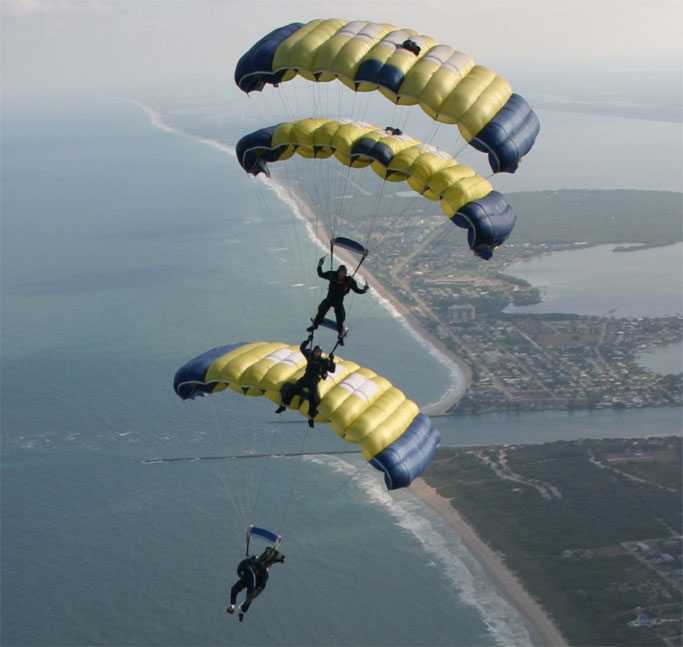
US Navy Leap Frogs 2010 Performance Schedule
This schedule is subject to change without notice.
15-22 March Tampa (FL) Navy Week
25-30 March Phoenix (AZ) Navy Week
02 April Lake Elsinore Storm Baseball
10-14 April Philadelphia (PA) Phillies Home Opener and High Schools
19-26 April Des Moines (IA) Navy Week and Drake Relays
29 April – 03 May St. Joseph ANG Open House, St. Joseph, MO
28-31 May NCAA Lacrosse Championship – Baltimore, MD
03-07 June Ocean City Air Show, MD
04-06 June High School Track & Field Championships, Clovis, CA
09 June Race Across America Marathon, Oceanside, CA
24-28 June Quad City Air Show, IA
03 July Minnesota Twins Armed Forces Day
09 July California State Games, Qualcomm Stadium, San Diego, CA
17 July Navy SEAL East Coast Reunion
09-16 August Chicago (IL) Navy Week and Sea/Air Show
19-22 August High School Lacrosse Championships – Florida
23-30 August Boise Navy Week, Boise, ID
03 September Del Norte High School football game
26 September Coronado Speed Festival, Coronado, CA
09 October Ironman World Championships, Kona, HI
06 November UDT/SEAL Muster, Fort Pierce, FL
11 December Navy/Army, Philadelphia, PA
Subscribe to:
Posts (Atom)