Showing posts with label NATO. Show all posts

Thursday, October 20, 2016

Russia taunts US with biggest military offensive since the Cold War

HMS Richmond
HMS Richmond escorting the Russian Task Group  Credit: Dez Wade /Royal Navy

From The UK Telegraph

Russia has begun its biggest surface deployment since the end of the Cold War as it aims to effectively end the war in Syria on the eve of the US election, NATO officials warned last night.


The Kremlin is sending the full might of its Northern Fleet and part of the Baltic Fleet to reinforce a final assault on the city of Aleppo in a fortnight, according to Western intelligence.


The final bombardment is designed to shore up the Assad regime by wiping out rebels – paving the way for a Russian exit from the civil war.


Click on pic to enlarge

Monday, February 29, 2016

Bombers receive warm welcome for Cold Response

A B-52 Stratofortress sits on the ramp at Morón Air Base, Spain, after recently arriving from Barksdale Air Force Base, La., Feb. 27, 2016. Three B-52s will participate in Cold Response 16, a large-scale NATO military exercise involving maritime, ground and air operations. The exercise’s location in the Trøndelag region of Norway will provide an extreme-cold environment in which a dozen allied and partner nations will jointly develop tactics, techniques and procedures. (U.S. Air Force photo/Senior Airman Joseph Raatz)
By Senior Airman Joseph Raatz,  2nd Expeditionary Bomb Group Public Affairs

MORÓN AIR BASE, Spain  -- B-52 Stratofortresses from Barksdale Air Force Base, Louisiana arrived in Europe Saturday, Feb. 27, in preparation for their participation in a large-scale NATO training exercise.

This year's iteration of the biennial Cold Response NATO military training and exercise program will be held in the central Trøndelag region of Norway and feature air, ground and maritime operations. Approximately 16,000 troops from a dozen nations will participate in the exercise, working together to collectively develop tactics, techniques and procedures for combat operations in an extreme cold-weather environment.

"We appreciate the opportunity to take part in such a large multinational exercise at the invitation of our Norwegian allies, and we are especially thankful for the opportunity to test our skills in such unique cold weather conditions," said Lt. Col. Dennis Cummings, 2nd Expeditionary Bomb Group commander.  "The ability to train bomber aircrews in different geographic combatant commands is essential to maintaining a strong, credible bomber force that enhances the security and stability of our allies and partners. Our ability to smoothly and effectively conduct these multinational missions is heavily indebted to the hospitality of Spain and fantastic support we are receiving from U.S. Air Forces in Europe."

The B-52s will conduct multiple sorties over the course of the exercise, engaging in simulated strikes against ground targets inside the training area. As the U.S. Air Force's premier nuclear-capable, strategic heavy bomber, the B-52 is capable of delivering a large payload of precision nuclear or conventional ordnance over long distances while also providing decision makers the ability to rapidly project military power.

"Bomber participation in joint military exercises like this one are an expression of the U.S. commitment to supporting our allies and partners, demonstrating our shared dedication to promoting global security and stability," said Maj. Matt Spinelli, 2nd EBG assistant director of operations.

The B-52s will join with KC-135 Stratotankers and F-16 Fighting Falcons to serve as the American air component for the duration of Cold Response 16. A number of C-130 Hercules will also be on hand to provide support to ground forces.

"This exercise provides a great opportunity for allies to train together and better understand how we each operate and communicate," Cummings said. "The increased understanding and cooperative efforts between our countries enable us to work together effectively, while also addressing any and all security challenges that may arise in the region or other parts of the world."

Cold Response 16 is scheduled to run through March 9.

Wednesday, February 24, 2016

493rd FS, NATO allies develop lasting, effective partnerships during Real Thaw

by Senior Airman Dawn M. Weber, 48th Fighter Wing Public Affairs

2/23/2016 - BEJA AIR BASE, Portugal -- More than 100 Airmen from the 48th Fighter Wing reported to Portugal to train with Portuguese, Belgian, Danish, French, Dutch, Norwegian, Spanish and other NATO ally forces, Feb. 22 - March 3.

Real Thaw is a Portuguese-led, large joint and combined forces exercise that
trains participating forces on a vast range of battlefield missions sets.
Forces participating will execute training missions aimed to merge and fully
employ different platforms covering defensive and offensive counter air
operations, high value air assets protection and close air support.

"It's an incredible opportunity to be here in Portugal," said Lt. Col. Rob
Fowler, 493rd Fighter Squadron operations supervisor. "We're excited to be
here working side by side with our NATO allies honing our joint air
inoperability as well as tactical skills."

Aircraft participating in the exercise include NATO E-3A aircraft, F-15C
Eagles from the 48th FW, C-130J Super Hercules from the 86th Airlift Wing,
Ramstein Air Base, Germany, as well as other partner aircraft.

"Real Thaw gives us the opportunity to train and learn from other countries
experiences," said "Buzzer," 301st Portuguese Air Base 5 F-16M pilot. "Here
we are able to effectively learn how to use each other's assets and how to
play together if there is ever a time we come together in a deployed
theater."

"Working with our NATO allies is crucial to joint inoperability." Fowler
said. "It's a good opportunity to plan, train and execute these missions in
a non-combat location so we're prepared if the day comes and we deploy with
our ally forces."

Participating in exercises like Real Thaw are an important component to
remaining "Forward, Ready, Now," for the 48th FW.

Real Thaw offers training opportunities for Liberty Airmen to train and hone
operational skills in a non-combat zone.

"We expect everyone involved to leave a better version of themselves.
Everyone; pilots, maintainers and anyone participating, we all need to leave
here with a better understanding of joint air inoperability and having
become more tactically proficient to keep the 48th FW and our NATO allies,
'Forward, Ready, Now", Fowler said.

Monday, August 10, 2015

NATO Reducing Air Patrols Around Baltic Sea as Russian Provocations Continue

BY: Jack Caravelli,

Only 8 NATO aircraft will patrol region beginning in September.


The NATO alliance will reduce by half the number of planes patrolling around the Baltic Sea beginning in September despite continuing provocations from Russian military aircraft, according to reports.
 
“Our military commanders assess that the posture is appropriate and adequate,” stated NATO spokesperson Carmen Romero.

So far this year across Europe NATO aircraft have scrambled 250 times in response to Russian military air activity.

NATO aircraft intercepted some 150 Russian military aircraft in the Baltic in 2014.
Another NATO official stated the planned reduction in the Baltic Air Patrol Mission does not represent “a change in our signal to Russia” and claims that there has recently been a slight decrease in Russian air activity in the region, although Russian military aircraft continue to fly at a high operational tempo there as well as over other parts of Europe.

Other long-range Russian flights have been observed near the Alaskan air defense zone in April and July.

Russia’s accelerated air activity, far beyond its rates of operation since the fall of the Soviet Union, has not been without cost to the Russian military. Since June, eight aircraft, including some aging TU-95 bombers, have crashed under various circumstances.

You can read the complete story at http://freebeacon.com/national-security/nato-reducing-air-patrols-around-baltic-sea-as-russian-provocations-continue/

Tuesday, November 11, 2014

Russia's 'close military encounters' with Europe documented

Russian military flights into Europe have increased over the past year
The growing strains between Russia and the West prompted by the Ukraine crisis are now sending ripples of military tension across Europe.

NATO has responded to Russia's incursions into Ukraine by stepping up its ties with Kiev and bolstering air patrols and exercises with its eastern and central European members.

Russia in turn has decided to pursue a more active, many might say a more aggressive, military policy of its own, returning to the sorts of flights and activities from the Cold War years that were used to regularly test out NATO defenses.

The European Leadership Network, a London-based think tank, has produced a detailed study of this more assertive Russian activity.

Close encounters

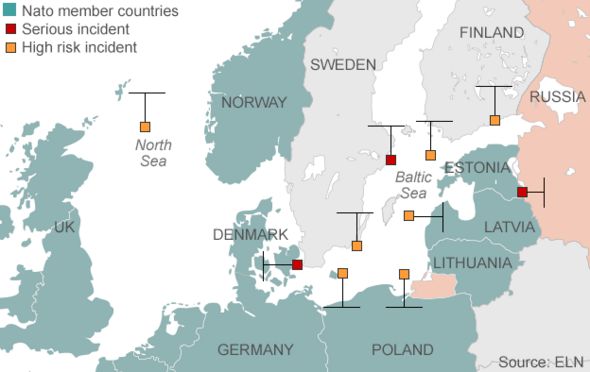
Entitled Dangerous Brinkmanship: Close Military Encounters Between Russia and the West in 2014, it chronicles almost 40 specific incidents that have occurred during the past eight months.

It says these "add up to a highly disturbing picture of violations of national airspace, emergency scrambles, narrowly avoided mid-air collisions, close encounters at sea and other dangerous actions happening on a regular basis over a very wide geographical area".

Key incidents by date
You can read the entire story on the BBC website at
http://www.bbc.com/news/world-europe-29956277

Thursday, October 30, 2014

NATO Tracks Large-Scale Russian Air Activity in Europe

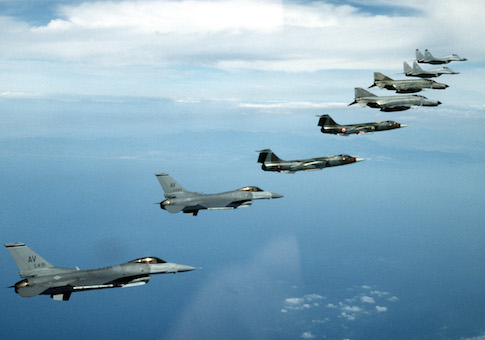
Norwegian Air Force F-16 Intercepting a Russian Bear Aircraft

Blog Editor Note: We have been following this military situation on our @MilcomMP twitter feed via various Bear HF Net frequencies. Will post more on them on the MilcomMP twitter feed as they pop up.

Story by SHAPE Public Affairs Office
MONS, Belgium – NATO detected and monitored four groups of Russian military aircraft conducting significant military manoeuvers in European airspace over the Baltic Sea, North Sea/Atlantic Ocean, and Black Sea on 28 and 29 October 2014.  These sizable Russian flights represent an unusual level of air activity over European airspace.

Eight Russian Aircraft Intercepted over North Sea / Atlantic Ocean on 29 October 2014

At approximately 3:00 a.m. CET on 29 October, NATO radars detected and tracked eight Russian aircraft flying in formation over the North Sea. F-16 aircraft from the Royal Norwegian Air Force were scrambled, intercepted and identified the Russian aircraft, which included four Tu-95 Bear H strategic bombers and four Il-78 tanker aircraft. The formation flew from mainland Russia over the Norwegian Sea in international airspace.  Six of the Russian aircraft then turned back to the north-east towards Russia, while two Tu-95 Bear H bombers continued south-west, parallel to the Norwegian coast, heading to the south-west. The Russian aircraft continued over the North Sea, and  Typhoon fighters from the United Kingdom were scrambled in response.  While over the Atlantic Ocean west of Portugal, the two Russian aircraft were intercepted and identified by F-16s from the Portuguese Air Force. The Russian aircraft turned back heading north-east, flying to the west of the United Kingdom. NATO aircraft from the United Kingdom and Norway were standing by and NATO assets on the ground and in the air tracked the Russian aircraft throughout. At present, the two Tu-95 bombers appear headed back to Russia, but as of 4 p.m. CET the aircraft were still airborne.

The bomber and tanker aircraft from Russia did not file flight plans or maintain radio contact with civilian air traffic control authorities and they were not using on-board transponders. This poses a potential risk to civil aviation as civilian air traffic control cannot detect these aircraft or ensure there is no interference with civilian air traffic.

Four Russian Aircraft Intercepted over Black Sea on 29 October 2014

During the afternoon of 29 October, NATO radars detected and tracked four Russian aircraft flying over the Black Sea in international air space, including 2 Tu-95 Bear-H bombers and 2 Su-27 Flanker fighter jets.  Fighters from the Turkish Air Force have intercepted the Russian aircraft and NATO is continuing to track them in international airspace.  As of 4 p.m. CET the aircraft were still airborne. 

Multiple Russian Aircraft Intercepted over Baltic Sea on 29 October 2014

During the afternoon of 29 October, NATO radars detected and tracked a number Russian aircraft flying over the Baltic Sea in international airspace, including 2x MiG-31 Foxhound, 2x Su-34 Fullback, 1x Su-27 Flanker and 2x Su-24 Fencer jets.  Portuguese F-16 Fighters assigned to the Baltic Air Policing Mission were scrambled in response and the Russian aircraft returned to Russian airspace.   

Seven Russian Fighter Jets also Intercepted on 28 October 2014

During the afternoon of 28 October, NATO radars detected and tracked seven Russian combat aircraft flying in international airspace over the Baltic Sea.  The aircraft were detected at approximately 2:30 p.m. CET on 28 October and included 2x MiG-31 Foxhound, 2x Su-34 Fullback, 1x Su-27 Flanker and 2x Su-24 Fencer jets.

The Russian aircraft were flying in the Gulf of Finland and were intercepted by German Typhoon fighter jets from NATO’s Baltic Air Policing Mission in order to identify the aircraft and protect Allied air space.  The Russian aircraft continued into the Baltic Sea and were subsequently intercepted by Allied fighters from Denmark as well as fighters from Finland and Sweden, which are not members of NATO.  The Russian fighters continued to the Kaliningrad Oblast.  The Russian aircraft had filed a flight plan with air traffic control authorities, were using transponders, but did not maintain radio contact with civilian air traffic control.

NATO jets were on standby throughout the duration of both Russian flights and Russian aircraft were continually tracked using Allied assets on the ground and in the air.  NATO has conducted over 100 intercepts of Russian aircraft in 2014 to date, which is about three times more than were conducted in 2013.

Scrambles and intercepts are standard procedure when an unknown aircraft approaches NATO airspace.  However, such flights pose a potential risk to civil aviation given that the Russian military often do not file flight plans, or use their on-board transponders. This means civilian air traffic control cannot detect these aircraft nor ensure there is no interference with civilian air traffic.

NATO Allies protect their airspace on a 24/7 basis. Allied air defense efforts are focused on stopping unauthorized incursions into NATO airspace and on preventing acts of airborne terrorism.

Tuesday, November 12, 2013

Scramble, scramble, scramble


 An F-15C Eagle turns onto a taxiway before take off at Keflavik International Airport, Iceland, in support of the NATO air defense mission here, Nov. 6, 2013. The 48th Air Expeditionary Group has been maintaining the NATO air surveillance and policing mission here since Oct. 28, 2013. The group, which is made up of U.S. Air Force and other North Atlantic Treaty Organization personnel, is a specialized team prepared to ensure Iceland's air sovereignty. (U.S. Air Force photo by Airman 1st Class Dana J. Butler/Released)

Monday, November 04, 2013

U.S. Air Force units arrive to Iceland in support of NATO exercise

by 1st Lt. Leah Davis 48th Fighter Wing Public Affairs

KEFLAVIK, Iceland  -- Airmen from Royal Air Force Lakenheath, RAF Mildenhall, Spangdahlem Air Base, Ramstein AB, Davis-Monthan Air Force Base, Tinker AFB and Robins AFB arrived at Naval Air Station Keflavik, Iceland, Oct. 28, 2013, to complete an air surveillance exercise in support of a bilateral agreement between the U.S. and Iceland.

Squadrons of U.S. Air Force and U.S. Navy aircraft have been committed to the defense of Iceland and NATO Air North out of NAS Keflavik since the two countries signed a defense agreement in 1951. Once the U.S. withdrew its permanently-based forces in 2006, Iceland requested NATO options for airborne surveillance and intercept capability. The U.S. participates in one U.S.-sponsored exercise and in one NATO exercise each year in Iceland.

While the U.S. has no plans to resume a permanent physical military presence in Iceland, commitment to its security and prosperity has never been stronger. By conducting periodic air surveillance, the U.S. ensures a safe and stable future for Iceland while aircrews and maintainers gain important experience in a unique operating area.

Wednesday, June 01, 2011

Bold Monarch 2011 Kicks Off in Spain

Members of the Deep Submergence Unit aboard the Military Sealift Command fleet ocean tug USNS Sioux (T-ATF 171) prepare to submerge a submarine rescue chamber during exercise CHILEMAR II. The exercise between the Chilean and U.S. Navy forces simulates submarine rescue operations. (U.S. Navy photo by Mass Communication Specialist 3rd Class Spencer Mickler/Released)
By MCC(SW/AW) Katt Whittenberger, Expeditionary Combat Camera

CARTAGENA, Spain (NNS) -- Participants and observers from more than 25 countries departed May 30, for the NATO exercise Bold Monarch 2011, the world's largest submarine rescue exercise.

The 12-day exercise supports interoperability between submarines and submarine rescue units, and this is the first time a Russian submarine has participated in a NATO exercise.

"In Bold Monarch 2008, NATO and our partner nations demonstrated dramatic improvements in international cooperation and interoperability in this challenging field," said Capt. David Dittmer, deputy commander, Submarines North. "Our achievements included the first ever rescues between the Russian Federation Navy and NATO submarines, and the first transfer of personnel with the new U.S. and NATO rescue systems. In 2011's exercise, we will move even further in demonstrating our technical capabilities and coordination processes. We will include a Russian submarine in this exercise for the first time and practice complex, international command and control procedures in a realistic scenario. This is the graduate level of submarine rescue operations."

More than 2,000 personnel and 20 ships have gathered off the coast of Spain, bringing with them rescue forces equipped with a range of sophisticated debris clearance, diver assisted gear and submarine rescue systems (SRS). With more than 40 nations operating submarines, the compatibility between assets and standardization of procedures in submarine rescue is exceedingly important.

"In the unlikely event of an emergency, we can work with our allies to respond appropriately, and having a standardized script helps cut through the language barrier," said Cmdr. David Lemly, commander, Deep Submergence Unit. "Exercises like this gives us a way to interact with militaries we may not normally interact with since we're primarily a humanitarian unit."

Filling the U.S. role for the exercise is the Navy's Deep Submergence Unit (DSU), which runs the only U.S. submarine rescue systems. Monday the Pressurized Rescue Module (PRM) submerged and successfully linked up with the Turkish SSK Anafartalar. One of the goals for this dive was to verify the possibility of using a remote operated vehicle (ROV) as a tool to allow recovery of the PRM if there's an emergency while it is submerged. The Swedish ROV launched from the HSwMS Belos, and as a safety precaution, it approached the PRM after the PRM had fully sealed on the Turkish vessel, but before the hatch was opened between the two.

"This exercise is great training for my operators and clearly demonstrates our ability to work with other subs to do our mission." said Lemly.

Bold Monarch 2011 will culminate with a 48-hour scenario involving the rescue of more than 150 personnel from multiple ships. Aircraft from Italy will deliver divers from the Italy, Russia, and the United Kingdom via parachutes, to provide first response. The medical professionals will respond to multiple mass casualty scenarios. Rescue systems from multiple countries will recover trapped Sailors.

Friday, April 01, 2011

Libya Military Operation Name Changed

Now that NATO has control of the Libyan military operation as of March 25, the name has changed from Operation Odyssey Dawn to Operation Unified Protector. More about this operation at http://www.bruxelles2.eu/afrique/maghreb/les-moyens-de-loperation-embargo-sur-les-armes.html

Tuesday, March 08, 2011

USAF AWACS Over Libya?


Media reports from NATO sources indicate that AWACS surveillance flights over Libya may be extended from 10 to 24 hours a day and that the US Air Force AWACS from the 552ACW would be capable of handling this mission.

I have pulled from my db frequencies that have had AWACS activity in the past by the French AF, UK RAF and NATO AWACS aircraft. I do not have any confirmed voicetell frequencies used by any USAF AWACS overseas in the past in my database.

The frequencies below have not been observed in use during this current situation and any intercept reports regarding any military service AWACS missions over Libya are certainly appreciated. You can email me at the email address in the masthead.

French Air Force AWACS Net
4745.0 5307.0 7650.0 8192.5 9050.0 kHz

RAF Command & Control AWACS HF Link
2205.0 4478.5 6673.5 6745.0 8500.5 kHz

NATO E-3 AWACS
3081.0 3089.0 3225.0 3900.0 4542.0 4721.0 4757.0 4779.0 5691.0 6690.0 6695.0 6700.0 6728.0 6754.0 6760.0 6762.5 8971.0 8980.0 8986.5 10315.0 10429.0 12165.0 15016.0 15018.0 17996.5 18009.0 23241.0 kHz

Thursday, September 02, 2010

Lakenheath unit assumes NATO mission

by Tech. Sgt. Chris Stagner, 48th Fighter Wing Public Affairs

LITHUANIA AIR FORCE AIR BASE, Lithuania (AFNS) -- The 493rd Expeditionary Fighter Squadron, deployed from Royal Air Force Lakenheath, England, assumed command of the NATO Baltic air policing mission Sept. 1 from the Polish air force at Lithuania Air Force Air Base.

For the next four months, the squadron, comprising approximately 125 people, is responsible for ensuring the air sovereignty of Lithuania, Latvia and Estonia.

This is the third time since 2004 the U.S. Air Force has accomplished this mission and the second time the 493rd EFS has had responsibility.

"The (493rd has) already established a legacy of professionalism in the Baltics, and we look forward to building upon it," said Anne Derse, U.S. ambassador to Lithuania. "As all warriors know, the surest way to maintain peace is to exercise constant vigilance and rigorously prepare to meet all potential threats. The Baltic air policing mission is just one of many facets of NATO's vigilance and preparation. This is a mission we take seriously and take on with pride."

The mission turnover from Poland to America is an example of the strong relationships America has with its NATO allies, said Maj. Gen. Mark Zamzow, 3rd Air Force vice commander.

"Our relationship with the Baltic nations has grown remarkably since the inception of the Air policing mission," he said.

The general went on to explain that a 2008 endeavor designed to provide complex air policing training has since evolved with a broader scope emphasizing a wide spectrum of air operations over Lithuania, Latvia and Estonia.

Airmen of the 493rd EFS are prepared to do their part to ensure that relationship continues to grow as they accomplish their mission, a squadron official said.

"The men and women of the 493rd EFS are proud to be here ... protecting the skies over the Baltic states," said Lt. Col. Skip Pribyl, 493rd EFS commander. "This mission falls in line with what we do -- establish air superiority -- and we're excited to do it."

Republic of Latvia Chief of Defence Maj. Gen. Raimonds Graube emphasized the importance of the NATO relationship that makes the air policing mission possible.

"It's been more than six years since we started the Baltic air policing mission, and it's an example of our solidarity (as allied partners)," he said. "It shows we are ready to work together to support our allies."

Republic of Lithuania Chief of Defence Maj. Gen. Arvydas Pocius agreed.

"As members of NATO, we work shoulder to shoulder to support Afghanistan and other operations," General Pocius said. "It's a strong alliance."

He also thanked U.S. Airmen for adopting the air policing mission and promised to do his best to accommodate American traditions.

"I know you're here during a difficult time," he said. "You're here through Thanksgiving, Christmas and New Year's. I promise you, we will find turkeys."

Friday, August 06, 2010

Multinational Crew Participates in Kearsarge ARG's COMPTUEX


By Clark Pierce, Naval Air Station Jacksonville Public Affairs

JACKSONVILLE, Fla. (NNS) -- A NATO Airborne Early Warning and Control Force E-3 aircraft, operating from Naval Air Station Jacksonville, Fla., took part in the USS Kearsarge (LHD 3) Amphibious Ready Group composite training unit exercise (COMPTUEX) July 7-28.

The aircraft is one of 17 Boeing NATO E-3 Airborne Warning and Control System (AWACS) aircraft deployed from the unit's main base at Geilenkirchen, Germany.

"Working with naval forces is different than operating with army and air force commands. Participating in COMPTUEX allows us to improve our maritime operational readiness," said Belgian Air Force Maj. Georges Deneffee, a deployment commander who is on assignment to NATO.

Sixteen nations, Belgium, Canada, Denmark, Germany, Greece, Hungary, Italy, Luxembourg, The Netherlands, Norway, Poland, Portugal, Spain, Turkey, United Kingdom and United States, provide personnel to the NATO Airborne Early Warning and Control Force.

"We normally operate our E-3 at an altitude of 30,000 feet, where we continuously monitor the airspace within a radius of 250 miles of the aircraft. We exchange information with ground- and sea-based commanders to provide information on both low-flying and high-altitude aircraft operating in a particular territory. Our radar also operates in a maritime mode, which allows us to detect and track ships," said Deneffee.

Intelligence Specialist 1st Class Marcus Fielder is assigned to the E-3 as an air controller of fighter aircraft.

"The NATO E-3 is much larger than the carrier-based Navy E-2 Hawkeye AWACS aircraft, which operates with a crew of five. The NATO E-3 flies with 12 mission crew and four flight crew. A new twist in this COMPTUEX is the addition of seven Royal Navy ships. That means we're supporting a more challenging level of combined operations," said Fielder.

Prior to his three-year tour with NATO Airborne Early Warning and Command Force, Fielder was assigned to Fleet Area Control and Surveillance Facility in Jacksonville, Fla.

"I'm fairly new to the crew and work as a communications technician responsible for radio and digital data link equipment. We fly the same E-3 platform as the U.S. Air Force, but that's where the comparison ends. This NATO E-3 features the latest computerized mission equipment, and it's all being put to the test by the Kearsarge COMPTUEX. The high heat and humidity at NAS Jax is another good test of our new equipment," said U.S. Air Force Staff Sgt. Jeremy Runyon. "This aircrew represents military services from 16 NATO member nations, so it becomes an interesting multicultural experience for Airmen and Sailors."

Deneffee added, "Our crew really enjoys operating from NAS Jacksonville and getting to see various slices of America. When time permitted, we toured Jax Beach, Cape Kennedy and Central Florida. And some crewmen tested their golf skills at many of the great courses in Northeast Florida."

A news release from the 26th Marine Expeditionary Unit (MEU), deployed aboard Kearsarge, said a key element of COMPTUEX was reconnaissance, communication and close-air support provided by joint tactical air controllers on the ground and aboard aircraft assets such as NATO AWACS.

"The Kearsarge Amphibious Ready Group and 26th MEU have a firm grasp on our communications and mission procedures, which was a major objective for this exercise. COMPTUEX was extremely productive and has set us up well for the certification exercise ahead," said 26th MEU Executive Officer Marine Corps Lt. Col. Mike Starling.

Thursday, June 10, 2010

Thursday War Frequency

From Michel and our friend Graham Tanner on UDXF:

05206.0 KK, KI w CONTROL / exercices NATO ? 0619 USB eng ( german & uk accent ) d/x 10jun10 Michel

It is a 'Thursday War' frequency. Every Thursday the Royal Navy and other NATO naval forces have a large exercise in 'La Manche' between Brittany/Normandy and Cornwall/Devon. As would be expected, all the vessels use codes rather than their ship-names, but you can usually work out the nationality of the ship from the accent on the radio.

Graham Tanner

Saturday, August 15, 2009

Radio Station Gives Voice to Remote Afghan Region

Broadcasting into areas so isolated -- many residents may only travel as far as the neighboring village in their lifetimes -- Kalagush Radio is "a live existence of the [outside] world," Hamdard said.

By Army Sgt. Matthew C. Moeller, Special to American Forces Press Service

NURISTAN PROVINCE, Afghanistan - NATO's International Security Assistance Force is giving voice to residents of this remote area through a radio station run by one of their own.

When Shaib Dad Hamdard was growing up here near the Pakistan border, he dreamed of being a voice to his people. Now, with the turn of a dial and the flick of the switch, he's on air at Kalagush Radio, reaching out across the remote mountain province.

And he doesn't shy away from controversy. Today's topic: the need for women's equality.

"With this," the 24-year-old station manager said, motioning to the microphone, "I can educate my people. I can provide a voice to them."


For 12 hours a day, the Nuristani radio station offers news and entertainment programs that cater to the local people.

Although the news stories are not always positive, they are honest. They offer a balanced look at issues affecting residents under the station's "don't take any sides" philosophy.

But news is only part of the station's programming. DJs offer a variety of music, history, education, religious and social commentary shows, as well. One of Kalagush Radio's most popular shows is a daily music program that allows listeners to phone in with requests, Hamdard said. The show has received a huge response, he said.

"We think of the needs of the local people, and what they want," said Hamdard, remarking on the station's success.

Although ISAF funds the station, Kalagush Radio employees insist they decide what is put on the air.

"Of course it is funded by the coalition forces, but I have total control over the programs," Hamdard said. "The programs are not limited to any specific groups."

ISAF forces are working with Kalagush Radio to expand its broadcast schedule to 24 hours a day. They're also planning to hire several new journalists for the station, including an Afghan woman, offering a voice for what the station's crew calls a silent majority.

Related Story Links:

Kalagush Radio Broadcasts Freedom
http://northshorejournal.org/kalagush-radio-broadcasts-freedom

Tuning into Kala Gush Radio
http://www.1stid.org/about/pressreleases/3bct0808.pdf


Kalagush Radio DJ prepares the Nuristan province, Afghanistan, radio station for broadcast, Aug. 3. The International Security Assistance Forces funded station offers the people of the remote mountain area a variety of news and entertainment programs. Combined Joint Task Force - 82 PAO Photo by Sgt. Matthew Moeller

And this from Kim Elliott's website (http://www.kimandrewelliott.com/

New NATO funded radio station in Afghanistan is "not limited to any specific groups." "NATO’s International Security Assistance Force is giving voice to residents of this remote area through a radio station run by one of their own. When Shaib Dad Hamdard was growing up here near the Pakistan border, he dreamed of being a voice to his people. Now, with the turn of a dial and the flick of the switch, he’s on air at Kalagush Radio, reaching out across the remote mountain province. ... Although ISAF funds the station, Kalagush Radio employees insist they decide what is put on the air. 'Of course it is funded by the coalition forces, but I have total control over the programs,' Hamdard said. 'The programs are not limited to any specific groups.' ISAF forces are working with Kalagush Radio to expand its broadcast schedule to 24 hours a day. They’re also planning to hire several new journalists for the station, including an Afghan woman, offering a voice for what the station’s crew calls a silent majority." American Forces Press Service, 10 August 2009. On FM? Or on medium wave or even shortwave, more capable of "reaching out across the remote mountain province"?

Friday, March 06, 2009

NATO Exercise Loyal Mariner Underway

From Wolfgang and the UDXF gang for our friends and readers in Europe:

NATO EXERCISE LOYAL MARINER 09 FROM 2 TO 13 MARCH 09

IN THE MEDITERRANEAN SEA - AREA SOUTH OF SARDINIA BOUNDED BY 37-50N AND 39-30N AND 07-30E AND 10-30E. MERCHANT SHIPS CO- OPERATION IS VALUABLE FOR TRAINING IN THE COUNTER PIRACY ACTIVITIES. ALL MERCHANT SHIPPING GREATER THAN 300 GRT APPROACHING THE AREA IS REQUESTED TO PARTICIPATE ON A VOLUNTARY BASIS (NO COST/NO DELAY) IN ORDER TO IMPROVE REPORTING AND EXCHANGE OF INFORMATION. MERCHANT SHIPS ARE INVITED TO INFORM THE NATO SHIPPING CENTRE THEIR WILLINGNESS TO PARTICIPATE IN THE EXERCISE VIA EMAIL TO: INFO AT SHIPPING.NATO.INT OR FREEPHONE 0044 1923956574 OR FREEFAX 0044 1923956575 FOR FURTHER INSTRUCTION NNNN

And here are a few possible related freqs from Wolfgang:

8327.9 Mike Kilo Unid NATO 1004 USB clg Alpha Whiskey for rc, then qso.
8327.9 Alpha Whisky: Unid NATO 1004 USB qso Mike Kilo.
8328.2 Unid NATO (ship station?) 0950 Stanag 4285/600L short msg´s KG84 [SOM].

And another possible related freq from Michel on UDXF

4760.0 Xray 51 wkg 7BY NATO exercice? "loyal mariner" 1023 USB eng d/x "alligator...all ships..." [Definite CWC Net-LVH]

Thank to Wolfgang and Michel for sharing this info on Loyal Mariner.

Saturday, February 28, 2009

U.S. Navy, NATO Complete Exercise Noble Manta 09

By Mass Communication Specialist 3rd Class Jonathan P. Idle

The U.S. Navy and seven NATO allies completed the annual anti-submarine warfare exercise Noble Manta 09 Feb. 27 in the Ionian Sea off the eastern coast of Sicily.

The exercise was conducted from Feb. 13-27 and was a cooperative effort facilitated by NATO assets in conjunction with Command Task Force 67 and included six submarines, 10 surface ships and 13 aircraft from countries including France, Germany, the United Kingdom, Italy, Greece, Turkey and Canada.

The purpose of the exercise was to demonstrate NATO's determination to maintain proficiency and improve interoperability in coordinated anti-submarine, anti-surface and coastal surveillance operations using a multinational force of ships, submarines and aircraft. The exercise also provided operational training in potential NATO Response Force (NRF) tasks/roles and missions, exercising the procedures for possible NRF operations as well as defense against terrorism.

"We had some friendly subs and some surface vessels," said Lt. Erik Sword, a naval flight officer with Patrol Squadron 4 stationed at Marine Corps Base Kaneohe Bay, Hawaii. "We were involved and the other NATO forces had their air assets out there as well. So, it was a lot of detect and deter type missions for submarines to either keep the battle group safe or just go out and detect subs that may or may not have been there."

Noble Manta offered service members from different nations a chance to work alongside many of their NATO counterparts.

"It's good exposure for us to get over here and represent Canada, reinforce our role in aviation community and work with our NATO allies," said Canadian Cpl. Tim Johnston, an aviation systems technician with the 14th Air Maintenance Squadron stationed in Greenwood, Nova Scotia, Canada. "The support that we have received from the other has been excellent. We're all on the same team here, and we have the same goal in mind."

Tuesday, December 23, 2008

NATO Operations Chief Discusses Deployments, Caveats

By Jim Garamone, American Forces Press Service

KABUL, Afghanistan - Most American troops deploying to Afghanistan in the next year will go to Regional Command South, the deputy chief of staff for operations for NATO's International Security Assistance Force said here today.
Army Maj. Gen. Michael S. Tucker said ISAF officials expect that area to have the heaviest fighting in the coming year.

"RC South is a mosaic of different [NATO] countries," he said. "There seems to be all these small regional wars."

The United Kingdom is in charge of operations in Helmand province, the Canadians are in Kandahar, the Dutch in Uruzgan, and in Nabol the force is Romanian. "They are kind of fighting their own war," he said.

In the past, the NATO commander in the south rotated every six months, and this encouraged this mosaic approach. The Dutch commander in charge now will serve a year, Tucker said. "It's now on the right track," he said.

And this is vital to success in the region, the general said, as the center of gravity in a counterinsurgency fight is not the enemy, it is the population.

"You have to build relationships with tribal elders, police chiefs, the local governments, provincial officials," he explained, "and it's hard to do that six months at a time." Army Gen. David McKiernan, who commands all NATO and U.S. forces in Afghanistan, has stressed to commanders at all levels that they must get out with the people and build these relationships.

The fight in Regional Command South also is affected by what officials call "national caveats" -- restrictions on how NATO commanders can use the military personnel of a particular country. Commanders assigning missions always must keep these restrictions in the back of their minds. U.S. forces have few caveats, and commanders can use American troops as needed.

"These caveats are strictly controlled by their national governments," Tucker said. "Some of them, for example, can't do a cordon-and-search without getting permission from their minister of defense. Some countries can't conduct an air strike without permission. Some can't cross a regional boundary with troops or helicopters without permission from their ministries."

McKiernan has addressed these caveats with various national leaders and has highlighted the effects of those restrictions. "The advantages that we have over the enemy are often taken away from us by caveats," Tucker said.

NATO has unmatched air power, but negotiating with various countries and asking for permission can take that advantage away, the general said. For example, he said, a medevac helicopter from one country could not cross a regional boundary to pick up wounded personnel in an incident over the summer.

That made an impression, Tucker said, and NATO defense ministers now are more apt to work to lessen the caveats.

"But more needs to be done," Tucker said. "You can't order. You need to nudge them in the right direction."

Friday, November 14, 2008

NATO Defense Ministers Discuss Ukraine

NATO Defense Ministers Discuss Ukraine
American Forces Press Service

WASHINGTON, Nov. 13, 2008 - Defense Secretary Robert M. Gates and his fellow NATO defense ministers are getting down to business today in consultations on Ukraine's course toward membership in the alliance.

NATO Secretary General Jaap de Hoop Scheffer said the ministers will focus on questions of defense and security policy, strategy and reform. The discussions will yield information that NATO foreign ministers will use in December, when they will seek to sculpt a membership action plan to chart Ukraine's course to full NATO membership, he said.

Ukraine has strong support for membership in the Euro-Atlantic alliance, a senior administration official, speaking on background, said after the first set of meetings. However, the official added, ministers also are expressing concerns about developments in Ukraine.

The country has not done as good a job on reforms as ministers would like, as political crises have created instability in reform efforts, the official explained.

"They need to do a better job themselves," the official said. "They need to do their part of the work. NATO is ready to help them; they need to hold up their end of it as well."

Membership in the alliance isn't just about defense matters, the U.S. official said, as NATO expects its prospective members to have stable institutions, pursue economic reforms and have strong anti-corruption laws in place.

De Hoop Scheffer said the overall theme of the NATO-Ukraine consultations is how the relationship works in an evolving security environment.

"The meeting presents an excellent opportunity to exchange views at a high level about the current security environment in the Euro-Atlantic area, as well as to address Ukraine's capabilities to meet modern security challenges and to contribute to NATO's security efforts," the secretary general said his remarks opening the conference.

"There can be no denying ... that the Russia-Georgia conflict last August has changed the European security environment," he said, adding that Russia's unilateral recognition of the Georgian provinces of Abkhazia and South Ossetia as independent states violates basic principles of sovereignty and territorial integrity. The secretary general said the Russian moves will not lead to the viable European security structure that all nations seek.

The meeting sends two messages, the senior administration official told reporters. "We need to be clear that Russia has not succeeded in drawing a line across Europe with its invasion of Georgia," he said. "We also need to convey that NATO remains very much on track working with countries in the East on this process of building a Europe, whole and free."

Also in play is the concept that a country has the right to freely choose its security alignments. De Hoop Scheffer called this "a test for a Europe we all seek to build."

"It is a principle we will not seek to compromise," he said.

The defense ministers also will take stock of Ukrainian progress in transforming its national security structures and practices. Defense budgeting and investment, an all-volunteer military and interoperability with NATO are key stones in that effort. "The road to Euro-Atlantic integration, after all, is a performance-based process," de Hoop Scheffer said.

Though Ukraine has not done a good job in prioritizing its defense expenditures or in forming interoperable and deployable forces, officials said, the country is involved in some way in every NATO operation from Afghanistan to Kosovo.

Saturday, October 11, 2008

NATO Responds to Pirates

With the recent uprise of piracy off the coast of Somalia, NATO is stepping up and taking action.