Thursday, February 11, 2016

Mode-S/ADS Milcom Intercepts 4-10 Feb 2016 - Brasstown NC

Here is the latest round of Mode-S/ADS-B intercepts and selected ATC call signs logged from here on the radio ranch in WNC. All dates/times are UTC and list is sorted in Mode-S address order.

140841 14-0841   ---  2016-02-04 16:56:35 BE30 United States --- ---  ---    
249249 Various   11111111 2016-02-09 17:43:49 Various Various --- ---  ---    
29CBB8 various   ---  2016-02-07 19:42:27 various various Various ---  ---   
7103D4 3208   FIXER55 2016-02-05 13:30:55 KC-130J Saudi Arabia RSAF | 32 Sqn ---  ---   
738B4E ---   FIXER55 2016-02-04 14:44:34 --- Israel --- ---  ---   
A768D4 10-3077   ---  2016-02-05 20:48:17 C-146A United States USAF | 27SOW | 524SOS [KCVS] ---  ---   
A85F6E N639CS   DOJ323 2016-02-05 19:11:59 737-4Y0 United States US DOJ ---  32000    
A8657E N640CS   0 2016-02-08 16:38:08 737-400 United States US DOJ 0000  25500    
A87889 ---   ---  2016-02-04 18:18:20 C-146A United States USAF | 27SOW | 524SOS [KCVS] ---  ---   
ACE003 10-3026   ---  2016-02-06 18:20:41 C-146A United States USAF | 27SOW | 524SOS [KCVS] ---  ---   
ADFC7B 91-0087   ---  2016-02-05 15:03:44 T-1A Jayhawk United States USAF | 47FTW | 86FTS [KDLF] 0000  6000   
ADFC9D 92-0348   ---  2016-02-04 14:54:19 T-1A Jayhawk United States USAF | 479FTG | 451FTS [KNPA] ---  ---   
ADFCE0 94-0129   ---  2016-02-05 18:57:48 T-1A Jayhawk United States USAF | 479FTG | 451FTS [KNPA] ---  ---   
ADFCE2 94-0131   ---  2016-02-08 15:25:45 T-1A Jayhawk United States USAF | 479FTG | 451FTS [KNPA] ---  ---   
ADFCE7 94-0136   ---  2016-02-08 18:29:34 T-1A Jayhawk United States USAF | 14FTW | 48FTS ---  ---   
ADFCF1 94-0146   ---  2016-02-04 19:20:04 T-1A Jayhawk United States USAF | 14FTW | 48FTS ---  ---   
ADFCF7 95-0043   ---  2016-02-04 18:49:05 T-1A Jayhawk United States USAF | 14FTW | 48FTS ---  ---   
ADFDB8 93-1038   COBB 38 2016-02-04 16:04:59 C-130H United States AFRC | 94AW | 700AS [KMGE] ---  ---   
ADFDBE 93-7311   ROLER31 2016-02-04 22:53:51 C-130H United States NV ANG | 152AW | 192AS [KRNO] ---  ---   
ADFDBE 93-7311   ROLER31 2016-02-06 14:59:12 C-130H United States NV ANG | 152AW | 192AS [KRNO] ---  ---   
ADFDC1 93-7314   ROLER14 2016-02-09 20:40:23 C-130H United States WY ANG | 153AW | 187AS [KCYS] 0000  23000   
ADFDCA 93-2041   SHARK21 2016-02-05 19:54:29 C-130H United States IL ANG | 182AW | 169AS [KPIA] ---  ---   
ADFDCA 93-2041   SHARK67 2016-02-09 15:23:26 C-130H United States IL ANG | 182AW | 169AS [KPIA] ---  ---   
ADFDD0 92-3328   WING11 2016-02-08 21:57:21 C-12R United States USARC | A/2-228 AVN (TA) [KWRI ] ---  12250    
ADFDD7 95-1001   GOFER01 2016-02-05 16:19:37 C-130 United States MN ANG | 133AW | 109AS [KMSP] ---  ---   
ADFDD7 95-1001   GOFER01 2016-02-06 14:20:14 C-130 United States MN ANG | 133AW | 109AS [KMSP] ---  ---   
ADFDE7 94-6702   SHARK21 2016-02-04 15:49:41 C-130H United States IL ANG | 182AW | 169AS [KPIA] ---  ---   
ADFDE8 94-6703   TORCH42 2016-02-05 15:54:41 C-130H United States IL ANG | 182AW | 169AS [KPIA] ---  ---   
ADFE61 90-1798   JESSE 98 2016-02-04 19:09:30 C-130H United States OH ANG | 179AW | 164AS [KMFD] ---  ---   
ADFE61 90-1798   JESSE 98 2016-02-07 13:30:03 C-130H United States OH ANG | 179AW | 164AS [KMFD] ---  ---   
ADFE77 92-1452   TORCH11 2016-02-05 15:52:49 C-130H United States IL ANG | 182AW | 169AS [KPIA] ---  ---   
ADFE85 92-0550   COBB50 2016-02-04 23:12:03 C-130H United States AFRC | 94AW | 700AS [KMGE] ---  ---   
ADFE8D 95-0088/95-0096   ---  2016-02-05 15:39:34 C-12R+ United States USARMY ---  ---   
ADFE97 95-0098   PAT205 2016-02-08 17:50:43 C-12V United States USARC | C/6-52 AVN (TA) [KSLI] ---  ---    
ADFEA2 96-7322 ANVIL61 2016-02-06 21:02:21 C-130H United States AFRC | 302AW | 731AS [KCOS] ---  ---   
ADFEC1 96-0111   ---  2016-02-06 19:04:29 UC-35a1 ??? United States USARMY ---  ---   
ADFEC9 84-0182   PAT544 2016-02-09 17:19:03 C-12U United States ARMY 0000  21975   
ADFEDB 86-0085   00000000 2016-02-09 21:44:37 C-12U United States NM ARNG | OSACOM DET-44 [KSAF] ---  ---   
ADFEDD 86-0087   ---  2016-02-04 20:08:04 C-12U United States PA ARNG | OSACOM DET-22 [KMUI] ---  ---   
AE0175 84-0120   SPAR483 2016-02-07 17:40:05 C-21A United States ND ANG | 119WG | 117AS [KFAR] ---  ---   
AE0224 85-0032   OPEC 78 2016-02-09 16:35:44 KC-10A United States USAF | 305AMW [KWRI] ---  28975    
AE022A 86-0032   TEAM44 2016-02-04 15:27:09 KC-10A United States USAF | 305AMW [KWRI] ---  ---   
AE0268 59-1523   STEEL41 2016-02-05 15:34:43 KC-135R United States PA ANG | 171ARW [KPIT] 0000  35000   
AE02DF 89-1187   BISON33 2016-02-04 19:58:33 C-130H United States AFRC | 914AW | 328AS [KIAG] 0000  20000   
AE02DF 89-1187   BISON33 2016-02-05 22:05:24 C-130H United States AFRC | 914AW | 328AS [KIAG] ---  ---   
AE02E0 89-1188   BISON82 2016-02-04 19:49:13 C-130H United States AFRC | 914AW | 328AS [KIAG] ---  ---   
AE02E0 89-1188   BISON82 2016-02-05 22:38:57 C-130H United States AFRC | 914AW | 328AS [KIAG] ---  ---   
AE0364 60-0347   EDDIE31 2016-02-08 20:19:15 KC-135R United States OH ANG | 121ARW [KLCK] ---  ---   
AE0384 59-1458   EDDIE41 2016-02-05 16:03:05 KC-135R United States OH ANG | 121ARW [KLCK] ---  ---   
AE0384 59-1458   EDDIE41 2016-02-05 16:50:18 KC-135R United States OH ANG | 121ARW [KLCK] ---  ---   
AE03DB 165316   ---  2016-02-04 18:56:02 KC-130T United States USMCR | VMGR-452 [KSWF] ---  ---   
AE03EA 165313   ---  2016-02-08 18:55:34 C-130T United States USNR | VR-62 [KNIP] ---  ---   
AE0419 164407   GOTO FMS 2016-02-05 19:06:41 E-6B United States USN | SCW-1 [KTIK] ---  ---    
AE0433 02-5001   ---  2016-02-06 20:57:46 C-32B United States USAF | 486FLTS [KVPS] ---  ---    
AE049C 59-1517   SODA81 2016-02-04 21:17:11 KC-135R United States TN ANG | 134ARW | 151ARS [KTYS] 0000  16800   
AE049C 59-1517   SODA81 2016-02-04 23:26:40 KC-135R United States TN ANG | 134ARW | 151ARS [KTYS] 0000  16800   
AE04AD 99-0104   ---  2016-02-05 13:18:49 UC-35a1 United States USARC | A/2-228 AVN (TA) [KWRI ] ---  ---   
AE04D1 63-7984   RCH159 2016-02-08 00:31:57 KC-135R United States AL ANG | 117ARW | 106ARS [KBHM] ---  ---   
AE04DB 57-1437   BACKY53 2016-02-05 17:35:28 KC-135R United States AFRC | 916ARW | 77ARS [KGSB] ---  ---   
AE04ED 63-8035   RCH597 2016-02-08 01:21:55 KC-135R United States AL ANG | 117ARW | 106ARS [KBHM] ---  ---   
AE0546 70-0448   ---  2016-02-07 19:46:56 C-5A United States AFRC | 433AW | 68AS [KSKF] ---  ---   
AE05DF 87-9282   BISON11 2016-02-06 17:44:49 C-130H United States AFRC | 440AW | 95AS [KPOB] ---  ---   
AE0605 80-0326   RCH455 2016-02-04 23:12:35 C-130H United States GA ANG | 165AW | 158AS [KSAV] ---  ---   
AE0650 58-0049   E80049 2016-02-05 13:55:12 KC-135T United States MI ANG | 127WG | 171ARS [KMTC] ---  ---   
AE066F 62-3580   BACKY52 2016-02-05 18:17:21 KC-135R United States AFRC | 916ARW | 77ARS [KGSB] ---  ---   
AE066F 62-3580   LUCKY23 2016-02-10 01:18:56 KC-135R United States AFRC | 916ARW | 77ARS [KGSB] ---  ---   
AE06E4 163836 ???   ---  2016-02-04 16:46:06 UC-12F United States USNAVY ---  ---   
AE07B6 62-3519   BOLT41 2016-02-04 15:49:13 KC-135R United States USAF | 6AMW | 927ARW 3747  27100   
AE07B6 62-3519   BOLT41 2016-02-04 16:23:01 KC-135R United States USAF | 6AMW | 927ARW 3747  27100   
AE07CC 88-0266   RCH8266 2016-02-07 18:36:04 C-17A United States USAF | 437AW [KCHS] 0000  37000   
AE07CC 88-0266   RCH8266 2016-02-08 00:10:54 C-17A United States USAF | 437AW [KCHS] 0000  37000   
AE07D0 89-1192   RCH411 2016-02-04 16:01:39 C-17A United States USAF | 437AW [KCHS] ---  ---   
AE07D4 90-0535   RHINO90 2016-02-06 16:49:44 C-17A United States AFRC | 445AW | 89AS [KFFO] ---  ---   
AE07DE 93-0604   RHINO90 2016-02-08 16:08:25 C-17A United States AFRC | 445AW | 89AS [KFFO] ---  ---   
AE07DE 93-0604   RHINO90 2016-02-09 16:21:52 C-17A United States AFRC | 445AW | 89AS [KFFO] ---  ---   
AE07F1 96-0007   RCH658 2016-02-09 22:00:45 C-17A United States MS ANG | 172AW | 183AS [KJAN] 0000  36000   
AE08BE 00-0184   RCH120T 2016-02-08 09:38:31 C-17A United States USAF | 62AW [KTCM] ---  ---   
AE10B6 01-0187   RCH526 2016-02-07 01:05:23 C-17A United States USAF | 62AW [KTCM] ---  ---   
AE1178 02-1106   RCH170 2016-02-09 02:42:38 C-17A United States USAF | 62AW [KTCM] ---  ---   
AE118A 02-1863   R1863 2016-02-04 15:29:31 C-37A United States US Army 0000  21000    
AE1191 03-0016   ---  2016-02-08 17:28:10 UC-35B United States USARC | B/2-228 AVN (TA) [KMGE] ---  ---   
AE1198 03-3115   RCH144 2016-02-05 18:42:32 C-17A United States MS ANG | 172AW | 183AS [KJAN] ---  ---   
AE123C 04-4131   RCH296 2016-02-09 15:55:20 C-17A United States USAF | 305AMW | 6AS [KWRI] ---  ---   
AE1240 04-4135   IMPAC98 2016-02-04 04:47:25 C-17A United States USAF | 305AMW | 6AS [KWRI] ---  ---  
AE1295 84-0476   TALON17 2016-02-09 02:24:57 MC-130H United States USAF | 1SOW | 15SOS [KHRT] ---  ---   
AE143A 166715   ---  2016-02-07 20:41:31 UC-35D United States USMC | VMR-1 [KNKT] 2732  41000   
AE143A 166715   ---  2016-02-08 19:05:58 UC-35D United States USMC | VMR-1 [KNKT] 0000  41000   
AE1471 07-7179   ---  2016-02-05 23:13:26 C-17A United States USAF | 60AMW | 21AS [KSUU] ---  ---    
AE1481 166764   OTIS32 2016-02-05 16:17:07 KC-130J United States USMC | VMGR-352 [KNKX] ---  ---   
AE148B 92-3290   PEACH4 2016-02-08 14:32:05 E-8C United States GA ANG | 116ACW [KWRB] ---  ---   
AE148B 92-3290   PEACH4 2016-02-08 18:47:00 E-8C United States GA ANG | 116ACW [KWRB] ---  ---   
AE148F 94-0285   PEACH88 2016-02-04 18:36:54 E-8C United States GA ANG | 116ACW [KWRB] ---  ---   
AE149A 02-9111   PEACH99 2016-02-09 14:36:40 E-8C United States GA ANG | 116ACW [KWRB] 0000  31000   
AE149A 02-9111   PEACH99 2016-02-09 18:03:53 E-8C United States GA ANG | 116ACW [KWRB] 0000  31000   
AE1749 06-3855   ---  2016-02-07 15:22:07 T-6A United States USAF | 14FTW | 41FTS [KCBM] ---  ---   
AE1E5E 07-3894   ---  2016-02-07 15:42:36 T-6A United States --- ---  ---   
AE223D 2306   C2306 2016-02-04 18:09:32 HC-144A United States USCG | ---  ---   
AE2731 08-27015   ---  2016-02-08 19:35:44 C-27J United States OH ANG | 179AW | 164AS [KMFD] ---  ---   
AE29FD 166694   CNV4882 2016-02-08 23:28:00 C-40A United States USNR | VR-56 [KNTU] 0000  41000   
AE2FA4 08-8192   RCH546 2016-02-08 14:30:25 C-17A United States USAF | 62AW [KTCM] ---  ---   
AE4A60 166696   CNV4302 2016-02-10 01:25:39 C-40A United States USNR | VR-56 [KNTU] ---  ---   
AE4D69 10-0216   RCH722 2016-02-08 23:59:01 C-17A United States USAF | 62AW [KTCM] ---  ---   
AE4E10 11-5736   GLEAN22 2016-02-10 00:12:10 C-130J-30 United States USAF | 19AW [KLRF] ---  ---   
AE4E13 11-5745   RCH1855 2016-02-08 14:51:12 C-130J-30 United States USAF | 19AW [KLRF] ---  ---   
AE4E17 11-5725   KING21 2016-02-04 23:03:36 HC-130J United States USAF | 23 Wing | 71RQS [KVAD] ---  ---   
AE4EB6 168432   VVLL864 2016-02-05 20:00:43 P-8A United States USN | VP-30 [KNIP] ---  ---    
AE4F15 10-0221   RCH0221 2016-02-04 17:22:19 C-17A United States USAF | 437AW [KCHS] 0000  35000   
AE5722 ------   RAVEN82 2016-02-04 20:30:09 CV-22B United States --- ---  ---   
AE5775 10-002xx   ---  2016-02-05 01:54:21 C-12V United States US army | 2-228 AVN ---  ---   
AE595C ------   LAC5788 2016-02-05 18:04:49 C-130J-30 United States --- ---  ---   
AE5969 ------   LAC5787 2016-02-04 17:21:38 MC-130J United States --- 0000  22750   
C2A000 144614   CFC3033 2016-02-09 13:55:24 CC-144B Canada CFC | 412SQ (TS) [CYOW] 0653  31975    
C2B39B 144614   CFC3033 2016-02-09 13:48:40 CC-144B Canada CFC | 412SQ (TS) [CYOW] ---  32000    
C2B369 144617   CFC3032 2016-02-04 23:24:30 CC-144B Canada CFC | 412SQ (TS) [CYOW] 0000  36525    
C2B5A3 130613   CFC2518 2016-02-07 13:54:57 CC-130J-30 Canada CFC | 8WG [CYTR] ---  ---   

Rainer and Stockdale Part of the Great Green Fleet

 
The fast combat support ship USNS Rainier (T-AOE 7) and the guided-missile destroyer USS Stockdale (DDG 106) conduct a replenishment-at-sea. Providing a combat-ready force to protect collective maritime interests, Mobile Bay, assigned to the Stennis strike group, is operating as part of the Great Green Fleet on a regularly scheduled Western Pacific deployment. U.S. Navy photo by Mass Communication Specialist 2nd Class Ryan J. Batchelder (Released)

Security Zone Enforcement in Djibouti


Sailors assigned to Coastal Riverine Squadron 10 enforce a security zone around the Military Sealift Command expeditionary fast transport vessel USNS Choctaw County (T-EPF-2) in the Gulf of Tadjoura, Djibouti. U.S. 6th Fleet, headquartered in Naples, Italy, conducts the full spectrum of joint and naval operations, often in concert with allied, joint, and interagency partners, in order to advance U.S. national interests and security and stability in Europe and Africa. U.S. Navy photo by Master-at-Arms 2nd Class Perry Lafoe (Released)

Ike Underway Conducting InSurv Inspection

 
Sailors on the flight deck of the aircraft carrier USS Dwight D. Eisenhower (CVN 69) retrieve ammunition delivered by an MH-60S Sea Hawk helicopter assigned to the Tridents of Helicopter Sea Combat Squadron (HSC) 9 during an ammo onload with the Military Sealift Command dry cargo and ammunition ship USNS William McLean (T-AKE 12). Dwight D. Eisenhower is currently underway preparing for the upcoming Board of Inspection and Survey (INSURV). U.S. Navy photo by Mass Communication Specialist 3rd Class Taylor L. Jackson (Released)
 

Wednesday, February 10, 2016

Table of Recent Orbital Launches Jonathan's Space Report No. 722 draft

Table of Recent Orbital Launches courtesy of Jonathan's Space Report No. 722 draft

Date UT       Name            Launch Vehicle        Site            Mission      
Intl Catalog  Perigee (km) Apogee (km)  Incl (deg)    Notes

Jan 15 1657   Belintersat-1       Chang Zheng 3B     Xichang LC3       Comms          01A   S41238    193 x 41730 x  26.4

Jan 17 1842   Jason-3             Falcon 9 v1.1      Vandenberg SLC4E  Climate       
02A   S41240   1295 x  1320 x  66.0

Jan 20 0401   IRNSS-1E            PSLV-XL            Satish Dhawan SLP Nav            03A   S41241    288 x 20547 x  19.2

Jan 27 2320   Intelsat IS-29e     Ariane 5ECA        Kourou ELA3       Comms          04A   S41308    280 x 35525 x   0.6

Jan 29 1550   AggieSat-4                             ISS, LEO          Tech       
98-067HP S41313    399 x   408 x  51.7

Jan 29 2220   Eutelsat 9B         Proton-M/Briz-M    Baykonur LC200/39 Comms          05A   S41310   4374 x 35663 x  12.1

Feb  1 0729   Beidou DW21         Chang Zheng 3C/YZ1 Xichang           Navigation     06A   S41315  21512 x 21981 x  55.0

Feb  3 1322   Fleshka             -                  ISS, LEO        Commemorative
98-067HR?S41326?   395 x   406 x  51.6

Feb  5 1338   GPS SVN 70          Atlas V 401        Canaveral SLC41   Navigation     07A   S41328  20438 x 20442 x  55.0

Feb  7 0021   Glonass-M No. 51    Soyuz-2-1B/Fregat  Plesetsk LC43/4   Navigation     08A   S41330  19132 x 19158 x  64.8

Feb  7 0030   Kwangmyongsong-4    Kwangmyongsong     Sohae             Imaging        09A   S41332    465 x   501 x  97.5 0840LT SSO

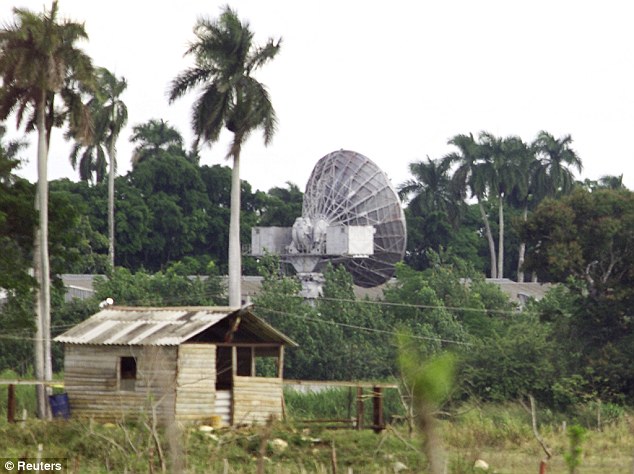
Putin Reopening the Lourdes SIGINT station on February 12

SeaWaves magazine and Russian media reports indicate that Vladimir Putin will be in Havana February 12, 2016, for reopening of the Lourdes SIGINT station.


The Lourdes SIGINT (Signals Intelligence) facility, located near Havana, Cuba, was the largest facility of its kind operated by the Russian Foreign Intelligence Service or SVR, outside of Russia. Located less than 93 miles from Key West, the facility covered 28 square miles. Construction began in July 1962. The station was closed in August 2002. All station facilities were shut down, the buildings were abandoned and later reconstructed to become what is now the University of Information Science.
 
At its peak during the Cold War, the facility was staffed by over 1,500 KGB, GRU, FAPSI, Cuban DGI, and Eastern Bloc technicians, engineers and intelligence operatives. In 2000, it was reported that China signed an agreement with the Cuban government to share use of the facility for its own intelligence agency.
 
In July 2014, reports surfaced that Russia and Cuba agreed to reopen the facility for usage by Russian intelligence. Russia Today later removed their original story and replaced it (using the same url) with one denying there was such an agreement.
 
The complex was capable of monitoring a wide array of commercial and government communications throughout the southeastern United States, and between the United States and Europe. Lourdes intercepts transmissions from microwave towers in the United States, communication satellite downlinks, and a wide range of shortwave and high-frequency radio transmissions. It also served as a mission ground station and analytical facility supporting Russian SIGINT satellites.
 
The facility at Lourdes, together with a sister facility in Russia, allowed the Russians to monitor all US military and civilian geosynchronous communications satellites. It has been alleged that the Lourdes facility monitored all White House communications activities, launch control communications and telemetry from NASA and Air Force facilities at Cape Canaveral, financial and commodity wire services, and military communications links.
 
According to one source, Lourdes had a special collection and analysis facility that is responsible for targeting financial and political information. This activity was manned by specially selected personnel and appeared to be highly successful in providing Russian leaders with political and economic intelligence.
 
From this key facility, first the Soviet Union and later Russia monitored US commercial satellites, and sensitive communications dealing with US military, merchant shipping, and Florida-based NASA space programs. According to a 1993 statement by Cuban Defense Minister Raul Castro, Russia was said to obtain 75 percent of its military strategic information from Lourdes.
 
The Lourdes facility enabled Russia to eavesdrop on US telephone communications. US voice and data telephone transmissions relayed by satellites visible to the facility are vulnerable to Russian intercept. Although sensitive US government communications are encrypted to prevent this intercept, most other unprotected telephone communications in the United States were systematically intercepted.
 
In addition to its military strategic value, after the Cold War Lourdes was increasingly used to support the Russian economy, a high FAPSI priority. In addition to unprotected commercial information, personal information about US citizens in the private and government sectors also could also be snatched from the airwaves and used by Russian intelligence to identity promising espionage recruits in these sectors.


Tuesday, February 09, 2016

Some Wierd Ionosonde Stuff on 8992 kHz USB heard in Europe and U.S.

This morning in the western US and this afternoon in central Europe the Milcom MP has captured the following screen grabs of what has been described to us as the mysterious 16/64 ionosonde (no one knows who is transmitting it). The first waveform marked as #1 is the start of the transmission and #2 is the completion. Our audio library has an audio sound bit of these transmissions. Earlier during the a.m. hours here in the eastern U.S., heard the first part of the waveform only on one of the west coast online SDRs. This afternoon (east coast time) have been hearing the full transmission again on a central European SDR. Again all the transmissions we have heard so far have been on 8992 kHz, a JCS HFGCS primary frequency.
 
16/64 ionosonde Part 1
16/64 ionosonde Part 2
 

USS Montpelier Returns Home After Successful Deployment

 
By Commander, Submarine Force Atlantic Public Affairs
NORFOLK (NNS) -- The Los Angeles fast-attack submarine USS Montpelier (SSN 765) returned to Naval Station Norfolk, Feb. 5, after completing a successful deployment to the European Command and Central Command areas of responsibility.

During the deployment, the crew executed the Chief of Naval Operations' Maritime Strategy in support of national security interests and maritime security operations.

During the underway, Montpelier steamed more than 38,319 nautical miles. The crew conducted port visits in Souda Bay, Crete; Manama, Bahrain; Jebel Ali, UAE; and Toulon, France.

"I am continuously amazed by the inherent resilience and dedication demonstrated by submariners," said Cmdr. Steve Mongold, Montpelier's commanding officer. "Montpelier is manned by an exceptionally talented crew."

While on deployment, Montpelier had 18 crew members earn their warfare qualifications. They also had 15 promoted to the next pay grade.

After spending major holidays overseas, the Montpelier Sailors were ready for their homecoming in Norfolk.

"We are looking forward to being reunited and spending time with our family, friends, and loved ones," said Mongold. "Montpelier celebrated Thanksgiving with a turkey dinner and all the fixings, prepared by our outstanding culinary specialist division. Christmas Day was spent in Jebel Ali."

According to Mongold, Montpelier's crew celebrated the New Year reflecting on their accomplishments in 2015 and preparing for their journey home.

First time ombudsman Cassie Tatum, wife of Chief Fire Controlman Thomas Tatum, summed up the overall excitement of the Family Readiness Group (FRG).

"Everyone's incredibly excited to have their Sailors back home," said Cassie. "While in the shipyard for repairs, we had a lot of crew changeover, so this was a first deployment for many of our families. We all made it through and did amazingly well."

Monthly FRG meetings that turned into potlucks; social media groups created to share advice and provide a forum for questions and answers; along with monthly newsletters were some of the vehicles used to keep the families engaged and create a bond among the families on the homefront.

"I think most people will be able to look back on this time and say they made at least one friend that made a difference," said Cassie.

The wintry weather may have delayed the boats arrival, but for Cassie and the rest of the families that surrounded Pier 3, "it's right on-time."

Fast-attack submarines like Montpelier have multi-faceted missions. They use their stealth, persistence, agility and firepower to deploy and support special force operations, disrupt and destroy an adversary's military and economic operations at sea, provide early strike from close proximity, and ensure undersea superiority.

Montpelier is the third ship in the U.S. Navy to be named for the city of Montpelier, Vermont. Built by the Newport News Shipbuilding Company and Drydock Company, the "Mighty Monty" was commissioned March 13, 1993. The submarine has a crew complement of 15 officers and 129 enlisted. The submarine is 360-feet long, and can travel in excess of 25 knots.

US Air Force, Boeing begin work on new Air Force One

Yahoo News Story (http://news.yahoo.com/us-air-force-boeing-begin-air-force-one-041204090.html) bt By Laurent Barthelemy

Washington (AFP) - Air force officials and Boeing engineers have started the years-long process of replacing Air Force One, the legendary aircraft that whisks the American president and his entourage around the world.
The Pentagon last week approved the first of a series of contracts with Boeing, the US aerospace giant chosen to convert a pair of its 747-8 jumbo jets -- there are actually two Air Force Ones -- into state-of-the-art, luxury command centers.
That first contract, worth a relatively small $25.7 million, is for Boeing to look for cost savings and get a better sense of the scope of the massive task at hand, the Air Force said.
 
Air Force One is an instantly recognizable emblem of American power.
The majestic, light blue-and-white liveried jets have "United States of America" emblazoned along their fuselage and a large US flag stamped on the tail fin.
But the current double-decker 747-200s, first ordered by Ronald Reagan and put into service in 1990, are getting old

Spare parts are increasingly hard to source and the hulking aircraft require ever longer times being serviced.
 
The Air Force in January last year announced it had chosen Boeing to build the new planes, but equipping the wide-bodied double-deckers for the role is a complex undertaking.
 
The total cost of buying and converting the two planes is unknown, but the Air Force has requested $3 billion over five years for the program. The work should be done by 2024.
 
"We are focused on ensuring this program is affordable," said Colonel Amy McCain, the manager of the Presidential Aircraft Recapitalization program.
 
"This contract gets us started on determining how to modify a 747-8 to become the next Air Force One, and finding opportunities for cost reduction through detailed requirements choices."

- $180,000 an hour -
The new planes will doubtless be very different from the current Air Force One incarnation, though the Air Force has yet to say much about its specifications.
 
Air Force One costs about $180,000 an hour to fly and provides the president with a spacious office, a meeting room and a health center that can even be converted into an operating theater.
 
The planes must also carry the Secret Service agents who protect the president, as well as advisers and journalists that follow him wherever he goes. The kitchens can serve up to 100 people simultaneously.
 
Air Force One is equipped with the latest in communications technology, allowing the president to continue working wherever he is, even if the United States is under attack.

The aircraft also boasts an array of defensive technologies, including electronic countermeasures and anti-missile flares.
 
And it can be refueled while still flying, enabling it to stay airborne for days at a time.
The new planes will have super-powerful engines that will let the planes nudge the sound barrier at Mach 0.92, faster than the current 747-200s.
 
There will not, however, be an escape pod like the one depicted in the 1997 hijacker movie "Air Force One" featuring Harrison Ford as president.
 
- Marine One fiasco -
 
The first contract announcement with Boeing illustrates officials' desire to tread carefully and avoid ballooning costs.
 
project to replace the Marine One helicopters that ferry the president proves a cautionary tale.
 
In 2009, Barack Obama stopped the development and purchase of 28 new choppers ordered in 2005, after costs soared to nearly $11.5 billion.
 
Among the many design specifications Obama balked at were built-in cooking facilities that could withstand a nuclear strike.
 
"If the United States of America is under nuclear attack, the last thing on my mind will be whipping up a snack," Obama later quipped.
 
Obama has also said that the perk he will miss the most when his term expires will be Air Force One.
 
"An amazing plane with an amazing crew, they clear out airspace so you don't have to wait. And you land anytime, you leave anytime," he told GQ magazine in November.
 

Monday, February 08, 2016

USSTRATCOM Detects, Tracks North Korean Missile Launch into Space

U.S. Strategic Command Public Affairs
2/6/2016

OFFUTT AIR FORCE BASE, Neb. – U.S. Strategic Command systems detected and tracked what we assess was a North Korean missile launch into space at 6:29 p.m. CST.
 
The missile was tracked on a southerly launch over the Yellow Sea.
 
NORAD determined that at no time was the missile a threat to North America.  The men and women of USSTRATCOM, NORAD AND USNORTHCOM, AND USPACOM remain vigilant in the face of North Korean provocations and are fully committed to working closely with our Republic of Korea and Japanese allies to maintain security.
 
UPDATE 1 (Feb. 7, 2016): Initial observations from U.S. Strategic Command's Joint Functional Component Command for Space, through its Joint Space Operations Center, following the launch of a North Korean missile into space, indicate two objects – NORAD catalog identification numbers 41332 and 41333 – are in orbit and at an inclination of 97.5 degrees. These observations are available on the publicly-available website Space-Track.org.
 
Note: An inclination of 97.5 means the object is rotating in the opposite direction of the Earth's rotation at a 97.5 degree angle from the Earth's equator, meaning the two objects are essentially orbiting over the poles.
 
UPDATE 2 (Feb. 8, 2016): The two objects U.S. Strategic Command's Joint Functional Component Command for Space, through its Joint Space Operations Center, tracked following the launch of a North Korean missile into space – NORAD catalog identification numbers 41332 and 41333 – have been added to USSTRATCOM’s satellite catalog on the publicly-available website Space-Track.org. The object with NORAD catalog identification numbers 41332 is KMS 4, the payload. The object with NORAD catalog identification numbers 41333 is UNHA 3 R/B, the rocket body.
 

USS Cheyenne Returns from Western Pacific Deployment


By Mass Communication Specialist 1st Class Jason Swink, Pacific Submarine Force Public Affairs
PEARL HARBOR (NNS) -- Los Angeles-class fast-attack submarine USS Cheyenne (SSN 773) returned to Pearl Harbor, Feb. 5, completing a regularly-scheduled five-month deployment to the Western Pacific.

The submarine's commanding officer, Cmdr. John Stafford, who hails from Staten Island, New York, said his crew's performance was admirable.

"They were resilient when they needed to be, and creative with their tactics, keeping the ship on point and on mission," said Stafford. "I can't say enough about the effort they put in to get there and stay there."

Lt. Cmdr. Jeremy Johnston, USS Cheyenne's executive officer, had high praise for the crew's performance.

"New crew members excelled," Johnston said. "It was a tough task, but they took it head on and worked hard. We supported our junior crew through a rigorous training and qualification program backed with practical evolutions and on-the-job training. On Cheyenne, we say that our best resource is new people."

Senior Chief Sonar Technician Julio Hernandez, Cheyenne's chief of the boat, from Brawley, California, said the crew performed phenomenally.

"We made the crew own the training, so they trained each other," said Hernandez. "It was the Sailors training the Sailors, which was effective because they owned it and believed in it."

While deployed, 15 Sailors and four officers earned their designation as qualified in submarines and now wear the dolphin warfare insignia. Additionally, eight Sailors were advanced in rank, three officers were promoted, and 14 junior Sailors reenlisted while underway.

"My favorite part of deployment was the relationships we strengthened as a crew," said Electronics Technician 1st Class Taquan Monrose, from Newport News, Virginia. "We spent months together doing some things other people couldn't imagine."

Cheyenne achieved a number of milestones while under way, including participation in anti-submarine warfare exercises with Submarine Group 7, a port visit to Subic Bay in the Philippines, participating in volunteer work at a school for physically-challenged children, and organizing a beach clean-up.

Upon returning home to Pearl Harbor, Stafford and his crew looked forward to reuniting with family and friends.

"We talked about doing a lot of big trips; but to be honest with you, I am just looking forward to Lanikai Beach, maybe movie night on Friday night, and going to church on Sunday," said Stafford. "If I could get back to that routine, I would consider it a great success."

Waiting on the pier were friends and family with leis, banners and signs, with many of the greeters cheering their return.

Debora Ann Harris traveled from Coconut Creek, Florida, to welcome home her son, Lt. Logan Harris.

"He always has been a leader and is very industrious," said Harris. "We are just so very proud of him. The excitement of them coming in is almost overwhelming."

Homeported in Pearl Harbor, USS Cheyenne is named after the city of Cheyenne, Wyoming, and was the last of the 62 Los Angeles-class submarines to enter service in the U.S. Navy. Commissioned Sept. 13, 1996, Cheyenne measures more than 360-feet long and weighs more than 6,000 tons when submerged.

In 2003, Cheyenne earned the distinction of "first to strike" as the first ship to launch Tomahawk cruise missiles in Operation Iraqi Freedom. Since then, the submariners aboard have modified the original "Live the Legend" motto to "Ride the Legend," representative of the warrior spirit of the crew and the pride they take in their mission and namesake city.

Blue Angels Fly Over 2016 Super Bowl

 
By Mass Communication Specialist 2nd Class Jenn Lebron, Blue Angels Public Affairs
SANTA CLARA, Calif. (NNS) -- U.S. Navy Flight Demonstration Squadron, the Blue Angels, helped kick off the 2016 Super Bowl when they performed a flyover at Levi's Stadium in Santa Clara, Feb. 7.

The Blue Angels' signature six-jet Delta Formation soared over more than 70,000 spectators at the stadium, following the national anthem.

"It doesn't get more exciting than representing the Navy and Marine Corps while flying over the world's premier sporting event," said Blue Angels Lead Solo Pilot Lt. Ryan Chamberlain. "Navy and marines serving all around the world should be proud of their efforts which make opportunities like this possible."

Flight Leader and Commanding Officer Cmdr. Ryan Bernacchi, a native of Los Altos, California, was proud to fly over his hometown.

"Being able to come back to the area you grew up in and being able to represent the Navy is always special, but being a part of this great American tradition makes this privilege that much more incredible," said Bernacchi.

The Blue Angels are currently training in California for the 2016 air show season and are scheduled to fly 65 demonstrations at 33 locations throughout North America in 2016, which is the Blue Angels' 70th anniversary year.

The mission of the Blue Angels is to showcase the pride and professionalism of the United States Navy and Marine Corps by inspiring a culture of excellence and service to country through flight demonstrations and community outreach.

Thursday, February 04, 2016

Mode-S/ADS Milcom Intercepts 1-3 Feb 2016 - Brasstown NC

Here is the latest round of Mode-S/ADS-B intercepts and selected ATC call signs logged from here on the radio ranch in WNC. All dates/times are UTC and list is sorted in Mode-S address order.

00000A Various   ---  2016-02-02 02:52:13 Various Various --- ---  ---   
A87889 ---   ---  2016-02-01 18:11:59 C-146A United States USAF | 27SOW | 524SOS [KCVS] ---  ---  
ADFDB7 93-1037   REACH897 2016-02-03 00:20:19 C-130H United States AFRC | 94AW | 700AS [KMGE] ---  ---   
ADFDB8 93-1038   COBB 38 2016-02-03 14:41:02 C-130H United States AFRC | 94AW | 700AS [KMGE] ---  ---   
ADFDCA 93-2041   SHARK67 2016-02-02 16:29:41 C-130H United States IL ANG | 182AW | 169AS [KPIA] ---  ---   
ADFE49 94-0317   ---  2016-02-01 13:30:20 C-12R United States USARMY ---  ---  
ADFE4D 94-0321   PAT944 2016-02-01 20:41:20 C-12R United States USARC | 6-52 AVN (TA) ---  26000    
ADFE8D 95-0088/95-0096   ---  2016-02-01 18:34:44 C-12R+ United States USARMY ---  ---   
ADFE8D 95-0088/95-0096   ---  2016-02-01 21:29:28 C-12R+ United States USARMY ---  ---   
ADFEDE 86-0088   PAT655 2016-02-02 12:52:02 C-12F United States FL ARNG | OSACOM DET-8 [KSGJ] ---  ---   
ADFEDE 86-0088   PAT655 2016-02-03 19:08:19 C-12F United States FL ARNG | OSACOM DET-8 [KSGJ] ---  ---   
ADFEF2 161530   LOBO01 2016-02-02 18:55:57 C-9B United States USNR | VR-61 [KNUW] ---  ---   
ADFEF2 161530   LOBO01 2016-02-03 13:58:24 C-9B United States USNR | VR-61 [KNUW] ---  ---   
AE0192 84-0125   SPAR430 2016-02-03 17:23:08 C-21A United States CT ANG | 103FW | 118FS [KBDL] ---  ---   
AE01AA 84-0071   SPAR377 2016-02-01 18:52:18 C-21A United States MI ANG | 110FW | 172AS [KBTL] ---  ---  
AE0228 86-0030   TEAM52 2016-02-01 14:56:41 KC-10A United States USAF | 305AMW [KWRI] ---  ---  
AE0228 86-0030   TEAM52 2016-02-02 18:25:39 KC-10A United States USAF | 305AMW [KWRI] ---  ---   
AE0314 74-1680   RCH461 2016-02-03 16:11:50 C-130H United States CT ANG | 103AW | 118AS [KBDL] ---  ---   
AE0368 63-8013   EDDIE61 2016-02-01 15:22:07 KC-135R United States NH ANG | 157ARW | 133ARS [KPSM] 6763  32000   
AE0372 60-0367   EDDIE61 2016-02-02 16:06:21 KC-135R United States OH ANG | 121ARW [KLCK] ---  ---   
AE0372 60-0367   EDDIE61 2016-02-02 16:56:10 KC-135R United States OH ANG | 121ARW [KLCK] ---  ---   
AE038A 62-3531   E23531 2016-02-02 13:51:05 KC-135R United States OH ANG | 121ARW [KLCK] ---  ---   
AE0477 58-0038   BACKY91 2016-02-01 14:52:12 KC-135R United States AFRC | 916ARW | 77ARS [KGSB] ---  ---  
AE0477 58-0038   BACKY91 2016-02-01 18:30:26 KC-135R United States AFRC | 916ARW | 77ARS [KGSB] ---  ---  
AE04AE 165740   EASY40 2016-02-01 17:19:49 UC-35 United States MAW-4 1535  36000    
AE04CF 62-3537   LUCKY77 2016-02-01 21:05:18 KC-135R United States AFRC | 507ARW | 465ARS [KTIK] 0000  39000   
AE05DF 87-9282   BISON11 2016-02-01 16:12:24 C-130H United States AFRC | 440AW | 95AS [KPOB] ---  ---   
AE06E4 163836 ???   ---  2016-02-01 16:48:47 UC-12F United States USNAVY ---  ---   
AE06E4 163836 ???   ---  2016-02-03 18:44:40 UC-12F United States USNAVY 0000  31000   
AE06E4 163836 ???   ---  2016-02-03 20:50:12 UC-12F United States USNAVY 0000  31000   
AE07E7 95-0104   ELVIS31 2016-02-02 17:50:01 C-17A United States TN ANG | 164AW | 155AS [KMEM] 0000  34000   
AE07E7 95-0104   ELVIS31 2016-02-02 19:15:34 C-17A United States TN ANG | 164AW | 155AS [KMEM] 0000  34000   
AE0802 98-0056   TOGO99 2016-02-02 23:46:44 C-17A United States USAF | 3WG | 517AS [PAED] ---  ---   
AE08BE 00-0184   RCH984 2016-02-02 17:36:04 C-17A United States USAF | 62AW [KTCM] ---  ---   
AE08E3 00-0183   RCH136 2016-02-01 21:41:40 C-17A United States USAF | 62AW [KTCM] ---  ---   
AE093C 00-1053   ---  2016-02-02 20:36:56 UC-35a1 United States US Army | OSACOM PATD [KADW] ---  ---   
AE1197 03-3114   RCH470 2016-02-02 17:35:29 C-17A United States MS ANG | 172AW | 183AS [KJAN] ---  ---    
AE11EA 80-0137   ---  2016-02-03 22:32:26 E-3C United States USAF | 3WG | 962AACS [PAED] ---  ---   
AE11F6 01-0041   VENUS31 2016-02-01 15:38:24 C-40B United States USAF | 89AW | 1AS [KADW] ---  ---   
AE11F6 01-0041   VENUS31 2016-02-01 21:57:48 C-40B United States USAF | 89AW | 1AS [KADW] ---  ---   
AE1235 03-3124   MOOSE11 2016-02-02 16:09:20 C-17A United States USAF | 437AW [KCHS] ---  26875    
AE1235 03-3124   MOOSE11 2016-02-02 16:56:57 C-17A United States USAF | 437AW [KCHS] ---  26875    
AE128F 85-0011   TALON18 2016-02-02 21:09:41 MC-130H United States USAF ---  ---   
AE12AD 88-0264   TALON17 2016-02-02 21:09:37 MC-130H United States USAF | 1SOW | 15SOS [KHRT] ---  ---   
AE1447 05-3147   GLEAN21 2016-02-03 22:24:37 C-130J-30 United States USAF | 19AW [KLRF] ---  ---   
AE1488 86-0416   PEACH88 2016-02-03 00:16:40 TE-8a United States 330thCTS 0000  19600   
AE1488 86-0416   PEACH88 2016-02-03 00:38:17 TE-8a United States 330thCTS 0000  19600   
AE149A 02-9111   PEACH99 2016-02-01 18:24:59 E-8C United States GA ANG | 116ACW [KWRB] ---  ---   
AE149A 02-9111   PHENOM6 2016-02-02 01:37:35 E-8C United States GA ANG | 116ACW [KWRB] ---  ---   
AE1531 06-4633   GLEAN20 2016-02-03 19:00:12 C-130J-30 United States USAF | 19AW [KLRF] ---  ---   
AE2FA6 08-8194   COHO75 2016-02-03 16:00:12 C-17A United States USAF | 62AW [KTCM] 0000  33000    
AE2FAB 08-8199   RCH027 2016-02-01 02:55:16 C-17A United States USAF | 62AW [KTCM] ---  ---   
AE2FAD 08-8201   RCH249 2016-02-01 15:14:15 C-17A United States USAF | 62AW [KTCM] 1564  34000   
AE4A81 09-0525   ---  2016-02-03 18:46:27 C-37B United States USAF | 89AW | 99AS [KADW] ---  ---   
AE4AF8 08-5683   HAVOC61 2016-02-03 16:04:17 C-130J-30 United States USAF | 317AG [KDYS] ---  ---   
AE4BDD 10-5700   HAVOC60 2016-02-03 16:04:15 C-130J-30 United States USAF | 317AG [KDYS] ---  ---   
AE4D66 10-0213   MOOSE13 2016-02-02 16:09:42 C-17A United States USAF | 437AW [KCHS] ---  25975    
AE4D66 10-0213   MOOSE13 2016-02-02 16:57:21 C-17A United States USAF | 437AW [KCHS] ---  25975    
AE4E0A 08-5724   HAVOC60 2016-02-03 16:04:15 C-130J-30 United States USAF | 317AG [KDYS] ---  ---   
AE4E10 11-5736   GLEAN20 2016-02-03 19:00:04 C-130J-30 United States USAF | 19AW [KLRF] ---  ---   
AE4EC1 168756   MADFX55 2016-02-01 21:36:48 P-8A United States USN | VP-45 [KNIP] ---  ---    
AE4EC1 168756   MADFX55 2016-02-02 00:55:50 P-8A United States USN | VP-45 [KNIP] ---  ---    
AE4F14 10-0220   COHO77 2016-02-03 16:47:06 C-17A United States USAF | 62AW [KTCM] ---  ---   
AE4F17 10-0223   MOOSE12 2016-02-02 16:09:55 C-17A United States USAF | 437AW [KCHS] ---  25975    
AE5774 10-00259   ---  2016-02-01 14:35:59 C-12V United States --- ---  ---  
AE57B5 168849   VVLL881 2016-02-01 22:39:00 P-8A United States USN | 0000  35000    
AE57B5 168849   VVLL881 2016-02-02 01:24:08 P-8A United States USN | 0000  35000    
AE57BC 168856   VVLL877 2016-02-01 22:34:01 P-8A United States USN | ---  35000    
AE57BC 168856   VVLL877 2016-02-02 01:10:28 P-8A United States USN | ---  35000    
AE596E 13-5785   KING21 2016-02-02 22:07:50 HC-130J United States USAF | 23 Wing | 71RQS [KVAD] 0000  15525   
AE596E 13-5785   KING21 2016-02-02 23:51:32 HC-130J United States USAF | 23 Wing | 71RQS [KVAD] 0000  15525   


Wednesday, February 03, 2016

Tokyo orders SDF to shoot down North Korean missile if threat to Japan

by and  Staff Writers The Japan Times
 
Japan on Wednesday condemned Pyongyang’s plan to launch a space rocket, calling it a thinly disguised test of a long-distance ballistic missile.
 
The government ordered Aegis ballistic missile defense warships of the Maritime Self-Defense Force and land-based Patriot PAC-3 rocket units to respond should projections show components falling in Japanese territory.
 
“This will effectively mean the firing of a ballistic missile. It would be a clear violation of United Nations Security Council resolutions and a grave, provocative act against the security of our country,” Prime Minister Shinzo Abe told a Lower House session Wednesday.
 
“Japan, in cooperation with the United States and South Korea, will strongly urge North Korea to refrain from (conducting) the launch,” Abe said.
 
On Tuesday night, North Korea notified the International Maritime Organization that it plans to send a “satellite” into orbit between Feb. 8 and 25. It said the launch will take place on one of those days between 7:30 a.m. and 12:30 p.m. Japan time.
 
Pyongyang conducted a fourth nuclear test on Jan. 6. The planned launch is widely seen as both a test and a demonstration of its advances in rocketry.
 
Feb. 16 is the birthday of late leader Kim Jong Il, the father of current leader Kim Jong Un. Observers believe the launch window has been set around the day for domestic purposes — to bolster the nation’s morale.
 
During a daily news conference, Chief Cabinet Secretary Yoshihide Suga pointed out that the projectile, expected to be launched from a site in western North Korea, would fly over part of the Sakishima island chain of Okinawa Prefecture, which includes the islands of Ishigaki and Miyako.
 
Japan lodged a formal protest with the North’s embassy in Beijing at 7:55 a.m. on Wednesday, Suga said.
 
“U.N. Security Council resolutions have repeatedly banned any launch by North Korea that uses ballistic missile technologies,” Suga said.
 
Meanwhile, Defense Minister Gen Nakatani ordered the Self-Defense Forces to destroy any parts of the rocket should they threaten to fall within Japanese territory.
Japan has already deployed Aegis destroyers equipped with the SM-3 missile system at sea and Patriot PAC-3 air-defense units of the Ground Self-Defense Forces on land. Both systems are designed to intercept ballistic missiles.
 
Their primary mission is seen as monitoring the launch, but the deployment also appears to be a gesture underlining Japan’s determination to defend its territory.
Pyongyang’s declared plan would involve three parts of the rocket falling west of the Korean Peninsula, in the East China Sea southwest of the peninsula and in the Pacific Ocean east of the Philippines, respectively.
 
The rocket is expected to fly over the Sakishima island chain, according to a map with navigation warnings posted by the Japan Coast Guard on its website.
 
The course matches that of a ballistic missile Pyongyang launched in December 2012, Suga said.
 
Later Wednesday, a high-ranking government official said Pyongyang may be preparing to launch the same type of missile as the one it used in 2012. A Defense Ministry white paper says Pyongyang fired a variant of its Taepodong-2 ballistic missile at that time.
 
A missile of this type can fly more than 10,000 km if the warhead weighs less than a ton, the Defense Ministry said.
 
If North Korea develops long-range ballistic missiles using the technologies tested in the launches, “the missiles could have ranges that potentially reach the central, western, and other areas of the U.S. mainland,” the Defense Ministry concluded in its 2015 white paper.
 
Meanwhile, Washington and Seoul have both condemned Pyongyang’s plan.
“The international community would regard a step like that by the North Koreans as just another irresponsible provocation and a clear violation of their international obligations,” White House Press Secretary Josh Earnest told reporters Tuesday in Washington.
 
“The U.S. has worked closely not just with our allies in South Korea and Japan but also with our partners in China and Russia, to convey to the North Koreans the need to end their provocative actions,” he said.
 
Earnest also maintained that China has “unique influence over the North Korean regime,” urging Beijing to join the U.S. and its allies to “counter this threat.”
Urging Pyongyang to drop its plan, the government in Seoul said the move would be a serious breach of U.N. resolutions and a “direct challenge” to the international community.
 
China on Wednesday expressed serious concern over North Korea’s plan, with Foreign Ministry spokesman Lu Kang calling on Pyongyang to “exercise restraint” and not escalate tensions in the region.
 
According to the Defense Ministry, Patriot PAC-3 air-defense units have been deployed at bases and facilities of the Self-Defense Forces in Asaka, Saitama Prefecture, Narashino, Chiba Prefecture, and Naha and Chinen of Okinawa Prefecture, as well as at the Defense Ministry’s compound in Tokyo’s Ichigaya district.
The ministry said that it will consider whether further deployment is necessary elsewhere.
 
Aegis destroyers carrying the SM-3 missile system have been deployed in the East China Sea and the Sea of Japan.
 
Meanwhile, Foreign Minister Fumio Kishida met with U.S. Ambassador to Japan Caroline Kennedy over North Korea’s move Wednesday evening.
 
“It’s important that Japan and the U.S. coordinate with each other closely. We hope to increase dialogue between us,” Kishida said during the meeting.
 
Kennedy responded by emphasizing that the trilateral relationship among Japan, the U.S. and South Korea is “critical” to deal with North Korea’s provocations.
 

Monday, February 01, 2016

Coast Guard CAMSLANT Closed? Not!

I have seen some post around the hobby net indicating that CAMSLANT Chesapeake has closed. Nothing could be further from the truth.  First some background on the closure of CAMSPAC Point Reyes courtesy of the Point Reyes Light (9/17/2015) at
http://www.ptreyeslight.com/article/after-43-years-coast-guard-site-closes. Bolding within the article below is by the post author.

After 43 years, Coast Guard site closes

 
The United States Coast Guard communications facility in the Point Reyes National Seashore was decommissioned last Friday as part of a nationwide process of consolidation to centralize communications. “It is a historic day. It is the end of a chapter in Coast Guard history,” said Vice Admiral Charles Ray, the Pacific Area commander of the Coast Guard, at the decommissioning ceremony. The Bay Area station first started in San Francisco in 1937, but was moved to the seashore in 1972, with a receiver station near Abbotts Lagoon and a transmitter site in Bolinas. The station—Communications Area Master Station Pacific, or CAMSPAC—called itself “the nerve center of the Pacific Area Coast Guard,” and provided communications to over 13,000 Coast Guard men and women at 358 units from Alaska to the Middle East to the South Pacific, as well as acting as a distress notification center and providing weather warnings and safety information to commercial and recreational vessels. At one point it had up to 183 employees, who generally lived in the former Coast Guard housing site in downtown Point Reyes. CAMSPAC, and all the communication stations, have been critical to the function of the Coast Guard. “You can’t operate if you can’t communicate,” Mr. Ray said, calling CAMSPAC a “lifeline” that has helped those in distress at sea. He told the story of a vessel named True Love that attempted to travel from Hawaii to Washington State in 1997. It encountered a bad storm, lost its drive shaft, and started to run out of food, water and ideas. The crew tried one last time to radio for help, and a 19-year-old crewman at CAMSPAC responded. “They lived because of this place,” Mr. Ray said. But changing technology, particularly the emergence of satellite communications, has made operating numerous stations unnecessary. Consequently the Coast Guard has been consolidating its communications sites for a few decades. In 1993, CAMSPAC took over operations once routed through Guam, and in 1997 it began remotely operating a station located in Honolulu. Now CAMSPAC—along with other stations in Boston, Miami, New Orleans, Honolulu and Chesapeake—will be remotely operated from a single station, eliminating about 200 full time jobs and saving the agency about $10 million a year. The guard has, however, established a small detachment in Novato to maintain the electronics at the decommissioned CAMSPAC facility, a Coast Guard report said. Speakers on Friday noted that the decommissioning was a solemn occasion, but said it was all in the name of forward progress. “We will be vigilant,” Mr. Ray said, “just from a different place.”

If you need any other proof that CAMSLANT is alive and well, here is the link to their website http://www.uscg.mil/lantarea/camslant/

CAMSLANT Chesapeake (USCG Photo)


Sunday, January 31, 2016

Is this the receiving end of our recent Rock and Roll Skyking messages? Late Breaking News

USAF RC-135U Combat Sent aircraft (USAF Photo)
Late Breaking News: This aircraft was the subject of an incident involving the Russian AF over the Black Sea Saturday. See USA Today story "Russian jet buzzes U.S. Air Force spy plane over Black Sea" at http://www.usatoday.com/story/news/world/2016/01/30/russian-jet-buzzes-us-air-force-spy-plane-over-black-sea/79563912/.

--------------

If you looked at my previous post this morning, and you checked out my "what is an EAM file," you would have discovered a bit of insight on what I believe a Skyking message is used for.

Well the aircraft in the picture above, even as I type, is flying around the Middle East (just spotted today in and around Turkey and Israel). It would certainly fall within the parameters I have set for a user of HFGCS Skyking message traffic.

Call sign seen today "BARN 06" another interesting consequence that I have mentioned before re: four letter ## call signs.

Here is a bit more information on the RC-135U courtesy of the official USAF public information files.

Mission
The RC-135U Combat Sent provides strategic electronic reconnaissance information to the president, secretary of defense, Department of Defense leaders, and theater commanders. Locating and identifying foreign military land, naval and airborne radar signals, the Combat Sent collects and minutely examines each system, providing strategic analysis for warfighters. Collected data is also stored for further analysis by the joint warfighting and intelligence communities. The Combat Sent deploys worldwide and is employed in peacetime and contingency operations.

Background
There are only two Combat Sent aircraft in the Air Force inventory and both are assigned to the 55th Wing at Offutt AFB, Neb. The RC-135U aircraft are manned by Air Combat Command crews from the 45th Reconnaissance Squadron and the 97th Intelligence Squadron (of the Air Force Intelligence, Surveillance and Reconnaissance Agency). The Combat Sent is composed of a wide variety of commercial off-the-shelf and proprietary hardware and software. Its current configuration allows for both manual and automatic analysis of electronic signals. By combining manual systems with the Automatic Electronic Emitter Locating System, Ravens and intelligence specialists can simultaneously locate, identify, and analyze multiple electronic signals.

The Combat Sent records these signals for future reference or for extensive analysis by electronic systems theorists. Any information garnered from the data will help determine detailed operating characteristics and capabilities of foreign systems. Evasion techniques and equipment are then developed from this knowledge that will detect, warn of, or defeat these electronic systems.

More Rock amd Roll Adventures from the HFGCS Chronicles

Saturday, the U.S. Navy sent the USS Curtis Wilbur (DDG-54) warship near a disputed island in South China Sea according to various press reports. See CNN story at http://www.cnn.com/2016/01/30/asia/us-navy-south-china-sea/.
 
Pacific Ocean: The guided-missile destroyer USS Curtis Wilbur (DDG 54) transits through the Pacific Ocean with Mt. Fuji in the background. Curtis Wilbur is underway supporting security and stability in the western Pacific Ocean. (U.S. Navy photo by Mass Communication Specialist Seaman Adam K. Thomas/Released)
Any naval operation like this can be a bit dangerous especially if the three parties involved in the disputed land mass get edgy. But there is also a potential treasure trove of intelligence to be gathered.
 
And what did we have flying around the South China Sea area Saturday using call sign Tora 82 (a 4-digit call I might add)? A USAF RC-135V Rivet Joint aircraft.
 
 
And what is this aircraft used for. From the official US Air Force public fact sheet:
 
Mission The RC-135V/W Rivet Joint reconnaissance aircraft supports theater and national level consumers with near real time on-scene intelligence collection, analysis and dissemination capabilities.

Features The aircraft is an extensively modified C-135. The Rivet Joint's modifications are primarily related to its on-board sensor suite, which allows the mission crew to detect, identify and geolocate signals throughout the electromagnetic spectrum. The mission crew can then forward gathered information in a variety of formats to a wide range of consumers via Rivet Joint's extensive communications suite.

The interior seats more than 30 people, including the cockpit crew, electronic warfare officers, intelligence operators and in-flight maintenance technicians.

The Rivet Joint fleet was re-engined with CFM-56 engines with an upgraded flight deck instrumentation and navigational systems to FAA/ICAO standards. These standards include conversion from analog readouts to a digital "glass cockpit" configuration.

All Rivet Joint airframe and mission systems modifications are overseen by L-3 Communications (previously Raytheon), under the oversight of Air Force Materiel Command.

Background The current RC-135 fleet is the latest iteration of modifications to this pool of -135 aircraft going back to 1962. Initially employed by Strategic Air Command to satisfy nationally tasked intelligence collection requirements, the RC-135 fleet has also participated in every sizable armed conflict involving U.S. assets during its tenure. 

RC-135s were present supporting operations in Vietnam, the Mediterranean for Operation El Dorado Canyon, Grenada for Operation Urgent Fury, Panama for Operation Just Cause, and Southwest Asia for operations Desert Shield, Desert Storm, Enduring Freedom and Iraqi Freedom. RC-135s have maintained a constant presence in Southwest Asia since the early 1990s.

All RC-135s are assigned to Air Combat Command. The RC-135 is permanently based at Offutt Air Force Base, Neb., and operated by the 55th Wing, using various forward deployment locations worldwide. More recently, RC-135s have also supported Operation Allied Force in Kosovo, and Operation Odyssey Dawn/Unified Protector in Libya
So looks like we had Tora 82 supporting the Curtis Wilbur on Saturday in the South China Sea. Was our Saturday "Santana" Foxtrot/Skyking message directed at Tora 82?
 
Maybe!  Chief Sends


Interesting times on HFGCS

Most ute monitors usually do not pay any attention to the message traffic that is passed on the DoD JCS HFGCS HF radio system. We have Emergency Action Messages (EAMs) and Skyking aka Foxtrot message traffic (see my detailed discussion of these messages on this blog at http://mt-milcom.blogspot.com/p/what-is-emergency-action-message-or-eam.html).

Recently things have become more interesting. Instead of a 3-character message that has been the staple of the Foxtrot messages since forever, they have now started using creative code words. The last three days Foxtrot message traffic have consisted of  Springstein, Santana, and now this morning Hendrix.

It also looks like we have gone back to our Cold War roots and have started using tac code words calls for various HFGCS stations when transmitting these EAM and Foxtrot message traffic when transmitting on this net. Prior to this you would have heard Andrews, Offutt, McClellan or one of the other HFGCS stations worldwide using their location as the identifier.

In addition, we have some other HF RF indicators being seen throughout the HF spectrum that would indicate that things are changing in the mil HF world.

So who says that HF is dead hasn't either turned on a receiver lately or monitored the right frequencies.

If you want to hear what is going on the HFGCS netork, check out my freq list at http://mt-milcom.blogspot.com/2006/05/joint-chiefs-of-staff-hf-gcs-network.html

Maybe someone four years ago didn't have their foreign policy stuck in the 1980s.

Chief Sends

Thursday, January 21, 2016

2016 Teak Air Show Guide Now Available

Every year, from March through November, millions of people hit the road to watch the excitement and thrills as military and civilian flight demonstration teams put their high performance aircraft through the paces to entertain the crowds and perform at air shows all over the world. Anyone who has attended one of these events will tell you it is thrilling to watch the close quarter flying of the Blue Angels delta formation or the hair-splitting maneuvers of the Thunderbird opposing solos.
 
While attending the show and enjoying the sights and sounds is an exciting experience that is only half the fun. You can add another whole dimension to that visual experience by monitoring the performing teams’ radio communications.
 
With a radio scanner in hand you will experience a whole new perspective of the show that few of the attendees will ever experience – pilot audio from the aircraft cockpit. While everyone else at the air show is just watching and listening to the public address system narrator, you’ll be able to hear what’s happening inside the cockpit, up in the tower and on the ground with the hundreds of players that keep these screaming, state of-the-art air machines thundering through the skies.
 
But you can’t tell the players without a program, and to indulge in the craft of monitoring the air show experience you need a current and well researched list of frequencies that the various performers may use during their performances.
 
In our new expanded 2016 Teak Air Show Guide e-Book, former Monitoring Times Editor and Milcom columnist Larry Van Horn - N5FPW, delivers the hundreds of frequencies you’ll need to monitor the action if you’re within receiving distance of any air show in 2016.
 
From the Blue Angels and Thunderbirds, military parachute and search and rescue demonstration teams, to a wide variety of other military and civilian demonstration teams from the U.S. and abroad, Larry has updated the list of frequencies each unit has used. Now you can bring the excitement you see at the show to your ears. Listening to the nonstop action at the air show on dozens of radio frequencies is part of the real fun of being there.
 
But wait, there’s more! Larry also tells you which scanners work best at the air shows, what features you’ll need and which models can cover the military as well as civilian frequencies used at these events. There is also a chapter on tips for enjoying a great day at the air show.
 
You will also get frequency lists for other possible frequencies that may be used at the air show including GMRS, Family Radio Service (FRS), DoD Intra-Squad Radio frequencies, and even Civil Air Patrol VHF/UHF frequencies and updated call signs. We also include in this eBook an up-to-date air show Internet resource guide and new frequencies/ listings for overseas military and civilian aeronautical demonstrations teams.
 
Finally you will get the latest air show schedules for the Navy Blue Angels, Air Force Thunderbirds, Canadian Forces Snowbirds, and the Army Golden Knight Parachute Teams. We include with each show location, the Internet link for each show, and the latest aero frequencies for each facility hosting a show, when known. This schedule information only covers the United States and Canada.
 
This is the 17th edition of this popular frequency monitoring guide published by the author. The first fourteen editions appeared annually each March in the pages of the former Monitoring Times magazine and were one of the most popular features carried in the magazine. This edition of the Teak Air Show Guide is now weighs-in at 197 pages and it is the most comprehensive collection of air show information and frequencies ever published for the radio listening hobbyist.
 
The 2016 Teak Air Show Guide is now available for purchase worldwide from Amazon.com at http://www.amazon.com/dp/B01AVLCGU4. The price for this third e-Book edition is still only US$3.99. Since this book is being released internationally, Amazon customers in the United Kingdom, Germany, France Spain, Italy, Japan, India, Canada, Brazil, Mexico and Australia can order this e-Book from Amazon websites directly servicing these countries. All other countries can use the regular Amazon.com website.
 
When the T-Birds, Blue Angels, and all the other precision flight teams are in the air, Larry has all the frequencies you need to hear them on the air in this new e-Book from Teak Publishing!
 
Here are a couple of the 5-Star Amazon reviews on the 2015 Teak Air Show Guide.
 
Totally thrilled to prep with the latest edition By Edward Sikora
Whether you're new to this hobby (as I was 2 years ago) or experienced you need reliable resources of information and frequencies. When I started, I was sure I could find my answers on the internet. I didn't think a book would be very useful or up to date. Five air shows later, I'm totally sold on this book. I'm delighted and excited to have the latest copy to prep for upcoming shows. It's a highly detailed road map to where the good stuff is. I haven't found any other resource that even comes close. What a masterpiece of organization and reliable information. This book provides so many answers where the rest of the internet gives you too little, too late. This book is totally awesome! - KB2OB Ed NJ
 
Air Show scanner GO TO GUIDE By Kevin Burke
Larry has been THE go to guy when it comes to air show frequencies for years, but you need more than just a bunch of numbers to enter into a scanner. No problem if you have this book, Larry tells you what your scanner has to be capable of, in order to open your ears to all there is to hear at an air show
 
Frequency updates, correction and late additions between editions of this e-Book will be posted on his Milcom Monitoring Post blog at http://mt-milcom.blogspot.com/.
 
For a complete list of all the authors books, go to his Amazon authors page at http://www.amazon.com/-/e/B00G1QMO4C.
 
You do not even need to own a Kindle reader to read Amazon e-book publications. You can read any Kindle book with Amazon’s free reading apps. There are free Kindle reading apps for the Kindle Cloud Reader, Smartphones (iPhone, iTouch, Android, Windows Phone and Blackberry); computer platforms (Windows XP, Vista, 7 and 8 and Mac); Tablets (iPad, Android and Windows 8), and, of course, all of the Kindle family of readers including the Kindle Fire series. A Kindle e-book allows you to buy your book once and read it anywhere. You can find additional details on these apps by checking out this link to the Amazon website at http://www.amazon.com/gp/feature.html?ie=UTF8&docId=1000493771.
 
For additional information on this and other Teak Publishing radio hobby books, monitor the company sponsored Internet blogs – the Milcom Monitoring Post blog(http://mt-milcom.blogspot.com/), the Btown Monitor Post blog (http://monitor-post.blogspot.com/), and the Shortwave Central blog (http://mt-shortwave.blogspot.com/) for availability of additional e-books that are currently in production.
 
You can learn more about the author by going to his author page on Amazon at http://www.amazon.com/-/e/B00G1QMO4C.


Thursday, January 07, 2016

New Winter 2015-2016 International Shortwave Broadcast Guide Now Available


What is shortwave radio and why should you listen to it?

Shortwave listening, or SWLing, is the hobby of listening to shortwave radio broadcasts transmitting on frequencies between 1700 kHz and 30 MHz. These transmissions can propagate thousands of miles and can reach audiences worldwide. For instance, if you live in the United States you can easily hear shortwave broadcast stations from countries like Australia, Canada, China, Cuba, Egypt, France, Germany, India, Iran, Japan, New Zealand, North/South Korea, Saudi Arabia, Taiwan, Turkey, United Kingdom, United States, Vietnam, and many other counties if you have a good shortwave radio receiver, and you know when and where to listen!

Quite simply shortwave radio provides the listener with a window to the world that no other communications medium can provide. The listener will be entertained with unique perspectives to events from around the world that you cannot get from most national media outlets.

Throughout the world, shortwave radio remains the most readily available and affordable means of global communication and information. You'll learn about the lives and concerns of people from all walks of life in over 300 different languages and dialects. Shortwave radio also provides nearly instantaneous coverage of news and events from around the world.

There are even transmissions from the dark side of shortwave radio from broadcasters known as clandestine or clanny stations. Clandestine broadcasters are deceptive and they usually exist to bring about political changes or actions to a particular target country. Programming is essentially propaganda, and may largely be half-truths or sometimes outright lies.

If you want to get into the action then the International Shortwave Broadcast Guide is a must purchase to let you know when and where to listen for broadcast radio stations in the shortwave broadcast spectrum.

The Winter 2015-2016 International Shortwave Broadcast Guide, by Amazon bestselling author Gayle Van Horn, W4GVH, is that all important information resource you need to tap into the worldwide shortwave broadcast radio spectrum.

It is a 24-hour station/frequency guide to “all” the known stations currently broadcasting on shortwave radio at time of publication. This unique shortwave resource is the “only” publication in the world that offers by-hour schedules that includes all language services, frequencies and world target areas for each broadcast station.

New In this edition, there is a feature on listening to Asia’s broadcast giant – China, updated information on the state of tropical band broadcasting, and a special feature on Who’s Who in the shortwave radio spectrum outside the regular broadcast bands. Frequency and station coverage has also increased in this edition to include Longwave frequency broadcasters, and international standard time and frequency stations worldwide.

The International Shortwave Broadcast Guide (Winter 2015-2016 edition) is now available for purchase worldwide from Amazon.com at http://www.amazon.com/gp/product/B0196UYDTI. The price for this latest edition is US$5.99. Since this book is being released internationally, Amazon customers in the United Kingdom, Germany, France Spain, Italy, Japan, India, Canada, Brazil, Mexico and Australia can order this electronic book (e-Book) from Amazon websites directly servicing these countries. All other countries can use the regular Amazon.com website.

This new e-publication edition is an expanded version of the English shortwave broadcast guide that was formerly printed in the pages of Monitoring Times magazine for over 20 years. This one of a kind electronic e-book is published twice a year to correspond with station seasonal time and frequency changes.

If you enjoy listening or monitoring HF shortwave stations, and you miss the monthly English frequency listings formerly published in the late Monitoring Times magazine, and multilingual station listing in the old MTXpress electronic magazine, this valuable tool will now be your new guide to listening to the world.

Frequency updates between editions will be posted on her Shortwave Central blog at: http://mt-shortwave.blogspot.com/.

And, the good news is that you do not need to own a Kindle reader to read Amazon e-book publications. You can read any Kindle book with Amazon’s free reading apps.

There are free Kindle reading apps for the Kindle Cloud Reader, Smartphones (iPhone, iTouch, Android, Windows Phone and Blackberry); computer platforms (Windows XP, Vista, 7 and 8 and Mac); Tablets (iPad, Android and Windows 8), and, of course, all of the Kindle family of readers including the Kindle Fire series. A Kindle e-book allows you to buy your book once and read it anywhere. You can find additional details on these apps by checking out this link to the Amazon website at www.amazon.com/gp/feature.html?ie=UTF8&docId=1000493771.

For additional information on this and other Teak Publishing radio hobby books, monitor the company sponsored Internet blogs – The Military Monitoring Post (http://mt-milcom.blogspot.com/), The Btown Monitor Post (http://monitor-post.blogspot.com/) and The Shortwave Central (http://mt-shortwave.blogspot.com/) for availability of additional e-books that are currently in production.

You can view the complete Teak Publishing book catalog online at http://mt-shortwave.blogspot.com/. Click on the Teak Publishing radio hobby e-book link at the top of the blog page. You can learn more about the author by going to her author page on Amazon at http://www.amazon.com/Gayle-Van-Horn/e/B0084MVQCM/.

The International Shortwave Broadcast Guide will have wide appeal to shortwave radio hobbyists, amateur radio operators, educators, foreign language students, news agencies, news buffs, and many more interested in listening to a global view of news and events as they happen. 

If you are an amateur radio operator or shortwave radio enthusiasts, and want to hear what is happening outside the ham bands on that transceiver or portable shortwave radio in your radio shack, then this new e-book from Teak Publishing is a must in your radio reference library.
Here are a few of the public comments from radio hobbyists who purchased the first four editions of this Amazon e-book.

Tuesday, January 05, 2016

Blue Angels Arrive in California for Winter Training


From Blue Angels Public Affairs

EL CENTRO, Calif. (NNS) -- U.S. Navy Flight Demonstration Squadron, the Blue Angels, made its annual deployment to Naval Air Facility (NAF) El Centro, to prepare for the upcoming show season, Jan. 2.

"For the last 49 years, NAF El Centro and the Imperial Valley have been the winter training home of the U.S. Navy Blue Angels," said Capt. William S. Doster, commanding officer, NAF El Centro. "Everyone is looking forward to the arrival of the new team this year and helping to celebrate their 70th anniversary."

The 10-week winter training concludes in early March after the team completes 120 flights during a rigorous flight schedule. The weather conditions of the Imperial Valley are optimal for the amount of flights the team is required to complete.

"We are eager to begin training for our 70th season of putting on world class demonstrations," said Lt. Ryan Chamberlain, Blue Angels lead solo pilot. "There is no better place than our second home in El Centro."

The team performs its first public flight demonstration of 2016 at NAF El Centro, March 12.

The mission of the Blue Angels is to showcase the pride and professionalism of the U.S. Navy and Marine Corps by inspiring a culture of excellence and service to country through flight demonstrations and community outreach. In 2016, the Blue Angels will celebrate their 70th anniversary.